

VIDEO GAME REVIEW: CAMP SUNSHINE
31/1/2017
BY GEORGE DANIEL LEA  RPG Maker is the most unlikely tool when it comes to horror video games; originally designed to allow developers to create their own late-era NES/early SNES style role-playing games, it has instead found itself at the heart of a burgeoning and endlessly creative independent horror renaissance that has proved so significant (largely thanks to the exposure provided by YouTube “Let's Players” such as Markpiler et al), it has begun to influence mainstream markets. Limited by technological restraint, lack of budget and simple time, many RPG horror titles seek to distinguish themselves via clever mechanics or high invention; by dint of their art design, stories or atmosphere. Titles such as Yume Nikki, The Witch's House, Undertale and The Crooked Man have all seen some measure of cult success, Undertale and Yume Nikki in particular courting attention far beyond mere cult or artistic circles; becoming significant titles in their own rights. Camp Sunshine is a more recent example of this peculiar species; notable from the off for its unusually high quality graphics (most RPG Maker titles are extremely limited in this regard, tending towards the more symbolic or “bare bones” styles of NES titles. This, on the other hand, has more of the quality of Earthbound about it and similar early SNES titles). Effort has been clearly made to make the game as presentable as possible given the graphical limitations of its genre; every area, sprite and environment is richly detailed and boasts a number of effects you simply don't often see in RPG-maker horror games, including dynamic lighting effects, moving shadows, animated trees and clear, fast-scrolling text. Like most RPG-maker horror titles, it is also extremely easy to pick up and play; if you are at all familiar with any of the aforementioned titles, then most of the buttons and mechanics will be second nature within a few moments of play. In terms of set up, the game's opening sequence is fairly overt in its influences; this game is not trying to seduce through mystery or pull a narrative fast one on its audience: it wears its influences and references on its sleeve from the very beginning: A kind of love letter to slasher and horror films of the late 1970s through the mid 1990s, Camp Sunshine's premise will be familiar to ANYONE who has ever even dallied with, say, the original few Friday 13th films or the original Halloween: teenage protagonist is taken to a remote summer camp by his Mother. Upon arrival, he settles in; meets some of the camp's residents, promptly falls asleep...wakes to find the camp dark and silent; the vast majority of his fellow campers either horrendously murdered or hiding away from the entity responsible... 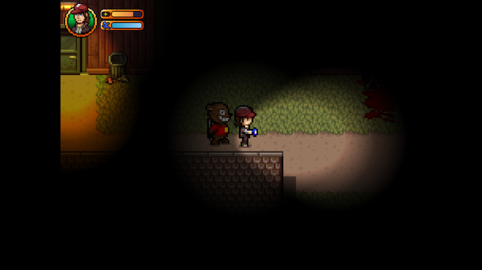 This is where the game's core mechanics come into play; where it starts to distinguish itself from its RPG Maker siblings, but also where its influences become overt: the game is not only a love letter to horror cinema, but also to horror video games, deriving influence from any number of sources, both recent and classic. Most notably, the style, structure and environment of the game recalls a now ancient video game adaptation of the Friday 13th films, which is generally fondly recalled for being genuinely tense and challenging (Jason, like the mascott-costumed killer of Camp Sunshine, can pop up practically anywhere and actively kills fellow campers whether player is present or not). Even the map of Camp Sunshine is highly redolent of that game's map of Camp Crystal Lake, with a notably similar lay out, symbolic style etc. For those of us who recall those earliest attempts at horror in video games as a medium, the resonance is joyous; the game actually feels like playing an updated version of that ZX Spectrum, C-64 classic, whether intentionally or no. That the killer, like Jason, can pop up practically anywhere (either through certain scripted moments or randomly, drawn by the player's flashlight, which MUST be used sparingly) enhances the tension of the game a thousand fold, echoing the likes of Clocktower and its “Scissorman.” Following an introduction sequence that is, perhaps, somewhat too lengthy and takes a little too much active control out of the player's hands (there are moments in the opening scenes in which, rather than allowing the player to explore for themselves, the game simply wrests control away from you and forces you down particular avenues), you are free to explore the eponymous Camp Sunshine, to encounter your fellow survivors (many of whom are blissfully unaware of the carnage occurring around them, others hidden away, unwilling to emerge until certain parameters are met), solve a variety of puzzles and gradually unlock the secret history of the camp and its masked killer (the key objective of the game is to discover numerous letters and diary entries scattered around the camp, each of which unlocks a flashback scene to events leading up to the present carnage). Though notably informed by its influences (the programmers have taken pains to lovingly incorporate every cliché; jump scares lifted directly from the movies it references, as well as certain situations and mechanics that will be familiar to anyone who has kept pace with horror video gaming over the last decade or so), the game does throw in a few narrative curve-balls; nothing as wildly experimental as Yume Nikki (which is arguably an anti-narrative experience) or even the likes of The Crooked Man, which is densely psychological and deeply disturbing, but enough to keep its seasoned audience engaged and to even surprise at times. 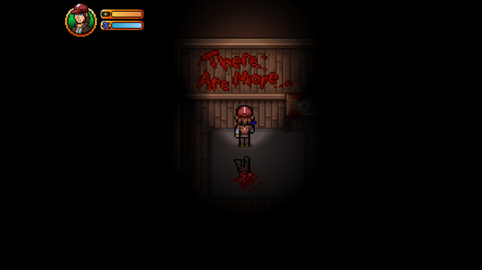 As for the masked killer stalking the camp site, his penchant for turning up without announcement or expectation, not to mention the sheer speed of his sprite, is perhaps one of the most unnerving elements of the game; equipped with a flash-light, wandering around sometimes in almost total darkness, it's not uncommon while playing to flick on the light momentarily only to find the costumed, knife-wielding figure only inches away, precipitating chases that are always fraught and, more often than not, culminate in the player's grizzly murder. In order to evade him, players must familiarise themselves with their environment; taking cues from more stealth-based horror titles, the main weapon the player has against the killer is the ability to hide: lockers, trees, bushes, wardrobes...all provide potential sanctuaries, though even they have an element of uncertainty about them (the killer can still find you, in certain instances; it's a matter of determining how desperate the situation is and trusting to chance). The fraught chase sequences followed by brief respites recalls childhood schoolyard games, though with a threat that is far from imaginary. Though nothing entirely new, the mechanics are slick and easy to get to grips with whilst being tricky to master; there is a fairly steep learning curve following the initial encounter that will likely determine how much enjoyment you're going to get from this title (like many RPG-Maker horror titles, there is often an element of trial and error; a case of dying, re-loading then tackling the same situation numerous times from a variety of different angles). This may frustrate those who seek a certain degree of dynamism in their horror titles, but to those of us with a penchant for the puzzling, it becomes something of a challenge, echoing the games that the title superficially resembles, that we grew up with, albeit without the overt horror motif. Many of the puzzles are also rather fiendish, requiring a degree of lateral thinking and retainment of information that recalls some of the nastier tricks the first few Silent Hill games played. Where the game universally shines is in its presentation; as previously mentioned, the game is gorgeous; easily one of the most graphically ambitious RPG-Maker horror games out there, with sound design to match: as with many such titles, sound is all important: passing certain areas, you might hear hurried footsteps, a furtive breath or giggle. You may hear a scream from inside of a building or a door slam shut. All of these elements become part and parcel of the survivalist experience; you learn to listen for the killer as much to look out for him, as well as treading more carefully when it comes to dry leaves or twigs on the ground, loose floorboards or pools of blood. There is an edgey, twitchy tension to the game that is extremely fun and impressively sustained throughout; the random elements mixed with certain set-pieces and the luridly graphic nature of the violence and mutilation on display make for a fraught and nerve-jangling experience; an impressive feat, given the comparative simplicity of its format and technological limitations. 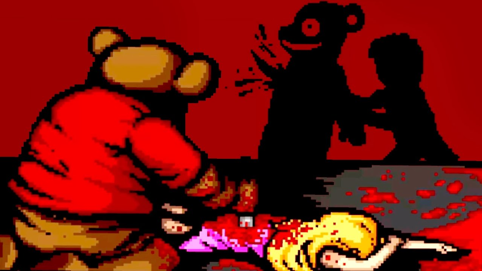 In terms of flaws, the game does have an overlong intro sequence that takes a little too much in the way of agency away from the player when it doesn't have to (the game could have easily allowed the player to simply explore the camp during the period before sunset, getting to know the campers, the environment etc, rather than forcing the narrative forward). Also, due to its composition of references, the depth of enjoyment will rely significantly on how immersed in those materials you happen to be; I can see children of the 1980s/1990s getting a genuine kick out of the (sometimes obscure) material the game toys with or evokes, whereas others may find it somewhat hollow or lacking in originality. That said, the game is one of the more mechnically coherent RPG-Maker titles on the market; extremely easy to pick up and play, and manages to evoke a sense of tension that is sustained right up until its closing moments. Not necessarily a game that will redefine RPG-Maker or independent horror as it stands, but an excellent example of what can be found on the market, if one digs deep enough and is willing to experiment. An experience well worth the asking price.  Comments are closed.
|


Archives
April 2023

|
 RSS Feed

|

|