

 Frequenters of the ginger nuts of horror will know well my abiding appreciation for this series of remakes; flouting the tradition of horror cinema to undermine and dilute itself with endless rehashes and reimaginings of familiar franchises, the recent updates of beloved survival horror franchise, Resident Evil, have been universally lauded not only as magnificent homages to the original titles, but also superlative works in their own rights. Both Resident Evil and Resident Evil 2 managed to not only evoke the ethos of their original incarnations but also improve upon them in every conceivable way, layering in new intrigues, fresh mechanics, better scripts, set pieces and voice acting, to the point whereby Resident Evil 2 became one of the best selling and most lauded titles of 2019. Flash forward to January 2020, and the remake of Resident Evil 3 is already on store shelves, just within a year of Resident Evil 2. As you can imagine, whilst the zombie-apocalypse-mongering audience were rightly excited by the update, there was also an air of concern regarding how ostensibly short the development cycle appeared to be, not to mention how closely it seemed to resemble the previvous two titles aesthetically and mechanically in promotion materials. The general feeling was: more of the same, with maybe one or two minor tweaks and updates. Furthermore, this particular instalment has a set of added pressures: whilst Resi 1 and 2 boast a dedicated and unambiguous fanbase, the original Resident Evil 3 is somewhat more tenuous in its positioning; originally occurring late in the 1990s, at the tail-end of what would become historically regarded as the survival horror boom, Resident Evil 3 marks the point much of the original audience -myself included- moved away to other platforms and alternative forms of video game horror (personally, this was the point at which I moved away from the console markets into PC gaming, and discovered works as sophisticated as System Shock 2, Half Life and numerous others). Resi 3 is generally regarded as the last of the classic survival horror titles in the franchise, those that would come later markedly changing certain standards and mechanics, thus marking the transition to new formats of video game horror. As such, whilst it has its fans, it is not as well remembered or as universally beloved as the original two instalments. 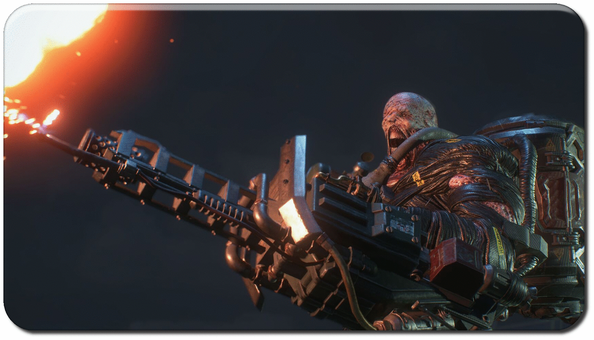 This is a problem Capcom have approached in the remake by making it a similar transition; eschewing the slower, more classically-exploration based gameplay of the first two games, Resident Evil 3 is a more streamlined, arcade-flavoured affair. Whilst elements of the original games remain -the classic item-based puzzles, the horror set-pieces, returning to familiar areas after discovering certain key-items or triggering certain events-, the game feels much-simplified and far faster paced. There is very little of the more conservative gameplay that defined the first two games, but also less in the way of saftey; whereas it was possible in Resis 1 and 2 to duck into safe rooms for a breath from the relentless action, here, that is much more difficult; the game hurtles the player through gauntlets of zombie-infested, bio-engineered-abomination-haunted wastelands with very little in the way of malingering. Much of this is due to the relentless nature of the enemies; as before, the classic zombies have been massively upgraded; whereas once, it was possible to “clear” areas by putting down all the zombies in any one space (headshots proving particularly effective), that is no longer possible; even the most mediocre specimen of the virally-induced undead can take enormous amounts of punishment, with even headshots only proving effective under particular circumstances. As such, given the incredible scarcity of ammunition and healing items, the player is forced to use other techniques in order to navigate the play-field. The game is subtly designed to allow for multiple different solutions to any given situation; it is possible to lead small bands of lurching, moaning zombies in a dance through the streets if you are quick enough to bait them, using debris, burning cars or piles of bodies in order to put some barriers between them and the player. Likewise, there are numerous environmental opportunities to stun or blockade them, from generators that can be shot to stun them with electrical discharge to explodable barrels, car fuel tanks etc. This obliges a subtly different style of play from the original games (whose environments tended to emphasise claustrophobic corridors and blind turns). Here, the player must look at the positioning of enemies and consider every move, making the map system absolutely essential (another enhancement over the previous games, the map is now much more detailed and provides specific information on what has been missed or overlooked in any given area). The environments also pose more in the way of hazard; whereas before, the Arklay Manor and the Raccoon City Police departments -for Resi 1 and 2 respectively- provided -albeit temporarily- stable strong-houses from which to venture and explore, the burning, corpse-riddled streets of the wider city offer no such opportunity. Thanks to the proliferation of the mutagenic T-Virus -not to mention the efforts of bio-weapons corporation Umbrella to “purge” the city of survivors- this is a sincere post-apocalypse scenario; the moment returning Resi 1 alumnus Jill Valentine is chased out of her apartment, she is in a scrabbling fight for survival in a city on the verge of collapse. Every street and alley is crammed full of debris, from crashed cars and trucks to collapsed, burning buildings. Paths through the environment are often determined by fire, the flames obviously proving lethal should Jill stray into them (but also useful for taking down particularly recalcitrant undead). Speed is more essential than caution here, as any lingering will give the various zombies and bio-weapon monstrosities time to mass and block off escape routes. Raccoon City itself is more of a character in this game than in previous titles; not only is the player given greater opportunity to explore the city (in what may be a derivative of -or deliberate homage to- sister survival horror franchise, Silent Hill), but the environment is more detailed, ambient and ironically “alive” than in any previous Resi game. Raccoon City feels like a genuine city on the verge of collapse; every element has been designed to eschew the standard expectations of a video game play-field and to evoke a place where people once lived and worked. This is particularly effective not only in emphasising the themes naturally implied by the franchise's title (this is maybe one of the most “resident” Resident Evils on the market), but also enhances the horror remarkably; even given the speed and impetus of the action, there is a profound sense of the atrocity underway; that thousands of people have already died under horrific circumstances and thousands more are lost or trapped, awaiting help. 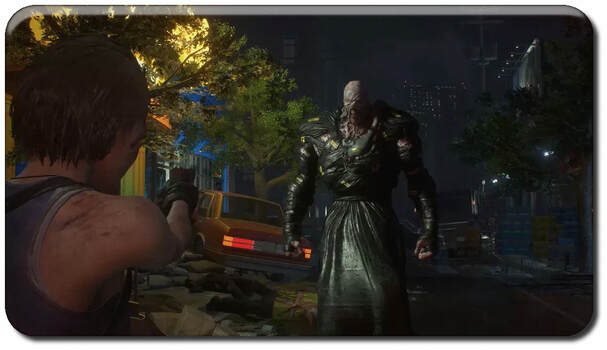 This factor is also enhanced by the zombies themselves; just as in Resi 2, the sheer range and detail of zombie-models is remarkable. Almost every single one is an individual, with details that imply their previous, human lives. Whilst it's difficult given the break-neck pace of the game to pause and properly appreciate them, examination of the zombie models will reveal distinct fibres on their shirts, tears and stains in their jeans, mobile phones hanging from pockets, identity and access cards, numerous grizzly wounds and seeping sores. As before, the number of wounds and mutilations Jill can inflict by aiming for particular areas of their anatomies is not only aesthetically incredible, but also lends combat a more nuanced level; it is possible, for example, to blind zombies by shooting out their eyes, which leaves them stumbling and lurching without clear direction. Likewise, they can be hobbled or completely crippled by aiming for legs, feet and/or ankles. Arms can be shot off so that they cannot grasp or drag you from your path. Likewise, players with acute aim might be able to get the much-coveted headshots that result in glorious bursts of gore and bodies that stumble around still spurting blood before slumping to the ground. This is before we even remark on the epic menagerie of bio-engineered abominations Umbrella has up its sleeve this time around. Early in the game, Jill has to restore power to a subway transit system, which involves infiltrating one of Raccoon City's many power stations. Unfortunately, breaching the outer perimeter of the station provides view of an immense, fleshy structure that has been woven like an insect hive to engulf the entire station. Whilst wandering the station's interior, she is attacked by strange, spider-like abominations -redolent of Resi 1's Chimeras- that, far from merely chomping on her face, extrude repulsive, fleshy umbilici by which they implant parasitic worms in their victim's bellies. Journal entries scattered about the area provide grizzly, first-hand accounts of the reproductive process. Later, after being chased into the sewers beneath Raccoon City -one of the most loving and grotesquely rendered areas in the whole game-, Jill is faced with immense, swollen entities that rise from the filth or slither from access pipes, the creatures capable of swallowing Jill whole or chomping her in half in a single bite. Incredible amounts of anatomical detail, background and behavioural pattern have been invested in each and every one of these creatures, and each and every one forms the basis for its own narrative set piece. One of the more trenchant criticisms of the original game -which is certainly carried over to the remake- is that the monsters and their various set pieces are simply far less frightening than in previous titles, erring instead on the side of action-horror and frenetic jump scares rather than atmosphere. Whilst this is certainly true -there is nothing here that even approaches the horror of seeing the flayed form of The Licker stalking past the window in Resi 2-, the more spectacle-oriented nature of the game as a whole actually serves to define it as its own work, rather than simply a rehash of previous titles. Whilst, for my personal tastes, I will always favour the slower build, more patient atmospherics of the previous two instalments, Resi 3's freshness, streamlined nature and faster pace serves as a palate cleanser, especially in an era predominated by exceptionally bleak and heavy indie horror titles (such as Visage, Dark Wood and the Amnesia series). 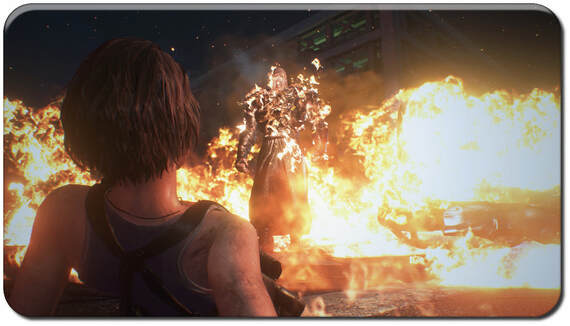 Despite its more overtly risky design (deaths are more frequent in this game than in previous Resi titles), it is also far easier in terms of exploration, puzzle solving etc. Pace and rhythm are clear watchwords with regards to its design ethos, making for an experience that feels remarkably fluid and friendly for a survival horror title, and whose excitement barely lets up for a single moment. Of course, one of the most iconic elements of the original and, indeed, the poster-child for this remake, is the eponymous Nemesis: A titanic, biologically-engineered assassin, the Nemesis occurs extremely early in the game -bursting through the wall of Jill's apartment and almost murdering her on the spot-, and, from that point on, is never absent, its threat pervading every moment, the player never entirely certain where or when the monster will next turn up. Whilst the design of the original monster never struck me as particularly remarkable -in point of fact, I found it far too exaggerated and somewhat silly in its constant exposure-, here, it has been redesigned to be more Cenobitic in nature; a tianic mass of biologically-engineered scar tissue, lashing tendrils and disturbingly incongruous mechanical components, the creature is never far away at any one time, and often comes hurtling down from rooftops or crashing through walls at the most unexpected, inopportune moments. The threat of Nemesis is profound, as not only is he practically indestructible -at various points in the game, he has burning buildings collapsed on top of him, falls from the rooves of skyscrapers, is caught in exploding train cars and far, far more besides-, he relentlessly stalks Jill throughout, his genetically-encoded mission to eliminate the surviving members of the S.T.A.R.S team from the original game. Nemesis also has the rather cute trick of being able to “upgrade” the various zombies by implanting them with mutating, parasitic organisms redolent of Resident Evil 4's “Ganados,” meaning that peviously passive areas become much more threatening. Every moment the Nemesis occurs is a breath-taking set-piece, often involving Jill fleeing through the streets or the tunnels of labs, subway systems and various other environments, attempting to throw off a creature that is not only fast but simply cannot be stopped by any conventional means. Essentially an upgrade of Resi 2's “Mr. X,” here, that dynamic of being stalked throughout the game becomes the principle theme. Invested with far more character and background than his previous incarnation, The Nemesis is a fantastic monstrosity that carries incredible threat, presence and is exceptionally redesigned, shifting from one of my least-favourite antagonists in the original series to one of my absolute favourites in the remakes. Criticisms of the game tend to echo those aimed at the original: is it a massive departure from the previous two games? Not remarkably. In fact, the game reuses many assets and even environments from Resi 2, which likely explains its foreshortened development cycle. Mechanically, it is basically the same engine as the previous game, with one or two tweaks to streamline the process and emphasise the breakneck pace it is attempting to achieve. Also, it deliberately eschews the slow atmospherics of the previous titles in favour of action set pieces, meaning it simply isn't as frightening as its forebears. That said, in an age where dense, weighty, profound horror experiences are fairly pervasive, this kind of popcorn horror experience is as welcome as a sorbet between courses; a light and pleasant palate cleanser, that is often ghost-train-ride, laught-out-loud fun, and consistently refuses to take itself too seriously. George Daniel Lea TODAY ON THE GINGER NUTS OF HORROR WEBSITE BOOK REVIEW: THE APOCALYPSE STRAIN BY JASON PARENT THE HEART AND SOUL OF HORROR WEBSITES Comments are closed.
|


Archives
April 2023

|
 RSS Feed

|

|