

 I've been revisiting some old favourites, recently; films to which I have (arguably strange) sentimental attachments. My Mother introduced me to all manner of film and fiction when I was a child, her library still vast and varied; the TV and recently pervasive technology of video providing more (I still have fond memories of visiting the local video rental; a darkened, chapel-like space above the local grocery store, its shelves stocked with images that still lodge deep in my memory). Horror was always the subject towards which I gravitated, the painted covers of titles such as Alien, The Lost Boys, It, The Thing, The Evil Dead drawing my eye far more insistently than the smiling, primary coloured efforts in the children's section. My Mother being my Mother, I was never censored or disallowed from watching whatever I wanted, but was always informed of the difference between the contrived violence and horror on screen compared to that outside, whose consequences were very real. The result is a certain sentimental attachment to some very odd titles (The Omen, The Amittyville Horror, Poltergeist et al), along with a distinct snobbery that leaves me feeling cold and empty with anything that doesn't intend to appal, disturb or distress me to my core. A recent revisiting of John Carpenter's seminal adaptation of the short story Who Goes There? (enigmatically titled The Thing) emphasised to me just how deep that affection and attachment goes. This is a film I know and have known since I was a child; every scene, every word. I could likely recite it or reproduce it descriptively down to the last detail, given enough time. Yet it still holds me; still arouses in ways so many more recent efforts do not. Is that entirely down to sentiment? I would say no; with adulthood, with distance, has come a degree of objectivity and analysis; just as old cartoons I once adored have revealed themselves to be little more than crass and cynical toy commercials, works such as The Thing have become so, so much more than matters of sentiment; its appeal is not one that is a simple reminder of childhood days (days I do not relish or lament the loss of as much as most), but of something finely honed; every scene, every word, beautifully pitched and framed and orchestrated to elicit tension; to deepen the audience's sense of paranoia; to have that paranoia explode into nauseated distress as the human form corrupts and distorts into lunatic shapes before their eyes. It is beautiful; far more so to my adult eye than it ever was as a child. I've found the same to be true of so many works whose ethos lingers: Hellraiser, one of the few that could distress me as a child and distresses me still with its subtle seductions; with its almost promotion of pain and mutilation as something transcendent, The Evil Dead, again, another work in exquisite tension, slow building, mounting and mounting to utter atrocity, Cronenberg's The Fly, an exercise in morbidity; essentially charting the disintegration of a human being on camera, eliciting as much sympathy and macabre intrigue as it does revulsion. I feel somewhat privileged to have grown up through the era in which mediums such as film were evolving, but also newer ones such as video games, which were in their infancy when I was, not to mention their adolescence. Back then, horror in video games, at least in the west, was something of a taboo; rare and extremely likely to draw ire from certain moral minorities, but far from non-existent. My own exposure to horror in the medium came from niche titles such as Darkseed,  DARKSEED a point and click adventure based on the work of the late H.R. Giger, Horrorsoft works such as Elvira: The Jaws of Cerberus and Waxworks, not to mention video games such as Super Metroid, Probotector/Contra III et al which, whilst not designated as horror titles in and of themselves, certainly utilised certain imagery, subjects and techniques borrowed from horror cinema of the era (Super Metroid in particular has several notable segments in which the player character is startled by the emergence of alien creatures or in which musical cues ramp up tension for a sudden boss reveal). It wasn't until much later, when the format became somewhat more sophisticated as a storytelling device, that we began to experience works that were designed explicitly to horrify; titles such as Alone in the Dark, Resident Evil and Silent Hill, all of which pay homage to the cinema and literature that is at once their inspiration and antecedents (the horrific mutations of the “T-Virus” in the Resident Evil franchise are highly redolent not only of zombie cinema, such as the work of George H. Romero, but also of various examples of body horror such as the works of Cronenberg and Carpenter's aforementioned The Thing). Silent Hill and its various sequels not only pay homage to horror fiction and cinema in terms of its story and subject, but also include any number of wry nods and “Easter Eggs” which recall the now iconic works of authors such as Stephen King, Ramsey Campbell and H.P. Lovecraft (the streets and settings of the eponymous town are all named after famous horror writers, film directors or characters in their works). From the very beginning, there has been a rich and overt relationship between horror in video games and somewhat more inveterate mediums. Being the youngest of them, it has looked to its elders for guidance and inspiration, such that examples can still be found of subjects, tropes and techniques that recall or refer to beloved books, short stories and cinematic works. The more recent Alan Wake is a lengthy love letter to 1980s popular horror fiction, in particular the works of Stephen King, the game not only referring to works such as The Stand, The Dark Half and The Shining, but attempting to emulate their ethos; including certain tropes and even clichés redolent of King's writing. Similarly, the surreal sleeper hit Deadly Premonition is a homage to David Lynch's masterpiece, Twin Peaks, attempting to do for video games what the TV series did for prime time American television; both parodying and extolling it in the same space; exploring its absurdities whilst also puncturing its entrenched sensibilities. The video game even evokes the setting and situation of Twin Peaks, not to mention the familiar, slightly off kilter protagonist who seems to have a penchant for talking to confidantes that only he can see or hear. Beyond direct adaptations of books or films (which tend to be hit and miss, erring more towards the miss side of the spectrum), horror in video games has slowly begun to evolve into its own state of maturity; incorporating elements of its ancestors and inspirations that are most salient whilst also developing new and novel means of storytelling; of evoking emotional reaction in its audience. Although the mainstream market (echoing the state of mainstream cinema) has become somewhat stagnant with certain established and extremely tired franchises dominating, the recent explosion of independent video gaming as a highly vibrant industry (echoing a similar situation occurring with underground horror in literature and written fiction) has allowed the medium to evolve into heretofore unimagined states. With titles such as The Last of Us, Five Nights at Freddy's, 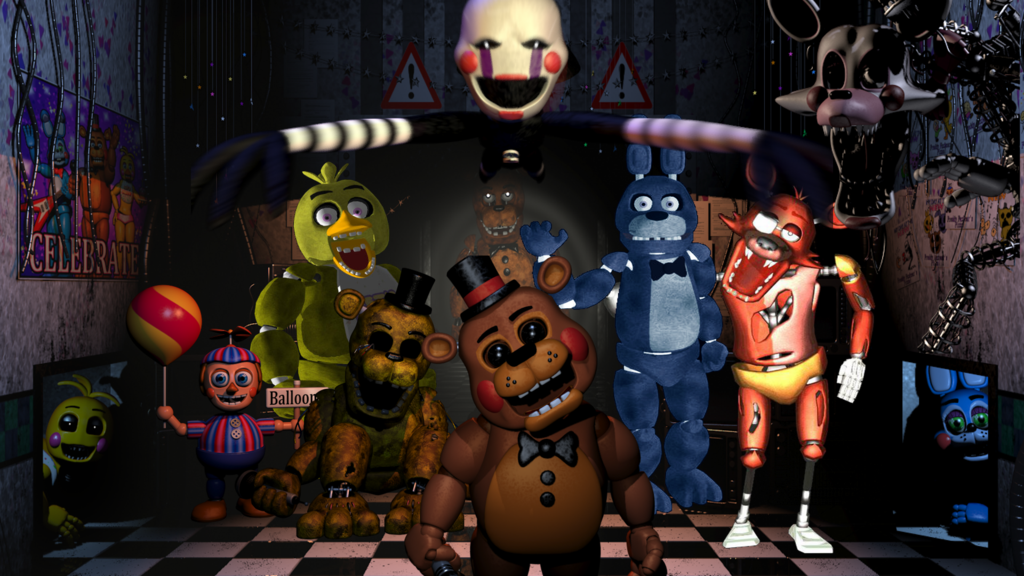 FIVE NIGHTS AT FREDDY'S Slender, I'm Scared, Tick Tock, Outcast, SCP: Containment Breach et al fast accruing iconic status, video games are fast outpacing the cinematic medium which was the first point of contact for many of us. Part of this is due to the nature of the mediums and their respective markets; video games have the potential to arouse and engage their audience in ways that cinema cannot; films and television will always be somewhat more passive, in which the audience sits and consumes; reacting to what others provide. Video games, on the other hand, are immersive and place the player in situations where their actions and choices directly affect how situations transpire; who lives, who dies. Not only that, but there is a degree of connection between the player and player character that simply cannot exist between a film's protagonist and their audience; in a very real sense, the player becomes part of the game; their character on-screen a virtual representation of themselves in the situation or environment, begging the question: what do you do now? The respective markets and cultures accrued around horror in both mediums are also noticeably different; glutted and stagnated on a “McSequel” and “Remake King” diet of unchallenging, produced by committee, edited by test-audience dross, fans of horror cinema (such as myself) have gradually gravitated away from the medium in its mainstream incarnation, owing to the fact that it would have us believe that there is nothing left; that everything has been done (a notion which the aforementioned independent fiction and video game markets drastically repudiate). As such, there has been an escalating dilution of material as studios seek to cater to wider audiences, driving away those that appreciate the artistry and potential of horror whilst catering to the more casual viewer; those who do not wish to be genuinely disturbed or distressed; who just seek something to jump at and spill their pop corn over. Generally speaking, the video game playing public seem to be more demanding than that, particularly when it comes to horror; the iconic works in the genre still resonating profoundly in most player's memories, they seek out the echoes of System Shock, Silent Hill, Resident Evil etc; demanding that the industry provide them with works of sophistication and genuine disturbance. Hence the efflorescence of the independent market, where there are no strictures on subject or format; no over-arching impulsion to cater to a mass market or, to paraphrase the press releases of Resident Evil producers Capcom: “...to appeal to the Call of Duty market.” As such, not only has independent horror video gaming allowed for an evolution in subject (largely foregoing shock and gore for subtle disturbance and narrative or atmosphere driven pieces), but also in format: it is not uncommon to find amongst its titles adaptations of the “point and click” adventure (examples including Tick Tock and The Last Door), as well as formats that are far less familiar and intuitive, obliging the player to engage with the unfolding narrative in highly asymmetrical fashion. This is a far cry from the “survival horror” and “first person” formats that dominate mainstream markets, and have become so familiar over years of sequels and repetition that very few have the capacity to surprise or even engage to any great degree (notable exceptions include the insanely beautiful The Last of Us). Specimens such as SCP- 087, SCP: Containment Breach, I'm Scared et al oblige players to put down presumptions that pervade mainstream releases and tackle situations in ways more considered than merely pointing the appropriate weapon or using the appropriate items. This serves to enhance player paranoia and uncertainty, leaving expectations defeated and the player characters exquisitely vulnerable. An interesting trend amongst these titles, as opposed to their mainstream equivalents, is that gameplay is almost exclusively non-violent; the player characters are largely stripped of weapons or the capacity to defend themselves, in stark and deliberate contrast to established “survival horror” titles, in which one of the main game dynamics is to amass as many weapons and ammunition as possible. One notable example is the aforementioned SCP-087, a randomly generated game in which the player descends a seemingly endless series of narrow, brick stairwells and darkened corridors, the environment itself seeming somehow sentient, malevolent; shifting and grinding and subtly echoing around you, the entities one may or may not encounter so strange, vague and disturbing, that the player is often left uncertain of what they have seen or experienced. These are not creatures whose health bars can be whittled down with the right ammunition; they have to be approached in highly considered ways, as does the maze itself. When a shadow in the distance seems to whisper “Look at me...” it is imperative that the player character looks directly down at their own feet and ploughs ahead, passing through the entity without doing as it asks. There are no suggestions or instructions as to this method; it must be intuited. Similarly, the manner in which story and back mythology are communicated are rendered more subtle, owing, in part, due to a lack of tools and budget, in a manner highly redolent of independent film making. Gone are the days of immersion-breaking cut scenes or dialogue heavy exposition; instead, we have examples such as the Five Nights at Freddy's series, in which the situation and back story are heavily implied through visuals and almost sub-conscious suggestions, with nothing entirely concrete or certain. The resultant sense of mystery and engagement is therefore heightened to a significant degree, allowing such titles to take root in the popular consciousness. This efflorescence of invention and novelty within independent video gaming echoes a similar revolution that is currently occurring in horror literature; thanks to new contexts provided by technology, it is now possible to read more people's work than ever before; for stories that would never have seen the light of day to be promulgated. Since, like the aforementioned independent video games, such titles are largely not bound by the need to sell X number of copies or to make X amount of money, any strictures of subject or format dissolve. Once again, this is in stark contrast to mainstream markets, which are currently stagnating in their requirement to appeal to mass demographics. This is not to say that anything published independently is automatically superior to its mainstream equivalents; such is clearly not the case. If anything, the ability to self publish and the proliferation of independent and small scale publishing houses means that a significant amount of bad or untempered fiction makes its way onto the market. What the situation does provide is a greater scope of potential; it is now not necessary to snare the interest of a significant publishing house or literary agent, nor does one necessarily require contacts in what was once a highly exclusive industry. Work that might not have seen the light of day is now readily available, often for a pittance, often in a variety of formats. Speaking as one of the beneficiaries of this situation, it is difficult to argue that the previous, more exclusive state of affairs had any significant advantages (this is particularly acute when one considers some of the lamentable affairs currently dominating the mainstream publishing industry). Across the board, in more mediums than ever before, horror is thriving in the dark, underground, where it has always been most at home. One only wonders what forms it might take when it finally rips its way out into the light again. BY GEORGE DANIEL LEAComments are closed.
|


Archives
April 2023
|
 RSS Feed

|

|