

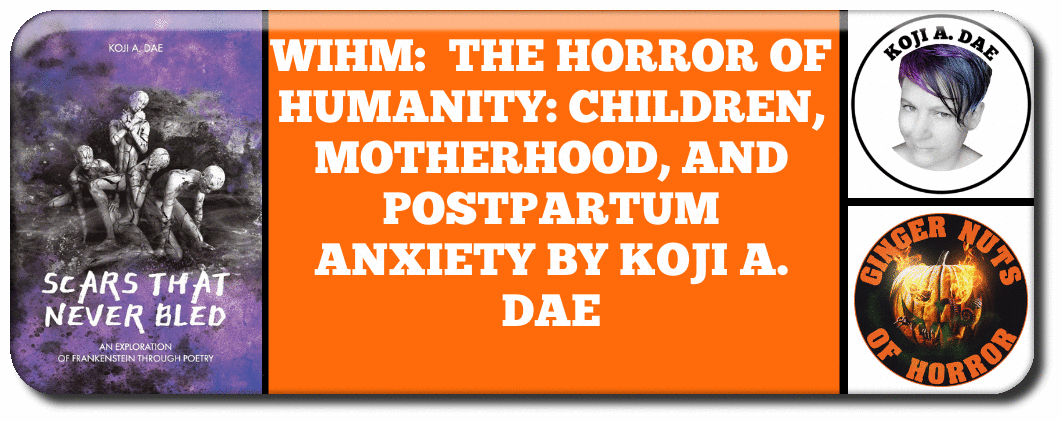
 Growing up, children in horror fascinated me. From the twins in The Shining to Damian in The Omen, I couldn't get the concept of an evil child out of my mind. I was far from an evil kid, myself. I was quiet and followed the rules. My two brothers caused enough trouble for our whole family, so I kept my head down — usually in a book. These books gave me a certain kind of release. They also gave me a mirror, because I felt something uncontrollable rising in me. Supposedly, it could be explained by the rush of pubescent hormones, but mine felt deeper, and I found myself looking for an explanation. This led me to a lot of supernatural and horror books. Especially books like Stephen King's Carrie, where a young woman comes into a power she couldn't control. I remember hiding that book from my mother, because she thought all Stephen King books were "Satan's tools." I stayed up late hours, tucked in a cocoon of blankets on my floor, reading and rereading it, thinking, "yes, someone gets me. I am not alone." Only later did I realize that simmering rage and overwhelming helplessness had other titles: depression, mania, anxiety. I got diagnosed with anxious-depression when I was thirty-six years old. That was twenty-six years after I started cutting. It was sixteen years after I became an exotic dancer and went down some really scary and thrilling roads of promiscuity and risk. It was ten years after I found running as a way to settle the monsters inside me and self-medicated with races and marathons. Through those years, when I was swimming in darkness, horror helped me feel understood. It gave me metaphors for what I was going through. In a lot of ways, it stabilized me. In general, I never liked particularly gory horror. I liked creeping dread, and I loved what I will call clean body horror. Usually short pieces that involved metamorphosis, often driven by psychological triggers. I was drowning in my own psychological horror, with no healthy way to express it. Books and movies gave me a way to navigate my internal feelings without resorting to mutilating myself, which had become fairly common in my teens. When I was twenty-eight, I had to stop watching horror films. Several times I had anxiety attacks that involved visual hallucinations, drawing from some of the horror films I had watched. After my second pregnancy, it got so bad that even the new trailer for It sent me into a panic attack. This left a huge hole in my life. While my mental health was transitioning (I no longer experienced bouts on mania, instead it was replaced with anxiety and panic) I no longer had an outlet I had come to depend on. What's more, since my first pregnancy at thirty, I couldn't watch or read horror that involved children. I no longer identified with the child but rather as a parent. In the years up to my pregnancy, I had become obsessed with the expression of the psychotic mother in horror. From Rosemary's Baby to Antichrist. Looking back, I can see that I wanted a child, and I was afraid of how my mental health would react to that kind of stress. So I was trying to find ways to mitigate those fears by thoroughly examining them. Even after I couldn't watch movies, I still read short stories and continued reading the synopsis of books and movies that explored the psychotic mother in depth. I was worried that with my mental health, I would become the psychotic mother. I wanted a concrete list of signs I could look for, and there honestly weren't a lot of articles talking about post partum psychosis. Instead, there were a few resources about the baby blues available. What if it's not just the blues? What if your psyche is a monster? How can you prepare yourself then? Well, then came the kids and the writing. I've always considered myself a writer. But when I was younger I didn't realize what I was writing was horror. Again, it was a lot of body metamorphosis and psychological horror. After my second pregnancy I began taking my writing more seriously. I finished a YA novel about the Blue Whale (a suicide club with Russian origins) and an adult novel about dun dun dun pregnancy-induced psychosis. I didn't consider either of these horror, because I still had a narrow definition of horror as slasher and jump scares. But then I got into short stories, which really allowed me to explore different genres. Most of the stories I've written have some horror aspects, crossed with science fiction or fantasy. Almost everything I write is dark. Most of my published short stories involve parenting fears and insecurities I am still working through. I figure if my mind can't handle seeing them, I can still read and write them. Writing out those fears has helped immensely (as has a diagnosis, medication, and therapy). But I've been surprised at how much these stories resonate with other parents. The concept of the evil child, the bad parent, and parental psychosis might not be universal, but it sure as hell is common. And in a way, that's comforting. While I still do shorts and am working on another novel, I recently switched gears to horror poetry, which was completely new for me because I only ever wrote contemporary poetry before. I spent 2019 and 2020 doing an in-depth study of Mary Shelley's Frankenstein and the concepts of mutilation, sacrifice, identity, and metamorphosis. In the end, I came out with a full-length collection called Scars that Never Bled. It pulls on the fears I've had my entire life and I have to say, I'm very happy with the way poetry can express body horror. 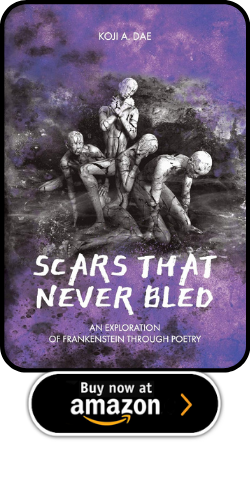 Mary Shelley's Frankenstein continues to haunt each generation. Although the story was written at the cusp of the industrial revolution, it continues to posit important questions about technology and humanity. In this book, Koji A. Dae uses poetry and tarot to explore some of the deeper questions within the classic Frankenstein archetypes. Join along to find pieces of yourself in the creature, the magician, Mary Shelley, the mother, god, nature, and the lovers.  BIO Koji A. Dae is a queer American writer living in Bulgaria with she/they/her/them pronouns and anxious-depression. She has horror and dark sci fi available in Bards & Sages Quarterly, Daily Science Fiction, and Dread Imaginings, among others. She has horror poetry in Star*Line and ParABnormal, as well as a full-length poetry collection entitled Scars that Never Bled. WEBSITE LINKS https://kojiadae.ink/ https://www.amazon.com/gp/product/6197588005?pf_rd_r=1YWG98VEMD8JENB6GFHD&pf_rd_p=6fc81c8c-2a38-41c6-a68a-f78c79e7253f https://twitter.com/KojiADae   Comments are closed.
|


Archives
April 2023
|
 RSS Feed

|

|