

FILM REVIEW - WHAT WE DO IN THE SHADOWS
12/3/2015
 WHAT WE DO IN THE SHADOWS In 2010’s faux documentary Vampires, a film crew follows a fictional vampire family in Belgium as they navigate contemporary life as members of the undead. The film was an uneven yet compelling attempt at providing an original narrative surrounding the modern vampire mythos. At times a social commentary and critique on race and immigration, other times more of a spoof on the vampire legend, the film, while occasionally humorous, missed the mark tonally, never fully figuring out what type of movie it wanted to be. What We Do in the Shadows, while a similar premise, avoids these tonal pitfalls entirely and delivers a delightfully original and hilarious look at undead life. Directed by Taika Waititi and Jemaine Clement, who also star in the film, Shadows knows exactly what type of film it is and, pardon the pun, goes for the jugular. While a mockumentary centering on the lives of several flat mates in Wellington, New Zealand who also happen to be vampires, the script plays to the tropes of vampire lore, deriving its humor from the awkward and socially inept protagonists and less from the traditional mythology surrounding vampire narratives over the last century. In other words, Waititi and Clement take seriously their subject matter while mining the humor that naturally emerges from the situational dynamics of vampires interacting with each other as well as modern life. Viago (Waititi) is the obsessive compulsive de facto leader of the house (“If you’re going to eat a victim on my nice green couch, put out some towels”), which also consists of Deacon (Jonathan Brugh), who sees himself as above the mundane nature of flat duties (“Vampires don’t do dishes!”), and Vladislav, the oldest of the main trio, who desires human slaves and virgin blood (“If you are going to eat a sandwich, you would just enjoy it more if you knew no one had fucked it.”) In addition, the eight centuries old Petyr (Ben Fransham), aesthetically related to Count Orlok from Nosferatu or Kurt Barlow from the mini-series version of ‘Salem’s Lot, occupies the basement of the house, a disturbingly creepy monstrosity that nobody seems entirely comfortable with. The vampires go about their nightly lives until Nick (Cori Gonzalez-Macuer), a recent vampire convert, shakes up their fairly routine existence and introduces the twenty-first century into the ancient bubble they are so firmly ensconced, demonstrating that not even immortals are immune from the siren call of the social media selfie. And it is here where the film settles into its arguable metaphor of the socially awkward misfits attempting to blend into a culture they neither belong to nor understand. A scene where a vampire “familiar” delivers two unsuspecting victims to the house clearly demonstrates, despite their power and disregard for human life, that the vampire flat mates want nothing more than to be perceived as cool…and fail miserably. What We Do in the Shadows is filled with countless jokes and observations revolving around vampire mythology and folklore in popular culture, adhering to the traditional tropes of the undead aversion to sunlight and the crucifix, not casting a reflection, and transforming into bats and other creatures. In addition, thematic riffs from vampire cinema and literature are given ample nods, such as ancient vampires trapped in the physical shells of children (“We’re meeting a pedophile”), as well as acknowledging the Underworld/Twilight inspired antagonism between vampires and werewolves (“Stop swearing! We’re werewolves, not swear wolves.”) All of this is conveyed with expert comedic timing and an obvious admiration and respect for the subgenre, making the movie something of a love letter to vampire films and stereotypes throughout history. Occasionally violent, always hilarious, and surprisingly poignant, What We Do in the Shadows is easily one of the better vampire films to be released within the last decade. Populated with a solid cast of actors (Rhys Darby is particularly memorable as the werewolf Anton), the film breathes new life and fresh energy into the vampire narrative found in popular culture, and deserves a special place in the pantheon of undead cinematic efforts. Review by Jess Peacock, author of Such a Dark Thing: Theology of the Vampire Narrative in Popular Culture, available now at Amazon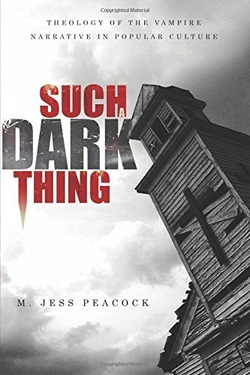 SUCH A DARK THING SUCH A DARK THING Evil, death, demons, reanimation, and resurrection. While such topics are often reserved for the darker mindscapes of the vampire subgenre within popular culture, they are equally integral elements of religious history and belief. Despite the cultural shift of presenting vampires in a secular light, the traditional figure of the vampire within cinema and literature has a rich legacy of serving as a theological marker. Whether as a symbol of the allure of sin, as an apologetic for assorted religious icons, or as a gateway into a discussion of liberationist theology, the vampire has served as a spiritual touchstone from Bram Stoker's Dracula, to Stephen King's Salem's Lot, to the HBO television series True Blood. In Such a Dark Thing, Jess Peacock examines how the figure of the vampire is able to traverse and interconnect theology and academia within the larger popular culture in a compelling and engaging manner. The vampire straddles the ineffable chasm between life and death and speaks to the transcendent in all of us, tapping into our fundamental curiosity of what, if anything, exists beyond the mortal coil, giving us a glimpse into the interminable while maintaining a cultural currency that is never dead and buried. ""Equal parts fan-boy adulation and academic analysis, this delightful book expresses such joy and enthusiasm in either mode: in both, the author shows what it is to be passionately engaged and intellectually stimulated by the subject. The section on liberation theology and social change also takes the vampire narrative into new areas of interpretation and application that I found especially exciting and invigorating. Those who identify as either fan or critic (or both) will find here fresh insight into and inspiration from their favorite monster--a sort of bracing antidote to Twilight!"" --Kim Paffenroth, author of Gospel of the Living Dead ""Jesse Peacock knows his theology and his vampires, making him a perfect guide to the dark places he wants to take us. Such A Dark Thing successfully explores how our fascination with the hungry undead not only connects with religious themes, but also sex, politics, and even social justice."" --W. Scott Poole, author of Monsters in America ""Such A Dark Thing is eminently readable, exhaustively researched, and always thoughtful--an examination of modern folklore through a theological lens that left me thinking about why I write about vampires and why the undead resonate so with the contemporary subconscious. Well worth reading for any scholar, student, or fan of the genre."" --David Wellington, author of Positive M. Jess Peacock is the editor of Street Speech, a social justice publication produced by the Columbus Coalition for the Homeless, and is the 2013 recipient of Methodist Theological School in Ohio's Ronald L. Williams Book Prize in Theology and Ethics, as well as The Matey Janata Freedwomen Award for his research and work in women's issues.
|

Archives
April 2023
|

 RSS Feed

|

|