

Hellraiser: A Look Back Into The Labyrinth
14/10/2017
By George Daniel Lea 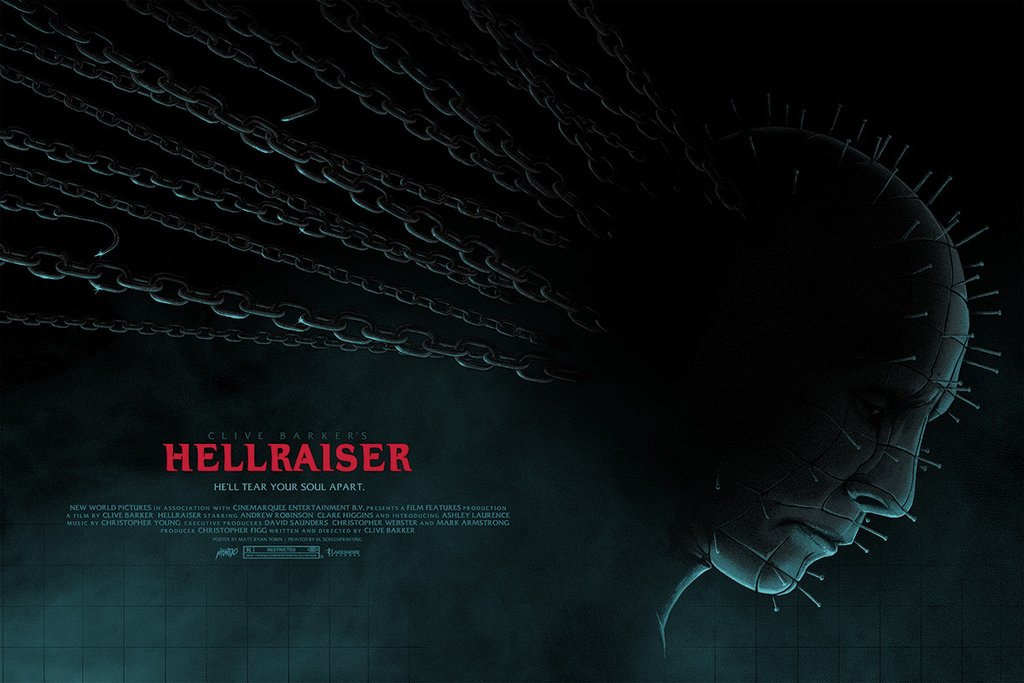 The assumption of absolute familiarity with a piece of work is all too often a stumbling block to genuine assessment of its qualities: The status has a tendency to blind us not only to potential faults (assuming that we proclaim some love for the work in question) but also to qualities that we haven't yet allowed ourselves to perceive; we fall back on the resonances and reinforcements that originally kindled our interest or aroused emotion, to the ignorance of what might elicit new resonances. In that manner, work that might have once been deviant and transgressive becomes somewhat banal and familiar (at least in memory). Whilst I'd never accuse it of banality, Clive Barker's 1980s work of transgressive, metaphysical horror Hellraiser certainly occupies a status not a million miles away from that in my own mind: a film and franchise that I cannot recall not existing; beloved and distressed by since childhood; as with so many of my generation, a gateway into realms of horror I'd never walked, and an inspiration for appetites that sustain to this day (albeit in much evolved and elaborated form). Having the chance to assess a reprint of the film is therefore both wonderful and somewhat intimidating: what is there left to say about a work that has been commented upon so much, that has been flayed and dissected and autopsied a million times over, whose imagery is now so powerfully lodged in public consciousness, it's possible to find examples of it on everything from T-shirts to bobblehead dolls? As is always the case when I commit to my (habitually annual) viewing of Hellraiser, the first thing that struck me is how powerful the film still is, not only in terms of its graphic imagery (which is what most seem to recall with sincere degrees of vividness) but in what that imagery suggests and symbolises: 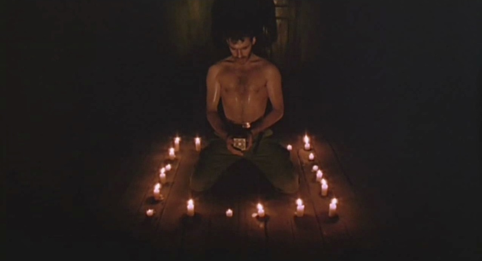 The film is not the out and out gorefest that people seem to recall and enshrine it as: whilst it certainly contains numerous examples of explicit mutilation, pain and the shedding of blood, each and every instance has wider and deeper resonance than what might be found in, say, the likes of Eli Roth's Hostel or the Saw franchise. Here, pain and bodily mutilation go beyond mere examples of suffering and grotesquery; there is an artistry and even allure to what the Cenobites (the film's monsters de jeur) promise; they come with words of seduction, with a priestly and noble bearing that is more...philosophical than anything that even their closest contemporaries boast: whereas the likes of Child's Play's Chucky, A Nightmare on Elm Street's Freddy Kreuger and Halloween's Michael Meyers conduct variously inventive means of execution, the Cenobites enact something far more theatrical, elaborate and potent: when Pinhead utters the iconic line: “...we'll tear your soul apart,” he isn't merely engaging in poetic threat: that is precisely what the Cenobites promise: a state of metaphysics beyond the fleshly, mortal and ultimately animal concerns that most horror films of the era present. The instant the amazing soundtrack by Christopher Figg begins to play, it's clear that we're dealing with a work of another order, here; this isn't the “three fingers on a synthesizer,” orchestra-sting laden shock-fest that saturated 1980s horror cinema: there are elements at play that make its popularity and cultural enshrinment almost baffling: a work that might have been more at home in the more obscure annals of arthouse cinema, were it not for the fact that the public took its deviance to their collective breast and wallowed in its surreal sadism. As someone who presumes to know the film inside out, who has watched it countless times since childhood, it's a truly wonderful experience to be surprised all over again; to find little details and factors that I'd not noticed before, to be mesmerised by the composition and framing of certain scenes...to discern entirely new resonances that chimed with fresh contexts and experiences. Beyond that: to be genuinely moved and unsettled by the work again, to feel those swells of emotion as it played out: the breathless moments of tension as characters manipulate the frames and faces of the “Lament Configuration” (the iconic puzzle box that “...opens doorways to Heaven or Hell,”) as the Cenobites announce themselves through luridly surreal theatrics (light streaming through cracks between tiles and wooden beams, the chiming of a great bell, scented smoke issuing from rents in walls, to name but a few), as a barely formed, skinless, seeping Frank emerges from the shadows to feed on his and Julia's latest victim... 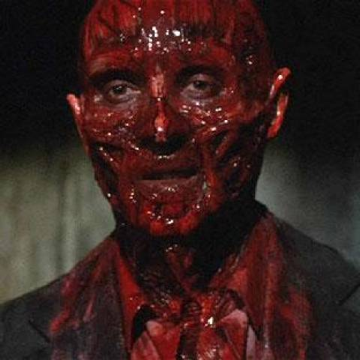 The film still exercises a giddy degree of disturbia; images that are explicitly designed to unsettle the audience rather than to make them nauseous or simply repulse: Take, for example, arguably the most iconic scene in the entire film, in which Frank Cotton -who is graphically torn apart and taken by the Cenobites in the opening sequence- is resurrected by the spillage of his brother's blood on the floorboards where he died: An extravaganza of the most grotesque practical effects, the scene is (quite literally) the beating heart and soul of the film; the presentation of something grotesque, wounded and ineffably distressing as celebratory and beautiful: it is the moment when events turn, when characters come to realise themselves and the superfice of familial stability fractures irrevocably. It also provides some subtle commentary on the truly horrendous metaphysics of the film: a form of immortality is possible, here: Frank has endured for time beyond time, from his own perspectives, in the Hell that the Cenobites preside over; a state of constant, unendurable extremity, his condition excoriated and flayed and eviscerated, reconstituted and remade, to the point that he himself is no longer human, but a creature of that state, to whom pain and extremity are merely facts of existence. His emergence into the midst of what is essentially a domestic drama that wouldn't be out of place in certain higher works of BBC domesticity serves to peel back the skin of proscribed hypocrisy; the family structure that clearly doesn't serve any one of its members, though some of them clearly ache for it to (whether they be the quietly desperate, inevitable victim, Larry, trapped and yearning Julia or walking Elektra complex Kirsty). 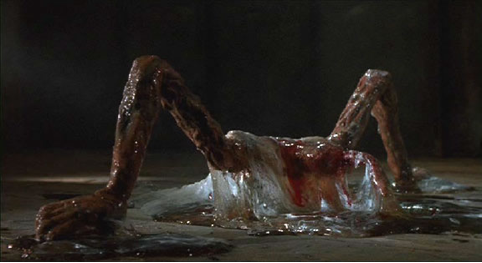 The domestic elements are far more densely entangled and complex than I previously realised, and far more engaging: very little is stated outright; exposition is trimmed and pared away or carefully concealed so as to feel like natural exchanges between the characters. Much of the unrest and disquiet derives from looks and peculiar interactions, most notably between Julia and the other two, the “wicked step wife” here inverted, played with a fittingly fairy-tale degree of coldness and malevolence, but also surprising sympathy: Julia is presented at least as much as a protagonist to the piece as the comparatively virginal, “Snow White” Kirsty, arguably occupying far more screen time and commanding more in the way of the audience's engagement than her step daughter, who often comes across as distant and dispassionate by comparison. The fact that Julia is trapped by circumstance and haunted by ghosts of old and dead passions makes her the fulcrum of the tale, the peculiar family dynamic that she, Larry and Kirsty occupy at least as significant as any of the extremity and metaphysics presented by the resurrected Frank or the Cenobites that come to reclaim him. There are moments within the film that play like domestic drama or French farce, but which are leant degrees of wit and poetry that they would otherwise lack owing to the surrealism and strangeness that the audience know is playing out behind the scenes: From the first instance, it is made clear that this is a family on the edge, fraying apart from the inside, with myriad tensions and issues, many of which remain unspoken (for example, Kirsty's “Elektra complex” relationship with her Father is never made overt or referenced specifically, rather symbolically through her resurrected and skinless Uncle's incestuous advances (“Come to Daddy”) and later, when Frank adopts the skin and form of her Father, in which condition he engages in a “cat and mouse” deception; a bleakly amusing parody of the family situation that Julia has always loathed, that Larry and Kirsty always blithely assumed. 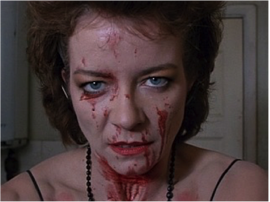 Beyond the obvious appeal of the Cenobites and the horrific imagery that accompanies them, the central domestic plot, the complexities and tensions between the familial characters, is what drives the story. As in most of my returns to the film, I was struck by how distant the Cenobites actually are; they rarely appear in the course of the film's run, their scenes restricted to certain key moments in which the domestic drama boils over and intermingles with the metaphysics that simmers beneath it: an opening scene designed to place the audience in a state of shock and disturbance through its strangeness and extremity, a half-way marker in which Kirsty inadvertantly summons them and learns -along with the audience- the true nature of the film's tensions, and in the climax, where they come to claim not only Frank, but also all who have been tainted by association with him and with themselves. For the most part, they are passive observers; they wait beyond the veil, watching and assessing with arachnid patience, for the moment when they have license to make themselves known. Rarities amongst horror movie antagonists of the era, they do not appear as overtly malevolent; rarely with threats, rather with words of poetry and promise, the lead “Pinhead” Cenobite's overtures resembling the long and florid dialogues of Frankenstein's monster, of the entities within Dante's Hell, as opposed to the almost mute monsters or wise-cracking killers that predominated horror films of era. Highly unusual in its sheer earnestness, Hellraiser doesn't seek to soften the blow or dull the pain by making the audience laugh with shock or fright; it has every intention of unsettling on a more fundamental level, which it succeeds in beautifully, even after all of these years and after so much sustained exposure. A perfect work?; Far, far from it. This new print, whilst enhancing certain factors (colours seem somewhat more vivid, scenes more crisp and well rendered. Also, whilst this may be simply a factor of different edits of the film being used for different editions, some of the transitional scenes seem to have been prolongued, allowing for more in the way of establishing shots and emphasis of mood), still leaves most of the original's faults intact, many of them the result of some truly baffling studio interference: A key problem -that dilutes the film's legitimacy to certain degrees- is the condescending decision of the film's original studio to dub most of the British actors -primarily the supporting players- with American accents. This not only makes little sense -the film is clearly set in Barker's hometown of Liverpool; there are shots alongside the Mersey, for Leviathan's sake-, it actively dilutes certain scenes to the point of them becoming nonsense: A particular exchange between the American Kirsty and her purportedly British boyfriend Steve refers to his clipped and slightly aloof accent, but makes no sense, given that he is overdubbed with a clearly American actor. 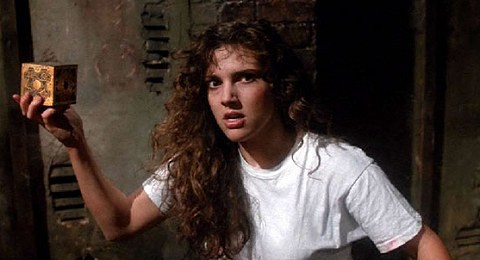 A few hours editing would be more than enough to fix this rather egregious fault; the re-dubbing of certain characters and supporting cast with appropriately Scouse accents would help to enhance the film's sense of place and remedy a factor that has the effect of jolting the audience out of the fantasy; of reminding us that we are experiencing a work of fiction. Beyond that, certain effects have not aged well; some of the latex skin tears and stretches in slightly odd ways, some of the graphic effects scrawled on top of the film cells (some of them purportedly by Barker himself, during the closing days of the film's production when they were running out of both time and money) are extremely crude, and certain scenes and characters could perhaps be trimmed to enhance the focus of the film (the aforementioned Steve is almost entirely redundant, and serves to distract from the Elektra complex dynamic occurring between Larry and Kirsty). Even so, I cannot deny being swept up into this beautifully macabre, graphic and transgressive fairy tale once more; enchanted all over again by its gruesome wiles. Hellraiser is as much part of my childhood; the self-authored myth of my own history, as any of its ostensibly more appropriate ephemera and influences (such as The Transformers, Visionaries, Knightmare etc). As such, I can't claim any great degree of critical distance from it -and certainly not objectivity, which is a beloved myth in itself-; all I can do is exclaim in various ways how I continue to adore it, and that I hope others will find their own pleasures in it, as years and generations sift by. 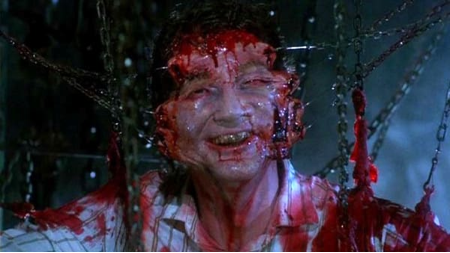 A couple, Larry and Julia, move into an old house belonging to Larry’s family, to make a fresh start. Exploring the dilapidated house, Julia discover a hideous creature - Larry's half-brother Frank, who is also Julia's former lover - hiding in the attic. Having lost his earthly body to other-worldly demons called the Cenobites after a ceremony with a strange golden puzzle box, he is brought back into existence by a drop of blood on the floor. Frank soon forces his former mistress to bring him human sacrifices to complete his body in a bid to escape the clutches of the Cenobites… but the Cenobites have other plans for him. We like it because: “Jesus wept!” Clive Barker’s debut film, a nightmarish vision of flesh ripping demons wreaking havoc on a suburban household, was unleashed on cinema audiences in 1987, and became a box office sensation, spawning numerous sequels, a legion of devoted fans and turning Pinhead and his Cenobites (“sado-masochists from beyond the grave” as Barker describes them) into horror icons alongside the likes of Freddy Krueger and Jason Voorhees. Thirty years later and the film is as terrifying, nightmarish and gruesomely effective as ever - featuring wonderful central performances from Andrew Robinson (made famous as the Gemini killer in Dirty Harry) and Clare Higgins as the couple, whose life is torn apart when brother Frank appears in the attic and starts demanding flesh; Ashley Laurence makes a terrific horror heroine, attempting to send the Cenobites back to hell. Barker’s taut, twisted script, adapted from his story The Hellbound Heart, coupled with his remarkably assured direction (belying the fact this was his debut) ensures a film dripping with dread, and bursting with inventive set pieces and bloody imagery - including the appearance of the gruesome Cenobites, summoned by the infamous gold puzzle box, and their metal hooked torture devices. The 30th Anniversary re-release - appropriately on Friday 13th of October - gives audiences a chance to see it once more in all its gory big screen glory - and for the uninitiated to have their souls torn apart for the first time! released by arrow films on 30 oct 2017 and available to purchase here |

Archives
April 2023
|
 RSS Feed

|

|