

HORROR FILM REVIEW: MAGGIE
2/7/2015
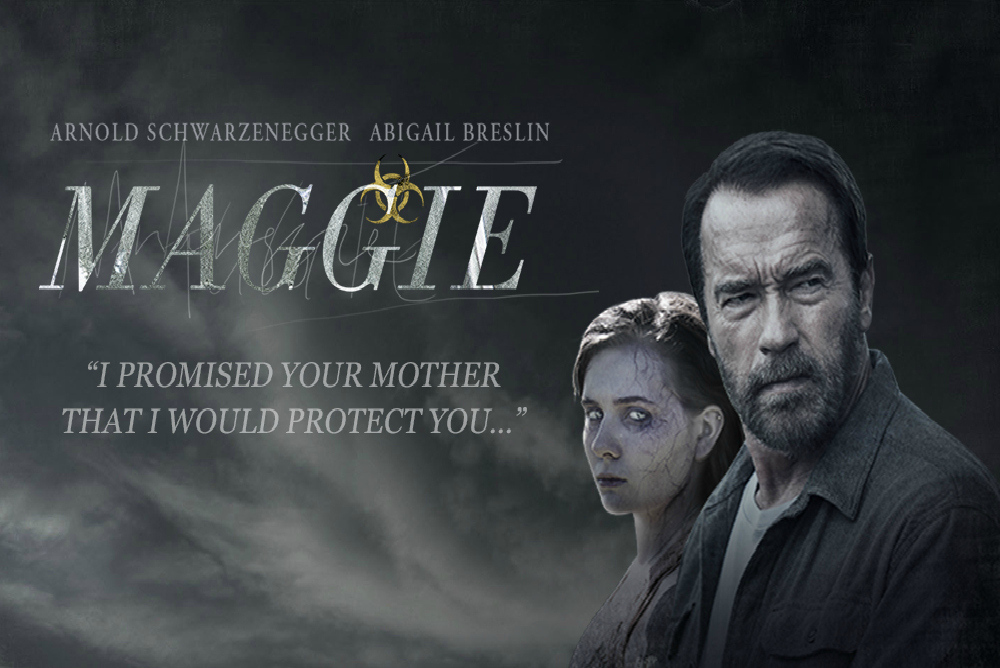 Confession: I love Arnold Schwarzenegger. Not the Gubernator. Not the guy who cheated on Kennedy’s niece with his maid. I’m strictly talking about the actor. I am one of those rare people who is able to separate the art from the artist. And yes, I just referred to Arnie as an artist. I first realized he wasn’t just an accent with muscles while watching Total Recall. The sheer amount of confusion and fear he had to play in some of those scenes… few action actors could pull that off as well as he’d managed. When word came out about Escape Plan, starring not just Arnold but Sylvester Stallone (whose own dramatic roles, in films like Rocky Balboa and Cop Land, are far too often overlooked), I’m sure I wasn’t the only one who got excited. And it didn’t disappoint. Escape Plan was great fun, solid action, some excellent concepts and twists. But most of all it reminded me of what I’d realized when Ahnuld went to Mahs for Paul Verhoeven: he’s a great dramatic actor. Still with me? Good. Fast-forward a few years (Christ, has it been twenty-five years already?), to the thick of the zombie resurgence. Word of a small zombie drama starring Arnold Schwarzenegger showing at the Toronto International Film Festival hits the news. Cue the collective groans. And when it’s pulled from the festival by its new distributors, Lionsgate, cynics laugh with vindication. Were they afraid critics would be too hard on it? That it wouldn’t do well among highbrow fare? What were they thinking, casting an aging ‘80s action star? It might not come as a shock to you that I liked Maggie a fair bit. Arnold plays Wade, a farmer (I know), taking care of his teenaged daughter, played by Abigail Breslin, after she’s infected with the “necroambulist” virus. (This is my only real issue with the zombie part of the movie: literally calling the virus “death walker.” I digress.) The doctor in charge of quarantine allows Wade to take her home because they’re friends, and Wade had promised his deceased first wife he would always take care of Maggie. His second wife (Joely Richardson) ships off their young children to be with her parents while the two of them take care of Maggie, her stepdaughter. This is a classic setup, allowing for disagreements between husband and wife about how to handle Maggie’s deteriorating condition. The main antagonist, aside from Maggie’s “necroambulism,” is an angry cop who’s merely trying to keep the virus from spreading to the rest of the town (though we might suspect a grudge between him and Wade). Thankfully, his veteran partner trusts Wade’s judgment. Thematically this film works very well. Maggie has come to terms with her impending death, while her father is still in denial. Wade’s doctor friend provides him with the drug they’re giving to the infected once they’ve reached the point of no return; he tells Wade the drug is extremely painful, and it would be in Maggie’s and his best interest to put her down easy with a bullet to the head. When a man and his daughter, both infected, frighten Maggie in the woods, we see Wade is not afraid to do what is required… though we sense his reaction will be different when it comes to his own flesh and blood. To me, this is what zombie fiction can do perhaps better than any other genre. Where movies like Lorenzo’s Oil or Dying Young stumble into melancholy, zombie fiction works best when it stops to remember that these mindless, flesh-eating creatures were once human. It’s what initially elevated The Walking Dead from almost any recent zombie fiction that had come before it. In Maggie, the virus is a metaphor, and it’s handled quite well. It’s concerned with grief, not fear or splatter. Consider this: in a sequence where a cynical film buff might expect Maggie will be ganged-up on by her former friends, they instead embrace her. In fact, there’s a boy with them who’s also infected, though he’s further along than Maggie. In this respect, Maggie has more in common with The Fault in Our Stars than Night of the Living Dead, and I don’t mean that as a bad thing. The kids discuss their fears. Maggie and her father talk about her mother in a brief scene that reminded me of Tom Hanks’s speech about the apple peel from Sleepless in Seattle. There are moments of honest sentimentality you wouldn’t expect from a Schwarzenegger film. I would say my biggest problem with Maggie is that the ending feels like a bit of a cop-out. While some viewers noted its lack of a major action scene they apparently thought it was building up to (I admit I felt the same based solely on the trailer, but nothing in the film led me to believe that would be how it ended), I felt the way Maggie eventually dies for good to be anti-climactic. But maybe that’s why the filmmakers chose Arnold in the first place. If that was the intent, it’s an effective twist. I just felt like they could have let Arnold really wallow in the depths of grief in the end. Because for the rest of the movie, he plays strong yet vulnerable just right. DUNCAN RALSTON |

Archives
April 2023
|
 RSS Feed

|

|