

Rogue One - A Response
11/1/2017
by Kit Power 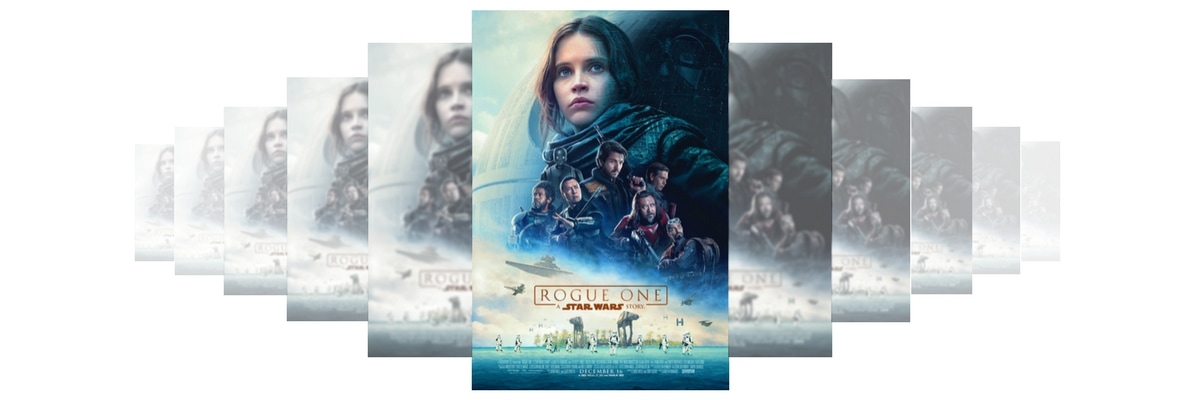 So then. That happened. Not a review. Not really a critique. More a brain vomit. Spoilers will abound, so if you have yet to see it, go no further - not least because I’ll be writing in the assumption that you have, and this probably won’t make a whole heap of sense otherwise. And I mean, I enjoyed it, so let’s start with that. I get that there will be Star Wars fans who prefer this to The Force Awakens, and I get why that’s the case. Like TFA, if feels palpably like a film made by Star Wars fans who are love with the original trilogy and desperate to play with those toys that have captivated them since childhood. And unlike some other sci-fi franchises, it doesn’t feel like the new creators are obsessed with remaking the whole thing in their image (yeah, that’s a swipe at Moffat’s Who, I guess, which I enjoy, but blimey, mate, leave some mystery on the table for the rest of us, eh?). No, this feels like something else. I mean, sure, there’s the fact that it’s competently made, which elevates it far above the prequels (oops, I guess I have to call them the other prequels now, don’t I?). By which I mean it’s made by a director who understands how to draw out acting performances rather than stifle them, writers who understand pacing and dialogue, and perhaps most important of all, filmmakers who get that the time to use digital is when you can’t do it physically, not all the fucking time. But there’s also… well, I feel ridiculous using this word in the context of a Star Wars movie, but actually, there’s a subtlety at work, I think. No, really. The movie has a tightrope to walk, after all. It’s an official Star Wars movie, sure, and it’s part of continuity, but it’s also a bridge between the woeful prequels and one of the most successful movie trilogies in history. And it’s also not part of the new unfolding story. You can feel that conflict from the very opening - we get ‘A long time ago, in a galaxy far, far away…’ but as you brace for the fanfare, starscape and logo, the rug is tugged from under you, and instead, you have a planet and a spaceship. The music is especially telling in this regard, with the score constantly starting familiar themes before moving them into different places, different configurations. It’s a bold choice, and I can only imagine the ludicrous amount of meetings that had to be held to work out how to do this - what do we keep, what must we change - but I think they nailed it. It evoked familiarity, but also sent the message - this is different. This is not your childhood Star Wars. Not quite. For starters, there’s a darker tone hanging over proceedings from the opening scene, with the Empire, in general, being portrayed as more brutal than in previous outings, I think. There’s a degree to which the moments that Lucas skillfully hinted at back in the original trilogy (I’m thinking particularly of the sinister interrogation droid that menaces Leia with a syringe in A New Hope) are made explicit here, happening on camera. Certainly blackmailing the scientist father by threatening the lives of his family (shortly before executing his wife in front of him) is, while not in any way out of character for the Empire, a significant step up in terms of physical and psychological violence, at least in an up close and personal sense (as opposed to a blowing-up-planets sense). In fact, let’s pause here for a moment and talk about themes. Because what Rogue One has in common with the Original Trilogy is that one of the central themes, arguably the central theme, is about fatherhood - more specifically about flawed fathers and their redemption. And I think there’s something to be teased out here about the similarities and the differences. Vader is pretty much a nightmare dad, for most of the OT. The ultimate authoritarian, second in command of a fascistic military government - oh, and also with the power to choke a man with his mind. Masked, too - apparently emotionless (aside from that constant rage). And, I mean, I have no idea about Lucas and his relationship with his father, but that sounds like a Boomer’s nightmare father, in many respects. I’m not one of those people who lionize the 60’s counterculture generation, but it is fair to say the generation gap may never have been wider than it was for the children who came of age in that decade. There was a moment of profound alienation between parents and children - perhaps best exemplified by a quote from a parent of a child present at the Kent State shooting who said ‘“it would have been a better day for America if the troops had kept shooting”. Leave aside, if you can, the bile that rises at this apparent sociopathy, and instead marvel at how fundamental the divisions between parent and child must have become, to allow someone to say that to a journalist. In that context, Vader makes sense. The counterculture must have felt like a rebel alliance; the establishment must have seemed like an Evil Empire (only seemed, Kit?). And even if Lucas was a young Republican and the apple of daddy's eye. He’ll have seen the contours of this conflict all around him, in the eyes and stories of his friends. All storytellers are, in part, a product of their environment. It’s as unavoidable as breathing. So if Vader was the nightmare father of his generation, what are we to make of Galen Erso, father to our heroine Jyn? The differences are striking. Galen is a reluctant pawn of the Empire, not a true believer. He goes to work for them only after his family is threatened - more, only after he realises that they can and will get it done without him. Yes, he builds the Death Star, but he also builds into it a flaw - a secret vulnerability that will destroy it. I’m reminded of the poem How do we forgive our fathers? by Dick Lourie. Vader’s redemption ultimately comes from his love for his son - when the rubber meets the road and his son is being executed in front of him, something snaps (turns out he doesn’t want the soldiers to keep shooting, after all) and he turns. Fittingly, it costs him his life to do so, but he dies redeemed, and without having to face a messy Nuremberg style trial. Let’s face it, probably for the best all around. Galen is a different kettle of fish. If we see Vader as a boomers nightmare father made flesh, then Galen feels very much like Boomer as a father - a counterculture figure who reluctantly joins the evil Empire, not out of conviction but out of a need to feed and protect his family. Which is… complicated. I mean, my parents are boomers, and I love them both dearly. At the same time, the boomers in Western society as a demographic have been pound for pound one of the most catastrophic and destructive generations the species has ever seen. Rampant explosion of the use of fuel sources that are not-so-slowly baking the planet, generational financial theft, gigantic proliferation of the most deadly weapons of mass destruction ever conceived of with absolutely no effort to decommission them after they’d served their dubious purpose - oh, and the last hurrah of voting for Brexit and Trump by pretty much the margin of victory, almost as a final fuck you to the poor sods who will somehow have to find a way to live in the rubble and flooded planet they bequeath us. I mean to say, talk about an Evil Fucking Empire. This makes Galen a fascinating figure, to me. It’s like the film is saying that some ‘goody’ boomer father has somehow built a back door, a vulnerability, into this death machine of ‘democratic’ capitalism that seems insistent on strip mining the planet in a bid to leave no harmful substance unburned. Which, please let it be so, but more fundamentally, feels to be over generous to me. I mean, I know they also gave us Star Wars, but come on. But then, of course, Jyn dies. To be precise, she’s killed by The Death Star, caught in the blastwave of destruction as the Empire tries to prevent the plans from being transmitted. The sins of the father are revisited upon the child, and all her nobility, bravery, and sacrifice can’t save her. Her death-in-victory may represent a redemption arc for her family as a whole, but man, that’s an Old Testament kind of redemption, a long way from the fluffy New Age messaging of the OT. So if we’re looking at Galen as a boomer parent, maybe this is a more damning indictment than Lucas had of his parent's generation. Vader turns at last, after all, and then has the good grace to die. Galen, compromised throughout, does ultimately build the weapon that kills his daughter and threatens the entire galaxy - and its exploitable weakness is only found due to the extraordinary efforts and sacrifice of that daughter. Shit, maybe it’s a pretty good metaphor after all. The hope may be new, but it’s also fragile and scary. And the notion that it’ll take a generational sacrifice just to give us a shot of righting the ship… Wow - bleak and accurate. Thanks, movie. That leads me to another thing that gave me pause about this film - the vampirism. I mean, there's a dead man in this film, and he has a sizable part, and that’s just fucking weird. I think I had some notion it was coming, probably thanks to Facebook friends, but in the opening shot, with the character's back to the camera and a shadowy reflection in a window, I thought ‘well, that’s not so bad, kind of touching, actually’, and then he turned around and Peter fucking Cushing is glowering out of the screen at me. I’m pretty sure I jumped in my seat. I’m still not sure how I feel about it, either. I mean, cinema has fundamentally always been a medium of ghosts, and if you don’t believe me, watch The Wizard Of Oz sometime, and afterwards reflect on the likelihood that every single person who worked on that film is now dead. I mean, really internalise that down to your boots, and see if it doesn’t shake loose some kind of reaction. This is what ‘immortalised on film’ really means, and always has. In that respect, this is the next logical step. After all, we’re twenty two years on from the at-the-time-gobsmacking-and-now-embarrassing-to-watch moments when Forrest Gump meets Nixon and Lennon, and before that, The Crow used CGI to finish off after their lead actor was inconveniently shot to death on set. So why does this feel different? I’ve been puzzling over that since I left the cinema. Because it does feel different - note I do not say ‘wrong’, I’m not yet confident in making that kind of a value judgement - and unsettling. I think it’s because this isn’t a case of interacting with a historical cultural icon (well, Cushing kind of was that, but you know what I mean) or covering for an unexpected death - this was a conscious decision to include a character played by a long dead actor, and then further to have that actor be represented by CGI (as opposed to a living actor - and yes, I know there was a performer underneath the CGI and doing the voice, but still). And see, bringing back Vader is easy, because with the greatest respect to David Prowse, Vader is The Suit and The Voice (and The Voice - AKA James Earl Jones - is mercifully still with us). It’s also, IMO, far more necessary - Vader is, in a film franchise so reliant on iconic character design, arguably the most iconic of them all. As soon as you decide to make a movie about the building of the Death Star and the Rebel acquisition of the secret plans, the question of Vader becomes when and how, not if. But Grand Moff Tarkin? Not that Cushing isn’t great in A New Hope, because he is, and his scenes with Carrie Fisher are especially glorious, but he’s not elemental to the story in the way Vader had to be. And I find myself wondering who made the spectacularly expensive decision to ‘cast’ him in the movie, and how they went about getting permission from the Cushing estate, and, well, why? Rarely has ‘because we could’ felt like a less satisfactory answer. Again, to be clear, I’m not saying it was wrong - but it sure was weird, and not in an entirely pleasant way. (Side note: for those of you who are yelling ‘but it wasn’t that good, you could tell it was CGI’ I can only quote you one of my friends, who leaned over to me and said ‘Isn’t he, like, a hundred?’. So, not if you didn’t know, you couldn’t, apparently.) It’s a fucking odd decision, is what I’m saying, and it exerted a gravitational pull on my attention and thoughts throughout the rest of the film. Not that I didn’t appreciate a lot of what else was going on. Jyn, like Rey in TFA, is a believable and engaging lead, with a similarly tragic parental backstory, and her arc is pleasing. There’s a brilliant row between her and Rebel fighter Cassian Andor where they really go at it, about the ethics of what they are doing, the violence of the Rebellion and Jyn’s self preservation, and they’re genuinely both right, and there are no obvious winners, and this is the kind of shit I didn’t realise I’d been missing in my popcorn. Similarly, the provocative moment where the rebels, wrapped up in the turbans and flowing robes of the middle east, open fire on the white armoured storm troopers guarding a tank full of the local natural resource was striking, in an ‘I-can’t-quite-believe-they-got-away-with-this’ way. I don’t want to put too much weight on that - this is at heart a war movie, after all - but still, it was a welcome moment of nuance and ambiguity none of us had any right to expect. There’s quite a bit of that, actually. The morality of the Rebellion and their tactics is put under unprecedented scrutiny (which is admittedly a singularly low bar to clear), and even if it’s both incomplete and unresolved, it’s was still for me a welcome moment. The introduction of dissent within the Rebellion was also a welcome complication, even as it somewhat mechanistically set up the final act. And I adored the reprogramed Empire droid, with his sideline in sarcasm. A lovely idea, beautifully executed. But I was left with a suckerpunch that sent me out of the theatre in as much emotional turmoil as my first viewing of The Force Awakens <http://www.gingernutsofhorror.com/film-reviews/the-force-awakens-a-response> did - perhaps even more. It must have seemed like such a cute idea - an uncomplicated feelgood moment to close out the film. And of course, Carrie Fisher must have signed off on it in some capacity. Still, thanks to 2016 swinging the scythe just one more damn time as the year ticked over and out, I’m left, in the final shots of the movie, face to face with another ghost - the ghost of the impossibly perfect nineteen-year-old Carrie Fisher, in full Leia glory. Her closing line, delivered to the camera, about hope, just about finishes me off. Again, to be fair to the filmmakers, it’s not something that you could have seen coming. But holy shit, it packs a poignant punch that’s almost too much. It’s also not fair to the movie because the feelings it evokes now are very different to those intended. But them’s the breaks, I guess when you’re working in a medium of ghosts. Sometimes it’s you that’ll get haunted, in ways you couldn’t have predicted. And two Christmases in a row, I am left with a complicated mess of emotions by a goddamn Star Wars movie. What a fucking world. KP 5/1/17  |

Archives
April 2023
|
 RSS Feed

|

|