

 Despite my unambiguous (and abiding) praise for the pilot episode of Neil Gaiman's American Gods, I will admit to going into episode 2 with a little trepidation: More than one series of promise has failed at this point, allowing the energy and dynamism of its first instalment to falter, losing focus or coherence, spiralling out into self-indulgence and absurdity. This and the following episodes are where the series will prove itself; where viewers hooked by the pilot will decide to either continue watching or find themselves alienated. It's therefore a tremendous personal joy to report that the second episode is at least as fascinaingly strange, as gorgeously deviant, as respectful of its viewers as the first. As in the original novel, much of what the story consist of is left to implication and symbolism; very little is overtly explained. As such, the viewer is obliged to engage with the material rather than allowing it to simply wash over them; in order to fully appreciate the layers and levels of storytelling, it is necessary to have some knowledge of various mythologies (a fact that the show makes no bones about; some of its visual and symbolic references are downright esoteric, if you don't know what it's referencing). This may serve to alienate those who want their TV more easily digestible; who wish to be patted on the head and consoled by their viewing material, but...for those of us that ache for something challenging, poetic and stimulating...American Gods is increasingly where it's at. The episode opens, just like the first, on a scene that is simultaneously incongruous and somehow absolutely pertinent to the story: a slave galley, a man in chains calling out to Anansi, the Spider-God whose stories and trickery are well known throughout various African cultures. Nothing is explained, no context is provided; the audience is left to interpret what this might mean in the wider context of the show for themselves. It's something of a surprise to both man and audience when Anansi actually shows up, in an anachronistic guise and speaking in the manner of a (post) modern man, his clothes, his motions, his posture, suggesting the creature beneath, the brightly coloured jumping spider that is his animal aspect and the symbol of his faith. 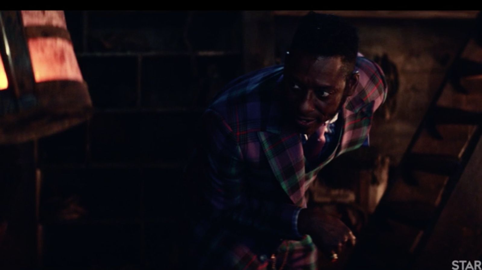 Delivering a blistering speech on the future of the black man throughout US history, he explains without ornament and without cowardice what their lot will be; the lots of their children and children's children in generations to come. He stirs their passions, ignites their faith, and drives them to an act of self-sacrifice that echoes those we have already witnessed (demonstrations of faith in their darkest and most passionate seeming to be a consistent characteristic of humanity's relationship with the deities it has shaped and spawned; one that is cruel, parasitic and presented here without any compunction whatsoever: faith demands blood, in one form or another, and Gods demand faith. Therefore, the demonstration of faith and the spilling of blood are inextricable). The scene acts like a small story in and of itself, echoing that of the ancient Nords landing on the shores of the Americas in the previous episode. Shifting from that opening scene back to protagonist Shadow Moon, we find him surprisingly alive, following what he endured in the closing scenes of the last episode; the beating and lynching he suffered at the hands of “The Technical Kid's” thugs having proved little more than an inconvenience. In any other show, this kind of absurd recovery might be taken as narrative convenience. Here, however, it has a far more sinister and profound implication, as we who have read the book already know. The transition from moments of high drama and mythological absurdity to these relatively still, domestic scenes is part of the show's genius; owing to its design and framing, it makes the most banal settings look like surrealist paintings; everything has colour and vibrancy and dynamism, whilst still retaining a degree of dirt and grit. The show isn't exactly a comfortable watch: it is, after all, a meditation on the nature of human migration; on how cultures swell and assimillate those they encompass or cannibalise, on a mythological level as much as any other. It's here that we encounter Ian McShane's superbly portrayed Mr. Wednesday once more, a man whose scurrilous charm is superceded only by his mystery. Again, he engages with every word and gesture, obscenity spilling from his mouth with the music of poetry, banality with the profundity of prayer. A quietly blistering performance, and one I imagine is going to be etched into cultural consciousness for a long time to come. Again, all is implication and innuendo; clearly, the world Shadow has found himself drawn into is a far cry from the faintly sleazy, criminal enterprise he expected (though there are elements of that, too). Wednesday knows him better than he knows himself; consoles and cavorts and manipulates with every word. That he needs Shadow is clear, though as to why... 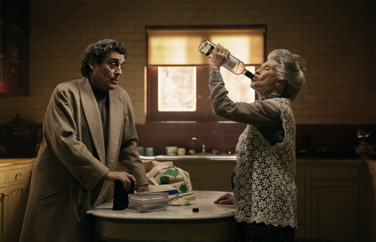 From the heightened, the emotionally fraught, the mythological to the domestic, the dramatic, the scene shifts once again, as does the tone of the episode, transporting us to Shadow's previous home, that he once shared with his wife, whom he discovered in the last episode is not only dead thanks to a car crash, but was also engaged in a torid affair with his best friend. These moments of slowness, as Shadow moves wordlessly through the house, finding spectres of unwelcome memory in every room, help to cleanse the palate; slowing the pace a little, lending another layer of significance to events, but also building the character through whose eyes the audience observes this strange and yet familiar world. Shadow has a chance to genuinely flex his muscles in this episode, now that the thorny business of establishment is out of the way: we see more of just how broken he is, how he genuinely doesn't care what happens from this moment on, and is only along with Wednesday because he has nowhere else to be and nothing else to live for. The scene at his former home serves to a draw a line under everything he assumed about himself and his former life, as everything is packed and shipped away, the house left empty, Shadow himself likewise. Again, the landscapes and geography of the USA have as much a part to play as the nation's history, as does the accrued mythology and poetry of that nation: Shadow and Mr. Wednesday engage in the classic road-voyage across states and through their myriad landscapes, the camera lingering on them in the manner of a road movie, whilst other, older and newer forces seethe all around. In a sequence of surrealism that borders on the art house, we return to Bilquis, as she sustains herself on a variety of lovers and adorers, repeating the fairly horrific scenes in which she was introduced, her hunger clearly growing as the show progresses. At the moment, these scenes are diversions from the main narrative, but in the most fascinating and brilliant of ways: they do not distract or diminish, but add fresh layers to an already towering confection; elements of surreal, almost Cronenbergian horror, along with subtle suggestions of the story arcs to come. At present, Bilquis's part in the narrative (unless, of course, you happen to have read the novel) is enigmatic; she is clearly one of the old gods, alongside Wednesday and numerous other characters, but her place is unfixed; building towards a potential confrontation in which her significance will be determined. As it stands, it's a joyous diversion to engage with her scenes, which are lit and framed in a different manner from the rest of the show; shades of deep, deep red and purple providing a dense and potent atmosphere, much of her time on screen without dialogue or explanation, everything suggested through framing and bizarre visuals. What we are left with in this episode is a suggestion that she is hungry for old states of power and glory, that she chafes at being reduced to her current condition. She is a creature of exquisite threat and potency, one that stands in stark contrast to the likes of “The Technical Kid,” who is a scrawny, whining, pathetic creature, rendered threatening only by the influence he exercises. 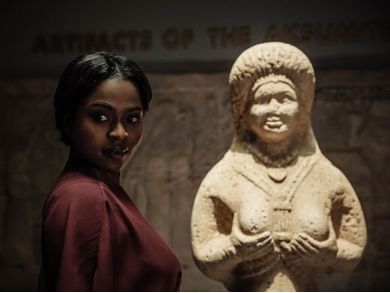 Another element of the show -that is not exclusive to Bilquis, but that she emphasises- is that it isn't afraid of the human form, either male or female: it has no compunctions about portraying any of its characters in various states of undress, often contrasted against the strangeness or violence that it exhibits with equally graphic enthusiasm: Bilquis in particular is a living icon; an animated idol whose anatomy is not merely female, but the very epitome of all that is female: as much metaphor as it is flesh, and is framed as such: even though the raw sexuality of her being is portrayed graphically, it is not in any way titillating or pornographic; rather, it is rendered as a moment of profundity and horror; the means by which she subdues and seduces her worshipers, who surrender everything to her, including their bodies, in the act of coupling. She is framed in such a manner that the actress's body becomes like a painting or statue; a thing of worship as opposed to an object of ownership. Similarly, Shadow's body is lingered over in earlier scenes following his assault at the end of the last episode; as beautiful, as sculpted and iconic, in its own way, as Bilquis's; the male equivalent to her aggressive female aspects. Interestingly, whereas Bilquis is portrayed as a thing of unambiguous power; a creature of absolute control and predation, Shadow is rendered vulnerable, the traditional dynamic of male/female presentations inverted; Shadow is bleeding, scarred, stitched together, every motion seeming to cause him pain, despite his rippling musculature: a creature that doesn't know its own capacities, hurtled into this world confused and powerless, not even realising what he represents. That inversion is one of the many ways in which the show demonstrates the transgression that beats at its heart, that informs its soul: this is in no way consoling television or comforting media; there is not even a suggestion of happy endings here, for anyone. New additions to the cast come in the forms of Czernobog, a rendition of a Slavic god of bad luck and ill omen, here rendered in typically ironic fashion as a self-loathing but poetically minded brute who makes art out of violence, who regards killing as a form of craft that has been stolen away from him by the mechanisation of slaughterhouses. Again, little is made of this outside of the name and some vague allusions to his past; the character could easily be just an immigrant out of love with the dream he was promised; the living nightmare that America has become. It is only with wider knowledge of the mythologies that the show references that so much of his character becomes profound; every word, aspect and action metaphorical, refering to the stories and symbolism he once inhabited. Immense, wild, threatening and defeated, Czernobog is presented as ambiguously as the rest of the cast; no more a “villain” than Wednesday or Shadow himself; a lost and despairing creature, reduced from mythological glory to something desolate and decrepit. Czernobog, alongside his compatriots, the triune Slavic goddesses Zorya Verchernyaya, Zorya Utrennyaya and Zorya Polunochnaya (Morning, Evening and Midnight stars, respectively), encapsulates a core theme of the source material: that of old ways, old stories, carried like disease from their places of origin to new lands, abandoned and half forgotten: divinities reduced to decrepitude, in a manner not unlike the least fortunate of their once-believers: they are as much immigrants here as those that sustain them, and are fighting for place and purpose and identity in exactly the same way. 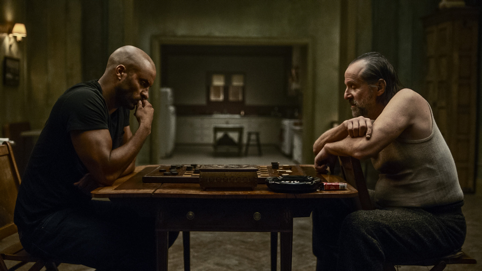 has a wonderful effect of diminishing divinities; lending them a certain humanity where they might otherwise be ineffable and unknowable. Despite being fairly hostile and threatening throughout, Czernobog is also garrulous, courteous and hospitable; a character it is impossible not to like, even when he descends into depths of crudity and discourtesy or displays outright violence. The sheer strangeness and mystery of the scenes in which he occurs lends them depth and atmosphere; a sense of pervasive threat that recalls other commentaries on the state of US culture, such as Cormack McCarthy's No Country for Old Men or even Chuck Palahniuk's Fight Club: here we have the fairy tale of “The American Dream;” the cultural myths on which the US sustains itself, hideously and unflatteringly exposed, but also a far broader examination of the phenomena of human migration: these gods are encapsulations and expressions of humanity, as much as humanity is an expression of them; they are ways and beliefs and stories and cultures that are slowly, slowly starving to death for want of retelling and remembrance, giving way to an entirely new and anodyne breed; a status in which stories are dead, left in the dust in favour of deities of plastic, consumerism and politics. Speaking of which, in one of the episode's stand out scenes, we meet another of the Technical Kid's breed in a moment that is as humorous as it is distressing: whilst Shadow performs a mundane task of goods shopping for Mr. Wednesday, an array of widescreen TVs flare into life, a rendition of I Love Lucy's eponymous housewife speaking to him directly, promising him pleasures and contentment beyond his dreams, if he'll only submit to work for her. This is the goddess of TV, one of the older and more powerful of the new breed, and one whose machinations I imagine we haven't even begun to explore, yet. A sigh of relief, an exultant hymn: American Gods, a potential contender to be the Twin Peakes of the era. 
|

Archives
April 2023
|
 RSS Feed

|

|