

 We are honoured to bring both the cover reveal for A Cosmology of Monsters by Shaun Hamill and an extract from the book. Ginger Nuts of Horror already has a review in the bank for this book, and trust us you will want to get a copy of this, it is a must read novel. Synopsis: Noah Turner’s family are haunted by monsters that are all too real. This coming-of-age story tracks the Turner family, his bookish mother Margaret, Lovecraft-loving father Harry, and his sisters Sydney, born for the spotlight, and the brilliant but awkward Eunice, a natural writer and storyteller. As his father becomes obsessed with the construction of an elaborate haunted house - the Wandering Dark - the family tries to shield baby Noah from the staged horror. As the family falls apart, fighting demons of poverty and sickness, the real monsters grow ever closer. Unbeknownst to them, Noah is being visited by a wolfish beast with glowing orange eyes. Noah is not the first of the Turners to meet the monster, but he is the first to let it into his room… About the author: Shaun Hamill grew up on a steady diet of horror fiction and monster movies. He holds an MFA from the Iowa Writers’ Workshop and his fiction has appeared in Carve and Spilt Infinitive. He lives in Alabama. UK pub date details: 2nd June 2020, paperback and eBook Extract: 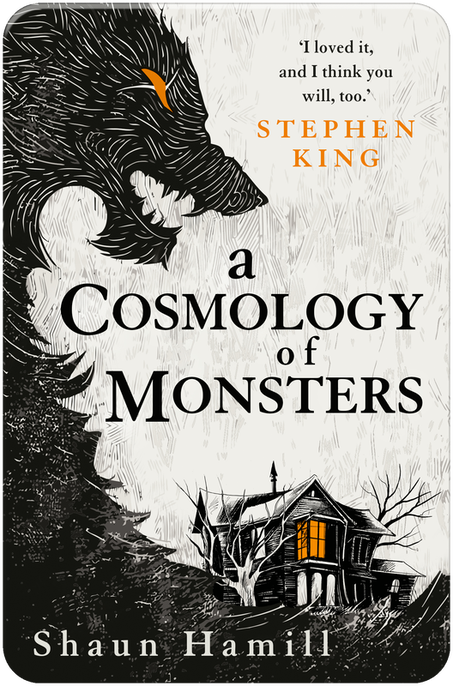 On their second date, Harry took Margaret out of Searcy and again followed all the signs for Little Rock. Once in the city, he pulled a scrap of paper from his shirt pocket and read from it as he navigated the downtown area. They entered a run-down residential neighborhood lined with old houses in various states of decomposition—broken windows, sunken porches, dangling rain gutters. They’d probably been beautiful once, but Margaret wondered who could live here anymore. They stopped at the corner of one of these streets, in the shadow of a turreted two-story house with a sign planted in the yard: SPOOKY HOUSE! A line of people started at the base of the porch and stretched down the sidewalk. “What is this place?” Margaret said. In 1968, a year before the Haunted Mansion opened at Disneyland, and well before the proliferation of copycat attractions around the country, Harry didn’t have the easily understood cultural shorthand haunted house available to him, and had to reach for the closest available equivalent. “It’s supposed to be like a fun house at a carnival, or a ghost train ride,” he said, as he circled the block and hunted for a parking spot. “But it’s a real house. So this is what it would actually be like to go into a haunted place.” He leaned past her, opened the glove compartment, and removed a folded-up newspaper. Margaret caught a headline (LOCAL BOY MISSING) before he flipped it over and handed it to her and pointed to a small ad in one corner. Margaret angled the paper so she could read by the streetlight as he backed into an open spot across the street from the attraction. The ad was a small square of black featuring a generic, cartoonish ghost with bold white print beneath: “Come to Spooky House—AND EXPERIENCE A TRUE-LIFE NIGHTMARE!” “This sounds like fun to you?” she said. “If you don’t want to go, that’s okay,” he said. “We can see a movie, or I can take you home.” She heard the strain in his voice. He wanted this bad, but also wanted to be a good sport. “No, let’s do it,” she said. “How often do I get a chance to live out a true-life nightmare?” They joined the line and shuffled closer to the door every twenty minutes or so, as groups of laughing people emerged through the fence around the side of the house. Finally they stood before the ticket taker, an older, heavyset woman with limp gray hair and a cigarette wedged in one corner of her mouth. Harry paid. The woman made change, and then pointed inside. “Should we— How does it work?” Harry said. “Go in. You’ll see,” the woman said, her voice the sound of stones scraped together. The front door stood open, but dangling orange streamers obscured the view. Margaret and Harry pushed through into a dimly lit entryway with a flickering bulb overhead and orange fairy lights strung around the banister, twisting up into the darkness of the second floor. Margaret leaned forward and peered up the stairs. Something moved, a shape distinguishing itself against the darkness, retreating from view. Margaret stepped back and bumped into Harry. “You okay?” he said. “Fine,” she mumbled. Maybe this had been a bad idea. A group of four teenagers came in after them, two couples giggling and leaning into one another, their energy palpable and reassuring. Harry and Margaret moved aside to let the kids take the lead. They followed them down the hall, which opened on the right side into the living room. Four people sat on a severe, uncomfortable-looking couch, wearing weird (but not exactly scary) costumes. They appeared to be family—the father dressed in a suit and sporting a thick black mustache; the mother with long, straight black hair and a tight, form-fitting gown; a chubby boy in a striped T-shirt with a chili bowl haircut; and a little girl in a black dress, dark hair braided on either side of her grumpy, dour little face. They stared at a television screen covered in static. “Welcome!” the father said, with a wave. “We’re watching the weather report on TV.” “Looks like snow again, Gomez,” the mother said to the father. Gomez? How did Margaret know that name? “It always looks like snow,” the little girl said. “You know, Wednesday, that’s an excellent point,” Gomez conceded. Wednesday? Gomez? “Oh, it’s like that TV show,” one of the teenage girls said. “The uh—what was it called?” “The Addams Family,” Harry said, so quiet only Margaret heard. She caught his eye and he made an apologetic face. She studied the Addams impersonators. She saw it now, sure—but wasn’t The Addams Family a sitcom that made fun of monsters? Wasn’t it a comedy of errors, not horror? The ad in the paper hadn’t seemed to be advertising funny. “Since we’re snowed in, you’ll have to join us for dinner,” Gomez said. “Lurch!” A slightly-taller-than-average figure shambled up the hallway toward the visitors. He wore a tuxedo and makeup that made him look like Frankenstein’s monster. He groaned in the tone of a question. “Lurch, show our guests to the dining room, will you?” Gomez said. The tuxedoed monster groaned again. Margaret, Harry, Gomez, and the teenagers followed him down the hall into a large, candlelit dining room, where a long table had been set for twelve. Lurch walked around the table and pulled out six chairs. When no one moved to accept the invitation, he leaned forward and removed the lid from a serving dish in the middle of the table. He gestured toward the contents, a mass of black that seemed to be writhing in the flickering light. Still no one came forward. Lurch reached into the dish, grabbed a handful of whatever was inside, and pitched it at the guests. The mass broke apart in midair and Margaret had time to register spindly limbs, a plastic shine. The teenagers shouted as the black stuff hit them and bounced off, thumping to the floor. Margaret squinted at the shapes. Rubber spiders. Lurch was throwing rubber spiders at them. At least they weren’t red. “Oh, brother,” Harry said. “Lurch, what have I told you about playing with your food?” Gomez said. He stood much closer than Margaret would have liked, and his breath stank of cigarettes. “Now we have to clean our guests!” She was grateful when he pushed to the front of the group and led them to a door at the end of the hall. Smoke drifted out from the crack between the door and the floor. They shuffled into a kitchen so full of fog Margaret couldn’t see the floor. A man in goggles and a white coat stood in the center of the room and stirred a smoking pot. “It’s alive!” he wailed. “Alive!” Harry’s shoulders slumped a little and his face dropped into his hands. “How’s the soup, Henry?” Gomez said. “It’s coming along swimmingly, Mr. Addams,” the man in the lab coat said. He used the metal spoon to beat at something in the pot, splashing water onto the stove. “Glad to hear it!” Gomez said. “Do you by any chance have clean towels? We had a mishap in the dining room.” “Nothing clean, sorry,” Henry said. “That is, unless—does bloody mean the same thing as dirty?” He held up a white towel soaked crimson. The teenagers moaned with disgust. Gomez turned to address the visitors again. “I think we have some towels in the upstairs bathroom if you want to head that way.” “We’re not dirty,” Harry said. “Can we go back out the way we came?” “Nonsense,” Gomez said. “We recently remodeled the upstairs guest bedroom. You simply must see it. Lurch?” Lurch reappeared in the kitchen doorway. “Take our guests upstairs for some clean towels,” Gomez said. Lurch grunted and gestured everyone back into the hall. Margaret went first, Harry right behind her. “It’s a small house,” he whispered, close to her ear, hot breath on her neck. “There can’t be much more.” Then, a second later, “I’m sorry.” Margaret led the trek up the stairs and moved aside at the landing to make room for the rest of the group. They stood in a narrow, dimly lit hall lined on both sides with closed doors. There was also, incongruously, a tall potted plant on the wall opposite the stairs. Margaret leaned over the railing and looked down at the first floor. She thought about the shape she’d seen staring down at her from this spot when she walked in. That part hadn’t felt hokey, or like it was part of a joke. It had felt real. She pushed away from the railing and faced the huddled group. “Where now?” one of the teenagers said. The door at the far end of the hall swung open. Lurch turned and went down the stairs, leaving them alone. They walked forward. No ghouls or demons sprang out. The house sounded quieter than before. Empty. The room at the end of the hall was doused in sickly-pink light, and had been dressed like an old woman’s bedroom. An old vanity stood on the left side of the room, and a twin-size bed sat in the opposite corner. The bed rested on a metal frame, head- and footboards so tall that it resembled a cradle for adults. A lump lay beneath the blankets, unmoving. Old black-and-white photographs hung on the walls: small children smiling and laughing on a summer day at the beach; a portrait of a soldier in formal wear, hat cocked at what must have been considered a jaunty angle; a newly married couple running from a church, heads ducked and hands raised against an onslaught of rice; an accident photo, one car T-boned into the other, the passenger side of the first car crumpled and caved in, the rear bumper of the second dominated by a Just Married banner and a train of empty cans. A second accident photo hung next to the first, this one depicting a body beneath a sheet that was soaked through with blood on one side. A single hand hung free and visible, white lace stopping at the wrist, diamond wedding ring glinting in the sunlight. Margaret stared at this one a long time. Was it real? Was it staged? “I don’t get it,” one of the girls said. “It’s creepy, sure, but what’s the gag?” “And what does this have to do with The Addams Family?” Margaret said. “I don’t know,” Harry said. One of the girls pointed at the lump on the bed. “What’s that?” “Go see,” said the other. “No way.” They argued for another moment before the taller, broader of the two boys volunteered to investigate. The smaller boy followed, a step or two behind, his torso bent away from the bottom half of his body as though restrained by its own good sense. The tall boy stood over the lump on the bed, his back to the room. He shook the stiffness from his hands and reached for the covers. Margaret licked dry lips, thought of the shape watching her through Pierce’s car window. She reached for Harry and his hand caught hers. The tall boy took hold of the covers and yanked them off. His friend shouted, the girls shrieked, and Margaret took a step toward the door. The tall boy stood unmoving, blanket in hand, gazing down. Margaret still couldn’t see what he was looking at. “What is it?” Harry said. He let go of Margaret and stepped forward for a better look. The tall boy dropped the blanket and picked the lump up off the bed. He turned around and held it so everyone could see that it was a pillow with a childish drawing of Dracula on it. The girls laughed, and Harry returned to Margaret’s side. “This place is officially the pits,” he said. “Want to leave?” “Yes, please,” she said. They exited the room, leaving the teenagers alone. When they returned to the potted plant on the second-floor landing, though, they found the way down blocked by a sliding metal gate. “I didn’t notice that on the way up,” Harry said. He tugged on it. It rattled a little, but didn’t budge. “Now what?” Margaret said. “Let me see,” Harry said. He began fiddling with the gate. Margaret looked back toward the pink room and realized the house had grown quiet again. What were the kids doing in there? She strained to hear, listened for the telltale noises of necking. She concentrated so hard on her eavesdropping that she didn’t notice the potted plant moving until it had her in its grasp. She screamed. In her terror, she twisted back and forth, trying to tear free, and the plant, perhaps surprised by her alarm, let her go all at once. She pitched forward into Harry, and he crashed into the gate. They both bounced off and hit the hardwood floor. Margaret shoved herself up off Harry, tried to stand, tangled her legs in his, and went down again. Her head smacked against the floor, and pain flashed white behind her eyelids. She blinked a few times, trying to focus, aware in some distant way of her body moving through space, hands on her arms pulling her to her feet. “C’mon,” Harry said. His hand closed over hers and he dragged her to a newly opened door at the end of the hall, away from the pink room, the plant, the stairs, and the gate. This room was bare, lit by a single bulb, and had a black hole where the window ought to have been. Harry let her go, walked to the black hole, and looked inside. He looked back at her, mouth open, eyes suddenly far away and blank. Before Margaret could ask what was wrong, a figure stepped into the doorway behind them and stopped any further intelligent thought. Tall and hunched, wrapped in a crimson cloak, the figure had a long, furry face and a snoutful of giant fangs. Instead of hands it had paws with long, curved claws. Its eyes glowed a bright orange. The creature pointed at Margaret with one talon and bellowed an inhuman, animal noise. Margaret shrieked. Harry grabbed and lifted her, and when she looked into his eyes, he appeared present again. He smiled and said, “Trust me,” as he tossed her into the black hole. She hit black plastic and sped down through the dark, her body squeaking against the texture of the slide. She heard something behind her, rushing up fast, big and noisy and impossible to see. As she turned her head to try to catch a glimpse, to see if it was Harry or the beast in red, the slide ended and she hurtled out into the crisp, clear night air. She hung there, weightless for a moment, before she landed with a whump on something big and soft. She lay on a giant pillowy mat in what appeared to be the backyard of the house. There was a teenager out here, too, shouting at her. Her heart pounding, her head still clearing, it took her a moment to understand what he was saying: Move out of the way. So she was still horizontal on the mat when the slide ejected Harry, and he landed right on top of her. In that moment in 1968, as they lay missionary style outside Spooky House, my mother looked into Harry’s face and felt a comfortable life with Pierce disintegrating. In its place, she saw a different, harder span of years stretch out before her: a small, anxious wedding, too many children, life in a blue-collar neighborhood, aggressive penny-pinching, hand-me-down clothes, thrift-store shopping. She felt powerless and unwilling to stop it from becoming a reality. She didn’t tell my father any of this. Instead, she put her hands on his face and said, “My mother’s going to hate you.”   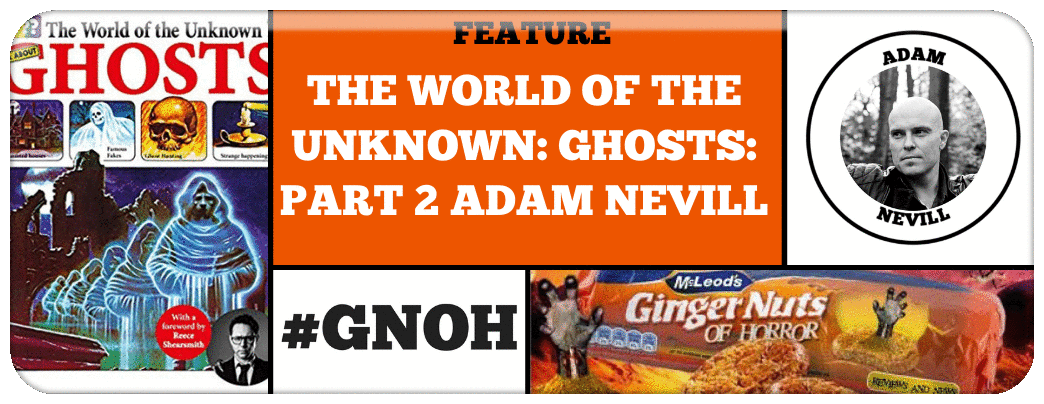 To celebrate the rerelease of Usbornes' World of the Unknown: Ghosts, Ginger Nuts of Horror has invited some of the UK's finest horror writers to tell us about their encounters with Ghosts. First published in 1977, this cult classic has been reissued for a new generation of ghost-hunters. This book is for anyone who has shivered at shadowy figures in the dark, heard strange sounds in the night, or felt the presence of a mysterious 'something' from the unknown. Ghost stories are as old as recorded history and exist all over the world. Many of the different kinds of ghosts that are thought to haunt the Earth and their behaviour are described here. You will meet haunting spirits, screaming skulls, phantom ships, demon dogs, white ladies, gallows ghosts and many more. This book also explains the techniques and equipment of ghost hunting and tells how lots of 'ghosts' have been exposed as fakes or explained away as natural events. Also included are some theories that attempt to explain the possible existence of ghosts. With a brand new foreword by BAFTA-winning writer, comedian and actor Reece Shearsmith, otherwise the book remains unchanged from the original. Today we welcome author Adam Nevill Adam L.G. Nevill was born in Birmingham, England, in 1969 and grew up in England and New Zealand. He is the author of the horror novels: ‘Banquet for the Damned’, ‘Apartment 16’, ‘The Ritual’, ‘Last Days’, ‘House of Small Shadows’, ‘No One Gets Out Alive’, ‘Lost Girl’, and ‘Under a Watchful Eye’. His first short story collection, ‘Some Will Not Sleep: Selected Horrors’, was published on Halloween, 2016, and won the British Fantasy Award for Best Collection. His second collection of short fiction, ‘Hasty for the Dark: Selected Horrors’ was published on Halloween 2017. His novels, ‘The Ritual’, ‘Last Days’ and ‘No One Gets Out Alive’ were the winners of The August Derleth Award for Best Horror Novel. ‘The Ritual’ and ‘Last Days’ were also awarded Best in Category: Horror, by R.U.S.A. Several of his novels are currently in development for film and television, and in 2016 Imaginarium adapted ‘The Ritual’ into a major motion picture. Adam also offers three free books to readers of horror: ‘Cries from the Crypt’ (downloadable from his website), ‘Before You Sleep’ and ‘Before You Wake’ (available from major online retailers). Adam lives in Devon, England. I can't claim to have seen a ghost, but I have had a few uncanny experiences. One of these occurred during a holiday with friends in a very old thatched-roofed cottage in Dorset in the early 90s; an adjacent barn had a big heated swimming pool inside it. Lovely place. And this was an old building, for sure, and one that incited some mischievous behaviour from a couple of the guys later in the week, in which they tried to manufacture something eerie. And yet, without any human intervention, the eeriness seemed to occur naturally, or supernaturally, from the first night. The recurrent traipsing of footsteps upstairs, when everyone was downstairs, none of us could explain. Temperature changes affecting the bending or straightening of floorboards or timber? It is physically possible, but the rhythmic nature of the footsteps that we heard traversing the first floor, through the ceiling, no one could explain. It happened so often that by the end of the holiday we were ignoring it, or even joking about it - the first few times it happened we all assumed one of us had gone to the loo upstairs. I remember the evening - we were playing Trivial Pursuit - when we all realised that everyone in our party was in the same room, downstairs, so who was walking upstairs? We even searched for an intruder. I am sure I would not have been able to stay there alone. In a group of 8, yes. But not alone. On the last evening we were awoken by the slamming of cupboard doors in the kitchen downstairs - everyone was in their room, two to a room - and a couple of people became so upset that had it been a joke, it wouldn't have stayed funny for long. There was no one downstairs when we were brave enough to investigate the ground floor. To me, this final commotion had felt like an intensification of the activity in the house; once the footsteps were no longer having any effect something wanted our attention and was prepared to get it the hard way. I'm glad that was our final night, because the final disturbance suggested agency from something that none of us could see. I called the owners to let them know we'd vacated, posted keys etc, at the end of the week and sheepishly asked if other holidaymakers had ever reported a disturbance in that property. Without a pause, the owner said, "Are you asking me if it's haunted?" She went on to say that she believed it was haunted. That nearly everyone who stayed there told them something similar to our experience. And someone even took a photo of the ghost looking through the window of the pool room. I heard an interesting story recently, from a baker in the old part of Paignton. She's had a bakery for nearly 30 years on the same premises and told me that the upper part of the building was once used for a small, private school, with about a dozen children attending, taught by one man - the master, or headmaster. Local elderly people remembered the school when they were children; the teacher even taught local kids until he was very elderly. Tenants who have since rented the upper part of the building, which is now a flat, occasionally glimpse an old man wearing a formal suit, sitting in a chair in one of their rooms as if he never left his place of work.  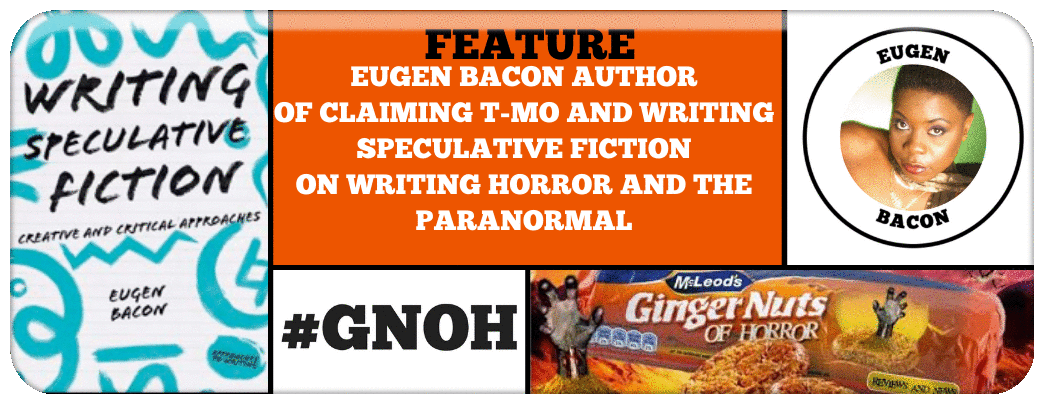 On Writing Horror and the Paranormal by Eugen Bacon, author of Claiming T-Mo and Writing Speculative Fiction Eugen Bacon loves chocolate, sake, Toni Morrison and Ray Bradbury. She has sold many stories and articles, together with anthologies. Her stories have won, been shortlisted and commended in international awards, including the Bridport Prize, L. Ron Hubbard Writers of the Future Contest and Copyright Agency Prize. Recent publications: Writing Speculative Fiction, Macmillan (2019). Claiming T-Mo, Meerkat Press (2019). In 2020: A Pining, Meerkat Press. Black Moon, IFWG. Inside the Dreaming, Newcon Press. Writing horror and the paranormal You think horror, you think Bram Stoker, Alfred Hitchcock, Ridley Scott, M. Night Shyamalan, Dean Koontz, Stephen King, Eleanor Lewis, H. P. Lovecraft, Shirley Jackson, Mark Danielewski, Mary Shelley, Robert Louis Stevenson, Anne Rice, Poppy Brite … Guy de Maupassant who wrote across many genres. In his book Danse Macabre, King paid homage to Jorge Luis Borges and Ray Bradbury in his list of ‘six great writers of the macabre’. As far as storytelling goes, horror can be an exhausted genre, and artists and producers are continually hunting ways to tap into audience curiosity by reinventing it. Horror films like Alfred Hitchcock’s Psycho (1960) and Wes Craven’s Scream (1996) typecast horror, and copycat stories emerged, exhausting fans with parodic slasher narratives, blood and gore, until zombies burst into the spotlight; the appetite for them has stayed rich. Is horror the jet black eyes of a silent entity, an atmosphere in a room that creaks, footsteps on a wooden floor, objects changing position, pictures turning to snow on the television screen, things falling when no one else is home, a shadow at the edge of your sight, a spectre on a fence by the road, staring little girls dressed in white, weeping walls, crying babies, songs behind a wall, barking dogs, horses going ape, an aura behind a headstone, a silhouette in every photograph, two sets of the same person out of nowhere, poltergeist? Clarkesworld in its online guidelines for authors says it looks for horror that ‘can be supernatural or psychological, so long as it is frightening’, but warns against ‘zombies or zombie-wannabes’, ‘stories where the climax is dependent on the spilling of intestines’. Horror.org admits that answering what is horror is a tough question—where your mind leaps to Freddy Krueger or Michael Myers, someone is looking for Shelley’s Frankenstein or Stevenson’s Dr. Jekyll and Mr. Hyde: The popularity of the modern horror film, with its endless scenes of blood and gore, has eclipsed the reality of horror fiction. When you add to that a comprehension of how horror evolved as both a marketing category and a publishing niche during the late eighties—horror’s first boom time—it’s easy to understand why answering the question of what today’s horror fiction actually is has become so difficult. Horror is personal. A spider may be horror to you. A snake. Height. Blood. Rot. A dead body. A ghost. In An Evening with Ray Bradbury, the author invited his listeners to ‘list ten things you love, and ten things you hate’ and then to write about those loves and kill those hates—also by writing about them. Do the same with your fears, he said. Bradbury shared a story on fear. He went to his doctor’s when he was 23 years old. ‘Take some aspirin and go home,’ the doctor said. Bradbury started thinking about tendons and muscles, all the things in his body he hadn’t noticed. The medulla oblongata, a crack in your head that hasn’t filled in yet. The action of the jaw itself. The knee caps. The toes. He went home feeling his bones. That afternoon he wrote the story of Mr Harris who goes to see his doctor. ‘You’re only nervous,’ the doctor says. ‘Let’s see your fingers. Too many cigarettes. Let me smell your breath. Too much whiskey. Let’s see your eyes. Not much sleep. My response? Go home to bed, stop drinking, stop smoking. Ten dollars please.’ But Harris stands there. The doctor looks up from his papers. ‘You still here? You’re a hypochondriac!’ he says. ‘But why should my bones ache?’ asks Harris. ‘You realize you caused most of the soreness,’ the doctor says. ‘Leave yourself alone. Take a dose of salts. Get out of here now!’ But, alone, Harris examines himself and, in pushing his spinal column, ‘fears and terrors answered, rushed from a million doors’; there is something there, a skeleton inside him. It starts manipulating him, determining whether he is to sit or to stand, a horrible gothic thing inside him. It is squeezing his brain, his vitals. His head aches, his chest is constricted. In an image of life and death, it becomes a competition about being true to himself or the skeleton. This is how the story ‘Skeleton’ came about. By being true to his own fears Bradbury was able to write speculative fiction stories. ‘Go back in time and collect up your fears,’ he advised. His short story ‘The thing at the top of the stairs’ was also birthed from a personal nightmare: When I was a kid, the bathroom was upstairs, single light half-way up the stairs. I had to run halfway up the stairs and turn on the light. But I always made the mistake of looking at the top of the stairs, and there was something there waiting for me. So peeing like crazy I fell back down. He recalled his fear and wrote about it. This is a great start to writing startling horror and the paranormal. *First published in Eugen Bacon’s Writing Speculative Fiction, Macmillan (2019) Writing Speculative Fiction: Creative and Critical Approaches (Approaches to Writing) by Eugen Bacon In this engaging and accessible guide, Eugen Bacon explores writing speculative fiction as a creative practice, drawing from her own work, and the work of other writers and theorists, to interrogate its various subgenres. Through analysis of writers such as Stephen King, J.R.R. Tolkien and J. K. Rowling, this book scrutinises the characteristics of speculative fiction, considers the potential of writing cross genre and covers the challenges of targeting young adults. It connects critical and cultural theories to the practice of creative writing, examining how they might apply to the process of writing speculative fiction. Both practical and critical in its evaluative gaze, it also looks at e-publishing as a promising publishing medium for speculative fiction. This is essential reading for undergraduate and postgraduate students of Creative Writing, looking to develop a critical awareness of, and practical skills for, the writing of speculative fiction. It is also a valuable resource for creators, commentators and consumers of contemporary speculative fiction. 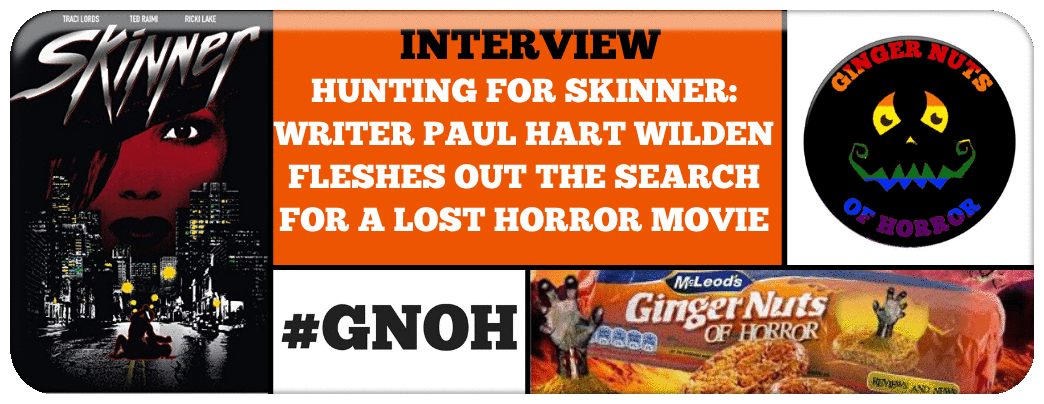 |


Archives
April 2023
|
 RSS Feed

|

|