

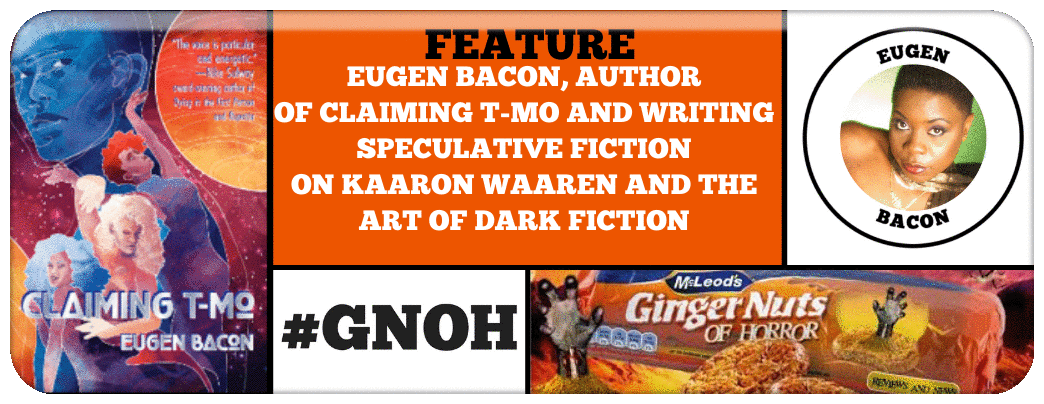
 By Eugen Bacon, author of Claiming T-Mo and Writing Speculative Fiction Eugen Bacon loves chocolate, sake, Toni Morrison and Ray Bradbury. She has sold many stories and articles, together with anthologies. Her stories have won, been shortlisted and commended in international awards, including the Bridport Prize, L. Ron Hubbard Writers of the Future Contest and Copyright Agency Prize. Recent publications: Writing Speculative Fiction, Macmillan (2019). Claiming T-Mo, Meerkat Press (2019). In 2020: A Pining, Meerkat Press. Black Moon, IFWG. Inside the Dreaming, Newcon Press. Kaaron Waaren and the art of dark fiction Multi-award-winning Australian author Kaaron Warren has mastered the art of shadow existence in her fiction, skilfully personifying conflict, the unknowable or evil in her perturbing text whose reading threatens your very sanity in the deep of all things spectral. I met Kaaron Warren at a convention in the Australian capital, where the Canberra Speculative Fiction Guild was also launching A Hand of Knaves, an anthology of rogues and ne'er-do-wells. Warren co-hosted a Frankenstein party one evening and, in my preoccupation with bold red wine paired with triple cream brie and a love-hate debate on Frankenstein’s monster, I did not notice Warren. She came to my attention a month later, back in Melbourne in my roles of reviews editor for Aurealis, and judge in speculative fiction awards. I met this subversive author’s dark writing, and something shifted. I tried to remember (but couldn’t) what Warren had read out loud in the ‘six-word horror’ writing activity at Conflux in Canberra. I was present to witness (but didn’t) this mesmeric writer in her creation of a mere six words likely already woven into some award-winner on its way to the reader. So mentally absent was I, consumed in drafting my own horror (the baby oozes out like brain-matter) and infusing it into prose poetry that I missed a moment with Kaaron Warren. So what is it about Warren? Dark fiction generally falls within the horror and paranormal genres of speculative fiction. In the short stories within Exploring Dark Short Fiction #2: A Primer to Kaaron Warren, the work embodies a distinctive otherness in its characters, where stories harbour ghosts with souls—they are curious, questioning, on a quest to expose an elemental truth. In this and Warren’s other works, she naturally applies the world building, characterization, hook/tension, plot/theme and fear/revulsion/spook essentials of convincing horror. Her art in applying these essentials is evident in the literary dark novel Tide of Stone, that went on to win the Aurealis Award for Best Horror Novel, Australian Shadows Award for Novel, and was nominated for Locus and Ditmar awards: World building: Creating imaginary worlds is essential in all forms of speculative fiction. In Tide of Stone, Warren pays attention to robust world building, the great tick-tock and each ball dropping, day by day, in a tide-licked tower looming over the town from a desolate island lit by an oil lamp. Characterization: A believable character is crucial to the credibility of speculative fiction that may not draw upon logic. In Tide of Stone, world building forges a forceful symbiosis with the characterization of saneness, madness and badness. You find prisoners like bones, nourished on candle stumps, their singular voice like the creak of a gate. They are foul in their preservation, bodies tiny like children’s. You are consumed by each Time Ball Tower keeper’s report but, despite the life in monochrome, nothing prepares you for the pigmentation of each prisoner’s villainy, each keeper’s secrets. Hook/tension: A story’s opener is part of its hook whose intent is to grab attention. Warren doesn’t fail: ‘There’s something very gentle about death.’ She builds tension in a hybrid of the unknowable and the uncanny. ‘Tick tock tock tick tick tock and the ball drops and the ball drops and the ball drops. Such beauty in the time pieces.’ What happens when the ball drops? Plot/theme: The novel explores the terrible fear of dying or not dying. In the mystery of the time ball tower that houses killers (some guilty of infanticide) who have chosen eternal life over a death penalty, there are also themes of societal law and its ethics, whether punishment always meets the crime. Warren unfolds each narration in intense yet impersonal vignettes, mostly the tower keepers’ reports, each story building on the suspense of the tower’s secrets to the climax of a final truth. Fear, revulsion or spook: Tide of Stone is a book pregnant with darkness, death and the undeath. It is gruesome in its murders, ruthless in its eternal punishments of the perpetrators—caged in a tower black with decay, the wind’s howl leaving them broken. Horror greats like Stephen King or Mary Shelley understood that obsession with the fear factor distinguishes horror and the paranormal from other genres. Warren is a masterful teller of weird and unusual tales, fascinating yet disturbing. She capitalizes on the ability to introduce revulsion, instigating in the reader a loathing so deep, inside beauty of text where tears are opaque drops in the corners of a prisoner’s eyes, it is ‘like watching a memory of crying’. I first met Warren, then discovered her writing. She makes Stephen King a lullaby. Nothing else will ever shock or mesmerise you all at once like this. Her style is of an author who settles into her writing. Her voice is steady, ramping up intensity. Her finish is her strength. I will enquire about those six words and ask if she has used them. Reading Kaaron Waaron is a great start to discern startling horror and the paranormal. *First published on the Macmillan Higher Education Blog READ PART ONE OF EUGEN BACON'S THREE PART ARTICLE SERIES HERE READ PART TWO OF EUGEN BACON'S THREE PART ARTICLE SERIES HERE Claiming T-Mo Paperback by Eugen Bacon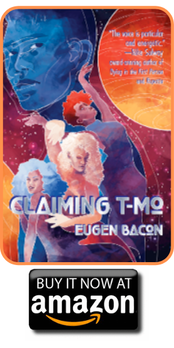 In this lush interplanetary tale, Novic is an immortal Sayneth priest who flouts the conventions of a matriarchal society by choosing a name for his child. This act initiates chaos that splits the boy in two, unleashing a Jekyll-and-Hyde child upon the universe. Named T-Mo by his mother and Odysseus by his father, the story spans the boy's lifetime ... from his early years with his mother Silhouette on planet Grovea to his travels to Earth where he meets and marries Salem, and together they bear a hybrid named Myra. The story unfolds through the eyes of these three distinctive women: Silhouette, Salem and Myra. As they confront their fears and navigate the treacherous paths to love and accept T-Mo/Odysseus and themselves, the darkness in Odysseus urges them to unbearable choices that threaten their very existence.  Comments are closed.
|


Archives
April 2023

|
 RSS Feed

|

|