

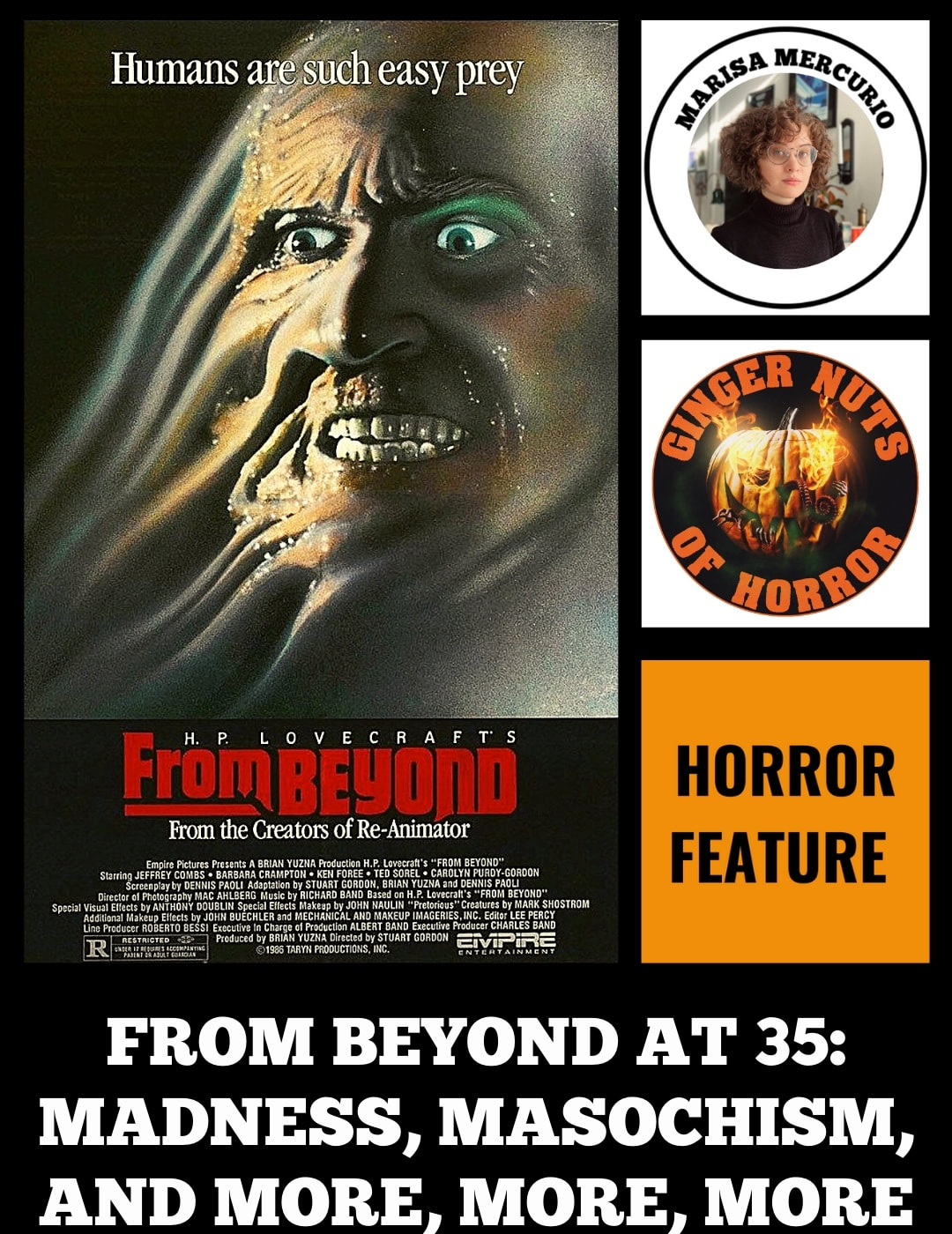
From Beyond At 35: Madness, Masochism, and More, More, More by Marisa Mercurio From Beyond is pretty in pink. It’s kinky in pink. It’s gooey and grisley in pink. Everything From Beyond does, it does it with gusto. Its star Barbara Crampton often quips that director Stuart Gordon’s films weren’t satisfied with the adage “less is more”; to Gordon, “more is not enough.” From Beyond revels in bizarre science and brain-sucking, overt sadomasochism, and, yes, the neon pink glow in which its characters are awash. Logical inconsistencies abound, but if you like this film as much as I do, they don’t really matter. Behind a veneer of macabre prettiness, it’s a daring exploration of sexuality and bodily malleability headed by one of the few female mad scientists in cinema. This October, From Beyond celebrates its 35th anniversary. While it received generally positive feedback upon its release and has since secured its place in the hearts of many cult horror fanatics, it deserves more recognition. And not just because of the leather get-ups. From Beyond is a stellar lesson in “more.” Given Gordon’s background in theatre, it’s no surprise that many of the creators involved in Re-Animator (1985) joined him in his second feature film. In addition to stars Crampton and Jeffrey Combs, producer Brian Yuzna and screenwriter Dennis Paoli were among those to return to Gordon’s troupe. Adapted from H.P. Lovecraft’s short story of the same name, From Beyond is a story of science gone wrong. While it lifts its ideas regarding perception and its relationship to the pineal gland from Lovecraft, the original story pales in comparison to the film’s delightful outrageousness. From Beyond begins with physicists Edward Pretorious (Ted Sorel) and his assistant Crawford Tillinghast’s (Jeffrey Combs) invention of the Resonator, a machine that stimulates the pineal gland to unleash a latent sixth sense. When it begins to run itself, the Resonator breaks down barriers between dimensions and reveals creatures swimming in the air. After Dr. Pretorious is seemingly killed by one such creature, Crawford is arrested and held at a psychiatric facility where Dr. Katherine McMichaels (Barbara Crampton) negotiates Crawford’s release on the basis that he demonstrates the experiment to prove his innocence. Detective Bubba Brownlee (Ken Foree) joins the pair as part of his investigation into Pretorious’s death. Soon, the Resonator seduces Katherine with its promise of knowledge and sensuality, and the three struggle against its catastrophic effects. Sexualities awaken; transdimensional insects swarm Bubba fatally; Crawford’s pineal gland pops out of his forehead, inducing him to eat brains. From Beyond moves with rapidity from one turn to the next, but it concludes fairly simply: Now determined to destroy the Resonator, Katherine attaches a bomb to it and only just escapes through a window as Crawford and Pretorious conjoin in viscous flesh and clash to the point of disintegration. The bomb detonates. A crowd circles Katherine, whose knee cap has burst through her leg. From Beyond’s last shots settle tightly on Katherine. As the house goes up in flames, her sobs turn into a delirious cackle. Though From Beyond borrows the general premise of Lovecraft’s story, it diverges significantly. There’s nothing of the sadomasochism in the original story, and Crawford changes from a Dr. Frankenstein to something like a post-doc Igor in Combs’s portrayal. Most notably, like Pretorious, Katherine McMichaels—the film’s protagonist—is a cinematic invention. Mad scientist stories have been around for a long time. In their familiar modern format, over two-hundred years. Yet, though explorations of gender and sexuality are innate to the subgenre, very few stories—in film or literature—feature female mad scientists. Enter Dr. Katherine McMichaels. Mad science is familiar territory for Gordon. Coming on the heels of Re-Animator’s success, which remains the director’s most beloved film, From Beyond is weirder, pulpier, and sexier than Gordon’s first. Part of the film’s gumption is its portrayal of a young woman with a doctorate who embodies, first, rational science and, later, the excessive sensuality it can uncover. It’s through her that From Beyond exercises its lesson in “more.” And perhaps, in a subgenre devoid of female mad scientists, there is something innately “more” about the fact that Katherine exists at all. Although Combs has top billing, it is Crampton’s portrayal of the mad scientist that garners this film a unique position in horror history. Derisively alluded to as a “girl wonder,” Katherine’s ethics as a psychiatrist are immediately questioned by her peers. It turns out to be a fair criticism: Even after the disastrous attempts at reperforming the experiment, Katherine demands they continue the work. “I have to see more,” she begs when Crawford threatens to turn off the Resonator, “Feel more.” Katherine’s desire for “more”—whether that is scientific knowledge or the sensual experience of the pineal gland’s stimulation—is driven by the mad scientist’s central trait: curiosity, the insatiable “What if?” For Katherine who feels “exhilarated” after their first experiment, even the threat of death is nothing in the face of discovery. The parallels between her and Pretorious, From Beyond’s antagonist, are abundant. His insistence in the first sequence that he wants to see “more than any man has ever seen” allows Crawford to later draw the comparison between him and Katherine. And after Crawford is nearly devoured by a giant worm, Bubba entreats Katherine to leave the house but she only acknowledges that she ought not have run the experiment with others around. “It’s clear now that only one person should run the experiment,” she concludes, “But I must do it myself.” Though Katherine destroys the Resonator at the end of the film and seemingly atones for her mistakes, the final shot of the movie, masterfully played by Crampton, reasserts her “madness.”  Fitting Katherine into the mold of a typically male archetype establishes the film’s exploration of gender roles and sexuality. In the documentary In Search of Darkness: A Journey Into Iconic 80s Horror, Gordon explains: “In From Beyond, Barbara plays the mad scientist essentially. And Jeffrey Combs is the victim. In a way, From Beyond reversed the roles that they played in Re-Animator.” Whereas Katherine drives the action, Crawford is indeed the victim. In the Blu-ray commentary track, Combs notes that he did a lot of “laying around in this movie, just kinda unconscious and helpless.” Yuzna concurs: “You’re not used to having that kind of sensitive or…” “Passivity,” Combs fills in, “no.” This switch highlights horror’s tendency, particularly in the 1980s, to portray action that happens to women. Cases of victimized men, as in The Evil Dead (1981) and A Nightmare on Elm Street 2: Freddy’s Revenge (1985), are exceptions that prove the rule. While there is power in the portrayal of female survival, it’s also a double-edged sword. At its worst, the significant lack of male characters’ passivity in this period of filmmaking enforces a binaristic presentation of gender. In her consistent resistance to the medical and scientific establishment’s norms, Katherine disrupts convention. Of course, From Beyond isn’t a simple case of gender role reversal. A queer sensibility peravdes the film. It’s certainly an early purveyor of bisexual lighting. As if the archetypal reversal wasn’t enough, the blatant portrayal of BDSM and Crawford’s subtextually queer relationship with Pretorious cement From Beyond’s investment in sexuality and the malleability of bodies. As Combs puts it, “[T]he whole movie is about stimulating people’s sexuality.” Its exploration of pain, pleasure, and comprehensive sensuality through the pineal gland as a channel for a sixth sense suggests that repression is an all too familiar experience; only when we open ourselves to new—more—modes of perception can we actualize ourselves. But, the film warns, we can lose ourselves too. Under the influence of the Resonator, Katherine’s sexuality emerges from her (literally) buttoned-up personality. It likewise corresponds with her unethical methods; her illicit visit to the Resonator prompts her awakening. Crampton comments in In Search of Darkness, “I was able to do a lot in that characterization in the space of one movie. Because of the Resonator, I was able to get in touch with my deep urgings and repressed feelings.” In perhaps the most cited scene, Katherine dons Pretorious’s fetish leather. Having just turned on the Resonator and been assaulted by Pretorious, Katherine is at once distrubed by the experiment (Crampton’s acting grounds the moment splendidly) and is seduced by it. In its aftermath, she straddles Crawford as he lay insensate on a bed. Only when confronted by Bubba does she relent. The film’s ultimate power resides in characters’ abilities to wield their sexualities, or others’. Towards the end of the film, Katherine is momentarily imprisoned by Crawford. She bites off his extended pineal gland (which Jeffrey Combs routinely jokes is just a “dog dick”) and frees herself and Crawford—who is metaphorically castrated—from its influence. Bubba’s insight is apt: “It's changing us, doc. All of us. And not for the better.” In each case, sexual awakenings are paired with assault. In the world of From Beyond, sexuality can mean either the loss of identity through uncontrollable urges or, as for Pretorious, liberation. Pretorious’s antagonism is defined by his excessive sexuality: he is a (poor) practitioner of BDSM; he consistently attempts to pull Katherine into the beyond by “kissing” (i.e., killing) her; and his relationship with Crawford teems with subtext. Like mad science, queerness isn’t an unusual topic for the film’s creators; in addition to Re-Animator’s queer themes, Yuzna’s Society (1989) is undeniably homoerotic. The choice to place Pretorious and Crawford in the same house with a lab—rather than at Miskatonic University or another professional space—frames the pair as strangely domestic. An abusive undercurrent, however, defines the physicists’ relationship. In a moment that hints at something more than mentor-mentee professionalism, Crawford tells Bubba that Pretorious “used to bring beautiful women here. They’d eat fine meals, drink fine wine, listen to music. But it always ended in screaming. And I would just lie there and listen to them. Screaming.” When Bubba responds, “Your boss had some screws loose,” Crawford replies defensively: “He was a genius. It’s just that the five senses weren’t enough for him. He wanted more.” Effectively drawing a comparison between transgressive sexuality and mad science, this moment frames From Beyond’s dominant themes. The search for knowledge becomes an act of sensuality in itself. Other moments between Crawford and Pretorious are notably sexual: upon his return “from beyond” as a transformed being, a naked Pretorious welcomes Crawford home and invites Crawford to touch him “if it pleases him”; he voyeuristically tells Crawford and Katherine “Don’t stop” when they break their kiss; Crawford calls his mentor by the personable “Edward”; and Crawford, at the film’s climax, retorts with surprising familiarity that Pretorious “never knew pleasure, or gave it, only pain.” Crawford’s mixed-bag of emotions for Pretorious make his death by fleshy incorporation even more disturbing; he resists him and ultimately aids Katherine’s escape but only after his body collapses with Pretorious. Bodily malleability is also central to From Beyond’s expression of “more.” Under the Resonator’s vibrations, transdimensional creatures appear. Modeled after tapeworms, eels, jellyfish, and insects, these creatures attack: if you can see them, they can see you. Pretorious’s “death” at the hands of these creatures, he explains, was only that of his former self. In his new state, he becomes an inarticulate mass of flesh. He changes at will, possesses “total bodily control on a molecular level,” and shares an identity with the creature that ate him in the opening sequence. When passed beyond, bodies obtain a Play-Doh-like malleability. Though Pretorious maintains the “mind is indivisible,” he also contends, “Bodies change.” At the climax, Crawford is rebirthed from a mass of gooey flesh and then is sucked back inside. It’s Pretorious’s body but no longer distinguishable from Crawford’s—their heads face one another, connected by elastic slimy tissue. To Pretorious, these changes are a mark of scientific achievement. Horrified by his mentor’s return, Crawford asks, “Edward, my God, what have you become?” Pretorious declares, “Myself.” From Beyond contemplates liberation through anatomic instability: with science, the body can become what the mind imagines. If, perhaps, a trans reading of From Beyond can be proffered (and I think it easily can), it lies in the fact that the Resonator is a device that, in essence, crosses boundaries. In human subjects, this boundary-crossing manifests as sexual stimulation and bodily transcendence. It induces transitions, awakenings. The Resonsator ramps up the sex drive, yes, but it is also a vehicle for fluidity—sexually, bodily, dimensionally. From Beyond, like many horror films, ultimately disposes of its worst transgressors. It warns us against excess. Yet, it remains provocative in its potential. And, like Re-Animator, it stops short of reinstating the status quo. Horror’s complexity resides in its desire to rid the world of the sins in which it luxuriates. Despite the villianization of BDSM and the association of queerness with violence, these moments of possibility offer much more than its conclusion limits. Rather than sweep gender and sexuality under the rug, From Beyond is willing to broach them and to do it with style. Anyway, I’d rather watch Jeffrey Combs slip and slide with a giant worm than an innocuous romcom where everything ends peachy keen. As audiences, we don’t watch for the moral message. We’re here for the sex and the slime. So is From Beyond. From Beyond’s charm is a little bit Jeffrey Combs looking at the camera dead-on, enunciating, “It ate him. Bit off his head. Like a gingerbread man,” a little bit Ken Foree running around in skimpy underpants and a gun, and a lot of Barbara Crampton’s versatility as one of cinema’s foremost female mad scientists. The stunning practical effects by John Carl Buechler are also substantive, as is the film’s tonal earnestness. It’s not without plot holes and, sure, there’s phallic imagery everywhere you look and forays into electroshock therapy, but it takes itself seriously. It wants us to do the same. What other ’80s horror flick is going to invoke Kant to ensure you know the science behind the pineal gland isn’t made-up movie logic? From Beyond balances a lot at once and it never settles for less. It can chew brain and walk at the same time. Most of all, though, it’s an ode to the late director’s sensibility for whom more was never enough. Thirty-five years later, From Beyond still thrills the persistently curious. It’s a film for the never-satisfied, those of us who want more, more, more. Under Gordon’s unique direction, mad science isn’t the deviance of a singular person but rather the wild, untapped potential that lies in us all—if only we let it. When Dr. Katherine McMichaels says, “There’s always more to see,” we’re with her. Flip the switch. Let the pink light pour in. I wanna see more. Marisa Mercurio Bio: Marisa Mercurio is a Michigan-based writer and scholar. As a PhD candidate writing on female detective fiction, queerness, and the Gothic, Marisa’s writing has recently appeared in Ghouls Magazine and for the Queer Moon Rising series on werewolf media at Ancillary Review of Books. Marisa is also the co-creator and co-host of the However Improbable podcast, a Sherlock Holmes book club that narrates and discusses the great detective. You can find Marisa on Twitter @marmercurio. Links: https://www.ghoulsmagazine.com/articles?author=606729b81c473310b544fa83 https://ancillaryreviewofbooks.org/category/series/queer-moon-rising-the-werewolf-reread/ https://www.howeverimprobablepodcast.com/ TODAY ON THE GINGER NUTS OF HORROR WEBSITE CALEB WATCHES MOVIES: BAD CANDY the heart and soul of horror feature ARTICLESComments are closed.
|


Archives
April 2023

|
 RSS Feed

|

|