

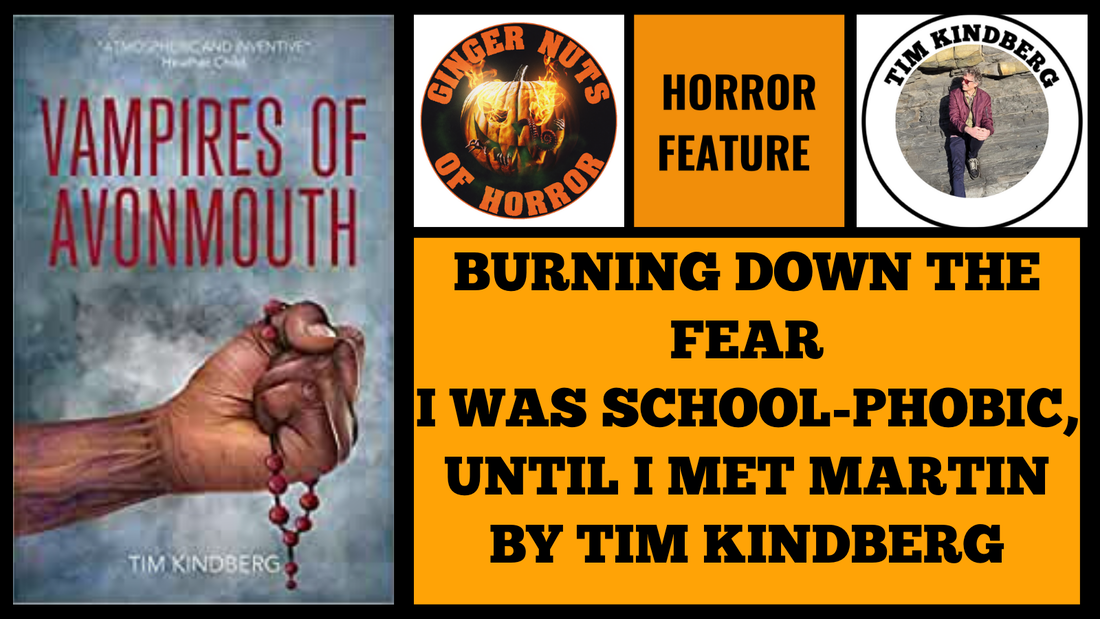
 One particularly distressing morning, aged about seven, I ran screaming and crying around our flat, on the middle floor of a large gothic red-brick in Nottingham. I held a kitchen knife pointed at my stomach, and told my mum that I would plunge it in if she made me go to school. I meant it. Throughout my primary school years I suffered from school phobia: a deep, irrational fear. No one bullied me. The teachers weren’t mean to me. I couldn’t explain what terrified me so – any more than an arachnophobe can account for their fear of a harmless creature. Much later, as an adult, I read an article which explained the syndrome in terms of family dynamics. My grandmother, a wealthy woman who lived in what we were sure was a haunted house and who called me “Jimmy” because she couldn’t be bothered with my actual name, kept my mum at her beck and call. She punished her for having five children by absent men, only the first of whom was a somewhat known quantity back then. Nils Kindberg was father to us all, my mum insisted, but he was unavoidably detained abroad. He was indeed my eldest sister’s father and married my mum but, I later discovered, the Soviets killed him in action in 1940 during the Winter War. And so in turn under the operation of her unconscious, according to the article, Mum kept me at her beck and call. It was for her sake that I stayed in the flat and didn’t go to school. She loved us but, an emotionally damaged woman with no friends, no work and barely enough to live on from her mother, couldn’t cope. She hid from the men knocking at the door and demanding payment of arrears. We lived in a degree of disorder which I never let outsiders see. Multiplying cats roamed the flat, often not house-trained. We were lacking curtains and lampshades. We mostly ate from cans or frozen food which we heated up ourselves. I still have school reports which record 20 or 30 days of absence per term. I didn't have the courage to go in on Mondays but, later in the week, a point was generally reached when the combination of mortification and loneliness equalled my dread, and I went through the gates with my tail between my legs. Usually nothing bad happened; I even had some friends who, however much they gave me stick for my lame excuses, accepted me. Primary school ended. My mum haplessly sent me to a public school for boys, whose rugby players with black eyes, gowned masters and formal Latin terrified me. I lasted a term. Then there was a Steiner school, where I mostly remember standing in the playground, frozen in loneliness and fear – despite all the gardening and eurythmy. Mrs Till, the headmistress of my primary school, agreed to take me back. I was placed in a room beside her office, for the third term of what should have been my first year of secondary education. No one knew what to do about me. Despite giving Mum insufficient money to pay the milkman, my grandmother was willing to pay for private school for us – perhaps so that we wouldn’t grow up to embarrass her even more. But what school could such a child possibly go to? One day my mum and I were in our garden when we saw a boy about my age with his parents, looking at new houses next door. The adults struck up a conversation. Their son, Martin, was evidently in need of a friend. It was arranged for us to meet. Martin was a boy who farted out loud in any circumstances, and who set light to anything he could find – although he failed in the case of his farts, despite repeated attempts. He had not fully developed mentally to match his age and showed little sign of catching up. Whereas I, my mum's stay-at-home companion, was grave and old beyond my time. We got on like a house on fire. With Martin I was suddenly free to enjoy a return to a largely missed childhood. We burnt stuff up without a care, making bonfires and raiding building sites for bitumen and other incendiary materials. We never harmed anyone; we simply had fun with flames, which seemed to burn away my sadness and fear. Martin went to a nearby school, Nottingham Coaching College, which occupied a small wedge of a building near the gates of Nottingham Castle. I was keen to join him so Mum sent me there as well. It was a school for local misfits and for foreign students learning English, run by the Sainsburys. Mrs Sainsbury seemed to do all the work; Mr Sainsbury occasionally appeared from his office with a lapdog nestling in his arms. I loved it there, still desperately shy but never once afraid to go. Sadly, Martin’s parents moved him to a secondary modern school about a year later, and we lost touch. But I stayed. It was time for me to take flight, under the nurture of inspiring Science and English teachers. The Sainsburys loved me back, because I proved to be a relatively able student. Keen on reporting exam results, they entered me for an ‘O’-level (the precursor to GCSEs) in English at the age of thirteen, which I passed with grade 3. Then a 1 in Maths at age fourteen, and so on, one or two ‘O’-levels at a time. For the sixth-form I asked Mum to take me to the entrance exam for the stiffly academic Nottingham High School, which I passed. I was daunted but no longer cowed. I had to fight my way up the sets but I gained ‘A’ grades in Maths, Physics and Further Maths, and I took the Cambridge University entrance exam. On the 17th of December, 1976, I received a telegram which I still have as a mark of reclaiming my education: “Congratulations. Awarded Exhibition. Senior Tutor St John’s”. I had been given a minor scholarship, and went on to obtain a Maths degree. I've been plagued by anxiety and depression for much of my life. The flat still wants me back. Many Mondays I have to overcome a dread of the outside world. But in truth, I made it. I've even taught in schools and universities. As well as following a career in digital R&D I'm a writer, mostly of stories about lonely misfits who struggle but make a connection in the end. Thanks Martin, wherever you are. Without you and your escapades, setting light to whatever you could find and leading me to somewhere I belonged, I might still be looking out through a curtainless window. Tim Kindberg writes gothic sci-fi. His latest novel is Vampires of Avonmouth, Nsoroma Press. His other writing is here. Vampires of Avonmouth |
 |  |
the heart and soul of horror promotion

A horrific, twisted tale of good v evil, man v monster and a gore fest battle for holy relics that could unleash hell upon mankind.
And so it begins...
“The wrath of hell is upon us....”
An enthralling supernatural, horror adventure, full of mystery that brings a fresh and exciting approach to the British comic book and graphic novel market, London Gothic® twists and turns like the ancient repellent Victorian sewer systems that lurk beneath the old city of London.
Chapter one marks the debut of an exciting new voice in the British comic book market and is the first of a four-chapter set of graphic novels, each as gripping as the last, which build to an epic battle for the existence of mankind.
A gruesome, horrific tale of light vs dark, man vs monster and a battle against pure psychopathic evil with striking images and an original, gripping storyline that will make you believe that all in this world is not what it seems.
The secret order of the Tuttori have protected the holy relics from the crucifixion of Christ for nearly 2,000 years and shielded humanity from the atrocities of the brotherhood of Sinistre; holy relics that in wicked hands would possess enough destructive power to create a hell on Earth. However, now the Sinistre have a new more calculating, narcissistic commander, Lord Finnius Cromwell, who is resurrecting an army of the most heinous, vile, immoral demons from legend and myth who will stop at nothing to find these miraculous artefacts.
The last known surviving member of the Tuttori, The Duke, and his accomplice, Jellico, an Irish ex bare knuckle fighter, must seek and destroy the Sinistre to prevent a world of fire and brimstone and the ultimate destruction of mankind. However, they face a breed of demonic entities the likes of which they have never encountered.
The ongoing battle and interweaving stories will captivate the reader as they proceed along a terrifying journey into disturbing darkness and psychological torment.
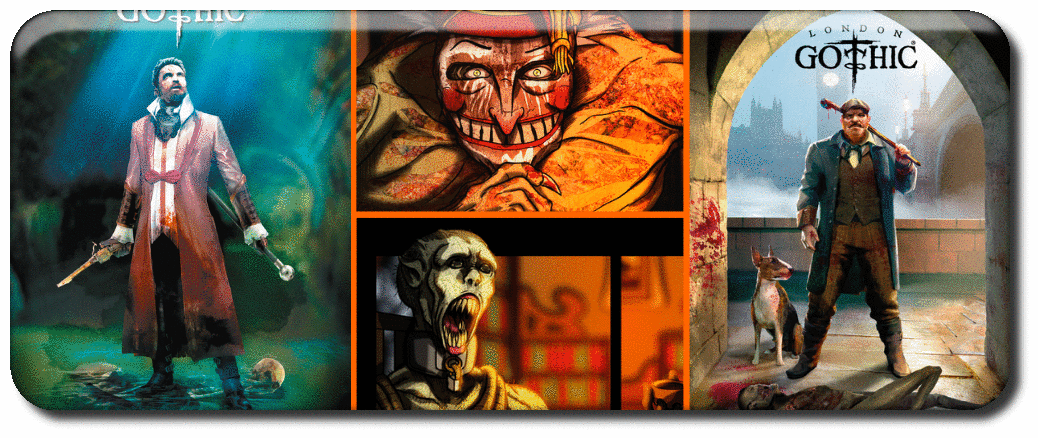
With amazing illustrations and atmospheric colouring by the fabulously talented Mike Burton and the eerie, unpredictable, dark humoured story written by Nick Henry, this will satisfy the hardiest of horror lovers, action thriller fans and comic enthusiasts alike.
Be very careful, once you begin the journey into London Gothic®, you may be lost within its world forever!
Click here to view London Gothic® The Graphic Novel chapter one, along with unique rewards on Kickstarter now.
For more information please visit www.London-Gothic.co.uk For press enquiries please contact info@london-gothic.co.uk
TODAY ON THE GINGER NUTS OF HORROR WEBSITE
 |  |
the heart and soul of horror promotion
10 Tips on How to Title Your Horror Story
by
Deborah Sheldon
by
Deborah Sheldon
My latest collection, Liminal Spaces: Horror Stories, comprises 24 works including novelettes, short stories and flash fiction. Naturally, each work required a title. Coming up with a title that suits your story can be daunting. However, since I’ve faced this dilemma over and over again throughout the years, I have techniques that make the process easier.
One thing to remember before we begin: your story’s chances of publication do not depend on its title! I’ve edited the award-winning Midnight Echo 14 magazine and my own anthology Spawn: Weird Horror Tales About Pregnancy, Birth and Babies, and I can assure you that a title didn’t influence my decision on whether to shortlist a story. Not convinced? Neil Clarke of the renowned Clarkesworld magazine states, “I don’t even pay attention to the title until I’ve decided to purchase a story.” (You can read his post on titles here: http://neil-clarke.com/the-truth-about-short-story-titles/) Believe me now? Try to relax, and think of the title as your chance to have a bit of fun.
And the following tips might help.
Don’t feel constrained by genre
Just because your story falls under the horror umbrella doesn’t mean you must have a horrifying title. If I’ve written a body-horror story, I’ll often choose a bland or innocuous title for contrast. “The Sand” includes gruesome deaths and dismemberment, but you’d never know from the title. Let go of the false belief that grisly stories need grisly titles. This will allow you to explore many different kinds of inspiration.
Think about your title’s purpose
To catch attention? Shock? Misdirect? Set the mood? Spending a few minutes mulling over your title’s purpose is a useful first step. What would you like your title to achieve? For example, drabbles are micro-stories of exactly 100 words. Since the title isn’t included in the word count, it provides an opportunity to enhance the reader’s understanding of the story. My title “Mourning Coffee” is a play on words that serves three functions: to indicate the time of day, touch upon the plot of death, and suggest an atmosphere.
Pull a line from the text
By far, this is the fastest and easiest way to find an apt title. Simply scan the text and look for a word or phrase that jumps out. For my story about monstrous tumours, the title “Hair and Teeth” captures the plot, mood and genre in one swoop, and comes from a line of dialogue.
Spotlight the inciting incident
What event kicked off your story’s plot? Isolating this key event will help you brainstorm titles. In my flash fiction piece “Cast Down”, a galley ship is rammed by an enemy craft and sinks. The inciting incident – that of getting ‘cast down’ into the sea – is the inspiration for the title, which also reflects the narrator’s state of mind.
Use who, what and where
Look at your story through the eyes of a newspaper journalist. Some examples from Liminal Spaces in which I used this technique include: WHO in “Molly, Dearest Molly”; WHAT in “The Stairwell”; and WHERE in “A Small Village in Crete”. Concrete titles are memorable and effective.
Focus on your story’s theme
My novelette Hand to Mouth is about a prosthetic arm, domestic violence, fear of poverty, and lies. The title quite literally addresses all four themes at once: a hand that is robotic, a slap across the mouth, the threat of living ‘hand to mouth’, and the habit of subconsciously touching the lips while being deceitful. Consider what your story is about from a thematic point of view.
Wax poetic
Look to adages. My title “For Weirdless Days and Weary Nights” is from a Scottish rhyme about fairies, back when these creatures were considered malevolent. “The Sea Will Have” is from a 19th-century superstition common to sailors – what the sea wants, the sea will have – which meant that death by drowning was decided by fate. However, do an internet search first to avoid played-out phrases. Shakespeare texts, for example, have been thoroughly pillaged and you might find your chosen snippet has been used too often for your liking.
Be mysterious
Choose a title that makes sense only within the story’s context. Think of this as an ‘Easter Egg’ that offers an unexpected reveal to the reader who pays enough attention. My novelette Barralang, pop. 63 is clearly about a small town, yes, but the significance of the title only makes sense upon reading. (And now I’ve spoiled my own Easter Egg… How else to explain this technique?)
Apply alliteration
See what I did there? (Ooh, bad joke.) Using words that start with the same letter can offer a catchy title with a rhythm. The title of my sci-fi story “Carbon Copy Consumables” stands out because of the triple hard-C repetition. I also used alliteration for the title of this article. One caveat: don’t push alliteration too far or it will come off as annoying or sarcastic – unless, of course, you want your title to suggest an annoying and sarcastic story.
When the title comes first
I would be remiss if I didn’t mention how sometimes the title occurs, in a flash of inspiration, before the story. While rambling around the web, I discovered the ophthalmological condition ‘asteroid hyalosis’ and was struck by how much an affected eye resembles the night sky. The title came to me instantly – “All the Stars in Her Eyes” – but it took some pondering to find the story. My advice if a title occurs to you? Make a note of the title and wait. In time, the story idea will rise from your subconscious and demand to be written.
One thing to remember before we begin: your story’s chances of publication do not depend on its title! I’ve edited the award-winning Midnight Echo 14 magazine and my own anthology Spawn: Weird Horror Tales About Pregnancy, Birth and Babies, and I can assure you that a title didn’t influence my decision on whether to shortlist a story. Not convinced? Neil Clarke of the renowned Clarkesworld magazine states, “I don’t even pay attention to the title until I’ve decided to purchase a story.” (You can read his post on titles here: http://neil-clarke.com/the-truth-about-short-story-titles/) Believe me now? Try to relax, and think of the title as your chance to have a bit of fun.
And the following tips might help.
Don’t feel constrained by genre
Just because your story falls under the horror umbrella doesn’t mean you must have a horrifying title. If I’ve written a body-horror story, I’ll often choose a bland or innocuous title for contrast. “The Sand” includes gruesome deaths and dismemberment, but you’d never know from the title. Let go of the false belief that grisly stories need grisly titles. This will allow you to explore many different kinds of inspiration.
Think about your title’s purpose
To catch attention? Shock? Misdirect? Set the mood? Spending a few minutes mulling over your title’s purpose is a useful first step. What would you like your title to achieve? For example, drabbles are micro-stories of exactly 100 words. Since the title isn’t included in the word count, it provides an opportunity to enhance the reader’s understanding of the story. My title “Mourning Coffee” is a play on words that serves three functions: to indicate the time of day, touch upon the plot of death, and suggest an atmosphere.
Pull a line from the text
By far, this is the fastest and easiest way to find an apt title. Simply scan the text and look for a word or phrase that jumps out. For my story about monstrous tumours, the title “Hair and Teeth” captures the plot, mood and genre in one swoop, and comes from a line of dialogue.
Spotlight the inciting incident
What event kicked off your story’s plot? Isolating this key event will help you brainstorm titles. In my flash fiction piece “Cast Down”, a galley ship is rammed by an enemy craft and sinks. The inciting incident – that of getting ‘cast down’ into the sea – is the inspiration for the title, which also reflects the narrator’s state of mind.
Use who, what and where
Look at your story through the eyes of a newspaper journalist. Some examples from Liminal Spaces in which I used this technique include: WHO in “Molly, Dearest Molly”; WHAT in “The Stairwell”; and WHERE in “A Small Village in Crete”. Concrete titles are memorable and effective.
Focus on your story’s theme
My novelette Hand to Mouth is about a prosthetic arm, domestic violence, fear of poverty, and lies. The title quite literally addresses all four themes at once: a hand that is robotic, a slap across the mouth, the threat of living ‘hand to mouth’, and the habit of subconsciously touching the lips while being deceitful. Consider what your story is about from a thematic point of view.
Wax poetic
Look to adages. My title “For Weirdless Days and Weary Nights” is from a Scottish rhyme about fairies, back when these creatures were considered malevolent. “The Sea Will Have” is from a 19th-century superstition common to sailors – what the sea wants, the sea will have – which meant that death by drowning was decided by fate. However, do an internet search first to avoid played-out phrases. Shakespeare texts, for example, have been thoroughly pillaged and you might find your chosen snippet has been used too often for your liking.
Be mysterious
Choose a title that makes sense only within the story’s context. Think of this as an ‘Easter Egg’ that offers an unexpected reveal to the reader who pays enough attention. My novelette Barralang, pop. 63 is clearly about a small town, yes, but the significance of the title only makes sense upon reading. (And now I’ve spoiled my own Easter Egg… How else to explain this technique?)
Apply alliteration
See what I did there? (Ooh, bad joke.) Using words that start with the same letter can offer a catchy title with a rhythm. The title of my sci-fi story “Carbon Copy Consumables” stands out because of the triple hard-C repetition. I also used alliteration for the title of this article. One caveat: don’t push alliteration too far or it will come off as annoying or sarcastic – unless, of course, you want your title to suggest an annoying and sarcastic story.
When the title comes first
I would be remiss if I didn’t mention how sometimes the title occurs, in a flash of inspiration, before the story. While rambling around the web, I discovered the ophthalmological condition ‘asteroid hyalosis’ and was struck by how much an affected eye resembles the night sky. The title came to me instantly – “All the Stars in Her Eyes” – but it took some pondering to find the story. My advice if a title occurs to you? Make a note of the title and wait. In time, the story idea will rise from your subconscious and demand to be written.

AUTHOR BIO
Deborah Sheldon is an award-winning author from Melbourne, Australia. She writes short stories, novellas and novels across the darker spectrum of horror, crime and noir. Her award-nominated titles include the novels Body Farm Z, Contrition and Devil Dragon; the novella Thylacines; and the collection Figments and Fragments: Dark Stories.
Her collection Perfect Little Stitches and Other Stories won the Australian Shadows ‘Best Collected Work’ Award, was shortlisted for an Aurealis Award and longlisted for a Bram Stoker. Deb’s short fiction has appeared in many well-respected magazines such as Aurealis, Midnight Echo, Andromeda Spaceways, and Dimension6. Her fiction has also been shortlisted for numerous Australian Shadows Awards and Aurealis Awards, and included in various ‘best of’ anthologies such as Year's Best Hardcore Horror.
As editor of the 2019 edition of Midnight Echo, Deb won the Australian Shadows ‘Best Edited Work’ Award. Her anthology Spawn: Weird Horror Tales About Pregnancy, Birth and Babies was a flagship 2021 title for IFWG Publishing Australia.
Deb’s other credits include TV scripts such as NEIGHBOURS, feature articles for Australian, US and UK magazines, non-fiction books (Reed Books, Random House), stage plays, and award-winning medical writing.
Visit her at
http://deborahsheldon.wordpress.com
Deborah Sheldon is an award-winning author from Melbourne, Australia. She writes short stories, novellas and novels across the darker spectrum of horror, crime and noir. Her award-nominated titles include the novels Body Farm Z, Contrition and Devil Dragon; the novella Thylacines; and the collection Figments and Fragments: Dark Stories.
Her collection Perfect Little Stitches and Other Stories won the Australian Shadows ‘Best Collected Work’ Award, was shortlisted for an Aurealis Award and longlisted for a Bram Stoker. Deb’s short fiction has appeared in many well-respected magazines such as Aurealis, Midnight Echo, Andromeda Spaceways, and Dimension6. Her fiction has also been shortlisted for numerous Australian Shadows Awards and Aurealis Awards, and included in various ‘best of’ anthologies such as Year's Best Hardcore Horror.
As editor of the 2019 edition of Midnight Echo, Deb won the Australian Shadows ‘Best Edited Work’ Award. Her anthology Spawn: Weird Horror Tales About Pregnancy, Birth and Babies was a flagship 2021 title for IFWG Publishing Australia.
Deb’s other credits include TV scripts such as NEIGHBOURS, feature articles for Australian, US and UK magazines, non-fiction books (Reed Books, Random House), stage plays, and award-winning medical writing.
Visit her at
http://deborahsheldon.wordpress.com

LIMINAL SPACES: HORROR STORIES
“Sheldon has an uncanny gift for unnerving imagery and story.” – Aurealis Magazine
Transitions occur in a liminal space. The familiar is gone. The unknown lies ahead and with it, terrible possibilities. Award-winning author Deborah Sheldon explores liminal spaces in this collection of dark, unsettling fiction. Her characters teeter on frightening thresholds with no way back.
Liminal Spaces includes Sheldon’s award-nominated tales “For Weirdless Days and Weary Nights”, “All the Stars in Her Eyes” and Barralang, Pop. 63, plus original and unpublished fiction.
Release date: 1 March 2022 in most regions; 1 June 2022 in North America.
LIMINAL SPACES: HORROR STORIES – AMAZON UK (EBOOK)
https://www.amazon.co.uk/Liminal-Spaces-Stories-Deborah-Sheldon-ebook/dp/B09SXKWM8Z
LIMINAL SPACES: HORROR STORIES – BOOK DEPOSITORY (PAPERBACK)
https://www.bookdepository.com/Liminal-Spaces-Horror-Stories-Deborah-Sheldon/9781925956993
Amazon author page: https://www.amazon.com/~/e/B0035MWQ98
“Sheldon has an uncanny gift for unnerving imagery and story.” – Aurealis Magazine
Transitions occur in a liminal space. The familiar is gone. The unknown lies ahead and with it, terrible possibilities. Award-winning author Deborah Sheldon explores liminal spaces in this collection of dark, unsettling fiction. Her characters teeter on frightening thresholds with no way back.
Liminal Spaces includes Sheldon’s award-nominated tales “For Weirdless Days and Weary Nights”, “All the Stars in Her Eyes” and Barralang, Pop. 63, plus original and unpublished fiction.
Release date: 1 March 2022 in most regions; 1 June 2022 in North America.
LIMINAL SPACES: HORROR STORIES – AMAZON UK (EBOOK)
https://www.amazon.co.uk/Liminal-Spaces-Stories-Deborah-Sheldon-ebook/dp/B09SXKWM8Z
LIMINAL SPACES: HORROR STORIES – BOOK DEPOSITORY (PAPERBACK)
https://www.bookdepository.com/Liminal-Spaces-Horror-Stories-Deborah-Sheldon/9781925956993
Amazon author page: https://www.amazon.com/~/e/B0035MWQ98
TODAY ON THE GINGER NUTS OF HORROR WEBSITE
 | |
the heart and soul of horror features

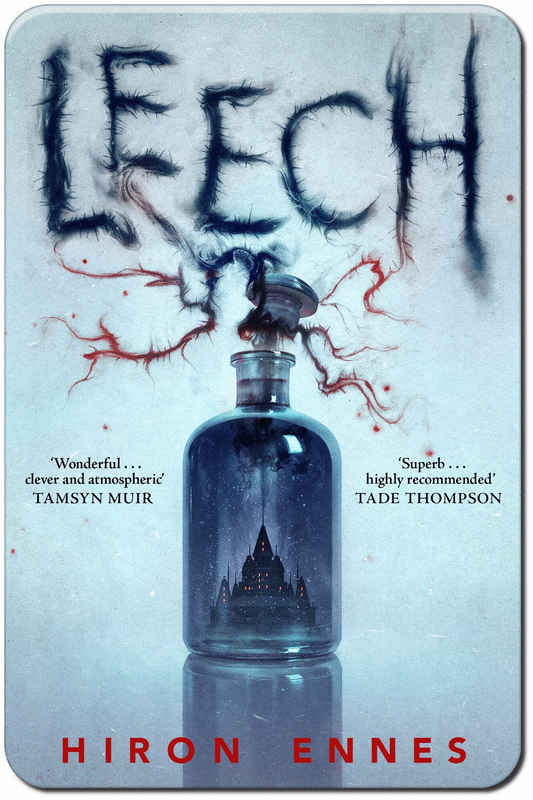
We are honoured to bring you the exclusive cover reveal and an exclusive interview with Hiron Ennes for their new novel Leech, coming your way in September from Tor UK.
Scroll down for a look at the gorgeous cover and a fascinating interview with Hiron.
Scroll down for a look at the gorgeous cover and a fascinating interview with Hiron.
'A wonderful new entry to Gothic science fiction, impeccably clever and atmospheric’
- Tamsyn Muir
'Leech isn’t like anything I’ve read before. Superb writing, interesting and fresh ideas, skilful execution. Highly
recommended. I’ll be reading anything Hiron Ennes writes from now on'
- Tade Thompson
'What a unique book! Surprising turns and staggering ideas – all woven together by beautiful writing. This is one to remember' - Tim Lebbon
'I didn’t know a book could perfectly convey the concept of a distributed intelligence, alive and aware of each of its proxies, but Leech is proof anything is possible in good hands'
- Cassandra Khaw
- Tamsyn Muir
'Leech isn’t like anything I’ve read before. Superb writing, interesting and fresh ideas, skilful execution. Highly
recommended. I’ll be reading anything Hiron Ennes writes from now on'
- Tade Thompson
'What a unique book! Surprising turns and staggering ideas – all woven together by beautiful writing. This is one to remember' - Tim Lebbon
'I didn’t know a book could perfectly convey the concept of a distributed intelligence, alive and aware of each of its proxies, but Leech is proof anything is possible in good hands'
- Cassandra Khaw
In an isolated chateau, as far north as north goes, the baron’s doctor has died. The Interprovincial Medical Institute sends out a replacement. But when the new physician investigates the cause of death, which appears to be suicide, there's a mystery to solve. It seems the good doctor was hosting a parasite. Yet this should have been impossible, as the man was already possessed. For hundreds of years, the Institute has grown by taking root in young minds and shaping them into doctors, replacing every human practitioner of medicine.
The Institute is here to help humanity, to cure and to cut, to cradle and protect the species. Now it seems they have competition. For in the baron’s icebound castle, already a pit of secrets and lies, the parasite is spreading . . .
These two enemies will make war within the battlefield of the body. Whichever wins, humanity will lose again.
An atmospheric Gothic triumph, for fans of Jeff VanderMeer and Silvia Moreno-Garcia.
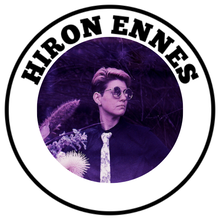
ABOUT THE AUTHOR Hiron Ennes is a writer, musician, and student of medicine based in the Pacific Northwest. Their areas of interest include infectious disease, pathology, and anticapitalist healthcare reform. When they’re not hunched over a microscope or word document they can be found playing in the snow or playing the harp (though usually not at the same time). They’re queer in every sense of the word, and they really want to pet your dog. Leech is their first novel.
The Institute is here to help humanity, to cure and to cut, to cradle and protect the species. Now it seems they have competition. For in the baron’s icebound castle, already a pit of secrets and lies, the parasite is spreading . . .
These two enemies will make war within the battlefield of the body. Whichever wins, humanity will lose again.
An atmospheric Gothic triumph, for fans of Jeff VanderMeer and Silvia Moreno-Garcia.
ABOUT THE AUTHOR Hiron Ennes is a writer, musician, and student of medicine based in the Pacific Northwest. Their areas of interest include infectious disease, pathology, and anticapitalist healthcare reform. When they’re not hunched over a microscope or word document they can be found playing in the snow or playing the harp (though usually not at the same time). They’re queer in every sense of the word, and they really want to pet your dog. Leech is their first novel.
An atmospheric Gothic triumph, for fans of Jeff VanderMeer and Silvia Moreno-Garcia.
A Ginger Nuts of Horror Exclusive, we talk to Hiron Ennes about their incredible debut, Leech (Tor UK, 29 September, 2022)
Tell us a bit about your new novel.
When people ask me to describe my novel, I often default to ‘soft-sci-fi gothic body horror.’ That tends to produce more questions than it answers, but honestly, I have difficulty describing this book. It’s got all the fun stuff, I say. Parasites. Apocalypses. Hiveminds. Spooky castles. Dogs. The existential horror of living inside a vulnerable, mutable human body.
What made you choose this particular genre/style?
I don’t think it was a conscious choice. All I knew was that I wanted something terrible to happen deep in the mountains, whether it was science fiction, gothic drama, horror, manners fantasy—the actual genre was secondary. In the end it turned out to be a bit of all the above.
Is there a particular character you’re excited for people to meet?
There is a certain dynamic duo who livens up the place quite a bit—or makes it a little more ghostly…
Who are your biggest inspirations author-wise?
Hard to say. I’ve seen my writing compared to Jeff VanderMeer’s or Ann Leckie’s, but I confess I didn’t read either of those authors until after I’d written much of Leech. I’d say my novel takes more inspiration from Peake or Shelley. Authors I usually cite as inspiration are ones who have redefined the limits of fiction for me. When I was a teenager, China Miéville’s Perdido Street Station showed me how a fantasy world could be lush and realistic not in spite of, but because of its surrealism. Around the same time, I read Glen Cook’s Chronicles of the Black Company, which is such a charming marriage of dissimilar genres (high fantasy and gritty war memoir). My literary tastes in my early-to-mid-twenties were influenced by Kathy Acker, Gabriel Garcia Marquez and W.G. Sebald, all masters of straddling the uncanny union of fiction and reality. At the moment, I’m obsessed with John Crowley and Sofia Samatar.
What is your daily writing routine like?
Right now I’m working on both a second novel and my masters of clinical research, so I spend half the day immersed in human serum and the other half immersed in Earl Grey. I wake up at about 6:45, bus to my favourite tea shop, write for about 4-5 hours, depending on how much pipetting and/or data analysis needs to get done that day, come home from the lab in the evening, run a bath, then write more. Don’t do this. It’s some unhealthy, obsessive bullshit and I’m not sure if it’s actually conducive to productivity. But writing for me is an impulse, like breathing—I might not enjoy it all the time, but if I stopped I would die.
Do you listen to music while writing?
Always. I have playlists dedicated to a novel’s changing moods, settings, and scenes. I pretty much only listen to classical music (classical in the broadest sense—so baroque, impressionist, romantic, ‘contemporary classical,’ etc). The soundtrack for Leech consisted primarily of Arvo Pärt, Hildur Guðnadóttir and Ezio Bosso, with a sprinkling of Dvořák.
How do you deal with writers' block/the urge to procrastinate/bad writing habits?
I’m not sure I do. I don’t really get writers’ block. What I do get are crises in which I abruptly and sincerely call into question every creative decision I’ve ever made and then, naturally, my legitimacy as a conscious being. The last time I had one of these breakdowns I dove into my tarot deck and drew all swords, deleted half my book, and ran for too many miles after having not exercised in months. Not recommended.
Which book(s) published in the last/next year are you most excited about?
I was pretty stoked to see that Tochi Onyebuchi’s Goliath was released—anything even distantly compared to Dhalgren has a spot automatically reserved on my shelf. I’m also beyond excited for Alex Pheby’s Mordew sequel, which is very Peakean and kind of like Oliver Twist for leftist goths. Mordew is one of those rare worlds that’s utterly miserable and stomach-churning but still has such redeeming charm.
What's the best piece of writing advice you've been given?
Simply put: ‘Keep going.’ Words I need when I have the aforementioned crises--keep going. Your first draft will be garbage, and probably the second and third, but there will be nothing to salvage if there’s nothing at all. Burn on, you glorious trashfire.
Tell us a bit about your new novel.
When people ask me to describe my novel, I often default to ‘soft-sci-fi gothic body horror.’ That tends to produce more questions than it answers, but honestly, I have difficulty describing this book. It’s got all the fun stuff, I say. Parasites. Apocalypses. Hiveminds. Spooky castles. Dogs. The existential horror of living inside a vulnerable, mutable human body.
What made you choose this particular genre/style?
I don’t think it was a conscious choice. All I knew was that I wanted something terrible to happen deep in the mountains, whether it was science fiction, gothic drama, horror, manners fantasy—the actual genre was secondary. In the end it turned out to be a bit of all the above.
Is there a particular character you’re excited for people to meet?
There is a certain dynamic duo who livens up the place quite a bit—or makes it a little more ghostly…
Who are your biggest inspirations author-wise?
Hard to say. I’ve seen my writing compared to Jeff VanderMeer’s or Ann Leckie’s, but I confess I didn’t read either of those authors until after I’d written much of Leech. I’d say my novel takes more inspiration from Peake or Shelley. Authors I usually cite as inspiration are ones who have redefined the limits of fiction for me. When I was a teenager, China Miéville’s Perdido Street Station showed me how a fantasy world could be lush and realistic not in spite of, but because of its surrealism. Around the same time, I read Glen Cook’s Chronicles of the Black Company, which is such a charming marriage of dissimilar genres (high fantasy and gritty war memoir). My literary tastes in my early-to-mid-twenties were influenced by Kathy Acker, Gabriel Garcia Marquez and W.G. Sebald, all masters of straddling the uncanny union of fiction and reality. At the moment, I’m obsessed with John Crowley and Sofia Samatar.
What is your daily writing routine like?
Right now I’m working on both a second novel and my masters of clinical research, so I spend half the day immersed in human serum and the other half immersed in Earl Grey. I wake up at about 6:45, bus to my favourite tea shop, write for about 4-5 hours, depending on how much pipetting and/or data analysis needs to get done that day, come home from the lab in the evening, run a bath, then write more. Don’t do this. It’s some unhealthy, obsessive bullshit and I’m not sure if it’s actually conducive to productivity. But writing for me is an impulse, like breathing—I might not enjoy it all the time, but if I stopped I would die.
Do you listen to music while writing?
Always. I have playlists dedicated to a novel’s changing moods, settings, and scenes. I pretty much only listen to classical music (classical in the broadest sense—so baroque, impressionist, romantic, ‘contemporary classical,’ etc). The soundtrack for Leech consisted primarily of Arvo Pärt, Hildur Guðnadóttir and Ezio Bosso, with a sprinkling of Dvořák.
How do you deal with writers' block/the urge to procrastinate/bad writing habits?
I’m not sure I do. I don’t really get writers’ block. What I do get are crises in which I abruptly and sincerely call into question every creative decision I’ve ever made and then, naturally, my legitimacy as a conscious being. The last time I had one of these breakdowns I dove into my tarot deck and drew all swords, deleted half my book, and ran for too many miles after having not exercised in months. Not recommended.
Which book(s) published in the last/next year are you most excited about?
I was pretty stoked to see that Tochi Onyebuchi’s Goliath was released—anything even distantly compared to Dhalgren has a spot automatically reserved on my shelf. I’m also beyond excited for Alex Pheby’s Mordew sequel, which is very Peakean and kind of like Oliver Twist for leftist goths. Mordew is one of those rare worlds that’s utterly miserable and stomach-churning but still has such redeeming charm.
What's the best piece of writing advice you've been given?
Simply put: ‘Keep going.’ Words I need when I have the aforementioned crises--keep going. Your first draft will be garbage, and probably the second and third, but there will be nothing to salvage if there’s nothing at all. Burn on, you glorious trashfire.
ABOUT THE AUTHOR
Hiron Ennes is a writer, musician, and student of medicine based in the Pacific Northwest. Their areas of interest include infectious disease, pathology, and anticapitalist healthcare reform. When they’re not hunched over a microscope or word document they can be found playing in the snow or playing the harp (though usually not at the same time). They’re queer in every sense of the word, and they really want to pet your dog. Leech is their first novel.
Hiron Ennes is a writer, musician, and student of medicine based in the Pacific Northwest. Their areas of interest include infectious disease, pathology, and anticapitalist healthcare reform. When they’re not hunched over a microscope or word document they can be found playing in the snow or playing the harp (though usually not at the same time). They’re queer in every sense of the word, and they really want to pet your dog. Leech is their first novel.
Leech Hardcover – 29 Sept. 2022
by Hiron Ennes
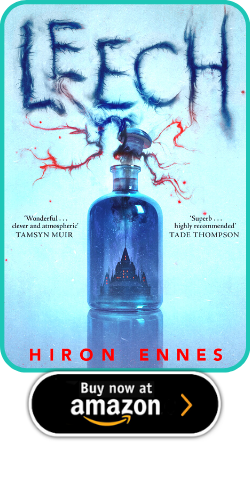
‘Highly recommended. I’ll be reading anything Hiron Ennes writes from now on’ – Tade Thompson, author of Rosewater
‘A wonderful new entry to Gothic science fiction, impeccably clever and atmospheric. Think Wuthering Heights . . . with worms!’ – Tamsyn Muir, author of Gideon the Ninth
In an isolated chateau, as far north as north goes, the baron’s doctor has died. The Interprovincial Medical Institute sends out a replacement. But when the new physician investigates the cause of death, which appears to be suicide, there’s a mystery to solve. It seems the good doctor was hosting a parasite. Yet this should have been impossible, as the man was already possessed. For hundreds of years, the Institute has grown by taking root in young minds and shaping them into doctors, replacing every human practitioner of medicine.
The Institute is here to help humanity, to cure and to cut, to cradle and protect the species. Now it seems they have competition. For in the baron’s icebound castle, already a pit of secrets and lies, the parasite is spreading . . .
These two enemies will make war within the battlefield of the body. Whichever wins, humanity will lose again.
Leech by Hiron Ennes is an atmospheric Gothic triumph, perfect for fans of Jeff VanderMeer and Silvia Moreno-Garcia.
TODAY ON THE GINGER NUTS OF HORROR WEBSITE
 | |
the heart and soul of horror promotion
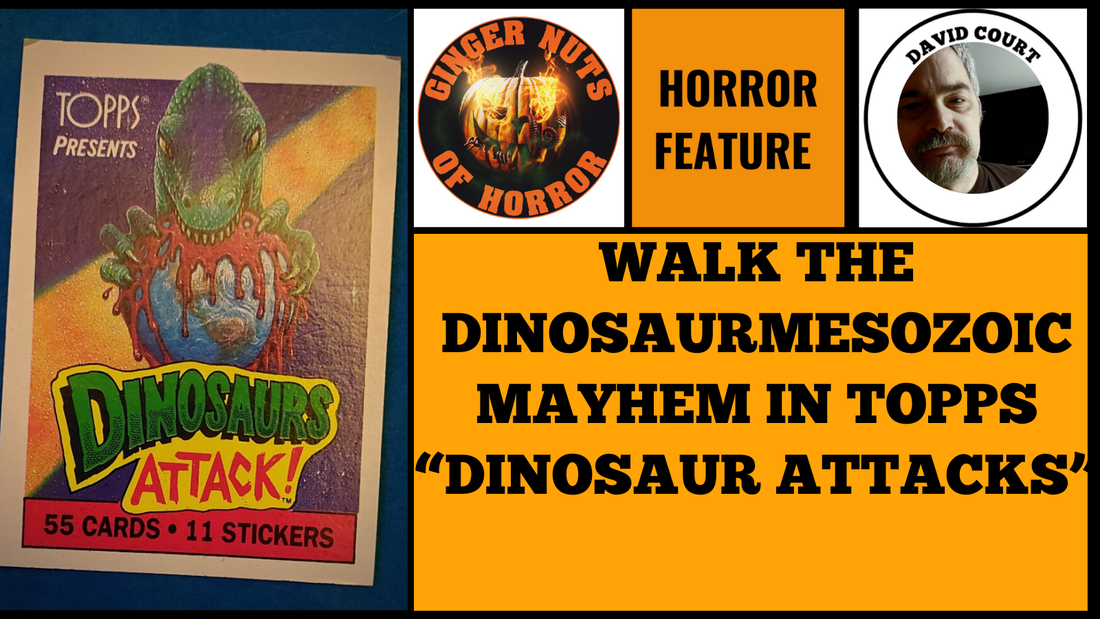
It’s the year 1988. Elias Thorne, scientist, is carrying out an epochal experiment from the Prometheus Space Station – his “Time Scanner” can replay moments from the past, and the boffin plans to learn once and for all what killed the dinosaurs some 65 million years ago. However, something goes horribly wrong – and the Time Scanner ends up pulling dinosaurs through to the modern day, to wreak bloody gruesome havoc.
Sounds like the average plot of your common-or-garden Asylum movie, but this is in fact the storyline for the Dinosaur Attacks Topps trading cards – an attempt to cash in on the success of the similarly gruesome Mars Attacks trading cards from nearly a quarter of a century before.
I suppose it was always inevitable that I’d end up in horror somehow, being attracted to the science fiction and horror section of nearby Bell Green Library – particularly drawn to the Pan collections of short horror tales (good old Herbert Von Thal). The covers are just as evocative and powerful as they were then; often simple manipulated photographs showing a twisted dull or a severed head, staring pale faces or the repeating motif of skulls with something insectoid or reptilian crawling merrily through an empty eye socket.
The Garbage Pail Kids cards (also from the Topps company) from the mid-eighties also appealed; clearly a piss-take of the popular Cabbage Patch dolls, they felt subversive – something your parents would not be pleased you were looking at, yet alone collecting and swapping.
(Incidentally, my parents were perfectly happy with my love of horror books when I was growing up, just happy I was a voracious reader. That was until I borrowed “Slugs” by Shaun Hutson and, not recognising a word, acted my mum what it meant. The word was “Vagina,” and I was henceforth banned from choosing my own books from Bell Green Library for a short while).
A friend of mine owned a copy of the Dinosaur Attacks cards in the late eighties, and – thinking back on it – I’m not sure how, as I don’t know if they were ever released in the UK. This was back from the days when trading card packets still came with gum, and every card had the strong mingled scent of cardboard and sugar, a heady neuron-fastening combination that can send me hurtling back to the eighties.
They were like the holy grail; grisly, depicting a level of gore you just didn’t get from Panini football stickers (unless you defaced them yourself with a red pen – sorry, Kenny Dalglish). And, up until a few weeks ago, I’d forgotten all about them – until a mistyped eBay search revealed them to me again.
For a full set, they weren’t expensive. They were – madly - never hugely successful. To many of you, this reminiscence will mean nothing – to others, they’ll transport you squarely back to those days of pastel-coloured sweatshirts and Nik Kershaw. Still, as a horror fan, you’ll no doubt appreciate the gore.
Sounds like the average plot of your common-or-garden Asylum movie, but this is in fact the storyline for the Dinosaur Attacks Topps trading cards – an attempt to cash in on the success of the similarly gruesome Mars Attacks trading cards from nearly a quarter of a century before.
I suppose it was always inevitable that I’d end up in horror somehow, being attracted to the science fiction and horror section of nearby Bell Green Library – particularly drawn to the Pan collections of short horror tales (good old Herbert Von Thal). The covers are just as evocative and powerful as they were then; often simple manipulated photographs showing a twisted dull or a severed head, staring pale faces or the repeating motif of skulls with something insectoid or reptilian crawling merrily through an empty eye socket.
The Garbage Pail Kids cards (also from the Topps company) from the mid-eighties also appealed; clearly a piss-take of the popular Cabbage Patch dolls, they felt subversive – something your parents would not be pleased you were looking at, yet alone collecting and swapping.
(Incidentally, my parents were perfectly happy with my love of horror books when I was growing up, just happy I was a voracious reader. That was until I borrowed “Slugs” by Shaun Hutson and, not recognising a word, acted my mum what it meant. The word was “Vagina,” and I was henceforth banned from choosing my own books from Bell Green Library for a short while).
A friend of mine owned a copy of the Dinosaur Attacks cards in the late eighties, and – thinking back on it – I’m not sure how, as I don’t know if they were ever released in the UK. This was back from the days when trading card packets still came with gum, and every card had the strong mingled scent of cardboard and sugar, a heady neuron-fastening combination that can send me hurtling back to the eighties.
They were like the holy grail; grisly, depicting a level of gore you just didn’t get from Panini football stickers (unless you defaced them yourself with a red pen – sorry, Kenny Dalglish). And, up until a few weeks ago, I’d forgotten all about them – until a mistyped eBay search revealed them to me again.
For a full set, they weren’t expensive. They were – madly - never hugely successful. To many of you, this reminiscence will mean nothing – to others, they’ll transport you squarely back to those days of pastel-coloured sweatshirts and Nik Kershaw. Still, as a horror fan, you’ll no doubt appreciate the gore.
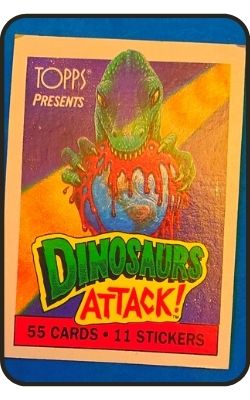
Setting the stall from the outset, a peckish oversized Tyrannosaurus Rex takes a chunk out of a bleeding Planet Earth. And this is just the cover.
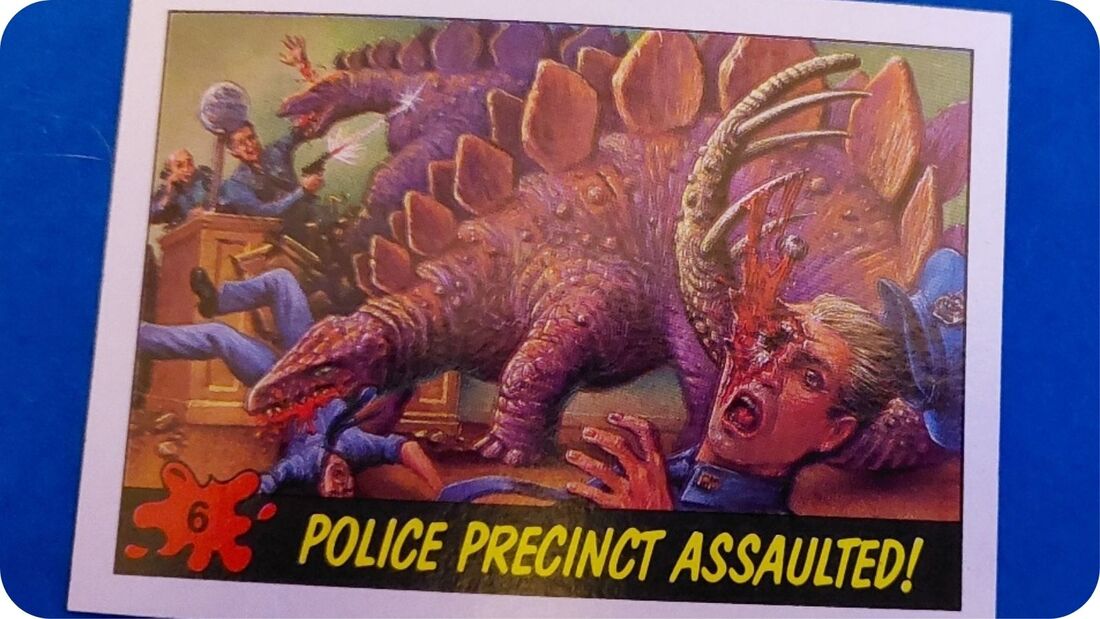
You’re not even safe from herbivores. Here we see a member of the Stegosauria family running amok in a police station, gouging out a copper’s eye with his thagomizer. Oh, and foregoing his standard diet of moss and ferns in favour of a meaty police officer.
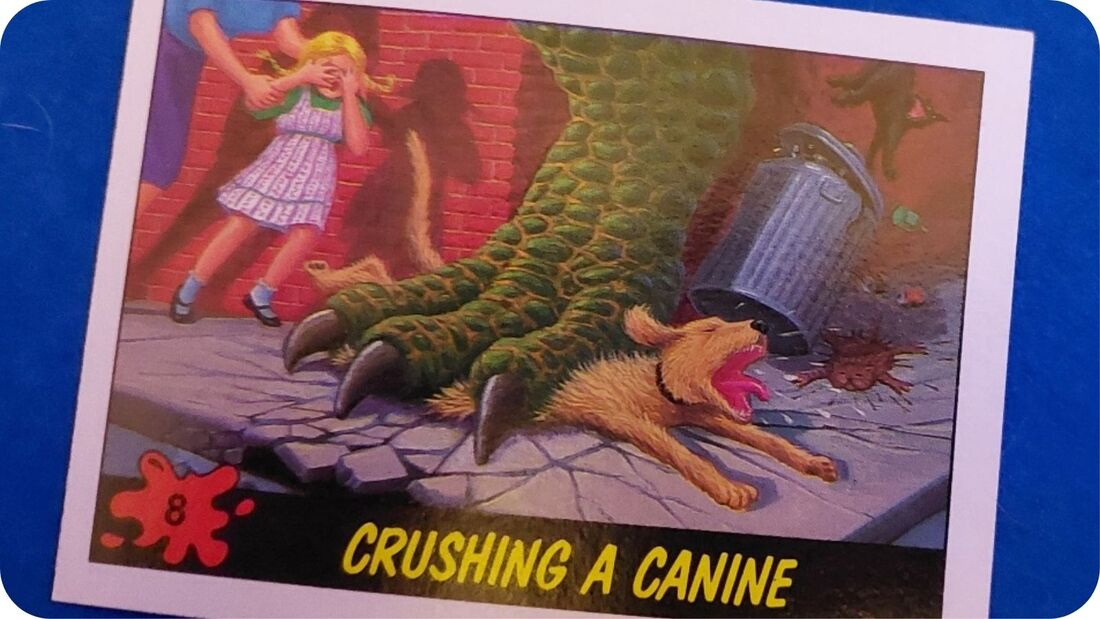
Dogs famously didn’t fare well in Mars Attacks either (Card 36: “Destroying a Dog”). Here, Fido meets an equally cruel fate.
You’re not even safe from herbivores. Here we see a member of the Stegosauria family running amok in a police station, gouging out a copper’s eye with his thagomizer. Oh, and foregoing his standard diet of moss and ferns in favour of a meaty police officer.
Dogs famously didn’t fare well in Mars Attacks either (Card 36: “Destroying a Dog”). Here, Fido meets an equally cruel fate.
 |  |
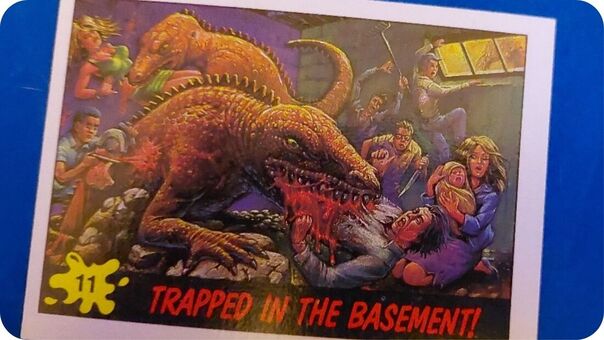
Ouch. That’s gotta hurt.
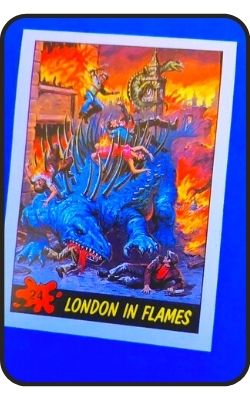
And the dinosaur shenanigans aren’t confined to just America either. There’s at least one of the bright blue blighters in blighty, clawing out for a cloth-capped cockney.
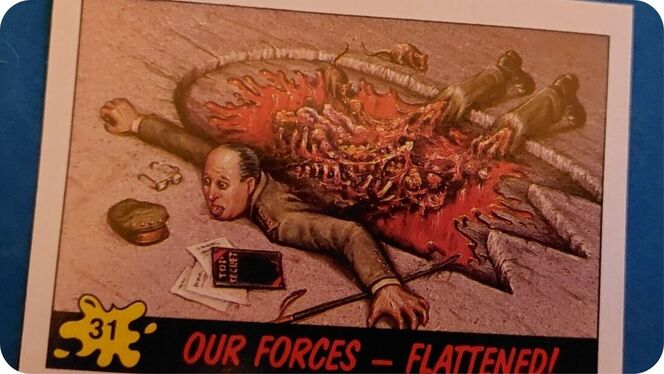
This was for kids.
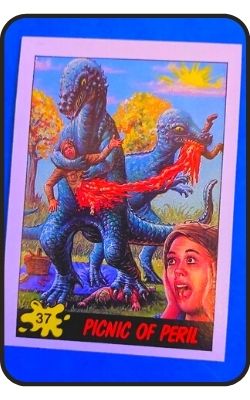 They could be educational, mind. This card clearly demonstrates the benefits of sharing. | 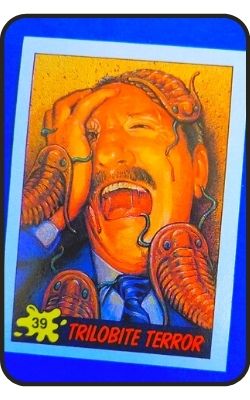 This image has occasionally haunted my dreams for thirty-odd years. You’re welcome. Even the arthropods are at it. |
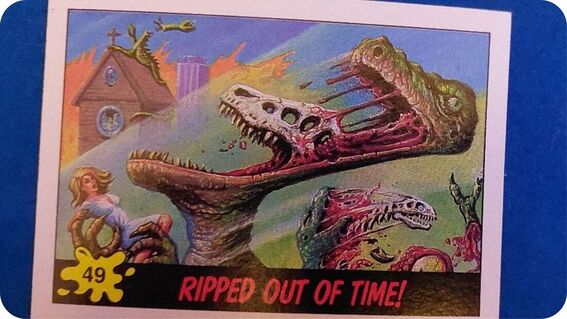
You’ll be relieved to know that – spoiler alert – humankind triumphs in the end. And it’s pretty messy.
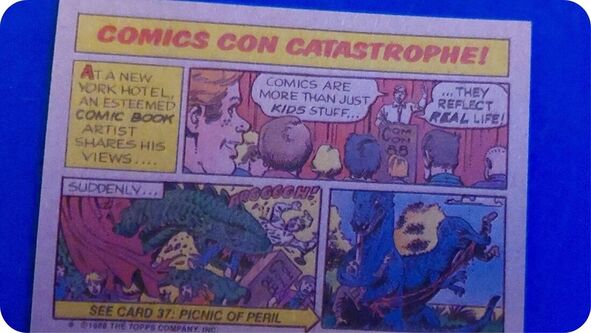
And, brilliantly for trading cards, the back is almost as good as the front. Telling the story through newspaper headlines or something related to the image on the front, it’s a wonderfully succinct and effective bit of storytelling.
So, there you go. Topps Dinosaur Attacks – a wonderful eighties slice of kid-inappropriate ultra-violence and gore. Well worth looking out for a set on popular auction sites, and infinitely more rewarding than a rewatch of “Mega Shark Versus Giant Octopus.” Don’t have nightmares.
So, there you go. Topps Dinosaur Attacks – a wonderful eighties slice of kid-inappropriate ultra-violence and gore. Well worth looking out for a set on popular auction sites, and infinitely more rewarding than a rewatch of “Mega Shark Versus Giant Octopus.” Don’t have nightmares.
David Court
About the Author
David Court is a short story author and novelist, whose works have appeared in over a dozen venues including Tales to Terrify, StarShipSofa, Visions from the Void, Fear’s Accomplice and The Voices Within. Whilst primarily a horror writer, he also writes science fiction, poetry, and satire. He’s also a freelance writer for Slash Film.
His last collection, Contents May Unsettle, was re-released in 2021 and his debut comic writing has just featured in Tpub’s The Theory (Twisted Sci-Fi). As well as writing, David works as a Software Developer and lives in Coventry with his wife, three cats and an ever-growing beard. David’s wife once asked him if he’d write about how great she was. David replied that he would because he specialized in short fiction. Despite that, they are still married.
David Court is a short story author and novelist, whose works have appeared in over a dozen venues including Tales to Terrify, StarShipSofa, Visions from the Void, Fear’s Accomplice and The Voices Within. Whilst primarily a horror writer, he also writes science fiction, poetry, and satire. He’s also a freelance writer for Slash Film.
His last collection, Contents May Unsettle, was re-released in 2021 and his debut comic writing has just featured in Tpub’s The Theory (Twisted Sci-Fi). As well as writing, David works as a Software Developer and lives in Coventry with his wife, three cats and an ever-growing beard. David’s wife once asked him if he’d write about how great she was. David replied that he would because he specialized in short fiction. Despite that, they are still married.
TODAY ON THE GINGER NUTS OF HORROR WEBSITE
 | |
THE HEART AND SOUL OF HORROR FEATURES

I was introduced to Arthur Machen’s The Great God Pan in HP Lovecraft’s essay “Supernatural Horror in Literature.” This was right after reading Lovecraft’s complete works, and in search for more weird fiction, I figured a good place to get recommendations was one of the genre’s best authors. I highly recommend the essay. Everything mentioned in it is worth reading.
It wasn’t just Lovecraft’s high praise for the story that interested me. As a lover of Greek Mythology and the horror genre, it sounded like an intriguing combination of the two. Here’s Lovecraft’s own words regarding the author: “Of living creators of cosmic fear raised to its most artistic pitch, few if any can hope to equal the versatile Arthur Machen; author of some dozen tales long and short, in which the elements of hidden horror and brooding fright attain an almost incomparable substance and realistic acuteness.” Nearly all of Lovecraft’s works capture a similar “cosmic fear” and “hidden horror” presented in Machen’s stories, and though they certainly come close to its level, nothing compares to the terrifying implications hinted at in the Great God Pan.
The story opens through the perspective of a man named Clarke called upon by an old friend named Raymond to witness an experiment. This experiment requires “a slight lesion in the gray matter” so minor it would “escape the attention of ninety-nine brain specialists out of a hundred.” The technical details are waved away by Raymond, who explains to Clarke that so-called modern breakthroughs had already been realized by Raymond himself a decade prior. Though it’s glossed over, it’s important to note that means he’s only slightly ahead of the curve. He warms a vial of green liquid that let’s off an earthy smell and causes Clarke to enter a trance, bringing to mind more of an occult ritual than scientific enterprise.
This is made even more apparent with the purpose of the experiment. With “a trifling rearrangement of certain cells” a whole new world of perception opens up. In Raymond’s words: “a whole world, a sphere unknown; continents and islands, and great oceans in which no ship has sailed (to my belief) since a Man first lifted up his eyes and beheld the sun, and the stars of heaven, and the quiet earth beneath.” Despite the pseudo-science garbed in romantic language, this brings to mind the biblical tree of the knowledge of good and evil. However, this fruit is almost a reversal of that to a more primitive state, when man knew no good or evil; a sort of return to the perceptual innocence of Eden. It does raise some interesting questions if such a procedure was possible: Did our early ancestors see the world differently than us? Did we evolve to ignore trans-dimensional entities? It’s almost like an evolutionary spin on the Catholic doctrine on the Fall of Man. Rather than sin, it was more of a survival mechanism, meaning matters of spirit and piety are vestiges of necessary instincts to appease these beings. Whatever the scientific or theological implications of the somewhat silly theory, the concept at least stirs the imagination.
The experiment is performed on a young woman named Mary wearing all white. Clarke looks away for a few moments while Raymond performs the surgery and conveniently looks back just as a bandage is finished being bound to her head. Shortly after, Mary wakes up and blissfully reaches out to something unseen by Clarke, only for her to erupt into a fit of terror before passing out. The experiment was a success, according to Raymond. Mary had gazed into true realm and seen the Great God Pan. The symbolism between the pure, virginal Mary and the devil-horned Pan is immediately obvious.
Much time passes and the rationally minded Clarke cannot forget the incident or the terror of Mary’s face, finding himself attending fraudulent séances and other hokey occult gatherings in the hope of convincing himself the experiment was just an elaborate hoax. He puts together a compilation of second-hand stories called “Memoirs to prove the devil exists” and hides it from his friends out of shame, not wanting to look irrational or superstitious. During his search for odd accounts of the supernatural, Clarke comes across a story about a girl named Helen, who recently arrived at a rural village. One day, a farmer is startled when his young son flees from the woods in fear, claiming to have seen a strange naked man with Helen. The event drives the boy into irrecoverable insanity. Six years later, Helen is involved in another strange event with a girl named Rachel. The two are close friends. One day, Rachel followed Helen into the woods. She later returns to her room with her clothes torn, cursing her parents for letting her go with Helen. However, Rachel returns to the woods by some compulsion and is never seen again.
The story moves away from Clarke’s perspective to another man from London, yet Helen remains the focus. Using primarily second-hand accounts proves to be one of the novel’s strongest points. Not only does it provide an air of mystery, but allows it to tell far more than it could from merely showing due to the method of the telling. Even at the end, despite being the focus, Helen never directly interacts with the chapter’s current point of view as she mingles and corrupts a decadent London high society.
To summarize, her interactions lead to the death of many men of supposedly good reputation. However, like Clarke’s memoirs, they all have their secrets, only some of them revealed directly to the main characters, such as Meyrick’s grotesque drawings of satyrs, fauns, and aegipan that appear lifelike. Among these sketches is a portrait of Helen, who is described as simultaneously repulsive and enchanting, frequently compared to a devilish statue. At this point, it’s easy to connect Helen to Mary and Pan. Though it isn’t told until the end, Helen’s age matches the time her mother saw Pan. The method of the impregnation is never explicitly stated. Perhaps it was the terror Mary experienced at the sight of Pan that impregnated her. It would be appropriate given the god’s notoriety for causing blind panic to soldiers amidst war, said to cause even brave men to flee from battle. After all, the word panic comes from Pan. Why wouldn’t his spawn be the product of a mind-shattering scare? It’s only a theory; the impregnation of a supernatural being likely wouldn’t be natural.
Helen never directly causes the death of her many victims. She seduces and ruins men like a fem fatale from a noir movie, but the reality is her role is clearly that of a priestess inducting decadent aristocrats into the mysteries of Pan. This is where the brilliance of the second-hand accounts comes in. One of Helen’s former associates is found with his neck tied to a noose by a servant. This is only one of a string of suicides of perfectly sane men. Like the young boy in Helen’s youth, the natural implication is that they were drawn into irrecoverable madness by the woman. This is clearly the case, but due to the surrounding vague circumstances, much could have been omitted for the sake of decency. Not just by Machen, but by the characters themselves. Perhaps the servant left out that his employer was discovered not only with his neck in a noose, but nude. Accounts of autoerotic asphyxiation go back further than the writing of The Great God Pan. Upon the story’s publication, the novel was denounced for its sexual implications, hurting Machen’s reputation enough that his writings became somewhat obscured. One of the stories defenders was Oscar Wilde, author The Portrait of Dorian Grey, which depicts similar themes of aristocratic decadence and was likely well-aware of Machen’s real-life comparisons if they were present. Considering the frequency of the accusations and parodies attempting to label Machen as a decadent artist, it comes across more of a means of discrediting and turning potential readers away than mere mockery. The London elite likely didn’t appreciate a story that made them turn a mirror on their own secret lives.
If the story merely meant to bring to mind sexual acts that were never spoken of outside whisperings, it would deserve a fate of obscurity. Along with its occasional comparisons of Pan to the devil, the Great God Pan represents change in the spiritual paradigm. Like the mad scientist Raymond, Machen, who was a member of occult circles, sensed change coming to Victorian London. Just as GK Chesterton called the proclamation: “The Great God Pan is dead!” the end of the paganry and the ushering of the Christian era, Machen’s novel proclaims “The Great God Pan has arisen!” with a sense of utter dread and despair. Helen is its prophetess. Even when she is reduced to a shape-shifting thing grasping at some sort of form in its death throes, only when she is reduced to goo is Helen truly revealed. The villain in the Great God Pan is akin to the Neo-Platonic concept of matter, which was devoid of form and idea, opposite of the eternally radiant and ever-flowing Good. As a member of the Hermetic Order of the Golden Dawn, Machen would’ve been familiar with Neo-Platonic thought due to their theurgical practices, which had deeply influenced Western occult.
This is not to say the story is strictly Christianity versus paganism or good versus evil. That’s only a one layer. At its core, The Great God Pan announces the failure of promises made by the Enlightenment and modernity. Mankind stumbled through the vast darkness with the dim candle of reason, no better off than when they cast off the so-called shackles of religion and superstition for science and rationality. Any attempts to understand the evil presented in the story will inevitably lead to madness because that candle cannot cast its light on the void. The entity is called Pan, yet that’s only a mask. Much like the statue of Pan and Helen’s uncanny human visage, it’s only a veil over an enduring principle: life, with all its savagery and brutality laid utterly bare, is closer to eternal darkness than the light of the Good. Not only the fear of death, but eradication in the spiritual sense is ever present and the curse of matter. The further removed we are from the light of the Good, the closer we come to being undone.
Its why there’s an apocalyptic atmosphere to the story. The Victorian Age was coming to a close. Whether this is a good or bad thing is up to the reader. Though not explicitly stated, it was obviously dreadful to the author. And why wouldn’t it? Whatever Machen stood for, it was the time period he lived in. To him, it was existence.
The Great God Pan is worthy in the company of horror classics such as Frankenstein and Dracula just based on its influence on subsequent authors in the genre. Though Helen lacks the magnetism of Dracula and the story lacks the dramatic punch of Frankenstein, its atmosphere more than makes up for it. The death of Helen may seem anti-climactic because it’s essentially meaningless. The evil in The Great God Pan no longer needs a bodily form. The essence of her message would soon spread through all mankind, best expressed in the inscription Clarke writes into his memoirs: “ET DIABOLUS INCARNATE EST. ET HOMO FACTUS EST.” which roughly translates: “And the devil was made incarnate. And he was made man.”
And this is why The Great God Pan deeply changed the way I viewed the horror genre. Modern works don’t focus on spiritual malaise and tend to either ignore or depict religious and spiritual practices as insane or evil. It’s why many don’t stick to your soul like Machen’s writings. He depicted evil as not only existing, but something simultaneously alien and intrinsic to mankind.
It wasn’t just Lovecraft’s high praise for the story that interested me. As a lover of Greek Mythology and the horror genre, it sounded like an intriguing combination of the two. Here’s Lovecraft’s own words regarding the author: “Of living creators of cosmic fear raised to its most artistic pitch, few if any can hope to equal the versatile Arthur Machen; author of some dozen tales long and short, in which the elements of hidden horror and brooding fright attain an almost incomparable substance and realistic acuteness.” Nearly all of Lovecraft’s works capture a similar “cosmic fear” and “hidden horror” presented in Machen’s stories, and though they certainly come close to its level, nothing compares to the terrifying implications hinted at in the Great God Pan.
The story opens through the perspective of a man named Clarke called upon by an old friend named Raymond to witness an experiment. This experiment requires “a slight lesion in the gray matter” so minor it would “escape the attention of ninety-nine brain specialists out of a hundred.” The technical details are waved away by Raymond, who explains to Clarke that so-called modern breakthroughs had already been realized by Raymond himself a decade prior. Though it’s glossed over, it’s important to note that means he’s only slightly ahead of the curve. He warms a vial of green liquid that let’s off an earthy smell and causes Clarke to enter a trance, bringing to mind more of an occult ritual than scientific enterprise.
This is made even more apparent with the purpose of the experiment. With “a trifling rearrangement of certain cells” a whole new world of perception opens up. In Raymond’s words: “a whole world, a sphere unknown; continents and islands, and great oceans in which no ship has sailed (to my belief) since a Man first lifted up his eyes and beheld the sun, and the stars of heaven, and the quiet earth beneath.” Despite the pseudo-science garbed in romantic language, this brings to mind the biblical tree of the knowledge of good and evil. However, this fruit is almost a reversal of that to a more primitive state, when man knew no good or evil; a sort of return to the perceptual innocence of Eden. It does raise some interesting questions if such a procedure was possible: Did our early ancestors see the world differently than us? Did we evolve to ignore trans-dimensional entities? It’s almost like an evolutionary spin on the Catholic doctrine on the Fall of Man. Rather than sin, it was more of a survival mechanism, meaning matters of spirit and piety are vestiges of necessary instincts to appease these beings. Whatever the scientific or theological implications of the somewhat silly theory, the concept at least stirs the imagination.
The experiment is performed on a young woman named Mary wearing all white. Clarke looks away for a few moments while Raymond performs the surgery and conveniently looks back just as a bandage is finished being bound to her head. Shortly after, Mary wakes up and blissfully reaches out to something unseen by Clarke, only for her to erupt into a fit of terror before passing out. The experiment was a success, according to Raymond. Mary had gazed into true realm and seen the Great God Pan. The symbolism between the pure, virginal Mary and the devil-horned Pan is immediately obvious.
Much time passes and the rationally minded Clarke cannot forget the incident or the terror of Mary’s face, finding himself attending fraudulent séances and other hokey occult gatherings in the hope of convincing himself the experiment was just an elaborate hoax. He puts together a compilation of second-hand stories called “Memoirs to prove the devil exists” and hides it from his friends out of shame, not wanting to look irrational or superstitious. During his search for odd accounts of the supernatural, Clarke comes across a story about a girl named Helen, who recently arrived at a rural village. One day, a farmer is startled when his young son flees from the woods in fear, claiming to have seen a strange naked man with Helen. The event drives the boy into irrecoverable insanity. Six years later, Helen is involved in another strange event with a girl named Rachel. The two are close friends. One day, Rachel followed Helen into the woods. She later returns to her room with her clothes torn, cursing her parents for letting her go with Helen. However, Rachel returns to the woods by some compulsion and is never seen again.
The story moves away from Clarke’s perspective to another man from London, yet Helen remains the focus. Using primarily second-hand accounts proves to be one of the novel’s strongest points. Not only does it provide an air of mystery, but allows it to tell far more than it could from merely showing due to the method of the telling. Even at the end, despite being the focus, Helen never directly interacts with the chapter’s current point of view as she mingles and corrupts a decadent London high society.
To summarize, her interactions lead to the death of many men of supposedly good reputation. However, like Clarke’s memoirs, they all have their secrets, only some of them revealed directly to the main characters, such as Meyrick’s grotesque drawings of satyrs, fauns, and aegipan that appear lifelike. Among these sketches is a portrait of Helen, who is described as simultaneously repulsive and enchanting, frequently compared to a devilish statue. At this point, it’s easy to connect Helen to Mary and Pan. Though it isn’t told until the end, Helen’s age matches the time her mother saw Pan. The method of the impregnation is never explicitly stated. Perhaps it was the terror Mary experienced at the sight of Pan that impregnated her. It would be appropriate given the god’s notoriety for causing blind panic to soldiers amidst war, said to cause even brave men to flee from battle. After all, the word panic comes from Pan. Why wouldn’t his spawn be the product of a mind-shattering scare? It’s only a theory; the impregnation of a supernatural being likely wouldn’t be natural.
Helen never directly causes the death of her many victims. She seduces and ruins men like a fem fatale from a noir movie, but the reality is her role is clearly that of a priestess inducting decadent aristocrats into the mysteries of Pan. This is where the brilliance of the second-hand accounts comes in. One of Helen’s former associates is found with his neck tied to a noose by a servant. This is only one of a string of suicides of perfectly sane men. Like the young boy in Helen’s youth, the natural implication is that they were drawn into irrecoverable madness by the woman. This is clearly the case, but due to the surrounding vague circumstances, much could have been omitted for the sake of decency. Not just by Machen, but by the characters themselves. Perhaps the servant left out that his employer was discovered not only with his neck in a noose, but nude. Accounts of autoerotic asphyxiation go back further than the writing of The Great God Pan. Upon the story’s publication, the novel was denounced for its sexual implications, hurting Machen’s reputation enough that his writings became somewhat obscured. One of the stories defenders was Oscar Wilde, author The Portrait of Dorian Grey, which depicts similar themes of aristocratic decadence and was likely well-aware of Machen’s real-life comparisons if they were present. Considering the frequency of the accusations and parodies attempting to label Machen as a decadent artist, it comes across more of a means of discrediting and turning potential readers away than mere mockery. The London elite likely didn’t appreciate a story that made them turn a mirror on their own secret lives.
If the story merely meant to bring to mind sexual acts that were never spoken of outside whisperings, it would deserve a fate of obscurity. Along with its occasional comparisons of Pan to the devil, the Great God Pan represents change in the spiritual paradigm. Like the mad scientist Raymond, Machen, who was a member of occult circles, sensed change coming to Victorian London. Just as GK Chesterton called the proclamation: “The Great God Pan is dead!” the end of the paganry and the ushering of the Christian era, Machen’s novel proclaims “The Great God Pan has arisen!” with a sense of utter dread and despair. Helen is its prophetess. Even when she is reduced to a shape-shifting thing grasping at some sort of form in its death throes, only when she is reduced to goo is Helen truly revealed. The villain in the Great God Pan is akin to the Neo-Platonic concept of matter, which was devoid of form and idea, opposite of the eternally radiant and ever-flowing Good. As a member of the Hermetic Order of the Golden Dawn, Machen would’ve been familiar with Neo-Platonic thought due to their theurgical practices, which had deeply influenced Western occult.
This is not to say the story is strictly Christianity versus paganism or good versus evil. That’s only a one layer. At its core, The Great God Pan announces the failure of promises made by the Enlightenment and modernity. Mankind stumbled through the vast darkness with the dim candle of reason, no better off than when they cast off the so-called shackles of religion and superstition for science and rationality. Any attempts to understand the evil presented in the story will inevitably lead to madness because that candle cannot cast its light on the void. The entity is called Pan, yet that’s only a mask. Much like the statue of Pan and Helen’s uncanny human visage, it’s only a veil over an enduring principle: life, with all its savagery and brutality laid utterly bare, is closer to eternal darkness than the light of the Good. Not only the fear of death, but eradication in the spiritual sense is ever present and the curse of matter. The further removed we are from the light of the Good, the closer we come to being undone.
Its why there’s an apocalyptic atmosphere to the story. The Victorian Age was coming to a close. Whether this is a good or bad thing is up to the reader. Though not explicitly stated, it was obviously dreadful to the author. And why wouldn’t it? Whatever Machen stood for, it was the time period he lived in. To him, it was existence.
The Great God Pan is worthy in the company of horror classics such as Frankenstein and Dracula just based on its influence on subsequent authors in the genre. Though Helen lacks the magnetism of Dracula and the story lacks the dramatic punch of Frankenstein, its atmosphere more than makes up for it. The death of Helen may seem anti-climactic because it’s essentially meaningless. The evil in The Great God Pan no longer needs a bodily form. The essence of her message would soon spread through all mankind, best expressed in the inscription Clarke writes into his memoirs: “ET DIABOLUS INCARNATE EST. ET HOMO FACTUS EST.” which roughly translates: “And the devil was made incarnate. And he was made man.”
And this is why The Great God Pan deeply changed the way I viewed the horror genre. Modern works don’t focus on spiritual malaise and tend to either ignore or depict religious and spiritual practices as insane or evil. It’s why many don’t stick to your soul like Machen’s writings. He depicted evil as not only existing, but something simultaneously alien and intrinsic to mankind.
This World of Love and Strife
by Shawn Mackey
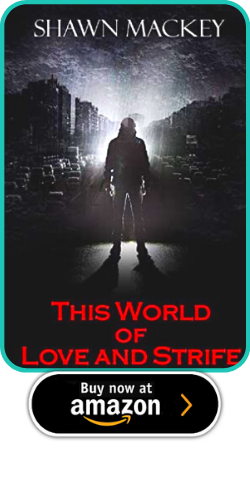
It is the duty of the Vanguard to protect the world from unseen demonic forces.
But what if the organization falls to corruption? Their reformation is up to Cato, a disgraced former member who discovers many of the elite using their powerful positions and martial skills for ill-gotten gains rather than fulfilling their true purpose: aiding mankind in a secret war against their eternal foe.
Aldous is a Vanguard who fell from grace after being stricken with vampirism by a mysterious figure known as the White Lady. His increasingly vile appetites are tolerated because his knowledge as an alchemist is vital in the Vanguard's battle against the demons. When those desires lead to the abduction of the woman Cato loves, Cato wages a one-man war against Aldous and his werewolf henchmen.
But what if the organization falls to corruption? Their reformation is up to Cato, a disgraced former member who discovers many of the elite using their powerful positions and martial skills for ill-gotten gains rather than fulfilling their true purpose: aiding mankind in a secret war against their eternal foe.
Aldous is a Vanguard who fell from grace after being stricken with vampirism by a mysterious figure known as the White Lady. His increasingly vile appetites are tolerated because his knowledge as an alchemist is vital in the Vanguard's battle against the demons. When those desires lead to the abduction of the woman Cato loves, Cato wages a one-man war against Aldous and his werewolf henchmen.
SHAWN MACKEY

Bio
Living in New Jersey for all his life, Shawn Mackey has been writing since childhood. Though his favorite genre is horror, he has a deep appreciation for fantasy influenced by mythology and science fiction that questions the modern world and its future.
Websites
https://mackeywriting.wordpress.com/
https://www.dxvaros.com/this-world-of-love-and-strife-presales
Living in New Jersey for all his life, Shawn Mackey has been writing since childhood. Though his favorite genre is horror, he has a deep appreciation for fantasy influenced by mythology and science fiction that questions the modern world and its future.
Websites
https://mackeywriting.wordpress.com/
https://www.dxvaros.com/this-world-of-love-and-strife-presales
TODAY ON THE GINGER NUTS OF HORROR WEBSITE
 | |
THE HEART AND SOUL OF HORROR PROMOTION


Archives
April 2023
March 2023
February 2023
January 2023
December 2022
November 2022
October 2022
September 2022
August 2022
July 2022
June 2022
May 2022
April 2022
March 2022
February 2022
January 2022
December 2021
November 2021
October 2021
September 2021
August 2021
July 2021
June 2021
May 2021
April 2021
March 2021
February 2021
January 2021
December 2020
November 2020
October 2020
September 2020
August 2020
July 2020
June 2020
May 2020
April 2020
March 2020
February 2020
January 2020
December 2019
November 2019
October 2019
September 2019
August 2019
July 2019
June 2019
May 2019
April 2019
March 2019
February 2019
January 2019
December 2018
November 2018
October 2018
September 2018
August 2018
July 2018
June 2018
May 2018
April 2018
March 2018
February 2018
January 2018
December 2017
November 2017
October 2017
September 2017
August 2017
June 2017
May 2017
April 2017
March 2017
February 2017
January 2017
December 2016
November 2016
October 2016
September 2016
August 2016
July 2016
June 2016
May 2016
April 2016
March 2016
February 2016
January 2016
December 2015
November 2015
October 2015
September 2015
August 2015
July 2015
June 2015
May 2015
April 2015
March 2015
February 2015
January 2015
December 2014
November 2014
October 2014
September 2014
August 2014
July 2014
June 2014
May 2014
April 2014
March 2014
February 2014
January 2014
December 2013
October 2013
September 2013
August 2013
 RSS Feed

|

|