

Thirteen For Halloween 2021: Gone Home by George Daniel Lea  Welcome, my loves, to another Halloween at the Ginger Nuts of Horror and another in our -nearly- annual series of seasonal horror articles! With our positioning as LGBTQ people here in the UK becoming increasingly fraught of late, with various attempts to erode our status, divide us, make us enemies of one another (looking squarely at the right-wing hate organisation, the LGBA, here. Looking and glaring and demanding that they fuck off from my garden, quite frankly), it's more important than ever that our concerns and conditions are examined via the media we consume. Horror might not be the most immediately obvious genre or vehicle in that regard, yet there's no denying that LGBTQ ddemographics in horror fandom are huge and significant. Whilst traditionally a far more exclusive and conservative genre, it has always been one in which LGBTQ people -and those cast outside the fishbowl of proscribed society- have always found a degree of identification. Even in the midst of its own conservatism, it often metaphorically or symbolically identifies and explores concerns that are particularly significant to us, especially given the tendency for us to be “monstered” by news media, religious organisations and culturally conservative bodies. That there are now significant sub-genres and voices within horror (not to mention fantasy and science fiction) who themselves identify as LGBTQ and who bring those concerns to the forefront in their writings is evidence of a burgeoning -and hopefully irreversible- paradigm shift away from the exclusions of tradition and into a more expansive, fruitful condition. Before we progress with the introductory subject, please be aware that these are all matters of personal taste and have been selected based on my own knowledge and experience of what is out there. If there is a piece of pertinent media you'd like me to discuss further or deeper at a later date, do not hesitate to get in touch and flag it up. So, to kick things off, we have a callback to the independent video game scene of 2013; a relatively modest title that -initially- dropped without enormous fanfare or significant discussion onto Steam, but which -largely thanks to the “let's player” community on YouTube- snowballed out of all containment in the weeks and months that followed: The strangely quiet, subtle and evocative work that is Gone Home. It's strange to consider that, for an era that feels so recent, our heels have barely cooled from it, the video game environment and culture of 2013 was a very different place to what it is now: independent video gaming was beginning to swell, thanks to platforms such as Steam and others, allowing for smaller studios and independent creators to promulgate their work. This, in turn, facilitated a significant shift in the nature of video games -even debates on what constitutes a video “game”- and the voices that the medium traditionally allowed for. Suddenly, we had the likes of Gone Home, a game that actively tricks its audience into believing it's a supernatural horror title by borrowing tricks and techniques from the last twenty years of titles, but that then gradually sloughs off those assumptions, inverting them in some instances, to become a far more domestic, hopeful and positive cultural commentary. To put it in context: LGBTQ representation in video games at that point was still phenomenally rare, barring one or two niche instances that were often played for laughs or fetishised to the Nth degree. Here, arguably for the first time ever in the medium, we have a story that explores the phenomena of “coming out,” set in the USA of the mid 1990s, in which doing so was far more fraught and ambiguous. Furthermore, it dares to do so with reference to a teenage girl, adding another layer to its representation by incorporating a focal subject that is still arguably underrepresented in media in general. In terms of presentation and format, the game is minimalist from the outset: providing very little in the way of instruction or backstory, it hurls the player behind the eyes of a young woman (21 year old Katie Greenbriar) who returns to her family home after some time away overseas. The home itself is classically gothic, deliberately evoking cinematic and literary associations that range from The Amityville Horror to The Shining. Gameplay consists of little more than guiding Katie around a home that seems strangely empty, almost abandoned, and interacting with certain items that evoke sentimental or distressing associations. In this, the game deliberately conjures the ethos of horror video games such as Amnesia: The Dark Descent, Silent Hill and numerous others. In terms of tone and atmosphere, it leads the player to believe that there is some impending doom afoot, a revelation concerning Katie and/or her family that will result in a descent into -seemingly supernatural- horror. The sheer emptiness of the game at this point compounds that assumption to the Nth degree; the house is eerily quiet, yet full of echoes and associations. As Katie wanders, she finds clues as to what has happened during her absence, some of which are personal to her -items that conjure personal associations or trigger specific memories-, others of which relate to her family (we learn, for example, that in classic Stephen King fashion, her Father is an aspiring writer, whilst her Mother is a wildlife conservationist). Of key interest in this regard is her 17 year old sister, Samantha, whose status and position within the household has been fraught since their impromptu move to the area. Struggling at school and socially, expressing behaviours that their parents consider problematic, the story takes a decided lurch when it becomes apparent that this is not a tale of revenants from the past or ghosts or hereditary curses or anything of the sort: Whilst there are instances and moments that might initially appear to be “ghostly” or supernatural in nature, the game undercuts them beautifully, changing timbre, tone and even language as both Katie and the player simultaneously realise what has been happening in her absence: Her sister, Samantha, it transpires, has been slowly realising her own homosexuality, thanks to her association with an older girl named Yolande. Through her diaries and journals, it becomes apparent that she is experiencing a self-realisation that is as terrifying as it is exultant, finding the sense of anchorage and identity that has been denied her for so long, and clawing her way out of the tension and strife that has bedevilled her recent life. Amidst all of this, the game implies suggestions of extraneous tensions: set in 1995, it explores attitudes and positions that aren't as enlightened or LGBTQ-friendly as they are in the post-2000s. Even the ostensibly cosmopolitan and sophisticated parents -each imaginative, creative and intelligent people in their own rights- respond with parental caution and a degree of negativity to their daughter's burgeoning identity and the relationship she is cultivating. Katie, experiencing all of this second-hand and in the aftermath of whatever confrontation resulted, becomes increasingly desperate as she seeks out clues as to what could've happened, where her family is now. Here, the game plays an extremely clever trick by subtly transposing the extraneous fear of something horrific or supernatural into concern for Samantha, the family and Katie herself. It is a brilliant example of sleight of hand; everything about the game up to this point -the grammar, the framing, the tone- borrows heavily from indie-horror games of yore, leading the player to make certain assumptions about what it is and how it will ultimately transpire. Assumptions that the game expertly undercuts and shreds to confetti in its closing chapters. Whilst it has become semi-legendary in the annals of video game history, at the time, people were genuinely shocked and surprised by its content and what it turned out to be. Certain “let's player's” videos on the game are extremely emotional and appreciative, as the game cleverly evokes certain expectations and feeds into them throughout only to invert them at the point of realisation. The resultant denial of expectation results in an experience not unlike the uncanny; a sense as of being delirious deceived, tricked by one's own experience and assumptions. Furthermore, the connections drawn between the player, Katie and characters we don't even meet or see firsthand, are so sincere, so intimate, we can't help but become emotionally invested in the situation. As a result, we share Katie's pain at the well-meaning misunderstandings of their parents, we share Samantha's distress and concern as they attempt to stifle what is blossoming and brilliant in her soul. And, most importantly, we share in both sister's exultation when it all ultimately comes right. The game paints an uncannily accurate portrait of “coming out” as a young lesbian in the mid 1990s in rural USA, along with all of the confusions and concerns that are part and parcel. Ultimately, whilst it has certain grim and unnerving implications -there is a faint suggestion that the Father figure may have been abused at some point in his life, which informs his own issues with his daughter's relationship-, it is ultimately a celebratory work that places all emphasis on the fulfilment and happiness of the daughters in their various states and pursuits. Samantha in particular is exulted in her ultimate decision to leave the family home and pursue a relationship with Yolande, despite her parent's difficulties, and Katie -being more worldly wise but also the player proxy- expresses nothing but happiness and support for her sibling, and resolves to help her parents cope with the situation and heal their own psychological scars when they return home. A horror game that isn't a horror game; a masquerade that echoes its own subject's efforts to closet and obfuscate themselves for the sake of societal and familial approval, and one that has helped more than one LGBTQ person out there find themselves. TODAY ON THE GINGER NUTS OF HORROR WEBSITE FILM REVIEW- BLOODTHIRSTY ( DIRECTED BY AMELIA MOSES)THE LITTLE GOD OF QUEEN’S PARK BY CAROLE BULEWSKI [FICTION REVIEW] THE HEART AND SOUL OF HORROR FEATURES
CHILDHOOD FEARS As Dead Silence is my first horror novel, I suppose it’s more a tour of what scares and intrigues me than anything else I’ve written. Horror, to me, is always both sides of that coin—not just the frightening but also what lures us in for a closer look. I’ve always been fascinated by haunted houses, both the real ones (old houses with an eerie aura to them) and the carnival version. In fact, when I was a kid, we lived in a small town that had a yearly festival, including rides and games…and a haunted house. Looking back on it now, I know it was just a trailer, literally. A semi-trailer that you entered on one side and exited through the other. It made use of small spaces, flashing lights, loud noises, and blasts of air to create “terror” more than anything genuinely scary. But it worked. I still remember that sweaty, closed-in feeling of not being able to breathe. It was more my own anticipation of what might come than anything frightening in the moment. (The sensation I also recognize now as a precursor to a full-blown panic attack, which I hadn’t, at the time, experienced.) I bolted out of there, going backward through the house—avoiding unknown frights by revisiting the ones I’d already survived—much to the embarrassment of my “too cool for this” twelve-year-old friends and the annoyance of the ride operator. So, writing about a haunted house—in this case, the Aurora is more like a haunted luxury cruise ship, but still—for my first horror novel seemed completely natural. And setting “my” haunted house in space allowed me to up the stakes of the story—you can’t just run away from a scary place in space, especially if that location (creepy ship) is the only thing keeping you alive. Beyond that, I don’t have one specific childhood trauma that influenced the creation of this particular story. In fact, it wasn’t until I started considering this article, that I could see the DNA of my own long-standing fears within Dead Silence. And now that I see them, I’m not sure how I missed them! I’ve always had an overactive imagination. But that frequently meant as a child, I would have trouble with distinguishing reality from my nightmares, especially when still half-asleep. Two instances immediately leap to mind, both vivid examples of that difficulty. In the first, I was on the family room couch after already having had a nightmare of some kind, and as I watched, a hand appeared on the back of the sofa above me. I can still see the moonlight on it, turning everything that pale shade of blue. Even now, thinking about it makes my heart beat faster. When I spoke to my mom about it, she told me that at the time, 1981 or so, there were advertisements all over television for a horror movie called The Hand. (I found the trailer for it on IMDb, and it is a treat.) She suspects my nightmare originated with seeing the ads for the movie. In terms of its influence, I’m not going to spoil a particular scene in Dead Silence, but let’s just say…you’ll recognize it immediately when you reach it. The hilarious part of this is that my little kid brain transformed the hand into the Hamburger Helper hand, which was even creepier to me at the time. As for the other instance, this is going to sound strange, but I hate whispering. Like, if you’re going to tell me a secret, that’s fine. But whispering from across the room or where I can’t immediately determine the source? Nope, no, huh-uh. Horror movies that make use of those vague whispering sounds in the background are incredibly effective for me. And those ASMR videos that were so popular a couple of years ago? Literally make my skin crawl. Some of my issues with whispering might simply be discomfort with feeling like I’m missing something. I have scar tissue in one of my ears, and I don’t hear well on that side. So it’s an anxiety-inducing feeling, perhaps a survival thing, to feel as though you can’t quite pin down what’s happening and where. All the easier for a saber-toothed tiger to be sneaking up on you, you know? But I suspect it has more to do with a nightmare from, again, childhood. I don’t know the source for this one, and neither does my mom. All I can tell you is what I remember: I sat up in bed, convinced there were people crouching and whispering at the foot of my bed, where I couldn’t see them. I called to my parents: “The boys are whispering, whispering by my bed.” Ugh. Goosebumps even now. Because even though I know now it was a dream and no one was there, I can still feel my certainty that they were there, that I’d heard them whispering. Claire and her crew encounter a great many whispers and voices that they can’t quite identify as they make their way through the halls of the Aurora, and I love it. In a fictional setting. Funny sidenote: when I was writing one of those scenes, I was at a Starbucks with my laptop. And I was into it—head down, noise-cancelling headphones on. But as I’m detailing a phantom touch against Claire’s cheek, I feel a hand brush the back of my neck. My heart immediately leapt into my throat, along with a scream that came out more like a gasp. When I whipped around in my seat, I found…a beaming toddler at the booth behind me. Her parents, having completely missed that their child touched me, both looked at me like I was crazy. So much for writing creepy scenes in public! I love horror for its opportunity to explore what both repels and fascinates us, and I hope you enjoy the deep, dark corners of Dead Silence and the Aurora…and my mind, apparently. Dead Silence will be available from Nightfire Books in hardcover, eBook, and audio digital download on January 25, 2022. Dead Silence |


 | Every image was alive with ghoulish oddity, faces covered in latex, monsters of science and the supernatural. They weaved a thousand creepy adventures in my head, and I thrilled to the shuddery stories in every last one of them. |
When you’re a kid, there’s good scary and there’s bad scary. The bad scary is what therapists and counsellors are for when we grow up, but the good scary is mind-food.
My favourite bit of good scary was a book by a journalist and pop culture historian called Denis Gifford, A Pictorial History of Horror Movies, published in 1973. It was a kind of love letter to the genre, packed from cover to cover with production photos and film posters from movies made all over the world since the birth of cinema. It was written for adults, so the prose style of the text felt a bit opaque, seeing as I was only 9, but I didn’t treasure this book for the words, I treasured it for the pictures.
I must have picked up that book at least once or twice every week, either curling up with it in bed or turning the pages in the dappled light of my den at the bottom of the garden. I’d never seen any of the films it included, and never would until I grew up and could find a few of them on VHS, but that didn’t matter to me. Every image was alive with ghoulish oddity, faces covered in latex, monsters of science and the supernatural. They weaved a thousand creepy adventures in my head, and I thrilled to the shuddery stories in every last one of them.
There was a still taken from the 1931 version of Dracula, of his three vampire brides gliding through a castle crypt. Perhaps they also haunted the school playground at night! Perhaps, at this very moment, they were climbing the stairs outside my room!
There was a poster from Bride Of Frankenstein, with Boris Karloff looming through green mist. What if he was looking out of the shiny paper, watching me back? What if that expression was his horror at my Planet of the Apes pillowcase?
It might have been the sense of other-worldliness the book conveyed which fascinated me so much. I think, looking back, that these freakish outcasts spoke to the inner me as few other fictional characters did. My latest book The Workshop of Filthy Creation is steeped – I hope! – in the same atmosphere of weird creepery, and I like to think the 9-year-old me would have approved.
I still have A Pictorial History of Horror Movies sitting on my bookshelf. It’s quite battered now, and over the years it’s had to have sticky tape surgery on its spine more than once, so I rarely take it down from the shelf these days, but it’s an old friend and something that helped shape my imagination.
My favourite bit of good scary was a book by a journalist and pop culture historian called Denis Gifford, A Pictorial History of Horror Movies, published in 1973. It was a kind of love letter to the genre, packed from cover to cover with production photos and film posters from movies made all over the world since the birth of cinema. It was written for adults, so the prose style of the text felt a bit opaque, seeing as I was only 9, but I didn’t treasure this book for the words, I treasured it for the pictures.
I must have picked up that book at least once or twice every week, either curling up with it in bed or turning the pages in the dappled light of my den at the bottom of the garden. I’d never seen any of the films it included, and never would until I grew up and could find a few of them on VHS, but that didn’t matter to me. Every image was alive with ghoulish oddity, faces covered in latex, monsters of science and the supernatural. They weaved a thousand creepy adventures in my head, and I thrilled to the shuddery stories in every last one of them.
There was a still taken from the 1931 version of Dracula, of his three vampire brides gliding through a castle crypt. Perhaps they also haunted the school playground at night! Perhaps, at this very moment, they were climbing the stairs outside my room!
There was a poster from Bride Of Frankenstein, with Boris Karloff looming through green mist. What if he was looking out of the shiny paper, watching me back? What if that expression was his horror at my Planet of the Apes pillowcase?
It might have been the sense of other-worldliness the book conveyed which fascinated me so much. I think, looking back, that these freakish outcasts spoke to the inner me as few other fictional characters did. My latest book The Workshop of Filthy Creation is steeped – I hope! – in the same atmosphere of weird creepery, and I like to think the 9-year-old me would have approved.
I still have A Pictorial History of Horror Movies sitting on my bookshelf. It’s quite battered now, and over the years it’s had to have sticky tape surgery on its spine more than once, so I rarely take it down from the shelf these days, but it’s an old friend and something that helped shape my imagination.
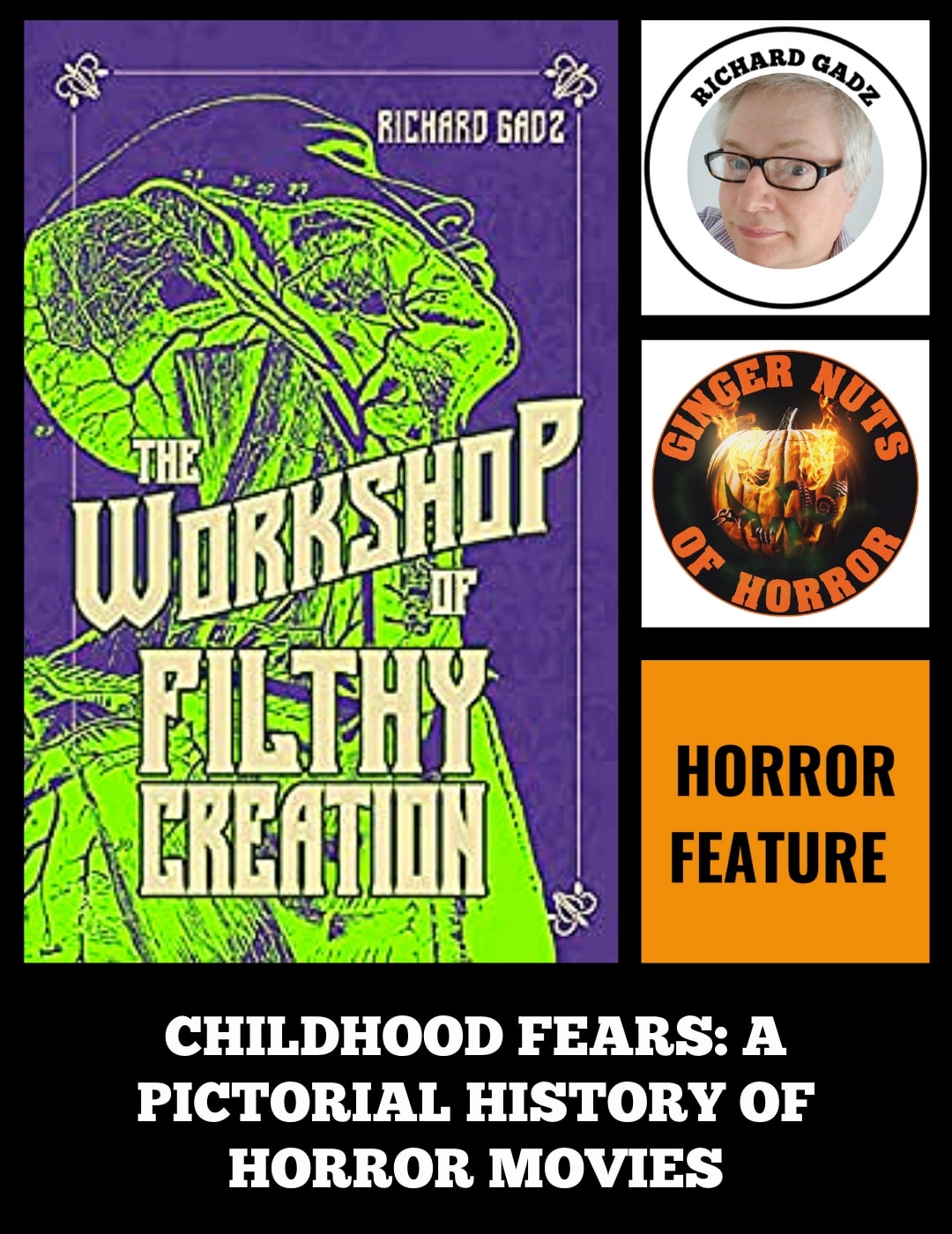
The Workshop of Filthy Creation
by Richard Gadz
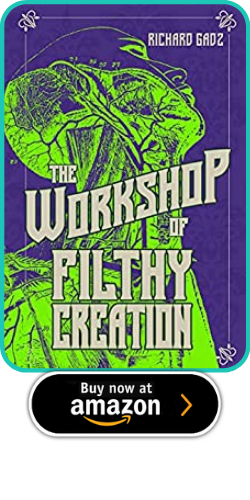
In the autumn of 1879, an intelligent, artificially-created being — outwardly a young woman called Maria — arrives in London under the protection of biologist Professor George Hobson. He gathers a few close friends and reveals her existence, explaining that she is the final result of a research programme undertaken by a dynasty of unethical scientists, the von Frakkens. All are now dead... or so it's thought.
Maria's mutilated creator tracks her down, and she goes on the run, pursued by both her creator and the police. She finds herself at the heart of a raging controversy: some want her jailed, some want her dead, and some want to peel the flesh from her bones.
Thrilling and evocative, fantastical and grotesque, The Workshop of Filthy Creation uses a Frankenstein-ian thread to stitch together elements of real scientific history with the darkest parts of Victorian London and speculation on the nature of human life.
In the autumn of 1879, an intelligent, artificially-created being — outwardly a young woman called Maria — arrives in London under the protection of biologist Professor George Hobson. He gathers a few close friends and reveals her existence, explaining that she is the final result of a research programme undertaken by a dynasty of unethical scientists, the von Frakkens. All are now dead... or so it's thought.
Maria's mutilated creator tracks her down, and she goes on the run, pursued by both her creator and the police. She finds herself at the heart of a raging controversy: some want her jailed, some want her dead, and some want to peel the flesh from her bones.
Thrilling and evocative, fantastical and grotesque, The Workshop of Filthy Creation uses a Frankenstein-ian thread to stitch together elements of real scientific history with the darkest parts of Victorian London and speculation on the nature of human life.
Publisher : Deixis Press (25 Oct. 2021)
Language : English
Paperback : 324 pages
ISBN-10 : 1838498745
ISBN-13 : 978-1838498740
"A remarkable book... The perfect combination of big ideas and a rattling good yarn. Hell of a read" - James Kinsley, author of Playtime's Over
"I adore this book... a Victorian romp, a philosophical tract, and an examination of class and privilege, as well as being a pretty gory horror novel, much like the original Frankenstein in many ways" - Goodreads
https://richardgadz.co.uk/the-workshop-of-filthy-creation/
Language : English
Paperback : 324 pages
ISBN-10 : 1838498745
ISBN-13 : 978-1838498740
"A remarkable book... The perfect combination of big ideas and a rattling good yarn. Hell of a read" - James Kinsley, author of Playtime's Over
"I adore this book... a Victorian romp, a philosophical tract, and an examination of class and privilege, as well as being a pretty gory horror novel, much like the original Frankenstein in many ways" - Goodreads
https://richardgadz.co.uk/the-workshop-of-filthy-creation/
BIO
Richard Gadz is the pen name of Simon Cheshire, author of the highly acclaimed horror novel Flesh & Blood. He lives permanently in Warwick, not far from the famous castle, although he spends most of his time in a world of his own.
Richard Gadz is the pen name of Simon Cheshire, author of the highly acclaimed horror novel Flesh & Blood. He lives permanently in Warwick, not far from the famous castle, although he spends most of his time in a world of his own.
WEBSITE LINKS
www.richardgadz.co.uk
https://twitter.com/Frankenwriter
https://www.instagram.com/richardgadz.horror.writer/
https://www.amazon.co.uk/Richard-Gadz/e/B096SZSCRD
linktr.ee/richardgadz
www.richardgadz.co.uk
https://twitter.com/Frankenwriter
https://www.instagram.com/richardgadz.horror.writer/
https://www.amazon.co.uk/Richard-Gadz/e/B096SZSCRD
linktr.ee/richardgadz

THE HEART AND SOUL OF HORROR FEATURES
 | Then suddenly the world wasn't going so well, and all the lovely ideas I'd had about writing in coffee shops and pubs and on hillsides with a flask of coffee by my side fell apart, and I was left hand writing ... at my desk. But I carried on, taking up various positions around the house while my wife and two kids were also trying to work, locked down and drinking too much coffee. |
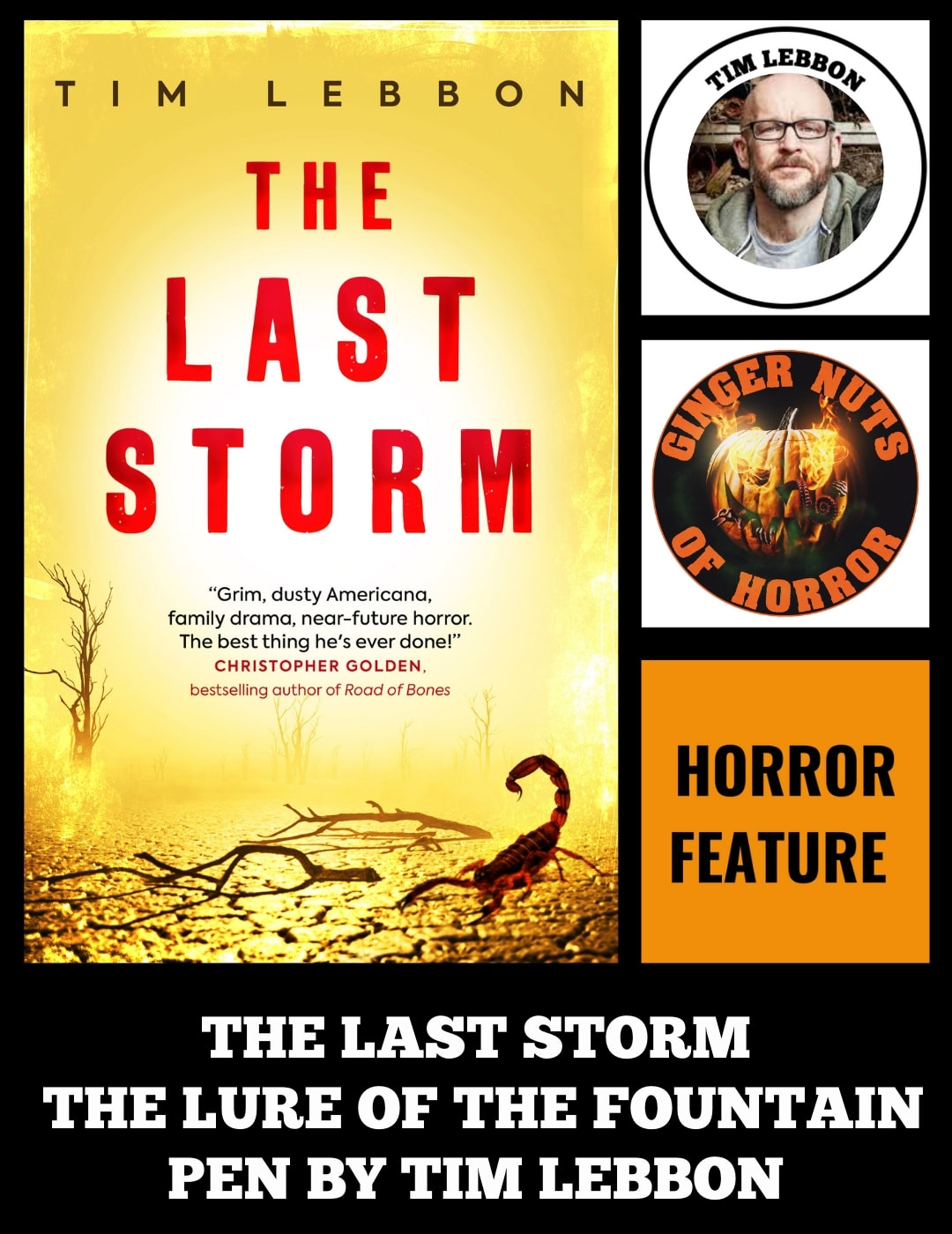
THE LAST STORM
The Lure of the Fountain Pen
by
Tim Lebbon
The Lure of the Fountain Pen
by
Tim Lebbon
It seemed like a good idea at the time. Writing my new novel longhand, in a varied selection of notebooks and with a nice new fountain pen, ticked all the boxes––being able to write literally anywhere; get away from my terrible 3-fingered typing technique (for the first draft, at least); and exercise that romantic notion I've had for years about writing a book on paper, with a pen. But without going hungry in a garret.
I blame Rio Youers. He writes all of his books like this. So for my 47th novel (9 in collaboration), for the first time ever I decided to give it a go.
I started on 20th January 2020, and to begin with it went well. Then suddenly the world wasn't going so well, and all the lovely ideas I'd had about writing in coffee shops and pubs and on hillsides with a flask of coffee by my side fell apart, and I was left hand writing ... at my desk. But I carried on, taking up various positions around the house while my wife and two kids were also trying to work, locked down and drinking too much coffee. And many months later I had a completed novel in 8 big notebooks. All I had to do now was type it up.
I'm a 3-fingered typist, remember. And I probably should have mentioned that my handwriting is truly awful, too. So much so that sometimes when I was reading it back to type up, I only just got the gist. Transcribing took a long bloody time, but it was a really good first editing process, and I don't regret the decision to write The Last Storm longhand at all. It changed a lot about how words transferred from my head and down onto the page. That aforementioned bad typing technique means that when I'm writing onto the computer, I'll often jump back and forth to correct spellings and typos, and edit the writing as I go along. Using a pen and notebook, you can cross out, sure, but I found the flow of words much more natural. I think the speed of writing using a pen matched the speed of my thoughts better than typing, and the creation of those words onto the page felt more natural. There was a flow here I'd not felt before. I'd always intended The Last Storm to have an epic road-trip feel, and I think the method of writing helped that a lot. There was an expansiveness to the experience that I just don't think would have been there if I'd written it all directly onto a computer screen.
I was also not too bothered with word count, which is something I usually keep an eye on when I'm writing on the computer. I had a rough idea, true, but I rarely finished a day worried that I hadn't written enough.
I blame Rio Youers. He writes all of his books like this. So for my 47th novel (9 in collaboration), for the first time ever I decided to give it a go.
I started on 20th January 2020, and to begin with it went well. Then suddenly the world wasn't going so well, and all the lovely ideas I'd had about writing in coffee shops and pubs and on hillsides with a flask of coffee by my side fell apart, and I was left hand writing ... at my desk. But I carried on, taking up various positions around the house while my wife and two kids were also trying to work, locked down and drinking too much coffee. And many months later I had a completed novel in 8 big notebooks. All I had to do now was type it up.
I'm a 3-fingered typist, remember. And I probably should have mentioned that my handwriting is truly awful, too. So much so that sometimes when I was reading it back to type up, I only just got the gist. Transcribing took a long bloody time, but it was a really good first editing process, and I don't regret the decision to write The Last Storm longhand at all. It changed a lot about how words transferred from my head and down onto the page. That aforementioned bad typing technique means that when I'm writing onto the computer, I'll often jump back and forth to correct spellings and typos, and edit the writing as I go along. Using a pen and notebook, you can cross out, sure, but I found the flow of words much more natural. I think the speed of writing using a pen matched the speed of my thoughts better than typing, and the creation of those words onto the page felt more natural. There was a flow here I'd not felt before. I'd always intended The Last Storm to have an epic road-trip feel, and I think the method of writing helped that a lot. There was an expansiveness to the experience that I just don't think would have been there if I'd written it all directly onto a computer screen.
I was also not too bothered with word count, which is something I usually keep an eye on when I'm writing on the computer. I had a rough idea, true, but I rarely finished a day worried that I hadn't written enough.
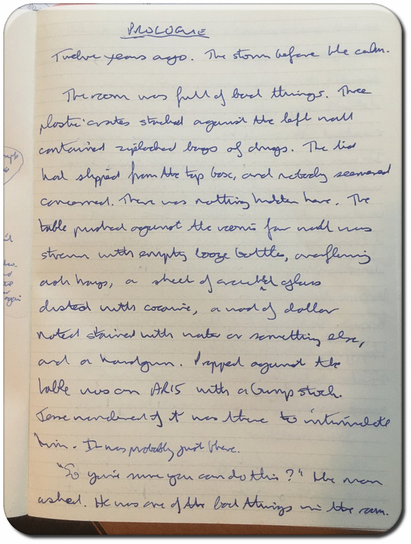
And for a novel about climate change, it felt kind of apt that I was writing using a pen and paper rather than an electronic gizmo.
The Last Storm is about a family of Rainmakers who attempt to use their arcane gift to aid a near-future America suffering from a decade of drought and famine. Things don't go according to plan. It's very loosely inspired by a short story I wrote some time ago called 'Hell Came Down', and I think it's one of the best novels I've written. The characters and the tensions between them really came alive, the setting and road trip felt real in my head––I could feel the heat on my skin, taste the sand gritty between my teeth––and the supernatural elements felt smooth and unforced.
In some ways the theme of this book might been seen as similar to Eden––people try to do something to combat the terrible climate disaster befalling our planet, and things go wrong––and that's no real surprise. I've been a lover of nature since I was a young kid, and I love being in the countryside now, whether it's taking a gentle hike with my family, or racing a tough triathlon through the mountains of Snowdonia. There's no better place to be, and I never take the countryside for granted. It's sad, then, to be able to notice such a change even in my lifetime. There aren't so many birds anymore. Writing that sentence and reading it back sounds stark, almost unbelievable, but it's true. Our garden used to be full of a variety of birds, now we're lucky if we see a few sparrows, an occasional robin or blue tit, and a few magpies. Insects, too, seem to be on the decline, and it's a rare occasion when I see a butterfly.
I'm a horror writer, so it's inevitable I'm going to write about these things. Covid has been tough, but we'll get over it. Climate change is the true challenge of our lifetime, and Eden and The Last Storm are inspired my fears and concerns about what's happening to our planet. I'm sure I'll be writing more novels in this vein ... in fact I have one taking shape now, I'm making notes, and I must admit just today I opened up the box and admired my fountain pen again. Maybe this time I won't be confined to the house.
I hope you'll check out my new novel next June, and drive those dusty highways with me, following the Rainmakers as they try to help. But keep one eye on the skies. You never know what else might fall during The Last Storm..
the last storm by tim lebbon
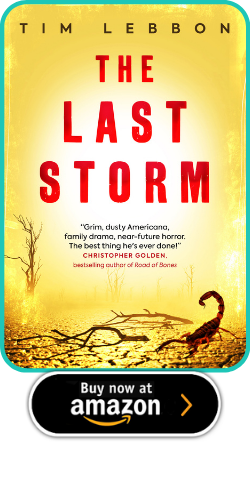
A gripping road trip through post-apocalyptic America from Tim Lebbon, New York Times bestseller and author of Netflix’s The Silence.
Struck by famine and drought, large swathes of North America are now known as the Desert. Set against this mythic and vast backdrop, The Last Storm is a timely story of a family of Rainmakers whose rare and arcane gift has become a curse.
Jesse stopped rainmaking the moment his abilities turned deadly, bringing down not just rain but scorpions, strange snakes and spiders. He thought he could help a land suffering from climate catastrophe, but he was wrong. When his daughter Ash inherited the tainted gift carried down the family bloodline, Jesse did his best to stop her. His attempt went tragically wrong, and ever since then he has believed himself responsible for his daughter's death.
But now his wife Karina––who never gave up looking for their daughter—brings news that Ash is still alive. And she's rainmaking again. Terrified of what she might bring down upon the desperate communities of the Desert, the estranged couple set out across the desolate landscape to find her. But Jesse and Karina are not the only ones looking for Ash. As the storms she conjures become more violent and deadly, some follow her seeking hope. And one is hungry for revenge.
The Last Storm is available for pre-order here
Struck by famine and drought, large swathes of North America are now known as the Desert. Set against this mythic and vast backdrop, The Last Storm is a timely story of a family of Rainmakers whose rare and arcane gift has become a curse.
Jesse stopped rainmaking the moment his abilities turned deadly, bringing down not just rain but scorpions, strange snakes and spiders. He thought he could help a land suffering from climate catastrophe, but he was wrong. When his daughter Ash inherited the tainted gift carried down the family bloodline, Jesse did his best to stop her. His attempt went tragically wrong, and ever since then he has believed himself responsible for his daughter's death.
But now his wife Karina––who never gave up looking for their daughter—brings news that Ash is still alive. And she's rainmaking again. Terrified of what she might bring down upon the desperate communities of the Desert, the estranged couple set out across the desolate landscape to find her. But Jesse and Karina are not the only ones looking for Ash. As the storms she conjures become more violent and deadly, some follow her seeking hope. And one is hungry for revenge.
The Last Storm is available for pre-order here
TODAY ON THE GINGER NUTS OF HORROR WEBSITE
BOOK REVIEW / GIVEAWAY: GIGANTIC BY ASHLEY STOKES
THE HEART AND SOUL OF HORROR FEATURES
 | Child after child plopped into that pool without incident, but I was a tangle of nerves. Pretty sure I was blubbering as I swung my pasty legs over the edge. I clung to the side of that pool like a sea anemone. The only thing gripping harder than my little white knuckles was a newfound fear of drowning, the claws of which burrowed deep into my mind. |
With the benefit of age, there are certain things you can look back on and know in your bones to be true. For example, I never liked vultures. Still don’t. It probably wasn’t anything personal - after all, I wasn’t likely to encounter many in rural Derbyshire - but I despised them as a concept all the same.
My first exposure was probably the 1994 classic, The Lion King, admittedly not a common source of night terrors. But let me remind you that this is a film in which every animal talks, and often spontaneously breaks into song. Even Scar and his army of cackling hyenas have a catchy little number with impressive choreography and (presumably expensive) pyrotechnics.
Yet when a mourning and guilt-ridden Simba flees from his childhood home and passes out in the desert, a new type of creature appears. One that doesn’t talk, or sing, or dance. A grotesque shriek is the only communication they offer. They circle ominously, all shadows and crooked talons. Then they descend upon our vulnerable protagonist; a small child who has just witnessed the murder of his father, might I remind you. They gather around his unconscious body. And then they start eating him alive.
No mercy. No words. They don’t even hum a ditty. Just a dozen of these shrill, black-clad demon birds pecking and stripping flesh. For a few seconds that seem to last an eternity, it looks like this is the end. But then the comedy duo of a warthog and a meerkat show up, scare the vultures away, and we’re - what - supposed to just forget it all happened?!
I didn’t forget, Lion King. They were eating him alive. The only reason Simba isn’t ribbons of flesh and agony is down to sheer coincidence. The fact that a jungle pig just happened to be passing by. As a child, this was no comfort whatsoever.
They. Were. Eating. Him. Alive.
Of course, the nightmares came soon after. My father was sunbathing in the garden - again, unlikely to happen in rural Derbyshire, but these are the dreams of a child - and dark shadows circled overhead. In a flurry of unkempt feathers, hooked claws and beaks like the grim reaper’s scythe, the vultures surrounded my father. The man who gave me life, utterly helpless, as they began to peck and shred and tear. No Pumba to scare them off this time. Just the harsh reality of the food chain.
I would awake in a cold sweat, struck with the same terrible thought looping in my mind. As though it were some vast, cosmic irony. They didn’t know he was sunbathing! They didn’t care, such was their lust for flesh. I ran to my parents room in floods of tears, desperate to confirm that my father was still intact. He was, but I was astonished to learn that my parents neither shared nor understood my fear of vultures.
Looking back, I suspect I was something of a naive child. A laundry list of childhood illnesses (eczema, asthma, milk allergy, bad eyesight and buck teeth - which, yes, I’m counting) meant my mother was very protective of me. I can’t exactly blame her. My childhood eczema was so bad I didn’t have eyebrows until after I hit puberty. Like the rest of my skin, I just scratched it off at night. Even wearing socks over my hands like some desperate puppeteer, I would still itch in my sleep until my legs and arms were red raw and bleeding.
Put that tiny violin away, I won’t keep on. My point is, I was a somewhat sheltered child, and my list of fears only grew over time.
For example, water was completely acceptable when I was in the shallow end of the pool. I was completely at ease in the bath. But it became an unholy terror once I was swimming and my feet couldn’t touch the bottom. A fear which I blame almost entirely on some punk kid. It was my first time at the ‘deep end’, and our swimming instructor had lined up the class. Shivering and nervous, I heard a sugary voice drift up from the pool.
“You wanna know how deep it is?” asked the punk kid, treading water, his voice dripping with faux sympathy.
I nodded, at the time unaware what faux sympathy was, or how to spell it.
This child of Satan - this stain on society - took a deep lungful of air, swam to the bottom and sat there, holding his breath for as long as possible. Maybe he’s still down there. The fact is, it terrified me. This pool was incalculably deep, and I was going to die.
Did I mention I was last in the line? Child after child plopped into that pool without incident, but I was a tangle of nerves. Pretty sure I was blubbering as I swung my pasty legs over the edge. I clung to the side of that pool like a sea anemone. The only thing gripping harder than my little white knuckles was a newfound fear of drowning, the claws of which burrowed deep into my mind.
After that, vultures didn’t seem so scary. It was like one fear made the other one pop out. For a while, I figured that was just the way it was. That people could only be afraid of one thing at a time. You’d be terrified of whatever, until something even scarier came along. Then you wouldn’t be scared of the first thing any more!
Told you I was naive.
Tales from Floor Fifty-Four (Volume 1): A collection of spine-tingling Horror stories
by Ryan Hunt
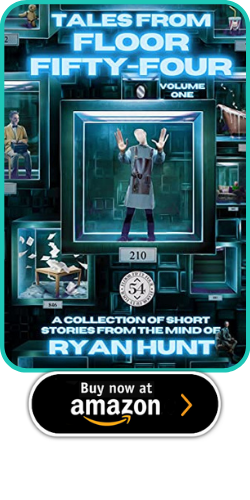
There are hundreds of horrors on Floor Fifty-Four. Curiosities too strange and dangerous to exist in our world.
Before they were locked away though, these monsters, miscreants and malfunctions roamed free on the surface. Waiting for some poor soul to devour.
TALES FROM FLOOR FIFTY-FOUR explores six such ‘Items of Interest’ - first the stories of those who stumbled upon them, then a glimpse of their new life, in this terrifying prison-for-things.
But that is not all. A seventh ‘Item of Interest’ will join you on your journey. In fact, they can’t wait to meet you.
Before they were locked away though, these monsters, miscreants and malfunctions roamed free on the surface. Waiting for some poor soul to devour.
TALES FROM FLOOR FIFTY-FOUR explores six such ‘Items of Interest’ - first the stories of those who stumbled upon them, then a glimpse of their new life, in this terrifying prison-for-things.
But that is not all. A seventh ‘Item of Interest’ will join you on your journey. In fact, they can’t wait to meet you.
Praise for TALES FROM FLOOR FIFTY-FOUR
“Utterly Genius”
“Gives me the eebie jeebies…”
“LOVE the Narrator’s story! LOVE LOVE LOVE”
ASIN : B09HTWHK7N
Publisher : Floor Fifty-Four Publishing (31 Oct. 2021)
Language : English
File size : 5609 KB
“Utterly Genius”
“Gives me the eebie jeebies…”
“LOVE the Narrator’s story! LOVE LOVE LOVE”
ASIN : B09HTWHK7N
Publisher : Floor Fifty-Four Publishing (31 Oct. 2021)
Language : English
File size : 5609 KB
Ryan Hunt
BIO
Ryan Hunt was born in the gutter and raised by wolves. A freak accident involving harps helped him discover a love for music and danger. He is a certified rascal and is often suspected of telling fibs on his author bios.
His billions of adoring fans have eventually deduced his true identity - an Engineer from Derbyshire, England. When he’s not openly lying to the general public, he can be found with a pint in his hand, and his Border Collie, Pepper, at his side.
His love of horror, science-fiction and fantasy have swirled together into the world of Floor Fifty-Four; an underground government facility that locks away paranormal artifacts too strange and too dangerous to allow roaming freely in our world. His first book, ‘Tales from Floor Fifty-Four’ launches on 31st October 2021.
Ryan Hunt was born in the gutter and raised by wolves. A freak accident involving harps helped him discover a love for music and danger. He is a certified rascal and is often suspected of telling fibs on his author bios.
His billions of adoring fans have eventually deduced his true identity - an Engineer from Derbyshire, England. When he’s not openly lying to the general public, he can be found with a pint in his hand, and his Border Collie, Pepper, at his side.
His love of horror, science-fiction and fantasy have swirled together into the world of Floor Fifty-Four; an underground government facility that locks away paranormal artifacts too strange and too dangerous to allow roaming freely in our world. His first book, ‘Tales from Floor Fifty-Four’ launches on 31st October 2021.
WEBSITE LINKS
http://www.floorfiftyfour.co.uk
Facebook - https://www.facebook.com/FloorFiftyFourOfficial
Twitter - https://twitter.com/FloorFiftyFour
http://www.floorfiftyfour.co.uk
Facebook - https://www.facebook.com/FloorFiftyFourOfficial
Twitter - https://twitter.com/FloorFiftyFour
TODAY ON THE GINGER NUTS OF HORROR WEBSITE
FILM REVIEW: ANTLERS DIRECTED BY SCOTT COOPER
THE HEART AND SOUL OF HORROR FEATURES
 | perseverance in the face of the unknown is important, that compassion is more important than self-blame, and that you must let others care for you and take care of you, just as you have to take care of others. The world is a harsh place, and no one can control everything, but we can get through these things with the people we love. |
In my new horror novel, The Wrath of Horus, there are plenty of childhood fears to talk about. Characters don’t journey through the circles of Dantes’ Inferno and not have horrible things happen to them. I am a survivor of child abuse, but rather than talk about the more graphic aspects of the book, I want to look through the lens of Marcellus Klaereon, the responsible oldest brother, and talk about a deep-seated childhood fear of mine: lack of control.
Marcellus and I both grew up in difficult circumstances. His parents are dead, and he is constantly worried about the threat of madness, both for himself and for his brother Gregorius. In my case, my parents were mad, and I was worried about the day-to-day safety of myself and my two brothers. Marcellus and I share a trait—we thought if we could plan everything, be responsible for everything, we could protect those we love from danger. Losing control of my destiny was a frightening concept, and I would short circuit whenever I felt control slipping through my fingers, which was often.
I know what you are thinking. From the vantage point of my fifties, I can see my strategy of planning everything to placate everyone is an insanity of its own sort. In reality, I was never really in control, but the illusion of control was very important to me because I could control so very little.
There are roles for members of dysfunctional families, and was the designated star or the hero, the family member who proved to the world that our family was legitimate. I developed hyper-organization and diplomacy and carried contingency planning into my college years and my adult work life, assuming that the only worth I had was in control, and in that control lay my virtue. If all else failed, I stepped forward and took responsibility for many things that were not my fault, because the alternative, that I did not have control, was unthinkable. At a certain point, I discovered I was a high functioning PTSD survivor, and I learned to live differently. There are still times when I spin, like with Coronavirus or Global Warming, or, well, many things going on in the world right now. Fear is alive and well in my psyche. I have learned strategies to cope.
In The Wrath of Horus, Marc grapples with these very issues. He has become the surrogate parent to both his brother Gregorius and their cousin Flavia. The adult in their life, Carlo Borgia, is more neglectful than abusive, caught up in his own obsessions and regret. Carlo has made one thing abundantly clear—Marc is responsible for his own sanity, and the unlikely sanity of his brother after a family rite of passage. Marc has also lost his parents, and he blames himself for that. As a child, he saw the problems in the adults in his life that resulted in his parents’ deaths. If only he could have done something more! Well, he will never be caught unprepared again! Marc believes in the illusion of control.
Unfortunately, Marc and his family are thrown into a situation beyond anyone’s control. They are subjected to judgment in the Inferno, and Marc learns he cannot control the actions of others. Writing Marc is a good exercise for me, because Marc and I learn together that perseverance in the face of the unknown is important, that compassion is more important than self-blame, and that you must let others care for you and take care of you, just as you have to take care of others. The world is a harsh place, and no one can control everything, but we can get through these things with the people we love.
The Wrath of Horus Paperback

For Gregorius Klaereon, his Trial with the god Horus isn’t about winning or losing. It’s about the fight. His temperament aggressive, his anger on display for all to see, Greg is a direct contrast to his brother Marcellus, the perfect Lord Klaereon, the prophet who can do no wrong. How Marc tolerates Greg is a mystery to Greg himself, especially as Greg knows deep down that Greg is responsible for the deaths of his parents. On the eve of the Klaereon birthday celebration, two days before Greg’s Trial, Greg fights with his cousin Flavia Borgia, and the two of them activate a reality shard which sends them, Marc, and others to the Abyss. There, they are judged and scattered throughout the nine circles. Greg, alone, discovers his Trial was the least of his worries as he is confronted by Set, the god of destruction, in a desolate landscape where his shadow powers no longer work. While Greg endures, certain his rightful punishment has found him, Marc and the others scramble to reunite, rescue Greg, and make their way to the Golden City of the banished Egyptian pantheon, desperate to find a way home.
Trigger Warnings: The Wrath of Horus is a horror novel set in Dante’s Inferno, and as such, many horrible things happen in it. It contains sexual assault, abuse, kidnapping and abduction, self-harm and suicide ideation, violence, blood, and homophobia.
Trigger Warnings: The Wrath of Horus is a horror novel set in Dante’s Inferno, and as such, many horrible things happen in it. It contains sexual assault, abuse, kidnapping and abduction, self-harm and suicide ideation, violence, blood, and homophobia.
Cath Schaff-Stump

Cath Schaff-Stump writes fantasy for children and adults. She writes funny stories, dark stories, and everything in between. She is the author of the Klaereon Scroll series and the Abigail Rath Versus series. Cath lives and works in Iowa. During the day, she teaches English at a local community college. More of her fiction has been published by Paper Golem Press, Daydreams Dandelion Press, and in The Mammoth Book of Dieselpunk. You can find her online at Facebook, Goodreads, Amazon, @cathschaffstump, and cathschaffstump.com. Follow Cath’s Kindle Vella serial The Autumn Warrior and the Ice Sword.
Links:
Cath’s Website: https://cathschaffstump.com
Twitter: https://twitter.com/cathschaffstump
Facebook: https://www.facebook.com/profile.php?id=100011247108958
Instagram: https://www.instagram.com/cathschaffstump/
Goodreads: https://www.goodreads.com/author/show/2936329.Catherine_Schaff_Stump
Amazon Author Page: https://www.amazon.com/Catherine-Schaff-Stump/e/B01BWA4V74?ref=sr_ntt_srch_lnk_2&qid=1627342800&sr=8-2
Cath’s Website: https://cathschaffstump.com
Twitter: https://twitter.com/cathschaffstump
Facebook: https://www.facebook.com/profile.php?id=100011247108958
Instagram: https://www.instagram.com/cathschaffstump/
Goodreads: https://www.goodreads.com/author/show/2936329.Catherine_Schaff_Stump
Amazon Author Page: https://www.amazon.com/Catherine-Schaff-Stump/e/B01BWA4V74?ref=sr_ntt_srch_lnk_2&qid=1627342800&sr=8-2
TODAY ON THE GINGER NUTS OF HORROR WEBSITE
WORLD EXCLUSIVE COVER REVEAL: THE LAST STORM BY TIM LEBBON
PAPERBACKS FROM HELL: THE SPIRIT BY THOMAS PAGE
THE HEART AND SOUL OF HORROR FEATURES


Archives
April 2023
March 2023
February 2023
January 2023
December 2022
November 2022
October 2022
September 2022
August 2022
July 2022
June 2022
May 2022
April 2022
March 2022
February 2022
January 2022
December 2021
November 2021
October 2021
September 2021
August 2021
July 2021
June 2021
May 2021
April 2021
March 2021
February 2021
January 2021
December 2020
November 2020
October 2020
September 2020
August 2020
July 2020
June 2020
May 2020
April 2020
March 2020
February 2020
January 2020
December 2019
November 2019
October 2019
September 2019
August 2019
July 2019
June 2019
May 2019
April 2019
March 2019
February 2019
January 2019
December 2018
November 2018
October 2018
September 2018
August 2018
July 2018
June 2018
May 2018
April 2018
March 2018
February 2018
January 2018
December 2017
November 2017
October 2017
September 2017
August 2017
June 2017
May 2017
April 2017
March 2017
February 2017
January 2017
December 2016
November 2016
October 2016
September 2016
August 2016
July 2016
June 2016
May 2016
April 2016
March 2016
February 2016
January 2016
December 2015
November 2015
October 2015
September 2015
August 2015
July 2015
June 2015
May 2015
April 2015
March 2015
February 2015
January 2015
December 2014
November 2014
October 2014
September 2014
August 2014
July 2014
June 2014
May 2014
April 2014
March 2014
February 2014
January 2014
December 2013
October 2013
September 2013
August 2013
 RSS Feed

|

|