


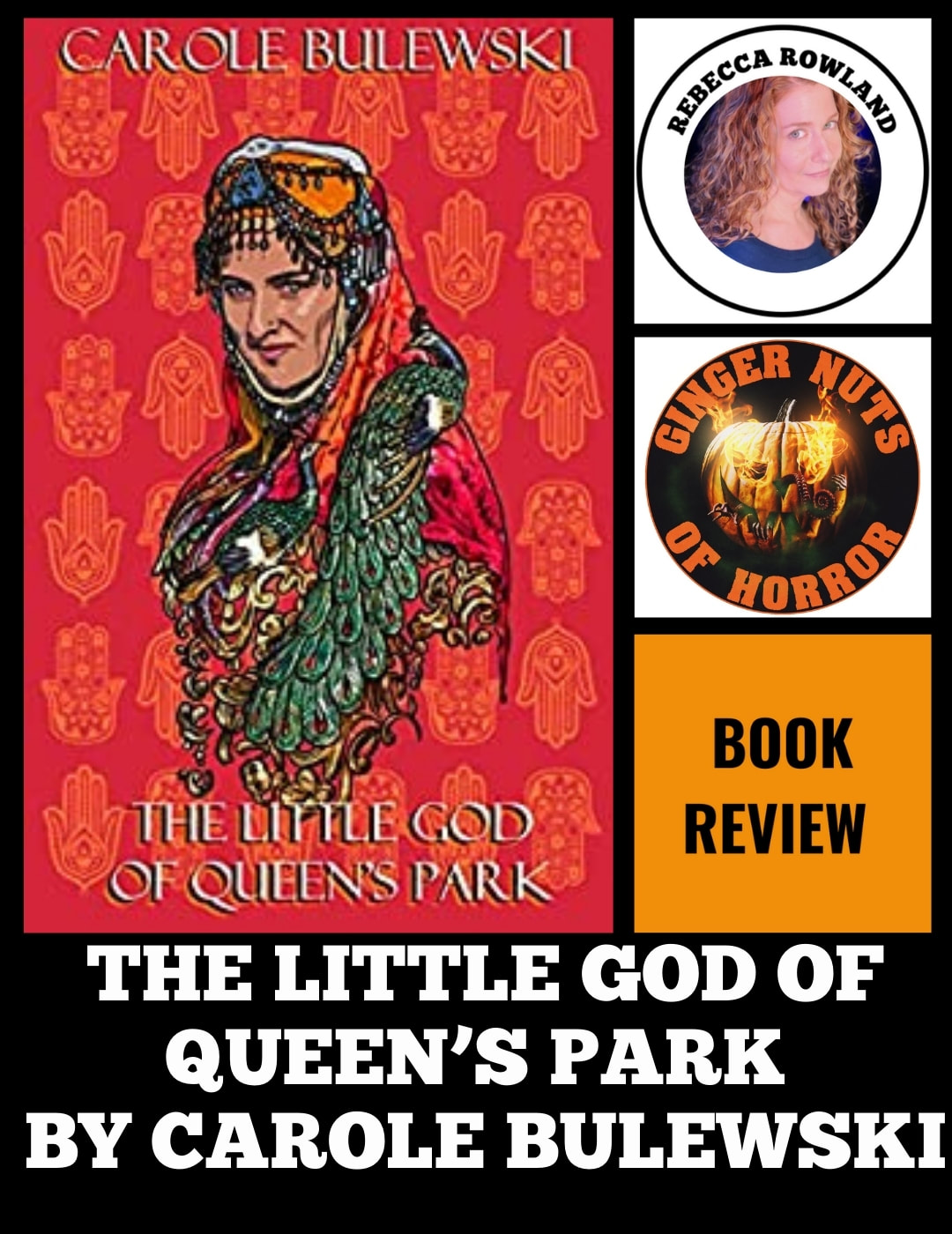
The Little God of Queen’s Park by Carole Bulewski (Review by Rebecca Rowland) In Marcus Zuzak’s The Book Thief, the everyday horrors of Nazi Germany during the Second World War are witnessed and reported on by Death himself, who eventually admits his voyeurism has caused him to be “haunted by humans.” In Carole Bulewski’s The Little God of Queen’s Park, the omniscient spectator is named Lilith, and she, too, is observing a human world ravaged by destruction. Here, however, the setting is post-apocalyptic: “half of the population had disappeared under water,” modern conveniences have evaporated, and the true nature of humankind is revealed when a group of interlopers joins a community of survivors in Queen’s Park, London. Framed as part religious horror, part dystopian morality tale, and despite clocking in at 225 pages, Bulewski’s short novel elbows its way into ensemble piece territory even as Iris and Lilith’s viewpoints steer most of the narrative. Counted among the multi-dimensional characters are Winston, a charismatic leader of musicians who join the community after their previous homestead collapses; the aforementioned Iris, a former sculptor and current co-owner of the co-op building; Raj, an Indian man whose family disowned him before The Flood when they discovered he was gay; and Julian, a xenophobic Cassandra character who warns of the destruction Winston’s group will bring. There are subtle scenes of nefariousness sprinkled about early on: one character spent time in a bizarre environmental cult until he gathered the courage to flee. After escaping, he committed himself to a mental institution, his hair having turned completely white from fright. Another character falls into a deep trance, chanting Lilith’s name again and again. It is Iris, however, who eventually channels a relationship with the lurking spirit and is soon plagued by a series of mysterious visions featuring a young girl with “dark eyes and dark hair, [and] olive skin aged before her time.” Iris is a medium and is attempting to decipher the dreams’ meanings when another resident points out, “Lilith…Laila Tov means goodnight in Hebrew. The crazy people at the Chai community, at least the Israeli ones, used to say that to each other. One day I asked if it was Laila as in the name, and Noam explained to me that it was derived from the name Lilith. Lilith, mother of demons, the one who comes at night.” Immediately after arriving at the housing development, Winston, a devout Seventh-Day Adventist, takes it upon himself to lead the residents in Sabbath services, but his plans expand much further beyond keeping tradition. A man whose faith swelled to consume him after he found himself saved from The Flood, Winston spreads a gospel that allows no mercy for vocal dissenters. As religious fervor envelopes Iris’ community, she begins to acknowledge Julian’s unheeded warning: “Winston and the Apostles won’t be starting a Church here in the Queen’s Park House, but they will do the next best thing: indoctrinate people at a time when they are mentally fragile and easy to manipulate.” Winston and his ever-growing flock of acolytes transform the first floor of the community housing development into a funeral home, and the people of Queen’s Park, still shell-shocked from the recent mass-destruction, are too frightened to do anything but follow orders in order to be “saved.” “This would have been impossible before the Flood, at least in this country,” notes Iris. “But things have changed beyond recognition. People are tired…they have no distractions. The one source of entertainment people could have is reading, for a lot of books have survived the disaster…but no one was reading anymore before the Flood, and people still cannot concentrate long enough to be able to read a novel. They’re ready for the great entertainment that is the new religion Father Winston and the Apostles have in store for them, for all of us.” Winston must reckon with Lilith, however, who has decided that the Flood is a vehicle of rebirth that has paved the way for her return. Bulewski’s writing style is cozy and readers will find it easy to hop onto the story train as it slowly increases in speed, but with that familiar voice come a bit of verbosity, not to the point of distracting the reader or interfering with the plot, but enough that readers who favor a fast-paced storyline may feel frustrated at times. Despite this mild flaw, The Little God is a smart novel: there are wisps of warning regarding the negative impact social media and other forms of mindless entertainment has made on our mental sharpness as a species and sly winks (whether intentional or not) at the cult of personality a few infamous individuals managed to glean in recent decades despite the horror of hands-tied onlookers. “People need something else in their lives so badly now,” Lilith says. “Something that is not just about survival but about believing in a power, and ideas, greater than themselves. They need a new religion, and I’m ready to be its god.” Consider it a cautionary tale for a world slowly pulling itself from the wreckage of a worldwide pandemic, and take heed.  In a not-so-distant world destroyed by an environmental disaster, a creature by the name of Lilith observes the daily lives of people forced to live together in what used to be a family house in Queen’s Park, North London. How they are trying to adapt to the new world order, to having lost everything, to being forced to do demanding manual work, and, most of all, how they interact with each other. But who is Lilith, or rather, what kind of creature is she to be able to read the innermost thoughts of the people living in the house? Could she really be a tri-millennial spirit first bound to this plane of existence by her witch mother in ancient Jerusalem, as she claims? Events take an unexpected and rather sinister turn when a new group of people who need rehousing after the collapse of a hastily constructed high-rise building come to the Queen’s Park house. Winston, their leader, is a preacher who announces the Second Coming for the virtuous people who will follow his teachings. But is he really who he pretends to be? Are his plans truly for the happiness of mankind? And how does he know so much about Lilith? Publisher : Dream's Edge Publishing (11 Sept. 2021) Language : English Paperback : 227 pages ISBN-10 : 1913844072 ISBN-13 : 978-1913844073 TODAY ON THE GINGER NUTS OF HORROR WEBSITE FILM REVIEW- BLOODTHIRSTY ( DIRECTED BY AMELIA MOSES)THIRTEEN FOR HALLOWEEN 2021: GONE HOME [FEATURE] THE HEART AND SOUL OF HORROR FICTION REVIEWS Comments are closed.
|


Archives
May 2023
|

|

|
 RSS Feed