


CRAZYTIMES BY SCOTT COLE: BOOK REVIEW
25/6/2020
 There are no hidden messages, no commentary on social issues, no metaphors or symbolism or stark warnings to stop chopping down forests or melting icebergs. It’s just a highly charged stampede into ... well, into crazy times! You know the feeling: you’re at a party and someone slides up to you, introduces themselves, and ends their sentence by adding, ‘I’m crazy; you can ask anyone.’ Deep down inside, you shudder. It’s not fear, nor is it excitement. It’s not even intrigue. The feeling you’re experiencing is the desperation to get away before the inevitable deluge of not very crazy anecdotes starts. They role their eyes and mutter, ‘I once ate my pudding before my dinner. Crazy, eh?’ Every fibre in your being screams to run, to break free, but before you can think of an excuse they drag someone else into the conversation. ‘Terry, tell him, I’m crazy, aren’t I?’ ‘Crazy,’ Terry endorses with a smile, pleased he’s not the one having to listen to the inane stories. He pities you, because he knows you’re stuck in the situation. With a shrug, he darts away. ‘Crazy,’ the self-proclaimed nut-job echoes. ‘You can ask anyone.’ You know it’s going to be a long night... When I started reading Crazytimes by Scott Cole, I had a slight dread that the novella would be not as crazy as the title or blurb suggested. Many books promise to take you on a wild ride, and few deliver. Some follow such well-trod tropes that you’ve already worked out the ending before the initial scene has been set and find yourself meandering through nonsensical twists and turns to get to the end. The problem is for many of us, if we are promised craziness, then craziness is what we want. I don’t spend valuable time reading books about craziness because deep down inside I want a bland character who eats their pudding before their dinner. Crazytimes starts slowly; well, as slowly as you can go in a relatively short novella. The main character, Trey, seems normal. His problems are problems we’ve all faced. His life is one we can all relate to, and even when he first encounters the first elements of craziness in his day, it doesn’t seem to be too crazy. The people are more annoying and rude than batshit off their heads. However, it doesn’t stay like that for long. Something is happening in the city, something strange and unexplained. The atmosphere is different, the loud ominous booms echoing in the air are alien, and people are getting increasingly crazy. There’s a good variety of craziness on show, from surly bus drivers (not too crazy in the grand scheme of things), through shit throwers (maybe a little more crazy depending on where you live), to full-on massacre and mutilation (you don’t see that every day). People are going nuts while laughing like maniacs and scratching pulsating boils on their necks. It’s a carnival of pustulant scratchy itchy insanity (plus a teapot of piss). As Trey struggles to understand what’s going on, we follow his attempt to find refuge in the city. It’s a game of cat and mouse as he tries to evade others and escape the developing insanity. On-going meteor showers seemed to be linked to the craziness, and after seeing one land he struggles to rationalise what is pretty much impossible to rationalise. 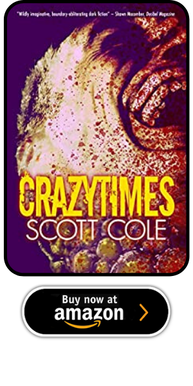 It's fair to say that Crazytimes isn’t heavy on plot. Trey wakes up, goes to work, the shit hits the fan, he runs and tries to evade the overwhelming numbers of crazy people. Having said that, it’s not the type of book which needs too much of a plot. It’s a tongue-in-cheek orgy of gore-splattered insanity, a short but high-speed blast through the centre of a hellish existence plagued by an unknown infections and alien happenings. The brevity of the book ensures you don’t get bored by the lack of sub-plot or development of other characters, and when the ending comes it does leave you with a feeling of completion. I was worried at one point it might all spiral out of control and become too much, but it delivers, leaving the reader with the feeling they’ve got somewhere! There are no hidden messages, no commentary on social issues, no metaphors or symbolism or stark warnings to stop chopping down forests or melting icebergs. It’s just a highly charged stampede into ... well, into crazy times!   THE HEART AND SOUL OF HORROR REVIEW WEBSITESTHE MAGPIE COFFIN BY WILE E. YOUNG
24/6/2020
 This book knocked my socks off! I have been craving a good western for quite a while so when I saw Deaths Head Press was publishing a series in a new subgenre they call Splatter Westerns, I was extremely excited. The book has everything you want in a western but it's written by an author who pens work in dark fiction. I was stunned by the protagonist in the story. Salem Covington holds true to the typical western tale but is also atypical in so many ways which made him intriguing and enticing. Here's the thing, this book is dark but it's seamless. The body count stacks up and there are some scenes that were terrifyingly twisted BUT it was all very fitting of the real American West. I also particularly liked the readability of this novel. The writing style, the pace, even the way the book us formatted made this a smooth and easy ride. If this story is any indication of what to expect from the rest of this series, I'm all in. The hero of this story is no hero at all. He's a blood-thirsty desperado consumed by darkness and armed with a six-shooter that yearns for death. Salem Covington is a man eager for revenge and he'll have it come hell or high water. He is exactly what you'd come to expect from the protagonist of a western only he's not. Covington is trained by the Apache Indians and well versed in many of the world's dark arts. He is definitely a force to be reckoned with and wanders the American west seeking more souls for the devil himself. Pray to God you get to keep your scalp if you cross paths with this scary desperado. The American west is an unforgiving place where a man needs grit and tenacity to survive. This is the kind of place where if you look at someone the wrong way you're apt to eat a bullet. Throw in a gunslinger that wanders the earth tallying up a massive death toll and collecting scalps, things are bound to get bloody. Wile E. Young knows how to deliver the ooey-gooey good stuff. This is a gruesome and visceral tale. I think as a fan of horror you become numb to the gorey scenes in stories but often they are excessive or extravagant whereas in The Magpie Coffin it felt... right. The viscera is decadent and fitting. 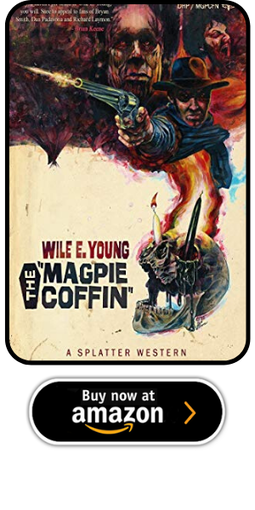 This was an incredibly easy read. Wile E. Young wrote a tale that is both fast-paced and grimdark. I thought The Magpie Coffin is the perfect example of how horrifying westerns can be. You were never waiting for something to happen, around every corner there was some terrifying danger where the antihero had to shoot his way out to survive. Aside from the author's style, Deaths Head Press did a spectacular job of formatting this book. It set the tone for the reader and made for an enjoyable reading experience. It was a pleasure to read this novel. I rate The Magpie Coffins by Wile E. Young 5 / 5 stars. This story sets the stage for what is bound to be a wildly successful endeavour in the horror community. Wile E. Young penned a terrifyingly twisted revenge story set in a gritty American wild west where terrible men and women thrive. I recommend this novel for anyone with a hankering for supernatural horror. Now, quit your caterwauling and grab yourself a copy of volume one in this splatter western series!  the heart and soul of horror review websites I have to say, the first image Christopher Stanley's 26-story collection conjured in my withered old brain was that of Suggs from Madness singing (another) comeback single about drunken love affairs with the titular lamppost. Any notions of whimsy or white men playing ska-pop were soon dispelled by the first story though, which left me with a wry grin on my face. The kind you get from a ghostly tale which ends abruptly, and shatters any preconceptions you might have about the well-worn character of a struggling writer. That opener gives way to a goodly number of other tales of the unexpected, and I use that phrase deliberately, as this gave me the same kind of vibes as the old TV show of the same name. The Lamppost Huggers... offers up some Very British Stories where bad things happen to worse people, or sometimes good ones. Not all of them are set in the UK though – the book takes you on a worldwide tour of dangerous destinations, and a range of diverse characters get pushed through Stanley's weird wringer. The globetrotting nature of the collection is a real strength, and even though the stories tend to fly by pretty fast, none of them running to more than 10 pages, you get a taste for each location before the frights begin. And if you want to talk range, you're in for more variety than a week-long jumble sale here. Witches with a taste for justice, apocalypse-summoning kids, ghosts conjured by guilt, a few (un)happy Xmases, magick, fairies, dragons and more. There's even a spooky appliance story which gives Stephen King a run for his money. Each story is short but never sweet; sometimes gory, sometimes ghoulish but mostly effective and pretty much always creepy. Some fly by too fast – there was one story about teenage troublemakers which felt like watching Lost Boys on fast forward. That one didn't quite last long enough to sink its claws in, but it still packed in some effective imagery. 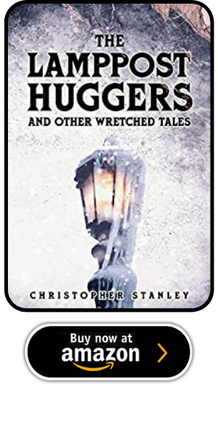 Unusually, the collection is divided into three parts, with each having a loose theme and a brief mood-setting quote. The first third has an overarching theme of lost childhoods (and sometimes lost children), where kids realise sinister fantasies in which they're separated from their less-than-attentive families. In that way, again, it brought me back to Tales of the Unexpected and Roald Dahl, as well as my own formative years in the 80's where kids were often cast as heroes, and parents as either an inconvenience or just plain shitty. There are echoes of Day of the Triffids, even Rosemary's Baby, a strong feeling of weirdness invading everyday situations along with a sense of hopelessness as situations inevitably spiral out of control, ending on notes that'll either have you grinning or grimacing. That same effective unease, and a reliance on world-ending scenarios follows into the second and third parts, where themes of climate change and altered realities also worm their way in. There are more bad parents, and put-upon children, more apocalypses and more peculiar goings-on in the most normal of settings. Most importantly though, you're always kept guessing. That's an essential part of any short story collection in my view, and this one does not disappoint. Plus, for the curious among you, there are a bunch of story notes at the end so you can delve further into the author's mind. Just don't wrap your arms around anything while you're there, you never know what might be waiting to pounce... Review by Ben Walker Paperback: 174 pages Publisher: The Arcanist Press (1 Jun. 2020) ISBN-10: 057865329X ISBN-13: 978-0578653297  the hear and soul of horror review websites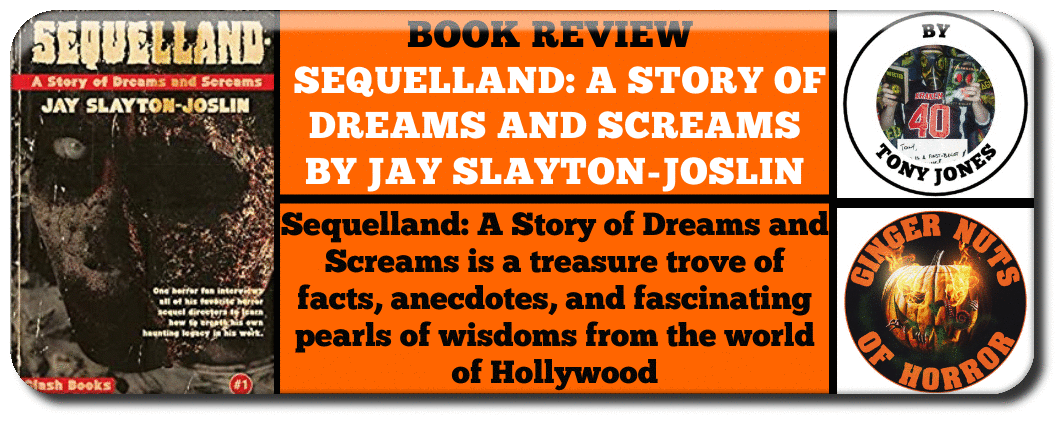 Excellent look at the diverse lives and careers of filmmakers If you enjoy reading about low budget and the trashier side of video, DVD, and cinema then Sequelland: A Story of Dreams and Screams is a treasure trove of facts, anecdotes, and fascinating pearls of wisdoms from the world of Hollywood and its outer backwaters. The movers and shakers interviewed are far from household names, but even if you do not know them from Adam that fact should not put you off, these guys have fascinating tales to spins. I am not going to bother pretending I have viewed and marvelled at Puppet Master 5, Leprechaun: Origins or many of the other flicks referenced in the book, but once again, it did not detract from an insightful series of interviews into careers which might not necessarily pick up much media coverage elsewhere. Sequelland is essentially a series of very revealing interviews with eleven filmmakers, who have all had success to some extent, and its strength lies in the fact that author Jay Slayton-Joslin really knows his source material on who are journeymen filmmakers to most readers. He does not waste our time with lame-arsed queries and asks the interviewees unique questions and allows their answers to dominate the flow of the narrative, which he skilfully steers towards his key subject of sequels. What becomes apparent, whatever your opinion on trash-cinema is, Slayton-Joslin sees these filmmakers as artists and is very respectful about their careers and this creates a rapport in which the interviewees genuinely open-up in very engaging chats. The core concept is a brilliant one and the interviews all circle this key concept: What, if anything, can a filmmaker who arrives late in a franchise bring to the party? Is originality expected or possibly even frowned upon? Although the interviews cover a lot of ground this question is the thread which links them all together and I found this fascinating and it got me thinking about films I had not seen in many years. When Adam Marcus directed Jason Goes to Hell: The Final Friday he became one of the youngest ever directors of a mainstream Hollywood film and according to Marcus the merits of this film are still debated 25+ years later as he attempted to break the mould of the previous Jason films. Personally, I remember it as being utter crap, but what Adam Marcus says interested me enough to mull over whether I need to take another look at the film? More than one interviewee notes that you must look beyond Rotten Tomato and IMDB scores, so I guess we need to look beyond the 24% this film scores on RT! Twenty years later Marcus directed Texas Chainsaw Massacre 3D, which had a twenty million budget cut down to eight which restricted what they wanted to do with the kill scenes which was an eventful career development. The interview with Uwe Boll, who specialises in films based upon video games, gave a fascinating account of how the death of the DVD market for streaming has really hurt the low budget film world. He frequently made films for between 300,000USD and 500,000USD and although his stuff was rarely seen in the cinema, they always made profit from the DVD market, with the sequels often being made more cheaply than the first on the same set. I cannot vouch for the quality of In the Name of the King I, II, or III, Seed, Bloodrayne I or II and Last Mission but this guy came across as an amiable wheeler and dealing businessman. I particularly enjoyed the interview with Jeff Burr whose first appearance in IMDB dates way back to 1982 and he notes that prospective employers would look him up on IMDB and straight away peg him for “those kind of movies” and has been involved in four relatively well known franchises. In 1989 he directed Stepfather II and the interview details the struggle he had in securing the services of Terry O’Quinn in returning to the role. The original had been a low budget sleeper hit which hit the cinemas and did massive business on video, if you have never seen it try and track it down, avoid the garbage remake lurking on Netflix. Burr notes how unambitious the studio was with Stepfather II and they would happily have released a substandard product, knowing it was still going to make money. Burr also directed Texas Chainsaw Massacre III, Puppet Master 4, Puppet Master 5 and Pumpkinhead II and was cheerfully philosophical about his involvement with these ongoing franchises and was honest about the diminishing budgets of the Puppet Master films and getting blanked by the director of the original Pumpkinhead who did not want there ever to be a sequel. John Skipp reveals how when he had been hired to write A Nightmare on Elm Street: The Dream Child, the company behind the film secretly got someone else to write an alternative script and after he was fired from the project his script was given to the other guy! The final result was an awful movie (arguably the worst in the series), which John had to battle to have his contribution honoured in the credits. Peter Webber recounts how he went from making the art house hit Girl with a Pearl Earring to Hannibal Rising, which is widely regarded as the weakest entry in the franchise, but at least he got to chat extensively with Thomas Harris. The interview with Kevin Greutert was also revealing, detailing how his job as editor in the early Saw films, led to him directing Saw 3D and Saw VI and all the problems the series had after killing Jigsaw off too early in the series. Coincidently, I spotted my daughter watching Jackals on the Horror Channel the other night, another directorial effort from Kevin. Others featured in the book include: Ernie Barbarash, responsible for Cube Zero, Stir of Echoes: the Homecoming; Zack Lipovsky, responsible for Leprechaun: Origins; Katt Shea, responsible for Poison Ivy, The Rage: Carrie 2, Stripped to Kill and II and Mary Lambert who directed Pet Semetary 1 and 2, and Urban Legends: Bloody Mary.  The final word goes to the fascinating interview with Kevin Yagher who only directed one major film, Hellraiser: Bloodline which is regarded as one of the weakest films in the franchise. Kevin points out that nobody sets out to make a bad film and this production was crippled with so many problems it was eventually anonymously credited to Alan Smithee. After this disaster Kevin returned to his main area of expertise, special effects, and make-up where he has worked on long running tv shows such as Bones and big budget films such as Face Off. Very recently he has been involved in one of the most highly anticipated film of 2020, Bill & Ted Face the Music. Along the way Sequelland author Jay Slayton-Joslin intersperses the interview with several very personal interludes which I found pleasantly engaging. These cover his love of film, his personal worries and where he hopes life may take him. It was a quirky way to split up the interviews, I got the impression he was a fairly young guy, perhaps not even old enough to remember the golden era of video shops and VHS, but his love of trash, b-movies and horror films really shone through. He sounded like a cool dude to chat about films with. Now, do I really need to watch Jason Goes to Hell: The Final Friday again? What do you think Jay? Tony Jones  THE HEART AND SOUL OF HORROR REVIEW WEBSITES I am so glad that I got the opportunity to read this book by Matt Corley and Sara Tantlinger. I absolutely DEVOURED it. The Devil's City is a novella written as a companion to Horror in the Windy City which is a sourcebook for an expansion to the Whispers in the Dark role-playing game. I will say that this was a fun read and both the book and the game can be enjoyed separately. First off, the story is incredibly immersive. The authors used diary entries to help the reader delve deep into the horrifying mind of Henry Holmes. Each and every scene was so vivid that I couldn't help but be transported to the helpless labyrinth the victims found themselves in. The murder castle is as dark and treacherous as Holmes himself. The only thing I didn't like about the book was how quickly I consumed it. I recommend that you get the companion RPG with this novella so you can keep the story going. If you are intrigued by Henry Holmes or just enjoy a grim and gruesome tale, this one is for you. The book is made up of a series of occurrences where people fall into the murderous grasp of Henry Holmes. What I really liked was how the authors used excerpts from Holmes's diary as a framing mechanism for each terrifying tale. I felt that it gave readers insight into the mind of madness. Each story brings you closer to understanding the monster that is HH Holmes. The vivid description of each scene is what really impressed me. My imagination ran wild as I was transported to the dark and grimy streets of Chicago in the 1800s. That and the nefarious Henry Holmes murder castle. It's as if we get to know an alternate antagonist. HH Holmes isn't the only monster. The castle is depicted as evil and contorted as the murderous villain. That building is proof of what kind of terror resides within its walls and is as much a partner in crime, aiding in the horrific acts that occur. 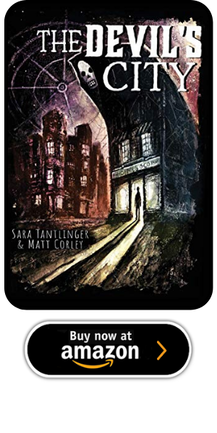 The only thing disappointing about this book is how quickly I finished it. So often, I read an outstanding novella and it's over so quickly. It always leaves me wanting more. That was certainly the case with The Devil's City. I really hope we see more Henry Holmes stories by Matt Corley and Sara Tantlinger. On the plus side, if you want to keep the story going there is a companion role-playing game called Horror in the Windy City that is an expansion to Whispers in the Dark. Essentially, you can keep the good times rolling if you liked the book as much as I did. It's something I normally wish I could have with a fun read like this. I rated The Devil's City by Matt Corley and Sara Tantlinger 5 / 5 stars. This story is a horrifying look into the mind of true evil. Readers get to experience the frightening experiments performed In the monstrosity that is the nefarious H.H. Holmes murder castle. I think that this is an exciting opportunity that fans of horror fiction will enjoy thoroughly. Not just because this is an incredible tale, readers can engage in the story and fully immerse themselves with the role-playing game as well. I don't know about you, but I'm excited to relive this dreaded tale over and over. REVIEW BY ANDREW FOWLOW THE HEART AND SOUL OF HORROR REVIEW WEBSITES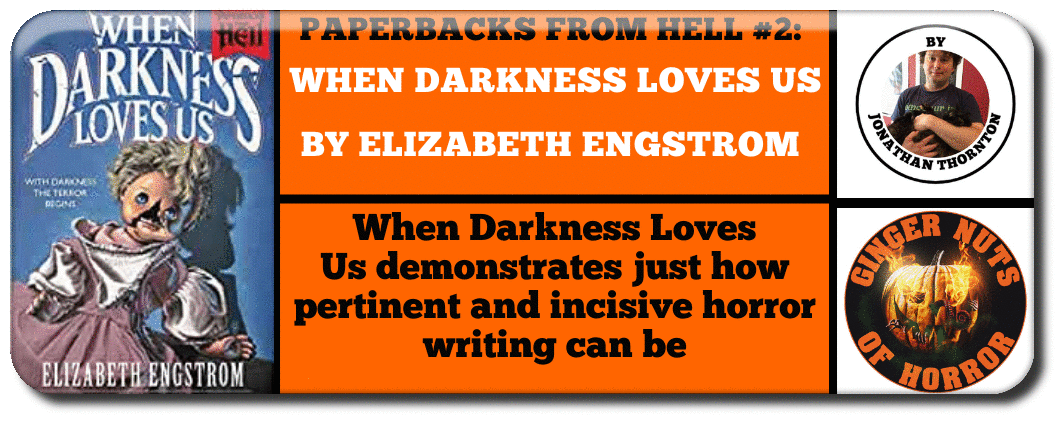 “She felt a growing surge of power in this relationship. The tables had indeed turned and she was enjoying every minute of it. She toyed with the idea of just leaving him and letting him find for himself the overpowering fear. Let him discover his own inner strength, she told herself with contempt. It takes no balls to ride a tractor. Was this the man she had pined for during more than thirty years in the underworld? This was her God, this weak man who carried peanut-butter sandwiches with him and whined when she wasn’t by his side when he awoke? She must have been insane.” Following the 2017 release of Grady Hendrix’s seminal history of the horror boom of the 1980s, Paperbacks From Hell, Valancourt Books set up its Paperbacks From Hell line last year. Curated by Hendrix and Too Much Horror Fiction’s Will Errickson, it brings many of the classics of horror’s heyday back into print, sometimes for the first time, with the original cover art lovingly restored. Given the inflating prices that the originals go for on the internet these days, this is a valuable service, bringing long out of print or hard to find books to a new and enthusiastic audience. This column will go through the series and review each title. When Darkness Loves Us (1985) was Elizabeth Engstrom’s first published book, and combines the two seminal horror novellas ‘When Darkness Loves Us’ and ‘Beauty Is…’. Both are standalone, self contained stories, but collecting them together makes sense because they are complementary explorations of similar ideas and themes, and the overall effect of reading one after the other enhances both. Engstrom’s stories are both told from the point of view of women who are deemed monstrous by the society they live in. Both stories expertly explore how these labels are forced on these women by the abuse of the patriarchy, delivered both systematically and personally. As such they are effective both as frightening horror stories but also as thoughtful critiques of the idea of the feminine monstrous in a patriarchal society. This makes Engstrom’s stories unsettling on multiple levels, her deft characterisation allowing the reader to sympathise with these characters even as they are driven to increasingly monstrous acts. ‘When Darkness Loves Us’ tells the story of Sally Ann Hixon, sixteen years old, newly married and pregnant when she is trapped underground. Presumed dead, the rest of her family above ground move on while she lives the next twenty years underground, raising her son and living off of slugs and moss. When she escapes and returns to the surface, she finds that she cannot fit in to her old life. Her husband has remarried her sister, and there is no space for her above the ground. ‘Beauty Is…’ follows Martha Mannes, a developmentally disabled woman living on her own after the death of her parents, who attracts the unwanted attention of some young punks when she wanders into a bar by chance. Both novellas follow the viewpoints of these women and explores how they are forced into monstrousness by a society that doesn’t see them as fully human. ‘When Darkness Loves Us’ is the shorter and more intense of the two. Engstrom’s vivid description of Sally Ann’s survival in chthonic darkness is claustrophobic and terrifying. Sally Ann is accompanied by Jackie, the ghost of her previous boyfriend who was killed in Vietnam, and Clinton, her son, who is a creature born to the darkness and so does not share his mother’s sense of loss over the outside world. Engstrom tightly controls the tone, leaving us unsure to what extent the darkness is populated by monsters and to what extent it is Sally Ann imagining things as her grip on sanity loosens. When Sally Ann returns to the surface, she has lost her hair and teeth, and is badly undernourished, whereas her healthy sister has a family with her ex-husband. Sally Ann is forced into the role of the monster, the vengeful revenant who destroys the domestic bliss her sister has taken from her, by a society that has no place for her now that she is older and no longer has her youthful good looks. Her husband, Michael, is dismissive and patronising towards her, refusing to believe that she gave birth to his son underground. However once Sally Ann brings him down to her domain, he is revealed to lack the courage and drive to survive that allowed Sally Ann to live down there. But Sally Ann has simply replaced one god of the patriarchy with feet of clay with another; her son Clint is vicious, angry and abusive, and controls her life underground in much the same way that Michael controlled her life above ground. Escaping the patriarchy is more difficult than simply embracing one’s status as a monster; there are always other monsters to take their place.  ‘Beauty Is…’ does not feature as many traditional horror tropes or visceral scares as ‘When Darkness Loves Us’, but it may be the more unsettling of the two stories. I was concerned about how a book from the 1980’s might handle a protagonist with developmental disabilities, but Engstrom draws Martha with depth and compassion. Over the course of the narrative, she makes it clear that Martha’s status as an outsider and a monster is entirely due to the way she is treated by others and by society at large. Her learning difficulties are the result of traumatic abuse from her father Harry, who is unable to love the baby Martha born without a nose. Martha and her mother Fern live in the shadow of Harry’s abuse, which limits what Martha is allowed to be. However, after her parents’ death, when Martha is treated with respect and compassion, she is able to learn things the doctors thought she would never understand, she flourishes and even forms a loving relationship with Leon, one of the boys from the town she lives in. Martha responds to violence when she is met by violence from the loathsome Leslie, a drunk petty criminal out to steal Martha’s inheritance, and Priscilla, who only befriends Martha to take advantage of her. Her ultimate act of violence against Priscilla again is a reflection of the patriarchy’s distorted view of women, that ties Martha’s worth forever to the fact that she can never be conventionally attractive because of her birth defects. These powerful two stories showcase Engstrom’s distinctive and troubling vision, one that still has resonance today years beyond the end of the 80’s horror paperback boom. When Darkness Loves Us demonstrates just how pertinent and incisive horror writing can be. Like all the best horror, the characters and their struggles leave one thinking long after the scares have subsided. Elizabeth Engstrom is so far the only writer who has two Paperbacks From Hell to their name, and given the strength of When Darkness Loves Us, I eagerly await reading her Black Ambrosia as I work my way through the series.  the heart and soul of horror review websites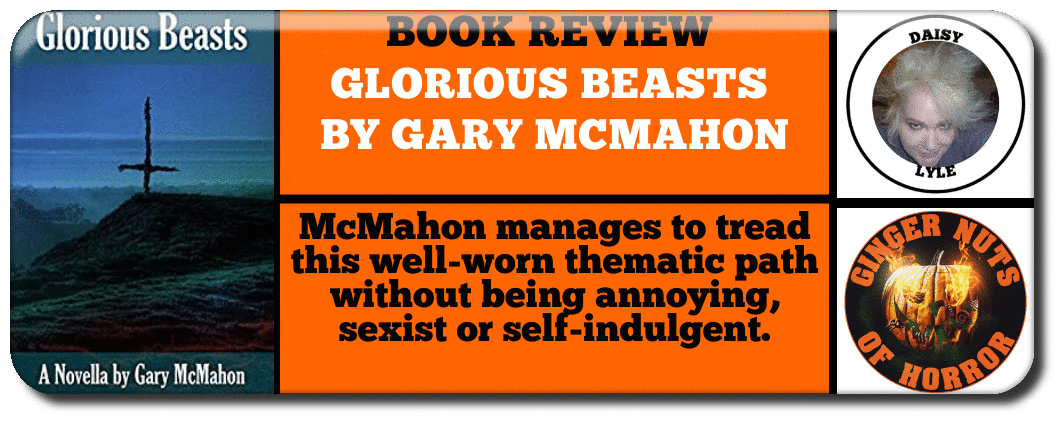 Gary McMahon is one of those authors you see popping up all the time in decent horror anthologies, and he is also known for his psychic detective character Thomas Usher (Pretty Little Dead Things, Dead Bad Things) and his more recent Concrete Grove series. He specializes in the kind of gritty, psychological but still very meaty horror that many authors from the North of England and the Midlands seem to do so well, and he always has his finger on the fluttering pulse of society. At a time when it seems that a number of social-injustice chickens are coming home to roost in even more obvious ways than usual, McMahon’s writing also feels distressingly prescient (that high-rise on the front of The Concrete Grove now looks much too much like Grenfell, for a start). In his new novella, Glorious Beasts, he’s gone a step further and ventures into post-apocalypse. The events in Glorious Beasts occur in the wake of a period of time referred to with alarming vagueness as the “Plague Years”. The conflicted hero Cable is a mercenary and recovering alcoholic who roams what’s left of society with his quietly psychic young son, Walker, eventually taking on a job investigating a kid-snatching amid rumours of terrifying supernatural beasts. The exciting bits of the apocalypse have been and gone by now, and everything is bleak and dirty, with everyone just trying to get by in an increasingly loveless world where you can’t get proper tea any more (you can still very much get booze, but that’s a dubious comfort to our hero.) It’s a very cinematic kind of read: the pair travel a landscape very reminiscent of the rural bits in the Yorkshire-based nuclear disaster film Threads, and the near-but-still-fairly-screwed-future vibe unsurprisingly evokes The Road Warrior, an impression the taut, no-nonsense prose and lashings of unglamorous dirt, putrefaction and violence do nothing to dispel. There’s also something of an Eastwood cowboy movie feel, with Cable spending a lot of the book in tiring and often futile efforts to establish control over his life by acts of physical violence, without ever quite achieving the upgrade from reactive to proactive status. However, as the story wears on other notes are heard, preventing ‘Glorious Beasts’ from turning into just another Cormac McCarthy imitation. In his afterword McMahon writes of his desire to explore the way conventional masculinity is crumbling in our modern world. This is certainly nothing unusual in itself – while women have been required to make massive adjustments to their own roles in the last fifty years without anyone shedding a drop of sympathy, the fate of Modern Man and his changing place in society seems to be of constant fascination to breast-beating writers and journalists alike. What is unusual is that McMahon manages to tread this well-worn thematic path without being annoying, sexist or self-indulgent. The focus on Cable’s relationship with his son (who, you will be relieved to hear, isn’t given to making precocious wisecracks) gives some Mouse And His Child-style emotional heft to the proceedings, and in fact I found myself wondering if the boy Walker is named after another book of Russell Hoban’s, the dystopian British rural sci-fi novel Riddley Walker.  McMahon doesn’t just cater to his male characters either. Although it takes a while for this side of things to fully emerge, the book is as much about motherhood as it is about fatherhood, and McMahon’s female characters are convincing and in some cases likeable, although a great deal of them are just as dirty, violent, compromised and/or psychotic as the men Cable has to tussle with in a series of (often literally) gutsy encounters. The love interest is a well-developed personality and isn’t just there to lay Cable (thank you I’ll be here all week.) Her own floundering in the moral quagmire of parenting has nothing to envy Spencer in David Lynch’s Eraserhead. If I had a criticism of the novella, it would be that you do at times lose sight of the supernatural element in all the rough-and-tumble, but eventually Cable and Walker’s quest leads them to a strange hill where tints of fairy lore begin to seep through. And, of course, there is the titular Beast. I won’t say too much about this, but lovers of cats great and small, and indeed wild animals in general, should enjoy its depiction and unpredictable story arc. An easy-to-read, briskly-paced work that ticks a lot of genre boxes but also has an emotional and thematic depth that creeps up on you, Glorious Beasts should have wide appeal, even in these times when the End often seems, as they say, extremely fucking nigh. Review by Daisy Lyle  the heart and soul of horror review websites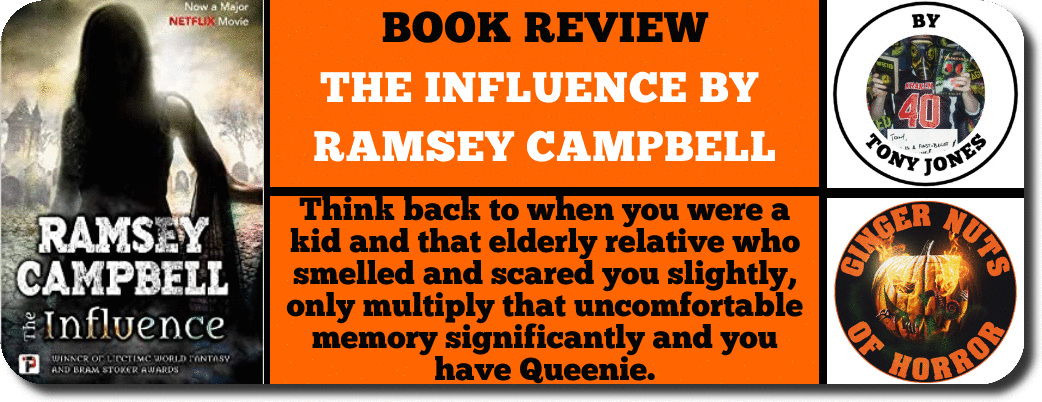 First released in 1988, Ramsey Campbell’s ‘The Influence’ has welcome rerelease to coincide with Spanish Netflix film ‘La Infuencia’ As well as releasing many great novels from both new and established authors Flame Tree Press are also resurrecting out-of-print classics, including Ramsey Campbell’s The Influence which was original published back in 1988, winning the prestigious best novel British Fantasy Society award. This is the perfect time to bring this outstanding chiller back to life for a new generation of horror fans as some months ago the Spanish film La Influencia dropped on Netflix and it was terrific to see a rare adaptation of this author’s work making it onto the screen. Although the film has relatively low scores on both Rotten Tomatoes and IMDB it remains a fascinating translation of the book, moving the action from Campbell’s hometown of Liverpool to rural Spain. Although there are many similarities, such as the main characters having the same jobs, moving the location, however, changes the dynamic completely. This review focusses on the book but will pick up elements from the film along the way. The story revolves around several members and generations of the Faraday family who are preparing for the imminent death of family matriarch, Queenie. For years she had had a stranglehold over her relatives and her unpleasant nature has blighted the lives of those closest to her. Most have avoided her when they can, but her psychological impact upon their lives is so strong that few mourn her when she eventually passes away. Queenie was an outstanding character, who must surely rank amongst Campbell’s finest, she appears mostly in flashback and dominates what is both a disturbing and unsettling story. One could argue that many of us have a spinster like Queenie in their families, but as the plot thickens the reader realises she is much more than a bitter old lady. Think back to when you were a kid and that elderly relative who smelled and scared you slightly, only multiply that uncomfortable memory significantly and you have Queenie. The blurb reveals Queenie dies in the early stages of The Influence so stating that fact is not a spoiler, however, the film is predominately built around the slow death of the old woman whilst she is in a coma in a remote farmhouse and slowly begins to influence her grandniece. Both book and film head in the same general direction, but it’s the journey of how they get there that differs greatly. The film also concentrates on the dynamics of the immediate family, whilst the book fans out with many more characters and has a much stronger sense of time and place, as Campbell’s novels often do, and are frequently set around the Merseyside area and the surrounding coastlines. The story is told in the third person from several characters point of view, including the niece Alison, her husband Derek and their daughter Rowan. Due to money difficulties they move into Queenie’s house and slowly but surely the reader is drawn into proceedings and the sense of unease develops. Like with most Ramsey Campbell novels, the pace is relatively slow and much of what goes on is connected to the problems in the extended Faraday family, a theme often revisited in Campbell’s fiction. Of course, Queenie and her residual effect is the root of all the most pressing woes. The books main weakness was it was relatively easy to see what direction the plot was heading into and although there were plenty of nice developments and a few shocking moments I was not surprised the way things panned out. Watch out for two outstanding sequences surrounding train stations, involving two different characters, which will really have the hairs on the back of your neck standing up to attention. This is connected to a second scene where a child enters a dreamlike state where they are wandering around an empty Liverpool suburb trying to find their way home.  I loved the way we were drip-fed small snatches of recollections about Queenie. We were told that she demanded the first milk tooth lost by one of her nieces and whenever she was naughty Queenie claimed she could instigate toothache, something which happened regularly until her death. Some of the very strongest sequences involved Rowan and the development of the ‘influence’ as she begins to change, the appearance of her mysterious friend ‘Vicky’ and the anxiety this causes her parents who have their own problems. If you have only watched the film, I strongly recommend you pick up the book, as there are many fascinating comparisons to be made. Films are always skeletons of books and this is no different and having seen the film is not going to spoil the enjoyment of the book as you will have fun with the contrasts. For anyone who has not read Ramsey Campbell before I would not necessarily pick The Influence as the best starting point, but it does contain many of the hallmarks which have made him one of the best supernatural writers in the world and a strong entry in the golden age of 1980s British horror. I hope Flame Tree Press continue to tap into the back-catalogues of both top writers such as Campbell and other lesser-known classics which are ripe for rediscovery. 4.5/5  THE HEAERT AND SOUL OF HORROR BOOK REVIEWS |


Archives
May 2023
|

|

|
 RSS Feed