


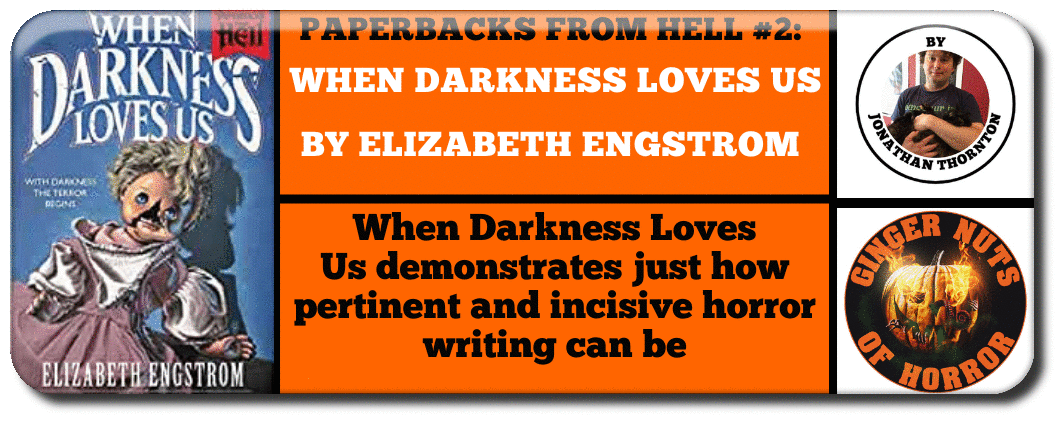
 “She felt a growing surge of power in this relationship. The tables had indeed turned and she was enjoying every minute of it. She toyed with the idea of just leaving him and letting him find for himself the overpowering fear. Let him discover his own inner strength, she told herself with contempt. It takes no balls to ride a tractor. Was this the man she had pined for during more than thirty years in the underworld? This was her God, this weak man who carried peanut-butter sandwiches with him and whined when she wasn’t by his side when he awoke? She must have been insane.” Following the 2017 release of Grady Hendrix’s seminal history of the horror boom of the 1980s, Paperbacks From Hell, Valancourt Books set up its Paperbacks From Hell line last year. Curated by Hendrix and Too Much Horror Fiction’s Will Errickson, it brings many of the classics of horror’s heyday back into print, sometimes for the first time, with the original cover art lovingly restored. Given the inflating prices that the originals go for on the internet these days, this is a valuable service, bringing long out of print or hard to find books to a new and enthusiastic audience. This column will go through the series and review each title. When Darkness Loves Us (1985) was Elizabeth Engstrom’s first published book, and combines the two seminal horror novellas ‘When Darkness Loves Us’ and ‘Beauty Is…’. Both are standalone, self contained stories, but collecting them together makes sense because they are complementary explorations of similar ideas and themes, and the overall effect of reading one after the other enhances both. Engstrom’s stories are both told from the point of view of women who are deemed monstrous by the society they live in. Both stories expertly explore how these labels are forced on these women by the abuse of the patriarchy, delivered both systematically and personally. As such they are effective both as frightening horror stories but also as thoughtful critiques of the idea of the feminine monstrous in a patriarchal society. This makes Engstrom’s stories unsettling on multiple levels, her deft characterisation allowing the reader to sympathise with these characters even as they are driven to increasingly monstrous acts. ‘When Darkness Loves Us’ tells the story of Sally Ann Hixon, sixteen years old, newly married and pregnant when she is trapped underground. Presumed dead, the rest of her family above ground move on while she lives the next twenty years underground, raising her son and living off of slugs and moss. When she escapes and returns to the surface, she finds that she cannot fit in to her old life. Her husband has remarried her sister, and there is no space for her above the ground. ‘Beauty Is…’ follows Martha Mannes, a developmentally disabled woman living on her own after the death of her parents, who attracts the unwanted attention of some young punks when she wanders into a bar by chance. Both novellas follow the viewpoints of these women and explores how they are forced into monstrousness by a society that doesn’t see them as fully human. ‘When Darkness Loves Us’ is the shorter and more intense of the two. Engstrom’s vivid description of Sally Ann’s survival in chthonic darkness is claustrophobic and terrifying. Sally Ann is accompanied by Jackie, the ghost of her previous boyfriend who was killed in Vietnam, and Clinton, her son, who is a creature born to the darkness and so does not share his mother’s sense of loss over the outside world. Engstrom tightly controls the tone, leaving us unsure to what extent the darkness is populated by monsters and to what extent it is Sally Ann imagining things as her grip on sanity loosens. When Sally Ann returns to the surface, she has lost her hair and teeth, and is badly undernourished, whereas her healthy sister has a family with her ex-husband. Sally Ann is forced into the role of the monster, the vengeful revenant who destroys the domestic bliss her sister has taken from her, by a society that has no place for her now that she is older and no longer has her youthful good looks. Her husband, Michael, is dismissive and patronising towards her, refusing to believe that she gave birth to his son underground. However once Sally Ann brings him down to her domain, he is revealed to lack the courage and drive to survive that allowed Sally Ann to live down there. But Sally Ann has simply replaced one god of the patriarchy with feet of clay with another; her son Clint is vicious, angry and abusive, and controls her life underground in much the same way that Michael controlled her life above ground. Escaping the patriarchy is more difficult than simply embracing one’s status as a monster; there are always other monsters to take their place.  ‘Beauty Is…’ does not feature as many traditional horror tropes or visceral scares as ‘When Darkness Loves Us’, but it may be the more unsettling of the two stories. I was concerned about how a book from the 1980’s might handle a protagonist with developmental disabilities, but Engstrom draws Martha with depth and compassion. Over the course of the narrative, she makes it clear that Martha’s status as an outsider and a monster is entirely due to the way she is treated by others and by society at large. Her learning difficulties are the result of traumatic abuse from her father Harry, who is unable to love the baby Martha born without a nose. Martha and her mother Fern live in the shadow of Harry’s abuse, which limits what Martha is allowed to be. However, after her parents’ death, when Martha is treated with respect and compassion, she is able to learn things the doctors thought she would never understand, she flourishes and even forms a loving relationship with Leon, one of the boys from the town she lives in. Martha responds to violence when she is met by violence from the loathsome Leslie, a drunk petty criminal out to steal Martha’s inheritance, and Priscilla, who only befriends Martha to take advantage of her. Her ultimate act of violence against Priscilla again is a reflection of the patriarchy’s distorted view of women, that ties Martha’s worth forever to the fact that she can never be conventionally attractive because of her birth defects. These powerful two stories showcase Engstrom’s distinctive and troubling vision, one that still has resonance today years beyond the end of the 80’s horror paperback boom. When Darkness Loves Us demonstrates just how pertinent and incisive horror writing can be. Like all the best horror, the characters and their struggles leave one thinking long after the scares have subsided. Elizabeth Engstrom is so far the only writer who has two Paperbacks From Hell to their name, and given the strength of When Darkness Loves Us, I eagerly await reading her Black Ambrosia as I work my way through the series.   the heart and soul of horror review websitesComments are closed.
|


Archives
May 2023
|

|

|
 RSS Feed