

THE RIVER HAS TEETH BY ERICA WATERS
26/7/2021
 To celebrate the launch of Erica Waters' The River Has Teeth, which is published on 27th July by HarperTeen we have a special double review of The River has Teeth and Erica's debut novel Ghost Wood Song from Tony Jones. ERICA WATERS – THE RIVER HAS TEETHWe often hear about the second ‘difficult’ album or novel in which the creative juices which fed the debut struggle to flow, however the second release from Erica Waters completely blows this old wife’s tale from the water. The River Has Teeth is a superb second novel and considering that Ghost Wood Song (2020) was a highly accomplished debut, this is an author to watch very closely and if she continues writing dark/horror YA fiction is destined to become a major new voice in the genre. Although the plots of her two novels are completely different, they have some similarities when it comes to themes, music (bluegrass to be precise) dominated Erica’s debut and although it does not do so in her second novel, it does play a role of some significance. Also, both novels feature bi-sexual female teenage characters who financially struggle and might be described as coming from the wrong side of the tracks. Erica convincingly gives these marginalised teens a voice. If you read and enjoyed Ghost Wood Song, you will absolutely adore The River Has Teeth. It hums with its own type of magic, which is so vibrant, believable, and beautifully described you will probably end up totally emersed in it. The action takes place in a small town in Tennessee where teenage girls have been disappearing and seventeen-year-old Della believes her mother to be the culprit. Della’s families are what we would probably term ‘hillbillies’ and live in a ramshackle house outside of town and make ends meet by selling remedies and potions to superstitious locals. Della is the youngest of a long family line of witches whose magic is connected to the area of land where they live and cultivate for the potions they create and make a living from. However, Della believes the magic has gone bad and this has turned her mother into a creature when night comes (don’t worry it’s not a vampire or werewolf) and as the police and others come snooping what can the teenager do to protect her dangerous mother? The story is told via a split first-person narrative, between Della and Natasha, whose sister is one of the disappeared girls. Natasha comes from a rich family but has her own problems from being adopted and accepting she is bisexual. After the police draw a blank Natasha comes to Della for help and after an initial personality clash the novel documents their developing friendship, secrets, and more. The River has Teeth was convincing on several levels and although magic never dominated the novel, it had an earthy type of feel to it and within the constraints of the book and the way the family operated was excellent. The conflict between the two teenagers, and developing friendship, was also a pleasure to read, both having their own problems, issues and clashes. The way in which everything came together was top notch writing, and I enjoyed the fact that the killer was not the most obvious character (or the second most obvious) helping build a very satisfying finish. Both novels by Erica Waters have specialised in giving the reader terrific ‘outsider’ characters to root behind and I cannot wait to see what this she gives us next. AGE 13+ Tony Jones  Lush and chilling, with razor-sharp edges and an iron core of hope, this bewitching, powerhouse novel of two girls fighting back against the violence the world visits on them will stun and enchant readers. Girls have been going missing in the woods… When Natasha’s sister disappears, Natasha desperately turns to Della, a local girl rumored to be a witch, in the hopes that magic will bring her sister home. But Della has her own secrets to hide. She thinks the beast who’s responsible for the disappearances is her own mother—who was turned into a terrible monster by magic gone wrong. Natasha is angry. Della has little to lose. Both are each other’s only hope. From the author of Ghost Wood Song, this eerie contemporary fantasy is perfect for fans of Wilder Girls and Bone Gap. Praise for Ghost Wood Song: “A gorgeous, creepy gem of a book.” —Claire Legrand, New York Times bestselling author of Furyborn and Sawkill Girls "It will make your heart dance." —Jeff Zentner, Morris Award-winning author of The Serpent King and Goodbye Days "Strikes the perfect balance of atmospheric chills, dark familial secrets, and a yearning for the warm comforts of home.” —Erin A. Craig, New York Times bestselling author of House of Salt and Sorrows “Waters' debut features a bisexual lead with both male and female love interests, an atmospheric southern gothic setting, and, for the musically inclined, lots of folk and bluegrass references.” --Booklist “Haunting and alluring.” --Kirkus Erica Waters – Ghost Wood Song |



|
COMPETITION |
Chapter One
The shadow was coming.
Fifteen-year-old Rasha Abadi lay slumped against her headboard, the hem of her duvet clamped in her fists. She dreaded the shadow’s return. For six nights it had come to poison her mind.
Rasha squinted through the nickel moonlight and scoured her bedroom for a sign of its arrival. It was the smallest room in caravan forty-five, and half-mended Oxfam charity electronics littered every available surface. Her clothes dryer aired the previous day’s laundry beside her secondhand desk, which bowed under the weight of school textbooks she’d eagerly consumed. That was where the shadow would appear, just as it had every night the past week.
Her digital alarm clock on her bedside table blinked: 2:03 a.m.
It was time, again.
In the corner, tendrils of viscous darkness coiled into a silhouette not quite animal, not entirely human: a malformed head, a barrel chest, misshapen limbs, and a pinched stomach. It was black – an unearthly deep void unlike anything Rasha had ever seen. The dark was hues of purple and brown in comparison.
The impossible shadow.
Rasha clamped her eyes shut, wishing it away – the shadow sometimes disappeared if she did. Only, with her eyes closed, she was plagued by memories of Syria.
Her bedroom’s plasterboard walls crumbled, and in their place came rubble, fire, and ash: the remains of her family’s apartment. Explosions shook the ground, screams filled her ears, and guilt gouged at her intestines. She reminded herself that she was in Cornwall – three thousand miles from her home city of Homs – and that she’d fled Syria four years earlier, even though her stomach knotted and her heart pounded as if it were happening at that very moment.
You’re fine, she thought to herself, opening her eyes to the shadow. It’s just PTSD, that’s what Dr Hewitt said. You’re with Mum in Gorenn Holiday Park.
The shadow grew so tall its waxen head would soon scrape the ceiling. It couldn’t have been her PTSD; her mind only conjured Syria’s decimation and their haphazard journey to Britain. Until that week, she’d never come across anything like it before. It was a shadow and so didn’t have a body. If it only had a mind, then there was one thing it could be.
A ghost.
In their culture, they didn’t have ghosts, for spirits didn’t stay on Earth. The closest to that nature were demons called Shaytan, creatures with malicious intent.
Could that be it? Rasha asked herself. Did she come back as a Shaytan to punish me?
Rasha called her sister’s name. ‘Milana?’
The shadow stepped forward, and its chest heaved.
Rasha collapsed onto her bed, too scared to cry. Sweat glued her untamable black hair to her face. The shadow didn’t move closer; it didn’t scream with agony or demand Rasha to atone. It did something impossibly worse: it stood rigidly and silently condemned her for what she had done.
‘I’m sorry,’ Rasha cried. ‘I’m so sorry.’
Rasha wept and apologised, slumped against her headboard, as her mind plunged into memories of scorching fires, singed flesh and bloodcurdling cries.
Chapter Two
A panicked shriek.
Rasha sat upright in bed. The shadow was gone, and the room was awash with tepid morning light. Another cry. A flurry of white rushed past the window. Beating wings carried on the air. It was just a seagull telling the world to wake.
She put her head between her knees so that her racing heart would still. Just a seagull . . . Just a seagull . . . Through the gap in her arms, her alarm clock read 6:20 a.m. Rasha wasn’t too sure if she’d slept or fainted. Her adrenaline had waned, and in the shadow’s presence she’d slipped into memories of Syria. Or were they nightmares? It was hard to distinguish the two. She dared not deliberate; it’d only induce another anxiety attack.
Her alarm clock blared at 6:30 a.m. Time to wake Haya. Since their family had been reduced to two, Haya had suffered extreme bouts of physically debilitating depression. It took her a long time to get going in the morning and longer still without Rasha’s support.
She raised herself from bed. Her arms were weak, her chest ached — the aftereffects of another panic attack. A nettlelike sting smothered her body, as it always did when she encountered the shadow.
Rasha left her bedroom for the kitchen, her every other thought plagued by the shadow. She mulled between cupboard and sink to brew a green tea. Its warped, melted body. Own-brand bread sizzled beneath the grill. Singed flesh. The kettle whistled to a steady boil. Milana, crumpled beneath rubble.
Stop it, she thought.
Rasha grabbed a foil sertraline packet from the top shelf and poured a glass of water, assembled a bed tray, and moped to Haya’s room. Rasha’s mother was awake when she entered – it was unlikely she’d slept. Her face was gaunt, as to be expected for someone who had to be prompted to eat. Her thick black hair was neglected and speckled grey. Rasha lowered the tray onto her mother’s side table and climbed into the bed beside her. Haya raised two heavy arms and cradled Rasha, who traced purple scars on her mother’s arm with her hand. Haya had gained those marks by saving Rasha’s life.
Only she and Haya had survived the explosion that fateful night in Homs. Haya had pulled her from the wreckage and burned her left forearm in a fire that shrouded the debris. Her father’s and sister’s bloodied remains eradicated all thought so Rasha remembered little of the following journey. They’d been crammed amongst crates in the back of a truck, hidden in a waterside town house in Calais, and sandwiched amongst other desperate asylum seekers in a shipping container. British border patrollers had cracked open the container and escorted them to a detention centre in Gatwick. Three months, two key workers, and an appeal later, they were granted ‘leave to remain’ and relocated to the village of Gorenn in South Cornwall. Since then, the duo had lived in a routine that Rasha tirelessly maintained to try to find some sort of normality.
‘It’s that time already?’ Haya asked in Levantine, their mother tongue.
Their Syrian friends had often mused how Haya’s daughters were mirror images of her, so when she looked at Rasha’s plump face, warm beige skin, and wide green eyes with adoration and sadness, Rasha wondered whether she was a constant reminder of Milana.
She deliberated telling her mother about the shadow, but Haya barely had enough capacity for what was real.
‘I don’t know if I can do it today,’ Haya uttered.
‘It’s a short day,’ Rasha assured. ‘Mr Keats said one deep clean, three stays. You’ll be done by eleven. Then you can go back to bed.’
‘There’s laundry to do.’
‘I’ve done it. Take your pill, drink your tea, and I’ll get the sink ready.’
Rasha planted a kiss on Haya’s forehead and left the bedroom. She arranged Haya’s work clothes on the bathroom flasket and filled the sink with hot water. Haya held on for as long as she could before she rose to wash; the water would be at the perfect temperature by the time she did.
Rasha changed and avoided the corner where the shadow had been. Within twenty minutes she was in her patched school uniform, sat at the dining room table, munching on a pack of chocolate bourbon creams to suppress her appetite. Glucose, the perfect fuel for the sleep-deprived.
For someone haunted by shadows.
Haya stifled a yawn as she entered, acrylic tabard on, hair wound in a tight bun. With her was the cup of tea and plate of toast, which hadn’t been touched. Haya was a far cry from the woman Rasha remembered in pre-war Syria when she’d worked as paralegal’s secretary. Rasha supposed that Middle Eastern qualifications meant nothing when she wasn’t legally allowed to work under ‘leave to remain.’ It was why Rasha had begged the site owner, Mr Keats, to allow her mother to do cash-in-hand work – she craved a purpose as much as they needed the money.
Haya tutted playfully and offered her hand. Rasha reluctantly gave her the packet of bourbons.
‘All this sugar,’ Haya moaned. ‘Your insides will rot, never mind your teeth.’
‘Yes, Mama.’
‘No sweets before lunch, you hear me?’
‘No sweets before lunch.’
It was time for Rasha to leave, after all. She had four miles of country lanes to walk. She rose and hugged Haya.
‘If I have to eat savoury, you have to eat something.’
Haya nodded.
‘I promise,’ she whispered.
‘Unconditionally,’ Rasha said.
‘Unconditionally.’
Rasha squeezed her tightly, then donned her rucksack and stepped into the spearmint morning. She faltered on the bottom step and wrung the straps of her bag. She contemplated every lesson sat quietly, hoping to be left alone by teacher and student, every solitary break time spent in an empty classroom or toilet cubicle.
Get through it, she told herself. Get through it and get back to the caravan.
Not that solace was found during evenings spent in forty-five, the place she was meant to call home.
She took a deep breath and trudged on. Gorenn Holiday Park was compiled of caravans each within their own fenced ten-by-twenty-metre paddock, all arranged alongside a clean gravel path. Mr Keats’s caravan was at the heart of the holiday rentals, adjacent to the maintenance shed and activities lodge. His family consisted of seven obese tabby cats that milled within their fenced enclosure. Rasha stopped a moment to itch one of their chins, taking in the sea as it frothed and rolled beyond the caravans, letting the cool salt air course through her nostrils and ease her lungs.
‘ ’ere, Rasha,’ came Mr Keats’s voice. ‘What do you know about cats?’
The site manager, a thin man with a whisker-clad face and beady eyes, looked like an inquisitive otter walking on its hind legs. The morning wind threatened to rush under his bathrobe and Monroe him.
‘They like fish, hate belly rubs,’ she replied.
‘They like fish.’ He laughed. ‘Well, ’parently mine dunt. They haven’t touched a thing since yesterday. Gonna ’ave to take ’em to the vets, ain’t I?’
‘Best be on the safe side,’ Rasha said. She nuzzled the head of an obese tabby.
‘Speakin’ of which, keep an eye out on yer walk. There’s been some wrong un’s loitering around here at night.’
‘People?’ Rasha returned. She always struggled with Mr Keats’s thick accent.
‘They ain’t guests, I know that much. Probably lookin’ to pinch gas bottles, so keep yer eyes peeled. Tell your mother, too.’
‘Sure. See ya.’
School started in an hour, so Rasha continued on. Shadows at night, strange people who wandered the caravan site by day. Rasha’s anxious mind couldn’t help but put the two together. For a moment she deliberated taking the school bus but decided against it. She hadn’t taken the school bus in months – crammed into a metal box with no escape from bullies was far from appetising. Into the bending valley lanes Rasha went until the caravan park was a blip behind her. Despite the long walk in all varieties of Cornish weather, she enjoyed the momentary freedom from the concrete and plaster that caged her very existence, where benign livestock plodded along in the fields beside her.
Escaping her thoughts was another matter. The shadow plagued her mind. She didn’t believe for a second that she’d imagined it. Its fathomless depths of black had absorbed all light in the room, whilst its silhouette could have been the decomposed carcass of an unearthly beast. Her imagination could not conjure such an image.
Not that it mattered. Rasha thought too much, and her lungs welded themselves to her diaphragm in anxiety’s havoc.
Her neck prickled, just as it had when the shadow appeared.
Not here, not now. She circled, but the grassy verges either side of her were empty.
Could it be the shadow? No, the shade around her belonged to trees and power lines. Nothing unordinary in the lane. But in the neighbouring field, there was.
Over the hedge to her left, across the pasture by a dilapidated cow shed, Rasha spotted three figures. Hoods hid their faces. A woman and two men. The shortest man consulted a gadget in his hands. Mr Keats had spoken of strange people who skulked around the area. What’s more, they looked straight her way. What else was there to see in the valley but fields and cattle?
They watched her.
Rasha ran as fast as her legs would carry her and never looked back.
The shadow was coming.
Fifteen-year-old Rasha Abadi lay slumped against her headboard, the hem of her duvet clamped in her fists. She dreaded the shadow’s return. For six nights it had come to poison her mind.
Rasha squinted through the nickel moonlight and scoured her bedroom for a sign of its arrival. It was the smallest room in caravan forty-five, and half-mended Oxfam charity electronics littered every available surface. Her clothes dryer aired the previous day’s laundry beside her secondhand desk, which bowed under the weight of school textbooks she’d eagerly consumed. That was where the shadow would appear, just as it had every night the past week.
Her digital alarm clock on her bedside table blinked: 2:03 a.m.
It was time, again.
In the corner, tendrils of viscous darkness coiled into a silhouette not quite animal, not entirely human: a malformed head, a barrel chest, misshapen limbs, and a pinched stomach. It was black – an unearthly deep void unlike anything Rasha had ever seen. The dark was hues of purple and brown in comparison.
The impossible shadow.
Rasha clamped her eyes shut, wishing it away – the shadow sometimes disappeared if she did. Only, with her eyes closed, she was plagued by memories of Syria.
Her bedroom’s plasterboard walls crumbled, and in their place came rubble, fire, and ash: the remains of her family’s apartment. Explosions shook the ground, screams filled her ears, and guilt gouged at her intestines. She reminded herself that she was in Cornwall – three thousand miles from her home city of Homs – and that she’d fled Syria four years earlier, even though her stomach knotted and her heart pounded as if it were happening at that very moment.
You’re fine, she thought to herself, opening her eyes to the shadow. It’s just PTSD, that’s what Dr Hewitt said. You’re with Mum in Gorenn Holiday Park.
The shadow grew so tall its waxen head would soon scrape the ceiling. It couldn’t have been her PTSD; her mind only conjured Syria’s decimation and their haphazard journey to Britain. Until that week, she’d never come across anything like it before. It was a shadow and so didn’t have a body. If it only had a mind, then there was one thing it could be.
A ghost.
In their culture, they didn’t have ghosts, for spirits didn’t stay on Earth. The closest to that nature were demons called Shaytan, creatures with malicious intent.
Could that be it? Rasha asked herself. Did she come back as a Shaytan to punish me?
Rasha called her sister’s name. ‘Milana?’
The shadow stepped forward, and its chest heaved.
Rasha collapsed onto her bed, too scared to cry. Sweat glued her untamable black hair to her face. The shadow didn’t move closer; it didn’t scream with agony or demand Rasha to atone. It did something impossibly worse: it stood rigidly and silently condemned her for what she had done.
‘I’m sorry,’ Rasha cried. ‘I’m so sorry.’
Rasha wept and apologised, slumped against her headboard, as her mind plunged into memories of scorching fires, singed flesh and bloodcurdling cries.
Chapter Two
A panicked shriek.
Rasha sat upright in bed. The shadow was gone, and the room was awash with tepid morning light. Another cry. A flurry of white rushed past the window. Beating wings carried on the air. It was just a seagull telling the world to wake.
She put her head between her knees so that her racing heart would still. Just a seagull . . . Just a seagull . . . Through the gap in her arms, her alarm clock read 6:20 a.m. Rasha wasn’t too sure if she’d slept or fainted. Her adrenaline had waned, and in the shadow’s presence she’d slipped into memories of Syria. Or were they nightmares? It was hard to distinguish the two. She dared not deliberate; it’d only induce another anxiety attack.
Her alarm clock blared at 6:30 a.m. Time to wake Haya. Since their family had been reduced to two, Haya had suffered extreme bouts of physically debilitating depression. It took her a long time to get going in the morning and longer still without Rasha’s support.
She raised herself from bed. Her arms were weak, her chest ached — the aftereffects of another panic attack. A nettlelike sting smothered her body, as it always did when she encountered the shadow.
Rasha left her bedroom for the kitchen, her every other thought plagued by the shadow. She mulled between cupboard and sink to brew a green tea. Its warped, melted body. Own-brand bread sizzled beneath the grill. Singed flesh. The kettle whistled to a steady boil. Milana, crumpled beneath rubble.
Stop it, she thought.
Rasha grabbed a foil sertraline packet from the top shelf and poured a glass of water, assembled a bed tray, and moped to Haya’s room. Rasha’s mother was awake when she entered – it was unlikely she’d slept. Her face was gaunt, as to be expected for someone who had to be prompted to eat. Her thick black hair was neglected and speckled grey. Rasha lowered the tray onto her mother’s side table and climbed into the bed beside her. Haya raised two heavy arms and cradled Rasha, who traced purple scars on her mother’s arm with her hand. Haya had gained those marks by saving Rasha’s life.
Only she and Haya had survived the explosion that fateful night in Homs. Haya had pulled her from the wreckage and burned her left forearm in a fire that shrouded the debris. Her father’s and sister’s bloodied remains eradicated all thought so Rasha remembered little of the following journey. They’d been crammed amongst crates in the back of a truck, hidden in a waterside town house in Calais, and sandwiched amongst other desperate asylum seekers in a shipping container. British border patrollers had cracked open the container and escorted them to a detention centre in Gatwick. Three months, two key workers, and an appeal later, they were granted ‘leave to remain’ and relocated to the village of Gorenn in South Cornwall. Since then, the duo had lived in a routine that Rasha tirelessly maintained to try to find some sort of normality.
‘It’s that time already?’ Haya asked in Levantine, their mother tongue.
Their Syrian friends had often mused how Haya’s daughters were mirror images of her, so when she looked at Rasha’s plump face, warm beige skin, and wide green eyes with adoration and sadness, Rasha wondered whether she was a constant reminder of Milana.
She deliberated telling her mother about the shadow, but Haya barely had enough capacity for what was real.
‘I don’t know if I can do it today,’ Haya uttered.
‘It’s a short day,’ Rasha assured. ‘Mr Keats said one deep clean, three stays. You’ll be done by eleven. Then you can go back to bed.’
‘There’s laundry to do.’
‘I’ve done it. Take your pill, drink your tea, and I’ll get the sink ready.’
Rasha planted a kiss on Haya’s forehead and left the bedroom. She arranged Haya’s work clothes on the bathroom flasket and filled the sink with hot water. Haya held on for as long as she could before she rose to wash; the water would be at the perfect temperature by the time she did.
Rasha changed and avoided the corner where the shadow had been. Within twenty minutes she was in her patched school uniform, sat at the dining room table, munching on a pack of chocolate bourbon creams to suppress her appetite. Glucose, the perfect fuel for the sleep-deprived.
For someone haunted by shadows.
Haya stifled a yawn as she entered, acrylic tabard on, hair wound in a tight bun. With her was the cup of tea and plate of toast, which hadn’t been touched. Haya was a far cry from the woman Rasha remembered in pre-war Syria when she’d worked as paralegal’s secretary. Rasha supposed that Middle Eastern qualifications meant nothing when she wasn’t legally allowed to work under ‘leave to remain.’ It was why Rasha had begged the site owner, Mr Keats, to allow her mother to do cash-in-hand work – she craved a purpose as much as they needed the money.
Haya tutted playfully and offered her hand. Rasha reluctantly gave her the packet of bourbons.
‘All this sugar,’ Haya moaned. ‘Your insides will rot, never mind your teeth.’
‘Yes, Mama.’
‘No sweets before lunch, you hear me?’
‘No sweets before lunch.’
It was time for Rasha to leave, after all. She had four miles of country lanes to walk. She rose and hugged Haya.
‘If I have to eat savoury, you have to eat something.’
Haya nodded.
‘I promise,’ she whispered.
‘Unconditionally,’ Rasha said.
‘Unconditionally.’
Rasha squeezed her tightly, then donned her rucksack and stepped into the spearmint morning. She faltered on the bottom step and wrung the straps of her bag. She contemplated every lesson sat quietly, hoping to be left alone by teacher and student, every solitary break time spent in an empty classroom or toilet cubicle.
Get through it, she told herself. Get through it and get back to the caravan.
Not that solace was found during evenings spent in forty-five, the place she was meant to call home.
She took a deep breath and trudged on. Gorenn Holiday Park was compiled of caravans each within their own fenced ten-by-twenty-metre paddock, all arranged alongside a clean gravel path. Mr Keats’s caravan was at the heart of the holiday rentals, adjacent to the maintenance shed and activities lodge. His family consisted of seven obese tabby cats that milled within their fenced enclosure. Rasha stopped a moment to itch one of their chins, taking in the sea as it frothed and rolled beyond the caravans, letting the cool salt air course through her nostrils and ease her lungs.
‘ ’ere, Rasha,’ came Mr Keats’s voice. ‘What do you know about cats?’
The site manager, a thin man with a whisker-clad face and beady eyes, looked like an inquisitive otter walking on its hind legs. The morning wind threatened to rush under his bathrobe and Monroe him.
‘They like fish, hate belly rubs,’ she replied.
‘They like fish.’ He laughed. ‘Well, ’parently mine dunt. They haven’t touched a thing since yesterday. Gonna ’ave to take ’em to the vets, ain’t I?’
‘Best be on the safe side,’ Rasha said. She nuzzled the head of an obese tabby.
‘Speakin’ of which, keep an eye out on yer walk. There’s been some wrong un’s loitering around here at night.’
‘People?’ Rasha returned. She always struggled with Mr Keats’s thick accent.
‘They ain’t guests, I know that much. Probably lookin’ to pinch gas bottles, so keep yer eyes peeled. Tell your mother, too.’
‘Sure. See ya.’
School started in an hour, so Rasha continued on. Shadows at night, strange people who wandered the caravan site by day. Rasha’s anxious mind couldn’t help but put the two together. For a moment she deliberated taking the school bus but decided against it. She hadn’t taken the school bus in months – crammed into a metal box with no escape from bullies was far from appetising. Into the bending valley lanes Rasha went until the caravan park was a blip behind her. Despite the long walk in all varieties of Cornish weather, she enjoyed the momentary freedom from the concrete and plaster that caged her very existence, where benign livestock plodded along in the fields beside her.
Escaping her thoughts was another matter. The shadow plagued her mind. She didn’t believe for a second that she’d imagined it. Its fathomless depths of black had absorbed all light in the room, whilst its silhouette could have been the decomposed carcass of an unearthly beast. Her imagination could not conjure such an image.
Not that it mattered. Rasha thought too much, and her lungs welded themselves to her diaphragm in anxiety’s havoc.
Her neck prickled, just as it had when the shadow appeared.
Not here, not now. She circled, but the grassy verges either side of her were empty.
Could it be the shadow? No, the shade around her belonged to trees and power lines. Nothing unordinary in the lane. But in the neighbouring field, there was.
Over the hedge to her left, across the pasture by a dilapidated cow shed, Rasha spotted three figures. Hoods hid their faces. A woman and two men. The shortest man consulted a gadget in his hands. Mr Keats had spoken of strange people who skulked around the area. What’s more, they looked straight her way. What else was there to see in the valley but fields and cattle?
They watched her.
Rasha ran as fast as her legs would carry her and never looked back.
COMPETITION
FOR A CHANCE TO WIN ONE OF TWO PRIZE BOXES CONTAINING
- A paperback ARC of the book
- A signed book plate
- 2 x bookmarks
- An art sticker
- A pin badge
SIMPLY FOLLOW TERRY KITTO ON TWITTER
AND RETWEET THIS PINNED TWEET
AND FOR AS BONUS ENTRY FOLLOW US ON INSTAGRAM AND LIKE THIS POST
https://www.instagram.com/p/CRmFMQRspY6/?hl=en
- A paperback ARC of the book
- A signed book plate
- 2 x bookmarks
- An art sticker
- A pin badge
SIMPLY FOLLOW TERRY KITTO ON TWITTER
AND RETWEET THIS PINNED TWEET
AND FOR AS BONUS ENTRY FOLLOW US ON INSTAGRAM AND LIKE THIS POST
https://www.instagram.com/p/CRmFMQRspY6/?hl=en
FOR A CHANCE TO WIN ONE OF TWO PRIZE BOXES CONTAINING
— Ginger Nuts of Horror (@GNutsofHorror) July 21, 2021
- A paperback ARC of the book
- A signed book plate
- 2 x bookmarks
- An art sticker
- A pin badge
follow @Terry_Kitto and retweet this tweet https://t.co/2PfpwAsMqN pic.twitter.com/DJG9cOvP0R

|

|
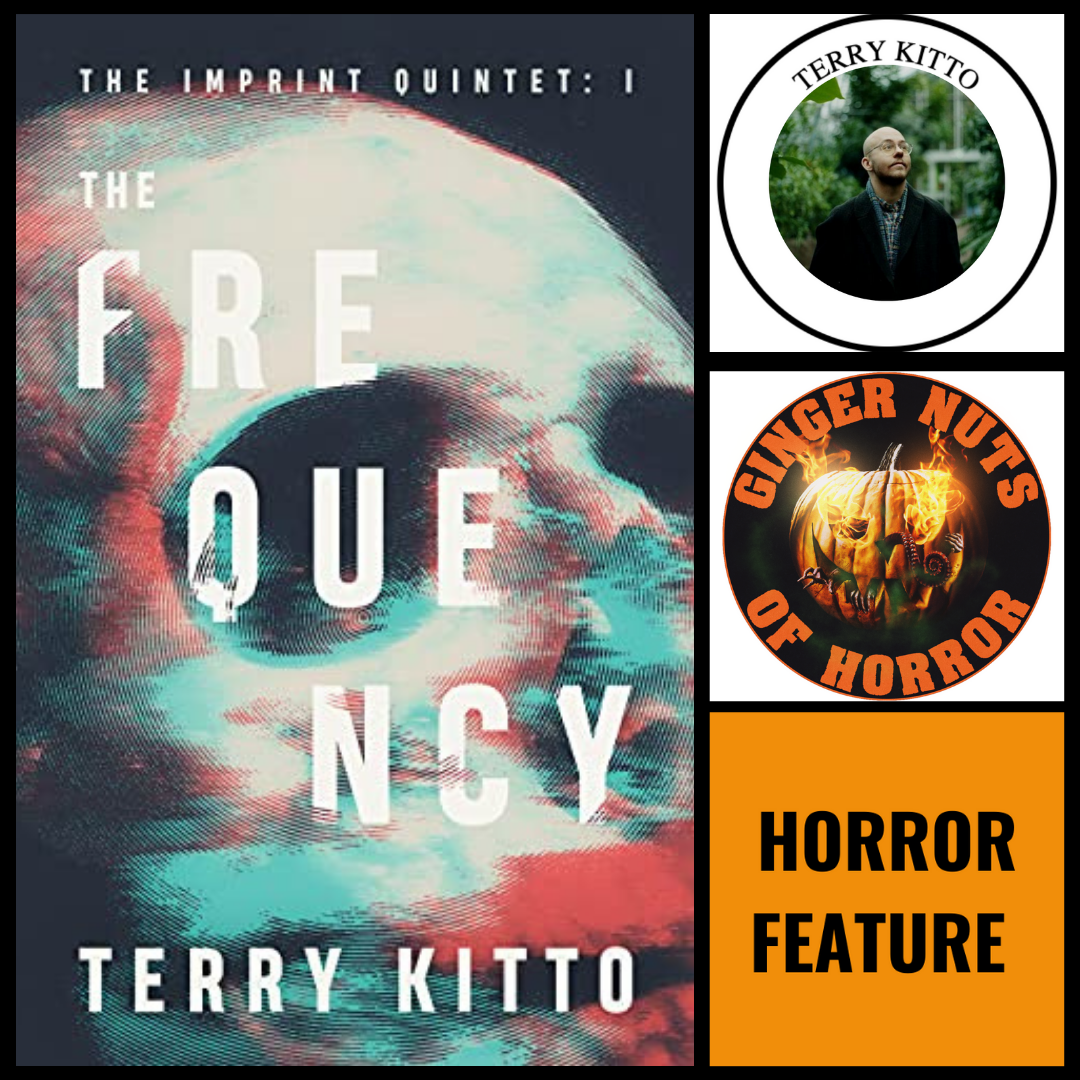
The Frequency: A Mind-Bending Paranormal Thriller (The Imprint Quintet Book 1) by Terry Kitto

Death wasn’t an absolute end, but a further form of being.
Deep within the bowels of an abandoned Cornish mine a covert occult group, known as the Network, protects the living from the dead. Their mediums host a plethora of abilities — from telepathy to astral projection — because of their connection to an energy source called the frequency.
Fifteen-year-old Rasha Abadi and her mother are Syrian refugees granted leave to remain in Gorenn Village. The seaside town sprawls with beaches and idyllic coves, but the last thing Rasha finds there is peace. An impossible shadow visits her nightly and infests her mind with memories of the chaos that she and her mother fled in Syria. When she becomes possessed by the shadow, the Network intervenes to save her.
The shadow’s wrath knows no bounds and orchestrates a string of interconnected possessions across the south coast. Having survived the shadow, Rasha eagerly offers to aid the Network’s investigation. They must all act quickly to unearth its motive before it disrupts the balance between the living and the dead, and forges a new world from the embers of their own reality.
No choice will be easy for Rasha when thwarting a monster means becoming one herself.
The Frequency is a paranormal thriller exploring grief in a world where death is just the beginning and where reality can be rewritten. Fans of Stephen King and James Herbert will enjoy this mind-bending, paranormal thriller with LGBTQ+ and POC characters.
This is book one in The Imprint Quintet series, a five-part saga following a rag-tag group of mediums as they attempt to thwart an otherworldly tyrant from unleashing paranormal terrorism.
Deep within the bowels of an abandoned Cornish mine a covert occult group, known as the Network, protects the living from the dead. Their mediums host a plethora of abilities — from telepathy to astral projection — because of their connection to an energy source called the frequency.
Fifteen-year-old Rasha Abadi and her mother are Syrian refugees granted leave to remain in Gorenn Village. The seaside town sprawls with beaches and idyllic coves, but the last thing Rasha finds there is peace. An impossible shadow visits her nightly and infests her mind with memories of the chaos that she and her mother fled in Syria. When she becomes possessed by the shadow, the Network intervenes to save her.
The shadow’s wrath knows no bounds and orchestrates a string of interconnected possessions across the south coast. Having survived the shadow, Rasha eagerly offers to aid the Network’s investigation. They must all act quickly to unearth its motive before it disrupts the balance between the living and the dead, and forges a new world from the embers of their own reality.
No choice will be easy for Rasha when thwarting a monster means becoming one herself.
The Frequency is a paranormal thriller exploring grief in a world where death is just the beginning and where reality can be rewritten. Fans of Stephen King and James Herbert will enjoy this mind-bending, paranormal thriller with LGBTQ+ and POC characters.
This is book one in The Imprint Quintet series, a five-part saga following a rag-tag group of mediums as they attempt to thwart an otherworldly tyrant from unleashing paranormal terrorism.
TODAY ON THE GINGER NUTS OF HORROR WEBSITE
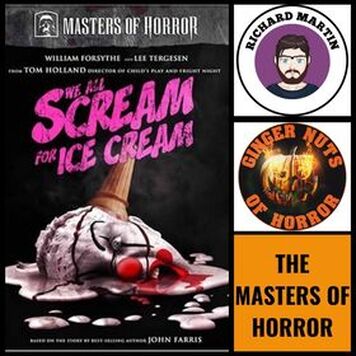
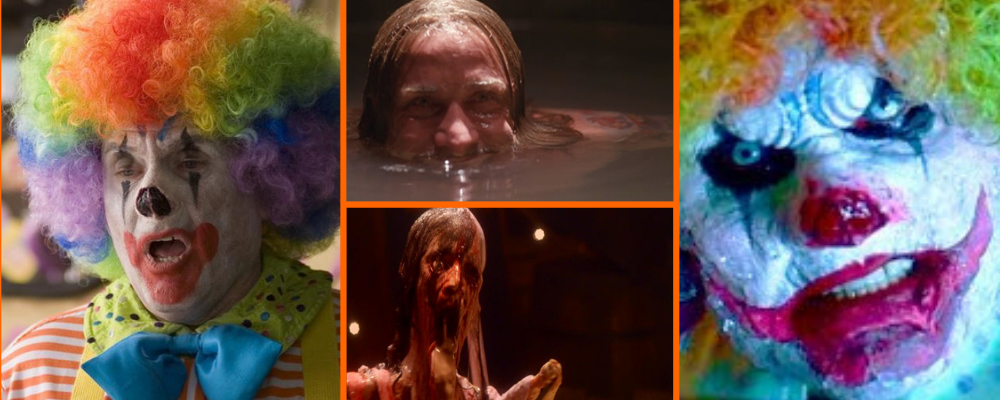
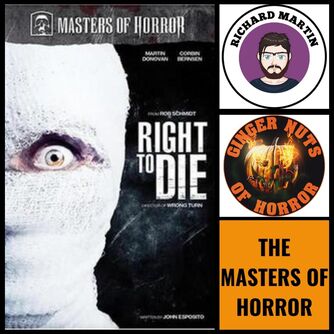
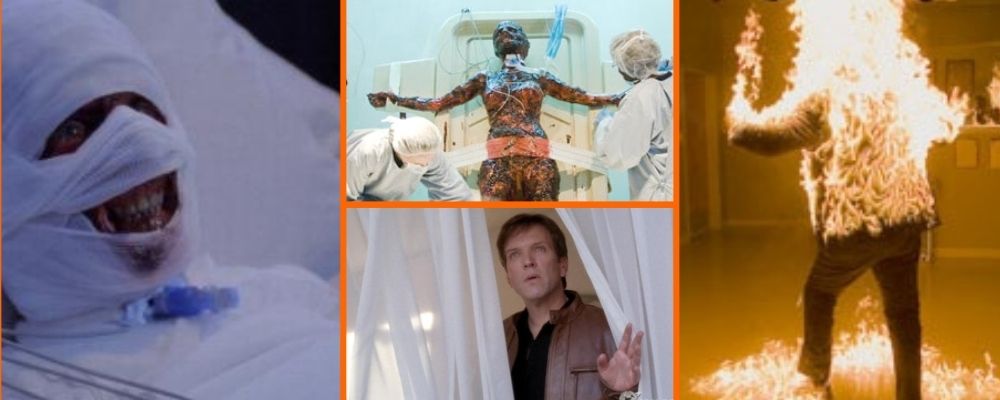
RICHARD MARTIN REVISITS THE MASTERS OF HORROR: RIGHT TO DIE, DIRECTED BY:ROB SCHMIDT

THE HEART AND SOUL OF HORROR FEATURES
WERE TALES: A SHAPESHIFTER ANTHOLOGY
20/7/2021
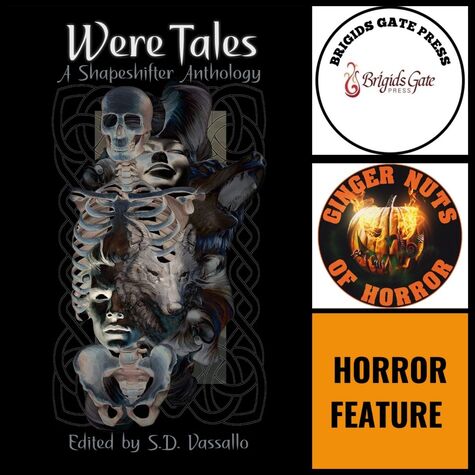
Werewolves. Berserkers. Kitsune. From the most ancient times, people have told tales of men who transform into beasts. Sometimes they’re friendly and helpful. Sometimes they’re tricksters, playing jokes on their hapless victims. And sometimes, they’re terrifying. The last sound anyone wants to hear while walking through a dark forest under the bright full moon is the howl of the werewolf. Especially when the howl is followed by the sound of something running towards them through the woods.
Were Tales is a collection of scary, thrilling, dark, mysterious, and even humorous tales and poems of shapeshifters, from the talented minds of Jonathan Maberry, Stephanie Ellis, Gabino Iglesias, Laurel Hightower, Eric J. Guignard, Michelle Garza and Melissa Lason, Shane Douglas Keene, Clara Madrigano, Kev Harrison, Beverley Lee, S.H. Cooper, Elle Turpitt, Catherine McCarthy, Alyson Faye, Theresa Derwin, Ruschelle Dillon, Baba Jide Low, H.R. Boldwood, Ben Monroe, Cynthia Pelayo, Cindy O’Quinn, Sara Tantlinger, Stephanie M. Wytovich, Linda Addison, Villimey Mist, Tabatha Wood, and Christina Sng.
S.D. Vassallo had this to say about the anthology.
Werewolves and other types of shapeshifters have long been my favorite horror and fantasy trope. I enjoy other horror icons as well, such as ghosts, demons and witches, but none of them capture my attention or fuel my imagination as much as the werewolf. Even vampires, as cool as they may be, pale in comparison to the shapeshifter. If you were to ask me to compile a list of my favorite horror novels and movies, some titles you would definitely see are “An American Werewolf in London,” “The Howling,” “Wolfen,” “The Wolf’s Hour” by Robert R. McCammon, and “Cycle of the Werewolf” by Stephen King.
It’s only natural, then, that the first anthology we’re creating for Brigids Gate Press is a collection of stories about werewolves and other shapeshifters. It’s been a dream come true. I’ve had the opportunity to work with talented writers for Were Tales. The stories they’ve submitted feature many different kinds of shapeshifters: werewolves, werebears, werefoxes, and many others, including a wereskunk.
ABOUT BRIGIDS GATE PRESS
My wife and I had a shared dream of running a publishing company one day. In late 2020, we decided dreams shouldn’t wait for a perfect ‘one-day’ scenario. So, here we are. We still dream of the perfect office space with cottage retreat spaces. Some day! While we welcome established authors, our primary focus is promoting the work of new and underrepresented voices in fiction.
Were Tales is a collection of scary, thrilling, dark, mysterious, and even humorous tales and poems of shapeshifters, from the talented minds of Jonathan Maberry, Stephanie Ellis, Gabino Iglesias, Laurel Hightower, Eric J. Guignard, Michelle Garza and Melissa Lason, Shane Douglas Keene, Clara Madrigano, Kev Harrison, Beverley Lee, S.H. Cooper, Elle Turpitt, Catherine McCarthy, Alyson Faye, Theresa Derwin, Ruschelle Dillon, Baba Jide Low, H.R. Boldwood, Ben Monroe, Cynthia Pelayo, Cindy O’Quinn, Sara Tantlinger, Stephanie M. Wytovich, Linda Addison, Villimey Mist, Tabatha Wood, and Christina Sng.
S.D. Vassallo had this to say about the anthology.
Werewolves and other types of shapeshifters have long been my favorite horror and fantasy trope. I enjoy other horror icons as well, such as ghosts, demons and witches, but none of them capture my attention or fuel my imagination as much as the werewolf. Even vampires, as cool as they may be, pale in comparison to the shapeshifter. If you were to ask me to compile a list of my favorite horror novels and movies, some titles you would definitely see are “An American Werewolf in London,” “The Howling,” “Wolfen,” “The Wolf’s Hour” by Robert R. McCammon, and “Cycle of the Werewolf” by Stephen King.
It’s only natural, then, that the first anthology we’re creating for Brigids Gate Press is a collection of stories about werewolves and other shapeshifters. It’s been a dream come true. I’ve had the opportunity to work with talented writers for Were Tales. The stories they’ve submitted feature many different kinds of shapeshifters: werewolves, werebears, werefoxes, and many others, including a wereskunk.
ABOUT BRIGIDS GATE PRESS
My wife and I had a shared dream of running a publishing company one day. In late 2020, we decided dreams shouldn’t wait for a perfect ‘one-day’ scenario. So, here we are. We still dream of the perfect office space with cottage retreat spaces. Some day! While we welcome established authors, our primary focus is promoting the work of new and underrepresented voices in fiction.
the heart and soul of horror features
 | As a teenager, none of my friends were interested in reading. Cheap booze on the chilly slopes of the local golf course? Yes. Awkward and infrequent dalliances with the opposite sex? Definitely. |
The Body of the State: Clive Barker, Politics and the Noble Tapeworm
‘The dead have highways.’ Even now, thirty or so years on from the first time I read those words, they send a chill down my spine. The omnibus editions of Books of Blood were my initiation into the shocking, sinister yet often beautiful worlds of Clive Barker and as an opener, that line takes some beating. Now an elder statesman of the genre, Barker was at the time horror’s Young Turk and spearhead of the nascent ‘splatterpunk’ movement in horror fiction, which was seen as a rejection of the ‘traditional, meekly suggestive horror story’. At a time when the Video Nasties List seemed to me like the irresistible menu of a restaurant whose doors were forever locked, the Books of Blood were a revelation. To stretch the analogy far beyond breaking, Barker had set up another eatery next door, one whose décor and clientele were decidedly more upmarket, therefore deflecting the squint eye of pearl-clutching eighties censors. Barker’s cuisine – served rare - was available to all; the only requirements were an open mind and the imagination to keep up with some bizarre and transgressive concepts.
It is impossible to speak in any meaningful way about the entirety of Books of Blood without expanding an article like this to towering, teetering proportions, so my focus will narrow to a single story from the first volume of that collection. In the Hills, The Cities features an unforgettable central image. Twin behemoths, each consisting of the lashed-together population of rival cities, meet in ceremonial combat in the isolated hills of a forgotten corner of Eastern Europe. When laid out in simple terms, it sounds faintly ridiculous, right? You see, Barker’s work often asks something of the reader, and this story in particular demands more than usual. Suspension of disbelief can be a tough hurdle for some readers to clear and with an obstacle this soaring, many might struggle to connect with the narrative, and so abandon it. But to do this would be to miss an incredible story, and the point. The story’s main characters, Mick and Judd, recognise the sheer absurdity of their situation. It is their struggle with disbelief that ultimately sends them into a mad spiral towards their divergent fates.
The horror genre can be perversely conservative. Especially at the time these stories were written, horror more often than not hued to traditional roles and societal norms. Think of the teenagers in so many slasher movies, horny and heterosexual, happy to indulge in some carefully framed missionary-position antics or smoke a little puff – just enough bad behaviour to justify their imminent brutal slaughter. From the off, Barker signals that he has no interest in this squeamishness. We meet Mick and Judd on a road trip through Yugoslavia, and quickly find that they are lovers. Their gay relationship is not flagged as unusual or shocking; their dialogue, like their entire dynamic, is believable in that it is almost completely mundane. Like many couples who only really come to know each while on holiday, they find that cracks between them are widening. In the confined space of their Volkswagen, differences that were perhaps overlooked in the first flush of infatuation become glaringly obvious. An impromptu sexual liaison by the side of the road – naturalistically and explicitly portrayed by Barker - temporarily papers over those cracks, but each has a feeling that their time together is coming to an end. Judd is a journalist with fervent political opinions while Mick is a dance teacher with a love for the arts. All that holds them together now is their mutual physical attraction and a desire to get through this final excursion unscathed.
In the Hills, The Cities is about communism. No, it’s not subtle. It is front and centre in that indelible image – the individuals of an Eastern Bloc city banding together for the greater good at the risk of their own lives. They are living and dying for the city, and are proud to do it. I’m ashamed to say I completely missed this when I first read it at age fifteen. Judd’s hyper-political remarks; the toiling of the locals as they are compelled to work harder and harder; the small lapses that lead to the downfall of the almighty whole – they all went over my head. What struck me – beyond the extraordinary concept of the rival giants – was the delicate way in which Mick and Judd’s relationship is handled. Unlike most horror fiction I had read up to that point, both were protagonist and antagonist. I could sympathise with both of them while also feeling like the other was a bit annoying, and all over the span of no more than twenty-seven pages. The rival cities of Popolac and Podujevo also eschew characteristics like good and evil. Both are simply carrying out a tradition that stretches far into the past, a friendly contest between neighbours, albeit one that has grown in stature and risk over the decades.
We are never told why these cities clash every ten years. In fact, the why is unimportant. The only justification that is given is that it has always been done. This struggle between the traditional (giant combat) and the modern (communism and its tendency to chew up the proletariat) is mirrored in Mick and Judd’s relationship. One wants only to view the hoary, antiquated art of local monasteries while the other wants only to debate the heavyweight political issues of the day. Each has nothing but disdain for the other’s interests, a situation that is tearing them apart.
To our modern sensibilities, the concept of the mysterious secret hidden in the obscurity of darkest Eastern Europe is perhaps a tough one to swallow. In some ways, it harkens back to much earlier horror fiction like that of Lovecraft, where the danger is foreign and unknowable. But Barker is the anti-Lovecraft; where one consistently fails to describe the horrors that assail his characters, the other does not flinch from the smallest detail, however outlandish or nauseating. This story bears all of Barker’s hallmarks, from sadomasochism and bondage to violence and gore, but also liberal springs of poetry. Consider Judd’s reply when Mick suggests a detour to view some more religious art: ‘”I told you, I don’t want to see another church; the smell of the places makes me sick. Stale incense, old sweat and lies…”’
The conclusion of the tale, with the countryside awash in blood and a mad behemoth rampaging through the hills, brings Barker’s surrealism and body horror to a fitting end. Judd, unable to comprehend the insanity that is striding towards him (or, to suspend his disbelief) is struck down. Mick, equally affected by this unimaginable spectacle, is caught up in it. The giants’ downfall is a mirror of that of the lovers, and like the giants, each goes to his end in his own particular way.
I’ve read this story many times over the years. It’s probably the entry in Books of Blood that I’ve read most (although the near-journalism of Down, Satan! is a close second). The care and intricacy that Barker corralled into those twenty-seven pages was revealed gradually over those readings, like a mystery slowly giving up its secrets. I love the believable humanity of the characters, and the otherworldly and bizarre situation they find themselves in. As always, Barker paints his worlds with thoughtful and surprising strokes, and requires the reader to invest enough of themselves that they feel brought along for the ride, not left to passively observe like some gawping onlooker. Perhaps that’s why so many of his stories feel personal to us. But I’m not here to talk about why I love this strange amalgam of fantasy, horror and politics now; let’s get to the origin story.
As a teenager, none of my friends were interested in reading. Cheap booze on the chilly slopes of the local golf course? Yes. Awkward and infrequent dalliances with the opposite sex? Definitely. As part of that group, I was just as enthusiastic and clumsy in my pursuit of these activities as the others. But as far as my contemporaries were concerned, reading belonged in school. Gav’s thing was that he liked to steal cars; Damo’s thing was the heroic intake of pills; Dave drank until he turned into a high street living statue. While I may have dabbled in their personal interests – some more than others – they never dipped so much as a toe into mine. That I was into nerdy stuff like books and all that, was just accepted and never discussed. It was my thing. Then I read Books of Blood, and suddenly I wanted it to become our thing. In my meandering, inadequate way, I described to them the stories I had read. They laughed and agreed that they did indeed sound cool, and then we went off to do something else, probably involving an off-licence and a blue plastic bag.
The creation of my Barker reading circle was a bust, but the effort revealed to me something else. Here I had found stories that I felt connected to for reasons I could explain – Incredible ideas! Addictive prose! Fountains of gore! – and also for reasons I could not. In fact, these were more than stories; they were a transaction that demanded investment on the reader’s part and rewarded them with unthinkable revelations. That fiction could be a mutual back and forth exchange between author and reader was yet another concept that had failed to occur to fifteen-year old me, but I have no doubt that I felt something like it on a subterranean level. Good fiction grants the reader a measure of ownership. The characters, the plots and the style itself are absorbed so deeply that they can’t help but become a part of you. Like nature’s hero, the noble tapeworm. And like that most excellent of beasts, good stories – once embedded – are tough to get rid of, even though there are some we would happily live without. Like the one about the massive pig. What the hell was that all about, Clive? I mean, ugh.
It is impossible to speak in any meaningful way about the entirety of Books of Blood without expanding an article like this to towering, teetering proportions, so my focus will narrow to a single story from the first volume of that collection. In the Hills, The Cities features an unforgettable central image. Twin behemoths, each consisting of the lashed-together population of rival cities, meet in ceremonial combat in the isolated hills of a forgotten corner of Eastern Europe. When laid out in simple terms, it sounds faintly ridiculous, right? You see, Barker’s work often asks something of the reader, and this story in particular demands more than usual. Suspension of disbelief can be a tough hurdle for some readers to clear and with an obstacle this soaring, many might struggle to connect with the narrative, and so abandon it. But to do this would be to miss an incredible story, and the point. The story’s main characters, Mick and Judd, recognise the sheer absurdity of their situation. It is their struggle with disbelief that ultimately sends them into a mad spiral towards their divergent fates.
The horror genre can be perversely conservative. Especially at the time these stories were written, horror more often than not hued to traditional roles and societal norms. Think of the teenagers in so many slasher movies, horny and heterosexual, happy to indulge in some carefully framed missionary-position antics or smoke a little puff – just enough bad behaviour to justify their imminent brutal slaughter. From the off, Barker signals that he has no interest in this squeamishness. We meet Mick and Judd on a road trip through Yugoslavia, and quickly find that they are lovers. Their gay relationship is not flagged as unusual or shocking; their dialogue, like their entire dynamic, is believable in that it is almost completely mundane. Like many couples who only really come to know each while on holiday, they find that cracks between them are widening. In the confined space of their Volkswagen, differences that were perhaps overlooked in the first flush of infatuation become glaringly obvious. An impromptu sexual liaison by the side of the road – naturalistically and explicitly portrayed by Barker - temporarily papers over those cracks, but each has a feeling that their time together is coming to an end. Judd is a journalist with fervent political opinions while Mick is a dance teacher with a love for the arts. All that holds them together now is their mutual physical attraction and a desire to get through this final excursion unscathed.
In the Hills, The Cities is about communism. No, it’s not subtle. It is front and centre in that indelible image – the individuals of an Eastern Bloc city banding together for the greater good at the risk of their own lives. They are living and dying for the city, and are proud to do it. I’m ashamed to say I completely missed this when I first read it at age fifteen. Judd’s hyper-political remarks; the toiling of the locals as they are compelled to work harder and harder; the small lapses that lead to the downfall of the almighty whole – they all went over my head. What struck me – beyond the extraordinary concept of the rival giants – was the delicate way in which Mick and Judd’s relationship is handled. Unlike most horror fiction I had read up to that point, both were protagonist and antagonist. I could sympathise with both of them while also feeling like the other was a bit annoying, and all over the span of no more than twenty-seven pages. The rival cities of Popolac and Podujevo also eschew characteristics like good and evil. Both are simply carrying out a tradition that stretches far into the past, a friendly contest between neighbours, albeit one that has grown in stature and risk over the decades.
We are never told why these cities clash every ten years. In fact, the why is unimportant. The only justification that is given is that it has always been done. This struggle between the traditional (giant combat) and the modern (communism and its tendency to chew up the proletariat) is mirrored in Mick and Judd’s relationship. One wants only to view the hoary, antiquated art of local monasteries while the other wants only to debate the heavyweight political issues of the day. Each has nothing but disdain for the other’s interests, a situation that is tearing them apart.
To our modern sensibilities, the concept of the mysterious secret hidden in the obscurity of darkest Eastern Europe is perhaps a tough one to swallow. In some ways, it harkens back to much earlier horror fiction like that of Lovecraft, where the danger is foreign and unknowable. But Barker is the anti-Lovecraft; where one consistently fails to describe the horrors that assail his characters, the other does not flinch from the smallest detail, however outlandish or nauseating. This story bears all of Barker’s hallmarks, from sadomasochism and bondage to violence and gore, but also liberal springs of poetry. Consider Judd’s reply when Mick suggests a detour to view some more religious art: ‘”I told you, I don’t want to see another church; the smell of the places makes me sick. Stale incense, old sweat and lies…”’
The conclusion of the tale, with the countryside awash in blood and a mad behemoth rampaging through the hills, brings Barker’s surrealism and body horror to a fitting end. Judd, unable to comprehend the insanity that is striding towards him (or, to suspend his disbelief) is struck down. Mick, equally affected by this unimaginable spectacle, is caught up in it. The giants’ downfall is a mirror of that of the lovers, and like the giants, each goes to his end in his own particular way.
I’ve read this story many times over the years. It’s probably the entry in Books of Blood that I’ve read most (although the near-journalism of Down, Satan! is a close second). The care and intricacy that Barker corralled into those twenty-seven pages was revealed gradually over those readings, like a mystery slowly giving up its secrets. I love the believable humanity of the characters, and the otherworldly and bizarre situation they find themselves in. As always, Barker paints his worlds with thoughtful and surprising strokes, and requires the reader to invest enough of themselves that they feel brought along for the ride, not left to passively observe like some gawping onlooker. Perhaps that’s why so many of his stories feel personal to us. But I’m not here to talk about why I love this strange amalgam of fantasy, horror and politics now; let’s get to the origin story.
As a teenager, none of my friends were interested in reading. Cheap booze on the chilly slopes of the local golf course? Yes. Awkward and infrequent dalliances with the opposite sex? Definitely. As part of that group, I was just as enthusiastic and clumsy in my pursuit of these activities as the others. But as far as my contemporaries were concerned, reading belonged in school. Gav’s thing was that he liked to steal cars; Damo’s thing was the heroic intake of pills; Dave drank until he turned into a high street living statue. While I may have dabbled in their personal interests – some more than others – they never dipped so much as a toe into mine. That I was into nerdy stuff like books and all that, was just accepted and never discussed. It was my thing. Then I read Books of Blood, and suddenly I wanted it to become our thing. In my meandering, inadequate way, I described to them the stories I had read. They laughed and agreed that they did indeed sound cool, and then we went off to do something else, probably involving an off-licence and a blue plastic bag.
The creation of my Barker reading circle was a bust, but the effort revealed to me something else. Here I had found stories that I felt connected to for reasons I could explain – Incredible ideas! Addictive prose! Fountains of gore! – and also for reasons I could not. In fact, these were more than stories; they were a transaction that demanded investment on the reader’s part and rewarded them with unthinkable revelations. That fiction could be a mutual back and forth exchange between author and reader was yet another concept that had failed to occur to fifteen-year old me, but I have no doubt that I felt something like it on a subterranean level. Good fiction grants the reader a measure of ownership. The characters, the plots and the style itself are absorbed so deeply that they can’t help but become a part of you. Like nature’s hero, the noble tapeworm. And like that most excellent of beasts, good stories – once embedded – are tough to get rid of, even though there are some we would happily live without. Like the one about the massive pig. What the hell was that all about, Clive? I mean, ugh.
Kill The Queen! (Tales From The Grindhouse Book 1)
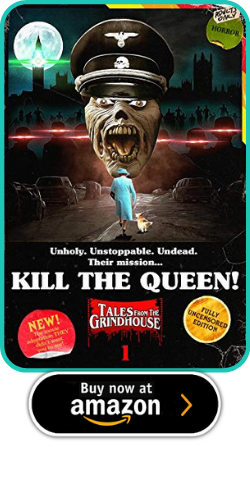
Unholy. Unstoppable. Undead.
1983 - From a forgotten World War II bunker beneath modern-day West Germany, an unspeakable evil arises to exact a madman's revenge.
Leaving a trail of death and destruction in its wake, this infernal horde advances across Europe nearing London with every jackbooted step. The few who survive ask: can this bloodthirsty hellspawn be stopped?
Or will they fulfil their satanic mission to...
KILL THE QUEEN!
WARNING - CONTAINS SCENES OF:
Graphic sex
Satanism
Drug use
Excessive gore
Ghoul rampage
NEW! The movie adaptation THEY didn't want you to see!
For the first time ever, the FULLY UNCENSORED EDITION!
KILL THE QUEEN! is #1 in the TALES FROM THE GRINDHOUSE series.
Experience BRAND NEW adaptations of the most shocking movies NEVER made - NOT FOR THE NERVOUS!
We open the vault and exhume the stories that were too violent, too horrific and too depraved for their time. Each entry in the series is a blood-soaked stand-alone narrative flung from a time when video stores supplied sick filth to minors, late night movies provided nightmares that would last a lifetime and a sleazy paperback was crammed under every pillow.
Welcome to the Grindhouse. We hope you enjoy these tales, but beware - they are NOT FOR THE NERVOUS!
1983 - From a forgotten World War II bunker beneath modern-day West Germany, an unspeakable evil arises to exact a madman's revenge.
Leaving a trail of death and destruction in its wake, this infernal horde advances across Europe nearing London with every jackbooted step. The few who survive ask: can this bloodthirsty hellspawn be stopped?
Or will they fulfil their satanic mission to...
KILL THE QUEEN!
WARNING - CONTAINS SCENES OF:
Graphic sex
Satanism
Drug use
Excessive gore
Ghoul rampage
NEW! The movie adaptation THEY didn't want you to see!
For the first time ever, the FULLY UNCENSORED EDITION!
KILL THE QUEEN! is #1 in the TALES FROM THE GRINDHOUSE series.
Experience BRAND NEW adaptations of the most shocking movies NEVER made - NOT FOR THE NERVOUS!
We open the vault and exhume the stories that were too violent, too horrific and too depraved for their time. Each entry in the series is a blood-soaked stand-alone narrative flung from a time when video stores supplied sick filth to minors, late night movies provided nightmares that would last a lifetime and a sleazy paperback was crammed under every pillow.
Welcome to the Grindhouse. We hope you enjoy these tales, but beware - they are NOT FOR THE NERVOUS!
Alan Power

Alan Power was born in the past, screaming. He is the author of the Tales from the Grindhouse series, for which he also creates cover art and the occasional imaginary map. He now lives in Scotland with his wife, a host of children and a flyblown horde of mangy street cur dogs that are nevertheless affectionate and mostly tick-free. He screams slightly less these days.
www.talesfromthegrindhouse.net
www.talesfromthegrindhouse.net
TODAY ON THE GINGER NUTS OF HORROR WEBSITE
WHERE ALL IS NIGHT, AND STARLESS BY JOHN LINWOOD GRANT (BOOK REVIEW)

THE HEART AND SOUL OH HORROR FEATURES


Archives
April 2023
March 2023
February 2023
January 2023
December 2022
November 2022
October 2022
September 2022
August 2022
July 2022
June 2022
May 2022
April 2022
March 2022
February 2022
January 2022
December 2021
November 2021
October 2021
September 2021
August 2021
July 2021
June 2021
May 2021
April 2021
March 2021
February 2021
January 2021
December 2020
November 2020
October 2020
September 2020
August 2020
July 2020
June 2020
May 2020
April 2020
March 2020
February 2020
January 2020
December 2019
November 2019
October 2019
September 2019
August 2019
July 2019
June 2019
May 2019
April 2019
March 2019
February 2019
January 2019
December 2018
November 2018
October 2018
September 2018
August 2018
July 2018
June 2018
May 2018
April 2018
March 2018
February 2018
January 2018
December 2017
November 2017
October 2017
September 2017
August 2017
June 2017
May 2017
April 2017
March 2017
February 2017
January 2017
December 2016
November 2016
October 2016
September 2016
August 2016
July 2016
June 2016
May 2016
April 2016
March 2016
February 2016
January 2016
December 2015
November 2015
October 2015
September 2015
August 2015
July 2015
June 2015
May 2015
April 2015
March 2015
February 2015
January 2015
December 2014
November 2014
October 2014
September 2014
August 2014
July 2014
June 2014
May 2014
April 2014
March 2014
February 2014
January 2014
December 2013
October 2013
September 2013
August 2013

 RSS Feed

|

|