

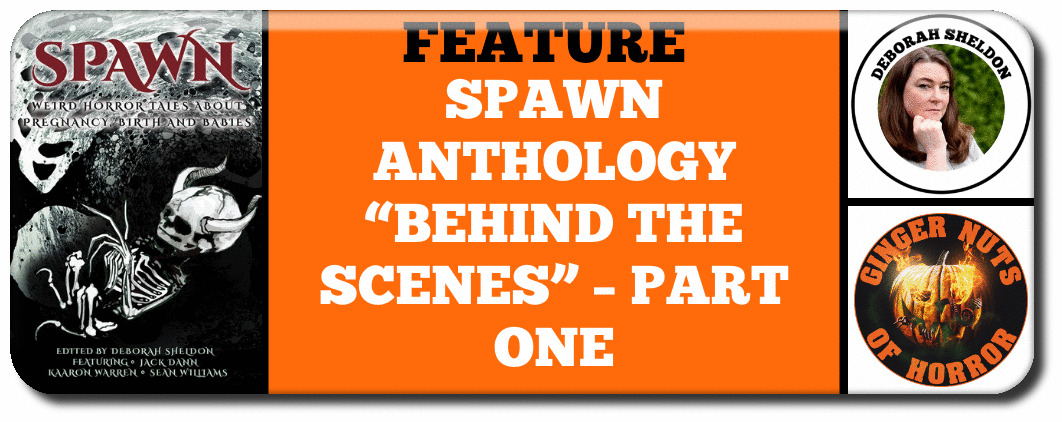
 SPAWN: WEIRD HORROR TALES ABOUT PREGNANCY, BIRTH AND BABIES, edited by award-winning author and anthology editor Deborah Sheldon, will be released worldwide by IFWG Publishing Australia on 3 May 2021. Spawn is a selection of the darkest Australian fiction penned by established authors and fresh new voices. The stories range from the gothic and phantasmagorical, through the demonic and supernatural, to the dystopian and sci-fi. In this four-part series exclusive to Ginger Nuts of Horror, most of the contributors have agreed to pull aside the curtain and reveal the inspiration behind their nightmarish tales. “Part One” includes insights from editor Deborah Sheldon, and writers Matt Tighe, Tracie McBride, Rebecca Fraser and Antoinette Rydyr. Editor Deborah Sheldon on “Hair and Teeth” and Spawn I’ve always been fascinated by human physiology and disease. In a different life, perhaps I would have become a doctor or surgeon. Before I switched to fiction, I spent about twenty years writing (among other things) health and medical information across various media. I composed feature articles, web content, and patient information for every kind of physical and psychological condition you could imagine. My story “Hair and Teeth” is about a middle-aged woman who suspects that her relentless vaginal bleeding is not due to menopause but something far more…nefarious. The story’s inspiration was a surgical operation. I wanted to create a grisly narrative that walked the line between reality and paranoia without flagging a definitive answer. My hope is that the reader decides what actually happens. I got the idea for Spawn: Weird Horror Tales About Pregnancy, Birth and Babies from “Hair and Teeth”, first published in Aurealis in 2018, reprinted in Year’s Best Hardcore Horror, and mentioned in Ellen Datlow’s “Recommended List for 2019” in Best Horror of the Year. The story’s images and themes wouldn’t leave me alone. I decided that I wanted to curate an anthology in a similar vein; a book that would resonate with readers by tapping into the terrors we all share in the shadowy depths of our reptilian brains. In 2019, I pitched Spawn to IFWG Publishing Australia. Gerry Huntman, managing director, responded with enthusiasm and suggested commissioning a few bestselling Australian authors; namely, Jack Dann, Kaaron Warren and Sean Williams. The other stories are from an open callout. I welcomed all subgenres without reservation. What I envisioned was a broad mix of styles that would keep the reader on the back foot, wary and cautious, never knowing what to expect with the turn of every page. I think Spawn achieved that vision. http://deborahsheldon.wordpress.com Matt Tighe on “A Good Big Brother” Just before our local COVID-19 lockdown, and purely by coincidence, my family and I moved to a small ‘bush block’ of land just outside of town. The place had the illusion of isolation, with only glimpses of the unsealed local road between clumps of trees and overgrown thickets of blackberries and brambles, and a handful of quiet neighbours that kept to themselves. Like many, we spent a few strange months with mostly ourselves for company, and it was kind of pleasant, if you ignored the feeling of the world holding its breath. But the world was still doing its thing, and the inevitable questions from my kids arose, about COVID, about the BLM movement, and about several other events that reinforced the fact that the isolation was an illusion. Watching my oldest boy thinking about these big events, and listening to my own halting explanations, made me more aware than ever of how hard it is to try and get your children ready for the world, while at the same time wanting so much to protect them from so much of it. I was thinking a lot about all this when I saw the call for Spawn. The idea for “A Good Big Brother” was almost fully formed as soon as I read the call, with the idea of pregnancy merging with everything I had already been thinking about. Despite that, I struggled to write the story at first. As soon as I realised it was a story not about a child, but a story told by a child, about big events as a child sees them, it went very quickly. For me, the story is about innocence and how fragile it can be, when we all find ourselves in uncharted waters. https://twitter.com/next_happened Tracie McBride on “Sins of the Mother” Earlier this year I saw a photo on social media of an unusually shaped piece of driftwood. In the centre of the piece was a hole, and nestled snugly in the hole was a smooth, oval stone. The caption read something along the lines of “an earth goddess and her stone baby”. (I have since learned that stone babies in humans are a real, although rare, phenomenon known as lithopedions.) That caption provided the idea for the first sentence of my story “Sins of the Mother”. It also gave me a starting point for some of the themes I would explore. As for the rest of the story… I thought about my personal experiences of pregnancy, birth, and motherhood. I have three children. All three were conceived naturally, with the man I have now been married to for over 23 years. I carried all three to full term in a straightforward fashion. I went through three labours with about the average amount of pain, gore, and screaming (OK, I might have been excessive with the screaming). All three labours resulted in big, healthy, completely human-shaped babies. All three were breastfed, and all three were and continue to be loved, cherished and cared for. They are now aged 16, 17, and 22, and not even in my darkest parenting moments did I consider abandoning any of them in the woods. Then I took everything I knew first-hand and flipped it on its head. Pregnancy and childbirth can be horrifying enough when it is ‘normal’. (I did mention the pain, gore, and screaming, didn’t I?) Rather than amplify that, I challenged myself to remove it, and still craft a story fitting the anthology’s theme and genre. Whether or not I have been successful in my aim is up to the reader to decide. http://traciemcbridewriter.wordpress.com/ Rebecca Fraser on “Beneath the Cliffs of Darknoon Bay” “Beneath the Cliffs of Darknoon Bay” had been making noise in my head for quite some time—whispering at first, then gradually raising its voice to a demanding shout, as story ideas tend to behave when they want to be told. When I saw IFWG Publishing Australia’s submission call for Spawn: Weird Horror Tales About Pregnancy, Birth and Babies, I felt the timing was fortuitous, and started committing the story to paper. I loved the specificity of the anthology’s theme, and hoped the elements of my story might prove to be a good fit. I’d already determined the tone, era and setting I wanted for “Beneath the Cliffs of Darknoon Bay”—a rugged, isolated, and unforgiving backdrop—which I hoped would further underscore the characters’ feelings of claustrophobia and ambiguity, and give the reader a chance to observe how vulnerable characters react to their environment…and ultimately each other. Deb Sheldon had requested submissions to also include a nod to body horror at some level, and it was only in the writing that it became clear how I would be able to incorporate this. I hope the ending is all the more impactful for it! My story is set on Darknoon Island, a fictious island in the very real Furneaux Group, a scattering of approximately one hundred islands located in the treacherous ink-black waters of Bass Strait that separates Tasmania from mainland Australia. The year is 1836, at the height of Australia’s sealing industry. The story begins when naively-adventurous Edward and his wife, Cecily, arrive on Darknoon where Edward has undertaken a year’s contract as the island’s lighthouse keeper. I love research. The component for this story was fun but quite intensive. I disappeared down an ever-expanding rabbit hole, exploring everything from the climate and indigenous flora and fauna present in the Furneaux Group, to the various styles of lighthouses in the 1800s, the logistics, duties and responsibilities of a lighthouse keeper, and learned all about lighthouse operation and technologies of the era including the impressive Fresnal lens—a type of composite compact lens developed by French physicist Augustin-Jean Fresnel, described as “the invention that saved a million ships.” Applying research to fiction might be compared to Hemingway’s ‘iceberg theory’. The reader doesn’t need to know the mass below the waters; it’s hoped the kernels that make it above the surface add to the overall vision, meaning and execution of the story. I had to make some firm decisions about which elements would carry the most weight in the most unobtrusive way. I hope you enjoy reading “Beneath the Cliffs of Darknoon Bay” as much as I enjoyed writing it. I’m so glad it found such a great home in Spawn: Weird Horror Tales About Pregnancy, Birth and Babies under Deb Sheldon’s skilful editorship. https://writingandmoonlighting.com/ Antoinette Rydyr on “Mother Dandelion” I’d known about the Spawn anthology for almost three months. I’d jotted down some story ideas but nothing resonated. A month went by, then another and I had nothing I cared to write about. The deadline was approaching and still nothing, so I gave up. However, I kept getting drawn back to the anthology. I reread the submission guidelines looking for a springboard or trigger to get started. I settled on “body horror”. Two weeks before deadline I retreated to a quiet room and started writing about body horror. All day and I could only muster 300 words, but the minimum requirement was 1,500. It was the scene of the official’s visit and I didn’t know where to go from there. So, I gave up again. The next day, in the car, I thought about the story and started developing ideas in my mind. That night I wrote about three pages of longhand notes. The day after, the ideas came thick and fast and I scribbled four more pages of longhand notes. It was then a case of transcribing the notes into the computer and sorting them into a coherent and cohesive order. I rarely write a story in linear order. Every plot point is usually out of sequence. It is like putting together a jigsaw puzzle with only half the pieces and the ones I have are blank and I have to draw the image on them. Scenes eventually grew and connected with other scenes. After much juggling and gap-filling, the full image revealed itself. One element I wrestled with was the names of the characters. The world I’d created was horrible, and cruel things happen to people. I felt that to give the characters actual names was too awful to people who had those names. I tried inventing names but a quick google search always found someone, somewhere in the world with that name. As a solution I decided not to name any of the characters but to give them designations. This strategy worked well for the story as it amplified the inhumanity that people had been reduced to and contributed to increasing the horror of the post-apocalyptic world that I’d created. It also provided me with the title for the story: “Mother Dandelion”. Although it was only two weeks before deadline, I was glad I didn’t have much time. The world I’d depicted was so horrendous that I didn’t want to mentally dwell there for too long. I spent about ten days writing, expanding, revising, editing, tweaking, tweaking, tweaking. Had I started the story three months earlier, I probably would have lingered in that world for much longer. My initial 300 words had expanded to 4,000 and I wished to move on from the nastiness and horror of that world. https://www.weirdwildart.com/  DEBORAH SHELDON is an award-winning author from Melbourne, Australia, who writes short stories, novellas and novels across the darker spectrum of horror, crime and noir. Her collection Perfect Little Stitches and Other Stories won the Australian Shadows ‘Best Collected Work’ Award. Her fiction has also been nominated for various Australian Shadows and Aurealis Awards, and long-listed for a Bram Stoker Award. As editor of Midnight Echo 14, she won the Australian Shadows ‘Best Edited Work’ Award. Other credits include feature articles, non-fiction books, TV scripts and award-winning medical writing. http://deborahsheldon.wordpress.com  IFWG PUBLISHING AUSTRALIA and its US-oriented imprint, IFWG Publishing International, are based in Queensland Australia and has been operating for 10 years. The Australian imprint’s releases are distributed through Novella in Australia and Gazelle in the UK and Europe. Most Australian publications are co-released through the International imprint and distributed through Chicago-based IPG, to our North American and Latin American readers. The Australian/UK imprint website: https://ifwgaustralia.com/     Comments are closed.
|


Archives
April 2023
|
 RSS Feed

|

|