

THE PLOT THICKENS BY JAMES BROGDEN
16/11/2020
 Obviously, allotments are great places to dispose of bodies, but the problem is that they are by definition places where the locals do a lot of digging Bone Harvest by James Brogden is released tomorrow by Titan Books, and to mark the launch we welcome James to the site for his guest feature on the why an allotment is the best place to set a horror novel. James Brogden is the author of Hekla's Children, The Hollow Tree, The Plague Stones and Bone Harvest, along with The Narrows, Tourmaline and The Realt. He spent many years living in Australia, but now lives in Bromsgrove, Worcestershire with his wife and two daughters. An allotment might seem an odd place to set a horror novel. After all, it is an oasis of tranquility in an otherwise busy and relentless city. It offers the chance to slow down, plant things with your own hands, and watch them grow with the unhurried rightness of natural rhythms; soil, rain, sun. To sit and chat with your neighbours, to interact socially in a way that doesn’t involve a screen. To make, in the words of Sam Gamgee, “the one small garden of a free gardener (that) was all his need and due.” It is the English village idyll in microcosm. An allotment can be a welcome refuge from the world, as in the case of Stewart, who lives in an old pigeon shed on an abandoned allotment in Whitby with his border collie Cariad and a wood-burning stove. He spends his days collecting driftwood and seaglass, and busking in town with his ukulele. Allotment sheds are easy targets for theft and arson, but have been used as shop-fronts to sell drugs. In Birkenhead an allotment-holder was arrested for growing in his greenhouse a cannabis plant that was so large that the police had to break it up with shovels to get it in their van. The owner claimed that it was something that had just spontaneously grown up between his tomatoes and that he didn’t know what it was. When asked whether its pungent smell and prodigious growth rate hadn’t given him a clue, his defence was that he thought it might have been “some kind of mint”. It’s a fine line between harmless eccentricity and dangerously aberrant or even psychotic behaviour, and a place like an allotment, where there are fewer prying eyes, can be perfect for indulging oneself - at least until one is caught. For example, in 2002 commuters on a train to Bridlington that had stopped at a red light were appalled to see, on an allotment next to the track, a man having what can only be described as ‘unlawful congress’ with a goat. Passengers called the police while some nearby walkers tackled the man to the ground and rescued the unfortunate animal from his attentions. A seventy-six year old man attacked his allotment neighbour and fellow pensioner with a machete at Pigsty Avenue allotments in Jarrow, 2009. By all accounts they had been great friends for years, there was absolutely no provocation and the attacker, who was known by all to be a mild and gentle soul, claimed to have no memory of his actions. In April last year a man returned from the pub to his allotment shed and found one of his neighbours – an acutely psychotic young woman called Odessa – had let herself in and was cleaning blood off her hands and arms with baby-wipes. After he chatted with her for a while to make sure that she was okay, she reached into a plastic bag beside her, pulled out the severed head of her mother, kissed it, and put it back. The man’s reaction? Call the police? No. He went back down the pub where he told his mates that he was having a “a queer day”. Obviously, allotments are great places to dispose of bodies, but the problem is that they are by definition places where the locals do a lot of digging. Take the story of Charlie Joseph, who was clearing out an old allotment in 2008. He tipped over a water tank to empty it and found the torso of Julie Dorsett, who had gone missing six years earlier. She’d been murdered andher corpse cut in half, presumably to make it easier to hide. Neither the rest of her remains or her killer have yet been found. On Christmas Eve 2014, Sameena Imam was murdered by her partner Roger Cooper, with his brother David acting as accomplice, and her body was buried in David’s allotment. When police discovered her remains, they also found a horrifically ironic joke sign hanging on the wall of David’s shed that read ‘Don’t wind me up, I’m running out of places to hide the bodies!’ In February of 2017, the body of Lea Adri-Soejoko, secretary and treasurer of the Colindale allotments just off the Edgware Rd in London, was found in the shed used to store the communal lawn-mower. She’d been strangled with the mower’s electrical cord by fellow allotment-holder Rahim Mohammadi, for reasons that may never be known. Mohammadi was an Iranian refugee and torture victim with his own complex psychological problems, and tended his allotment as a form of therapy courtesy of the charity Freedom From Torture. The last thing I want to do here is give the impression that people who maintain allotments are all criminals and psychopathic murderers. My best friends have allotments, and they haven’t killed anyone. At least, not that they’ve told me. My Mum and Dad did the whole ‘Good Life’ thing back in the 70’s on five acres of Tasmanian farmland – with sheep and chickens and a big vegetable patch and it was a magical childhood. It’s just that allotments are liminal places - not quite farm, not quite garden, with their own rules and power structures running parallel to the mainstream world – and those are the places I like to go in my stories, where magic and horror are the flip side of each other and might flower one spring amongst your beanpoles or be waiting an inch below the topsoil for the careless turn of a spade. It’s spring as I write this and the world is hiding from a killer pandemic. Don’t get me wrong, that scares the hell out of me. But my strawberries are starting to sprout and I think I need to keep an eye on them too. Just in case. 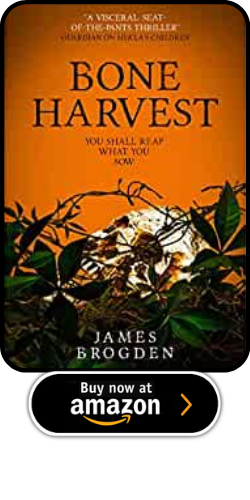 From the critically acclaimed author of Hekla's Children comes a dark and haunting tale of an ancient cult wreaking bloody havoc on the modern world. YOU SHALL REAP WHAT YOU SOW Struggling with the effects of early-onset Alzheimer's, Dennie Keeling leads a quiet life. Her husband is dead, her children are grown, and her best friend, Sarah, was convicted of murdering her abusive husband. All Dennie wants now is to be left to work her allotment in peace. But when three strangers take the allotment next to hers, Dennie starts to notice strange things. Plants are flowering well before their time, shadowy figures prowl at night, and she hears strange noises coming from the newcomers' shed. Dennie soon realises that she is face to face with an ancient evil - but with her Alzheimer's steadily getting worse, who is going to believe her? FURTHER READING BONE HARVEST A REVIEW BY TONY JONES HORROR FICTION REVIEW: HEKLA'S CHILDREN BY JAMES BROGDENFIVE MINUTES WITH JAMES BROGDEN BOOK REVIEW: THE HOLLOW TREE BY JAMES BROGDEN THE HOLLOW TREE BY JAMES BROGDEN THE PLAGUE STONES BY JAMES BROGDEN - BOOK REVIEW (AND A GIVEAWAY )   Comments are closed.
|


Archives
April 2023
|
 RSS Feed

|

|