

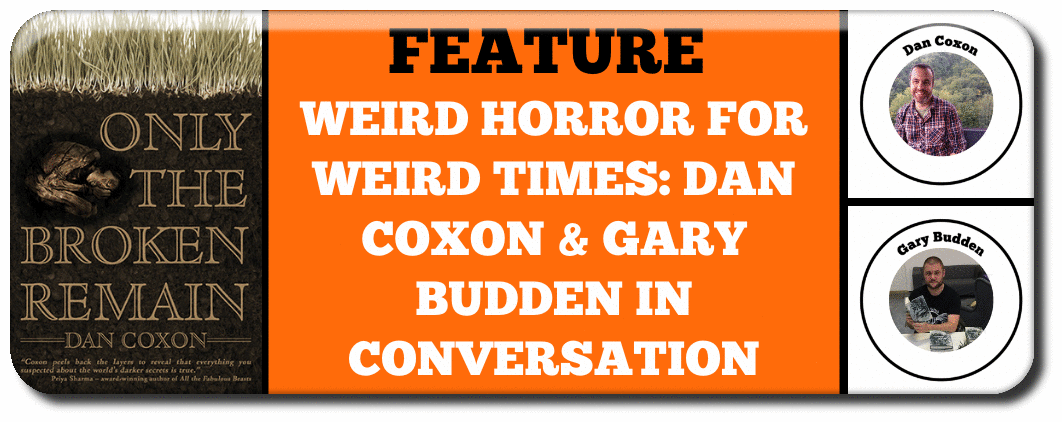
 To mark the launch of Dan Coxon's collection Only The Broken Remain, we welcome Dan to the site for a fascinating chat about weird fiction and its place in these troubling times, with fellow master of the new Weird Gary Budden, who also has a new recently published collection, London Incognita. Be sure to check out our review section over the next two days where we will be reviewing both Dan's and Gary's collections. Dan Coxon: We both have new short story collections out right now – your second, London Incognita; and my first full-length collection, Only The Broken Remain – and I’d say they both fall into a genre (sub-genre? sub-sub-genre?) that I call weird horror. Just labelling them as ‘weird fiction’ feels too broad to me, it’s a label that can include everything from magical realist fantasy to satirical sci-fi these days. But equally, it feels wrong to just brand them as ‘horror’ – I think there’s something else we’re both trying to achieve, other than traditional shocks. Would you agree? And how useful is the term ‘weird horror’, or is there a better term? Uncanny fiction? Robert Aickman’s ‘strange stories’? Gary Budden: ‘Weird horror’ does feel accurate for the book, and I’d be happy with that description, but London Incognita (as the title suggests) is entirely city-focused, so for me a more apt description would be ‘urban horror’ or ‘urban weird’. Definitely not ‘urban fantasy’, which I am not a fan of. I was consciously referencing back to what I consider prime examples of urban weird horror writing – Arthur Machen, Joel Lane, Ramsey Campbell, and aspects of M. John Harrison’s work – but trying to use that mode of writing to create a specific effect, which is to capture the darkness, absurdity and moments of actual horror that have been a part of living in the city of London over the last few years. I’m quite bored of folk horror at the moment, and consciously turned my attention to the urban as a reaction to that sub-genre’s current popularity. I’d agree that we’re both going for something other than traditional shocks. Mood, atmosphere and an evocation of the weirdness of the urban landscape are my primary goals with this book, and the stories tended to arise naturally out of paying attention to this dark strangeness of the human-built environment. Though I do think there are shocking elements in London Incognita – warped sexualities, domestic violence, classism and racism are all tackled in the book, as well as real-life horrors like Grenfell Tower and the London Bridge terror attacks. Would you say Only The Broken Remain has an overarching theme? If you’re not going for shock in your work, what are you trying to achieve? How important is atmosphere and location for you? DC: Maybe we need to coin ‘urban weird horror’ as a new sub-sub-sub-genre! Location was still important for me in writing the stories in Only The Broken Remain, but it’s not a theme of the book. In fact, the stories are set in a wide variety of places, from Australia to the Home Counties. A lot of the writers you mention deal with liminal space in some way – waste grounds, abandoned factories, the desolate edges of cities – but I was aiming to look at liminal characters instead. People who sit at the fringes of society, and who are often in a state of personal transition or change. In some cases this is obvious – the main character from the opening story, ‘Stanislav in Foxtown’, for example, is an immigrant worker who’s struggling to find his place. In others it’s maybe less so, or comes from the characters pushing themselves to the fringes of society through their actions, rather than society marginalising them. In ‘Miriam is No Longer at her Desk’, the title character is a wealthy accountant for a major firm, but by choosing to embezzle funds from the company she unhinges herself from her comfortable life, and ends up lost, both personally and geographically. These are the ‘broken’ people of the title, at least in concept. I was also interested in looking at people pushed to extremes, and seeing the ways in which their strengths emerge from these extreme situations. They may be broken, but there’s also a thread of resilience and endurance through the stories, I hope. Someone has also pointed out that the title could be taken as a comment on Brexit, but we’ll skim over that for now… I wouldn’t say that I’m aiming to shock people – not in the traditional horror sense, at least. I prefer something like creeping dread, an existential terror that is both quieter and deeper-seated than traditional ‘monster’ horror. There are a couple of monster stories in the collection, but hopefully I deal with them in a slightly different way. For me, the true horror comes from experiencing the fringes of something dark and unknowable, rather than facing down something gory and evil – werewolves are all well and good, but once you have that silver bullet in play it never feels like there’s much at stake. Weird horror in general tends to be much more tangential and oblique, but I think it has the potential to genuinely unsettle the reader. It occurred to me recently that many people’s Covid-19 experience has been something like weird horror. There’s no obvious monster or bad guy to fight, just an overwhelming anxiety and dread of something invisible, out there, waiting to get us. We don’t quite understand it, we can’t really fight it, but it fills us with terror. Does that make sense, or am I over-reaching here? How has your experience of the pandemic been – has it fed into your writing, or has it been an extended case of writer’s block? GB: I’ve always been drawn to weird fictions that posit reality itself as inherently bizarre, and horrifying when seen for truly what it is – Machen’s concept of seeing the Great God Pan, seeing beyond the veil. ‘Panicking’ meaning ‘seeing reality’. It’s something I was drawn to in the work of Thomas Ligotti, or his work and philosophy as interpreted in the first series of True Detective – ‘the terrible and the secret fate of all life. You’re trapped… like a nightmare you keep waking up into.’ I like the notion that our human physical senses are designed to stop us comprehending the awful true nature of things. The pandemic shows us a deeper reality that most of the time our senses block out – after all, constantly thinking about our own mortalities is not a sensible way to live your day-to-day life and get anything productive done, including writing. It reminds us of our physicality, our inherent susceptibility to disease – things we try and escape in our digital lives. It’s not even that the virus is out to ‘get us’. The virus has no agenda; it’s actually more comforting to think that there is some sort of enemy to fight, or some conspiracy, or whatever. The reality is that the virus, like the ocean or the mountains or the depths of outer space, is both deadly and indifferent to us. I wouldn’t say it fills me with terror, just a low-level dread. It’s boring above all else. The pandemic made it harder to write, but to be honest for more prosaic reasons than existential dread – fear of keeping my business afloat and financial concerns made me devote far more time to working than to writing fiction. There’s another thing the pandemic exposed about the illusion of our daily realities – how fragile neo-liberal economies are and how easy it will be for them to crumble. How did it affect your writing? DC: Yes, you’re right – I’m giving Covid too much agency there! That’s very much the horror trope still, isn’t it: that the big bad is out to get us. Maybe that’s one of the reasons the pandemic has felt more like weird fiction than horror. If this were a horror story, there would have been diseased zombies staggering through the streets by now; instead, we’re just all bored, anxious, uncertain of the future, and feeling somehow under threat even though the virus itself is indifferent. (Unless you believe it’s targeting individuals using 5G masts, of course… but that’s a whole other kind of horror.) For me, the sense of boredom and ennui also has something of weird horror about it. Traditional horror stories tend to be more action-based, with immediate threats, and danger, and weapons, and slavering monsters. The tone of the lockdown has felt quite different to that: confusion, anxiety, frustration. Several years ago I had a short story called ‘Not the End of the World’ published in The Portland Review, and Gatehouse Press kindly reprinted it on their website during the lockdown (you can read it online here). It’s not a weird horror story – I was just starting to turn to the kind of stories I write now – but it does float the idea that our experience of the apocalypse won’t be raging battles and car chases and thrilling feats of heroism, but everyone sitting around at home, scared and wondering what the hell’s going on. In my story all electronic devices have stopped working, though – at least during lockdown we had Netflix. Writing has been difficult for me during the lockdown period, for much the same reasons as you. We have two kids, so I was home-schooling them for a few months, while my wife tried to continue working. I earn my living as a proofreader and copy-editor, and the wheels of the publishing machine slowed down considerably during that time, too. As you say, I spent more time trying to stay afloat than doing anything creative. I feel like I’m starting to come out of that slump now, though, and it’s actually been quite easy to get back into that weird horror frame of mind. I guess it’s what we’ve all been living lately. Do you think weird horror fiction was on the rise before the pandemic, too? There seems to be something in the air at the moment that has brought the weird, and the gothic, and the uncanny back to the forefront of popular culture again. Would you agree that’s the case? And if so, why do you think that is? GB: I definitely think weird fiction was on the rise again (it’s not the first time it’s been popular, clearly) before the pandemic. It has certainly filtered into film and TV culture in a noticeable way with series like True Detective, the film adaptation of Jeff Vandermeer’s Annihilation, Nathan Ballingrud’s Monsterland and so on, which does feel like a new kind of visibility to me. The amount of high-quality interesting fiction in the weird mode currently being produced is a testament to the fact that it’s a genre that’s definitely having a moment. The reason to me seems simple. Whatever we want to call reality has, especially since 2016, become totally bizarre and fucked up. I do not feel that strictly realist literature has the tools to deal with the stresses, fears and anxieties of the modern age in an accurate way. The world does not make any sense anymore (if it ever did). Straightforward horror, I often felt, was more reassuring than anything else. Usually the monster, or whatever the threat is, is defeated. Weird fiction is a reflection of the fact that we don’t even know what the enemy is anymore. All there is anxiety and uncertainty, which are two things weird fiction can convey very well. The pandemic is just another part of that. You’re right about the weird boredom and ennui of it all – this is a glimpse of how our world could end, not any grand dramatic cataclysm but a slow decline into curfews, quarantines, shortages of goods until ‘normal life’ gets forgotten. Maybe this a chance to avoid that happening to future generations, but a part of me does believe that this is actually the start of that slow decline I just described. Then again, human beings have been thinking the world has been ending for almost as long as we’ve existed. Cultures and societies do end, though, and morph into something else – we are the Romans and all that. Are there any notable pieces of weird horror in recent years that have caught your attention? That reflect this new mood? DC: I’ll confess that I’ve done less reading (and viewing) over the past six months than I’d have liked. As we’ve already said, the pandemic and lockdown had a way of changing priorities, and for a while keeping afloat took precedence. What’s struck me recently, though, is that some of this ‘weird’ tone is starting to bleed through into other forms; stories – or TV shows, films – that I wouldn’t actually consider to be weird horror are sharing some common ground with it. The example that springs immediately to mind is Hari Kunzru’s latest novel, Red Pill. (An excellent book, by the way.) I wouldn’t want to call it weird horror, but it touches many of the points we’ve talked about – the pervasive anxiety, the creeping dread, the ‘nightmare that you keep waking up into’. There’s a hint of conspiracy, but even that is left vague and unresolved, and all the more unsettling for it. It’s no coincidence, I’m sure, that Red Pill also deals with the resurgence of the Far Right, and modern era of surveillance and lack of privacy, the rise of Trump. I suspect all of these factor into the increased popularity of weird fiction, and weird horror specifically – even before Covid-19, there was a pervasive sense of anxiety and dread creeping into everyday discourse, I think. What Red Pill does so well is distil all that into a compelling narrative that’s part thriller, part literary fiction, part weird fiction. I guess, in a way, that brings us back to a question we’ve discussed many times before – how useful is it to have genre labels? They’re an obvious tool for selling books – ‘If you liked this, then you might like these others…’ – but increasingly the borders between genres, and between ‘literary’ and genre fiction, are looking very fluid. Is that something that weird fiction does particularly well, this breaking down of genre borders? Is weird fiction even a genre at all? GB: That’s an interesting question about genre labels, especially when you say they’re an ‘obvious tool for selling books’. As someone who runs an independent publisher, selling books is key for our survival and therefore we have to engage with the idea of different genres, different markets, demographics, etc. Running Influx completely removed any notion that these things don’t matter, at least in a practical sense. I do feel there have been a few novels and collections I read recently that were fairly average weird fiction, coming out through the more literary channels and hailed as amazing examples of a new type of weird writing coming to the fore again – when the work of, in my opinion, much better weird writers was being published in the small genre presses. Sales for literary fiction are very small, but it gains a lot of media and arts coverage, which distorts the perceptions of what is worthy and successful. I have no issue with there being loose genres of fiction, with their own styles and concerns and thematic tropes. The problem is when one genre is seen as inherently more – or less – worthy than another. I also think that both the genre fiction world and the literary fiction world have a tendency to be blinkered and self-ghettoise, much to their detriment. In regards to my own writing, I do consider weird fiction to be a genre, and one I am consciously writing in. I’m consciously acknowledging influences from Machen, Joel Lane, Nina Allan, but hopefully not just aping those writers. Weird fiction is certainly more a defined genre than literary fiction. I’ll put the question back to you – is weird fiction a genre at all? DC: As with all the best answers, I’ll say ‘yes and no’. Much like the ‘Literary Fiction’ tag, it seems to be more a mode of writing than a genre in itself. You could have Weird Horror, Weird Fantasy, Weird Crime… in that sense, it’s not a clear genre, and can be utilised when writing within any other genre (I might draw the line at Weird Romance, though). The same is true of Literary Fiction, however, so if LitFic can be a genre, then so can WeirdFic – at least in my book. If we’re viewing genres as a way of selling books to readers, then it certainly fulfils that role, gathering similar books together. So, if bookshops were to suddenly see the light and create a Weird Fiction section, which writers would you fill the shelves with? Whose names should we expect to see? I’ll start the ball rolling with Robert Aickman, right up there on the top shelf… GB: You’ve allowed me to do one of my favourite things – compile a list. My Weird Fiction section would have to include: Nina Allan Joel Lane M John Harrison Livia Llewellyn Mariana Enriquez Marian Womack Helen Marshall Malcolm Devlin Thomas Ligotti Camilla Grudova Aliya Whiteley D.P. Watt Bruno Schulz Plus, you’d have to have the ‘classic’ weird fiction writers – Arthur Machen, Algernon Blackwood, Lovecraft, William Hope Hodgson, etc. And I’d sneak in ‘literary’ writers who really write weird fiction: writers like Sarah Hall, Helen Oyeyemi, Latin American writers such as Julio Cortázar. It would end up being a huge section of the bookshop now I think about it. DC: I’m aware that we’re still very much in weird horror mode, too. I think there would be a strong case for someone like Jeff Vandermeer. Maybe even China Mieville. Plus, I’d have to add Robert Shearman, Nicholas Royle, Shirley Jackson. And I think I’d make a fairly strong case for Paul Tremblay. Sure, he’s already firmly entrenched in the Horror section, but I’d argue there’s a strong vein of the weird in his work, especially his short fiction. Or am I stretching the boundaries too far now? GB: I’d add all of those writers, including Tremblay – I’m generalising massively but the USA seems to have more weird writers writing in a mode that’s clearly evolved from horror, but doing something a bit different and more interesting (and better written) with it. We’d have to add Ramsey Campbell’s short fictions too, I think, and Adam Nevill’s. Can I add Jenn Ashworth, Naomi Booth, Lucie McKnight Hardy… and I’ll stop now. DC: Probably best to – an exhaustive list would include so many others (we haven’t even mentioned Undertow Publications yet, and all their wonderful weird writers). I like to think our books would be there too, nestled somewhere between Robert Aickman and Malcolm Devlin. And that’s pretty good company to be in.  Gary Budden is a writer, editor and the co-founder of award-winning independent publisher, Influx Press. He is the author of London Incognita (Dead Ink, 2020), Hollow Shores (Dead Ink, 2017), the Shirley Jackson Award-Shortlisted Judderman (Eden Book Society, 2018), and The White Heron Beneath the Reactor w/ artist Maxim Griffin (2019). He lives in London.  Dan Coxon is a Shirley Jackson Awards and British Fantasy Awards-shortlisted editor and writer based in London, UK. His fiction has previously appeared in Black Static, Nightscript, Unsung Stories, Not One of Us, Humanagerie (shortlisted for the British Fantasy Awards) and Nox Pareidolia (shortlisted for the Bram Stoker Awards). His non-fiction has appeared in numerous publications, from Salon to The Guardian. A micro-collection of his short fiction, Green Fingers, was published in April 2020 by Black Shuck Books, and his first full-length collection, Only The Broken Remain, is available now.  London Incognita by Gary Budden £9.99“Budden’s taut, exquisitely formed pieces are a striking exploration of fading geographie.” – Irenosen Okojie, author of Nudibranch “An honest, scalpel-sharp and unafraid dissection of the collective British psyche.” – Niall Griffiths, author of Runt Includes the Shirley Jackson Award shortlisted Judderman. London Incognita chronicles a city caught in the cycle of perpetual decline and continuous renewal: the English capital, groaning under the weight of two-thousand years of history, as seen through the eyes of its desperate and troubled inhabitants. A malicious presence from the 1970s resurfaces in the fevered alleyways of the city; an amnesiac goddess offers brittle comfort to the spirits of murdered shop-girls; and an obscure and forgotten London writer holds the key to a thing known as the emperor worm. As bombs detonate and buildings burn down, the city’s selfish inhabitants hunt the ghosts of friends, family and lovers to the urban limits of the metropolis, uncovering the dark secrets of London. Gary Budden’s debut collection, Hollow Shores, was published by Dead Ink Books in October 2017. He was shortlisted for the 2015 London Short Story Award and the 2019 Shirley Jackson Award and his story ‘Greenteeth’ was nominated for a 2017 British Fantasy Awar Purchase a copy here 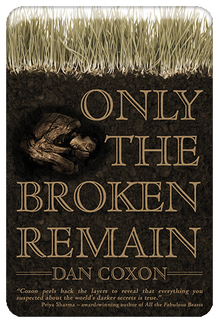 ONLY THE BROKEN REMAIN by Dan Coxon I could see into the room well enough, but there was nothing there. No furniture, no ornaments. A rusted sink streaked with black and grey. An empty light fitting. Nothing more than a thick layer of dust on tired linoleum, forming a furred carpet that stretched undisturbed into the empty room beyond… There was no neighbour. It occurred to me for the first time that I might be going mad. A young man joins a circus where the mysterious ringmaster is more interested in watching him fail. An immigrant worker forms an unlikely alliance with his housing estate’s foxes. A fraudulent accountant goes on the run, but loses herself in the dry heat of Australia. This debut collection from Dan Coxon unearths the no man’s land between dreams and nightmares, a place where the strange is constantly threatening to seep through into our everyday reality. Populated by the lost and the downtrodden, the forgotten and the estranged, these stories follow in the tradition of Thomas Ligotti, Robert Aickman and Joel Lane. Because when the dust has settled and the blood has been washed away, Only the Broken Remain. “Dan Coxon’s subtle, delightfully dark tales creep up on you from the shadows, then refuse to let you go. I devoured these stories about crises of identity and reality being undermined after glimpsing something inexplicable from the corner of your eye.” —Tim Major, author of Snakeskins and Hope Island Purchase a copy here Further Reading LONDON INCOGNITA BY GARY BUDDEN (BOOK REVIEW) BOOK REVIEW: ONLY THE BROKEN REMAIN BY DAN COXON   Comments are closed.
|


Archives
April 2023
|
 RSS Feed

|

|