

horror film review: watch over us
20/10/2017
by Stewart Horn 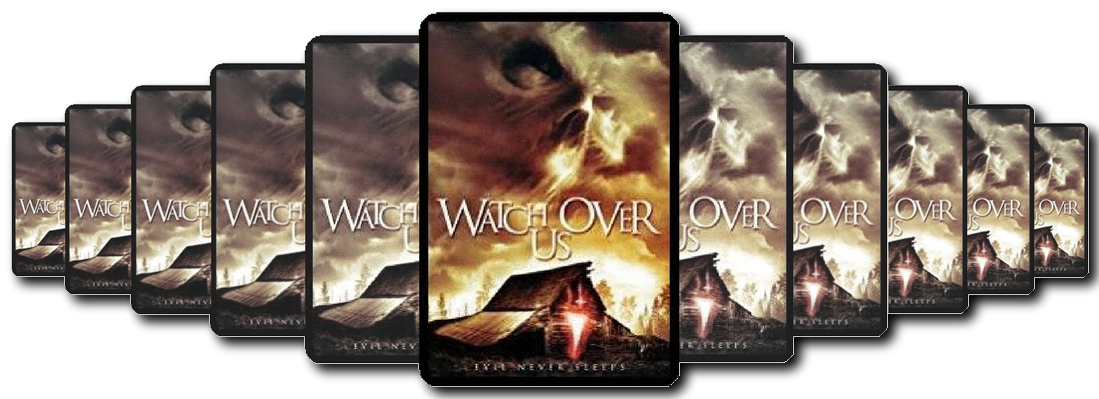 Jon Randall's life sucks. He's a middle-aged divorcee who can't seem to find a job or a girlfriend. He doesn't get on with his teenage daughters or his successful brother, and he has to look after his elderly father, in a house that seems to be haunted. It's almost as if he's cursed. It transpires that, centuries ago when his ancestors arrived in America, the family made a deal with The Devil, who now lives in their barn, and they have to keep the deal going by sacrificing family members. On this flimsy frame hangs an almost plotless muddle of scenes that really don't cohere well enough to move the narrative along. There are some good moments, like some of the family scenes and Jon's comically catastrophic dates, but it's all a bit leaden and lacks structure and drive. A lot of what's wrong with it is down to budget. Anything potentially expensive, or that required the hiring of somebody who would want paid, happens off screen. So the girls do a lot of screaming and the men make shocked faces, but I get the feeling they don't know what they're supposed to be looking at. And neither does the writer. It was never clear what the devil in the barn wanted, what the deal was, or why anybody did anything. And that uncertainty came across in the performances, whereby actors are delivering lines or running off somewhere just because that what the script says, with no reference to what the character wanted or what the consequences might be. I notice in the credits that the film is "written, directed, shot and cut by F. C. Rabbath". That's probably why it doesn't quite work: a director can spot holes in a script and tighten things up, and an editor can take flabby scenes and make them lean and dramatic. One person doing everything has no critical input from anyone else. However, the photography is nice. The shots are well set up on obviously decent cameras, and there is some nice slow motion drone footage in the establishing shots. The sound is well recorded and clear so we can hear every irrelevant and confusing word, and I liked the music. So, really not recommended, but some bits worth looking at. Perhaps F. C. Rabbath will go on to collaborate with professionals on something better.  HORROR FILM REVIEW: LOU SIMON’S 3
18/10/2017
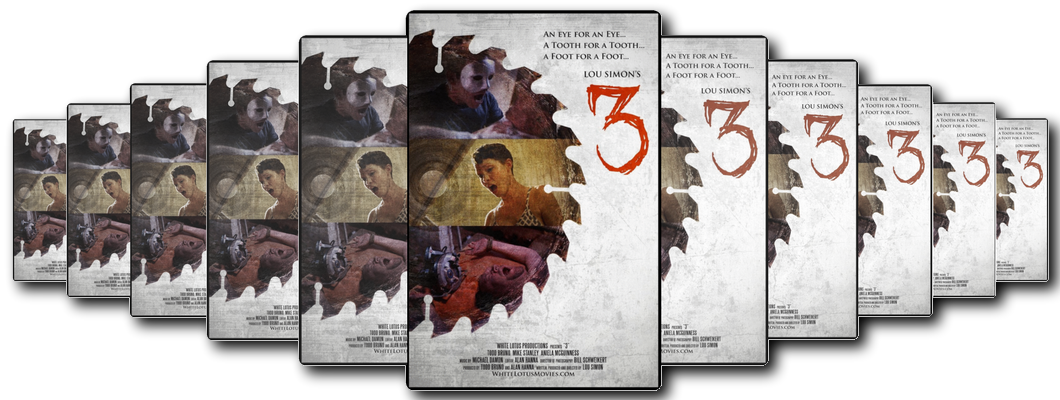
A man and a woman kidnap her rapist in order to extract a confession, but how far are they willing to go for justice?
Good question with a very good answer. Whenever I see films which don’t have a regular title but have a kind of brand name such as “Rob Zombie’s this”, or “Quentin Tarantino presents that”, I’m always a little wary because it seems to me that the person is trading on a reputation more than on the actual substance of the film. Lou Simon’s 3 is one film I shouldn’t have been concerned about as it is very different from the standard torture porn doing the rounds these days. As you can gather from the first line the premise is somewhat simple, and it is indeed straightforward in that the victim of a rape involving mutilation is assisted in bringing the rapist to a secluded property so that he can be forced to confess on camera to the crime he committed. All is not what it seems, as the guy helping the woman has certain methods in mind of extracting the information which the woman is worried about because the guy has serious anger issues and without his medication all bets are off. There’s a further complication in that the woman has a form of PTSD following the rape, and recollections are somewhat fuzzy to say the least, more so as Rohypnol was involved. This leads her assistant to wonder whether or not he is actually making a mistake and torturing a confession out of an innocent man. With the excellent cast for the most part limited to 3 people and a single location it’s quite difficult to tightly maintain an entire movie, however 3 managed to hold my attention throughout. The plot is constructed in such a way that it’s never entirely obvious which way things are going to go, and there are several revelations which pile on the uneasy sense that the kidnapped man didn’t rape her after all. Brutally sadistic in places yet not gratuitous Lou Simon’s 3 is a refreshing take on the revenge tale and I hope to get the opportunity to see more of Lou Simon’s work in the future. 
King On Screen: THE DARK TOWER
17/10/2017
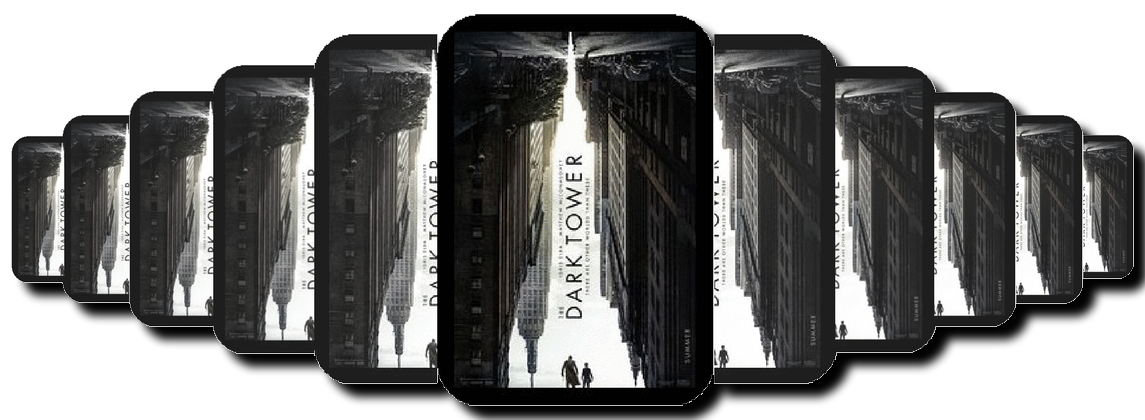 Due to the recent cinema releases of The Dark Tower and IT, along with the BFI showing a season of King movies to celebrate his 70th birthday, I’ve seen five movies based on King’s work at the cinema in the last month. So, here’s a mini-series of trip reports - nothing so grand as reviews - based on my month of King Cinema. Spoilers, for both the movies under discussion and the source books abound, so be warned. Enjoy.
I think it’s fair to say this was the one I was most nervous about, going in. I like the two lead actors a great deal - especially Idris Elba, who has the kind of screen presence that makes almost anything he’s in some kind of watchable - but reviews, both on my Facebook wall and in the wider media had been… well, charitably, let’s call them ‘mixed’, shall we? A couple of the King Facebook fan groups I am a member of had some especially vitriolic responses. Also, I basically love the Dark Tower books. From what I’d seen of the pre-publicity, I suspected the movie might work as well as a sequel to that series as an adaptation - and so it proved to be, I think - but I had to admit to being perplexed by the 90 minute running time. I also wondered, given the ‘book sequel’ angle, if the movie would work on any level at all for a non-fan, so I took along my missus as a control sample - a woman who also likes the two leads, but hasn’t read a word of the books. I’ll get to her verdict later. And basically, I was charmed. I didn’t love it, it didn’t set me on fire, but I enjoyed the experience thoroughly. I thought the film did a good job of weaving itself into the narrative that had come before, and in the process served as a worthy coda to that sprawling epic. There were a ton of fannish nods, from the setting of The Dixie Pig to a gorgeous mural of the rose (an aspect of the original narrative otherwise entirely absent), and my personal favorite, the Horn of Eld on Roland’s back, as he and Jake stepped through the gate and into Mid World in the final shot of the film. Mcconaughey worked pretty well for me also, as The Walkin’ Dude. Age, and that weight loss thing he does so well, gave him a lean, sinuous, hungry look, and I felt he did an admirable job of avoiding the obvious scenery chewing, instead letting his dark charisma do most of the talking. In particular, the sequence where he met Jake’s mum was superbly played by both actors, and for me evoked a very King-like sense of awful inevitability and dread - a staple effect of many of his books, but one surprisingly absent from a lot of his cinema adaptations. Tom Taylor as Jake was impressive too, for me, avoiding the seemingly endless pitfalls of being a child actor in this kind of movie. He sold both the sense of terror at the impossible things that were happening to him and also a child’s ability to adapt to the unlikely - the suppleness of their imaginations and the sense that basically everything is new allowing them to accept events and circumstances that would make most adults catatonic, and yes, I did start re-reading IT recently, well spotted, but also it’s still true. And there are some just beautiful moments - quite a few of them, actually. The living house guardian that attempts to stop Jake from making it to Mid World was brilliantly realised, and a fair example of just what talented CGI artists can achieve in 2017. Similarly, the desert was gorgeous (though our time spent in it was, for me, too brief, and crucially lacking the honkey-tonk piano performance of Hey, Jude - still one of my all-time favourite moments in any King book). As for the trailer moment, when an injured Roland, in the middle of a massive raider attack, takes slow breaths, tunes into Jake and the raider carrying him, and then points and shoots blind - I mean, what the fuck in cinema even for, if not moments like that? Similarly, I know some people didn’t like Roland’s mid air reload technique, but come on, people - Roland was absolutely a superhero, whose superpower was shooting. In that context, again, it’s just cinema doing what it can do better than a book. All that said and meant, as Dark Tower fan, it was a fucking weird viewing experience - like a whistlestop tour of a place you’d spent month living in - or, maybe better, like a greatest hits of one of your favourite bands, on shuffle - all the right notes, but not necessarily in the right order. Well, some of the right notes. No Suzanna, in this turn of the wheel, and sadly no Oy either, though there was a very funny gag/reference when Roland caught a TV advert with a talking animal on it (and the joke made my missus chuckle, too, so clearly it stood on it’s own terms, and not merely as an in-joke). And, I mean I wasn’t kidding about spoilers, and we need to talk about this - but killing off Flagg at the end was a pretty bold move, given all the talk of a possible follow-up TV show. I can't argue it wasn’t dramatically satisfying in the context of the story the movie told (and the actual method of his dispatch I found pleasing, and at least movie-clever), but at the same time, this is a fictional character with arguably the longest and darkest shadow of any in the King mythology. Ninety minutes and out felt a tad perfunctory, however well done the final putdown was. The ending in general intrigued me, actually. As I said up top, as a coda to the novels, I found it satisfying, if a little odd and rushed. As the launch pad for a franchise of TV shows and further movies… I dunno, man. Flagg’s dead, the tower is safe, and Jake and Roland are off to Mid-World. Not that I don’t love that setting, but unless they’re going to abandon the mythology of the books almost entirely and go do their own thing, I don’t immediately see where the propulsion for the narrative comes from, going forward. Still, I’m not sure how fair it is to judge a movie based on what it isn’t. And on it’s own terms, while a long way from having the earth shattering impact of the books, I thought the film was a fun enough whistlestop tour through the mythos of Mid-World and The Dark Tower. My missus dug it, too. ‘It was good. Not brilliant, but good. But it can’t have been anything like the books, can it? It wasn’t long enough...’ Which will teach me to use a thousand words where four sentences would do :/ KP 10/9/17  THE RITUAL: FROM BOOK TO FILM, A COMPARISON
16/10/2017
By Tony Jones “How much of the Adam Nevil novel made it into the film version? 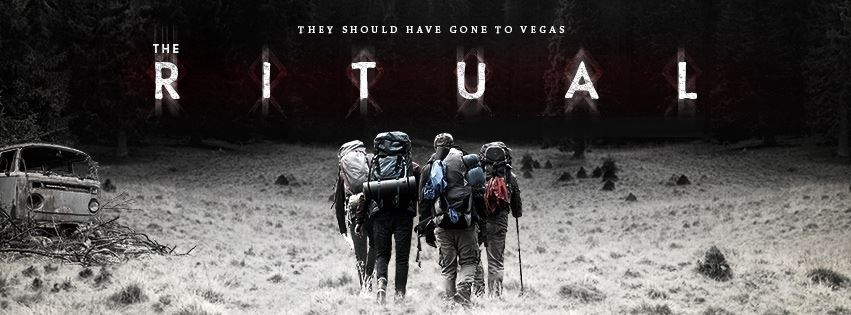 Adam Nevill's The Ritual hit the UK cinema on Friday the Thirteenth, this hugely anticipated movie has been met with with a fantastic critical response, and Ginger Nuts of Horror's Tony Jones brings us or first of many reviews of this film. However rather than just going for the obvious plain review of the film, Tony has reviewed the film as a comparison to the novel itself. Be warned there are spoilers ahead! “The Ritual” finally hit over 300 cinemas last Friday to an enthusiastic response from critics and horror fans. At the time of writing the film has a very respectable 73% rating on Rotten Tomatoes, a relatively high score for a horror film and one which it deserves. Rather than add yet another review to the internet pile Ginger Nuts of Horror examines the film in relation to the 2011 Adam Nevill novel. Like many in the UK horror community, Ginger Nuts is delighted to finally see one of this fantastic writer’s creations arrive on the big screen. The film should breathe new life into the book which is now in its fourth reprint and currently on promotion in the UK superstore ASDA. Having been a fan of Nevill for many years and have reviewed his work widely, I still recall excitedly buying “The Ritual” for double the UK price while holidaying in Ireland after finding it lurking in a Cork airport bookshop long before the UK release. I’m sure Adam Nevill is pleased with this strong version of his novel which in many ways stays pretty faithful to his text, albeit with a couple of major alterations. It is not perfect, but well worth watching whether you have read the book or not. One thing is for sure when Adam Nevil first put pen to paper about a disastrous trip with university friends to North Wales in 1993; he would never have imagined what he originally called “The Blasted Heath” would hit the cinema so many years later. I will try not to give too many obvious spoilers, but a few are inevitable… The central background plot which leads to the group of four old friends trekking in north Sweden is significantly different providing a recurring guilt theme which is absent from the book. The latter features four old university friends who meet up to relive the glory years of their youth; the problem is Luke has been much less fortunate in life than the other three which causes recurring friction and ill feeling. In contrast, the opening sequence the film brutally kills off a fifth friend (Bob) who interrupts a shop robbery whilst accompanying Luke who has dragged him into the shop for a carryout. Luke hides and does nothing to help his friend, ducking behind shelving before he is spotted by the robbers. Although nobody says anything, Luke is secretly blamed for not helping and suffers from what looks like posttraumatic shock which recurs in a few dream sequences with Bob's death scene replaying powerfully throughout the film. This is a smart variation from the novel, as it almost certainly gives the backstory more bite than the original idea of Luke feeling less than just because he has a crap job in a shop. Instead, these tensions have considerable intensity, the elephant in the room, a feeling that is present but not spoken about until tensions finally bubble over and Luke punches Dom, as he does in the book. As a film is a much more immediate experience that a book nobody can argue with this clever alteration. The book has a terrific atmosphere which the film tries hard to recreate, succeeding to some extent, but the true horror which lurks in the woods is way more terrifying in the novel than in the film. Recreating Nevill’s vision of a dark, foreboding forest is near impossible, especially when the sounds and the full descriptions are added into the mix. These descriptions are so real the forest can almost be touched and smelt after the first dead animal is found and the ancient pagan runes start appearing. Instead, you have four guys wandering around in “The Blair Witch Project” territory, which is nothing new, but very well done with a solid pace to proceedings. The film uses a very effective soundtrack of cracks, grunts and echoes with no real music to authentically recreate the book’s dark atmosphere and makes a decent fist of a near impossible job. Once the four friends take the shortcut to hell, the film follows the same pattern of the book for some distance. Dom hurts his knee and starts to whine, and there are some pretty intense sequences very similar to the book, particularly when the group discovers the cabin and what awaits upstairs with the dream sequences which follow. Of course, many horror fans who have not read the book will most likely think of “The Evil Dead” as soon as the cabin is discovered. Like most horror films you can tell who is going to live and die from pretty early in the film, and faithful to the book the killings are in the same sequence which was a nice touch. Only the third kill deviates majorly in style. The novel obviously has more time to develop the characters and their backstories. In the book, for instance, Dom is way more unlikeable than he is in the film and it has the added dynamics of the fear of them quickly running out of food and water. Neither has the film time to hark back to the supposed wealth of the other three and the wives and kids they have left behind. The film adds in the discovery of an old tent equipment and wallet which ups the ante in the realisation of the deep level of crap the friends have found themselves in. Another noticeable similarity was the fact that in the book the first three characters are killed off-screen, and this is almost the same in the film, with the death of Dom the major difference. After the death of Hutch and Phil, the film and book begin to differ leading to a final third which is majorly different from the book, called “South of Heaven” and a probable nod to thrash metal band Slayer. As the film moves further away from the book, I wonder whether Adam Nevill was disappointed to see “Blood Frenzy” chopped completely from the film version? Personally, I was not surprised to see the filmmakers replace the two Black Metal fans Loki and Fernis with a mini-community of old god/demon worshippers. As I work in a library, I regularly recommend this author and chat to readers afterwards. The shorter second part of the novel “South of Heaven” concerns these two heavy metal fans who dream of playing a gig at the Camden Underworld one day, but meantime are preparing a fresh sacrifice to the ancient demon god with the help of an old woman with hooves for feet. More than a few readers found these two guys irritating and felt they killed some of the atmosphere in the final sequences of the novel. However, these two dudes are necessary to invoke “The Ritual” of the title, but something about them just did not quite gel and so perhaps the cult-like village of weirdos which capture Dom and Luke was a solid replacement? Of course, you are welcome to disagree. In Nevill’s free collection of writings “Cries from the Crypt” he says somewhere that he once wrote to the Scotsman newspaper and the journalist who reviewed “The Ritual” and mixed up the different sub-genres of heavy metal music, something which was essential to get right in the novel. So there was no mention of Black Metal or Satanic Metal anywhere, but hey, you cannot have everything, I am sure Adam has softened over the years as the status of the novel has grown, but it is obviously an interest of his and notes his sources in the notes which precede the novel. It is also worth noting that Nevill’s 2016 short story collection “Some Will Not Sleep” includes a story called “The Original Occupant” which is set in a remote Swedish forest and most definitely has a waft of an idea which germinated into “The Ritual”. The film wisely keeps the creature hidden for the majority of the film, and it is only revealed fully towards the final ten minutes. Ultimately it was a disappointment, sure it may scare kids who watch “Shaun the Sheep”, but I really don’t think my twelve year old would bat an eyelid at it. Portrayed as a giant grotesque variation of a giant moose which can mutate to stand on two legs, this ancient god did not impress me too much. Did it need a big ‘reveal’ at all? Probably, most viewers would have felt short-changed otherwise. The novel cleverly reveals the beast exquisitely slowly, and nobody creates horrific creatures supernatural better than this author, so my imagination invoked something much nastier than this CGI monstrosity. However, then again, I do not like CGI too much and am probably being too picky for a relatively low budget film. The film pulled in at a tight 94 minutes and did not overstay its welcome at all. Ultimately it is a solid genre horror film which does little we have not seen before, but it is very well acted, beautifully shot and heavy on atmosphere. I doubt I would enjoy it as much if I had not been such a fan of the author and was looking for his influences on the screen version. Watching a film is easy, that is why I often shake my head at the many horror fans who watch films but don’t read the books. Sure films have their place, but the descriptions of getting lost in this dismal remote Swedish forest in the novel can never be replicated in any film, no matter how good, scary or atmospheric. Reading the book is signing a pact to go on a journey with the author, and although the book tops the film, it is still a journey well worth taking and is pretty authentic version with the exception of the back-stories and the disappearance of Blood Frenzy, which were both clever alterations. It’s also worth noting that my wife of many years is Swedish and I have walked in numerous Swedish forests and whenever I do I always think of that bloody book and its menacing descriptions. So after being optioned three times and after five years in development we finally have a film of an Adam Nevill novel. Go see it! Stay Tuined for more reviews of this film form the Ginger Nuts family Hellraiser: A Look Back Into The Labyrinth
14/10/2017
By George Daniel Lea 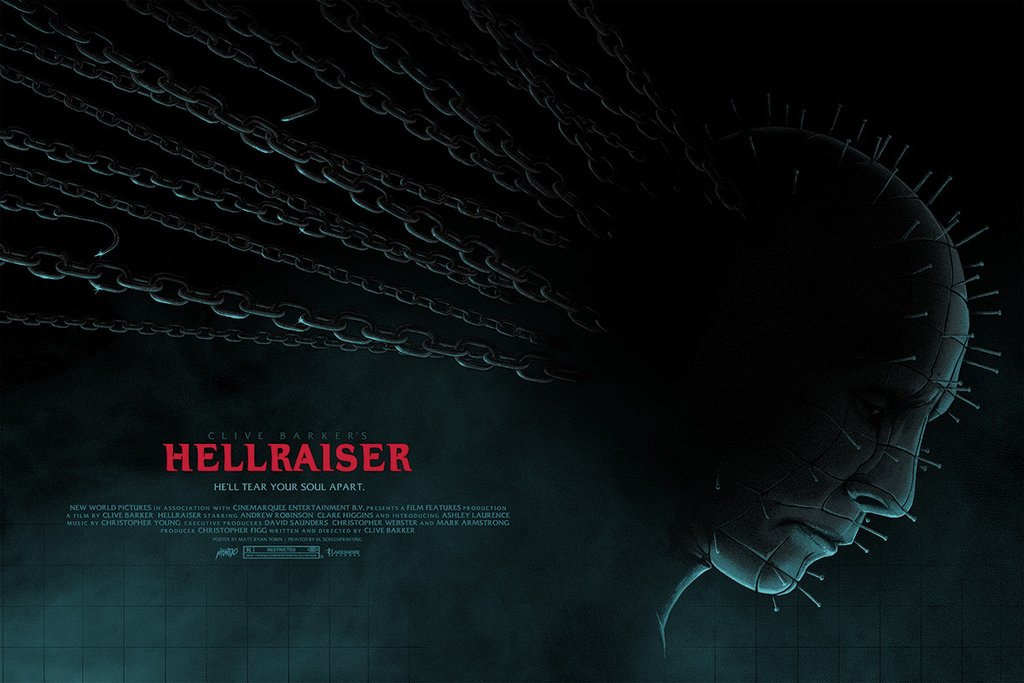 The assumption of absolute familiarity with a piece of work is all too often a stumbling block to genuine assessment of its qualities: The status has a tendency to blind us not only to potential faults (assuming that we proclaim some love for the work in question) but also to qualities that we haven't yet allowed ourselves to perceive; we fall back on the resonances and reinforcements that originally kindled our interest or aroused emotion, to the ignorance of what might elicit new resonances. In that manner, work that might have once been deviant and transgressive becomes somewhat banal and familiar (at least in memory). Whilst I'd never accuse it of banality, Clive Barker's 1980s work of transgressive, metaphysical horror Hellraiser certainly occupies a status not a million miles away from that in my own mind: a film and franchise that I cannot recall not existing; beloved and distressed by since childhood; as with so many of my generation, a gateway into realms of horror I'd never walked, and an inspiration for appetites that sustain to this day (albeit in much evolved and elaborated form). Having the chance to assess a reprint of the film is therefore both wonderful and somewhat intimidating: what is there left to say about a work that has been commented upon so much, that has been flayed and dissected and autopsied a million times over, whose imagery is now so powerfully lodged in public consciousness, it's possible to find examples of it on everything from T-shirts to bobblehead dolls? As is always the case when I commit to my (habitually annual) viewing of Hellraiser, the first thing that struck me is how powerful the film still is, not only in terms of its graphic imagery (which is what most seem to recall with sincere degrees of vividness) but in what that imagery suggests and symbolises: 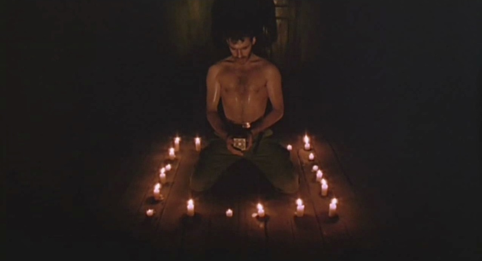 The film is not the out and out gorefest that people seem to recall and enshrine it as: whilst it certainly contains numerous examples of explicit mutilation, pain and the shedding of blood, each and every instance has wider and deeper resonance than what might be found in, say, the likes of Eli Roth's Hostel or the Saw franchise. Here, pain and bodily mutilation go beyond mere examples of suffering and grotesquery; there is an artistry and even allure to what the Cenobites (the film's monsters de jeur) promise; they come with words of seduction, with a priestly and noble bearing that is more...philosophical than anything that even their closest contemporaries boast: whereas the likes of Child's Play's Chucky, A Nightmare on Elm Street's Freddy Kreuger and Halloween's Michael Meyers conduct variously inventive means of execution, the Cenobites enact something far more theatrical, elaborate and potent: when Pinhead utters the iconic line: “...we'll tear your soul apart,” he isn't merely engaging in poetic threat: that is precisely what the Cenobites promise: a state of metaphysics beyond the fleshly, mortal and ultimately animal concerns that most horror films of the era present. The instant the amazing soundtrack by Christopher Figg begins to play, it's clear that we're dealing with a work of another order, here; this isn't the “three fingers on a synthesizer,” orchestra-sting laden shock-fest that saturated 1980s horror cinema: there are elements at play that make its popularity and cultural enshrinment almost baffling: a work that might have been more at home in the more obscure annals of arthouse cinema, were it not for the fact that the public took its deviance to their collective breast and wallowed in its surreal sadism. As someone who presumes to know the film inside out, who has watched it countless times since childhood, it's a truly wonderful experience to be surprised all over again; to find little details and factors that I'd not noticed before, to be mesmerised by the composition and framing of certain scenes...to discern entirely new resonances that chimed with fresh contexts and experiences. Beyond that: to be genuinely moved and unsettled by the work again, to feel those swells of emotion as it played out: the breathless moments of tension as characters manipulate the frames and faces of the “Lament Configuration” (the iconic puzzle box that “...opens doorways to Heaven or Hell,”) as the Cenobites announce themselves through luridly surreal theatrics (light streaming through cracks between tiles and wooden beams, the chiming of a great bell, scented smoke issuing from rents in walls, to name but a few), as a barely formed, skinless, seeping Frank emerges from the shadows to feed on his and Julia's latest victim... 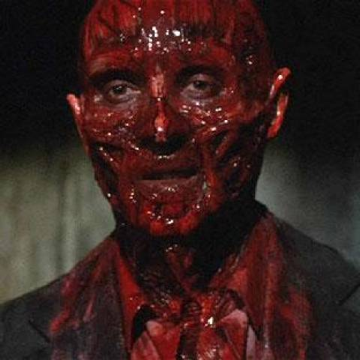 The film still exercises a giddy degree of disturbia; images that are explicitly designed to unsettle the audience rather than to make them nauseous or simply repulse: Take, for example, arguably the most iconic scene in the entire film, in which Frank Cotton -who is graphically torn apart and taken by the Cenobites in the opening sequence- is resurrected by the spillage of his brother's blood on the floorboards where he died: An extravaganza of the most grotesque practical effects, the scene is (quite literally) the beating heart and soul of the film; the presentation of something grotesque, wounded and ineffably distressing as celebratory and beautiful: it is the moment when events turn, when characters come to realise themselves and the superfice of familial stability fractures irrevocably. It also provides some subtle commentary on the truly horrendous metaphysics of the film: a form of immortality is possible, here: Frank has endured for time beyond time, from his own perspectives, in the Hell that the Cenobites preside over; a state of constant, unendurable extremity, his condition excoriated and flayed and eviscerated, reconstituted and remade, to the point that he himself is no longer human, but a creature of that state, to whom pain and extremity are merely facts of existence. His emergence into the midst of what is essentially a domestic drama that wouldn't be out of place in certain higher works of BBC domesticity serves to peel back the skin of proscribed hypocrisy; the family structure that clearly doesn't serve any one of its members, though some of them clearly ache for it to (whether they be the quietly desperate, inevitable victim, Larry, trapped and yearning Julia or walking Elektra complex Kirsty). 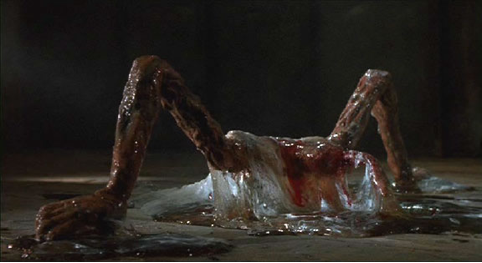 The domestic elements are far more densely entangled and complex than I previously realised, and far more engaging: very little is stated outright; exposition is trimmed and pared away or carefully concealed so as to feel like natural exchanges between the characters. Much of the unrest and disquiet derives from looks and peculiar interactions, most notably between Julia and the other two, the “wicked step wife” here inverted, played with a fittingly fairy-tale degree of coldness and malevolence, but also surprising sympathy: Julia is presented at least as much as a protagonist to the piece as the comparatively virginal, “Snow White” Kirsty, arguably occupying far more screen time and commanding more in the way of the audience's engagement than her step daughter, who often comes across as distant and dispassionate by comparison. The fact that Julia is trapped by circumstance and haunted by ghosts of old and dead passions makes her the fulcrum of the tale, the peculiar family dynamic that she, Larry and Kirsty occupy at least as significant as any of the extremity and metaphysics presented by the resurrected Frank or the Cenobites that come to reclaim him. There are moments within the film that play like domestic drama or French farce, but which are leant degrees of wit and poetry that they would otherwise lack owing to the surrealism and strangeness that the audience know is playing out behind the scenes: From the first instance, it is made clear that this is a family on the edge, fraying apart from the inside, with myriad tensions and issues, many of which remain unspoken (for example, Kirsty's “Elektra complex” relationship with her Father is never made overt or referenced specifically, rather symbolically through her resurrected and skinless Uncle's incestuous advances (“Come to Daddy”) and later, when Frank adopts the skin and form of her Father, in which condition he engages in a “cat and mouse” deception; a bleakly amusing parody of the family situation that Julia has always loathed, that Larry and Kirsty always blithely assumed. 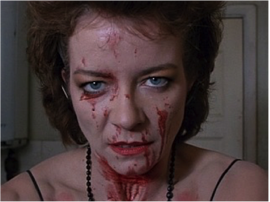 Beyond the obvious appeal of the Cenobites and the horrific imagery that accompanies them, the central domestic plot, the complexities and tensions between the familial characters, is what drives the story. As in most of my returns to the film, I was struck by how distant the Cenobites actually are; they rarely appear in the course of the film's run, their scenes restricted to certain key moments in which the domestic drama boils over and intermingles with the metaphysics that simmers beneath it: an opening scene designed to place the audience in a state of shock and disturbance through its strangeness and extremity, a half-way marker in which Kirsty inadvertantly summons them and learns -along with the audience- the true nature of the film's tensions, and in the climax, where they come to claim not only Frank, but also all who have been tainted by association with him and with themselves. For the most part, they are passive observers; they wait beyond the veil, watching and assessing with arachnid patience, for the moment when they have license to make themselves known. Rarities amongst horror movie antagonists of the era, they do not appear as overtly malevolent; rarely with threats, rather with words of poetry and promise, the lead “Pinhead” Cenobite's overtures resembling the long and florid dialogues of Frankenstein's monster, of the entities within Dante's Hell, as opposed to the almost mute monsters or wise-cracking killers that predominated horror films of era. Highly unusual in its sheer earnestness, Hellraiser doesn't seek to soften the blow or dull the pain by making the audience laugh with shock or fright; it has every intention of unsettling on a more fundamental level, which it succeeds in beautifully, even after all of these years and after so much sustained exposure. A perfect work?; Far, far from it. This new print, whilst enhancing certain factors (colours seem somewhat more vivid, scenes more crisp and well rendered. Also, whilst this may be simply a factor of different edits of the film being used for different editions, some of the transitional scenes seem to have been prolongued, allowing for more in the way of establishing shots and emphasis of mood), still leaves most of the original's faults intact, many of them the result of some truly baffling studio interference: A key problem -that dilutes the film's legitimacy to certain degrees- is the condescending decision of the film's original studio to dub most of the British actors -primarily the supporting players- with American accents. This not only makes little sense -the film is clearly set in Barker's hometown of Liverpool; there are shots alongside the Mersey, for Leviathan's sake-, it actively dilutes certain scenes to the point of them becoming nonsense: A particular exchange between the American Kirsty and her purportedly British boyfriend Steve refers to his clipped and slightly aloof accent, but makes no sense, given that he is overdubbed with a clearly American actor. 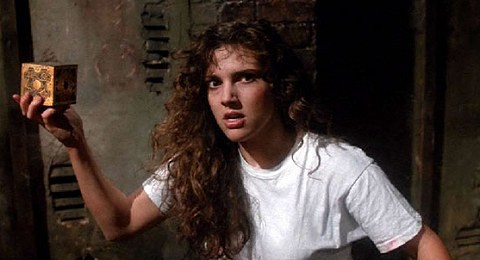 A few hours editing would be more than enough to fix this rather egregious fault; the re-dubbing of certain characters and supporting cast with appropriately Scouse accents would help to enhance the film's sense of place and remedy a factor that has the effect of jolting the audience out of the fantasy; of reminding us that we are experiencing a work of fiction. Beyond that, certain effects have not aged well; some of the latex skin tears and stretches in slightly odd ways, some of the graphic effects scrawled on top of the film cells (some of them purportedly by Barker himself, during the closing days of the film's production when they were running out of both time and money) are extremely crude, and certain scenes and characters could perhaps be trimmed to enhance the focus of the film (the aforementioned Steve is almost entirely redundant, and serves to distract from the Elektra complex dynamic occurring between Larry and Kirsty). Even so, I cannot deny being swept up into this beautifully macabre, graphic and transgressive fairy tale once more; enchanted all over again by its gruesome wiles. Hellraiser is as much part of my childhood; the self-authored myth of my own history, as any of its ostensibly more appropriate ephemera and influences (such as The Transformers, Visionaries, Knightmare etc). As such, I can't claim any great degree of critical distance from it -and certainly not objectivity, which is a beloved myth in itself-; all I can do is exclaim in various ways how I continue to adore it, and that I hope others will find their own pleasures in it, as years and generations sift by. 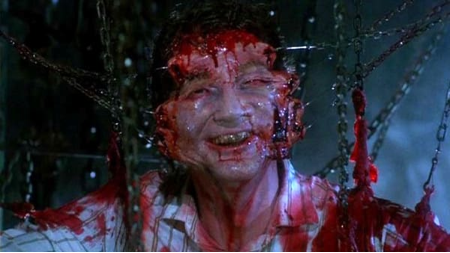 A couple, Larry and Julia, move into an old house belonging to Larry’s family, to make a fresh start. Exploring the dilapidated house, Julia discover a hideous creature - Larry's half-brother Frank, who is also Julia's former lover - hiding in the attic. Having lost his earthly body to other-worldly demons called the Cenobites after a ceremony with a strange golden puzzle box, he is brought back into existence by a drop of blood on the floor. Frank soon forces his former mistress to bring him human sacrifices to complete his body in a bid to escape the clutches of the Cenobites… but the Cenobites have other plans for him. We like it because: “Jesus wept!” Clive Barker’s debut film, a nightmarish vision of flesh ripping demons wreaking havoc on a suburban household, was unleashed on cinema audiences in 1987, and became a box office sensation, spawning numerous sequels, a legion of devoted fans and turning Pinhead and his Cenobites (“sado-masochists from beyond the grave” as Barker describes them) into horror icons alongside the likes of Freddy Krueger and Jason Voorhees. Thirty years later and the film is as terrifying, nightmarish and gruesomely effective as ever - featuring wonderful central performances from Andrew Robinson (made famous as the Gemini killer in Dirty Harry) and Clare Higgins as the couple, whose life is torn apart when brother Frank appears in the attic and starts demanding flesh; Ashley Laurence makes a terrific horror heroine, attempting to send the Cenobites back to hell. Barker’s taut, twisted script, adapted from his story The Hellbound Heart, coupled with his remarkably assured direction (belying the fact this was his debut) ensures a film dripping with dread, and bursting with inventive set pieces and bloody imagery - including the appearance of the gruesome Cenobites, summoned by the infamous gold puzzle box, and their metal hooked torture devices. The 30th Anniversary re-release - appropriately on Friday 13th of October - gives audiences a chance to see it once more in all its gory big screen glory - and for the uninitiated to have their souls torn apart for the first time! released by arrow films on 30 oct 2017 and available to purchase here HORROR FILM REVIEW: CUTE LITTLE BUGGERS
4/10/2017
Definitely NOT a ‘fluffy bunny’ movie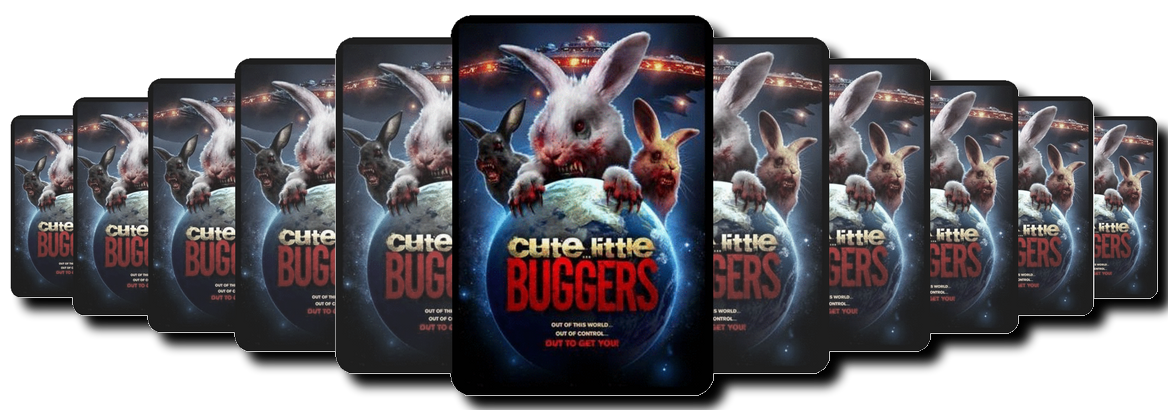
The distributor blurb is as follows:
“Gremlins meets Hot Fuzz in Cute Little Buggers, premiering on VOD Nov 7. Tony Jopia’s highly anticipated comedy-horror hybrid sees locals of a peaceful English village, enjoying their annual summer festival, when they are suddenly attacked by mutated killer rabbits! Somewhere in the depths of space, aliens are watching the earth and planning their attack. Unaware of the impending danger, the locals of a sleepy English village are preparing for their summer festival. The aliens launch their offensive by mutating the local rabbit population, and when the furry demons are released, the body count starts to pile up as blood, guts, and fur flies in all directions as the humans fight off the alien threat. Featuring genre icon Caroline Munro (Maniac, The Spy Who Loved Me) and from Tony Jopia, director of Crying Wolf , comes the wildest film of the fall, Cute Little Buggers – crashlanding Nov 7 from Uncork’d Entertainment.” It’s a mood thing, and if you’re in the mood for a silly sci-fi horror sex comedy in a 1980s style then cute little buggers might be just what you’re looking for. When I was in my late teens/20s I had already lived through the far from PC era of the ‘Carry-On’ movies and Benny Hill and was experiencing the likes of Critters, Gremlins, Attack of the Killer Tomatoes and many others of varying quality. The 80s and early 90s in particular appeared to spawn a great many ‘straight to VHS’ copycats, the emphasis placed more on copious quantities of blood and guts/tits and arse and of course humour. Recently films and TV are harking back to the good-old-bad-old-days with productions such as Stranger Things, the remake of Stephen King’s IT, and one of my personal favourites of recent years Turbo Kid, the latter of which captures a similar vibe to Cute Little Buggers in that the 80s influence is clear, and all of which are the higher quality end of the spectrum. Cute Little Buggers is one of those films which is more difficult to accurately define, as much of what I would normally consider to be piss-poor is seemingly quite deliberate. The special effects are a good example of this as although better than average for low-budget offerings they still have that bargain basement quality with the mutants looking like they would be more at home in Who Framed Roger Rabbit, which is somewhat appropriate. The basics: aliens seek to impregnate Earth women. Those given the task attempt to select the species most likely to be successful at procreation and mutate them to do their bidding, so choosing rabbits seemed like the best bet. Cue a lot of lame jokes, topless babes (Not Caroline Munro as she has a tiny cameo role) and an absolute mass of gore as the local villagers take on the alien hybrid bunnies. Is it actually any good though? Well, as I said at the beginning, it’s a mood thing. When I first started watching it I thought “what is this shit”, turned it off soon after and left it a few days. Today I had a bit of time to kill and felt guilty for not giving it a fair crack of the whip, so watched the whole thing and have to admit that I found it fun in places. I couldn’t help but think that if this film had been released in 1985 the 20-year-old me would have enjoyed it more and perhaps it would have become a cult classic, but nowadays it’s more destined to be a somewhat cheesy nostalgic throwback. If you’re the kind of person who likes no-brainer entertainment then this is for you. Watch the trailer and decide for yourself. 
HORROR FILM REVIEW: DEMON HUNTER
25/9/2017

I started watching Demon Hunter and stopped 15 minutes into the film because I’m uncertain as to whether or not to have some aspirins on standby. You may not believe that relevant to the film, but the ludicrously high volume on totally unnecessary music is spoiling what began as a quite interesting horror film. 10 minutes further and again we have deafening music, now I understand that a lot of films have a heavy soundtrack, some have creepy music et cetera to enhance the mood, but when the music is so intrusive you can scarcely hear what the characters are saying it distracts from the enjoyment.
35 minute stage and I have conceded defeat. Okay, it’s now four hours after watching 35 minutes of Demon Hunter and I still have the headache. I’ve not taken any aspirins as I’m not a fan of medication unless absolutely necessary, Demon Hunter was just so damned noisy that I almost succumbed. In those four hours I have watched two other movies, one of which had hardly any music interspersed, but the other had quite a bit more than average yet still less than Demon Hunter. The soundtrack in the second film although generally present was not intrusive and I could still hear every word of dialogue perfectly well, which is what’s supposed to happen. I’m telling you this so that you can fully understand that it’s not just me having a bad day, as let’s face it, there are always times when we are a little more sensitive to noise than others. The other two movies were a test, to see if it was just me, it wasn’t. I even recruited my fiancée to watch the first half-hour as a test. She said the same thing I have. This is all very sad as Demon Hunter got off to a fairly good start, a little bit like a not so slick version of ‘Underworld’, and by the time my head was pounding the film was actually hitting some very good horror notes which made me progress as far as I did, but I’m so sorry ladies and gentlemen, I’m not going to compromise my health for a horror film and end up like some poor sod on ‘Scanners’. I have no idea whatsoever regarding the motives of the sound editors, and I know I’m repeating myself, but WTF! It’s a shame, it really is, as a lot of people clearly put a lot of effort into this and it looked like it might have been excellent but for the soundtrack. Of course you can always choose to watch it anyway, but for me it’s one of those rare instances where I was forced to abandon the film. It’s available right now as video on demand from Wild Eye Releasing. Good luck! 
HORROR FILM REVIEW: CIRCUS KANE
22/9/2017
Oooh Bloody Hell!
From Uncork'd Entertainment and DeInstitutionalized comes Circus Kane. Christopher Douglas-Olen Ray directs a James Cullen Bressack and Zack Ward script, based on a story by Sean Sellars. Gerald Webb, Christopher Ray and James Cullen Bressack produce. Here’s the official blurb: “The notorious and disgraced circus master, Balthazar Kane, invites an unsuspecting group of social media stars to the revival of his CIRCUS KANE by promising $250,000 to any of them who can make it through the night. Kane’s true plan quickly proves to be far more sinister as the contestants realize more than money is on the line. The group must fight for their lives to escape Kane’s demented house of horrors.” Well, with that team behind it and that basic premise it looks promising. It would appear that in these modern times one could not chuck a dart without hitting a killer clown movie, and for the most part they are total dross. Circus Kane has killer clowns, albeit mercifully used sparingly and to great effect. There’s also the fiendish, top-hatted ringmaster required by every circus who is a joy to watch, and it has bucketloads of gore, a mansion full of booby-trapped rooms and diverse victims chosen to survive for a cash sum. This is where we could easily start yawning as we have seen all of these components in loads of other movies; however circus Kane is one of those rare instances where all of the run-of-the-mill clichés come together and actually work out pretty well. One of the biggest problems in horror movies of this ilk is flat characterisation, it’s not enough to just have a bunch of victims, you really need to give a shit what happens to them and as such they need to be at the very least interesting enough via personality or looks. Most films coast on eye-candy, of which, depending on your preferences, there’s enough to satisfy with former ‘Miss Poland USA’ winner Victoria Konefal proving she’s not just a very pretty face. For the ladies there’s Jonathan Lipnicki (the little speccy blonde kid from Jerry Maguire) who has grown up all clean-cut handsome and buff. Circus Kane doesn’t rely on good looking actors though, choosing instead to have solid performances from believable even if not likeable characters. I say ‘if not likeable’ because one or two are somewhat self-serving whilst another, ‘Big Ed’ played by the hilarious Ted Monte, is a complete and utter arsehole, which is great as he is so generally obnoxious and funny that I was rooting for him to survive. The eight ‘contestants’ (for want of a better word) are all chosen because of their links to the horror community, A Scream Queen, a memorabilia trader, a reviewer, a blogger, a collector et cetera, all with some way of promoting Circus Kane far and wide as the scariest experience ever. Now this may seem a little far-fetched, the booby-trapped mansion idea and so on, yet at the time of writing this there are several such places in America offering what can best be described as a fully immersive torture porn experience requiring a full physical and mental medical and the signing of a waiver with an ‘anything goes’ policy. That really only makes the basis of Circus Kane even more plausible, otherwise the premise might have been off-putting as it would be unlikely that anyone would sign up for that no matter how much money was involved. Having real-life counterparts proves the lengths that some people go to even if only for the kudos of lasting longer than anyone else in degrading and dangerous scenarios. Circus Kane doesn’t go for dangerous it goes for deadly with the unlucky contestants searching for clues and performing tasks which lead to elimination in a variety of very nasty ways. There are so many similar films out there, but this one manages to effortlessly float above them as the cast are excellent, production values are spot-on and it never gets tiresome. It’s currently available as a VOD and maybe you’ll like it, maybe you won’t, but I loved it and it will definitely stand up to another viewing. Follow the trailer below to see a little of the gory delights in store.
[object Object]

HORROR FILM REVIEW: CLOWNTERGEIST
21/9/2017

In an attempt to broaden my horizons I thought I would give Clowntergeist a view, obviously there’s a spate of movies with names such as Sharknado, Zombeavers and Piranhaconda which the titles alone would suggest were created with the tongue wedged firmly in the cheek, so I made the incorrect assumption that perhaps this was a comedy horror. Clowntergeist was not best choice for my horizon broadening as it soon became apparent that this was neither a comedy or indeed a horror and was barely scraping by as a thriller.
The psychopathic clown had all of the presence of a limp dick at a porn shoot, and yes, I know, we’re kinda sorta basking in the glow of Pennywise who obviously sets a high bar, but ‘Ribcage’ (Eric Corbin) doesn’t even compare favourably with any of the few dozen killer clowns I’ve seen so far. The only thing he brings to the table is a huge Turkey. The dialogue is dreadful as in this example:
Woman: “What’s the curfew for?”
Jonah: “A manhunt” One of the other customers then says to his companion “What’s a manhunt?”
Really? I know society seems to have dumbed down a lot lately, but when a guy who appears to be in his mid-20s has to ask what a manhunt is I think we are in serious trouble. That scenario came about after a Police Officer entered a soda shop and asked the temporary manager Jonah (Sean Patrick Murray) to close as soon as possible and inform everyone there is an 11 o’clock curfew. I’m questioning the logic on this, as surely it would be better for the Police Officer to have announced the curfew himself, what with him being your general-purpose authority figure and all that, but hey, the stupidity doesn’t end there. Remember what I just wrote about the store having to close? Couple of minutes after telling the customers they are closing in 10 minutes the same guy when asked by a staff member if they will remain closed the next day replies, and I quote…
“Not when I’m in charge… WE don’t close for the Apocalypse”.
Erm, okay, but didn’t he just say they were… CLOSING?!
He then gives the same staff member a set of keys and instructs her to close up the shop. Maybe I am too strict over this sort of thing but in my world that just doesn’t compute, which unfortunately is the case with most of what happens in this complete dog’s breakfast of a film. The only good thing in Clowntergeist is what comes across as a genuine rapport between the two female leads, Emma (Brittany Belland) and Heather (Monica Baker) who deserve a much better script in a much better film than this one. The plot is a by the numbers thing relying mainly on jump scares delivered for the most part by a piss-poor supernatural clown, who walks like an ape with severe constipation carrying an imaginary roll of carpet under one arm as he thuds about in the shadows. The lighting, colour and music are good though as they do give a decent atmosphere, but not enough to elevate this film beyond the mundane. Of course this is just my opinion, so feel free to watch it if you absolutely must, but with the several dozen other clown-based horror films available to choose from I’d watch all of those first. 
HORROR FILM REVIEW: COLD MOON (2017)
11/9/2017

Michael McDowell remains something of a cult figure today, despite authoring some of the best novels to come out of the 1980s horror paperback boom and having a successful career as a Hollywood screenwriter (his filmography boasts such credits as Beetlejuice and The Nightmare Before Christmas in addition to many episodes of anthology T.V. shows like Amazing Stories, Monsters, and Tales From The Darkside).
No less an authority than Stephen King described McDowell as one the finest writers to ever work in the genre, yet the man’s name has never attracted the same kind of attention or appreciation King’s has. It’s not a name your non-horror-reading friends are likely to recognize. McDowell is not a cottage industry. People don’t dress up as his characters for Halloween. Movies have not been made from his books. At least, until now. Shortening the title of one of McDowell’s best novels, Cold Moon Over Babylon, Cold Moon (which hits DVD and VOD this October) takes place in a quiet town along the Florida panhandle, a close-knit community teetering on the raggedy edge of the poverty line. When doe-eyed teenager Margaret Larkin washes up on the snake-infested banks of the river Styx, lashed to her bicycle and drowned in a shocking act of seemingly senseless murder, said community is shattered and, from beneath its broken shards, its most prominent residents’ darkest secrets come slithering out. Something else comes slithering, too. Something pale-faced and drenched in sludge, seeking vengeance for the crimes perpetrated on the unquiet dead. Full of chilling nightmare imagery, McDowell’s supernatural Southern Gothic is practically tailor-made for cinema. Though dominated by long stretches of suggestive terror and psychological dissolution, it knows when to pop the cork on all the tension it’s bottled up, bursting with garish, macabre gouts of all-out horror. Equally grimy and grim, McDowell’s black-haired, waterlogged ghosts would fit right in on the set of a J-horror spookshow. In theory, Cold Moon is a home run. But what about in execution? Director Griff Furst is probably the last person you’d expect to tackle this particular source material. His previous credits include such SyFy Channel-style CGI monster-mashes as Ghost Shark, Arachnoquake, and Alligator Alley (AKA Ragin’ Cajun Redneck Gators). On top of that, the cast list for Cold Moon includes that infamously ignominious ignoramus known as Tommy Wisseau. Y’know, the laughingstock “auteur” responsible for The Room? Yeah, that one. Upon hearing that alone, longtime McDowell readers would certainly be forgiven for letting their excitement over Cold Moon turn into trepidation. Happily, there’s no need to fear. Not only has Furst delivered far and away his best directorial effort to date, but Wisseau’s presence is limited to a brief, wordless cameo. Hallelujah! Sure, Cold Moon gets off to a rocky start. McDowell’s book is unusual in that it has little interest in maintaining the mystery of who its killer is, unmasking the culprit rather quickly so as to focus instead on the murderer’s piecemeal mental unraveling under the assault of angry spirits. As a result, the movie’s first act stumbles in its efforts to simultaneously appease audience expectations while also setting them up for imminent subversion. Once over that hump, though, Cold Moon zips along with nary a hitch. The first act may be a little shaky, but the second and third stand pretty damn solid, successfully keeping your eyes glued to the screen right up until the final credits roll. A huge portion of that second and third-act magnetism comes thanks to actor Josh Stewart (best known to horror film fanatics as Arkin, the protagonist of those underrated Collector movies) who plays Nathan Redfield, a disturbed banker with a weakness for booze and jailbait. Even more than the ghosts who lurk in Babylon’s shadows, the look on Stewart’s face and the murky depths behind his eyes prove genuinely haunting. Similarly worthy of praise are Frank Whaley (most famous as that burger-scarfin’ bullet-sponge Brett in Pulp Fiction), playing the out-of-his-depth sheriff Ted Hale, and Christopher Lloyd (don’t act like you don’t know who he is!), playing Nathan’s lecherous invalid father James. Much of the supporting cast is serviceable but forgettable, though that’s to be expected for a modestly budgeted production such as this. Indeed, evidence of Cold Moon’s meager origins is readily apparent throughout. That doesn’t stop Furst from crafting an admirably effective atmosphere of melancholy dread, though. McDowell’s story and characters do a lot of the heavy lifting, but Furst himself deserves credit for realizing McDowell’s ominous and even grotesque apparitions so well, while also orchestrating plenty of spine-tingling scares of his own. Rounding out the package is an original score by the director’s brother, composer Nathan Furst, which imbues the proceedings with oodles of potent drama and emotion. All in all, Cold Moon isn’t quite the home run it could have been, but it is a damn good horror movie nonetheless. Dark, creepy, and ultimately tragic, it’s an adaptation that does its source material justice. Here’s hoping more Michael McDowell adaptations follow. THE Film receives a 10-market theatrical release along with digital on 10/6 through Uncork’d Entertainment. produced by Furst’s Curmudgeon Films.
|

Archives
April 2023
|

 RSS Feed

|

|