

|
"felt almost like a parody of a jump-scare, where a monster would dive onto the screen only to waggle its tongue and spout something unintelligible, like a kid leaping out of a closet making a silly face and shrieking."  Director: Andy Muschietti IT, the original TV mini-series, was my introduction to genuine horror. Up until that moment, I’m not even sure if I’d read any RL Stine, and because from my earliest infant memories I had always loved creepy and forbidden concepts, my excitement at finally seeing an adult horror film was hard to contain. Being younger than 10, I wasn’t quite mature enough or equipped with a long enough attention span to enjoy the book, but some years later I read Stephen King’s almost endless novel, and loved it. Now, at 34, I’m currently revisiting the work, and it is even better than I remember it. Re-reading the book makes IT (2017) a tough one to review, because the book is, quite simply, astounding. The characters have some of the best-drawn and most memorable personalities I’ve ever read. The atmosphere is awash with dread, and King’s (thankfully fictional) town of Derry feels haunted from the very start, as if something malign lurks beneath every innocent encounter, every landmark, and the most innocuous of events. Themes run through the tale like broken blood vessels: innocence being cut short, memories acting like hauntings, the disturbing transition from childhood into adulthood. The tightrope of overcoming or succumbing to that which frightens us most, and whether we allow our fears to shape our adult selves. A film maker could hardly ask for stronger source material – or a more intimidating tale to translate into 4 hours of screen time. Now, for anyone who doesn’t know, IT is about a town haunted by a malevolent, shape-changing presence which feasts on the fears and the flesh of those who believe in it – usually the local children. When this entity, which primarily takes the form of a clown, targets 7 close friends, they decide to fight back, and are forced to return to their home town 27 years later to finish the battle they started. IT (2017) unravels the intertwined chronology of the novel and tells the children’s tale first, altering the time setting to the 80s rather than the 50s. For the most part, it works. Let’s start with the good stuff: Pennywise was, for me, pretty goddamn great. Ignoring the wonderful ham of Tim Curry’s unforgettable performance in the flawed but fantastic 90s mini-series, Bill Skarsgard’s Pennywise is a seriously unsettling interpretation of Derry’s eater of worlds, and of children. Skarsgard appears constantly on the brink of frenzy, delivering each line with hyper-intensity. Modern-day effects and budget are at their absolute best here, contorting the clown into a horrific array of different forms that are complemented by Skarsgard’s manic performance. And the monsters. Oh, the monsters! Eddie’s leper, minus the unpleasant and thematically relevant proposition of oral sex featured in the book, is hideous. Stan’s painting-lady apparition is truly distressing. Beverly’s sink experience has an added element that works immensely well. In fact, almost every ghoul and ghost ticked the right boxes for me. However… While I’ve read that a lot of people had no problem with the jump-scares, there were moments when they took me out of the film. Not to press the point too much, but some felt almost like a parody of a jump-scare, where a monster would dive onto the screen only to waggle its tongue and spout something unintelligible, like a kid leaping out of a closet making a silly face and shrieking. I may be a jaded horror movie viewer, but these often made me giggle during moments when I felt that the director wanted me to paint my pants brown, instead. The cast is great, and as many have already observed Sophia Lillis is perfect as Beverly and likely to be heading for a glittering acting career. The direction is good, the cinematography great, and the sound, lighting and overall atmosphere top-drawer. Okay. That’s the good stuff. Now let’s change gear. I found the characters, themes and lore to be painfully trite and 2-dimensional. We know nothing of Ben’s home life. Stan’s family background is boiled down to his Jewishness. Bill is just a stutterer and not a storyteller. Richie has become a dick-joke-machine. Eddie’s mum has become malevolent rather than simply pathetic. Only Beverly’s character comes close to achieving nuance, as she puts on a brave public face in response to the school’s cruel rumours and her fearful relationship with her revolting, abusive father. While it’s easy to argue that it would be near-impossible for a film maker to offer even a glimmer of the depth found in the novel, I believe that the characters and the loving friendships they share was drawn better in the 90s mini-series, which dedicated even less time to the children’s story. The problem is that we never see the children hanging out or having fun – they are just caricatured bullied kids who spend their time either getting beaten up or fighting a supernatural entity. One aspect of the thematic shallowness can partially be blamed on the film’s A-to-B chronology. The book and the 90s miniseries focus heavily on nostalgia and uneasy memories, as the horrors of one summer the characters spent 27 years ago are revealed through a tangled network of flashbacks and recounted recollections. This, for obvious reasons, would have been impossible to portray in IT (2017). As for the demon’s status as a world-devouring, fear-swallowing, almost God-like entity, in IT (2017) he’s very much an earthbound clown-monster. While there is a hint to them, there are no deadlights. Easter eggs aside, there is no turtle. Gone is the existential terror of something unfathomable, something that creeps through and haunts every element of a town and possibly beyond. As jarring as Pennywise is, in IT (2017), he is essentially a child-killer who says “Boo” a lot. I even wonder if most of today’s audience would have picked up on the idea that Pennywise uses the children’s deepest fears against them, in order to feast on their terror, such is the amount of time spent discussing the subject. I had issues with the film’s climax, but these veer too close to spoilers. I’ll simply mention three parts near the climax that had me raising my eyebrows, but this is only for those who have already seen it: The dance was hilarious. The kiss felt thematically irrelevant. And the line “…FEAR…” was, um. Actually, what the clown-fucking fuck was that about? Anyway, despite my gripes, I enjoyed IT (2017) a great deal. My peeves were almost inevitable, because I’m a fanboy, and I would have preferred to have been given a 10-part TV series rather than two movies. But that doesn’t mean that I’m not 100% excited for the next instalment. WHAT DID YOU THINK OF THE FILM, PLEASE LEAVE A COMMENT IN THE SECTION BELOW RELATED POSTS
HORROR FILM REVIEW: THE VAULT.
8/9/2017
BY JOE X YOUNG Heist meets Geist  I love a good ‘heist’ movie almost as much as I love a good horror, so when the opportunity to watch a combination of both arrived I thought it would be worth my time. Okay, I’m not going to say I was wrong about that, as it was a good enough film to keep my interest overall, but as absolute honesty is my bag I have to tell you that although I enjoyed it overall, it’s a flawed film in a number of ways. First of all is something which really is just a personal gripe, it’s got a lot to do with James Franco, or to be much more accurate, James Franco’s moustache, it’s well on the way to being a ‘70s porn-stache and deserves a film of its own, but in this one it just looks a bit moth-eaten and obvious. Moving on from the moustache to the film proper, it’s a great idea, five people stage a robbery which goes pear-shaped almost as soon as they are in the bank, which isn’t the best start, but hey-ho there you go. There’s a dose of mayhem outside as a fire is raging in a warehouse, the fire set by the bank robbers to keep the emergency services busy. Part of me is going ‘nah’ as it’s a bit dumb to bring that kind of heat (pardon the pun) around when trying to rob a bank, but another part of me is thinking that at least they have some sort of cover for the old ‘in-out no messing about’ robbery. There’s a brace of females involved in the blag, one is Leah, a woman attending a job interview, and the other is Vee, an awkward customer, both of whom are just awaiting the arrival of three robbers dressed as firefighters before they drop the acting and get on with the robbing. Unfortunately it’s absolutely clear that it is acting, which is made all the less credible by Francesca Eastwood’s blonde wig, which even on a good day would look like a trainee Drag Queen’s first effort. Is that important? I think so, because if I were interviewing someone for a job in a bank, where trust would be a vital asset, I’d be a little concerned if Clint’s daughter turned up looking like ‘Bad Disguise Barbie’. The robbery itself doesn’t take much, the usual stuff, hostages bound, their heads hooded in cash-bags, the safe opened after a lot of fumbling and so on, but the yield is poor, so much so that there’s arguing over who stays to look for more or who escapes with the meagre pickings, it’s all a bit pointless as it’s revealed that three of the robbers are family, the brother, Michael, got into a bit of trouble and needs cash to get square, and the women are his sisters who are helping him. Their relation to the two others isn’t really stated, but doesn’t need to be either, as one is a safe-cracker and the other is the muscle. I’m not sure if the brother’s predicament is supposed to elicit sympathy for the robbers, but it doesn’t help, even when Michael remains adamant that they have one rule ‘nobody gets hurt’. Aww, the big bad bank robber has a heart, but the point here is that we’re watching villains performing a heist, and as such they are the bad guys, so it’s not as if we’re going to be rooting for them when they meet their respective fates. Our sympathies should rightly be with the hostages, talking of which: From underneath a cash bag the hole under James Franco’s moustache offers help. They remove the bag and he tells them that he’s the assistant manager and he can help them get away as well as get six million dollars secreted in a second vault. Obviously this seems the right way to go, and our robbers decide they’ll crack the vault and get rich before going home for beer and pizza. There’s just one snag, which is actually totally spelled out for us in the opening credits as well as talked about in the preamble before the robbery, in 1982 the bank was the scene of a major crime, big nasty robbery gone South resulting in a high body count and things which go bump in the night ever since. NOBODY goes down there. NOBODY. Muhahahahaaaaa…… Well, that doesn’t deter the robbers, one of whom grabs his trusty sack of safe-breaking tools and heads for the vault. He does in fact get it open, but that’s not all he gets as some nasties hiding in the dark step out and snag him, forcing him to go all Abel Ferrara with his cracksman’s drill. I won’t dwell on the gore, there’s not much of it, which is for the better in this instance, same as the ‘jump scares’ being kept to a minimum, so it’s more about the atmosphere and the supposition of something more sinister at work. It’s actually a schizophrenic offering, the heist part being subdued to the overall detriment of the film, especially as it involves a Police Detective, played by Clifton Collins Jr, who is seriously underused throughout. I’ve never seen a bad performance from Mr Jr and always considered him to be one of the finest character actors out there, so to see him in what is basically a throwaway role is a sad waste of a talent. I’m also left wondering what James Franco was doing in this as he is playing a small part in a film in which the comparative unknowns get the major screen time. Maybe he had a slow weekend and the phone rang, who knows, I just think he’s wasted in this. What happens below stairs is creepy and malevolent; we’re treated to a few scenes of well-handled horror but to my way of thinking it was all a bit disjointed. The ending is an attempt at a ‘Sixth Sense’ finish but doesn’t come close. Would I recommend it? I think I’d probably say that it’s worth a V.O.D. but I wouldn’t get my umbrella out on a rainy day to go see it at a cinema. If we had a GingerNutOmeter this would score around two-thirds of a packet.  Carnivorous cars, carnal knowledge and total carnage.   The SyFy Channel’s latest offering of a break from the norm is the wittily titled ‘Blood Drive’, the plot of which is fairly straightforward in that it’s a car race set in a version of 1999 which we all know didn’t happen here. In this version of reality the United States has been split apart by a natural disaster and an evil corporation has exploited this to gain the type of power we’ve seen before in films such as Robocop (Think ‘Omnicorp’ and you’re not far off the mark). In fact, if we’re talking films here, which I am, then ‘Blood Drive’ is better explained because it has somewhat derivative content, especially if you are old enough to have seen ‘The Gumball Rally’, ‘The Cannonball Run’, ‘Mad Max’ and especially Paul Bartel’s cult classic ‘Death Race 2000’ from 1975. It takes all of the best aspects of those films and blends them into a (ahem) ‘high-octane’, high speed, high action bloodbath. Death Race 2000 was a brutal no-holds-barred extravaganza with a high body count, giving participants bonus points for eliminating not just other contenders but also random members of the public unlucky enough to get in the way of the drivers. ‘Blood Drive’ has a similar thing going for it, but with the more unusual twist that the cars have living engines fuelled by the blood of their victims, and make no mistake; there IS blood, bucketloads of it. This is gruesome fare, but not to the point where it’s all about the gore, there’s so much more to it than that.
AMERICAN GODS: EPISODE 5
29/6/2017

Even amongst the endlessly inventive and abstruse material that American Gods provides, this episode is an oddity. The show seems to be intent on never being predictable; on constantly re-defining its audience's parameters and expectations in the manner of a David Lynch work. Not only does it do so in terms of story and subject, but even in the styles and mediums it presents them. So, the episode opens with a familiar scene; where the last two culminated, in Shadow's reunion with now-undead wife, Laura, but then quickly shifts to one of the “Coming to America” sequences which is, ironically not a “Coming to America” sequence at all, but an “Established in America” sequence, involving tribespeople from the last ice age, hunting down mammoths, making clothes from their hides, eating their meat, rendering icons in their bones and skulls. What makes this sequence bizarrely (but effectively) incongruous is the nature of its recording: whereas all previous such sequences have been live action, this one is rendered in CG animation, lending it a quality that is removed from waking reality, almost fairy tale or dream like in its ethos. The story of the tribe itself is all but wordless, exploring their hardships, their efforts to eke out a living from increasingly hostile and bitter land, turning to the divinity they have made, the god they have brought into being, to help them, who does so (purportedly) via visions visited upon the tribe's shaman, who leads them in a voyage across the hostile wilderness in search of a promised land, many suffering and dying along the way. It's an oddly melancholy sequence, designed to demonstrate how the divinities that pervade the show's mythology come into being, what strengthens and transforms them; how they are tied symbiotically to their worshipers, often treating them with neglect or contempt as a means of subtly facilitating expressions of faith through sheer desperation. AMERICAN GODS: SERIES 1 EPISODE 4 REVIEW
13/6/2017
 Following the deviant extravaganza that was the last instalment of American Gods (Arabic immigrants engaged in graphic homosexual intercourse, one of whom turns out to be an Ifriti fire demon of Middle Eastern myth), this was always going to be a problematic episode. That is not to say there's anything in particular wrong with it, only that it may suffer in the eyes of some by contrast alone. Tonally and in terms of rhythm, the episode removes itself from any prior from the get go, focus shifting away from Shadow Moon (at least, in his present incarnation) to erstwhile wife, Laura, who vacilates back and forth between past and present, the episode exploring how she and Shadow first met, the truly bizarre relationship they enjoyed even before the latter got himself mixed up in a mysterious game of gods and demons and mythological monsters. Whilst some have criticised the episode for stretching out a back story that could have, conceivably, been told in a ten minute flash back, I find it a useful tonal palate cleanser and calming period following the intensity and emotion of the previous episode, before things start to kick into high gear once more. One of the more fascinating elements of the episode is how it frames Laura, whom Shadow clearly idolises in a manner that is distorting, almost religious in its delusion. When they first meet, she is a lost and despairing individual, out of love with the world, sustaining from day to day in a job she loathes, working at a casino into which Shadow drops as a naïve and not entirely successful con-man. Having attempted to play his hand at her table and been spotted, instead of finding himself reported and detained by casino security, he is instead informed by Laura of the situation, who urges him to leave without any further ado. Waiting for her outside, he seduces her -and vice versa- without pre-amble, the two finding something in one another that they assume they need, though what she takes from Shadow is far more ambiguous and less profound than what he takes from her: to her, he is a distraction, almost a hobby, rather than something in which she finds meaning.  Everything in this small back story is framed from Laura's perspective; a sincere effort to make her more than simply an element of the protagonist's back story (as so many female characters still are, even in present day TV series), she is a complex and emotive agent, with her own ambiguities and agendas, many of which contrast or even contradict the narrative or mythology that Shadow invests their relationship with. Whilst she clearly finds some release and pleasure in him, he is simply not enough to entirely forestall the despair and darkness in her soul: she remains detached, nihilistic, quietly unsatisfied, though she can't articulate to herself why. Meanwhile, in the present, where her life has unambiguously ended, she finds herself at the behest of a familiar character: her disembodied soul lost in the metaphysical desert where Anubis presides; a state where she, once again, exercises her agency, refusing the mythological rite in which her heart must be weighed against a feather, tipping the scales of her own volition, taking control of her own guilt. Whilst Anubis insists that she believed in nothing and therefore will go to nothing, she refuses that proscribed fate, hurtling back to where her body lies, finding herself waking to it, though its heart has long stopped beating, its blood long stopped pumping, in a state of not only distress, but also new and uncertain processes: no longer requiring breath, her heart and entrails still, her body rejecting the formaldehyde and various chemicals swilling about it in a graphically gross and hilarious manner... There's more than a hint of gallows humour about these scenes, in which the show seems intent on portraying Laura at her most disgracefully human, despite her undead condition; that her state hasn't become entirely better or worse simply because she happens to be no longer burdened by life. This in itself is a rarity for female characters, certainly romantic leads, that have a tendency to be idealised to ludicrous and dehumanising degrees by popular TV: this episode portrays Laura both in living and undead states as something entirely other; just another lost and frightened and beaten down woman, trying to make something of her existence, not known how, making mistakes and slip ups along the way, but ultimately just trying to be. 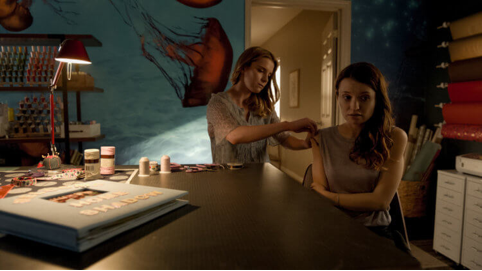 This has the effect of making her incredibly endearing and identifiable; not some pedestal-mounted, unobtainable icon (though this is, ironically the way in which Shadow regards her), but as a human being. Whilst it's very easy to condemn her for the infidelities she commits whilst Shadow is in prison, the manner in which the show frames them makes the act more one of desperation than of conscious cruelty or selfishness; before her death, she is on the very edge of terminal despair, of abandoning life altogether, which she likely would have, were it not for Shadow, her relationship with whom she cannot fathom or define, knowing only that it endures and endures in a way that nothing else in her life ever has. Her reunion with former best friend Audrey (with whose husband she continued an on-going affair whilst Shadow was in jail) is one of the stand out moments in the entire episode; funny, fraught and dramatic, Audrey herself, whilst ostensibly a supporting character, complex and engaging in her motivations, in the manner she relates and responds to Laura: whilst initially horrified that her former best friend is somehow out of her grave and walking around, her terror -hilariously played- is soon supplanted by angry and bitter bitchery, that is brilliantly portrayed; not exploding in histrionics or displays of violent contempt, but hissing and seething in exchanges that are all the more fraught for taking place in a bathroom where Laura expels the formaldehyde from her system in none too dignified a manner. These exchanges are some of the most beautiful in the episode, not to mention the series thus far; the emotional spectrum of their relationship cycled through and blossoming into something new and ambiguous in the space of a few moments. Whilst far from friends, Laura does not lie to Audrey; she answers her questions honestly and without ornament, to which the woman responds with more than necessary grace, even helping Laura to sew on her arm, which became detached earlier in the episode in an encounter with the Technical Kid's digital minions. It's also during these exchanges that Laura articulates both to Audrey and herself how her relationship to Shadow has changed during death: whilst she could not say she unambiguously loved him in life, she most certainly does now in death, Shadow's presence seething before her eyes like a miniature sun fallen to Earth, allowing her to follow him wherever he goes. 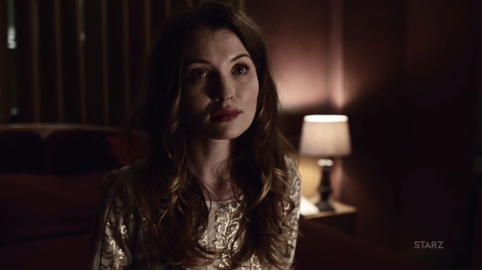 A reunion with Anubis and his cohort, Mr. Ibis, leads to a strange and ambiguous relationship, in which the erstwhile Egyptian Gods of the dead help her to repair and maintain her mouldering body, until such point as they are no longer able, when her business in the world of the living is concluded. As to what role they will later play in her strange thread of the American Gods mythology, it is left deliberately ambiguous, even for those who have read the book, as Laura's back story has been elaborated and expanded upon by significant degrees. The episode ends in the same place as the last, though from a significantly removed perspective; on her reunion with Shadow, allowing the audience to regard the exchanges to follow from a position of information rather than bias: whilst, in the last episode, it would have been very easy to condemn Laura, following events in this episode, such becomes profoundly more problematic: this is not a simple case of “good guy vs. bad guy,” in which one participant is unambiguously correct and the other wrong: their reunion is a ragged, uncertain, fraught and powerful event, all the moreso, given the revelations that both have experienced, suggesting intense and potentially cataclysmic exchanges in the episodes to come. It is easy to regard this episode as simple filler, given that it goes through a great deal of material simply to end up at the same place where the last one ended, but that would be to ignore the manner in which it shakes up and even inverts the audience's perceptions and position, not to mention the fantastic things it does with Laura as a female lead (and a conscious parody of female leads). The show seems intent on providing all of its characters, from the most prominent to the most incidental, a degree of genuine weight and back story; motivations that make them more than mere protagonists and antagonists, heroes and villains: no one and nothing here is so clean cut: despite the existence of extreme and aspect-defined entities such as gods, demons and monsters, everything, everything, everything boasts a freight of ambiguity and uncertainty that is pleasingly human, but also serves to upset or invert the narrative roles they would traditionally occupy. Far quieter than the previous, far less breath-stealing in its deviance, but still significant degrees beyond much of what popular television presently offers.  In Defense of Alien: Covenant
5/6/2017
 (WARNING: MANY, MANY SPOILERS)In 1979, Director Ridley Scott established an entire mythos with his horror-science fiction film Alien. I am not entirely confident Scott envisioned that his film would spawn a sequel that is completely derivative of his vision; or an entire line of comic books that would include epic battles against Batman and Superman. Given an opportunity to return to the universe he created with the visually pleasing, head-scratching “prequel” film Prometheus, Scott’s latest entry into the story--Alien: Covenant–is proving to be just as divisive among audiences, if we consider the reviews so far.
Full disclosure: I loved the film, and I loved Prometheus. I am glad a lot of people don’t like either film, simply because I don’t think these movies should be enjoyed by everyone. I was inspired to write this by the review I read for Covenant on Ginger Nuts of Horror. I like “negative” reviews that provide intelligent commentary, even if I don’t agree. WHO’S WATCHING OLIVER
22/5/2017
Review by Joe X Young

Who’s Watching Oliver has done rather well for itself on the festival circuit, gathering numerous awards with five for Best Picture, two for Best Actor (Russell Geoffrey Banks) and one each Best Supporting Actress (Sara Malakul Lane and Margaret Roche respectively), and it’s easy to tell why when you see it. Oliver has an undisclosed mental illness, but given the nature of his actions during his ‘normal’ but very OCD daily routine it’s possibly an Autistic Spectrum Disorder, which in no way validates the more abnormal parts of his day. He’s quite the visually awkward specimen, tall and slim with a look initially reminiscent of a young Elvis, in this case though it’s Costello with his lean pallid face, NHS glasses and old fashioned dress sense. Already someone who may stand out in a crowd, but Oliver stands out even more when considering that he is living in an area of Thailand where there aren’t that many English people around, which makes it somewhat implausible that he could be a successful serial killer as his description would be simple to give. ‘Last seen with tall, skinny, nerdy four-eyed white guy’ would certainly narrow things down.
 Well, if nothing else; if the rest of the series crashes and burns or descends into mediocrity (a la The Walking Dead), American Gods will have sealed its place in televisual history with this episode alone. First of all, let's address the obvious: there is a scene in this episode that EVERYONE is talking about, and with good reason: a scene that I never believed would survive translation from the book, certainly not intact, but which has, and then some: DEVIL TOWN
18/5/2017
REVIEW BY JOE X YOUNG  Devil Town from Corporeal Films is a short film at just under 17 minutes, yet 17 minutes is all that it needs to very effectively tell the tale of Patrick Creedle (Matthew Hebden), an estate agent with an attitude problem and of a ‘down-and-out’ called Driscoll (Johnny Vivash) who accosts him in the street and follows him to a coffee shop. With a tight focus on the two lead characters what could have been a dull interchange is instead a charged argument with excellent, and more importantly, believable dialogue in a script which perhaps could have been a little stronger but for an Indie film is pretty darned good. The acting is natural; we take the fly-on-the-wall seat whilst Driscoll attempts to convince Creedle that all is not as it seems in the streets of London. Both leads are flawless. There are other actors in the film, but their task is to remain unconsidered until required, and none of them in any way distract or detract from the tale as it unfolds. Kudos to Nick Barrett for writing and directing a story which although giving more than a nod in the direction of John Carpenter’s ‘They Live’ still manages to capture the paranoia of that classic without directly aping it. The film takes place in West Hampstead, but largely in the La Brocca café/bar, a very normal location for such an abnormal story. The quality of the filming is as professional as it gets, with everything just right. Like I said earlier, it’s just under 17 minutes long, it’s already started gathering pace on the festival circuit and will be part of a supernatural compilation due out later this year. If you don’t have 17 minutes spare to watch this you are missing out, so be sure to keep an eye out for Devil Town. Devil Town is playing a great screening and music night in London on the 24th Picturehouses - Film information for RAW - REALITY AS WRITTEN at Hackney Picturehouse Despite my unambiguous (and abiding) praise for the pilot episode of Neil Gaiman's American Gods, I will admit to going into episode 2 with a little trepidation:
More than one series of promise has failed at this point, allowing the energy and dynamism of its first instalment to falter, losing focus or coherence, spiralling out into self-indulgence and absurdity. This and the following episodes are where the series will prove itself; where viewers hooked by the pilot will decide to either continue watching or find themselves alienated. It's therefore a tremendous personal joy to report that the second episode is at least as fascinaingly strange, as gorgeously deviant, as respectful of its viewers as the first. |

Archives
April 2023
|
 RSS Feed

|

|