
 Alice Cooper has the dubious honour of being the first artist for whom I bought an album. I was around fourteen years old, and I’d started to embrace my teenage goth/rock phase (which, as I write this in my red and black living room full of gargoyle ornaments, hasn’t quite ended yet). This was in the era of CDs and Cassette albums. Vinyl was still around but was becoming increasingly rare, and music downloads hadn’t really become a thing yet. I’m sure they already existed in some format at that point (we’re talking mid-late nineties), for those not hampered by legality or an actual user interface via a website. But sites like I-tunes and Spotify were a long way off. Buying an album meant actually walking into a shop and walking out with a physical copy of some music. Presumably one that you’d paid for, but I hear that Woolworths in my native Sheffield was ridiculously easy to shoplift CD’s from because they kept them right by the entrance, and this was before those white rail things that trigger an alarm at the exit. But I digress. Shoplifted or otherwise, an album was a physical thing, full of art and lyrics and informative dates and credits. And the first of these for me, was Alice Cooper’s ‘Hey Stoopid’. The reason for choosing this album was a mixed bag really. I’d gone into HMV….this being that nice era when HMV were quite cheap, before they got greedy and started charging £18 per album, then crashed and burned and blamed it all on amazon before coming back humbled and somewhat cheaper once again….with the express purpose of choosing an Alice Cooper album. This was to be the first time I would spend my own money on an album. I already owned music, of course. Random birthday or Christmas presents from aunties and uncles resulted in “Now” compilations and the like, but they were rarely listened to. The music I liked, that I responded to, was always that which had come slightly too early for me. Although born in the eighties, I arrived in the middle of that decade, so by the time I was really old enough to be appreciating music as a thing, the nineties were here. And holy Christ did I hate nineties music. I still do. Most decades have a good mix, when you look at them. The sixties, seventies and eighties all have some great stuff to be found in rock, pop and even the more “out there” genres of the time. But in the nineties it was all awful. All of it. The stuff I liked was from the eighties, at that stage, with a particular focus on rock. I was at that “before really owning music but still enjoying it” stage of life where I knew what kind of thing I liked and would seek it out on radio stations or my parent’s collections, but this wasn’t how I came to Alice Cooper. Strangely, my first encounter with him was via a comic book. I was massively into comic books as a teenager (still am really, although I don’t buy the volume that I once did) and I would snap up more or less any title that was within my price range. Whilst browsing the boxes at my regular comic book shop, The Sheffield Space Centre, I found a comic book that was all about Alice Cooper. The cover, I half-recall, was of him being dragged away by men in white coats. Even then I had a vague idea of who he was from having seen him on retrospective music programmes and such, but it was only the faintest of recognitions. But still, I bought that comic book. And twenty years later I remember absolutely nothing about it, save that it spurred me to ask my mum if she knew who he was. As it turns out, she did, as she had owned some of his albums on vinyl back in the early seventies. She told me how he was famous for his stage shows, combining horror with rock music. My paternal grandma even told me about him, explaining how Alice would famously use a guillotine on stage and seemingly behead himself. She was very fond of this, because as she put it “you pay a lot for a concert, it’s nice to get a bit of a show.” The stage was set up now, the guillotine loaded, and when I decided not long afterwards to purchase my first album with my own money, I knew exactly which artist I’d be looking at. ‘Hey Stoopid’ was chosen not because I’d heard it was the best album, or that I was familiar with any of the songs. In fact none of the few songs of Alice’s that I knew didn’t appear on this track list at all. Rather, it was chosen for price. It was five pounds, and I had five pounds. Not the grandest of revelations, but an honest one. I played that album over and over, immediately after getting it home. Thankfully the stereo I’d been bought as a birthday gift the year before had a CD deck, allowing me to listen to it more privately than playing it through the massive (ridiculously massive. It looked like Alan Turing built it) eighties Hi-Fi system that my mum and dad had in the dining room. From the title track through to “Wind Up Toy”, I loved every track on that album. Whilst the horror themes Alice was supposedly famous for weren’t quite as strongly present on this album as I might have hoped, there were still touches of them to be found. But I knew I wanted more. Over the next few years, my music collection expanded rapidly. I went from owning one album to owning over a hundred. The discovery of market stalls and tabletop sales brought with the realisation that five pounds could buy more than one album, if you weren’t fussed about a few scuffs on the CD case. And I wasn’t. Alice Cooper remained my target for a good while, and before long I’d snapped up more than ten of his albums. I now owned everything from School’s Out through to what was, at the time, his latest release “The Last Temptation”. I knew there were some earlier releases, even some from when Alice Cooper was the name of the band and not the lead singer, and when Vincent himself still had short hair and no makeup. But these proved quite difficult to find, and whenever I did come across them they cost far more than I was willing to pay. With my Alice Cooper collection complete for the moment, I started to branch out into other artists such as Kiss, Motley Crue, Bon Jovi and Queen. But Alice remained my favourite. When I look at my Alice Collection now (which I have very recently started to build up on Vinyl as well) I can see all the different eras in his music. The seventies psychedelic horror stuff, the eighties “slasher horror” stuff, the later eighties stuff that moved more into traditional “sexy rock music” but never quite enough that it lost what made it Alice, and then into the next era where he experimented with a trilogy of “Heavy” albums; Last Temptation, Brutal Planet and Dragontown. I liked, and still like, all three of those albums, but I always felt like they were an attempt to try and keep up with the popularity of bands like Marilyn Manson and Korn at the time. They still sounded like Alice, but like an Alice that had been amped up a little bit, given a shot in the arm that wasn’t necessarily taken willingly. To me it was reminiscent of superhero comics in the nineties, how they all had to suddenly become MAXED OUT TO THE EXTREME!!! Which meant bigger guns, more black leather, unnecessary spikes on their uniforms, and so…many…ammo pouches. Even characters that didn’t carry guns suddenly had ammo pouches. Superman had ammo pouches. The Hulk had them. Alice never got ammo pouches, but he did get a new sound. And it wasn’t a bad thing, as I said I do enjoy those albums. But even at my first listen, I remember thinking “I hope this is an experiment rather than something he’s going to stick to”. It was. The albums Alice has released since then have been more of a return to form. Still slightly heavier than the older stuff, perhaps, but getting back to a more fun form of horror mixed with rock music, rather than the bleak and heavy industrial feel of the Brutal Planet trilogy. I’ve now seen Alice Cooper in concert on three occasions, and I was pleased that his set list always included as much focus on the classics as it did on his new releases. And of course, the theatrics. I’d been told of what sort of thing to expect, and even my own grandmother apparently enjoyed it when she’d seen it on television. I wasn’t disappointed. Giant skeletons, fire eaters, a zombie parade and of course the guillotine all made an appearance at these concerts. I’d have felt slightly robbed if I hadn’t seen his head hit the basket at least once. It’s now a part of the whole myth of the character that he’s become. A perfect blending of horror, glam, art and rock. He even posed for a photograph for Salvador Dali, for no other reason than Dali asked him to. Beneath all that, of course, is a man, and one who by all accounts is extremely pleasant. I know two people who’ve met him either once or on multiple occasions, and none of them have a bad word to say about him. Which whilst not essential….. I am not one of those who can’t separate the artist from their art. Hearing someone is actually a bit of a dick won’t necessarily stop me buying their music….does make me even happier to have spent so much time and money on his work over the years. And I aim to continue doing so, as long as he’s alive and well and releasing albums. Although with Alice, I wouldn’t be too surprised if he kept releasing music long after he was neither alive nor well. ABOUT LEX JONES Lex Jones was born and raised in Sheffield, north England, in 1985. A keen writer from a young age, he was always fascinated with the supernatural and is obsessed with stories. He loves films, books, theatre, videogames, graphic novels, anything with a good story that captures the imagination. His books tend to have a supernatural (or at least 'unusual') undercurrent, as this moves them away from the more boring aspects of real life.  
 Forgive me if this is a somewhat rambling and reminiscent article. What you have in me is an old man with a long fucking memory, too much weed on his hands, and a deep and abiding love of the great Alice Cooper so I may wax nostalgic from time to time. Think about this for a minute before I get rolling: in 1969 an unknown group called The Alice Cooper Band, formerly The Spiders, released their first sleaze nouveau rock album, Pretties For You. Fifty. Fucking. Years. Yep. So it’s kind of remarkable to me that after all these years, and all the albums he’s released since then, this 70 year old rocker is not only still producing and releasing albums, he’s also managed to stay somewhat relevant. And while that’s largely because of the music, it’s also because of the man himself. Musician, superstar, rock and roll icon that he is, what really keeps him valid to this day are his mesmerizing live performances. With an almost vaudevillian panache and a flair for the absurd, in both his music and his shows, Alice draws you in with his stories. Many of his albums tell relational stories, as do his individual songs, but nowhere is this more evident than it is in his live concerts. He draws you in with a hook, creates a little conflict, maybe eases up a little to keep the pacing under control, then piles on story after interconnected story until he reaches his denouement in a cacophonous crescendo of light and sound. And for those of us who have been fortunate enough to see him live, it’s easy to visualize and vicariously experience those performances when listening to his albums. The fairly vast lexicon of this rock and roll legend consists largely of music designed as love songs to his extremely devoted fans, effectively riffing on all the things he’s done before while also managing to evolve. He’s expand into an ever changing audience and grown with them, endeavoring to keep his former following dedicated while drawing new devotees into his dark and deadly embrace. He’s a rock and roll horror maestro, a glam rocker, pop singer, metalhead who appeals to a vast and diverse array of demographics and that is, to my thinking, exactly what keeps him relevant. What does all this have to do with this album that was in many ways 48 years in the making? Well, by virtue of comparison, where his previous works were largely designed to keep old fans while gaining new ones, those proverbial love songs I wrote of, Paranormal seems like more of a tribute to his own remarkable career, not to mention classic rock as a whole. With notable guest appearances from the original classic lineup of the Alice Cooper Band, the great Billy Gibbons, and Roger Glover of Deep Purple fame, this album held a lot of promise for the masses of fans who just can’t get enough of the Dark Lord. But did it deliver? Or did it suck? Well, I find myself at least slightly surprised that I’m sitting here right now to tell you it didn’t suck, not at all. In fact, it’s pretty damned good and I would recommend it to newcomers and dedicated fans alike. A straight up hard rock album for the most part, this record is a departure from his previous album, Welcome 2 My Nightmare and many of his other works in that it isn’t a themed piece. It doesn’t tell a cohesive story or adhere to a specific trope, but rather chooses to just rock your ass off. And while the titular song fell flat for me, seeming like it could have been performed by Casper the Friendly Ghost, the rest are all—to this 54 year old rocker—pretty fucking representative of one of the most iconic careers in rock and roll history. As track two, “Dead Flies,” commences this record really starts to kick ass, paying stellar homage to greats such as Jimi Hendrix, Pink Floyd (reference “The Sound of A,” a great song that is almost certainly homage to that band) and, well, the Alice Cooper Band itself. There are three songs on this disk that I anticipated more than any other. They are: “Genuine American Girl,” performed by the surviving members of the classic ACB lineup and hearkening back to the “Schools Out” and “Billion Dollar Babies” era; “You and All Your Friends” another ACB helmed song that felt like what white bread would sound like; and “Fallen In Love,” a song that features the great Billy Gibbons on guitar and that unsurprisingly contains the best string work on the record and easily the best solo. Standout songs for me are “Dead Flies,” featuring Coopers signature growling voice, “Rats,” and “Genuine American Girl,” a hilarious number about a cross dressing dude that I love mostly because of the lines: “I’m only 30 out of 50 shades of grey” and “My mama says the world’s an oyster and I’m the pearl.” This album has something for everyone and, while it doesn’t come close to such classics as Billion Dollar Babies, it does come highly recommended from Shane for just good, fun, listening enjoyment. In addition to the studio fare and the two ACB tracks, which are on a separate disc because, hey, it’s Alice, the work also contains six live bonus tracks of classic Cooper tunes that are well worth your attention too. When it comes to singing, Alice Cooper hasn’t lost a step, retaining the use of his full vocal range and still able at 70 to grind out his trademark growl or regale you with that smooth, sweet voice he typically reserves for songs like “You & Me.” And when it comes to songwriting, while it couldn’t be said that he’s maintained the same level as the works he’s famous for, he can still pen a worthy song and, with the few exceptions I’ve mentioned, there isn’t a song on this album that isn’t worth of a listen. All in all, Alice Cooper’s Paranormal is pretty fucking good.  Shane Douglas Keene is a powerhouse of reviewing and blogging, owner of Shotgun Logic and co owner of Ink Heist, Shane is one of the strongest voices in the review community and a person i am proud to call a brother  
 The first time I saw Alice Cooper was on a TV “documentary” about life after death. The show used rock music videos to illustrate its points. We’re talking about the late 1970s, when the mysticism of Woodstock still hung in the air like incense. One part of the show featured the story of a man who claimed he had “died” only to have visions of a hellish afterlife, until a bright light called him back to his body and he woke up on a mortuary slab, much to the surprise of the staff. The rock video chosen to depict this was Welcome to My Nightmare. In my memory, we see the spirit of a rather bewildered, innocent-looking Alice who gets separated from his body, a wandering soul doomed to intangibility and tormented by the damnations of Hell. At the end of his ordeal Alice is reunited with his body and returns to the land of the living. At least, that’s how I remember it. To my five or six year old brain, this was a truly haunting experience. One that has forever coloured my perceptions of Alice Cooper. Cut to the 1980s: Alice has a genuine renaissance thanks to hits like “Poison”. No longer Mr Not-So-Nice-Guy, he becomes a horror celebrity, a sardonic showman able to poke fun at his own image. Cue a montage of tongue-in-cheek moments – Alice playing a homicidal tramp in John Carpenter’s Prince of Darkness; Alice in Wayne’s World 2 singing Feed My Frankenstein on a stage worthy of Spinal Tap. In the new millennium Alice appears with cosy British comedian Ronnie Corbett in a TV advertising campaign where they both act like an old married couple, drinking tea in an English drawing room. How did we get from point A to point B? How did Alice go from the dark, surreal icon that outraged the hippies to the comedic boogeymen of today? Alice’s personal story is the classic arc of rock’n’roll temptation and redemption. But it’s one I only found out about recently by watching the movie biopic: Super Duper Alice Cooper. Alice was born Vincent Fernier, son of a pastor in Detroit before heading out west to L.A. in the late 1960s with the band that would become Alice Cooper. Somewhere down the line the band fell away, Alice took the name, and became a superstar. The film documents Alice’s early life, subsequent rock stardom, battles with alcohol and drugs, and his rehabilitation into the grinning ghoul we know today. Is it fascinating? Sure. It’s packed with factoids and photographs. A nice touch is how the movie is interspersed with scenes from Jekyll and Hyde, showing how Vincent created the domineering character of Alice only to have it gradually swallow him up, plunging him into rock’n’roll excess before he came out the other side with the Hyde personality under control…. as long as he is allowed to vent on stage. One memorable highlight is the notorious “chicken incident” which involved the brutal murder of said fowl when the band opened for John Lennon at Toronto in 1969. Another is the meeting between Alice and Salvador Dali, who made a hologram entitled Alice Cooper’s Brain. And of course, there’s The Muppets. There are also scenes that are quite hard to watch. After a bout of alcoholism, Cooper got sober only to fall prey to a more lethal variety of temptation in the shape of cocaine. It’s quite distressing to see him appear on camera, skeletal and obviously dying, until he somehow claws his way out of the pit of addiction. Fortunately, the story ends happily, with Alice’s resurrection in the ‘Eighties into the sly horror rocker we know today. There are significant gaps in the story, though. Vincent’s early life is mentioned, but his relationship with his family is never examined in detail. And while his split with the original band isn’t glossed over, the truth is hard to find amid all the conflicting accounts. Alice’s marital breakup is also alluded to but never explored. I got the sense there was a whole lot more to Alice Cooper than meets the eye. But I guess even rock stars deserve some privacy. I met Alice at a convention last year and I have to say he’s a thoroughly nice chap. Pleasant, sociable, gracious, and brimming with tales about the many celebrities he’s met over the years. His Elvis Presley story is a corker. When a young boy asked him to sing School’s Out to celebrate summer break, the convention host excused Alice from performing, but Alice ignored him and rattled out a few bars, to thunderous applause. That was class. Watching the movie, I was left wondering if this sensitive preacher’s son found the only way to deal with constantly playing the bad guy offstage and on was to intoxicate himself. To his credit, he found a way out by himself. Alice says he decided when young that if he became hugely famous he wanted to be one of the nice guys. Ironically for the prince of horror rock, that is exactly what he has become.   
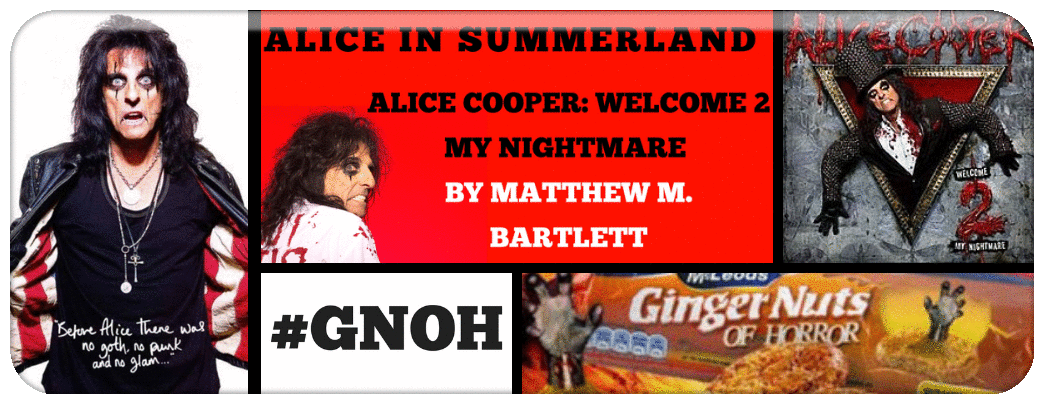 Less than a minute into the first song on Welcome 2 My Nightmare the listener is confronted with…is that…could it be…auto-tune? The notorious crutch for bad singers, and the scourge of modern pop? It was. It is.And it’s great. I came to Alice Cooper very late compared to most—in my early 40s. I’m 48 now – I grew up on classic rock radio, and of course I heard the hits, School’s Out, I’m Eighteen, Welcome to My Nightmare (sadly, the least frequent). But I was more into the Cars, The Who, Genesis, and Pink Floyd. I paid him little mind. I liked his look. Of course I did. But I never felt any need to follow up, especially after seeing the video for “Poison” in the eighties and assuming the hair-metal crowd had co-opted and watered him down to bland mediocrity (I like the song now).. I’m not sure what made me pick up a copy of Alice Cooper Goes to Hell a few years back. I think maybe someone had posted a live video on Facebook—something from a music awards show that aired in 1976. In any event, I fell in love with it. In short order I acquired all of his albums through sketchy online machinations, and then guiltily bought the ones I loved best. Welcome 2 My Nightmare came out about a year after I started listening to his stuff. It was technically my first “new” Alice. I hadn’t liked the previous record, so I was wary, but tentatively excited. Especially because Bob Ezrin was producing, and Bob brings out the best in Alice. Welcome 2 is a decades-later sequel to a Coop classic. The intro is from the earlier albums spooky song “Steven,” which segues into the “I Am Made of You,” a rising, rousing, billowing ballad that builds to a glorious crescendo. It’s a monster of an opener. The aforementioned auto-tune serves to warp Alice’s vocals, to bend them. The effect is creepy and cool. The second song raises the stakes. "Caffeine", an appropriately frenetic ode to a safer sort of stimulant, is appropriately dramatic and driving and powerful. It’s one to turn up in the car and pump your fist, like some eighties guy in mirrored sunglasses in a Mustang convertible. Given Alice’s infamous difficulties with alcohol, it’s a kick to picture him waking up to a strong steaming coffee instead of a warm Budweiser. The next short ditty "The Nightmare Returns" could have been something right off of the original record. Horror movie music, creepy and seventies-soaked. That’s followed by “Runaway Train,” an all-verse, no-chorus chugger with great guitar work. Things slow down a bit after that with “Last Man on Earth” which reaches for a Tom Waits vibe and doesn’t quite make it there. It’s catchy, though, and listenable. "The Congregation", with a very effective spoken-word bit featuring Rob Zombie, is a solid, enjoyable song and "I’ll Bite Your Face Off", the radio track, is a crowd-pleaser, a Stones-esque romp, another one to turn way up in the car. The next two songs are my favorites on the record: the wild pulpy "Disco Bloodbath Boogie Fever" and the silly, surfy "Ghouls Gone Wild" are sugar-filled confections for aficionados of the creepy. This is what I came here for. The ballad “Something to Remember Me By” floats by emotively, slowing things down again, but it’s just setting you up for the kill, for the song that comes next, "When Hell Comes Home" is a relentless, devastating, gripping song told from the point of view of a kid with a violent alcoholic father. This one’s a powerful, rousing paean to violent revenge. The pace picks up after that with a killer duet with, of all people, Kesha, whose strong vocal presence makes the song. "What Baby Wants" is a playful devil-femme fatale story. "I Gotta Get Outta Here" revisits the previous songs in a catchy, rousing, fun closer. The denouement is an instrumental overture that musically ties together the old and the new album. Some critics found it to be overselling the connections between the two records, but I kind of liked it. A nightmarish vaudeville show of humor, gore, savagery, and devils—and you can dance to it. This is, for my money, Alice at his late-career best.   
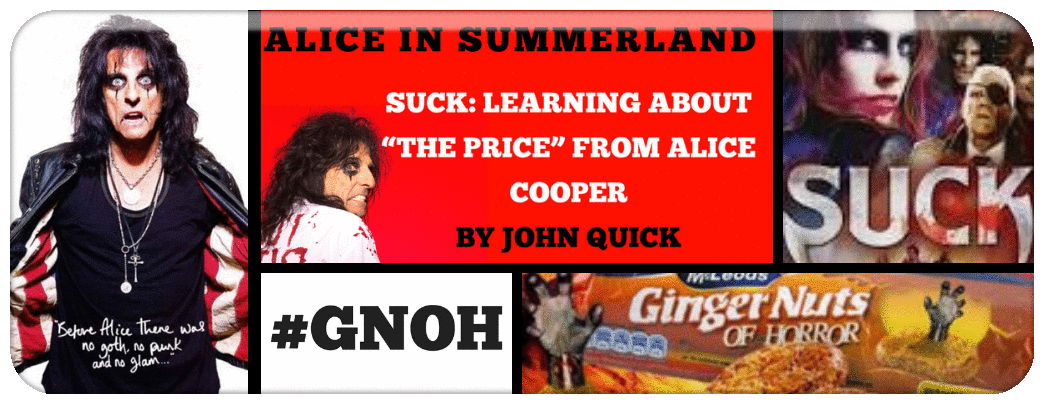 Beyond just his music, Alice Cooper is known for his ability to blend elements of horror and shock into his stage shows and even his lyrics. It’s the reason he was chosen to provide songs for FRIDAY THE 13TH PART VI (“Teenage Frankenstein”, “Hard Rock Summer”, and “He’s Back (The Man Behind the Mask)”), and it’s also the reason his appearance in the rock ‘n roll / vampire movie SUCK is so appropriate. Alice Cooper didn’t write SUCK—that honor goes to Writer / Director / Star Rob Stefaniuk. His role isn’t even that large, though I would argue it’s one of the most important. Still, his influence is all over the place in the movie, considering how closely the movie’s themes mirror some of the same ones he has written about in countless songs over the course of his career. SUCK is the story of a down-and-out rock band, satirically named The Winners (played by Rob Stefaniuk, Jessica Paré, Paul Anthony, and Mike Lobel). Their shows are lackluster, they’re broke, and their manager (Dave Foley) just quit on them when they wouldn’t rebrand themselves as a K-Pop act. After yet another unmemorable show, their bassist, Jennifer (Paré), decides to go party with a cool, mysterious, and slightly frightening guy who came to see them and chatted her up after she came offstage. What none of them know is that the guy’s a vampire, named Queenie (Dimitri Coats), who has spent his undead existence turning promising musicians to give them what they’ve always wanted. Lead singer (and Jennifer’s ex-boyfriend) Joey (Stefaniuk) doesn’t know what happened to her that night, but he knows that all the increasing attention on the band afterward is focused squarely on her. When he catches her drinking blood from the severed arm of a man she just killed, he figures it out, and in so doing, finds himself at a crossroads: kick her out, keep his soul, and remain a failure, or let her stay to get the fame and fortune he wanted, but at a steep price. Two things can be said about Alice Cooper in relation to this concept: one, he is a consummate storyteller, weaving his tales through song rather than prose, and two, the price you’re willing to pay to achieve your dreams and ambitions is a frequent theme in those tales. When we first meet him as a wise old bartender, he sums up our protagonist quite effectively: “You're afraid of being a loser for the rest of your life. Too late for you. Too late for the band. I would say you're 30 pounds of junk food and a retail job away from killing yourself.” I don’t care what aspect your creativity takes, if you chose to pursue those dreams, you hit that make-or-break point, that proverbial crossroads that Robert Johnson sang about and implanted in the music industry consciousness for the remainder of time. We’ve all been there, or are rapidly approaching it. Do you keep going because you’ve no other choice and you can’t not do it, or do you give up, relegating your dreams to an occasional hobby when you feel especially down on yourself? Unfortunately, too many people give up. Let’s face it: being an artist of any kind, be it a painter, photographer, musician, writer, it’s hard. Hard enough that at some point, you wish there was an easier way to achieve that dream. SUCK, much like Alice Cooper, shows you that easier way. Head down to the crossroads, sign your name, strike a deal, and watch those dreams soar. Once you do, however, there’s one question that will haunt you for the rest of your life: was it worth it? Is the success you gain worth the price you pay? That question is the crux of SUCK, much as it is a common theme in Alice’s music. Another theme from Alice’s music that makes an appearance here is that of addiction. They treat a vampire’s need to feed the same way they might treat a junkie’s need for a fix, or a crack head’s desire to hit the pipe one more time. It brings up the interesting question of: is an addict a monster, or just a victim of their own vices? Alice has gone on record about his own adventures living the sex, drugs, and rock n’ roll lifestyle, and they’re reflected quite nicely here as well, under the same auspices he did it: horror. Don’t get me wrong. SUCK functions perfectly well as a black comedy featuring vampires and cameo appearances from the rock elite such as Alice, Iggy Pop, Henry Rollins, and even Alex Lifeson and Moby. But if you want to dig deeper, the question’s there for you to ponder. Likewise, Alice Cooper makes good music, but there’s more than just cool guitar lines and his distinct vocal delivery, if you want to look for it. Why would he be interested in this particular project? Because I think he saw himself in it, and understood those deeper implications. As we see later in the movie, his character is more than just a simple bartender with an uncanny knack for prescience. After being knocked out when his current girlfriend hits him in the head with a beer bottle, Joey finds himself in a physical representation of that metaphorical crossroads, and who else could be there to meet him but Alice Cooper? Only he’s not a bartender, he’s something… more. There’s an ambiguity to what that exactly is. He says he’s a vampire, the oldest of them all, but there’s some context to suggest that perhaps he’s the devil himself, maybe even the same one who gave Robert Johnson exceptional talent on the guitar all for the low, low price of his soul. If it’s just a vampire movie to you, then the answer is obvious. If, like me, the metaphors run deeper, then it seems more and more like Old Scratch himself was tending bar in that sleazy rock club. Especially fitting when you consider that a devout Christian, such as Alice Cooper has become in his later years, would use the role to hammer home the theme about the price you pay for your dreams. A point that becomes clear, I should add, when Alice, quoting himself, tells Joey, “Welcome to My Nightmare.” As a movie, SUCK is a low-budget ($3.5M Canadian) indie picture with big-budget aspirations. Yes, some of the effects look hokey, and the stop-motion interludes of cars and bats are the definition of cheese, but the filmmakers intended for it to be that way, and that makes all the difference. It’s obvious that they chose to focus on the script, the themes, and the music, all of which are incredible. The third act is a bit weak, but there’s a sting of “Six Months Later” just before the credits roll that delivers on the thematic promise of the price you pay, and shows also how hard it is to escape once you’ve made the bargain. The cameos are used well, and allow these larger than life figures the chance to gnaw away at the scenery to their heart’s content. In-jokes, throwbacks, and Easter eggs abound, such as the band crossing a street to form the Beatles’ Abby Road cover and Malcolm McDowell’s vampire hunter being named Eddie Van Helsing. Another stand-out here is the soundtrack. Stars Rob Stefaniuk (Joey) and Dimitri Coats (Queenie) are talented musicians in their own right, and get to shine with the bulk of the movie’s original songs. That’s not to say our cameo performers are left out in the cold, though. Moby does a pretty cool metal turn as lead singer of a band called The Secretaries of Steak, and we get Iggy Pop’s “Success” on the soundtrack as well as Alice’s own “I Am the Spider”. Nothing from Rush or Henry Rollins’s catalog, but it’s unlikely they would fit with the overall theme of the movie as well as the others. Alice Cooper didn’t write this. He’s not even the main antagonist—though you could argue that in a way, he actually is. His music isn’t especially prominent in the movie. Yet, without him, the movie would not work nearly as well. His portrayal of the road-worn, “seen-it-all” creature who inhabits that mystical crossroads provides moments of gravitas in a film with precious few of them, and is so believable that you might even wonder if he’s the one who’s been there all along, even outside of the movie realm.   
|


 RSS Feed

|

|