
DEHUMANIZER : BY JASON ARNOPP
9/10/2017
Depending on how you look at Heaven And Hell, it’s either an astonishing mini LP, or an album that ultimately runs out of steam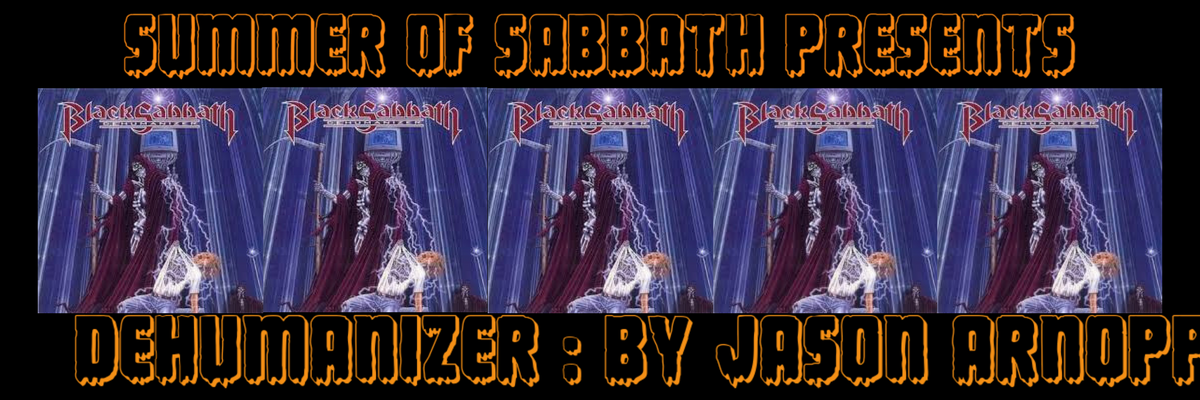 So, what in the name of Satan’s toast rack makes Dehumanizer my favourite Black Sabbath album? First of all, I’ve always been much more of a Dio man than an Ozzy man. I appreciate the Double-O, obviously, and really like plenty of his Sabbath and solo career, but Ronnie James Dio always struck more chords with me, in pretty much every way. The first four Dio albums stole my soul, so it was a foregone conclusion that my favourite Sabbath album would be fronted by RTD. Heaven And Hell, Ronnie’s 1980 debut with Sabbath, is Dehumanizer’s closest competition. And we’re admittedly talking very close. There’s much to commend the following year’s Mob Rules, but Heaven And Hell always had the edge. It packs four solid gold classics in Neon Knights, Children Of The Sea, the title-track and Die Young. The problem with Heaven And Hell, though, is consistency. In the valleys between those undeniably mountainous tunes, lurks the other half of the album: four pedestrian, forgettable or plain dull tracks. I mean, have you heard Walk Away lately? Sweet Jesus. Depending on how you look at Heaven And Hell, it’s either an astonishing mini LP, or an album that ultimately runs out of steam. Dehumanizer has no such failings. It ends strong, in fact, with its two finest tracks: I and Buried Alive. Not only are these two of the most awesome Sabbath tracks in existence, but they’re two of the finest things Dio ever put his name to. I is a wonderfully malevolent steamroller, with a pleasingly direct chug from guitar lord Tony Iommi. Ronnie rants about being a one-man legion, yelling, “I’ll smash your face in”. Basically, he’s saying he’s the Devil and you’re fucked. You simply cannot get better than that. Buried Alive must be one of the heaviest things Sabbath ever put their name to. The production is obviously an advantage here, because Iommi and Geezer Butler’s unholy fretboard union just sounds downright bigger and fatter in 1990 than it did in the 70s or 80s. But the riffing is gargantuan full-stop, and coupled with Vinny Appice’s dependably brutal drumming, the whole thing blends together so well. It’s rare to find a song whose verses, bridge and chorus are all superb, but Buried Alive belongs to that privileged club. Just amazing. So what other delights does Dehumanizer have to offer? For a start, there’s the intensely Sabbathy dirge After All (The Dead). ‘What do you say to the dead?’ Ronnie intones, giving Ozzy a run for his money in the ominous tone stakes. The whole thing’s shot through with mausoleum darkness, which is patently for the good. It’s followed by another corker in the shape of TV Crimes, which showcases Sabbath at full throttle as they hurl sonic stones through the windows of every evangelist on the planet. I very much doubt I’ve heard a faster riff from Iommi, not to mention one which remains super heavy at such extreme velocity. I’m still not entirely sure what Letters From Earth is about, but it’s an intriguing story and downright tremendous. The moment at the end of the middle-eighth when Ronnie sings, ‘The game is called the end’ is quite, quite wonderful. Master Of Insanity’s title may well have been drawn from a bag full of Stereotypical Sabbath Words, but it’s a spirited and riffy effort, if not one of the album’s strongest. Incidentally, you might notice I’ve skipped the opening Computer God, and that’s because I feel like it might be Dehumanizer’s least excellent thing. Which doesn’t mean it’s not excellent… just less so. I prefer to think of Computer God as a warm-up for the rest of the album. Time Machine is one of the album’s catchier songs in the traditional sense, and probably also the lightest in tone, which no doubt explains why it was chosen for the Wayne’s World soundtrack. Sins Of The Father delivers further ominous Sabbathery-pokery, with some nice time changes. Lastly, there’s the album’s sole slow track, Too Late. Usually, slow tracks are my cue to hit Forward Skip, but I actually enjoy this one, because it seems to tell a compellingly creepy story about messing with the powers of darkness. As a result, Too Late is not so much up my street as sitting in my study, listening to itself. The same goes for Dehumanizer as one whole, mighty beast. It’s an album of varied songs, united by their commitment to heaviness and nailing your ears to the wall behind you. An album entirely and rightly deaf to the fundamental changes which were afoot in the music world at the time. An album on which Ronnie James Dio and Black Sabbath are indistinguishable, working together like parts of the same glorious and thunderous machine. You owe it to yourself to get Dehumanized. About Jason ArnoppJason Arnopp is a novelist and scriptwriter, currently working on the screen adaptation of his novel The Last Days Of Jack Sparks for Ron Howard. His new non-fiction book From The Front Lines Of Rock gathers his favourite interviews he wrote for Kerrang! magazine as a rock journalist. Find him at Twitter (http://www.twitter.com/jasonarnopp) and his website (http://www.jasonarnopp.com) RELATED POSTS
No longer hamstrung by voice-matching another singer’s material, he takes to each song with impressive gusto.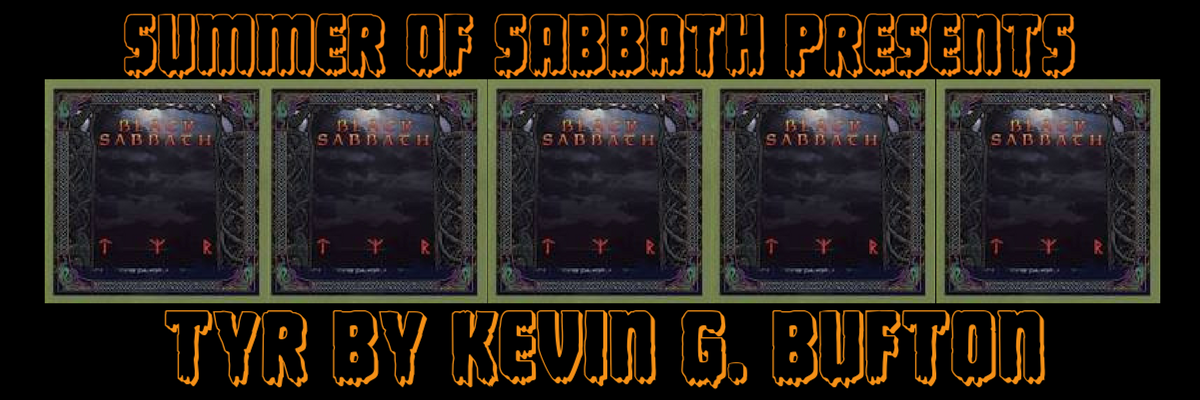
Not just my favourite Black Sabbath album, but one of my favourite albums of all time, Tyr never felt like it really belonged in the Sabbath canon. Though hotly denied as such by bassist Neil Murray, it is the closest thing the band have ever released to a concept album. Aside from the commercial rock of ‘Feels Good to Me’, the other tracks share a religious theme which, whilst hardly new ground for Sabbath, had rarely been as cohesive as is here.
Moreover, a good number of the tracks – not to mention the title of the album – have a Nordic feel to them, either musically or lyrically. Make no mistake: this is the Ragnarok of Sabbath albums. As a young teen with his own Scandinavian roots (not to mention certain theological obsessions that are bound to spring up when you’re raised by a Catholic and an atheist) this was terribly exciting for me. From the choral chanting that introduces the opener ‘Anno Mundi’ to the breakneck bombast of eye-gouging anthem ‘Heaven in Black’ this was the first album I had to replace because I wore the cassette out (sorry, Dad!). As is standard for the period, it’s the two Tonys who anchor the album. Iommi’s riffs are tight, measured and heavier than a blue whale’s testicles (if you’re interested, that’s a good half-ton apiece... I looked it up). There’s little in the way of experimentation on this album from him, as the whole thing has a certain Wagnerian feel to it, but nowhere does it feel like he’s just running through the motions. As for Tony Martin, this would have been the first time I’d heard him and, if you read my previous entry for this series, you already know about the platonic man-crush I have for him. The seeds of that were sown with this album. Every track gives him license to set his vocals soaring in a way that The Eternal Idol never did. No longer hamstrung by voice-matching another singer’s material, he takes to each song with impressive gusto. Whether that’s the sinister ‘The Lawmaker’, the pumping ‘Jerusalem’, the sonorous ‘The Sabbath Stones’ or the melancholic ‘Odin’s Court’, he makes every track his own, and demonstrates his versatility as a frontman, even down to belting out the closest thing to a power ballad that Sabbath have knocked out. Ah yes, ‘Feels Good to Me’.
This is a matter that very much divides the Black Sabbath fanbase. Is it a brave and daring change of musical direction from a band that had relied on a certain tone and style, or is it a cynical attempt to produce a potential chart-topper?
The answer, in the opinion of this particular scribe, is a little from Column A and a little from Column B. There is no doubt that it’s a radio friendly tune. Likewise, one can’t deny that it sticks out like a sore thumb sandwiched between ‘Valhalla’ and ‘Heaven in Black’ but to decry it as selling-out seems a bit harsh for a band that redefined heavy music as we know it. Personally, I think it’s a belter of a track, a soulful piece of balladry that’s right up there with ‘Love Walked In’, ‘Bringing on the Heartbreak’ and ‘Fucked with a Knife’. But then, I’m just an old softy at heart. 
HEADLESS CROSS BY MARK CASSELL
3/10/2017
by Mark Cassell Perhaps if I’d been a little older – not just a 12-year-old-developing-metalhead – I would’ve at least added one more ticket sale to a London show.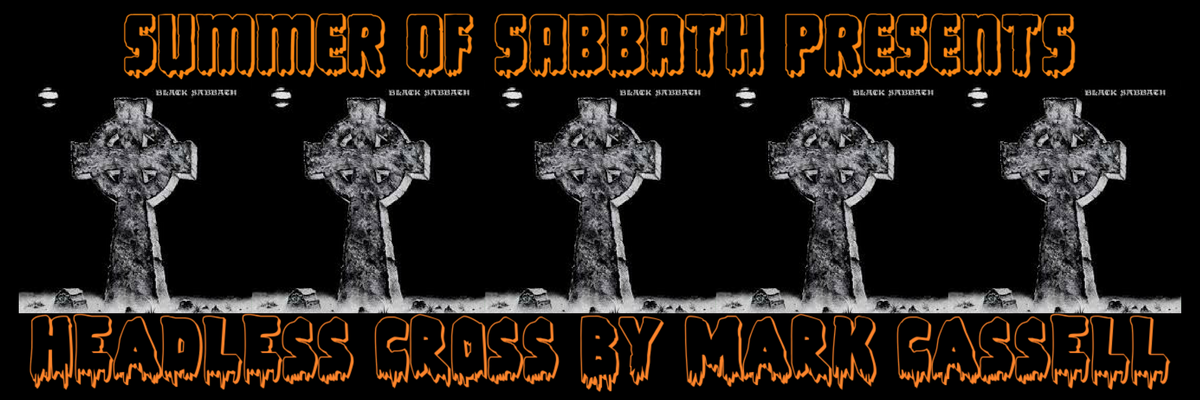 1989, a year to almost mark the 20th anniversary of Black Sabbath’s inception, and US label Warner Bros and UK label Vertigo dropped them. After recruiting vocalist Tony Martin for their previous release, The Eternal Idol, the band’s future was in serious question. Tony Iommi himself elected to produce their fourteenth studio album, Headless Cross, and it hit the shelves to a frowning audience that was still plugged in to the Ozzy and Dio eras. Don’t get me wrong, with Ozzy there were many fine tunes – now classics, of course – and after that we had Dio who claimed some fine Sabbath territory. But with Martin, and I know some would hate me for saying this, his voice reflects Dio’s. Only cleaner, bringing the band into the 90’s where Grunge was about to leak from our speakers. Among the fans’ lack of enthusiasm, worldwide distribution issues and below-par marketing added to a possible downward spiral. The Headless Cross tour, with supporters Kingdom Come and Silent Rage, was cancelled due to poor ticket sales… after only eight shows. Perhaps if I’d been a little older – not just a 12-year-old-developing-metalhead – I would’ve at least added one more ticket sale to a London show. “I believe that Satan lives…” It wasn’t until several years later, probably the late-90’s, when I truly appreciated the power of Sabbath. And to this day, I constantly hit the play button for Headless Cross. Of all their albums, it is recognised this has the cheesiest lyrics with direct references to Satan. But it’s all harmless fun, right? After all, I’m a horror author and much of my work turns demonology on its head. To get me in that occult-groove, I’ll often tune in to Sabbath while I write. No matter which era. With a duration of 40:24 Headless Cross contains eight tracks and, back when I nabbed a copy of my dad’s CD, the album fit on one side of a TDK D90. Incidentally, the other side consisted of Sabbath’s follow-up album Tyr (1990). “Misguided mortals, you’ll burn with me.” The album opens with “The Gates of Hell”, a short intro with haunting atmospherics reminiscent of old-school Sabbath… then blasts straight into the title track “Headless Cross”. Newcomer-drummer-boy Cozy Powell stomps with us into a typical Iommi riff, all the while Martin’s vocals borderline power metal. Personally, this track is one of my favourite Sabbath tunes. Next up, “Devil & Daughter” – renamed from “Devil’s Daughter” because a guy called Ozzy wrote a song with the same name. Here, Iommi stuns us with some excellent riffs and astounding soloing. After this, we have “When Death Calls”, one of those tunes with a steady-pace that comes at us in waves; melodic and ferocious, pounding with a superb chorus. Atop this, we have Queen’s Brian May to give us a sneaky solo. Talent all round. “Kill in the Spirit World” takes us halfway through the album and with this track, you can’t help but nod your head. It also has some fine demonic riffage going on. Following this, “Call of the Wild” begins with one of those stuttering drum intros that I’m always fond of – I’ve no idea the technical term for it, but I think it’s cool. Again, this is another that had to be retitled (from “Hero”) because Ozzy already released a track with the same name. To wrap up the album, there are another two great tracks, the kind that belong together; you know, those that somehow complement each other superbly. Both are a powerful finale to an already fantastic album. With “Black Moon”, the two Tonys, along with keyboardist Geoff Nicholls, bassist Laurence Cottle, and drummer Cozy Powell give us a pulsating melody straight out of an unashamed 80’s rock textbook. Finally to sign off, “Nightwing” proves a darker track, which again highlights all the musical talent laid down in a time when Sabbath was supposedly in trouble. “Fear of the Devil.” In 2005, the album ranked number 403 in Rock Hard magazine’s book, The 500 Rock and Metal Albums of All Time. For me, it ranks high in my all-time favourite albums. While writing and revising this article for the Summer of Sabbath, I’ve listened to the album over and over and… And, I’ll leave you with the closing verse from the track “Nightwing”: So tell every creature of the night The kill is around the bend Listen my friend Nightwing flies again  Mark Cassell lives in a rural part of the UK where he often dreams of dystopian futures, peculiar creatures, and flitting shadows. Primarily a horror writer, his steampunk, dark fantasy, and SF stories have featured in numerous anthologies and ezines. His best-selling debut novel THE SHADOW FABRIC is closely followed by the popular short story collection SINISTER STITCHES and are both only a fraction of an expanding mythos of demons, devices, and deceit.
Mark’s 2017 release HELL CAT OF THE HOLT further explores the Shadow Fabric mythos with ghosts, a black cat legend, and a gruesome demon. Stepping aside from the supernatural, his dystopian sci-fi collection CHAOS HALO 1.0: APLHA BETA GAMMA KILL is in association with Future Chronicles Photography where he works closely with their models and cosplayers. His work has been compared with British horror authors such as James Herbert, Clive Barker, Dennis Wheatley, and Brian Lumley. Also, his influences spread over to the US where he admits to having been first inspired by Dean Koontz, Stephen King, Dan Simmons, and H P Lovecraft. For more about Mark, visit www.theshadowfabric.co.uk Or sign up for FREE STORIES at www.markcassell.com |

 RSS Feed

|

|