

An Interview with Jason Arnopp
4/4/2017
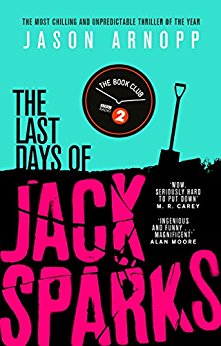
 Following the release of his debut novel ‘The Last Days Of Jack Sparks’ to great critical response, Jason took some time out of his busy schedule to sit down and chat with us about writing, process, his debut novel, Hollywood deals, his new book, and more. Enjoy! Jason Arnopp is the author of the Orbit Books novel The Last Days Of Jack Sparks, which is currently being developed as a feature film at Imagine Entertainment, the Hollywood production company co-founded by director Ron Howard (Apollo 13, Frost/Nixon, The Da Vinci Code). The Last Days Of Jack Sparks has been described as "a magnificent millennial nightmare" (Alan Moore), "scarier than watching The Exorcist in an abandoned asylum" (Sarah Lotz) and "The Omen for the social media age" (Christopher Brookmyre). Arnopp's next novel will be Key Man, slated for release via Orbit Books in January 2018. While you wait, why not check out his four ebook-exclusive fiction titles? These are Beast In The Basement (a suspenseful, mind-blowing thriller novella), A Sincere Warning About The Entity In Your Home (a chilling and groundbreaking short story set in YOUR home), Auto Rewind (a dark, emotionally charged thriller) and the free short story American Hoarder (a supernatural creep-fest), which is available at Arnopp's website. Gingernuts Of Horror: Firstly, congratulations on the successful launch of your debut novel! Critical and fan response seems to have been incredibly positive - how have you found it so far? Jason Arnopp: Thank you, you horrific gent! When you release a book into the world, especially a dark and twisted one like The Last Days Of Jack Sparks, you do have to steel yourself for reactions of all kinds. Basically, you have to accept that some people would gladly destroy the master copy of the book, and that there’s nothing you can do about that. But as you say, I must admit the response really has been overwhelmingly positive! It’s been incredible, actually, and really heartening, the sheer amount of support I’ve had from readers, The Radio 2 Book Club and amazing people like M.R. Carey, Sarah Lotz, David Schneider, Christopher Brookmyre and the mighty Alan Moore! I’m still trying to come to terms with it all. Of course, a few people haven’t connected with the novel at all and that’s absolutely fine: as long as the consensus is good, I’m very happy. My favourite one-star Amazon review of Jack Sparks simply reads “Stupid book”. Genius. GNoH: Before taking up fiction, you’ve had a long career as a music journalist. Was fiction writing always something you wanted to try your hand at? And what lessons did you learn from journalism that set you in good stead as a novelist? JA: Yeah, I always seemed to have the storytelling urge. I still have all the exercise books in which I wrote Doctor Who stories as a little kid, both in prose and comic strip form. It’s hard to say exactly what stuff music journalism instilled in me as a fiction writer, but it certainly allowed me to write a hopefully convincing and authentic journalist like Jack Sparks. Certain moments in the book, like Jack ranting about music PRs introducing the concept of ‘copy approval’ to journalists, are just me straight-up ranting through Jack’s mouth. Ha! And I’d like to think that working on a weekly magazine like Kerrang!, for a rather long time, helped me develop the discipline to hit deadlines. (Hear that sound? That’s my wonderful editors at Orbit Books, stifling laughter.) GNoH: Doctor Who seems to be such a touchstone for so many dark fiction writers, especially in Britain. What do you think it is about the show that is so inspirational? And what’s your favourite era? JA: Well, for me, Doctor Who is the only SF thing that I truly love. And it’s taken me a while to realise that this is because I don’t really see it as SF - to me, it’s always been a horrorfest! It’s always been about body horror, possession, people with no heads inside their hoods and, of course, death, death and more death. So that very darkness swept in through my eyeholes early on, and has never left me. Most people’s favourite eras tend to be the ones they first encountered - we imprint on stuff like baby birds - and I’m no exception. So the Tom Baker/Philip Hinchcliffe era will always hold a pretty untouchable magic for me, as will certain Peter Davison stories - especially Earthshock, which is just wonderful. I love Eric Saward’s cold, hard ruthlessness as a writer. GNoH: Jack himself is a fairly unlikable character - interesting, but unlikable, especially early on in the book - what made you decide to go with such a spiky protagonist? And is he modeled on anyone you encountered as a music journalist? JA: I hold little truck with the idea that characters have to be really likeable, in order for the reader to engage. If that was true, then American Psycho wouldn’t be a classic. And TV shows like Breaking Bad and The Shield have also helped rubbish this notion. ‘All’ we need from a lead character, I think, is to find them fascinating. We either find them fascinating because we understand them, or we want to understand them. So I was aiming for the latter with the arrogant Sparks, who sets out to debunk the supernatural with his new non-fiction book, but seems to have real issues bubbling away in his closet. Hopefully, readers are drawn to keep reading and find out what the hell’s really going on inside this terrible human being! GNoH: One of the things that impressed me about ‘Jack Sparks’ is the structural complexity of the piece. How much work went into planning the novel in advance of drafting? Did any surprises come to you in the writing, or was the whole thing carefully plotted ahead of time? JA: Why, thank you! I did spent quite a while working out that structure. The challenge was to avoid inconsistencies and my beta readers and editors really helped me rise to it! But actually, you might be surprised to hear that the toughest section was the middle: what I think of as the second act, from Jack’s arrival in Hollywood onwards. That whole part took way longer. Had to break the whole thing down into index cards on the wall, then swap them around and around and around until the pacing and momentum was right. Funny how sometimes the parts of a book that might seem fairly routine to the reader can turn out to be the hardest… GNoH: What was the issue with that section? Finding the right sequencing of events, pacing, something else? I have to say it flows smoothly in the finished product… JA: Cheers. The issue was all of the above. Act Two has several threads that need to run in tandem and play off of each other, leading up to a specific calamitous event, which in turn leads to Act Three. So, getting that right was a real challenge, and it’s a relief to hear you say it seems smooth enough. Hooray. GNoH: One of the things I really enjoyed about the novel was the use of supplemental material at the end of each chapter, which often gave some pretty major context to what had just happened. Had you always planned on using this technique, and did it ever cause you any challenges? JA: I don’t think those passages were among my initial ideas for the book. But once I got down to the writing, I realised that I needed ways to (a) hint at Jack’s inner state of mind; and (b) keep his brother Alistair involved with the book in some way. And so those passages, they’re one of those lightbulb moments where I thought, ‘Aha! Two birds with one stone!’ And I guess that another aim was to add to the realism. When you see one event described from two or more people’s differing perspectives, for some reason it does make the event itself feel more real. GNoH: I also felt that seeing Jack through the eyes of the other characters was a revelation early on, and became almost a running gag by the end - ‘now let’s see what those events looked like outside of Jack’s singular head’... JA: Ha, yeah. ‘You probably didn’t fully believe how Jack described that event, so let’s catch it from another angle!’ As the book progresses, Jack becomes more and more truthful, but that element is still there, for sure. GNoH: In general, what do you see as the attractions and potential pitfalls of using an unreliable narrator? JA: The attractions include the way that an unreliable narrator has in-built depth. Deep characters are, by and large, a very good thing, and every character has (or should have) an internal and external self. But with an unreliable narrator, you can really make a virtue of that. By having things to hide, perhaps even from themselves, a character can really blossom. One potential pitfall, though, is to just have a narrator who tells you stuff and then goes, ‘Hey, that was all bullshit!’, for no apparent reason. That’s not so great, because anyone can just lie to you. So the key, for me, is to try and make each piece of unreliable narration contribute to character and story. Why are these people unreliable? That’s the key thing to keep in mind, and eventually bring to the page. GNoH: There’s at least a couple of set-piece action horror sequences in the novel. What are you thinking about as a writer when you approach those scenes, and what are the techniques you employ to help bring them to life? JA: I expect different writers imagine the events of their novels in different ways, but I tend to imagine mine as a movie. So perhaps that informs the way I approach, or even write, those events. What I try to do, more than anything, is make you feel like you’re there. I aim for each set-piece to be in Ultra 4K HD, but without going overboard with irrelevant description. Plus, every now and then in a book, I do like to deliver the scary and/or gruesome goods. It’s a perfectly valid approach when authors leave things ambiguous or draw a veil over violence, for instance, but that doesn’t tend to be the approach I take. Ha! GNoH: And I understand from your recent blog posts that we won’t have to imagine this scene as a movie too much longer! Many congratulations on the exciting news that Jack Sparks has been optioned by Ron Howard’s movie company, that’s incredible. How does something like that happen? When did you know it was a possibility, and how was the deal sealed? JA: Thanks very much, sir! Yes, Imagine Entertainment have optioned the novel and I couldn’t be happier about that. It came about after the book was floated around Hollywood by my US manager Lawrence Mattis at Circle Of Confusion (who produce The Walking Dead among other tremendous things), to whom I was introduced by my UK literary agent Oli Munson at AM Heath. Several companies were interested, but… y’know, Ron Howard. Ron Howard! I couldn’t believe it, and even a year on, a big part of me still can’t believe it. So I’ve known about the option deal for a year, and the contracts were signed in March, so now I can finally quack about it. Thank God. GNoH: In general, what do you think about the fact that, in horror fiction, the skeptic will almost always be the one to be given a kicking by the narrative? Is that just a necessary function of the genre? And do you have any concerns about that aspect of horror? JA: I sense that you might have concerns about that aspect of horror, Mr Power! Haha. That’s an interesting one, though. I suppose it is a necessary function of the genre. Certainly in the case of The Last Days Of Jack Sparks, if skeptic Jack didn’t get a kicking, it would pretty much be the book he originally set out to write: an atheist travelling the world and not seeing anything supernatural! Basically, when it comes to horror, skeptics can and must never be right… unless they’re skeptical about the non-existence of ghosts. GNoH: And finally, I understand that you’re hard at work on your next book - what, if anything, can you tell us about that at this point? JA: Ah yes! Key Man is the title of my second novel for Orbit Books, and it’s entirely unrelated to The Last Days Of Jack Sparks. Set in Las Vegas, the story revolves around a sinister hooded figure, who walks the city’s streets holding one key. He tries this key in each front door he comes to… and then when a door opens, he walks inside and terrible things happen to the occupants. We first meet Emilee Brink at the age of six, as she watches the key man enter her family home. It’s a supernatural thriller in the same ballpark as Sparks, I think, although I’m still too close to it to be sure of exactly how they compare in terms of style and content. And good lord, Key Man is already available for pre-order! Fancy that. GNoH: Jason, thanks so much for taking time out of your increasingly insane schedule to talk to us, and again, many congratulations on all your successes. Really looking forward to seeing what 2017 holds for you. JA: You’re utterly welcome! Thanks so much for the interview. The Last Days Of Jack Sparks is available in the US and UK, with the US paperback arriving April 4th. READ OUR TWO REVIEWS OF THE LAST DAYS OF JACK SPARKS |


Archives
May 2023
|

 RSS Feed

|

|