

WHAT IS THE AIRSPEED VELOCITY OF AN UNLADEN AUTHOR? AN INTERVIEW WITH HORROR LEGEND KATHE KOJA
28/4/2020
 Your new collection of short stories Velocities is coming out with Meerkat Press in April. Would you be able to tell us a little bit about it? Yes, we’re very excited. This is the first time that I’ve worked with Tricia, and it’s been a lot of fun so far. When I read a short story collection, I don’t read all of them at once and sometimes I don’t read them all in order and sometimes I read some and not others. So when I chose the stories I tried to group these thematically. So if people wanted to go in a particular direction or feel a particular mood the stories are grouped to offer that to the reader. There are a couple of stories in the collection that are original to the collection and haven’t been published before, and some are from anthologies and places that people might know and some are from more surprising places. So I hope I gave people a good cross section of my voice and what my stories can do. As with your novels, your short stories cover a wide range of ground and genre. How do you feel about genre and where your work sits in it? I never really think of it to be honest. Everything that I work on starts from whatever the idea is, the character that sparks the story or the novel. Then afterwards I try to think of or try to see where that might fit in the larger world of publishing or where it might find its most sympatico readers. So I never set out to specifically create something in the genre, I don’t work very well that way. This is your second collection of short material after Extremities (1997). How do you feel you’ve changed as a writer since then? I hope I’m better! I’m always trying to get better, that’s kind of the point. These stories though themselves cover a fairly wide chronological range. My collected stories would be a fairly hefty book. there are lots of stories out there that don’t appear in either of these collections. Maybe someday we’ll do a nice omnibus of all of them. It was fun to be reminded of some of the circumstances and the place where these stories came out originally. But hopefully anyone who enjoyed Extremities will enjoy Velocities. And for people who are completely new to my fiction, Velocities I think makes a good taster menu. And if you like what you read there then you’ll probably like the rest of the things I do. And if you don’t, no harm, no foul, it wasn’t for you and we’ll part as friends. Your work frequently features obsessive artists with a really intense connection to your work. What keeps bringing you back to these characters? I think because that’s a large part of my own worldview. My work is very central to my life. My husband is an artist, I’m an artist, a lot of my friends are creative workers in one way or another, although I hate that term! Anyone can be a creative worker. You can be an extremely creative nurse, or an extremely creative bus driver. But people who work in, lets say in the creative industries. And I find that the people whose work that I enjoy the most seem to have an intense focus on what they produce and what they do as an artist. So I would imagine that’s why I go there, cause that’s where I already am. You have written many novels as well as short stories. When you start a story do you always know if it’s going to be a novel or a short story? I would have to say I always know. Sometimes when I start something, you kind of have a feel for the shape of it. It’s like how much room does this idea need, how much room does this character need, how far are you going to go with it, or how far can I go. And it does have a particular feel. Like, this is going to be a very short story, or this has to be a novel. A couple times I have misjudged the length of a novel. My Victorian puppet trilogy Under The Poppy (2010) started out as one book, and I had no idea it was going to be much larger until I got to the end of the first book and said oh, wow there’s tons more stuff that I have to tell about these people. And it ended up turning into a trilogy. Which is kind of good, because if I’d known in the beginning it was a trilogy, it might have scared me off. At that time it was the most difficult thing I that had ever ventured, and it was an education. Under The Poppy is more historical fiction compared with your horror novels. Was it very different writing it, and did it require a lot more research? Yes and no, but that’s like anything, that’s like any of my books. When I was writing Bad Brains (1992) I had really no idea how close head injuries worked, or how treatment was. Or what did people experience, what drugs were they on, what was likely to happen, what was likely to go wrong. So I had to do a lot of research to be able to have the correct facts to add to my story to make sure that the things that happened in the story were things that would actually happen, or could actually happen. Under The Poppy, because it takes place at the end of the Victorian era, and the beginning of modernity, we have a kind of colourful idea of what those time periods might have been like. But to get a better idea of what was available, how did people travel, what did they do, what were societal expectations of you, if you were a performer what did people think about you in polite society – all that stuff. Because you’re trying to create this world that partakes of the reality of the larger world as closely as possible. So you kind of lay reality over what you’re doing like a template and see where are the rough edges, where is the stuff that doesn’t fit, or isn’t correct. In one of my YA novels Straydog (2002), I had thought I knew some of the animal control laws and regulations. I got to a certain point in that novel and said, you know I had better check, just to be sure. And I found out I was completely wrong. And everything I had planned for the last third of the novel would have to be thrown away, because it’s not what would happen. So I was punished for my ignorance! But the answer is always, as much research as the project itself will need. Straydog was your first YA novel. How did you find that after having written your adult horror novels? It was great. It was a lot of fun. Again I don’t plan things out ahead of time, I don’t say well now I think I’m going to try to do this. I’d written a short story in fact for a young adult magazine called Cicada that was the basis of Straydog, and my agent really liked it and suggested I see if I would like to try writing a YA novel. That book was the result and then I went on to write a bunch more for FSG and I loved the experience. I think the bridge or the connection between the horror novels and the YA novels is probably intensity. There isn’t a time in your life generally when you’re more intense than in your teenage and growing up years. So I felt very much at home there. I loved writing YA. Another thing that comes through in your writing is the intensity of the voice. A lot of your characters have very specific ways of speaking and looking at the world. Do you find when you’re writing does the character’s voice have to come first or does it take a lot of writing and rewriting to find it? No, they always come first, and that’s how everything starts. If there is no voice for me then there is no way in, and there isn’t anywhere to go. It’s always the voice, it’s always the person, the particular point of view, and that’s what makes the story for me, the novel or whatever. When I start working, I’m always following that voice. And the project that I’m working on now, Dark Factory, there are two very different voices in that book, and that took a minute to navigate. Because they’re two very different people, and nobody has more weight than the other. There isn’t a viewpoint character, it’s both of these guys, so that took a second. Frequently your characters tend to have a doomed aspect to them. Do you feel that in order to really find out how a character works you have to grind them down? I don’t think I’m grinding them down, I think that’s what they’re doing. I don’t have a particular plan for any character when I’m writing, again I’m following the voice and seeing what would naturally happen to that person in that situation. I don’t do any of that consciously at all. And that would not be fun at all to do! Meerkat Press is also reissuing your legendary debut novel The Cipher (1991) and bringing it back in print for the first time in ages. Would you be able to tell us a bit about that? Sure. I’m really excited to have The Cipher coming back into print again in English. It’s been quite a while, and for years and years people have asked, when will it be back, will it be reprinted? And I really wanted to do it in the best possible way. I found a really good home at Meerkat, and I’m really happy with the way the book’s been handled there, and the relaunch of it’s gonna be a lot of fun. I’m excited to see how people respond to it. Many people have read it through the years, and especially since the ebook edition was made available, but there are lots of people who haven’t. I’m very excited to see how they resonate with the Funhole. It’s such an iconic book but it’s been so hard to track down for ages, it’s really nice that it’s going to be back in print. Yeah I’m really glad and I think now is a good time. Where did the Funhole come from? I think people really respond to that feeling of this kind of emptiness that asks something of you but you don’t know what it wants and you don’t know why you’re attracted to it. That’s clearly something that we as a species are kind of pulled to the inexplicable, even though we deduce probably correctly that it’s not safe or even desirable. But there’s something in that mystery that draws us forward. And you know obviously I’m not the first person or will be the last to think of this void or this emptiness and why are we drawn to emptiness. And answering the question was really interesting. And again it began in fact as a piece of short fiction. And the Nicholas character was not central to that piece of fiction, but it became clear that something else was happening. So I moved him out of the other piece and gave him his own place to play and the book just took off on its own. Nicholas also is a character that people resonate to or with in different ways. His adversary in a way, his girlfriend, Nakota, a lot of people are very harsh on her. I’m particularly fond of her because I think she’s probably the most honest character in that book. She knows exactly what she wants, and she’s not afraid to go after it. Actually very much like Bibi in Skin (1993). Bibi was also another very definite, very strong and concentrated character. She knew exactly what she wanted and was not afraid to go after it. I’m always very interested to see or to learn from readers what are they getting out of a particular novel, and The Cipher’s been great for that. People have shared their ideas and theories and questions throughout the years, so I’m really excited to see what will happen now. That relationship between Nicholas and Nakota is very dysfunctional, which could be said of a lot of your characters. Is that something you feel particularly drawn to explore? No, not really. Again it’s a function of the characters. The character relationship at the heart of Under The Poppy is a quite functional one. They manage to stay together through every kind of separation and torment that the world can throw at them, so they’re magnificently functional. It’s going to come out of whatever the stresses and the particular shape of whatever those characters are going through. There’s a character in The Cipher, Vanese, who gets up and leaves – spoiler alert! – at a certain part of the book, because that’s how she would react. That’s how she would respond to the things that are going on. Which has always bothered me about fiction in general but maybe horror fiction in particular, I want to see the people who get up and leave. I want to see the people who say, “You know what? I don’t think I’m going to go into this hellmouth, so bye! Let me know how it turns out if you can!” But that’s a natural human response as well. Smart people generally flee pain. You mentioned earlier the project you’re working on at the moment, Dark Factory, would you be able to tell us a bit about it? Yes, I’m really excited about this, and this has been a total learning experience for me, and an education. Dark Factory started out as a novel. It’s about these two guys who both come to work at this club called Dark Factory that’s like an augmented choose your own reality type of club. You can dance, you can drink, you can see all kinds of things. There’s a huge menu of different experiences you can have. And once these two get together, their synergy causes the club to change and causes the reality of the club to change. And writing this book has brought me into collaborative contact with artists and musicians and designers and the world of Dark Factory itself is going to be something unique in my creative method. It is a book it is also a lot of other things. I don’t want to say too much about it. I do have a Patreon if people are interested. There’s a video they can watch that tells more about the project, and of course I would love it if people would support it. But it’s going to be something I haven’t attempted before, it’s very ambitious for me. I really believe that we are so sophisticated now in the way that we take in narrative. We’re used to watching and binge-watching and taking in long stories with multiple branching narratives, and do that easily and well. I’m excited to see how that will translate to something that’s immersive fiction, that’s a narrative and there’s a lot more than what is going on on the page. it’s been a lot of fun. It’s been very nerve wracking, cause you’re kind of building the airplane while you’re flying it! But I hope that people will have as much fun with it as I and my collaborators had. Meanwhile, with Meerkat Press bringing back The Cipher, are there any plans to bring Bad Brains or any of your other works that are out of print back? At the moment no, but I would never say never. They’re all available in e editions so people can have ebooks. And so the fiction’s there. Right now no, no plans yet. What’s next for Kathe Koja? Dark Factory is my life pretty much for the foreseeable. In fact I just locked down a performance space for November of this year – assuming we’re still all alive and viable – for a Dark Factory performance event. So that’s my life going forward. Thank you Kathe Koja for speaking with us! Velocities Paperback by kathe koja From the award-winning author of The Cipher and Buddha Boy, comes VELOCITIES, Kathe Koja's second electrifying collection of short fiction. Thirteen stories, two never before published, all flying at the speed of strange. Dark, disturbing, heartfelt and utterly addictive.   DAISY LYLE DIGS DEEP: AN INTERVIEW WITH AARON A. REED AUTHOR OF THE UNIQUE NOVEL SUBCUTANEAN
24/4/2020
 Could you tell the readers a little bit about yourself? I suppose I have a bit of an unusual background for a writer: I started out getting a degree in film, then got deeply into games and interactive stories, and ended up going to grad school to study new ways of abusing computers to get them to collaborate with people in telling stories. In the process I ended up with an advanced degree in computer science, despite primarily thinking of myself as a writer, and since then I've been working professionally on tools for helping game writers put generative text into their games, while continuing to write both traditional and interactive fiction in my spare time. What aspects of writing do you find the most difficult? One of the hardest things for me is the conceptual leap from having the first few pieces of a story to understanding how they're going to fit together into a satisfying whole. Lots of my ideas die as maps or outlines with a few strong pieces here and there but no clear sense of what to do with them. Every once in a while when I'm lucky, something will click and I'll see the full shape of a story and how it all works: and from then it's just work (often hard work, of course) to get it completed. I can sometimes try to force that to happen when I'm sitting down carefully planning a project out (which I've had to do for contract work in game writing, for example) but it's magical when it happens on its own, sometimes in the middle of the night waking up from a dream or at other unexpected times and places. Other than the horror genre, what else has been a major influence on your writing? Though I've actually written less of it than other genres, I was most influence by science fiction growing up. I'm technically too young for it but I read a lot of Golden Age SF as a kid because it was all my school library had: the 40s, 50s, and early 60s stuff, and I think that sense of rational optimism colored a lot of my worldview and writing style, although sometimes in subtle ways. Later on in college I discovered 60s and 70s SF (again, a couple decades out of date) and that blew me away in a different way, and I've loved the incredible turn towards a much wider range of stories and authors that the genre has taken in the most recent decade. Unrelated to SF, I've always had a fascination with caves and underground spaces, a theme that shows up in Subcutanean as well as in some of my prior games and stories, and most of my favorite horror books and films take place underground in one way or another. Have you had any feedback yet about the way the uniqueness of each copy of the book has impacted readers? What kind of emotions are you hoping it might awaken in them? One of the primary emotional journeys I want to take readers on is to let them feel the same sense of unease and worry about the alternative possibilities they might be missing that the characters do. That was a "pieces fitting together" moment for me with Subcutanean: realizing that I could create this situation in the reader's mind where they felt that same sense of multiple possibilities that the characters did, even reading what seems to be a static book with no interactive component. It's a kind of real-world frame story around the experience of reading the book itself. And I'm also hoping that by the end, each reader, like Orion, has made peace with their "reality"; their version of the story, and isn't yearning for another world they wish they could see... even if there's maybe a bit of bittersweetness to that feeling. As far as feedback so far: I haven't had too much yet about this specific aspect. Next month I know there's a class on horror fiction that's going to be reading the book and has asked me to give a remote guest lecture, and I am LOVING the thought of those class discussions. "Wait, WHAT did you say happened in your book???" Part of the experience for me as an author has been to avoid the temptation to tell people about alternate possibilities unless they specifically ask. So if someone tells me they love it that a certain scene happened the way it did or I picked a certain theme to emphasize, I'm not going to say "Oh, well it could also have happened this way, or that way." The version they read is just as legitimate a Subcutanean as any other, and I don't want to invalidate it by implying it's not the true or best story. It was the one they got, and if they liked it, that's all that matters! There is a lot of overlap between the themes in your book and the experiences of people suffering from certain kinds of mental illness, in particular psychotic disorders and social anxiety. Was this deliberate or did these echoes just arise as a natural result of the subject matter? I think both Orion and Niko, in different ways, are people who feel like they don't fit in to the lives they feel they're supposed to live, and can't escape the feeling that this is their own fault, that they're doing something wrong. I personally was someone who had a very rough time in my early 20s figuring out who I wanted to be. In my own personal case it wasn't about a diagnosed mental illness. But I think there are huge swaths of people, myself at that age and these characters included, who don't have access to or the wherewithal to seek out therapy, or diagnoses, or other kinds of support to get the help they need to be happier. That interstitial space, feeling not well enough to live a happy life but not unwell enough to get help, was something I saw in myself and a lot of my friends back then, and wanted to capture in the book. Subcutanean makes a good point about the way another “you” is generated every time you form an emotional or social bond with someone, and suggests that this proliferation of “yous” can have a corrosive effect on the self. At a time when the Internet is encouraging us to make ever more social contacts, what do you think we can do to protect ourselves from this? This is something most of us don't really explicitly learn growing up and have to figure out, I think: how to be someone who can support a friend, partner, family member etc. and give them what they really need from you, rather than what you want them to need from you. This is even harder in stressful times like these: to work out when you're okay to vent or panic and when you need to be the one who stays strong for someone else, or whether a visit to a family member that might put them at risk is really for their benefit or just your own. One of the great things about fiction, of course, is how it helps us practice getting inside other people's heads and seeing different perspectives from our own, and get better at being good humans with each other. Clive Barker’s Imajica is mentioned in the book. Was he a big influence on your writing generally? And who do you feel are his successors today, in terms of incorporating gay issues into horror fiction? Barker and a couple other queer authors like Samuel Delany and Thomas M. Disch were some of the first openly gay authors I read as a teenager, and they were all hugely important to me. Imajica is still one of my favorite books ever: it's such an original vision of an other world that stains and is stained by our own. I've always admired the way his works can seamlessly meld genres together, and his characters so often feel deeply truthful in the ways real people do, no matter how briefly they appear. As far as his successors, I've actually read more queer fantasy and literary fiction than horror lately, but Michael Golding's "A Poet of the Invisible World" is one book I'd call out as capturing some of the same strange magic and poignant heartbreak. A lovely poem by Gwendolyn MacEwen, “Dark Pines Under Water”, is quoted in your book. What do you think about using generative text to write poetry? I studied generative text systems a lot as part of my dissertation work, and to me they're most fascinating not for the output they generate but for the process a human went through to create those systems. I think working with a generative text algorithm is just a new kind of constrained writing, like working in a specific poetic form. The system you built or chose to use, the words you fed into it, the way you curated or didn't curate the output, are all artistic acts expressing something that the actual generated output is just another piece of. What effect do you think the increasing use of generative text in online journalism and literary genres such as erotica will have on human writers in future? Will it result in a wave of structural unemployment, or are we worrying too much? I think you only have to be worried if you're writing the sort of prose that could easily be replaced by a computer! Which of course is not a knock on any particular genre or style. The latest AI techniques are starting to get pretty good at mimicking the surface coherency of prose, especially certain kinds of prose. But they're still light-years away from writing prose that engages with us emotionally, because that's about making a human-to-human connection through the medium of the written word, and we don't yet have algorithms that want to make connections with us, or do anything other than exactly what they're told. I think where we're mostly likely to see real gains in generative text is in prose that's designed to have a more predictable and measurable response, like erotica and, yes, parts of horror. Long before we have an AI Tolstoy, I can see a writer tool connected to a deep understanding of how terror works in the human brain that could help suggest ideas, pace a scene for maximum effect, predict when to ratchet up the tension and when to stretch it out, and maybe even generate its own creepypastas. But the deeper stories that really stick with us are going to need to connect that stuff to human characters that readers care about, so I wouldn't worry about being out of a job just yet. Rickety old student houses often abound in odd nooks and crannies. Do you have a lot of experience of real-life uncanny architecture? There's a bit in Subcutanean where Orion talks about always having dreams of discovering new rooms or hallways in his house, and that's all me. I've lived in a couple rambling old houses, but probably the biggest real-life architectural inspiration for Subcutanean was a miserable basement apartment I almost moved into with a friend during college when we were pretty poor and it seemed like a suspiciously good deal. It was windowless and had low ceilings and too many rooms for the price they were asking connected by hallways that seemed longer than they should have been, and we'd actually already paid the deposit and started moving in when we both got a bad feeling about the place and backed out. Every now and then in years later I would remember it with a disturbing gut feeling, like I might not still be alive if I had moved in there. Some of the specific details in Subcutanean's Downstairs are straight out of my memories of that place: the brown carpet and the tacky, too-bright wall sconces, in particular. Let’s finish up with something a bit more light-hearted. Orion and Niko both obviously love music. If Subcutanean was made into a film and you had to choose five pieces of music from any genre to soundtrack it, what would they be? Right now I think all five would be by Rob (Robin Coudert) who wrote the incredible soundtrack to Gretel & Hansel. Sound design is one of my favorite parts of horror films: despite the late '90s period nature of Subcutanean, my ideal soundtrack for a movie version would be weird, experimental soundscapes instead of pop hits. Not that Hollywood ever listens to the writer, of course...  Aaron A. Reed is a writer, designer, and researcher focused on finding new ways for gamemakers and players to tell stories together. His fiction, games, and playable artworks have won recognition from a broad range of storytelling communities, including the Independent Games Festival (video games), the ENnie Awards (tabletop roleplaying), and Kirkus Reviews (traditional publishing). Aaron is a multi-time IndieCade and IGF finalist, and his work has also been shown at South by Southwest, Slamdance, and GaymerX; he has spoken about digital storytelling at PAX and PAX East, Google, WorldCon, NarraScope, and the Game Developer Conference. Aaron holds a PhD in Computer Science and a MFA in Digital Arts and New Media. He lives in Santa Cruz, California. aaronareed.net Subcutanean: a novel where each copy is different Insecure college senior Orion loves music, books, and his best friend Niko. When the two of them find a secret basement in their rambling old off-campus house, at first Orion’s thrilled. It’s another secret to share, another adventure to maybe, at last, bring them closer together. But something's wrong: the basement doesn't end. Blandly decorated halls stretch on for miles past peeling wallpaper, empty bedrooms, and countless stairwells always leading down. Soon they realize Downstairs is a snarled tangle of possibilities, more and more opening up the deeper they go. Something down there multiplies everything: architecture, emotions, even people. Together they must navigate an increasingly dangerous labyrinth that peels back their friendship to raw and angry roots, filled with two-faced doppelgängers, treacherous architecture, and long-buried secrets. Most dangerous of all is Orion's consuming obsession: somewhere down there, is there a Niko who loves him back? "Lurking inside this generative horror novel is a deeply felt and strangely moving coming-of-age story." --Isaac Schankler Purchase a copy here   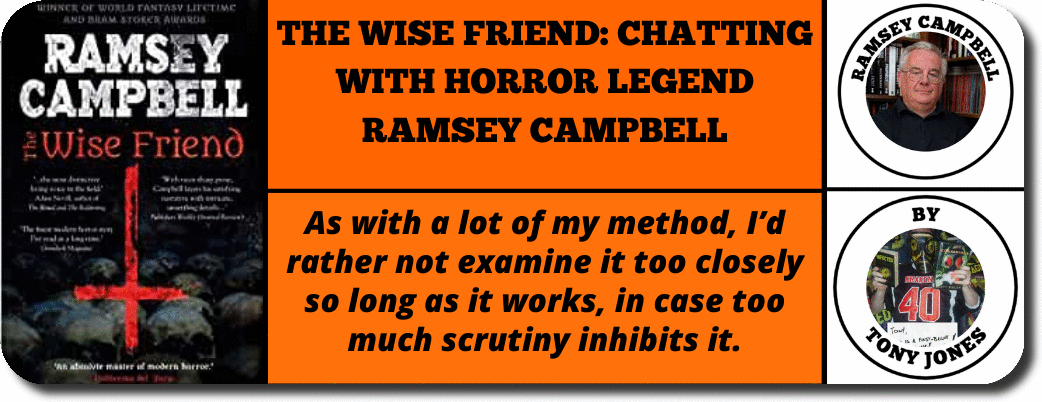 The Wise Friend: Chatting with horror legend Ramsey Campbell Today we are delighted to give you a brand-new interview with horror legend Mr Ramsey Campbell. There are few, if any authors, who have given as much to the genre as Mr Campbell. His massive shadow and influence cloaks every aspect of modern horror fiction and in 2020, almost 45 years since his debut novel, he is in fine form with The Wise Friend, which this interview focuses upon. Considerable his status in the world of horror it is lovely to find Ramsey so accessible online and is incredibly friendly to fans and those curious in the macabre. There is a Facebook group called Books of Horror (of over 7000 members) which I just must mention which both Ramsey and I haunt. Although the odd interesting thread pops up it usually features dumb and very repetitive questions along the lines of “I’ve read Stephen King. What do I try next?” style of questions and those looking for writing tips or other recommendations. I always enjoy Ramsey’s, often amusing, comments on this page and sometimes ask myself “DO THESE PEOPLE NOT KNOW WHO THIS GUY IS?” He has much more patience for the page than I do and if he abandoned the page I would probably follow him! The darkness in paintings by the likes of Hieronymus Bosch and William Blake makes art a perfect medium for horror fiction to nod to for inspiration. What is your take on this? I think you’re right, though I’ve rarely taken directly from paintings. One exception is an image of an isolated streetlamp in The Doll Who Ate His Mother, which was my version of a favourite Magritte image – indeed, I wanted Liverpool University Press to use one of these Magrittes on the cover of Joshi’s monograph, but apparently the rights would have cost too much. I certainly feel affinities with some art – the psychedelic images in Walter Hopps’ anthology Visions remind me quite a bit of similar experiences of my own, which show up in tales such as “Above the World” and “The Voice of the Beach”. For that matter, there are book covers I love – for instance, I bought Best Horror Stories back in 1957 partly for the splendidly atmospheric cover by the gay New Zealand painter Felix Kelly, who had quite a feel for the uncanny. One artist I have collaborated with more than once is J. K. Potter, and very productive it was. Apart from a brief flashback scene Patrick Torrington’s artist aunt Thelma is dead long before ‘A Wise Friend’ begins, nevertheless her presence dominates the novel, was the character based upon/inspired by any real artist(s) or anything genuine from the world of art? No – to be honest, I invented her and her work and then went looking for actual figures who might have influenced her or were similar (though I did know of Leonora Carrington, not to mention folk like Osman Spare). It’s sometimes uncanny how that process can work – finding sources for a fictional character – though of course I could have been drawing subconsciously on them. Much of the novel involves Patrick, his son Roy and the slightly odd Bella retracing the footsteps of Aunt Thelma and the potentially magical/mystical sites which inspired her work. This was from all around the Merseyside countryside, did you use genuine locations or places with dubious histories? You obviously use Liverpool a lot in your fiction…. I have to confess, that all the magical sites are my invention – a pity, since I wouldn’t mind visiting some of them. Perhaps I shall in dreams. New Brighton is as described, though, along with Liverpool and a bit of Manchester. Thelma featured in one major flashback scene when teenage Patrick visited, was there any particular reason why there were no subsequent flashbacks or any thoughts to develop her character more fully? I thought this was a very strong sequence…. My instinct was to keep her relatively mysterious, a haunting memory and an enigma. I hope it works! Patrick is not the most likable of characters and has the habit of antagonising and getting the backs up of the rest of his family. Often when the main character is unlikable it can put readers off a book, did you ever have any concern readers would struggle connecting with Patrick? I must admit I never saw him that way. He’s just a human being, as flawed as the rest of us – certainly as the author. I do think his motives are sympathetic, even when he makes mistakes. Mind you, your question reminds me that early in my career as a novelist my old much-missed friend and agent Kirby McCauley commented that my characters were morally grey and compared them to those of the director Fritz Lang. I took this as a considerable compliment – he made quite a few great films. ‘The Wise Friend’ and some of your other very recent fiction I’ve read, such as ‘Thirteen Days at Sunset Beach’, features virtually no violence, blood, and few deaths; as you’ve got older (or mellowed) have you noticed your work moving away from the bloodier side of horror fiction? Not that I have ever seen your work as particularly bloodthirsty…. I’ve generally shown no more than necessary in terms of horror or violence, but that varies from tale to tale. The first novel where I consciously tried to avoid violence as unnecessary was Midnight Sun, and I think that has influenced my approach in some books since. I’ve certainly tended to concentrate on the uncanny and to do my best to reach for awe in some, and gore isn’t really relevant to that. On the other hand, we have a pretty grisly act of violence near the rend of Ghosts Know. It’s a matter of the requirements of the context, I believe. Along with the recent ‘Thirteen Days at Sunset Beach’, both novels for a very long period tread a fine line on whether there is anything supernatural going on at all, you’ve used this tactic incredibly successfully over the years, is this your favourite type of ‘horror’ always laced with ambiguity? It’s one of them, certainly. Perhaps multiplicity of meaning and interpretation is a larger preference that includes it. My absolute favourite would be the kind that aspires to awesomeness or cosmic terror – The Willows, The White People, The Colour out of Space lead my list. I keep making literary leaps at it and perhaps occasionally manage more than a feeble hop. Both ‘The Wise Friend’ and ‘Thirteen Days at Sunset Beach’ involve family problems as an opportunity to create a supernatural story. When you were developing ‘The Wise Friend’ did you come up with the supernatural story independently and then build the family dynamics around the core idea? I think these elements developed pretty well in parallel. In both books I began to see my way once I had some sense of the mina characters and their relationships, but that’s generally how it happens for me. In Thirteen Days the central couple came to visit my imagination almost as soon as the initial idea of Sunset Beach did, and I had pages of notes about both by the end of that first day (on Zakynthos, for the record). I couldn’t help googling the character ‘Lumen Scientiae’ but came up blank…. His presence (and book) also lurk in the background of the story, was this inspired by anything historically genuine? Lord, I hope not! I’d stay out of his environs if so, should we be able to locate them. On the other hand, there is indeed a witchcraft collection in Manchester Central Library, though I’ll swear I didn’t know that until I decided to set some scenes in that city and looked in their online catalogue to see what they had on the subject. I’m a great believer from experience in happy coincidences when it comes to writing. I should mention that the staff of the Manchester library archive in my tale bear no resemblance to the actual very helpful staff. I noticed ‘The Wise Friend’ had a first-person narrative in which the entire story is seen from Patrick Torrington’s point of view. Was this to build in an unreliable narrator element into the plot or do you have any other spoiler-free thoughts you can share with us? I have to admit that my choice of viewpoint or viewpoints in any tale, as well as person and tense, is wholly instinctive. I was recently chatting with a Twitter/reviewer friend who was just about to read ‘The Wise Friend’, which would be the first of your novels he had sampled. How good an introduction to your fiction do you see your latest effort? Pretty good, I’d say. I hope so, anyway! By day I work as a school librarian and because of my lifelong interest in horror fiction our fiction collection is superb, including yourself and the likes of Adam Nevill, Stephen King and Nick Cutter. To teens developing an interest in horror, of your fiction I usually recommend ‘The Grin of the Dark’, but a couple of years ago a kid (around 16) when he returned it commented that although he enjoyed the novel it gave him an unpleasant bad dream! Which of your novels would you recommend to a horror newbie or younger reader? The Influence might be a candidate, which could almost (or maybe not even almost) be published as young adult fiction, do you think? [TONY ADDS: OKAY RAMSEY YOU’VE CONVINCED ME, BOUGHT FOR MY LIBRARY!] I enjoyed the Spanish language version of ‘The Influence’ currently on Netflix, it was atmospheric and well-paced, retaining the spirit of your novel. What did you think of it? Pretty powerful and disturbing, I thought. Given the choice which of your other novels would you like to see filmed? Maybe The Grin of the Dark by someone suitably unsettling. Or perhaps the trilogy for television? From ‘idea to completion’ how long did ‘The Wise Friend’ take? How does this compare with some of your other recent projects? Pretty well like all my novels for decades, it was about a year in the making. I’ll usually get the basic idea or ideas earlier than that, but the concerted process involves developing them and gathering material until I think I have enough to make a start on the writing – not a preconceived plot but a looser idea of the structure and the order of events, which will change in the process of writing. Once the first (always longhand) draft is done I’ll let it sit for a while and then reread it as a preamble to rewriting it on the computer. That version is printed out for reading and further revision, and at last it’s loose on the world – on my agent, at any rate. In the last couple of years Flame Tree Press have made a major splash in the horror world and have published new work by yourself (‘Think Yourself Lucky’, ‘Thirteen Days at Sunset Beach’ and ‘The Wise Friend’) as well as ‘The Hungry Moon’ and ‘The Influence’ from your back-catalogue. With the rereleases, ‘The Influence’ was obviously picked up because of the film, why ‘The Hungry Moon’ in particular? Will Flame Tree be rereleasing other titles in future? In fact, The Influence was scheduled before the film went into production, which suggests that some benevolent force may have been sat work (thank you, Daoloth?) It and The Hungry Moon were the publisher’s choices, and more indeed may be to come. If you were to spot any author, alive or dead, reading one of your novels on the London Underground who would you like it to be? Since I can dream, Graham Greene. Ramsey, it has been a pleasure having you on Ginger Nuts of Horror. On a personal level, the opportunity to correspond with an author I have for read for over twenty years has been one of the genuine highlights of the years I have been reviewing and writing about horror fiction. The best of luck with ‘The Wise Friend’ and your future projects. Tony Jones Be sure to tune in on Thursday when we have not one but two reviews for The Wise Friend from Tony Jones And Allen Stroud THE WISE FRIEND by RAMSEY CAMPBELL An absolute master of modern horror. And a damn fine writer at that - Guillermo del Toro Patrick Torrington's aunt Thelma was a successful artist whose late work turned towards the occult. While staying with her in his teens he found evidence that she used to visit magical sites. As an adult he discovers her journal of her explorations, and his teenage son Roy becomes fascinated too. His experiences at the sites scare Patrick away from them, but Roy carries on the search, together with his new girlfriend. Can Patrick convince his son that his increasingly terrible suspicions are real, or will what they ve helped to rouse take a new hold on the world? FLAME TREE PRESS is the new fiction imprint of Flame Tree Publishing. Launched in 2018 the list brings together brilliant new authors and the more established; the award winners, and exciting, original voices.  ERIC LAROCCA IS STARVING THE GHOSTS
15/4/2020
 ABOUT THE AUTHOR Eric LaRocca holds an MFA in Writing for Film and Television from Emerson College. His fiction has appeared in various literary journals and anthologies published in the US and abroad such as, Stiff Things and Year's Best Hardcore Horror, Volume 2. He is also the author of several plays which have been developed and produced at theaters across the country including, Gadfly Theater Productions, Hartford Stage, La Petite Morgue, and Love Creek Productions. He currently resides in Cambridge, MA. Follow him on Twitter @ejlarocca. Starving Ghosts in Every Thread is his debut novella. LINKS Starving Ghosts in Every Thread (preorder): https://amzn.to/38Dd85n Could you tell the readers a little bit about yourself? I recently graduated from Emerson College’s MFA program in Writing for Film and Television. It was an incredible two-year experience where I connected with so many talented people in the film industry, as well as developed lifelong friendships with the peers in my cohort. I currently live in Cambridge, MA with my partner, Ali, who’s also a writer. Now that the weather’s thankfully getting warmer, I love to spend my weekends exploring Boston or finding a shady spot in the park to read a new book. To get the ball rolling and get everyone relaxed, here is a hopefully lighthearted question to break the ice, which one of your characters would you least like to meet in real life and have them complain at you about they way you treated them in your work. I think the character I would least like to meet in real life is Clay from my short story, “If My Face Were Transparent, You’d See the Devil” featured in Red Room Press’ collection, Stiff Things: The Splatterporn Anthology. I treated Clay very poorly in my piece and I’m sure he’d have his share of complaints if he ever met me. Of course horrible things are expected to happen in horror stories; however, I recognize I crossed a line when it came to deciding Clay’s dreadful fate. Other than the horror genre, what else has been a major influence on your writing? Though I grew up relatively insulated in a small Connecticut town, I was surrounded by courageous, intelligent, and self-sufficient women. I think their presence had such a profound effect on me and has consequently informed many of my writing choices. I love inverting the standard of male-dominated horror by writing from a female perspective and I get so excited when I attempt to bring dynamic and compelling female characters to the table. Being involved in Community Theater at a young age has also been a major influence on my writing. I grew up reading the greats such as Arthur Miller, Tennessee Williams, and Eugene O'Neill. I always attempt to infuse palpable human drama in my pieces no matter how fantastical the subject matter is. The term horror, especially when applied to fiction always carries such heavy connotations. What’s your feeling on the term “horror” and what do you think we can do to break past these assumptions? I definitely agree that the term “horror” carries such heavy connotations. I might even suggest it carries undesirable implications in certain select circles. I often found myself skirting around the word when people would ask me what I write, using more benign terms like “thriller” or “dark fiction.” I think horror’s negative inferences are obviously fueled by the limited scope with which people interact with the genre. They assume all horror content mistreats women and involves exaggerated and gratuitous depictions of violence. Horror connoisseurs know this is not the case with all horror content as the genre clearly has the potential to highlight poignant human issues. I think in order to break past these assumptions we, as writers, have a responsibility to constantly challenge our readers by subverting the tropes and producing the unexpected. A lot of good horror movements have arisen as a direct result of the socio/political climate, considering the current state of the world where do you see horror going in the next few years? I think we’ve seen a tremendous surge of home invasion-type thrillers in recent years simply because of the cultural divisiveness being encouraged by the Oval Office. I think people have always been fearful of “the other,” but I feel as of late we’ve seen more content being produced about a fear of intrusion and powerlessness. That being said, I think our fears are becoming more internally based and I think we’re about to experience a renaissance of the Body Horror subgenre with content focusing on the invader existing as an inside force as opposed to an outside antagonist. Given the dark, violent and at times grotesque nature of the horror genre why do you think so many people enjoy reading it? I think exceptionally well-done horror is a truly cathartic experience. It’s like surviving a car crash without actually getting in the car. We identify and empathize with the characters in horror fiction – their failures are our failures, their triumphs are our triumphs. I think it’s also one of the few genres to accentuate the true resilience of the human spirit. We, as viewers and readers, play witness to a character’s determination to survive no matter the obstacle. What, if anything, is currently missing from the horror genre? I’d love to see more openly queer characters in horror fiction and film. Of course it would be a dream to see a prideful gay man as the protagonist of a mainstream horror release, but I’m uncertain if the general public is prepared for that. Regardless, I think it’s important for more queer authors to unabashedly add their voices to the mix, share their experiences, and tell their stories. Is horror its own worst enemy? What do you think keeps horror from being regarded as a valid genre by the public at large? I think what keeps horror from being regarded as a credible genre by the public at large has to do with the fact that the most mainstream representations of the genre are redundant and religiously follow the overworked tropes from which we should be struggling to break free. Of course I worry horror will always be considered a “ghetto genre” because of its sordid history, but recent commercial successes in the film industry like Midsommar and The Lighthouse prove that horror has the potential to captivate audiences without tactless jump scares or unnecessarily brutal violence. What new and upcoming authors do you think we should take notice off? One of the most exciting voices in horror fiction I’ve read recently has to be J. Daniel Stone. Not only is his writing electric and vividly compelling, but he’s such a kind person and has always been supportive of me and my work. Check out his newest release, Stations of Shadow, when it’s released in May. Another equally talented writer to watch out for is Rob Costello. His queer horror story, “Emergent,” published in The Dark Magazine shook me to my very core. After you’ve finished reading this interview, head over to The Dark and read his piece! What are the books and films that helped to define you as an author? The book that resonated with me most has to be Haunted by Chuck Palahniuk. Not only is the novel one of the most disquieting and unsettling works I’ve ever read, but it’s spectacularly audacious with regard to structure and content. I first read it several years ago, but I’ll never forget how much it challenged me as a reader. When it comes to films that have changed my life, there’s only one: Pascal Laugier’s 2008 masterpiece, Martyrs. It’s probably one of the bleakest, most soul-destroying films I’ve ever seen. Martyrs showed me the unexpected, the aberrant, and the unusual. More importantly, Martyrs is excellent proof of the horror genre’s capability to explore the more difficult questions of humanity from which other genres shy away. I envy anyone seeing the film for the very first time. It’s a harrowing descent into the depths of depravity. Are there any reviews of your work, positive or negative that have stayed with you? I’m relatively new to the business, so I haven’t accumulated a massive amount of reviews yet. However, one reviewer once performed a makeshift gender reassignment surgery on me and referred to me as “Erica LaRocca.” That was a new one. What aspects of writing to do you find the most difficult? I find the most difficult aspect of writing to be actually finding the time to sit down and write. Any moment I have free I make certain to strap myself to the keyboard and hammer away at a scene until I’m satisfied with the outcome. However, the more responsibilities I accrue in my personal life, the more difficult I find it to be productivity-wise with regard to writing. Is there one subject you would never write about as an author? I don’t believe in limiting the imagination, so I can’t say I would shy away from certain subject matter others might deem offensive. If it’s relevant to the story and executed tastefully, I’ll write about it. How important are names to you in your books? Do you choose the names based on liking the way it sounds or the meaning? Names are very important to me and my creative process. Most of the time the names of my characters are references to musicians or artists I admire. Regardless, it’s a struggle to find names that suit the character in question. Writing, is not a static process, how have you developed as a writer over the years? I think more than anything I’ve learned to trust my intuition when it comes to crafting content. I used to be so consumed with self-doubt and I would constantly compare myself to others. But, I’m so proud to say I have the skills to ignore my inner saboteur and write to the best of my abilities. What is the best piece of advice you ever received with regards to your writing? The best piece of writing advice I ever received has more to do with the business side of writing as opposed to the actual craft. In my Undergrad, I had a very successful writer as an instructor tell me that “true talent never goes unnoticed for long.” It was heartening to hear those encouraging words from such an established writer. More than anything, it gave me a sense of hope. For those who haven’t read any of your books, which of your books do you think best represents your work and why? I think my new novella, Starving Ghosts in Every Thread, best represents the new direction in which I’m heading as a writer. I was engrossed in the hardcore subgenre of horror for a while, but lately my fiction has leaned into a more literary space with fantastical sensibilities. I’m excited to see where it takes me! Do you have a favorite line or passage from your work, and would you like to share it with us? My favorite passage from my new release, Starving Ghosts in Every Thread, has to be our introduction to the main character as she walks home from work: “I tuck my chin into my scarf, slide my hands into both of my coat pockets, hiding my face beneath my hood – as if I were boxing the bigness inside me. Because, even if I wasn’t so unusual, the world would still want me to be kept as small as possible. It wants all girls that way.” Can you tell us about your last book, and can you tell us about what you are working on next? My debut novella, Starving Ghosts in Every Thread, will be available on Amazon on Friday, May 1st 2020. A somber mixture of dark fantasy and queer horror, Starving Ghosts in Every Thread follows a young girl who harbors a gruesome secret – her body literally unravels unless she feeds off the emotions of others. When she encounters another girl from town with an equally disturbing secret, it’s not long before Teddy’s insatiable hunger fueled by guilt begins to threaten her safety and violently touch all those who cross her path with disaster. As for what’s next, I’m currently wrapping up a short story and then setting my sights on beginning to write my first novel. I finished outlining the concept the other night actually and am very satisfied with what I have so far. I have a title in mind, but I’d rather not share until I actually start writing. If you could erase one horror cliché what would be your choice? I think the horror cliché I would erase immediately would be the jump scare in film. I find it more annoying than anything. Being startled is not necessarily frightening, but rather a momentary inconvenience. What was the last great book you read, and what was the last book that disappointed you? The last great book I read was John Hornor Jacobs’ A Lush and Seething Hell. Both novellas contained in his collection are haunting, lyrical, and deeply unsettling. In truth, I can’t recall the last time I was disappointed by a book. What's the one question you wish you would get asked but never do? And what would be the answer? The question I seldom get from reviewers is simply “How are you doing?” My answer (though I can be somewhat mercurial) right now would be: “I’m doing OK.” Starving Ghosts in Every Thread by Eric LaRocca She's so consumed with guilt that it compels her body to literally unravel unless she feeds off the emotions of others. Teddy’s parasitic condition is usually tempered easily and is invisible to most, unless she feeds from them. However, her insatiable hunger has already begun to threaten her safety. Trapped in her tiny Connecticut hometown thanks to a careless mistake which cost her a prestigious scholarship, Teddy grieves her father’s death and cares for her neurotic mother, Mercy, who is convinced scorpion venom is the only remedy for her own peculiar skin ailment linked to her daughter’s sadness. Once an aspiring songwriter, Teddy now merely alternates between shifts at the local market and visits to the house of her eccentric neighbor, Mr. Ridley, for fresh scorpions to bring to her mother. It’s during one of her routine visits to Mr. Ridley’s subterranean grotto of exotic animals that Teddy meets an unusual young girl named Kiiara. Immediately enamored with one another, Teddy soon discovers that Kiiara is hiding a gruesome secret, too – a secret that will threaten to undo everything Teddy has ever known and loved, and violently touch all those who cross their path with disaster.   Who are you? I’m Penny Jones and I’m a writer of horror fiction. (Occasionally other types of fiction, and the odd bit of nonfiction. Basically I’ll write anything if asked.) Your signature style: I tend towards a first person narrative, in quite a lyrical style. Characters are a big part of my stories, and it’s how they react to what is happening, rather than what is happening, that I’m most interested in. Toot your own horn: I’m still a really new author, but I remember hearing Alison Littlewood talking about being invited to be in an anthology (as opposed to open submissions). And I remember thinking, if that ever happens to me I’d be ecstatic. I was, and still am. So my first ever invite would have to be my greatest achievement. Books read: I’m doing a lot of Beta reading at the moment, so can’t really talk much about what I’m currently reading, other than it is science fiction and brilliant. The other books I’ve beta read recently are Robert Shearman’s We All Hear Stories in the Dark (PS Publishing) which is a poignant magnus opus collection of Rob’s short stories. Georgina Bruce’s Honeybones (TTA Press) which was released earlier this year and is beautifully bonkers dark novella. And Charlotte Bond’s The Watcher in the Woods (Black Shuck Books) which is due to be released on the 30th April, and is a lyrical collection of horrific folk and fairy tales. Movies watched: I’m usually years out from managing to catch up on films, but with the recent lockdown I’ve actually managed to catch up on some I wanted to see, and seen some great surprises. Finally saw Midsommar and Parasite, which had been on my list to see for a while. I’ve also seen Vivarium and Extra Ordinary which were both new to me, and absolutely brilliant. Games and/or music played: Currently playing Mystery Case Files: Moths to a Flame, which is a hidden object game. I don’t play many computer games as I find them quite stressful, but do like a hidden object game. Also been playing Othello the old fashioned way across the dining table. Looking forward to being able to meet up with people and play Drinking Fluxx again though. Music is old. I like comforting music, so I’m listening to some old favourites; Pink Floyd, Fleetwood Mac, Enya, REM and Bon Jovi at the moment. Words written: I’m currently working on a submission for Tartarus’s open submission period, but as you can see from the fact that their closing date is in just over 24 hours and I’m writing this instead, procrastination levels are high. Just before lockdown I did manage to write an entire short story in a day, whilst staying at my friend’s (and fabulous author’s) house. That one is currently submitted, but I won’t say where for fear of jinxing it. Future stuff: Once my Tartarus submission is completed, I have a haunted house novella that I’m working on. I’d like to have a first draft completed by Stokercon in August. Brain worms: “At what point does biting your fingernails or chewing on the skin around your nails become auto-cannibalism?” PENNY JONES Penny Jones knew she was a writer when she started to talk about herself in the third person (her family knew when Santa bought her a typewriter for Christmas). She loves reading and will read pretty much anything you put in front of her, but her favourite authors are Stephen King, Shirley Jackson and John Wyndham. In fact Penny only got into writing to buy books, when she realised that there wasn’t that much money in writing she stayed for the cake. Suffer Little Children by penny jones Black Shuck Shadows presents a collectable series of micro-collections, intended as a sampler to introduce readers to the best in classic and modern horror.In Suffer Little Children, Penny Jones offer six stories of juvenile peril.   URBAN GOTHIC AT 20: AN INTERVIEW WITH WRITER TOM DE VILLE A film and television writer with an impressive string of credits to his name, from Hammer's The Quiet Ones to NBC's Hannibal to Stan Lee's Lucky Man, Tom de Ville got his big break as the co-creator and writer of British horror anthology Urban Gothic, when he was only 23 years old. With this year marking the 20th anniversary of the cult show's debut on Channel 5 – and ahead of his own rewatch/analysis for GNOH – John McNee spoke to Tom to learn how the show came together and what his feelings are about it, two decades on. What's the origin of your interest in horror (specifically writing it)? I fell in love with horror at an early age. In my local library there were big books on horror from the early days through to the 1970s, with these lurid pictures from Hammer movies. Lots of Christopher Lee looking terrifying and attractive young women covered in blood. That completely caught my attention. These were things I knew I wasn't ready to watch yet, but the hook was in. Then I got to about 12 or 13 and I would go the local newsagents and flick through Fangoria, just to see the gross pictures. I still didn't feel I was ready to watch the films, but I was aware of them and became obsessed with Nightmare on Elm Street. The concept really got under my skin and I started having nightmares in which Freddy would visit me and force me to watch it. The concept of watching the film – seeing the images moving – was what really frightened me. Finally one day, I was alone in the house with a VHS copy of the film that my dad had left lying around. I decided I had to get through the experience, so I put it on. The way I handled it was, whenever I could tell a scary part was coming, I would play it on fast-forward. When I understood what was going to happen, I could rewind it and play it through again. It totally broke the barrier for me and, after that, I was a full convert and spent my teenage years watching everything I could get my hands on. These were the glory days of the video rental store and my local one was full of obscure B-movies, which I loved. While this was going on, I'd also figured out that making films was what I really wanted to do. I'd fallen in love with authors like HP Lovecraft so I was writing a lot of homages, which were basically ripping his stuff off. In my late teens, I started looking into applying to go to film school and ended up getting into Bournemouth University which, at the time, had the only screenwriting degree in the country. Whenever we had a screenwriting project I always tried to produce something very genre-based. I spent a lot of my time there reading scripts that were specifically horror or thrillers, learning how to do that kind of thing in script form.  How did the opportunity for Urban Gothic come about? About four or five months after I graduated, I got a call from Bournemouth. They'd been contacted by a producer called Steve Matthews, who was looking to work with a recent graduate, so they put my name forward. I met with him and learned he had a script for a cop show from a successful but quite elderly writer and he wanted someone young to come on board and rewrite the dialogue to make it more modern. While we were at that meeting, he asked me what I really wanted to do. This was in the late 1990s when no-one, particularly in British TV, was making horror. I said I wanted to do horror and Steve's eyes just lit up. He said it was his favourite genre and he would love to do something in it too. We talked about it a bit more and he suggested doing an anthology, which I had mixed feelings about. I really loved stuff like Buffy the Vampire Slayer and wanted to do an ongoing series, but I was also hungry for opportunity and did like the idea of being able to do a different story every week. So I went away and came up with a handful of ideas, including one that I knew would be the first episode, 'Dead Meat'. I wanted to do a very simple, Sam Raimi-esque story about a bunch of kids and a zombie in a building. I wrote the outline really quickly and Steve called me back soon afterwards to commission a script. How did you decide on the overall concept for the show? Like I said, it was Steve who pitched the idea of doing a horror anthology. But I decided pretty quickly that I didn't want to do this very traditional form of British horror set in old mansions and misty graveyards. I wanted every story to be set in the modern day and city-based, not the traditional gothic style that was still lingering in British film-making at the time. We already had that urban part of the formula in place before we began shopping it around. What was the process of getting Urban Gothic onto TV? At some point, Steve took the project to Channel 5 and we had one of those amazing strokes of good fortune where someone, in a meeting that morning, had said “we really should be doing horror”. Then Steve walked in and said he had a horror project. It was just perfect timing. So I went away and wrote a couple more scripts that they really liked. I kept on pitching ideas and it snowballed to a point where they decided I should write the whole series. And because I was young and stupid, I said yes. About two or three scripts in, Channel 5 gave the green light and that was it. Were you involved much with the actual production? I was always around it. I was still writing the later scripts while they were in production on the earlier stuff. I would quite often go down to the production offices near Suffolk. I was involved in pre-production with all of the directors, getting the scripts the way they wanted them. But as a writer on set, it's very evident that no-one wants you to butt in at any point. By the time it's in production, everything is set and everyone has their jobs to do. In my head I always had this fantasy that I would be heavily involved in that part of the process, but the truth is no-one wants that. I could tell by the ambience the first time I went on set. But I was always around, though I was usually at a desk, writing. What were your thoughts when you finally saw the finished episodes? My feelings were mixed. What you learn very quickly is that once you've handed a script over to production you are not in control of it. There were definitely episodes I thought I'd conceived and executed better than others, so those were the ones I was most interested in. And each director brings their own unique approach and perspective, which means the finished product can end up very different from what you imagine. Sometimes a director would nail it and deliver something very close to what I had in my head. Other times it would be very different. With an anthology, that's just part of it. Every episode should feel different. As a writer, it was an education in realising what you imagine is not always what you get. What do you recall about the reaction the show received when it was broadcast? It had a fairly solid response. The internet was still very primitive back then, but there was an Urban Gothic chat site for fans that I would visit a lot. It was always really cool to see people talking about each individual story and I remember it being really positive. We got solid reviews in stuff like SFX, so I was definitely happy with the response. The funny thing about it, though, is that it was always a very small, cult show. One of the things that's delighted me about it is you'll just occasionally run into somebody who was a fan and will wax lyrical about it. Even now, there are people out there who hold it very close to their hearts. That's the best result I could have hoped for. How did the process differ for series two? At the time we were told we were getting a second series, I think I was feeling a little burnt out, creatively. I certainly knew I didn't want to write all of them, so it was decided I would write four and the other five would be given out to other new writers. I was overseeing all the scripts, but I was mostly focussed on my four. I was less involved, generally, but I came up with this mad idea for my episodes. I'd fallen in love with writers like Grant Morrison and Alan Moore – these very experimental storytellers – and I wanted to do something like that. At the end of the first series I had written a story which attempted to tie together the previous 12, creating a background mythology that could explain how all these things were happening in the same universe. My four-parter in series two built on that. In retrospect I kind of wish I'd just written four more juicy stories, but at the time I was young and just wanted to splash about and try different things. I do love some of the episodes in series two, but I feel way more invested in series one. Was there ever any discussion about the possibility of a third series? I'm not sure what discussions took place. I think Channel 5's management was changing a lot and people came in who wanted to focus on something else. During the production of series two I kind of got the feeling it was going to be the last one. One thing we did look at, for a while, was taking a couple of the episodes and turning them into small films. There were two in particular we were talking about – 'Vampirology' and 'The Boys' Club'. They're probably my two favourites from the first series. What was next for you, after Urban Gothic? I went over to the States and worked on the fourth season of a Canadian sci-fi show called Lexx. It was like a Canadian Red Dwarf but weirder and I absolutely loved it. I had a blast going over to Halifax in Nova Scotia, where they made it, and hanging out in their writers' room. It was my first state-side experience. After that I wanted to do more TV in the UK and pitched a few series that were very much like British versions of Buffy, but it wasn't the right time. This was just before the return of Doctor Who, so the appetite wasn't there yet, among the broadcasters, for those kind of shows. So I moved over into film and spent a couple of years working on a completely mad project that George Romero was going to direct about a British boarding school that gets overrun by vampires. After that came The Quiet Ones, which Hammer made, and then I worked with a director called Corin Hardy, who recently made The Nun, on a film called The Hallow. After that was more TV and right now I've got things happening with a couple of film scripts, one that's just about to be announced (Lord of Misrule, to be directed by William Brent Bell).  Are you still most interested in working in the horror genre? Definitely, when it comes to film. In TV, particularly in the UK, it's still very hard to get horror projects off the ground, unless it's skewed towards the more family-friendly Doctor Who-style end. There's a real appetite for that now, but more adult horror on British TV is still quite rare. Why do you think that is? Horror is not an easy format to work in, in TV. I think the two models that work best are the anthology series or the American Horror Story/Channel Zero idea where each season tells a self-contained story. I think that's a good model for TV horror, but it's really hard to sustain ongoing shows, because there always comes a point in a horror story when you have to explain what's going on. After that, an end-point is unavoidable. So it's hard for horror projects to have longevity. I also think that, over here, in the '60s and '70s, horror was very mainstream, but now it's viewed as quite niche. You get occasional films that break out and become hits, but other than that it's still quite niche. Unfortunately, that has a lot to do with the tastes of commissioners. I have no doubt the audience is there. I don't imagine Urban Gothic would have any chance of being made by Channel 5 these days. I don't think so, though they have recently begun to commission some interesting dramas. But for a long, long time they shifted away from scripted shows. What you've got to remember is, when I was writing Urban Gothic, it was just before the debut of Big Brother, which fundamentally altered the landscape of British TV. For a big part of the 2000s, reality TV was where it was at. I think the needle has swung back the other way now with the streaming boom and drama has become a big thing again.  If you look up Urban Gothic online, you'll often find references to you writing the stories when you were 13 or 17 years old. Any truth to that? No, definitely not. I met Steve just after I graduated, so in the middle of writing the scripts I would have been 23. They definitely did make it part of the publicity for the show. They would describe it as being created and written by a 23-year-old, which I find really embarrassing now. I can imagine that becoming exaggerated to the point people were saying a 13-year-old had written it. Some of the scripts I look back on now and think they were definitely written by a 23-year-old and I sort of wonder what I was thinking, but at the time it was great. Looking back 20 years on, what are your feelings on the show? What counts to me is there are still people out there who remember it, talk about it and hopefully view it kindly as a show that existed at a time when there wasn't much like it on British TV. Other than that, it's something I wrote when I was very young, I had a lot of fun doing it and I'm really glad I did it. It was such a lucky break and a great start to my career. It's something I'll always cherish. I directed one of the episodes in the second series and I've got the slate for that on my mantelpiece, so it's still something I carry with me and that I don't want to be forgotten. At the same time, it was a very small show that went out late at night on Channel 5, so I think I knew at the time that it wasn't going to be a breakaway smash hit. I certainly don't expect it to become one now, but I am so glad I got to do it.   BIO Halo Scot is the author of the Rift Cycle, a grimdark, science-fantasy series. Follow Halo on Twitter and Instagram (@halo_scot), or visit haloscot.com. Could you tell the readers a little bit about yourself? I’m a grimdark, science-fantasy author who has written stories since I learned how to write. Writing is therapy for me — a way to escape, a way to process, a way to admit what I would otherwise hide. To get the ball rolling and get everyone relaxed, here is a hopefully lighthearted question to break the ice, which one of your characters would you least like to meet in real life and have them complain at you about they way you treated them in your work. I’m fairly ruthless with my characters and tend to put them through hell, so I would prefer not to meet any of them in real life — they would all probably kill me lol. Other than the horror genre, what else has been a major influence on your writing? Science fiction and fantasy have been HUGE influences in my life. The term horror, especially when applied to fiction always carries such heavy connotations. What’s your feeling on the term “horror” and what do you think we can do to break past these assumptions? To me, horror is anything that summons a feeling of terror. However, I think it carries the stereotypes of “jump scares” and excessive violence. To break past these assumptions, I think we can ensure we include well-rounded characters, captivating plots, and a catchy voice. Good stories will dispel any cliché. A lot of good horror movements have arisen as a direct result of the socio/political climate, considering the current state of the world where do you see horror going in the next few years? I’ve seen the rise of more psychological horror, such as with the new Joker movie, and over the next few years, I could see the genre continuing in that direction. Given the dark, violent and at times grotesque nature of the horror genre why do you think so many people enjoy reading it? We, as a culture, love the taboo. Horror gives voice to our deepest fears, our darkest desires, and just as people rubberneck a car crash, we can’t help but fixate on our fear. What, if anything, is currently missing from the horror genre? I think the genre, especially over the past few years, has fleshed itself out. I don’t see anything missing, but I do see a few great trends — such as the psychological horror direction I stated above. In the past authors were able to write about almost anything with a far lesser degree of the fear of backlash, but this has all changed in recent years. These days authors must be more aware of representation and the depiction of things such as race and gender in their works, how aware are you of these things and what steps have you taken to ensure that your writing can’t be viewed as being offensive to a minority group? I have included a diverse range of nationalities, genders, and sexual orientations in Edge of the Breach and researched each in depth. As someone who identifies as gay, I understand what it is like to be a minority and went to painstaking lengths to ensure I am sensitive to the portrayal of all types of diversity. Does horror fiction perpetuate its own ghettoization? I think horror is becoming more and more popular as people are becoming more open and honest with the shape of our world. Horror is unflinching, yes, but I don’t think that ghettoizes it. People love to read about blood and gore and guts and things that go bump in the night. Take Game of Thrones, for example. It’s a fantasy, and yet, there are many horrifying elements to it. If anything, I think horror is seeping into other genres, as well, and this is increasing its popularity overall. What new and upcoming authors do you think we should take notice of? A few excellent authors I’ve read recently include Chris DeVito (@ChrisMDeVito), Evan Knapp (@MovementWhere), and Sahreth ‘Baphy’ Bowden (@Baphy1428), and a couple pre-orders I’m stoked about include Ash Knight (@ForgottenAstro2) and A.C. Merkel (@Blink_Drive). What are the books and films that helped to define you as an author? Star Wars, Star Trek, and Battlestar Galactica were HUGE inspirations to me in terms of film and TV. As for books, Red Rising by Pierce Brown, Ninth House by Leigh Bardugo, and A Darker Shade of Magic by V.E. Schwab have been instrumental in my development of voice and style. Are there any reviews of your work, positive or negative that have stayed with you? The reviews and feedback by the new and upcoming authors I listed above completely blew me away. I am very, very lucky to have their support. What aspects of writing to do you find the most difficult? Trusting my gut and taking risks. I used to hedge much more than I do now, but I still feel myself pulling back into my comfort zone every now and then, so it’s something I’m keenly aware of. Is there one subject you would never write about as an author? I don’t like to limit myself, but I’m probably not the best choice to write children’s books haha. How important are names to you in your books? Do you choose the names based on liking the way it sounds or the meaning? Names are extremely important, and I choose them based on both sound and meaning. I usually have nameberry.com open, and with absolute chaos, I search for names in different cultures and meanings until one sticks. Writing, is not a static process, how have you developed as a writer over the years? I’ve become much bolder and broken many of the “rules.” But I’ve also learned to trust my decisions more. What is the best piece of advice you ever received with regards to your writing? Do what works for you. Don’t worry about what works for anyone else. To many writers, the characters they write become like children, who is your favorite child, and who is your least favorite to write for and why? In Edge of the Breach, Kyder was my favorite to write for, and he came the easiest to me (don’t judge lol). I don’t really have a least favorite to write for, because if I’m not connecting with the character in some way, I ax them. For those who haven’t read any of your books, which of your books do you think best represents your work and why? Edge of the Breach is my debut book, and it is the most representative of my tone and style. Do you have a favorite line or passage from your work, and would you like to share it with us? “It’s easier for them to accept physical injuries than mental illness, than substance abuse, than grief. What a pathetic, backwards society on a broken, upside-down world.” – Edge of the Breach Can you tell us about your last book, and can you tell us about what you are working on next? Edge of the Breach is about how we all have the capacity for monstrosity when pushed to our limits. In a post-apocalyptic world where season of birth determines power — spring healers, summer mages, fall shapeshifters, and winter shields — a man and a woman emerge from tragic childhoods to lead humanity on opposite sides of an interrealm war. Excerpts and more information is available at my website: https://haloscot.com/books/. If you could erase one horror cliché what would be your choice? The oblivious family that doesn’t move out of their clearly haunted house after the first puddle of blood appears out of nowhere. SAVE YOURSELVES, PEOPLE! What was the last great book you read, and what was the last book that disappointed you? The last great books I read were all of the books by the authors listed above, and I haven’t been disappointed by a book in recent memory. What's the one question you wish you would get asked but never do? And what would be the answer? Oof, you’ve asked such amazing questions that I have none left! Thanks so much for having me! Edge of the Breach (Rift Cycle Book 1) We all become monsters at the edge of the breach. In a post-apocalyptic world where season of birth determines power — spring healers, summer mages, fall shapeshifters, and winter shields — a man and a woman emerge from tragic childhoods to lead humanity on opposite sides of an interrealm war.
There is a hole in the sky. They call it the Rift. A portal to the gods. The scar of a suffering world. Through it, the gods rule the last scraps of civilization, harkening war. As chaos beckons, two leaders emerge from the ashes of a dying planet. Julian Kyder is the son of an abusive rape victim who compensates for his abandonment through psychopathy. Sira Rune is a cancer survivor who dedicates her life to living free and fearless while experiencing the taboo and the unorthodox. Rune is the only one unafraid of Kyder, and that terrifies him, because he only knows how to function through fear. Even though she gives him more chances than he deserves, how much violence can she forgive? When is a person beyond redemption? While he struggles to control his demons and she struggles to find purpose, the gods drag the ruined world into war. |


Archives
May 2023
|
 RSS Feed

|

|