

DAISY LYLE DIGS DEEP: AN INTERVIEW WITH AARON A. REED AUTHOR OF THE UNIQUE NOVEL SUBCUTANEAN
24/4/2020
 Could you tell the readers a little bit about yourself? I suppose I have a bit of an unusual background for a writer: I started out getting a degree in film, then got deeply into games and interactive stories, and ended up going to grad school to study new ways of abusing computers to get them to collaborate with people in telling stories. In the process I ended up with an advanced degree in computer science, despite primarily thinking of myself as a writer, and since then I've been working professionally on tools for helping game writers put generative text into their games, while continuing to write both traditional and interactive fiction in my spare time. What aspects of writing do you find the most difficult? One of the hardest things for me is the conceptual leap from having the first few pieces of a story to understanding how they're going to fit together into a satisfying whole. Lots of my ideas die as maps or outlines with a few strong pieces here and there but no clear sense of what to do with them. Every once in a while when I'm lucky, something will click and I'll see the full shape of a story and how it all works: and from then it's just work (often hard work, of course) to get it completed. I can sometimes try to force that to happen when I'm sitting down carefully planning a project out (which I've had to do for contract work in game writing, for example) but it's magical when it happens on its own, sometimes in the middle of the night waking up from a dream or at other unexpected times and places. Other than the horror genre, what else has been a major influence on your writing? Though I've actually written less of it than other genres, I was most influence by science fiction growing up. I'm technically too young for it but I read a lot of Golden Age SF as a kid because it was all my school library had: the 40s, 50s, and early 60s stuff, and I think that sense of rational optimism colored a lot of my worldview and writing style, although sometimes in subtle ways. Later on in college I discovered 60s and 70s SF (again, a couple decades out of date) and that blew me away in a different way, and I've loved the incredible turn towards a much wider range of stories and authors that the genre has taken in the most recent decade. Unrelated to SF, I've always had a fascination with caves and underground spaces, a theme that shows up in Subcutanean as well as in some of my prior games and stories, and most of my favorite horror books and films take place underground in one way or another. Have you had any feedback yet about the way the uniqueness of each copy of the book has impacted readers? What kind of emotions are you hoping it might awaken in them? One of the primary emotional journeys I want to take readers on is to let them feel the same sense of unease and worry about the alternative possibilities they might be missing that the characters do. That was a "pieces fitting together" moment for me with Subcutanean: realizing that I could create this situation in the reader's mind where they felt that same sense of multiple possibilities that the characters did, even reading what seems to be a static book with no interactive component. It's a kind of real-world frame story around the experience of reading the book itself. And I'm also hoping that by the end, each reader, like Orion, has made peace with their "reality"; their version of the story, and isn't yearning for another world they wish they could see... even if there's maybe a bit of bittersweetness to that feeling. As far as feedback so far: I haven't had too much yet about this specific aspect. Next month I know there's a class on horror fiction that's going to be reading the book and has asked me to give a remote guest lecture, and I am LOVING the thought of those class discussions. "Wait, WHAT did you say happened in your book???" Part of the experience for me as an author has been to avoid the temptation to tell people about alternate possibilities unless they specifically ask. So if someone tells me they love it that a certain scene happened the way it did or I picked a certain theme to emphasize, I'm not going to say "Oh, well it could also have happened this way, or that way." The version they read is just as legitimate a Subcutanean as any other, and I don't want to invalidate it by implying it's not the true or best story. It was the one they got, and if they liked it, that's all that matters! There is a lot of overlap between the themes in your book and the experiences of people suffering from certain kinds of mental illness, in particular psychotic disorders and social anxiety. Was this deliberate or did these echoes just arise as a natural result of the subject matter? I think both Orion and Niko, in different ways, are people who feel like they don't fit in to the lives they feel they're supposed to live, and can't escape the feeling that this is their own fault, that they're doing something wrong. I personally was someone who had a very rough time in my early 20s figuring out who I wanted to be. In my own personal case it wasn't about a diagnosed mental illness. But I think there are huge swaths of people, myself at that age and these characters included, who don't have access to or the wherewithal to seek out therapy, or diagnoses, or other kinds of support to get the help they need to be happier. That interstitial space, feeling not well enough to live a happy life but not unwell enough to get help, was something I saw in myself and a lot of my friends back then, and wanted to capture in the book. Subcutanean makes a good point about the way another “you” is generated every time you form an emotional or social bond with someone, and suggests that this proliferation of “yous” can have a corrosive effect on the self. At a time when the Internet is encouraging us to make ever more social contacts, what do you think we can do to protect ourselves from this? This is something most of us don't really explicitly learn growing up and have to figure out, I think: how to be someone who can support a friend, partner, family member etc. and give them what they really need from you, rather than what you want them to need from you. This is even harder in stressful times like these: to work out when you're okay to vent or panic and when you need to be the one who stays strong for someone else, or whether a visit to a family member that might put them at risk is really for their benefit or just your own. One of the great things about fiction, of course, is how it helps us practice getting inside other people's heads and seeing different perspectives from our own, and get better at being good humans with each other. Clive Barker’s Imajica is mentioned in the book. Was he a big influence on your writing generally? And who do you feel are his successors today, in terms of incorporating gay issues into horror fiction? Barker and a couple other queer authors like Samuel Delany and Thomas M. Disch were some of the first openly gay authors I read as a teenager, and they were all hugely important to me. Imajica is still one of my favorite books ever: it's such an original vision of an other world that stains and is stained by our own. I've always admired the way his works can seamlessly meld genres together, and his characters so often feel deeply truthful in the ways real people do, no matter how briefly they appear. As far as his successors, I've actually read more queer fantasy and literary fiction than horror lately, but Michael Golding's "A Poet of the Invisible World" is one book I'd call out as capturing some of the same strange magic and poignant heartbreak. A lovely poem by Gwendolyn MacEwen, “Dark Pines Under Water”, is quoted in your book. What do you think about using generative text to write poetry? I studied generative text systems a lot as part of my dissertation work, and to me they're most fascinating not for the output they generate but for the process a human went through to create those systems. I think working with a generative text algorithm is just a new kind of constrained writing, like working in a specific poetic form. The system you built or chose to use, the words you fed into it, the way you curated or didn't curate the output, are all artistic acts expressing something that the actual generated output is just another piece of. What effect do you think the increasing use of generative text in online journalism and literary genres such as erotica will have on human writers in future? Will it result in a wave of structural unemployment, or are we worrying too much? I think you only have to be worried if you're writing the sort of prose that could easily be replaced by a computer! Which of course is not a knock on any particular genre or style. The latest AI techniques are starting to get pretty good at mimicking the surface coherency of prose, especially certain kinds of prose. But they're still light-years away from writing prose that engages with us emotionally, because that's about making a human-to-human connection through the medium of the written word, and we don't yet have algorithms that want to make connections with us, or do anything other than exactly what they're told. I think where we're mostly likely to see real gains in generative text is in prose that's designed to have a more predictable and measurable response, like erotica and, yes, parts of horror. Long before we have an AI Tolstoy, I can see a writer tool connected to a deep understanding of how terror works in the human brain that could help suggest ideas, pace a scene for maximum effect, predict when to ratchet up the tension and when to stretch it out, and maybe even generate its own creepypastas. But the deeper stories that really stick with us are going to need to connect that stuff to human characters that readers care about, so I wouldn't worry about being out of a job just yet. Rickety old student houses often abound in odd nooks and crannies. Do you have a lot of experience of real-life uncanny architecture? There's a bit in Subcutanean where Orion talks about always having dreams of discovering new rooms or hallways in his house, and that's all me. I've lived in a couple rambling old houses, but probably the biggest real-life architectural inspiration for Subcutanean was a miserable basement apartment I almost moved into with a friend during college when we were pretty poor and it seemed like a suspiciously good deal. It was windowless and had low ceilings and too many rooms for the price they were asking connected by hallways that seemed longer than they should have been, and we'd actually already paid the deposit and started moving in when we both got a bad feeling about the place and backed out. Every now and then in years later I would remember it with a disturbing gut feeling, like I might not still be alive if I had moved in there. Some of the specific details in Subcutanean's Downstairs are straight out of my memories of that place: the brown carpet and the tacky, too-bright wall sconces, in particular. Let’s finish up with something a bit more light-hearted. Orion and Niko both obviously love music. If Subcutanean was made into a film and you had to choose five pieces of music from any genre to soundtrack it, what would they be? Right now I think all five would be by Rob (Robin Coudert) who wrote the incredible soundtrack to Gretel & Hansel. Sound design is one of my favorite parts of horror films: despite the late '90s period nature of Subcutanean, my ideal soundtrack for a movie version would be weird, experimental soundscapes instead of pop hits. Not that Hollywood ever listens to the writer, of course... 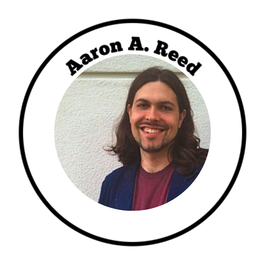 Aaron A. Reed is a writer, designer, and researcher focused on finding new ways for gamemakers and players to tell stories together. His fiction, games, and playable artworks have won recognition from a broad range of storytelling communities, including the Independent Games Festival (video games), the ENnie Awards (tabletop roleplaying), and Kirkus Reviews (traditional publishing). Aaron is a multi-time IndieCade and IGF finalist, and his work has also been shown at South by Southwest, Slamdance, and GaymerX; he has spoken about digital storytelling at PAX and PAX East, Google, WorldCon, NarraScope, and the Game Developer Conference. Aaron holds a PhD in Computer Science and a MFA in Digital Arts and New Media. He lives in Santa Cruz, California. aaronareed.net Subcutanean: a novel where each copy is different Insecure college senior Orion loves music, books, and his best friend Niko. When the two of them find a secret basement in their rambling old off-campus house, at first Orion’s thrilled. It’s another secret to share, another adventure to maybe, at last, bring them closer together. But something's wrong: the basement doesn't end. Blandly decorated halls stretch on for miles past peeling wallpaper, empty bedrooms, and countless stairwells always leading down. Soon they realize Downstairs is a snarled tangle of possibilities, more and more opening up the deeper they go. Something down there multiplies everything: architecture, emotions, even people. Together they must navigate an increasingly dangerous labyrinth that peels back their friendship to raw and angry roots, filled with two-faced doppelgängers, treacherous architecture, and long-buried secrets. Most dangerous of all is Orion's consuming obsession: somewhere down there, is there a Niko who loves him back? "Lurking inside this generative horror novel is a deeply felt and strangely moving coming-of-age story." --Isaac Schankler Purchase a copy here   Comments are closed.
|


Archives
May 2023
|
 RSS Feed

|

|