• HOME
  • CONTACT / FEATURE
  • FEATURES
  • FICTION REVIEWS
  • FILM REVIEWS
  • INTERVIEWS
  • YOUNG BLOOD
  • MY LIFE IN HORROR
  • FILM GUTTER
  • ARCHIVES
    • SPLASHES OF DARKNESS
    • THE MASTERS OF HORROR
    • THE DEVL'S MUSIC
    • HORROR BOOK REVIEWS
    • Challenge Kayleigh
    • ALICE IN SUMMERLAND
    • 13 FOR HALLOWEEN
    • FILMS THAT MATTER
    • BOOKS THAT MATTER
    • THE SCARLET GOSPELS
GINGER NUTS OF HORROR
  • HOME
  • CONTACT / FEATURE
  • FEATURES
  • FICTION REVIEWS
  • FILM REVIEWS
  • INTERVIEWS
  • YOUNG BLOOD
  • MY LIFE IN HORROR
  • FILM GUTTER
  • ARCHIVES
    • SPLASHES OF DARKNESS
    • THE MASTERS OF HORROR
    • THE DEVL'S MUSIC
    • HORROR BOOK REVIEWS
    • Challenge Kayleigh
    • ALICE IN SUMMERLAND
    • 13 FOR HALLOWEEN
    • FILMS THAT MATTER
    • BOOKS THAT MATTER
    • THE SCARLET GOSPELS
GINGER NUTS OF HORROR
horror review website ginger nuts of horror website

FIVE MINUTES WITH AUTHOR KITTY HONEYCUTT

21/3/2018
Picture

Could you tell the readers a little bit about yourself?
 

Kitty Honeycutt is the single mother of an amazing daughter whom she currently home school’s. She is a publisher for over 100 authors, a writer, an entrepreneur, a singer and an animal and human rights activist.
 
Her household is comprised of various creatures that include, but are not limited to:
 
Two Chihuahua’s (Lobo) & (Tinkerbell) Thirteen cats (Merlin), (Pandra), (Salem), (Mythian), (Sabrina), (Austin), (Mestofelees), (Sage), (Zoey, aka Jadis), (Willow Pixie), (Totoro aka Tiny), (Clementine) & (Sandy) Five fish, (Pumpkin), (Thing 2), & (Orca the Oscar Fish) One Ball Python, (Dragon), Four Bearded Dragons, (Rexie), (Chubby aka Kingsley), (Samantha) & (Georgia) One Crested Gecko, (Copper) Two Uromastyx, (Mary) & (Elizabeth) Two Aquatic Turtles, (Purple) & (Myrtle) and eleven babies that have yet to be named. One Desert Tortoise, (Bubble).
 
*As you can see she is also a part-time zoo-keeper.*
 
She sometimes writes under the pseudonym Kitty 'de Chatfou and her book “Pray For Hell” is due out later this year 2018, and will be her second published work.


What do you like to do when you're not writing?

I mostly spend time with my daughter and our various animals. I also like to read and review other people’s books or just spend my time dreaming up ideas for new novels and letting the insane characters run freely in my head, just to see how much trouble they can get into.

Other than the  horror genre, what else has been a major influence on your writing?

Fantasy, I love fantasy and I also love historical fiction. I have books coming out with both in them in the very near future.


The term horror, especially when applied to fiction always carries such heavy connotations.  What’s your feeling on the term “horror” and what do you think we can do to break past these assumptions?

I feel the term ‘horror’ has been used a lot to describe gore and grindhouse, I don’t feel that it’s all encompassing enough for some people. They usually see the word horror attached to really gory outrageous writing but I feel that people need to see and understand that not all horror has to be that way. I write horror in both senses even some horror for children so there are many facets to the diamond we call ‘horror’ I feel we need to make people see and understand that.


A lot of good horror movements have arisen as a direct result of the socio/political climate, considering the current state of the world where do you see horror going in the next few years?  

Oh man, I can see it going into more of the ‘Purge’ venue. There is so much craziness out there right now I wouldn’t be surprised to see horror take on more of a political satire type venue. It’s going to be interesting that’s for sure.


What are the books and films that helped to define you as an author?

I will not lie, I am a fan of Stephen King not only for his genius in writing but also for the fact that we share a birthday. His books have been part of my library for years and I still purchase them today. Anything he writes I’ll read it. I think we have a similar style to; it could be because we’re both Virgo’s. I also love Dean Koontz, his writing is phenomenal and of course the old Wes Craven movies and such. I’m a huge fan of 80’s horror. I get a kick out of it and miss those days.

What new and upcoming authors do you think we should take notice off?  

Joe Schwartz, he just wrote a book about a year ago now called STABCO, it is very good and I think it’s worth a read for anyone that likes horror. Very dark and psychotic but with a twist of the old horror genre tricks. I loved it!

How would you describe your writing style?

I’d say a cross between Stephen King and Dean Koontz. I have a tendency to put on the gore when I feel I need to and sometimes I play things a bit cleaner. It all depends on my mood.

Are there any reviews of your work, positive or negative that have stayed with you? 

I haven’t had any reviews yet but I’ll let you know when I do!

What aspects of writing to do you find the most difficult?

The plotting, it takes a lot of time and true effort to plot the story before it happens completely and I find that a lot of times my characters have a tendency to take me in an entirely different direction. My characters are a part of me and they will not be denied!

Is there one subject you would never write about as an author?

Erotica…. I just don’t think I could do it. I’m not a very sexual person and I just don’t know if I could bring it out good enough to even try.

How important are names to you in your books? Do you choose the names based on liking the way it sounds or the meaning?

I choose some names just because I like them but to be honest a lot of names are taken from names of friends that I know. They love to be put in a book, it doesn’t even matter if they die, they just enjoy being in a book. It’s cool to do that too because I love to make people happy.

Writing, is not a static process, how have you developed as a writer over the years? 

I think I have learned to take more risks. There are times and have been times when I thought I may not should have put some things in a book that I did only to find that the readers loved it. So taking risks aren’t all that bad after all.

What tools do you feel are must-haves for writers? 

A computer is a must, editors, pens and pencils in your purse or pockets. Trust me you never know when an idea is going to pop up.         

What is the best piece of advice you ever received with regards to your writing?

Don’t let reviews bother you, they are opinions, even some of the greatest authors we know got bad reviews and it doesn’t always mean that you suck. If you get a bad review take it with grace and accept it, you can also learn from them.

Getting your worked noticed is one of the hardest things for a writer to achieve, how have you tried to approach this subject?

I do my own promoting; I love to keep in touch with fans or potential fans. I like being out there where they can ask me questions and such.  It’s hard to promote and you have to remember to promote yourself not just your book.

To many writers, the characters they write become like children, who is your favourite child, and who is your least  favourite to write for and why?

Well I feel they are more part of my own personality, but I can’t say I truly have a favorite or even a least favorite. If I did have to choose right now my one favorite from my last book would be Davina Honeycutt, my least favorite would be Seth, he’s a bad bad cat.

What piece of your own work are you most proud of?

‘Crazy Cat Lady’ that’s my newest book. I am very proud of that and hope that I will be able to get it up and going with promotions.

And are there any that you would like to forget about?

None yet.
​
For those who haven’t read any of your books, which of your books do you think best represents your work and why?  

‘Crazy Cat Lady’ because it’s my first full book.

Do you have a favorite line or passage from your work, and would you like to share it with us?  

My favorite parts is where you first meet Davina as the wise woman she is and get to see her true personality.
 
“Davina Honeycutt had been a wise-woman and midwife for these parts for some time. She was getting old faster than she’d hoped, bones were creaking, skin loosening and she didn’t mind in the least. The only thing she hated was that she’d have to stop soon. She enjoyed bringing babies into the world; she loved to kiss that wrinkled skin and missed her own little ones romping about her feet. They’d all left her a long time ago, off to Raleigh the big capitol of North Carolina to find their own way in the world. They barely even kept in touch anymore. It was as if they had forgotten her. All accept one that one was her son born of another man when she was sixty years of age. John Ovie, her precious sweet boy that had been sent to live with another family by the surname of Tew. That one was special, born of the man she truly loved, the one she could never have. Their babies, some of them lived close by but they didn’t care to be associated with the old woman in the woods. She supposed she’d been called worse so she adopted that name with ease. The crazy cat lady was the one she detested the most. She loved these old feral felines as though they were her children and made sure all were fed, safe and warm no matter the weather. They seemed to love her just as much. They called to her in the night and when she was feeling young again, in spite of herself, she’d go out sky clad into the open field and dance beneath the moon with them.

Her ways were the old ways, the ways of the world before horror and evil had taken root. The ways of the fae folk and the sidhe, the ways of old Ireland and though she was born English, she held to those beliefs with ironclad fists as though when they left and with none of her own to take up the mantle, that would be the true end and she would weep at her own passing as she moved out of this world and into the next. She hated to think what she’d be leaving this world to. So much had changed and was still changing and not for the better. She saw wise and young JFK as the only savior for this world. Little did she know that he’d follow her in death just a year after her own.”

Can you tell us about your last book, and can you tell us about what you are working on next? 

My previous book before ‘Crazy Cat Lady’ is called ‘Where This World Ends’ it’s basically some excerpts from roleplay on AOL allowing the readers to see how people use to come into a room and create stories together. It’s very interesting to read some of the excerpts and see such difference in your writing compared to others as well as compared to now.  I am currently working on the sequel to ‘Crazy Cat Lady’ another story in the Sampson County Supernatural Series.

If you could erase one horror cliché what would be your choice?

How the females are always weak! It seems in almost every book you read that the females are weak and don’t make it through the book or either they are always being chased and falling down. That just gets old. I’d love to smash that, that is why I write stories where the females are tough and can handle things.

What was the last great book you read, and what was the last book that disappointed you?

The last great book would be ‘The Call’ by Peader O’ Guillin it was meant for young teens but it was amazing! I haven’t had one that disappointed me as of yet.

What's the one question you wish you would get asked but never do?  And what would be the answer?

What my real name is. I never have people ask because I have so many. I go by Morrigan Austin, Kitty de’ Chatfou and so on … my real name is Kitty Honeycutt. I also never get asked why I don’t use my real name and the answer to that is, because I think it’s just a little too boring.
Picture
Picture

FICTION REVIEW: GLIMPSE BY JONATHAN MABERRY
​​HORROR NEWS: GINGER NUTS OF HORROR TRAVELS TO PARTS UNKNOWN FOR A SERVICE WITH JOE R LANSDALE AND KASEY LANSDALE

FIVE MINUTES WITH… DARK BEACON CO-WRITER / DIRECTOR COZ GREENOP

19/3/2018
FIVE MINUTES WITH... DARK BEACON CO-WRITER / DIRECTOR COZ GREENOP Picture
To coincide with the long-awaited release of award-winning horror, Dark Beacon, we chat to the film’s co-writer, producer and director Coz Greenop.
 
In Dark Beacon, Amy (April Pearson, TV’s Skins) loves her former colleague Beth with a passion, a relationship they had kept secret. When Beth's devastated husband dies tragically, the widow disappears into seclusion with her young daughter. Tracking down Beth to a remote lighthouse, Amy finds her there, broken, and attempts to re-connect. But before long, they experience strange and terrifying visions suggesting Beth’s husband is back and won’t stop until they meet the same fate.

Winning multiple awards including Best Film, Best Actress (for April Pearson) and Best Cinematography at the American Horror Film Festival, Dark Beacon is a must-see movie from acclaimed filmmaker Coz Greenop and co-stars Lynne Anne Rodgers, Toby Osmond and Jon Campling. Look for it in cinemas and on digital platforms!

Could you tell us a little bit about yourself?
 
I was a child actor for a long time until the age of about 14. I always had a buzz on film sets but assumed it was directly from the acting. As I got into my early teens, I was doing drama at GCSE and the department had an old camera they used to film exams. I realized I wanted to start telling my own stories, probably because I was a pretty terrible actor [Laughs]. I took the school’s camera home and made short films with my mates. As I did that, I realized this is what I wanted to do.
 
Later, when everyone in my school was getting Saturday jobs, I didn’t want to get a job I hated for the sake of money. I decided to offer a wedding video package and approached the reverend in our local village. I said that if he helped sell them, I’d put 50% of the money back into the church. With this, I started buying my own kit, like a new laptop and eventually my own camera. Around this time I started A Level media, really enjoyed it and knew this is what I wanted to continue with.
 
What was your first big intro to film and television?
 
During my A Levels I got a job on Emmerdale, since it was our local show in Leeds. I emailed and they let me go there for work experience. That led to me being a runner and eventually a camera assistant. Having done it for two years, I realized it wasn’t for me and it just wasn’t creative and fulfilling enough, so I went back to making music videos and short films. Throughout my education I got three GCSEs and my A Levels weren’t great, so university wasn’t an option, until I discovered the Northern Film School in Leeds. I got an unconditional offer based on the films I’d made, they weren’t really looking at my grades, so I was lucky. I was there for three years and working for a post-production house in Manchester who did a lot of extreme sports. It was great because I’m a rock climber and skier myself. I started working with them and got a job when I graduated from uni. This led to freelance camera work for the Discovery Channel and other companies, travelling the world.
 
When did you write your first script?
 
In 2012 I had a really bad rock climbing accident and was stuck in bed for three months. I’d always wanted to write a script for a feature film so I knew, if I didn’t write it then, I’d never do it. I’d always been a huge horror fan. Some of my earliest memories are watching Freddy Krueger in the A Nightmare on Elm Street films and traumatizing myself [Laughs]. I got the biggest telling off from my mum. I always loved the low budget, B-movie horror, but it also gave me a confidence. While some are quite bad, they were still out there and got released. I spent a month watching films and created a checklist. They often had small casts, they had an isolated location and other conventions you could replicate cheaply. After three months I had a script and shared it around with people I knew or had worked with. I even took to my local film council but since I didn’t know anyone in the industry, they turned me down.
 
I believe that if you’re a plumber or electrician, you invest in your tools, so I had to invest in my tools as a filmmaker. During university I saved £20,000 to put a deposit on a house and I took a decision to possibly live with my parents for the rest of my life and use the money to finance my first feature. I got my own crew of about six people, we went to the Scottish Highlands, stayed in a lodge and shot my first film, Wandering Rose, later known as Little Devil and Demon Baby. I didn’t think it would get anywhere but thought it might make a good calling card.
 
Later, I showed the finished film to the lead actress and she suggested I take it to Cannes. From all my DVDs I owned, I looked at the distributors and companies on the back cover and setup meetings ahead of time, then went to Cannes and stayed on a friend’s sofa. I got a phone call about two weeks later that Entertainment One in the USA wanted to buy the film, it was crazy. Now, it’s been sold to 25 territories and dubbed into six languages. That’s how it all started for me.

What do you like to do when you're not writing or working on a film?
 
I constantly write and I’m always watching movies and encouraging people to go out and make films. I also love outdoor sports.

Other than horror films, what else has been a major influence on your work?
 
I’m a huge fan of Stephen King’s novels. His work and how he develops characters is so amazing. My major influences come from other filmmakers and, surprisingly, it’s not all horror. I love musicals too and one of my favourite films is Moulin Rouge [Laughs]. I love anything that fires you up to go out and do stuff.


The term horror, especially applied to film and writing, always carries heavy connotations.  What’s your feeling on the term “horror” and what do you think we can do to break past these assumptions?
 
It’s all about getting past pre-conceptions. For me, as a horror filmmaker, my work isn’t gory, slasher stuff that relies on jump scares. “Horror” is so broad and you can have films like The Shining or The Texas Chainsaw Massacre under the same banner and they’re very different.
 
We had the title Wandering Rose for my first film, which was quite subtle, but to get it out to the market they called it Demon Baby but there are two problems with that in my view - there isn’t a demon and there isn’t a baby in the movie [Laughs]. People expecting something like that won’t get it in my film, and people who want a subtle psychological horror wouldn’t necessarily pick up a film called Demon Baby, so it’s very tricky.

A lot of good horror movements have arisen as a direct result of the socio/political climate, considering the current state of the world where do you see horror going in the next few years?
 
In terms of politics, I don’t think audiences care too much about an agenda in horror movies, they just want to be entertained. You can always go back and find some subtle political or social themes in horror but, for the most part, it’s about being taken on a rollercoaster ride.
 
On a trend of technology, I know that many sales agents and distributors have said, due to affordable technology that filmmakers now have, the market has become very saturated. Just look at all the found footage films. The Blair Witch Project and Paranormal Activity were such game changers and now there’s an influx. I think it’ll reach a climactic point where the market won’t want any more unless there’s something very different within the genre.

What are the books and films that helped to define you as a writer and filmmaker?
 
I love Stephen King and the way he writes characters is so filmic, which is why I think so many of his books have been adapted for the screen. He’s a very visual writer. I wasn’t much of a reader as a kid. Until I was 14 I mainly read Roald Dahl and a few Stephen King books! I kind of have ADHD when it comes to books. I want my mind to work as fast as I’m thinking, and if I’m struggling to keep up, I lose interest. But I’m always totally immersed in Stephen King’s stories and he keeps me engaged.
 
The Shining has been such a huge influence and remains one of my favourite films. Again, it’s not a gory slasher film, there’s a great psychological aspect. I’m also passionate about Japanese and Korean horror. I love A Tale of Two Sisters, Audition and the original Ringu. The stories are brilliant but they’re also deeply psychological.

What new and upcoming filmmakers do you think we should take notice of?
 
Tom Paton is filmmaker much like me and has the same attitude of getting out there and making as many films as possible, doing it our own way. His new film Redwood which is coming soon is a great example of that. He knows how to tell a great story on a tight budget, he does it very well and he’s a hungry filmmaker.
 
Oliver Park is one of the best horror writer-directors right now. He’s done a few shorts and will soon be making his first feature. His first short, Vicious, is literally one of the scariest films I’ve seen in my life. He’s in talks with some big companies so I hope he gets his shot soon.

How would you describe your writing and filmmaking style?
 
I get inspired by locations and things I see. I think my films are very visual, so I like to use locations. In low budget filmmaking you can’t use big sets so I like to shoot on location, find something cool and shoot the hell out of it and show off where we are. I also like to use characters that I believe in and care about. There are a lot of horror films where you don’t care about the characters, so I try to write them like real, relatable people.

Are there any reviews of your work, positive or negative, that have stayed with you?
 
I only tend to read bad reviews because I think they’re brilliant, but I also think you need to take criticism. One comment that sticks out for me is when Wandering Rose was released as Demon Baby in America. A guy tweeted me and said, “to the director of Demon Baby, I really hope you die of cat aids, it’s the worst film I’ve ever seen”. That’s a very creative insult! Then he repeated the point asking why have a film called Demon Baby when it doesn’t have a demon or a baby [Laughs]? Now with social media, everything is instant and everyone can be a critic which I think is fantastic. I look at that and think he wasn’t having a go at me or the film in general, it was the title. This is part of the industry. When I was first told the title was being changed, I genuinely thought it was a joke. The film did well and it made money so I can’t complain, but you have to be aware that it’s a product and a business.

What aspects of writing to do you find the most difficult?
 
I love developing the original idea and planning my characters. What I hate is re-writing drafts when changes come. You’ve written something for your own reasons and I understand why you need to do it, sometimes there’s a good logic from notes, but it takes away some of the creativity.

How important are names to you in your books?
 
Every single character I’ve named is after members of my family. I’ve got a big Irish family so I’m going through everyone! [Laughs]


Writing is not a static process, how have you developed as a writer over the years? 
 
I collaborate a lot more. I now write with Lee Apsey who was also my co-producer on Dark Beacon. It’s good to have someone to bounce ideas around with. After I did Wandering Rose, I completed a Masters in scriptwriting and that was the most amazing education and helped me improve a lot. If I go back to watch Wandering Rose, I cringe at some of the dialogue now, but it’s about evolving and growing. Getting input from actors is important too and they can bring a lot of ideas, both in character and dialogue, so I like to have read-throughs beforehand.

What tools do you feel are must-haves for writers?   
 
Alcohol! [Laughs] My Masters lecturer used to say, “write drunk, edit sober.” Get a bottle of red wine or whatever your tipple is and write away. Also send your work around to friends and welcome feedback. For me, a film is like building a house. The script is the architect’s plans you have to follow. Once the film is made, you can’t go back knocking down walls, adding doors and changing things. It’s the blueprint you follow, so make sure you get it right.

What is the best piece of advice you ever received with regards to your writing and filmmaking?
 
I love Robert Rodriguez’s book “Rebel Without a Crew” which gives a lot of advice and that was the point I realized I just had to go and do it. If I’m around other filmmakers or even guest lecturing, I always say that your brain is your biggest excuse… thinking you need a famous actor, a specific piece of kit, or a £50m budget. Just go out and tell your story with whatever resources you have.

Getting your work noticed is one of the hardest things for a writer to achieve, how have you tried to approach this subject?
 
Don’t be scared. With sales agents, distributors or even publishers, once you’ve made it, you’re the one with the product and you’ve got something they want. Don’t think “please take my work” but ask “what are you going to do for my work?” No one is a better salesperson than you, so you need to go out and have confidence because they need what you’ve got.

To many writers, the characters they write become like children. Based on that idea, who is your favourite child and who is your least favourite to write for and why?
 
I always seem to write about women with psychological problems, but they’re anti-heroes! I think my favourite character would be Rose from Wandering Rose because although she’s got a lot of psychological issues, she’s the first character I ever wrote. I couldn’t name a least favourite because you always have an affection for them, even the bad, sick characters!
 
What was your experience making Dark Beacon?
 
I loved it and always enjoy being on set with great actors, seeing it come alive. Dark Beacon is another psychological horror and we had a great time with it, but it was tough at times, filming at night on the rocks next the beacon on hard terrain. It’s a small price you pay for such a stunning location and we had an amazing team on hand. After many festivals, I’m excited for everyone to see it here in the UK.
 
Can you tell us a bit about your next film, House Red?
 
I had an incredible time but it was also terrifying and daunting. I found myself there with incredible actors from huge Hollywood blockbusters, a legendary DOP with many classic films under his belt and a whole crew. They were standing, looking at me, waiting to be told what to do. Part of me wanted to hide [Laughs], but you need to get that out of your head and realise you’re the best person for the job. I love being on set and, as a writer, I love seeing your own words come to life. We were standing in this amazing location in Italy and it’s crazy that this all happened as a result of something in my head, from writing in my bedroom.
 
We have a brilliant cast including Tamer Hassan (The Football Factory, Layer Cake, TV’s Snatch) who also produced the movie with me. He’s known as a tough guy but he’s the sweetest, loveliest person. We’ve got Natasha Henstridge (Species, Ghosts of Mars) who is a Hollywood icon, and Clara Paget (Fast & Furious 6, Black Sails) who is wonderful, so it’s a great cast. Douglas Milsome was our DOP and, earlier on in his career, he worked with Stanley Kubrick on films like A Clockwork Orange and The Shining. He was also the DOP on Full Metal Jacket and Robin Hood: Prince of Thieves so he’s a real icon and it was incredible working with him. It’s certainly the most commercial horror film I’ve made and quite a lot more gory than my other work. It’s in post-production now and we’re planning for a release later this year.

Which of your films are you most proud of?


In everything I do, I see mistakes and I see things I like, but I’m fond of all of them for different reasons. It’s a body of work I’m proud of and want to continue growing.


If you could erase one horror cliché what would be your choice?
 
I think it would be the jump scare. I hate false scares. Don’t rip off your audience! It’s been overdone, overused and you need to be more creative than that.

What was the last great horror film you saw, and what was the last one that disappointed you?


The last great one was The Ritual. For me, it’s the best British horror film since The Descent. It was a real surprise. I didn’t think much of the trailer, but the film blew me away and I’d encourage everyone to see it.
 
The recent remake of It did very well but, in my opinion, it wasn’t a scratch on the original. There was so much hype and it didn’t feel like the Stephen King film we grew up with and loved. There was something missing and it just didn’t have the payoff that I wanted.

What's the one question you wish you would get asked but never do?  And what would be the answer?

The question would you be: “Would like to come and direct this £50m horror movie?” and my answer would be “hell yeah!” [Laughs]


Dark Beacon is released in Cinemas 22nd March and Digital Download 27th March 2018
Book tickets

Pre-order on iTunes
https://apple.co/2th3fv2

Social Media
Official Page: www.darkbeaconmovie.com
Twitter: @DarkBeaconMovie
Facebook: DarkBeaconMovie
Instagram: darkbeaconmovie

Trailer: https://youtu.be/YQvJCy8z23o
Picture

TIM LEBBON THE DIFFICULT MIDDLE BOOK - HOW TO MAKE THE MIDDLE BOOK OF A TRILOGY STAND OUT
​
EXPLORING THE LABYRINTH: KIT POWER VISITS THE CITY OF THE DEAD

WE'VE GOT IT COVERED: AN INTERVIEW WITH ARTIST BOB FREEMAN

14/3/2018
Picture
Ginger Nuts of Horror launches a new series of interviews with the artists behind the book covers.  To launch the series of interviews we are honoured to have our long term friend Bob Freeman pay us a visit.  

How did you first get into book design?

 
It started when I first dipped my toes into the independant comic book scene in the 90s. Then, years later, after I started writing novels, I was surrounded by really bad cover art and a few ended up draped over things I'd written and I thought I could do better. I've been at it ever since and I've been lucky enough to cover some of my favorite authors — guys like William Meikle, Steven Shrewsbury, and Michael West.

Would you say you have particular style or does it vary between projects?

No. I approach every project differently and try to capture the atmosphere of the author's work appropriately.

What’s your preferred medium to work with?


These days I tend toward pen and paper to start and follow-up with Photoshop, but I have done everything from oils to watercolors to charcoal, depending on what the work calls for.

And what’s your process from initial concept to final proof?

There's still nothing better than brainstorming with a pencil in hand. The doodle is your friend. From there, its refined, over and over until some semblance of what the client is looking for takes shape. Then it's all assembled and addressed on the computer.

What specific challenges or constraints do you face in designing a book cover, as opposed to a poster, an album cover, or other print design platforms?
 
Size and the wraparound aspect, I suppose. I prefer to be more than just the artist. If I can handle the graphic design as well, more's the better, then I know where the word placement is handled. Some clients do not think those things through and I like it better when I have a more thorough hand in the whole process.


Is working with an independent author different than working for a publisher?
 
They both come with their own unique challenges. I find that most authors face similar issues when dealing with clients who are not artists. There is a language barrier that must be overcome. Trying to capture someone else's idea on paper is the hardest part of the process, often times because they seldom know what they want, but almost always know what they don't.

What do authors need to know to have the best outcome when working with a professional cover designer?
 
Be clear and precise, and most of all honest. The artist wants to deliver the best piece they possibly can. Clarity is a must.

Do you usually read the book before designing the cover?


In almost every case, though sometimes I am just presented with a couple of scenes that the author wants captured.

Your job can sometimes be frustrating, when the publisher pursues a direction that you’re not 100% in agreement with, and you still have to comply. Do you think that designers should have more creative freedom?
 
Well, I would be lying if I didn't say yes to this question. But the fact of the matter comes down to who is signing the check. They need to be happy. I need to eat.

What in your opinion is your favourite book cover?  And why is it your favourite?
 
The first edition of my short story collection, That Olde Black Magick. It's moody, atmospheric, and tells a story.

And what is the one cover from another artist that you wish you had designed?
 
My favorite book cover, without a doubt, is Ken Kelly's Red Nails. It is evocative and feral and gets you right in the gut. While my favorite artist is Frank Frazetta, it's his nephew who brings home the prize. I aspire to create something as visceral as this.


What’s the one design feature that annoys you the most on book covers?
Stock images.

Do you have any tips for authors who are self-publishing when it comes time for them to start thinking about their book covers, hiring designers, or any other part of the process?
Be patient and be clear about what you want up front.
 
What is the best way for  any prospective clients get in contact with you? 
Email is your best course: caliburn@comteck.com


Bob Freeman is an artist, game designer, paranormal adventurer, and author. He lives in rural Indiana with his wife Kim and son Connor. You can find him online at:

TWITTER 
FACEBOOK 


CLICK ON THE IMAGES FOR A FULL SIZED VERSION 

Picture

GINGER NUTS OF HORROR NEWS  SENDS FLOWERS TO A BUNCH OF STRANGERS FOR ARTSPLOITATION

FIVE MINUTES WITH THE HORROR SCRIBES

7/3/2018
Picture
​Could you tell the readers a little bit about yourself?

Horror Scribes is a repository for horror fiction.
 
We started out a couple of years ago as a new-age campfire around which horror fans would gather and share their tales of the macabre. We grew, and this is a common trend among horror blogs, into a tight-knit community of users who turn out at every campground event with the sole purpose of scaring the hell out of each other.
 
Our events consist mainly of competitions that we constantly run on the blog. Each, of course, with a variety of themes aimed at wringing the creative lifeblood out of our followers. And, also, pretty neat prizes.
 
When did you first know you loved horror and why do you love it so much?
 
There doesn’t seem to be a time when I wasn’t a horror fan.
 
I’m the youngest of 3. My elder siblings are both horror fans. Both are way older than me. And both were terrible at babysitting.
 
By the time I was 10 I had watched The Exorcist, Alien and, my personal favourite, the 1979 Salem’s Lot mini-series.
 
I’ve followed, studied, and dissected the genre as I’ve grown older.
 
And the main reason I love horror is because of what it tells me of its audience.
 
Fear, in its essence, is contextual. I’m not talking about jolts, which is a cheap trick that anyone can use to elicit a reaction. I’m talking about pure undiluted fear that lingers long after that last page is turned. Fear has always been a reaction to what is smothering in the zeitgeist of any given time. Good horror exploits (and explores) that Fear. Good horror exposes contemporary shortcomings; social, cultural or historical. Good horror strips its audience bare, defenceless and forces it to LOOK. And good horror is what we celebrate at Horror Scribes.
 
The term horror, especially when applied to fiction always carries such heavy connotations.  What’s your feeling on the term “horror” and what do you think we can do to break past these assumptions?
 
This only applies to films. We’ve moved past these assumptions when it comes to writing around the time the second Mrs De Winter went to Manderley again. Films, on the other hand, have pinned horror into a clichéd and formulaic mess which has resulted in 8 Saw and 4 Insidious films.
 
And it’s easy to pinpoint why when you look at how horror is used in the two mediums.  In films, horror drives the plot. This, unfortunately, often makes the latter feel contrived to accommodate the former.
 
In writing, horror informs the plot. It lurks and looms underneath it and exposes actions and motivations. This makes it a crutch rather than a peg in terms of narrative device and is the main reason why it doesn’t restrict the story as it seems to often do in films. I’m not saying that I don’t enjoy horror films (I do. Massively). But they are the reason why the term horror is loaded with preconceived notions.
 
So here’s my advice to you, consumers of fiction, on how to challenge your own assumptions on what horror is and can be. Read John Ajvide Lindqvist’s “Let the right one in” and watch its film adaptation. They’re both examples of good horror but the film will tick boxes that you, as a viewer, will unconsciously expect to be ticked. The book, on the other hand, take you through seldom explored themes that are wholly unexpected. And these make the horror, when it emerges, utterly debilitating.

A lot of good horror movements have arisen as a direct result of the socio/political climate, considering the current state of the world where do you see horror going in the next few years?
 
We’ve unfortunately gone back a few decades on this.
 
I’ve mentioned above that horror has always been a reaction to what is smothering in the zeitgeist of any given era. And this current one, unfortunately, has shades of the 40s and the 60s. Eras where horror would reflect shambling, rambling masses turning on one another while desperately looking for brains and following powerful leeches at the top. This is what horror will tackle in the next few years and I, for one, can’t wait for it to satirise and dissect this climate.


What are the books and films that helped to define you as an author?

I’ve grown up reading authors like Clive Barker, Susan Hill and Ramsey Campbell. The one who stands above all for me, however, is Stephen King.
 
I can already hear the groans from some readers. Stephen King has, somehow, turned into a caricature of himself over the last decade, regardless of the fact that he has been back to form for a while now. I mentioned what I like about horror in one of the previous questions. Stephen King at his best, for me, hits all of the points that I made. He understands naked fear and exploits it.
 
It’s not the bloodsuckers of Salem’s Lot that we fear. It’s the underlying lies and weaknesses of small town America.
 
It’s not the Walking Dude that we fear in The Stand. It’s the choices that we, as a society, can and will make when backed against a wall.
 
It’s not Pennywise the clown that we fear. It’s… actually no. It’s Pennywise.
 
What new and upcoming authors do you think we should take notice of?

We feature new and upcoming authors on our blog quite regularly, so we couldn’t be so unfair as to pick one!

How would you describe your writing style?
Direct.

Are there any reviews of your work, positive or negative that have stayed with you?

Yes, the first one I ever received on Goodreads! Man talk about a confidence knock!  But it is all part and parcel of being a writer.
 
What aspects of writing to do you find the most difficult?

Definitely editing your own work, it gets really hard to stay objective when you’ve read your own work a dozen times!

Is there one subject you would never write about as an author?

Hmm, that’s a good question.  I guess probably a subject I didn’t feel knowledgeable in, so maybe science.
 
How important are names to you in your books? Do you choose the names based on liking the way it sounds or the meaning?
 
Names for me have to be memorable but not ridiculous.  I either choose the first thing that pops into my head or use an online name generator.

What is the best piece of advice you ever received with regards to your writing?
 
Don’t get it right, get it written!
to find out more about The Horror Scribes follow the links below 

www.horrorscribes.com
@horror_scribes
Picture

DARK SOULS DOES HORROR: A GAME THAT MATTERS

FIVE MINUTES WITH G.B. GABBLER

1/3/2018
Picture
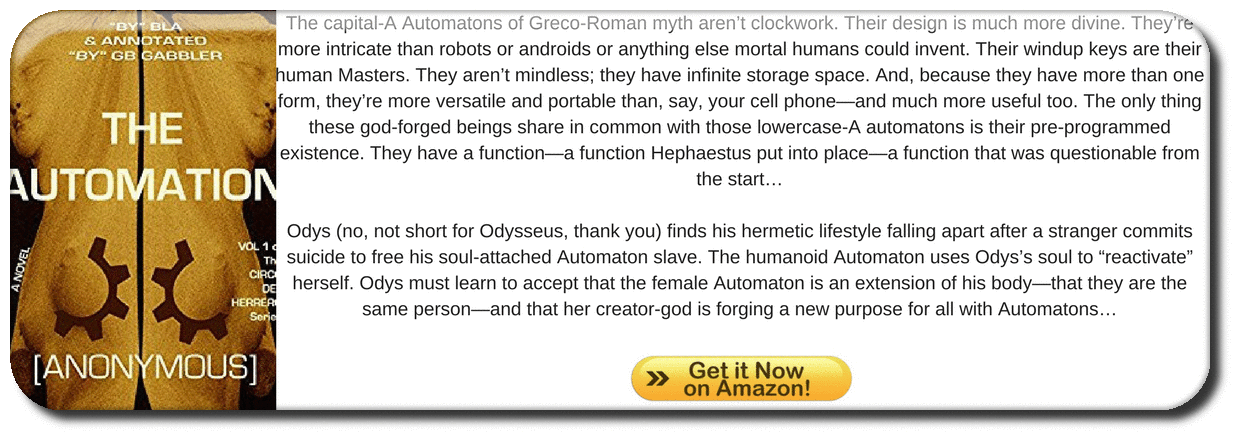
G.B. Gabbler is the editor [and half the pen name] behind The Automation and its upcoming sequel The Pre­-programming. The books are part of the Circo del Herrero series (don’t worry, it’s in English). Gabbler has most recently written on the Zombie genre for TheFanzine, but has other publications under their full name. More info at circodelherreroseries.com.

Could you tell the readers a little bit about yourself?

I probably seem weird—promoting a book when I am only “The Editor,” but it’s a bit more complicated than that! My contribution to the novels are apparent—I’m the footnotes. I’ve taken a manuscript from my partner, B.L.A., and have not only edited it into a much more digestible story (a story that B.L.A. claims is true, but we all know that is not the case—ancient robots and gods are not walking around the earth today), but I have added annotations to the Narrator’s mythmaking.

What do you like to do when you're not writing?

When I’m not writing/editing, I’m trying to get my Narrator (B.L.A.) to write.

Other than the horror genre, what else has been a major influence on your writing?

Besides the exploding head in the first chapter of our first book, there is a horror of oedipal complexes throughout (and I mean that in the more mythic sense of the word). It’s the same grotesqueness that propels people to watch Game of Thrones, I think. We saw GOT get away with it, so I wasn’t as scared to let these horrors slide. Beyond that, there is the horror of inescapable fate and predestined outcomes—the illusion of choice. Religion—old and contemporary—shadows many of our characters. They have so much power, yet very little control over their lives.

And while we’re on religion: Our work was once nicely rejected by a literary agent who said it reminded him of The Master and Margarita—a book where Satan comes down to earth and there is a talking cat. While our book deals with Greco-Roman myth, you’d be surprised how Satan and cats have worked their way into it…

The term horror, especially when applied to fiction always carries such heavy connotations.  What’s your feeling on the term “horror” and what do you think we can do to break past these assumptions?

Oh, this is a hard one. I was recently introduced to the concept of Post-Horror when researching the film A Ghost Story--a movie we liked, by the way.  For Christ's sake, the ghost in that film is represented by an absurd bed sheet but still manages to scare me into existential dread. It took what I call "bed sheet lore" and made us accept it and that is what’s chilling—something so silly can be made to feel real and believable and allegorical. On the flip side, part of how we talk about Horror now is “the old slasher no longer does the trick”—at times feeling ridiculous. Being startled at the movie theatre is more funny than scary. Funny is now scary and scary is now funny. The “Post-Horror” term itself is laughable, but part of a Post-Genre movement I’m happy to embrace. Horror will always be a descriptive term, at  least. You can’t have Post-Horror without Horror.

What are the books and films that helped to define you as an author?

Me? Well, I guess you could say I was inspired by the Norton Anthology of Literature. So many damn footnotes.

How would you describe your writing style?

Marginal.

Are there any reviews of your work, positive or negative that have stayed with you?

The book blog called The Loaded Shelf once said my footnotes “were like eating Saturday dinner with my Grandparents and listening to [them] argue…Entertaining at first, but then you kinda wish someone would suddenly start choking…”

That was the funniest thing! The reviewer has no idea just how close to murder the Narrator and I sometimes get.

How important are names to you in your books? Do you choose the names based on liking the way it sounds or the meaning?

As the person with the editorial role who did the obfuscating of names and dates, I did choose the names. I took a “Marvel” approach and made the names alliterative. Example: Odys Odelyn, Pepin Pound, Gwendolyn Gwendy. And of course they have double meanings and harken to other literary characters. That's part of the job.

What tools do you feel are must-haves for writers?

Money. If you don’t have money, you can’t promote your work. Even mainstream publishers aren’t doing as good a job of promotion these days.

To many writers, the characters they write become like children, who is your favourite child, and who is your least favourite to write for and why?

My favorite character is the cat in our novel. Cats and gods and Automata get along quite nicely, as you’ll see.

Least favorite is a character named Mecca. Mecca is a little turd of a character that only served as a vehicle for our Narrator to explore Peter Pan Syndrome. I wanted to cut him out, but B.L.A. would not let me. I still don’t understand it.

Do you have a favorite line or passage from your work, and would you like to share it with us?

“Leeland doesn’t kill people. They kill themselves. They triggered their own fate.” That’s a passage from B.L.A., there. It’s about a man who is too moral to kill people, yet they find ways of ending up dead all the same.

Can you tell us about your last book, and can you tell us about what you are working on next?

The Pre-Programming is volume número 2 of the CIRCO series. It picks up right where The Automation left off. It’s sprinkled with just as many exploding heads—yet with a dash of suicidal cannibal, possessed young girl, and gladiator sport.

What was the last great book you read, and what was the last book that disappointed you?

The last great book would be The Library at Mount Char. Seriously, go buy yourself a copy. When Scott Hawkins followed me back on Twitter I almost pissed my pants. We are HUGE fans.

The last book to disappoint is The Clockwork Dynasty. Why wasn’t someone like Charles V, Holy Roman Emperor and king of Spain, a focus of the book rather than Peter the Great? Charles V was known to commission actual automata. There were a lot of missed opportunities in this book that I just can’t move past.  I. Don’t. Under. Stand. It.

What's the one question you wish you would get asked but never do?  And what would be the answer?

"Are we selling the film rights to this series?" The answer is yes, but talk to me, not B.L.A.

Twitter: @CircoFootnotes
Picture
Picture

FICTION REVIEW: THE HUNGER BY ALMA KATSU
HORROR NEWS: THE BLACKOUT CLUB, BREAKING THE WORLD AND THE TERRIFIER

    Picture
    Picture

    RSS Feed

    Archives

    May 2023
    April 2023
    March 2023
    February 2023
    January 2023
    December 2022
    November 2022
    October 2022
    September 2022
    August 2022
    July 2022
    June 2022
    May 2022
    April 2022
    March 2022
    February 2022
    January 2022
    December 2021
    November 2021
    October 2021
    September 2021
    August 2021
    July 2021
    June 2021
    May 2021
    April 2021
    March 2021
    February 2021
    January 2021
    December 2020
    November 2020
    October 2020
    September 2020
    August 2020
    July 2020
    June 2020
    May 2020
    April 2020
    March 2020
    February 2020
    January 2020
    December 2019
    November 2019
    October 2019
    September 2019
    August 2019
    July 2019
    June 2019
    May 2019
    April 2019
    March 2019
    February 2019
    January 2019
    December 2018
    November 2018
    October 2018
    September 2018
    August 2018
    July 2018
    June 2018
    May 2018
    April 2018
    March 2018
    February 2018
    January 2018
    December 2017
    November 2017
    October 2017
    September 2017
    June 2017
    April 2017
    March 2017
    February 2017
    January 2017
    December 2016
    November 2016
    October 2016
    September 2016
    August 2016
    June 2016
    May 2016
    April 2016
    March 2016
    February 2016
    January 2016
    December 2015
    November 2015
    September 2015
    August 2015
    July 2015
    June 2015
    May 2015
    April 2015
    March 2015
    February 2015
    January 2015
    December 2014
    November 2014
    October 2014
    September 2014
    August 2014
    July 2014
    June 2014
    May 2014
    April 2014
    March 2014
    February 2014
    January 2014
    December 2013
    November 2013
    October 2013
    September 2013
    August 2013
    July 2013
    June 2013
    May 2013
    April 2013
    March 2013
    June 2012

https://l.facebook.com/l.php?u=https%3A%2F%2Fmybook.to%2Fdarkandlonelywater%3Ffbclid%3DIwAR1f9y1sr9kcIJyMhYqcFxqB6Cli4rZgfK51zja2Jaj6t62LFlKq-KzWKM8&h=AT0xU_MRoj0eOPAHuX5qasqYqb7vOj4TCfqarfJ7LCaFMS2AhU5E4FVfbtBAIg_dd5L96daFa00eim8KbVHfZe9KXoh-Y7wUeoWNYAEyzzSQ7gY32KxxcOkQdfU2xtPirmNbE33ocPAvPSJJcKcTrQ7j-hg
Picture