

WHO LET THE DEMONS OUT? AN INTERVIEW WITH THE DIRECTORS OF HOSTS, ADAM LEADER AND RICHARD OAKES
26/9/2020
 The relentlessly gripping possession thriller Hosts is coming to VOD/Digital 10/2 from Dark Sky Films. And I was lucky to be able to sit down and chat with Adam `Leader and Richard Oakes the writers and directors of this excellent tense and unrelenting horror film On Christmas Eve, an innocent couple become hosts to a malicious entity. Throughout the night they proceed to terrorize a family of five in unimaginably violent and disturbing ways. But these demonic possessions won't end with this unfortunate family; they mark just the beginning of a horrific worldwide epidemic. Beneath its nerve-jangling suspense, the film offers a dark and bloody insight into how lying to your loved ones can not only alienate them, it can completely destroy your bonds with them forever. The film follows in the footsteps of classic successes such as, The Exorcist, The Texas Chainsaw Massacre, Invasion of the Body Snatchers, and Inglorious Basterds. Hosts was written to keep viewers on the edge of their seats and leave a lasting impression Rich ‘n’ Adam reveal all! Hello guys, how are things with you? RICH - Really Good thanks! We have been on a super high with this film and excited for everyone to check it out. ADAM - Yeah great! Same as Rich, couldn’t be more excited to start the next part of the journey! Just to get a feel and by ways of an introduction to you, you have been asked to curate an all-night horror film festival, what four movies would you pick as being the cream of the crop, and what one film would you choose for a Mystery Science Theater 3000 type mickey take/ RICH - Oh good question, I think, ALIEN, RINGU, THE SHINING, MIDSOMMAR and for the mickey take maybe TEETH ADAM - Hereditary, Last House On The Left, It Follows, The Exorcist, and for the Mystery Science Theatre I’d have to go with a film called Excision. One of the best and most horrific discoveries I’ve made film wise. It’s so messed up. You should check it out! Hosts is unleashed today how are you feeling in the run up to its release? RICH - I’m 50% excited and 50% nervous coming up to the release, when you have directed, and edited your own film and seen it 82 gazillion times, you really have no idea what you have created. It could be great and received really well or it could be a brown stain smeared on Ghislaine Maxwell's prison cell bed pan. So far we have received overwhelmingly positive responses so I am quietly optimistic for the release. ADAM - I think obviously leading up to the release, especially like Rich mentioned having watched it way too many times for our own good, I began to get nervous about what others might think, but then recently I kind of took a step back from all that fear of judgment from others and remembered why we did this in the first place. Rich is my best friend, and we’ve gone through so much to get to where we are today. After day one of shooting, we were all best friends with each other, and since then we’ve all been super tight. So the fact that we’ve all made something together that we’re all massively proud of means more to me than anything, and because of that, I already feel successful. The entire Hosts journey was incredibly special and will forever hold a place in my heart... But yeah, I hope the general public dig it, haha! In terms of being on the filmmaking scene, you are both relative newbies, can you tell the readers about how you first came on to the scene and some of the events that lead you to create Hosts? RICH - I began my career as a Bin man and hated every second of it, I quit my Job and decided to shoot music videos instead focusing on VFX, people seemed to like what I was creating. By my 3rd music video I was creating videos for bands on Universal and moving onto bands on EMI and Sony. Creating features was always in the back of my mind as the long game and after doing music videos for 6 years I felt I had gained the experience to push into narrative work as a DOP. I worked on many short films and pushed from there to shooting features before deciding to make Hosts as my directorial debut. ADAM - Since I was a kid I always wanted to make movies and play music. I chose music first, since leaving school I joined a number of bands and nothing ever really clicked. So I started my own and found the other members. We’re called In Search Of Sun and we’ve been going for eight years now. In terms of how that ties into this; Well, by chance, Rich was hired to shoot our music video back in 2014 and as of that day, the two of us just clicked. We are one but the same! Not long after that, I ended up working alongside Rich and the two of us would go out and shoot music videos for other bands, including mine, until eventually we both decided that it was about time we stepped up and made our first movie. So we did, and here we are today. We may as well get the elephant out of the room; Host was released just before your film, how has having two very similarly named horror films released so close together affect the publicity for your film? RICH - Hah Ha, this comes up a lot, The thing is we had HOSTS written, shot, and edited before the COVID 19 Lockdown in the UK and was clearly up on IMDB for a year prior to that. Host on the other hand is a film centered on the recent lockdown situation. We checked IMDB for any similar film titles out the same year before we settled on the name HOSTS, which at the time there wasn't. Whether the guys behind HOST looked into that, I’m not sure, you would have to ask them. But there is no issue there, their film is getting a lot of praise and I’m hoping ours does too, aside from the title there aren't many similarities other than them both being kick ass horrors ha ha. ADAM - Yeah, well like Rich touched on, we wrote Hosts at the end of 2018 and shot it in the summer of 2019, so it’d been floating around on iMDb for a while, but perhaps they missed it. Either way I don’t mind. I’m an optimist, perhaps both movies can do each other favours having similar titles, who knows? All we know is that it’s too late to go back now. I actually watched their film a few weeks ago and I have to hand it to them, they did a kickass job. To have that pressure of getting it shot and edited with all these restrictions in place, all the way to cutting a distribution deal in time to coincide with the lockdown ‘hype’ must have been such a huge pressure on them, and knowing what goes into making a film and how time consuming it can be, I praise them for working so hard on that. Hats off to them, and I don’t take my hat off that often.  You first came up with the concept of Hosts in 2018, did you attempt to shop to film to other production companies before deciding to produce it yourselves? RICH - Not really, We have run a music video production company for the past 9 years so we already had a lot of the tools and skills we needed already in house. We also run a semi spoof youtube channel called Dark Fable Media that teaches new cinematographers how to shoot a film so it would have been a bit hypocritical to pass the buck when the rubber hit the road. ADAM - I think I can speak for the both of us here when I say that this was always going to be our baby, and will be the film that opens doors for us moving forwards with our future projects. That was always the plan, so signing it over to anybody else just wasn’t an option. It needed to be a Dark Fable production in order for us to prove ourselves as writers and directors, and I think we’ve achieved that. It’s turned into an even bigger beast than we ever anticipated. Dark Fable Media has developed a lot of music videos, what lessons from your time producing these did you bring onto the set of Hosts? RICH - A lot of the same skills and processes carry across, I do think that having seasoned myself as a music video DOP has created a unique style to my work, and perhaps enabled me to push into more creative lighting ideas, The same with the edit. When you have been editing to a musical rhythm for years, you can take that into features and work with the rhythms in different areas, whether it be the score or the movement of the actors, you get a real feel for the pace and flow of the film. As I'm used to editing to music we asked Benjamin Symons, our composer to write us 5 tracks prior to the edit for me to edit to, this ensured the music and the edit flowed harmoniously. ADAM - And to add to that, it was amazing to be able to shoot certain things to Ben’s already written score pieces in order to really get those feels, you know? Even before we started shooting the film, having that music on as background atmosphere when we were tweaking bits of the script or creating shot lists was super helpful. In terms of what we brought to the set of Hosts, I think having worked together for a few years now, the most valuable thing the two of us could bring to the table was our friendship. Don’t get me wrong, of course the in house equipment and knowledge of shooting, lighting and rhythmical editing helps a great deal, but writing, planning and shooting a full length feature film as a duo on the foundation of a solid six year friendship was the glue, in my opinion. A lot of the time, mixing business and friendship can get ugly, but with me and Rich, everything has changed for the better! We share the same ideas, the same passion, the same morals and neither of us are ever thinking about paychecks. Who was your favourite artist to work with? RICH - Well, that would have to be Adam’s band ‘IN SEARCH OF SUN’ who also did the end credits tracks for HOSTS. We have created a music video for one of these songs titled ‘HOSTS’ which releases on the 9th of October make sure you check it out! ADAM - Yeah man, the title track and music gets released on the band YouTube channel on October 9th. It will also be out across all music streaming platforms on the same day so look out for it! Many would think that it is just a case of scaling up production, what was the biggest hurdle you faced getting the film to the filming stage of the process? RICH - I think the biggest hurdle being absolute nobodies in the film industry was finding someone willing to throw money at our project to get it off the ground. As we ran a youtube channel who had a small but loyal, passionate following, we thought it might be an idea to crowdfund through youtube. What never sat well with me tho about the usual way crowdfunding is done is that the people trusting you with their money and ultimately pay for the film rarely get anything decent back, maybe a dodgy print of a poster or a home printed DVD-R of the film. We Didn't feel happy with that and wanted anyone who contributes to have something more. So What we did was offer investment into the film itself, so anyone who invests becomes a part of the film and earns a percentage of the film's revenue for life. At this point in time, before the film has even been released, all those investors have now been paid back in full and will continue to receive payments as the film sells. ADAM - I wouldn’t have wanted to do it any other way. Essentially, our board of investors for Hosts are a handful of people who trust us fully as both individuals and as a filmmaker duo. It only extends that tight nit family of awesome people on this special thing we’ve all got going on. Something that I personally think is extremely hard to ever recreate. The fact that regular people such as ourselves can benefit a little financially as opposed to an already financially comfortable investor is so much more rewarding in my opinion. I kind of see it as creating opportunities for people who could; A, do with some extra pocket money, and B, invest their money in something they’re just as passionate about as we are. It’s a win win situation all round.  It's hard to talk about the film without giving to much away, thanks to the many "watercooler moments" that are key to the film's success, in this eras of digital knowledge, how concerned are you about people talking about these and lessening the "WTF" reaction from the viewers? RICH -It is a concern, The best way to experience this film is to go in dry without hearing anything for sure. So if you want the best experience from this film, try to avoid spoilers. ADAM - It will always be hard to keep those key moments under wraps, impossible to be honest, because there really are some scenes that still to this day make mine and Rich’s jaws drop when we watch it for the millionth time, so I think people will inevitably have no choice but to talk about those moments. I mean, those scenes were ultimately the reason the industry got talking about it, which felt great (not for the people in the scenes though… Nevermind). I've got to admit; there were a couple of scenes that I am in no rush to go back and watch again, to the point where I don't think I can look at DIY in the same way. Did you ever think, boy, we might have gone a bit too far? RICH - Quite the opposite, as I said previously I have been watching this film on repeat for what seems like 82 years in the edit, you become very desensitised in that time. The film is supposed to shock and my fear was that it wasn't shocking enough. But it does seem from the feedback we have received so far, that this may not be a problem ha ha. ADAM - We went as far as we always intended, and that never felt ‘too far’. It’s intention is to shock, and by the sound of it, they do, haha! One thing we seriously wanted to focus on in the writing process were the characters, and we can’t stress enough just how crucial it is to NOT rush into a meaningless kill just for the sake of having something violent on screen to suit an algorithm. What’s the point? That’s not horror, that’s just short lived, easy to forget senseless violence. Instead, why not feel your stomach plummet when people you actually care about are in serious trouble, and there’s literally nothing you can do about it! That’s terrifying in itself because I’m sure we’ve all been in relatable situations where we feel the sheer dread and anxiety of being absolutely powerless. I know I have, although in most of those situations I was the victim unfortunately! When filming "that scene" did the rest of the cast know what was coming, and did any of them need a sick bucket? RICH - They did know what was coming, but they did seem confused that Adam and I burst out laughing every time we called cut and a few comments of “What is wrong with you guys?” did float around the set. ADAM - Haha, yep! The cast did such a phenomenal job, but one thing that always crosses my mind is if we had the time to be able to hide what was coming to the rest of the cast, like they did in the first Alien film, just to be able to see their genuine reactions would have been hilarious for us to watch. It is set during Christmas, and you filmed the outdoor scenes during the winter, what challenges did that throw up? RICH - It threw up a few when we first tried to film these scenes in the summer, something about the blossoming flowers and butterflies just didn't quite work so we put the film on hold for 6 months and shot in the winter. It turns out it was the coldest night of the year and the poor Girls were out in thin dresses in the icy night. Half of our equipment died a death right there. But we got through. ADAM - Shooting the majority of it in the summer was such a challenge. Obviously the film is set mostly at night, so come 3am, we were boarding up all the house windows and waiting for the damn birds to stop singing. But waiting for the winter to shoot those outdoor scenes was definitely the right call, even though we were all freezing to death, haha. The cast of the film is very small, did this allow them to riff off each other? RICH - it was a very intimate cast and crew, 20 people all in all. But to be honest we were tripping over each other as it was in that small bungalow any more would have been a nightmare. It was like a family all going mad together for 10 nights, we all loved each other and had such a great time, there were no complaints, everyone chipped in wherever they thought something needed doing and it was the best shoot of my life. The cast became very close, combining that with the long all night nature of the shoot and confined spaces really brought magic from the cast onto the screen. ADAM - I cannot praise the cast enough. They’re all just phenomenal actors. The way they bought the script and those characters to life was just pure magic. They’re all insanely talented and I can’t wait to see what comes their way next! One of my favourite scenes in the film is set in the attic, where Samantha appears to relish her role as a soulless killer, how many times did you have to shoot that scene, it looks like it was perfect for the cast cracking up? RICH - Like I said before us and the cast are so close we are like siblings especially Nadia and Neal as we go way back. Now and again we like to prank each other, especially Nadia. We did that dribble shot about 15 times, I think the first one is perfect. We just had fun making her have to get dribbled on a lot ha ha. (this is actually be the reason we wrote it in in the first place but shhhh) ADAM - Yeah, that entire night shooting in the attic, I think Nadia had it the worst! Not only the many, many dribble retakes, but I remember taking Neal aside before we started rolling and telling him to make Nadia feel as uncomfortable as humanly possible, and I’m sure you can tell that this comes across on screen. Bless her. I'll assume that wasn't all her spit; there had to be some SFX involved there? RICH - It was a saline solution I believe. ADAM - Or was it... In terms of casting, when did you know that you had the perfect actors for Lucy and Jack? Samantha looks like she wouldn't say boo to a ghost, at least with Neal he has that look in his eyes ( no offence Neil) RICH - Neal was cast before there was a script and he even sat in on the writing sessions and offered ideas, many of which ended up in the final film, he is one of my best friends and an incredibly talented actor. Sam was a different story, we initially didn't cast her (stupid I know) but the Actress we cast pulled out 2 days before the shoot because she demanded a private villa or something which we couldnt provide. So Neal stepped in and Recommended Sam and she stepped up, learned 20 pages of script for the first day of shoot and smashed it! Then there is the pure dread the both of them bring to the screen when it hits the fan, Incredible! I really can't rate these 2 enough! ADAM - Yeah, the fact that she literally had to learn 20 pages of full on dialogue in like a day and totally nailed it only shows how talented she is. Not only that, but later on in the film, the times where she isn’t speaking at all, the way she composes herself, the expressions she pulls off, her movement and her overall presence throughout Hosts is a product of sheer talent. Same goes for Neal. The guy is a chameleon. One minute he can play the kindest, most thoughtful dude in the world, and then the next, he’s a cold blooded devil. There will never be a better Jack and Lucy. In terms of extraneous plot, Hosts is a very tight and lean film; you don't waste any time with needless supposition or explanations. Is there a draft of the script where everything is explained fully? And are you concerned that some people might not like that the film isn’t all wrapped up in a nice neat package? RICH - What you see was what was written. Our favorite films are the ones that don’t give you all the answers, they are the ones that sit with you or make you have a second watch. We wanted to create conversations and theories about the non spoken elements of the film. There is a lot of allegory hidden in there if you want to look. On the flip side of that we didn’t want to make a film that you couldn't follow, you needed to be able to just mindlessly watch with some popcorn and find enjoyment that way too. ADAM - There’s a time and place for handing people things on a plate, and there’s a time and place for leaving things open to interpretation. Sometimes we don’t always know what’s next or what’s likely to happen in the moment, and if anything, not knowing makes it that more frightening. In this instance, it’s impossible to just close the book and be done with it. Your imagination runs away with you, and before you know it, you’ve got your own theory based on what you think should happen, or what you want to happen and sometimes that keeps us awake at night. The unknown is scary! Where did the inspiration for the demonic plague come from, and what is the significance of the TV? Rich - Growing up in the church I read a lot about the history of demons and the end times etc . What I find interesting is their origins. God initially made them as his children but they were ultimately banished. The whole film is a duality between the henderson children who feel let down by their father in our reality and the demons who are angry that they were cast out by their father God. Mixing these themes together created some really interesting concepts. The TV is very Metaphorical being Michaels inheritance that he must pass on, it represents the truth of a situation in plain sight that noone wants to look at and after knowing the truth nothing can go back to how it was. We inherit a lot of our problems and flaws from our parents, and the fact that Michaels inherited the TV from his father makes you think what did Michael's father do to pass on his demons to him? ADAM - I’m huge on metaphors, and being able to express something that happens in day to day life via the use of horror can really help emphasise a powerful message. There are layers to this film, there’s so much subtext. On the surface, what you see is obviously what you get, then you’ve got the metaphor of your truth being locked away because you can’t face it, only to manifest itself as a demon and eventually finding its way out to destroy everything you love, all because of your own selfishness and deceit, which you were too cowardly to take responsibility for, and all of a sudden there’s this negative, unstoppable domino effect. Then there’s the whole biblical story similarity, which is another layer in itself! When writing it, I was super keen on involving the supernatural element, not because I believe it, but because I find it fun and fantastical, and I grew up watching films like The Exorcist, Poltergeist etc, so it was a huge influence on me. Rich is more into the real home invasion type films, things that can actually happen in real life. So with Hosts, we married the two and it works well I think. The visceral side is very real and, let’s face it, could and does happen, and the supernatural side is a platform to tell the story on, in order to elevate that metaphoric message. Some of the scenes make excellent use of colour grading, was there a reason other than it looks really cool for this? Rich - Most horrors we see are bleak and desaturated, we wanted to have the welcoming warmth of the home evident representing the seemingly happy family at christmas and slowly bring in that cold darkness in the outside scenes and finally into the house as the film progressed. I’m a fan of classic horror and wanted to give a timeless feel to the film and using very tungsten lighting gave a more classic feel. Juxtaposing that with the steely cold blue on the outside and mirroring the eyes helped shift the tone of the final scenes to elevate the horror and the feel that the outside is coming in. ADAM - Rich is a cinematic genius. Need I say more? You wrapped up shooting of the film just before lockdown hit the country, but the film could be seen as a metaphor for what has happened since. Stay indoors, don't socially mix, and wear a mask. How would you feel if Hosts is tagged as a pandemic horror film? Rich - I see the resemblance for sure, and people will put their current fears onto a film that has a lot of ambiguity. But personally I wouldn't want to push it that way, everyone and their mums have asked us since if we should do a pandemic locked in movie and I'll be honest, I’m not interested. If everyone is having the same idea then it won't be original to do that film and I personally wouldn't feel comfortable trying to cash in on a world wide tragedy that has claimed the lives of thousands of people just because It’s currently on trend. ADAM - We’re not about following trends. We’re not about making a quick buck. We’re about telling powerful stories and making films that leave you thinking about life, the ones you love and encourage personal growth, and sometimes, to really learn a lesson, you need something drastic and traumatic to slap you in the face. And on that note is the film a metaphor for anything? Rich - Yes it is, the theme of the film is failed fatherhood and is laced throughout if you know where to look. ADAM - If you lie to the ones you love, it will always find its way back up to the surface after consuming you for so long. It’ll destroy everything you love! How happy are you with the film, if you could go back with a magic bucket of cash is there anything that you would change? Rich - hmmm, you know what? There may be some things I would change given more budget, but I do feel that the lack thereof made the film and the whole experience we had together as a family on set the most amazing experience ever, and I wouldn't change that for the world. ADAM - I wouldn’t want to change anything. Sure, having a higher budget always means bigger, but not necessarily better. I feel like a lot of films these days can spend millions on crazy elaborate sets and CGI etc, but then, more often than not, the story gets left behind. You don’t need an endless pile of cash to tell a compelling story. The film is distributed by Dark Sky films, what does working with a company like them bring to the table? Rich - Dark Sky are amazing and they showed us from day 1 that they understood our vision and what we creatively made with this film. We really didn't want some corporate company throwing numbers and algorithms around, Dark Sky are that continuation of the family of HOSTS and they truly believe in the film like we do and that was so important for us as a distributor. ADAM - We had our eye on them for a while, and having them keen to sign with us was a dream come true. They’re an incredible team of people who, like us, are fans of horror first and foremost. Hosts is released on 2nd October, where can we watch? Rich - US and CANADA for now not sure on them all but most VOD channels including APPLE TV and ITUNES, Playstation store etc ADAM - Follow us on our socials too Facebook/hostsmovie Facebook/darkfablemedia Instagram - @hosts_movie, @darkfablerich Twitter - @hostsmovie, @DarkFableMedia So what's next from you guys? Rich - We have 3 more films written and they are some crazy shizzle, just watch this space! ADAM - Yep, what Rich said. The world isn’t ready for what we’re about to pull out the bag! tune into tomorrow for my review of Hosts   Ginger Snaps: Mini Interviews with Bite! Ginger Snaps is a brand new segment for Ginger Nuts of Horror. It is a quick-fire “bite-sized” interview, where your answers relate to what you’ve been doing in the past month (30 days or so). Keep your answers short and sweet, but also add your own flair where you can. Please include a brief bio, a photo that we can use, and any links that you would like us to add to the interview. Tell us: Who are you? My name is Joshua Rex. I’m an author of speculative fiction and historical nonfiction. Your signature style: I write literary horror. The primary themes of my fiction are memory and the inescapability of Time. My historical research/writing deals primarily with the American Victorian era. Toot your own horn: I’ve worked as a luthier. I can cross stitch (poorly). I can “eat and drink” in the Thai language. Books read: Currently: Famous Men Who Never Lived by K Chess; The Chronicles of Stephen Foster’s Family (Vols. 1&2) by Evelyn Morneweck Movies watched: The Basil Rathbone Sherlock Holmes—on repeat. Games and/or music played: Currently: Vertigo by French harpsichordist Jean Rondeau; and lots of Fleetwood Mac. Words written: My new collection What’s Coming for You: Stories is available now at Amazon. Future stuff: My novel A Mighty Word, which involves a city poisoned by the runoff from an anti-depressant factory and the “civilized undead” the chemical awakens, will be released in the spring of 2020 from Rotary Press. Brain worms: I’m guessing this means what’s been in my head the past several weeks? If so: White Sands, NM; cholla cacti; Fraiser; N/A gimlets; Currier & Ives prints.  Bio Joshua Rex is an author of speculative fiction and historical nonfiction. His horror collection What’s Coming for You was released in August, 2020. He lives in El Paso, Texas. Links Website: www.joshuarex.com Goodreads: https://www.goodreads.com/author/show/7905036.Joshua_Rex Twitter: @JoshuaRexAuthor Instagram: @joshua_rex_author Amazon: https://www.amazon.com/dp/B08GCVY75L  In these ten unsettling tales—the debut collection from Joshua Rex—cities and houses become predators, mothers macabre curators, dormant antique coats and colonial legends revivified dangers. A psychometress resurrects a rapacious fiend, and a psychologist counsels an eerily familiar patient. A man returning home to bury his father is forced to exhume a horrid secret, and a bullied adolescent’s game-winning shot is not only a team victory but a bloody and visceral personal triumph. Uniting these doomed is the unequivocal certainty that what is coming is coming for us all. Includes: The Leap. Breakout Season. The Unfinished Room. What’s Coming for You. A Mother’s Museum. Coattails. The Whispering Wheel. The Reveal. In Situ. A Voice Below.   L.C. Barlow is a writer and professor working primarily in the field of speculative fiction. She has studied with popular writers, including Nancy Holder, Elizabeth Hand, and James Patrick Kelly. Her fiction has reached over sixty-five thousand readers and garnered praise and multiple awards. Barlow’s horror trilogy – Pivot, Perish, and Peak – was picked up in 2018 by California Coldblood Books, an imprint of Rare Bird Books. The first of the trilogy, Pivot, was released in October of 2019. Perish will be released in October of 2020. Peak will be released in October of 2021. Barlow lives in Dallas, TX with her two cats, Smaug and Dusty. WEBSITE LINKS Amazon Link: https://www.amazon.com/Pivot-L-C-Barlow/dp/1644280531/ Audible Link: https://www.audible.com/author/LC-Barlow/B00CRQLPCM Book Trailer: https://www.youtube.com/watch?v=utwJ0g6cvLo Author Website: https://lcbarlow.org/ Twitter Link: https://twitter.com/LCBarlowAuthor Instagram Link: https://www.instagram.com/lcbarlowauthor/ GoodReads Link: https://www.goodreads.com/book/show/44579050-pivot Could you tell the readers a little bit about yourself? My name is Lindsey Barlow, and I am an English professor at a community college, as well as a writer. I have been writing stories off and on since probably middle school (though I did recently find one of my first stories that I wrote in kindergarten). When I started college, I began writing more seriously – so I’ve been writing seriously for a little over a decade, now. I have a wide array of hobbies in addition to writing. I like to travel on my own and have visited many European countries, including England, Ireland, France, Italy, Switzerland, the Netherlands, Liechtenstein, Germany, and the Czech Republic. I lived with a host family for a few months in Talheim, Germany, which is halfway between Stuttgart and Frankfurt, while teaching their daughter English. I have gone ziplining, parasailing, skiing, and indoor skydiving. I attended an intensive acting workshop at the William Esper Studio in New York City for several months one summer. Before becoming a professor, I had an array of jobs, and I volunteered in an Emergency Room for about a month. I enjoy outdoor activities and recently re-achieved my backflip, which is saying something, since I’m nearing my mid-thirties. Which one of your characters would you least like to meet in real life? I would least like to meet Cyrus Harper in real life. Cyrus is the “primal father.” What I mean by that is that he is the unstoppable adoptive father who heads the following, has unearthly tools at his disposal, and is able to discover those who blaspheme before they can stop him. To Jack, the main character of the Pivot-verse, he is a charismatic and maniacal mentor (think Charles Manson meets Lucifer from Supernatural). The immenseness of Cyrus, and the details of him, came about in the act of my writing. In other words, I didn’t plan him in the way he revealed himself, and so there were moments where he was a surprise to even me. He has no remorse and is willing to do anything to achieve what he wants. I definitely would not want to meet him. Other than the horror genre, what else has been a major influence on your writing? My studies in English during my BA and MA had ensured my exposure to more literary works that I loved just as much, like Moby Dick (which greatly influenced me). In addition, I also ventured into the sexier, semi-mystery, semi-fantasy, and semi-erotica works of Laurell K. Hamilton right before and then during my MA. I primarily read her Anita Blake series, falling in love with the variety of her characters and the sexiness imbued in each and every one. Though the series often had me rolling my eyes, it also had me smirking, and I devoured about fourteen or so of the novels. One other literary influence was actually not really a book at all, but rather a theory that I took to heart and mind very earnestly during my MA—Jacques Lacan’s psychoanalytic theory. Lacanian theory aided me not only in deconstructing television series during my first master’s, but also in getting into the psychology of my own characters, of deconstructing them, as well as simply understanding the movements of plot. Though Lacan did not necessarily help me write, he did help me understand. Many times, when encountering new ideas that might have otherwise seemed foreign to me, I am able to hook them onto something in Lacanian theory so that I can more quickly absorb what there is to know. The Lacanian Subject by Bruce Fink is despised by many graduate students, but I truly appreciate everything it offered and don’t know where I would be in my academic or literary career without it. Lacan shows me a different magic than, say, Anne Rice or Stephen King—the magic of the human mind. The term horror, especially when applied to fiction always carries such heavy connotations. What’s your feeling on the term “horror” and what do you think we can do to break past these assumptions? My psychoanalytic graduate school background is probably going to show here. Horror is the abject, which Kristeva discusses quite a bit in Powers of Horror. It is that which disturbs the sense of identity and reality – a breakdown in the self and other, to where they mix in interesting ways. One example of this would be a person staring at a cadaver and having the sense of self break down to the point that one feels like one is the cadaver. Thus, horror could be found in the simplest, most mediocre of things. If one has seen the movie Incendies, what causes the utter breakdown of a woman’s sense of reality and identity (inside and outside) are three dots on the back of man’s ankle – a man that represents two men (which is, of course, the Lacanian split subject). One essential piece of the abject (and of trauma) is that it is not expected. I think the “easy” route to exploring the unexpected is through jump scares or the gross out. Through a bit more work, though, it could be three dots on the back of an ankle or the sound of a silver spoon in a teacup. I think that to break past assumptions of horror, horror has to become more complex, in that how authors explore the unexpected is beyond the easy “jump scare” or “gross out.” That is, the plot and story need to lay out certain rules that get twisted, such that what was once thought to be inside is outside and vice versa. I hope this makes sense. A lot of good horror movements have arisen as a direct result of the socio/political climate, considering the current state of the world where do you see horror going in the next few years? Due to the current socio/political climate, I can envision a lot of horror stories revolving around the following: climate change, the end times, the patriarchal cult, matriarchy, chemical warfare, nuclear war, genetic experiments, zombies, and dystopias. I’m sure this is just the tip of the iceberg. Given the dark, violent and at times grotesque nature of the horror genre why do you think so many people enjoy reading it? People have to be civilized day in and day out for the sake of their survival. There are, of course, wonderful things about civilization; however, to be required to be civilized – without any community-oriented way of burning off steam – means that people are often wound tight. For six weeks I took an acting class at the William Esper Studio in New York City one summer. (I did this because Daniel Knauf recommended acting classes so that authors could see just how difficult it is for actors to bring a character to life). While at that studio, I discovered that it is very difficult for most people to remove the mask of civilization. Even in a room where people are given the permission to scream and cry, to bring things to a boiling point, they have lost much of the ability to do so. They have to re-learn how not to be civilized to one another, to scream, to cry – essentially, to be human again. And when they do finally find a way to take off the mask of civilization, it is an accomplishment. I feel like reading and writing horror does something similar to acting. It is a way of exploring that which is not allowed in society, of finding a way to remove the mask of civilization that we don’t know how to take off, anymore. It is, one could argue, a way of staying sane, since horror is willing to admit something about us that nothing else is – that there’s something about us that isn’t civilized, and that it’s okay to acknowledge that. What, if anything, is currently missing from the horror genre? I’m not sure that I can argue anything is missing from the horror genre, right at this moment. It may simply be that there are aspects of horror that are not yet mainstream, and, thus, you have to dig a little to get to them. From my own perspective, there are aspects of horror that I simply haven’t experienced yet; for instance, I’m just now reading my very first military sci-fi/military horror novel by Weston Ochse, and it’s fantastic. At one panel, I remember an author saying that genre is just a way to advertise, and many things that could be classified as horror are often instead classified as a different genre that is, perhaps, more marketable. So, one could argue that horror pervades the other genres, too, and is simply not named. What new and upcoming authors do you think we should take notice of? I would like to mention Barry Lyga (I Hunt Killers), Josh Malerman (Bird Box and Black Mad Wheel), Lucas Mangum (Gods of the Dark Web), Stephanie M. Wytovich (Brothel), Maria Alexander (Mr. Wicker), Sylvia Moreno-Garcia (Mexican Gothic), and Rena Mason (The Evolutionist). Are there any reviews of your work, positive or negative that have stayed with you? I tend not to read very many reviews because they can become an obsession. There are a few, however, that have stuck with me. Several readers have either compared my writing to Poppy Z. Brite’s or stated that my writing is what Stephen King’s is lacking. Though I don’t feel like I am deserving of this praise, it does encourage me on those nights where writing is tough and slow, and I’m doubting myself. Most recently, I had someone write to me on my Facebook author page and say that he reads about 100 books a year, decided to give my book a shot, absolutely loved it, and cannot wait to read the next in the series. It meant so much to me, especially since he said he doesn’t use social media. He had gone out of his way to find a means of contacting me. Second to last, the Publisher’s Weekly and ALA Booklist reviews of Pivot were just so meaningful, so positive, and it just felt like they vaulted my understanding of myself to a new level. They were also quite unexpected! Finally, Josh Malerman’s and Weston Ochse’s blurbs for Pivot, as well as Wes’ blurb for Perish, blew me away. I don’t know what I would do without these people. What aspects of writing to do you find the most difficult? Whew! This is difficult to answer. I’ll start off by saying that the only thing harder than writing is not writing. It’s a beast, and there’s a lot of blood, sweat, and tears poured into each novel. One thing that’s hard is you really have to get into the world, much like an actor gets into character, and you have to live there for a while. Being so immersed in it, you can feel overwhelmed because at times, it feels like you’re carrying it with you to the grocery store, to class, to your doctor’s appointment, etc. It’s there, begging for your attention. At least, that’s how it was a lot of the time for me. I am curious if this will change as I continue writing. In addition to this, though, good art I suspect is always incredibly difficult. I remember going to an art gallery and hearing various artists talk about their work. One pointed at three different twenty-foot sketches he had created and described them as “Sisyphus pushing a boulder up a hill.” It’s so true. Writing is like that. At the same time, what can be so difficult is the isolation – the four walls all around you. It doesn’t matter if those walls are a mansion or a shack. It’s the same four walls, and they’re always there. You have to get out, you have to live, you have to travel, to go to restaurants and cafes, in order to continue to write, in my opinion. I think this is one of the reasons why writers pursue writing conventions so much. We need them. The wait is tough, too. This has more to do with publishing than writing, but waiting on a response or critique can be so difficult. It was about two years between when I found an agent and when my books landed with a publisher. In those two years, I did several revisions, and before the agent, I did several revisions, so there was a lot of writing and waiting for feedback and writing and waiting for feedback. I also think that going back to square one after finishing a novel is tough. If you can imagine putting years and years of work into a novel or two and then starting a brand new one, it feels a little bit like finding your sea legs again. That’s because all novels are different. I remember a fellow writer telling me one time that writing the second novel is tougher than writing the first, and I think that that’s right. It’s because as a young writer, you’re still getting your system down, the elements of plotting down, and you accomplished it (somehow) in the first novel (woohoo!) and guess what! You have to do it again! But differently! This is how you learn, though. It’s part of the process. Is there one subject you would never write about as an author? I can’t think of a subject on which I would never write. I suspect I do have some boundaries; however, I also think that phrasing and plotting is paramount and that almost anything can be phrased, plotted, etc. in such a way that it is palatable. Writing, is not a static process, how have you developed as a writer over the years? My process of writing changed dramatically over the course of producing my first book. Pivot was originally self-published, and when I wrote the novel, I didn’t really know anything about writing. I wrote the chapters alternating between past and present, with two plot lines that complemented one another. When I finally met up with several people who were willing to help me produce a more professional, publishable version of the novel, they helped me to significantly change, enhance, and build those different plotlines. When an agent took on the novel, he wanted me to separate the book into two books. At first, I declined, but as time went on, I realized that the book needed to be separated into two, that my agent was right, and I did so, taking the time to build the first one up and knowing the second one would be the second of the trilogy and that it needed to be built up like the first one. The thing, though, was that I had really kind of built that first book through trial-and-error. I had written over 1,000 single-spaced pages to produce a 250-page single-spaced novel, and even though I had managed to make it work, I wasn’t exactly sure how. At this time, I had started an MFA program because I had anticipated this problem. Nancy Holder—an amazing writer, woman, author, person in general—was my professor for two semesters and two residencies, and she told her classes about two books that she uses to help plot books: Black Snyder’s Save the Cat! and Christopher Vogler’s The Writer’s Journey. I immediately purchased these books and read them. Subsequently, I compared Pivot to see how much its plot points lined up with the 15-point beat sheet in Save the Cat! As it turned out, 13 out of 15 points lined up. Thus, I was able to see how I had made the book work and move onward to the next novel. I used the same beat sheet to help finish the second of the trilogy, and I, like Nancy, will most likely use the two beat sheets from these books for every novel in the future. Writing requires so much problem solving, and these books help me better able to address those problems before seeking outside help. They help me produce things that I didn’t know I could produce, and I learn something new every time I read them. Ultimately, though, after learning how to more effectively plot, I also learned that plotting isn’t everything. There’s just something about letting the novel develop organically that is so important. Really, if you sit down and say exactly what you wanted to say when writing, you’ve kind of failed. It’s only by writing something beyond what you knew to write that you have succeeded – when you write more than you thought you knew. So, when I do pre-emptively plot, I do so while taking it with a grain of salt, and often times the plot shifts dramatically three or four times as I go back and revise. What is the best piece of advice you ever received with regards to your writing? Remember that the first draft doesn’t have to be perfect. It just has to be written. You can’t revise something that isn’t there. Once you have a draft, and someone suggests trying something, feel open to trying it. You can have several versions of the same story, and just because you take it a new direction doesn’t mean your old draft disappears if you need to go back to it. Be brave and take your story to foreign places. It’s not foreign, anymore, after you write it. Do not expect professionals to be mean. Many are some of the kindest people you can meet. You can only enter a room for the first time once. That’s why it’s important that you get your work to as optimum of a level as possible before submitting it to an agent or editor. Because once they “enter the room” (read your work) for the first time, they can’t see it nearly as objectively after. Your own objectiveness is compromised because you’ve been with the work for so long. That’s why you need workshoppers you can trust (and who know how to get you to emphasize things and back off things without being cruel or mean). In every story there are “crunchy” and “floaty” items, also known as literal and figurative. The crunchy is the bare facts that ground the story. The floaty is the unnatural, metaphorical things. Often times, writers throw in figurative things to feel better or redeem the story. The reality, though, is that you don’t need to do this. You don’t need to “redeem” the story. The more you add trying to “redeem” the story, the more work you make for yourself when revising. Trust the reader to follow you. Keep in mind the Hemingway Theory – that 10% of the story is what the author lets the audience see, and 90% is hidden. It’s very much like a glacier – the top 10% is visible, and the bottom 90% is below water. The amount of work you put into a novel is the 90%. When I wrote Pivot, I wrote about five times the amount that the book ended up being. The book is around 280 pages. I definitely wrote over 1,000 pages while constructing it. Read Save the Cat! by Blake Snyder and The Writer’s Journey by Christopher Vogler. These were books that Nancy Holder (a prolific author and one of my professors) recommended to all of her students in my MFA program. Both books have beat sheets in terms of how a story should move. When I read them, I was so incredibly impressed. Before my MFA, I had written my first novel without any plot guidance. I retroactively compared it with Snyder’s 15-point beat sheet. To my surprise, I found that 13/15 elements in my manuscript aligned. That was the Aha! moment of, “Oh, this is why it worked. I know what I did, so now I know what to do.” I regularly return to these books and always learn something new. Which of your characters is your favourite? I wouldn’t dare choose a favorite. All my characters have a place and a need that they fulfill, and they work in harmony (or disharmony) with one another. They need each other, and together they create something much greater than each one could: a conversation, a statement, etc. That being said, the character of Patrick in The Jack Harper Trilogy is a departure and contrast to the other characters. He is not so dark, he is energetic, he’s funny and entertaining; he has a sparkle. In a way, I think he (or the scenes he’s in) sold the novels to my publisher. I also had a lot of fun writing him; however, I have a lot of fun writing all of my characters. Which of your books best represents you? I don’t know about which of my books represents me, but currently, I really feel as though Perish is a solid representation of my work; however, it is the second of the Jack Harper Trilogy, and I highly recommend reading Pivot, first. Pivot, though, as many have noted, is a more claustrophobic novel, and the main character really doesn’t enter the “real world” until Perish. I was able to have a wider variety of characters in Perish, simply because the world allowed for it, and I think there is a lot there for the reader to enjoy. Do you have a favorite line or passage from your work, and would you like to share it with us? The following is one of many favorites I have: “The repetition of these particular lessons helped me—the time and effort I devoted to them. Winning a fight had nothing to do with an instantaneous surge of power and awareness but was about maintaining a sense of normality in the moment. It was about what I could forget. I got used to the sensation of a body against my body, of someone coming at me, the foreign twisting, pulling, and driving. When it became the norm, then it all fell away, much like a common denominator. Only the crosshairs, the target, the wind, the heart, the head, the veins were left. Training meant learning what one should remember and, more importantly, what one should forget. The winner is the one for whom the fight feels most like home.” – Jack Harper, Pivot Can you tell us about your last book, and can you tell us about what you are working on next? I am currently working on the copyediting of Peak, the last book in the Jack Harper Trilogy. In addition, I just finished up a dark fantasy novel separate from the trilogy titled Seize. The main character of Seize is Beryl Portant, a seventeen-year-old seer who has just entered into her sight. In her world, there are many like her (millions of individuals) who can see potential futures, as well as the past. They are the aristocracy of Tiresia, and they rule over all those who are not clairvoyant. Though the elite of this world have obvious advantages—knowing everything that might happen before it might happen—there are downsides to visions, including the threat of knowing too much and being driven insane. Thus, seers must use a drug called Imogen to stop or limit their visions, and the government requires seers to dose regularly with it. If seers do not use Imogen, the effects are obvious—their silver eyes shift to black under the weight of too much knowledge. Unfortunately, Beryl soon learns that Imogen does not work on her like it does with others, and after a particularly traumatic vision, one of her eyes turns black. In order to find a way to make Imogen work for her and to maybe reverse her eye’s alteration, she must seek help from an underground vigilante group who has mysteriously managed to thwart the seer dictatorship. As Beryl seeks this group’s help, she discovers the unexpected. There are objects in her world that have no history or future, that are invisible to seers’ perception. In addition, there are people invisible to her, in that they seem to have no future and no past. As she delves deeper into who and what these individuals are, all while seeking refuge from Tiresia’s Capital, she learns that she is at the center of a threatening change in her world—the rise of those who are outside of seer sight because they exist outside of time. If you could erase one horror cliché what would be your choice? If I could erase one horror cliché, it would be that of a character not believing what one is seeing/questioning what one is seeing. Characters lose so much time just coming to terms with the fact that what they are seeing is reality. I feel like, as a result, they seem less intelligent or less sure of themselves. I would like to see characters who trust themselves and act immediately. What was the last great book you read, and what was the last book that disappointed you? I recently read David Lynch’s Room to Dream and was blown away. It’s an incredibly short book but so well done. I also highly recommend Eddie Izzard’s Believe Me, Joe Hill’s NOS4A2, and Weston Ochse’s Seal Team 666. I can’t think of the last book that disappointed me. What's the one question you wish you would get asked but never do? And what would be the answer? I gave this answer some thought and was not able to come up with anything. You have been very thorough!  “Beyond good and evil, Pivot juggles archetypes until you’re not sure which ball is airborne and which is still in the author’s hand. A story about cracking free of your intended role in life, as plot and depth travel at the same exceptional speed.” ―Josh Malerman, author of Bird Box "Suspenseful and delightfully disturbing (...) This is a promising beginning to the Jack Harper trilogy." ―Booklist “Impressive and arresting prose drives this vivid debut. (...) Barlow’s gorgeous writing will easily propel readers through the rest of the series.” ―Publishers Weekly From the age of seven, Jack Harper is raised by the leader of a mystical cult, Cyrus Harper. Through Cyrus, Jack receives a full education in all usual subjects―economics, literature, mathematics, history―as well as one unique skill useful to a person in Cyrus's position: assassination. With the help of Roland James, a man incapable of dying, Cyrus hones Jack into the perfect weapon to use against all who oppose him. It is not long, however, before Jack discovers that Cyrus and Roland are not the only ones living in Cyrus’s mansion. There, too, exists a mysterious creature in the depths of the house with supposed immortal magic. According to Roland, this creature is responsible for all the miraculous things Jack has witnessed throughout her childhood, including Roland’s resurrection. The creature, potent and powerful, only weakens in the presence of Cyrus’s red velvet box―a dark, enchanted tool that grants Cyrus his invincibility and ensures his reign. Lonely and terrified by her life in the cult, under Cyrus's neverending watch, Jack desperately pursues the mysterious being. When they finally meet, her world is turned upside down, as he offers her more than she could have ever expected―the possibility of escape and her own secret, magical power.  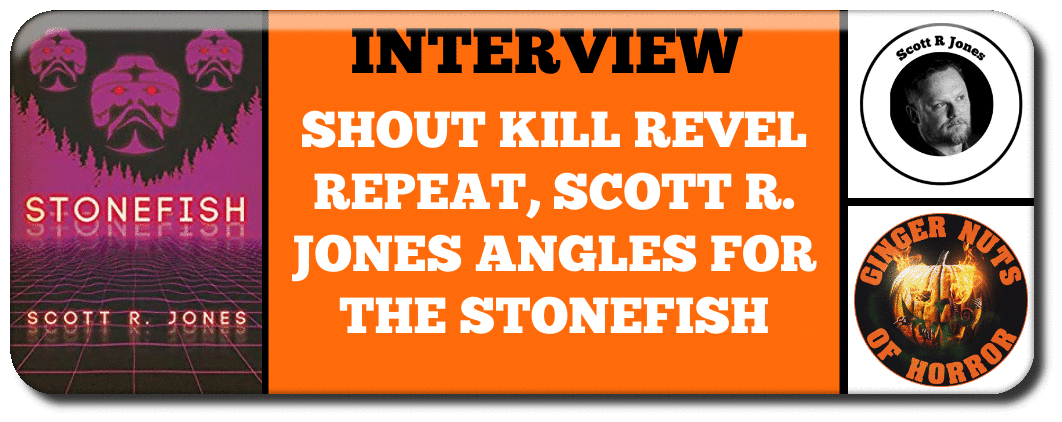 Occult technology. Mind-bending hallucinations. The very fabric of reality broken down and reconfigured before your very eyes. Oh, and Bigfoot, too. All these things and more have found a home in the transgressive, transhumanist, transcendent syntax of one Scott R Jones: author, cyborg, Canadian. As the head (in every sense of the term) of Martian Migraine Press, Jones has helped preside over dramatic interrogations of Lovecraftian fiction, cosmic horror, and the weird tale. As an anthologist, he’s weaponized some of the most cutting-edge voices in the genre against its own regressive elements. And as an author himself, he has crafted a own uniquely subversive, psychedelic storytelling style designed specifically, one must assume, to turn readers’ psyches inside out. It is in that role of creator that two of Jones’ most recent contributions, his first solo collection, Shout Kill Revel Repeat, and his first novel, Stonefish, have been unleashed. Jones spoke with The Ginger Nuts of Horror to reveal the spiritual roots of his fiction, how the global coronavirus pandemic is impacting the publishing world, and what he really thinks of everyone’s favorite foot-in-mouth capitalist tech-daddy Elon Musk. Wear a helmet for this one, kids. In terms of publishing 2020 has been a big year for you, with the release of your first collection Shout Kill Revel Repeat coming right at the very end of last year and your first novel Stonefish coming out a few months later. Was there any planning on your part to come into 2020 all guns blazin’ or is that just how coincidentally fell together? That is the way it all fell together, indeed. No planning on my part anyway; I can’t speak for my publishers, maybe they knew better? I’d like to think so. But yes, it’s been a bit of an accelerated timeline since last December. Feels all right, too, if that makes sense. I feel I’m on a decent track now and I can plan for more progress in future. Releasing not one but two new books has got to be exciting, but 2020 has turned out to be a pretty chaotic year all around with coronavirus and all the global political drama. Has that taken the wind out of your sails at all? My allostatic load is HUGE, not gonna lie. Reading other material is difficult. I don’t think I’ve read a book cover to cover since March. And creating new stuff has had its challenges, although in recent weeks I’ve found reason to go on, writing-wise. Finally, new stories are rising out of the mire of my mind, so that’s nice to experience. But yes, it has been rough. Do you think the current world climate has had a positive or negative impact on these releases? On one hand, with the lockdowns people have had more time to stay indoors and read. On the other hand, people have less spending money and have a lot of other things vying for their attention. Exactly. No, I think the overall impact is negative and I think, given the world situation, that we should expect that and normalize that. Finding other ways to connect with and provide entertainment for readers is a key issue now. But then, I’m not privy to all the sales information (as I was when I ran Martian Migraine Press) so I’m quite comfortable with the idea that I am completely wrong on this and the impact of plague and cultural disaster has been a boon for books and those who read them. Who knows? We’ll find out as the years pile on, I guess. So since Shout Kill Revel Repeat came out earlier, let’s talk about that first. The stories included are very eclectic, but many of them share, at least on some level, a kind of cosmic scope and/or questioning of the nature of reality. Are these themes intentional fixtures of your work or is it something that just naturally finds its way into your stories? What is it about these themes that speaks to you? Nice question. I would say that there’s a definite lean in my work towards those perspectives first, and other themes second. For myself, I think we don’t question reality enough because here we are, as a species, on the brink of extinction largely due to our own unthinking manipulation of the planet and its resources, and on the brink of social and economic catastrophe because we can’t seem to think differently enough to fix these dangerous issues. We have the capability but we don’t seem to use it to its full capacity. So, humbly, I present these small fictions as a tonic. I hope they help readers to start seeing the planet in a new, dangerous, alien way. It’s weird here! The bulk of the stories included in Shout Kill Revel Repeat were originally published elsewhere. You’ve certainly been around the block a few times, having your work appear in various magazines and both themed and non-themed anthologies. Compiling the stories for this collection, see them all together in one place and having them laid out one right after another, were you surprised by any recurring motifs or, alternately, vast differences? Do you feel like the stories in the collection revealed any stylistic or thematic evolution for you, as a writer or just a person? I wasn’t surprised. I mean, I knew what was in there. Certainly seeing them all in one place created a kind of solidifying effect. If I didn’t know what my themes were before, then I do now! I like transhumanist narratives. I like writing about drugs, monsters, things unseen that nevertheless have a deep impact on the world, hyperobjects, the occult, AI science, camouflage. These are the big items in my bag! On a similar note, were there any stories you wanted to include but for whatever reason just didn’t fit? How well do you feel the three original pieces published for the first time in Shout Kill Revel Repeat pair with the others? I wanted to include “The Damage” as it’s my latest written story and honestly, it feels more like my recent work than, say, “Turbulence,” which was the first story of mine someone published. In case you are looking for someone to blame for that instance, look to the inestimable Silvia Moreno Garcia; “Turbulence appeared in one of the last issues of her Innsmouth Free Press. As such, “The Damage” I think points to a spot on the horizon where I seem to be heading, which is to say more intimate narratives between close characters as they come up against the world in all its strangeness. Moving on from Shout Kill Revel Repeat to your first ever novel Stonefish, I have to ask what it was like making the leap into long-form storytelling. Many authors seem to find writing their first novel a daunting task. How was it for you? And what made you want to try your hand at a novel? Why would this idea only work as a novel and not as a short story? Well, Stonefish isn’t my first kick at the can. There is a novel called The Waiting Deeps which is as awful a piece of Lovecraftian pastiche as you can imagine. In fact, it’s more Brian Lumley than ol’ HP, if that makes any sense. I have gone through my Innsmouthbreather phase, as have we all. And there’s another disaster, missing body parts and generally a shambling Burroughs-influenced metanarrative called The Boy’s Own Guide to Sorcery which I hope will never see the light. So I was ready for the grueling aspects of writing a novel when I began Stonefish. As for size and length of it, I’d approached some of the themes before, in stories like “Assemblage Point,” and I knew if I wanted to lay down the full Gnostic horror of the situations the characters Den and Gregor find themselves in, I would need more spacetime/pages in which to do it. Stonefish is set in a near future world devastated by unchecked climate change, and it tells the story of a journalist following the trail of a tech industry wunderkind gone missing, in the process plunging himself into a cyber/cosmic horror nightmare that includes sentient artificial intelligence systems, interdimensional entities, the fundamental hostility of the universe itself, and even Bigfoot. A less respectable interviewer might jokingly ask “What are you smoking?” As a professional, however, I am going to sincerely ask “What are you smoking?” It’s a special blend of my own devising. Thanks for asking! The climate change and tech guru themes are obviously very relevant to the current social climate. What made you want to explore these ideas in Stonefish? Did the process of working on this novel refine your understanding of these matters in any way? I’m especially curious how you feel about real-life figures like Elon Musk and Mark Zuckerberg. I wanted to explore them because they are there to explore and hugely relevant to our continued existence on this planet. Despite being surrounded by PNW hippies and lightworkers, despite living most of my life so far in one of the more socially and environmentally progressive places in Canada, I realized also that I didn’t know all that much about climate change, so I contacted the climate science department of the University of Victoria and sat down a couple of times with two researchers there and boy, did they help me dig down. Dig down into the terrifying meat of the problem! It’s gross in there, the situation is incredibly heinous, but they find themselves in the uncomfortable position of having to trot out the data in a way that won’t cause people to panic and yet the data is, when looked at objectively, worthy of a panic response. Or at best, a better response than what is currently being offered. I can’t do much as one man, and maybe a little bit more a writer, so in it goes. I’m writing about the 2070s, after all. I went to the experts to learn what that decade is going to be like; I made nothing up in Stonefish, that’s all legit climate science. As for Musk and Zuck and all those greedy boys, I say string em up, raid their larders, deal out the dollars to the rest of us. I mean, hell, also let them go to Mars and put chips in our brains, that’s un fait accompli anyway, and we kind of need them to do it because like it or not, historically, its wealthy whack jobs like them that are going to push the species in novel directions, BUT there’s more than enough to go around. Stonefish does not mark the first time your work has combined high-tech science with occult mysticism. What fascinates you about these topics? And what do you think the crossover is between the two? How are they connected? I’ve been a classic head for decades now, so I cut my teeth on those early psychedelic pioneers who’s main deal was the overlap between, say, poorly understood quantum physics and oh I dunno, the frequency differentials found in the angelic Keys of John Dee. Or the kabbalistic Tree of Life mapped onto the drive train for an automatic transmission automobile. At the end of the day, this is all we operate with: a series of mapped thought pathways that we can superimpose on any physical (or social, or environmental, or spiritual) system (yes, you can get all layered up with your religion and magic, it’s called the syncretic approach) with a greater or lesser degree of accuracy. In truth, I don’t think there are many actual things in the world, that much of it is camouflage in some higher-dimensional way, and that much of reality works more due to habit than anything else. Habits change, and tech (whether material and physics-based or occult ie. mental and spiritual techniques) can help change them. In both Stonefish and Shout Kill Revel Repeat, you revisit Lovecraftian ideas and themes without just rehashing the standard Mythos Iconography, tropes, and stereotypes. In addition to your own writing, you’ve also edited and published several anthologies inspired by Lovecraft. What is your own history with Lovecraft, what impact has his work had on you, and what do you think is different about the way you approach his influence compared to those who have basically just rewritten his tales under their own names? Like I said earlier, I went through my Innsmouthbreather phase as a younger man. Yes, I fantasized about having a dinner of tinned spaghetti, coffee, and ice cream with Grandpa Howie like everyone else, I’m not special! But even during the early days, it was more Lovecraft’s ideas, his way of looking at the cosmos, and the things he peopled it with (things that continue to increasingly resonate today) than the writing itself that attracted me. Right now, my connection with Lovecraft is, like many others, a kind of love/hate thing. By writing the things I do, and by editing the Martian Migraine Press anthologies, I feel I’m taking those ideas and either pulling them into the present so they can speak to our heightened sense of impending horror/knowledge or firing them from a cannon into the future where they can express themselves in bizarre and fulfilling ways. Pastiche is for, literally, the last century. We all had our fun, but no one wants to spend another minute in Arkham or Innsmouth or goddamn Dunwich. Well, speaking for myself, of course. Your mileage may vary. Referring to another Lovecraft-related work in your bibliography that predates both Stonefish and Shout Kill Revel Repeat, you’re also the author of the non-fiction book When the Stars Are Right: Towards an Authentic R'lyehian Spirituality, a kind of hybrid of a critical analysis and a philosophical manifesto. How do you feel works like Stonefish and the stories in Shout Kill Revel Repeat embody or echo your R'lyehian spirituality? Simple. We aren’t what we think or believe ourselves to be. We’re something stranger, stronger, and far more capable of navigating weirdness than we’re taught. Owning that, becoming what we are meant to become, that is survival, that is the clear-eyed appraisal of our place in the cosmic mechanism, that is the moment we can embrace our humanity in all its strangeness and put it to real, transformative work. In the stories of SKRR and to a lesser degree in Stonefish, I give my characters a path to that becoming. To put it in the faux-glib fashion of When The Stars Are Right, I try to open up the possibility that they, too, could be Keeping It R’lyeh! Some have greater success than others. Like Lovecraft, I am hampered, sometimes, by the conventions of the “horrifying weird tale”. You’ve written a fiction novel, a fiction collection, and a non-fiction book. In your own words, how would compare the processes of writing each? For you, what purpose does one serve that the other can’t? I found the writing of WTSAR to be the most relaxed process, as it’s basically a collection of essays on Lovecraftian-derived mysticism. Short fiction is intense and finishing a piece usually takes me anywhere from a couple of days to a month and change; I like writing these because they help me flesh out ideas for the longer works. The short story Assemblage Point was the moment I became really interested in the ideas of higher-order camouflage which led to Stonefish. The non-fiction lays out the philosophy and the short fiction builds on it in a specific way before handing over the results to the novel(s). It’s clunky but it works for now. Piggybacking off that last question, of those three types of writing (short fiction, long fiction, and non-fiction) what can we expect to see coming from you in the near future? I know Stonefish and Shout Kill Revel Repeat only just came out, but do you have any plans or projects in mind? I am currently digging down into the next novel, which will hold such things as religious and environmental hyperobjects, cults, memetic viral disease, and social engineering. In it, an estranged mother and daughter become victims of a group that is taking advantage of people who are hearing a “call” from the ocean. It’s not what you think, though. And in between bouts with the novel, I’m starting to pump out some more short fictions, the rona be damned! Finally, I just wanted to say thank you for taking the time to talk to The Ginger Nuts of Horror. How can readers best stay up to date with you and your work online? Best to follow me on Twitter @PimpMyShoggoth. I also exist virtually on the ol’ Facebook! My god, talk about a hyperobject! Also there is a website scottrjoneswriter.com but like most writer types I maintain it only sporadically. Thanks for having me! Interview by William Tea 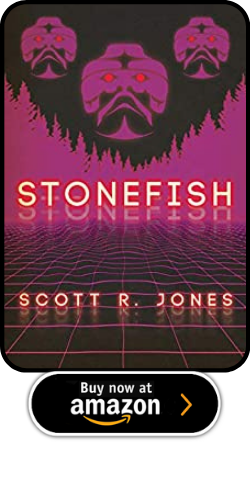 A missing tech mogul... ...a jaded reporter... ...a damaged AI returned from a horrifying reality... ...and something lurking in the woods. When journalist Den Secord is tasked with locating enigmatic tech guru Gregor Makarios, he soon finds his understanding of reality under threat. At the edge of the world, surrounded by primeval forests, in the paradisiacal environs of Gregor's hi-tech hermitage, Den learns of the true nature of our Universe. This is the way the world ends. Heart of Darkness meets The Magus meets bleeding-edge psychedelic gnosticism in Stonefish, the debut novel from Scott R. Jones (When Stars Are Right, Shout Kill Revel Repeat).   Recently released in North America, The Unfamiliar is the newest addition to the horror genre. The Dark Matter Studios film deals with home invasion, possessions, exorcisms, and demonic rituals. Basically any horror trope you can think of is compiled into this movie. The film is carried by an excellent performance from lead actress Jemima West, The Borgias and The Mortal Instruments. I had the pleasure of asking a few questions to the Franco-English actress, and she was kind enough to oblige me.  Hello Jemima, Thank you very much for taking the time to answer a few of my questions for your upcoming release of The Unfamiliar here in the US. I thought your strong performance carried the entire picture and you were a delight on screen. This is my first questionnaire with a cast member of a mainstream production, so I am grateful that you are willing to give my questions the time of day. Hello Caleb and thank you for your kind words and taking the time to talk about the film. I’m very pleased to be your first interviewee. What was it about The Unfamiliar that intrigued you to sign on for the role of Izzy? The challenge of playing a strong role and having so much action to deal with in such a short amount of time. Also Henk, Llewelyn (our producer) and their magnetic energy. My biggest draw to Izzy was her sense of Proactiveness. It’s a common horror troupe for the “final girl” to always be running from the horror in the film, but Izzy is always moving towards the horror and trying to resolve it on her end. Did you have any collaboration over this characteristic of Izzy with Henk Pretorius? That’s a really interesting point. I think Henk and Jennifer who wrote the script always intended it to be that way. And I portrayed her as being so unsure of what the next event would bring that she had to find out, always, as she was constantly struggling with what was actually happening to her or if it was a figment of her imagination. There is a moment in the film where Harry McMillon-Hunt’s character is possessed by Izzy. Did you provide any coaching/collaboration to him on how to portray Izzy during those scenes? Haha. I had literally nothing to do with Harry’s performance. He was so good from the first read through I kept on being impressed by every scene he played. So when it came to shooting that part of the film, I just knew he’d nail it. Through the magic of the camera, sometimes scenes that look terrifying from the audience’s viewpoint look silly/ridiculous from the actor’s perspective. But was there any point while shooting The Unfamiliar that you were legitimately terrified? As I was doing all my stunting, some was slightly more challenging. Being completely covered and feeling suffocated even if only for a few seconds was one of the scariest moments as I literally had no control! Thankfully it was only a one shot, don’t know if I could have done it again If you could only take away one life lesson you learned from your experience on the set of The Unfamiliar, what would it be? Group effort is what pays off. We had only a very short time to shoot and every single person have it their best. We all did it together and that’s how it should be every time! There are several horror movie subgenres in the film (home invasion/possession/exorcisms) that all could have been resolved if you had a superpower. From the following list, which superpower would you want and why?
Def hard to choose between b and c but I’m going to go for the speed, that way I can get close to my favorite people as fast as possible. I love watching movies so much that years ago I started a YouTube channel where I select movies at random to watch and review; whether they are ones I own or if they are recommendations from my subscribers. What is your favorite movie, and do you have any recommendations for me to watch/review on my channel? I recently watched for SAMA the true story of a journalist and her family in the city of Aleppo during the uprising. One of the hardest and most emotional films I’ve seen this year. All the images are true. Utterly moving. Thank you very much for taking my questions, and I wish you all of the success in your career’s future. Thank you! Best Jemima THE UNFAMILIAR will release on 21 August 2020 with Vertical Entertainment in North America, followed by Lionsgate UK (digital) in the United Kingdom on 11 September 2020 and Filmfinity in South Africa on 28 October 2020. British Army Doctor, Elizabeth “Izzy” Cormack, returns from war to rekindle her relationship with her estranged family. Izzy notices numerous inexplicable activities in her house that her husband believes are due to her suffering from PTSD as a consequence of war. Izzy militantly pieces the daunting puzzle together to reveal a terrifying, invisible enemy that has infested her entire family. In a heroic attempt to save her family, she is pulled into a dark underworld in Hawaii to explore ancient mythology.  the heart and soul of horror promotion websites Ginger Snaps is a brand new segment for Ginger Nuts of Horror. It is a quick-fire “bite-sized” interview, where your answers relate to what you’ve been doing in the past month (30 days or so). Keep your answers short and sweet, but also add your own flair where you can. Please include a brief bio, a photo that we can use, and any links that you would like us to add to the interview. If you would like to take part in this series Download the template here Who are you? I am Pippa Bailey – although I got married three weeks ago and due to lock-down, I’m both Pippa Bailey and Pippa Pilgrim. I am an author and voice actor. Your signature style: I write supernatural, speculative fiction, with a lean towards the crude and unusual torture of my characters. There’s generally sex, dribbling, overly spindly people, and someone always dies. Toot your own horn: I’ve co-written and released four books in the last year and a half under a co-owned publishing company – Pugnacious Press. Books read: My favourite book is Cabal by Clive Barker. I really enjoyed the NPC series by Drew Hays, and the audio series is terrific. I read a big mish-mash of horror and fantasy. Movies watched: Favorite film is Fifth Element. Recently we’ve been delving into foreign horror, there are so many amazing films and series. The film Terrified is beautiful and twisted; also the French series Marianne is stunning. Games and/or music played: I’m currently hooked on Slime Rancher and Stardew Valley, I like kid’s games with bright colours. I play wholly inappropriate card games, like Cards Against Humanity and Disturbed Friends. Music-wise, I’m obsessed with Ghost, I’ve been to see them twice and love, love, love, satanic rock. I have a music degree myself and like to sing, but I get a bit shy about it. Words written: This month I’d like to finish the first book in a series that I have been prodding for the last two years. It’s erotic horror, so it should be interesting. I’d really like to be writing every day if I can. Future stuff: In the next couple of weeks there will be a new story released through the Wicked Library for their podcast, a story called “Close Your Mouths and Clench Eyes Tight”. A review for one of Robert Shearman’s stories from a book collection “We All Hear Stories in the Dark” will be out soon through Gingernuts of Horror. Most of my solo projects are likely to be around next year. Still, for the foreseeable future, I’ll be creating not completing, unfortunately. Brain worms: Did you know that as you digest casein (casomorphins) from cheese, it released a chemical like morphine, which is why cheese is so addictive. It’s a feel-good food. When finding out this fact, I found out that I have Tyramine sensitivity. I have a major Tyramine Hypertensive Response when eating aged cheese; some people get it with wine and chocolate as well. You’ll most likely know this as “The Cheese Sweats” Tyramine has the same effect as adrenaline on the nervous system, blood pressure will rise, heart rate will increase. You’ll find yourself feeling all sweaty around your eyes. So, warning – CHEESE CAN KILL, BUT IT’S SO DAMN TASTY. IT’S A RISK I’M WILLING TO TAKE!  Pippa Bailey lives north of the wall in the Scottish Highlands. Principally a horror writer with Pugnacious Press Publishing, and YouTube personality and independent reviewer at Deadflicks with her partner, Myk Pilgrim. Pippa's work has appeared alongside Clive Barker, Ramsey Campbell, Jack Ketchum, Joe R Lansdale, and the marvellous Myk Pilgrim in Dark Faces Evil Place 2. Her stories have been published in 13 Wicked Tales; a Wicked Library Anthology, featured on the Wicked Library podcast, Frisson Comics, Sirens Call Magazine, & Holiday-themed horror collections with Myk Pilgrim; Poisoned Candy: Bite-sized Horror for Halloween, Bloody Stockings: Bite-sized Horror for Christmas, & Rancid Eggs: Bite-sized Horror for Easter. You can spot her drinking too much tea, making terrible puns, and bothering the local wildlife at pippabailey.co.uk  From the Authors of Poisoned Candy and the publishers of The Little Book of Harm, comes Devil's Night, a collection of bite-sized horror stories for Halloween. Halloween has returned in all its dark and depraved glory, and Devil's Night: Bite-sized horror for Halloween will satisfy your carnal urges for death, decay, and far too much sugar. Inside this short horror fiction goody bag is brimming with poisoned candy, ravenous haunted houses, casual necrophilia, yummy scrummy cat faeces, teleplasm, and of course an angry skeleton called Bob. So slip into something a lot more creepy (we suggest your Nan’s nightie) crack open a cold cider and dip into Devil's Night: Bite-sized Horror for Halloween! "Pippa Bailey and Myk Pilgrim return to form with the all-new Devil's Night collection. Simply put, the two authors deliver hard with tight sharp wit, humour and horror hand in hand. As it should be." ★★★★★ Nelson W. Pyles - author, Creator and executive producer of The Wicked Library  THE HEART AND SOUL OF HORROR PROMOTION WEBSITES  Sascha Stronach is an author from Wellington, New Zealand. His debut novel, The Dawnhounds, is a genre-bending fantasy-horror-noir that won the 2020 Sir Julius Vogel Award for Best Novel. You can find him in the forest, chanting in a language that seems to leave fish-hooks under your skin, his face wet and red with the blood of ... a deer? It is hard to say, it is not quite right, its limbs are too long, its eyes too dark, its arrangement too spiderlike, but it will have to do. Best leave the way you came, and do not under any circumstances heed the call of the bone pipes. Amazon Goodreads Blog Could you tell the readers a little bit about yourself? I’m Sascha. I’m an author and poet from Wellington, New Zealand. My debut novel, The Dawnhounds, won the SJV Award for best novel just last month, and I won the SJV for Best New Talent. I’m Greek, Māori (Kāi Tahu), and Scottish so I’m a bit of a mutt, and I think that syncretism often influences my writing: I’m a little bit horror, a little bit sci-fi, a little fantasy, a whole big pile of miscellaneous fungi. Which one of your characters would you least like to meet in real life? A woman came up to me at the launch of The Dawnhounds and said “Monkey’s the guy you see when you try to kill yourself, right?” and I’m still not sleeping right after that. I slammed Hastur into a sleep paralysis demon into, well, yeah that woman at the launch wasn’t wrong. It’s probably just a coincidence or a random fact about human neurochemistry or the power of storytelling to bridge two peoples’ traumatic experiences to provide cathartic release-- but also I’m going to live the rest of my life wondering whether I created Monkey or whether he was there already, just waiting for me to call him. Other than the horror genre, what else has been a major influence on your writing? Well, my debut novel was speculative fiction with a nice horror glaze and I feel like that’s often the direction I come from—I write a lot of short horror and it bleeds over into my longform work aesthetically and thematically, but SF/F is really where my heart lives. I love me some dark fantasy or sci-fi horror: I’ve been chasing the rush I got from the first Dead Space for over a decade now. Outside of that, I think it’s important to read broadly: literary fiction, poetry, music criticism, engineering manuals, labels on soup cans etc. There’s a sort of genre tunnel vision that rookie writers can fall into where they only consume the genre they want to produce, and it ends up … too tropey? A reflection of a reflection of a reflection. Read everything. If you had to rank the seasons of Community from best to worst, what would your ranking look like? 3, 2, 1, 6, 5, 4. We all know why the first three seasons are great and why the fourth is awful. Five, despite a few knockout episodes, still hasn’t quite figured out what it wants to be doing post-gas-leak. Six is highly underrated, it rings with real grief and I think that sudden turn to darkness caught a lot of people by surprise. It’s remembered as bad because it didn’t go where people expected it to, but if you take it on its own terms it is genuinely very powerful television. Also spy paintball is best paintball. Fight me. The term horror, especially when applied to fiction always carries such heavy connotations. What’s your feeling on the term “horror” and what do you think we can do to break past these assumptions? There’s often this assumption that horror is cheap, that it’s the exclusive domain of hack authors putting out airport schlock. We often tack it on as an afterthought: “Science Fiction and Fantasy, oh and horror can come too”. I dislike the term ‘elevated horror’ because it comes with this assumption built in: oh well I know you don’t like horror, but The Babadook is different. My personal response has always been that I just don’t care. I feel like the distinction between ‘high’ and ‘low’ art is fundamentally classist; I don’t think a book goes from ‘art’ to ‘not art’ if you put a zombie in it, y’know, it’s what you do with that zombie. It’s a person infected with a disease that forces people around them to make complex moral and ethical decisions—if you can’t see a way to make a statement with that I don’t know what to tell you. Maybe it’s coming from SF/F, which has been dealing with this same shit since forever (see: “Never Let Me Go cannot be science fiction, because the prose is good, that’s what makes it literary fiction”) but I say just write the words and let your audience find you. The baggage of being Low Art is just weighing you down, so why not just throw it out? It never meant much. A lot of good horror movements have arisen as a direct result of the socio/political climate, considering the current state of the world where do you see horror going in the next few years? Obviously we’re going to start seeing a lot of plague books (oh god I locked myself in for a plague trilogy in 2017, I swear I didn’t do it on purpose) but, more than that, I’m really curious about the idea of cop horror, which is starting to be explored a little, which flips a lot of standard cop book genre conventions on their head by making the cops monstrous, which is a lot scarier than a lone slasher to me because it has implicit support from the state. What do you do when fighting back against the monster is a crime? It leads to some fascinating explorations of sociopolitical power that could also be some damn good horror. Given the dark, violent and at times grotesque nature of the horror genre why do you think so many people enjoy reading it? I was fascinated by Cory Doctrow’s horror panel at coNZealand: my friend and colleague Sek Han Foo spoke at length about his time in a Chinese Vernacular School in Kuala Lumpur and how all those schools are haunted (which contained the incredible line “the toilet is very dirty, and by dirty I mean filled with ghosts”, and which he has since turned into a Twitter thread). He talked about being forced to go to the toilet in a room reputedly haunted by a headless Japanese soldier, and how the experience of being able to do that made him feel brave, and he took that courage with him out into the world. Horror can inoculate us against suffering; we take a little in a safe way, and it builds up an immunity. We live in dark, grotesque times, and—quite apart from catharsis, which is also crucial but gets enough attention in these discussions already—and horror can empower us to survive them by granting us resilience and teaching us tools to survive. If you’re not scared of the headless toilet ghost, then pandemic and political corruption and police brutality become things that you can maybe stand up to and defeat. What, if anything, is currently missing from the horror genre? COP HORROR DO IT, YOU BEAUTIFUL NERDS MAKE IT HAPPEN What new and upcoming authors do you think we should take notice off? My wheelhouse here leans much more to sci-fi and fantasy, but I feel like I should shout out the old Seksan Gallery grew from Kuala Lumpur, many of whom are crushing it right now (Zen Cho in particular, and I think Cassandra Khaw used to also hang out there but I admit that might just be something my memory made up to trick me), but I’m also really excited about Eeleen Lee, Zedeck Siew, and Sek Han Foo, who all seem to be having a moment right now. Back home in NZ, I’m enjoying Melanie Harding-Shaw’s Censored City books, a series of dystopian novelettes which are tickling that cop horror itch for the time being. The journey from starting Dawnhounds to finishing came close to ten years to complete, taking in many rewrites to find your own voice. How did you keep your motivation up during this period, and was there anything that stopped you from throwing in the towel? Well, it wasn’t really ten years. I wrote the first draft in 2013–2014, but it sat mouldering in a folder until 2018 when I picked it up again. It’s more like two years, just very spread out. There is also almost nothing of the first draft remaining in the final book, not in the least because my attitude towards the police changed a lot in those four years and I couldn’t write a book about hero cops saving the world by breaking the rules any more. I think if I did try to write something for ten years I might just chuck it in. That sounds torturous. The world changes too fast these days: if you take ten years to finish, you’ll be a relic by the time you debut. The first draft was based on Sanderson's rule system, what was the initial appeal of using his methods as a template for your own? I was a young writer and I wanted rules, you know? I wanted scaffolding to help me build. Eventually the thing grew like the Winchester House, busted out of the scaffolding, became something strange and new that the old shape couldn’t contain. Part of finding your voice is learning to impersonate writers you like, but at some point you can’t keep doing it if you want to be honest with yourself. I have to admit that I don't read a lot of fantasy, but The Dawnhounds for me has one of the most unique settings I have ever come across. How did you create this unique world? After years of trying to write to market, I sorta just jammed all the crap I love into one place. “You can’t have engineered bioweapons in the same book as old-fashioned sailing ships! You can’t just write a revenant warlock noir set in Wellington-Kuala Lumpur, those aren’t European cities at all! You have to draw from the Western canon, what’s this Journey to the West I’m just now hearing about for the first time?! And it worked. It worked significantly better than all my failed attempts at generic Euro fantasy, because it was about things I cared about, things I’d grown up with, things that genuinely inspired and moved me. It was rooted in my real experiences of the world rather than second-hand accounts of a fantastical England. If you want to start building a fantasy world, first you need to go outside. I assure you, there's enough fantasy in the cracks in the sidewalk to power a thousand stories. Historically fantasy fiction is rooted in the European dark ages, but The Dawnhounds doesn't fall into this setting. Was this something that you were keen to avoid throughout its development? We write what’s around us, and I wrote the first draft half while living in rural Indonesia and half while living in Kuala Lumpur. The first seed of the book came while I was in a plane descending over Singapore at dusk, and there were so many ships approaching the port that they formed a single contiguous line over the horizon, all trying to get into the harbour. The first draft had a sort of floating city made of boats welded together, sort of like The Scar, which ultimately complicated things too much and didn’t work with the rest of the book so it got cut, but it was a hard thing to cut. Then I came home and revised and totally rewrote the thing while living in Wellington. The first draft was very Malaysian, and I felt a little bit uncomfortable with that—it was a culture I'd lived in, but only temporarily, only as an outsider. I'd written a world of first impressions, it was all too surface-level. The rewrites dug deeper into my Greek, Māori, and New Zealand European cultures, and I think that synthesis really brought it to life. KL is still very much visible in the mix, but whenever I felt out of my depth, I could lean on something I'd actually grown up with. With that in mind I don’t think it was ever going to be traditional Tolkien-esque fantasy. I particularly loved the magic system in your book, could explain the basic rules of it to the readers? It’s electricity, except instead of circuits it powers life. Organic material is a conductor and nonorganic material is a resistor. Capacitors get blown out, sufficient voltage can arc, two people turn themselves into a lightning rod, at one point I explicitly use the metaphor of a lightbulb blowing when somebody tries to pull too much. My dad’s an electrical engineer and I grew up building circuits and devices with him, and it apparently rubbed off on me more than I thought. I only realised any of this after the book came out. Now that I’ve realised what I was doing, book 2 explores it in ways that are a ton of fun to write. Ladowain is a city that requires some new tricks. My notes referred to Ajat as “cool trans hacker mum” and book 2 is the one where she gets to actually hack things. I had a fun sitdown with some hacker pals and I asked them with a very straight face “so how would you hack a golem?” and it was like throwing steak into a lion enclosure—the minds on these folks, I love them all. People love to pigeonhole books into genres and sub-genres, how would you describe The Dawnhounds? How about MycoPunk? Mycopunk is exactly what we called it! “Biopunk” leaned much more heavily towards sci-fi like The Windup Girl and “Funguspunk” didn’t flow off the tongue as well, and I figured my fellow mushroom nerds would recognise “myco” anyway. Not that the books aren’t sci-fi but uh, leave that for book 2. I think one of the reasons I was fascinated by the book was the inspired way in which mycology is such an integral part of the story, (I'm a microbiologist by training) where did your love of mycology come from? On what was meant to be one of my last nights in Indonesia, Kelud blew. I woke up and looked out the window and the world was black and white, and I thought I was dreaming and went back to sleep. I would later realise the whole town was under an ankle-deep blanket of volcanic ash. If you look up the eruption you’ll see shots of heavy ashfall in Jogja, which is about twice as far away as I was in Kota Sidoarjo. That whole day had a strangely dreamlike quality, and one thing I distinctly remember is that, somehow, a mushroom had come up through the floor and punched its way into my nightstand. I’d never seen that sort of explosive plant growth before. It didn’t feel real. Before that, there was a cordyceps plague because I saw the same BBC documentary as everybody else in 2009, but the fungi weren’t super integrated into the setting otherwise. That bizarre dreamlike day got me reading more about mushrooms and things sort of snowballed from there. They’re not plants! They’re not animals! They have a lot of potency as a metaphor about connectivity and civilization! You can sometimes even eat them! Fungi are the best. Apart from the main themes of the novel, the one thing that grabbed me right from the start was the "worm gun", what in the world inspired the development of that tech? When I was a kid my parents came back from eXistenZ and my mum couldn’t stop talking about the gristle gun. It obviously really freaked her out, and she was bringing it up for weeks. This was in the 90s when it was hard for a kid to watch a restricted movie, so for years and years it occupied this place in my mind as The Scariest Movie Ever, the one with the gun made of meat and teeth. I spent years working it up in my head, and when I eventually saw it at 17 it actually managed to at least partially live up to the hype. It’s that AND one of my big formative experiences with science-fiction being my friend’s 3rd edition Tyranid codex, which had an extensive section on biomorphs; they were my favourite part, and I’m still praying for a ‘nid codex that goes into that level of detail on them again. I took the Cronenberg gristle gun and smashed it into a tyranid devourer and bam, borer rifle. The narrative wears its LGBTQ themes proudly on its sleeves, were you ever concerned that by having these as such an integral part of the story would put off the substantial core of conservative fantasy fans? Not really. Nobody’s forcing them to read it, and I’m more interested in telling good stories than pandering to any particular group of fans. How much of Yat's story is based on your experiences? Parts of it here and there. I’m also a deeply neurotic queer who has spent most of their life sad and broke, and I think naturally I’m overprotective of people and had to teach myself to stop policing their actions. That’s her damage, right? She wants to help everybody but she doesn’t listen to anybody, she sort of just charges in and slams her solution down on top of them regardless of what they want and ends up hurting them. I think that’s definitely something I’ve had to learn in my own life, that it is a fine thing to care and want to keep people safe but there are toxic ways of going about it. The other thing in there is her response to the terrorist attack in the first half of the book. I wrote that scene in 2018, then when I was querying in 2019 the Christchurch Mosque Attacks happened. I hastily went back and rewrote the scene to make it less similar, to pull away from this thing that I couldn't bear to look at, but with hindsight it’s very clear to me that I rewrote it in the white-hot horror of the moment, that I made it something closer to reality than I’d started. That scene is still hard for me to read; I think there’s a real pain coming from real experience, and I still don’t know how to feel about it. Typically until recent times the "gay" character in fantasy fiction served more of a noble sidekick who ends up dying to save the hero role, was this something that you were keen to address in The Dawnhounds? The sidekick thing was less of an issue to me than the Burying Your Gays. I made a decision that I was going to write about gays who refused to stay buried, who woke up in darkness, punched their way through coffin lids and clawed back up into the light. They’ve got that regenerative healing factor that makes them hard to kill in the first place, and if you successfully take them down they just pop straight back up angrier. Which leads to some tension problems: how do you keep the stakes engaging if the characters can’t die? Well, you get creative. And talking of characters in the novel, none of them are your clear cut stereotypes, was this something you were keen to avoid? One thing I find really interesting is that LGBT+ characters are often expected to be perfect. I don’t like that, I think it’s putting us on a pedestal that we can’t hope to achieve. It’s dehumanising, just from the other direction. We’re not angels, we’re just folks like everybody else. I wasn’t out to write queer-coded villains either, but I wanted everybody to be messy, you know? I wanted them to have neuroses and unresolved trauma and I wanted them to make bad calls sometimes. I got very nervous when I saw the venom in criticism around Gideon the Ninth calling Harrow an abuser because like … yeah Harrow’s a mess, Harrow’s this knot of scar tissue, Harrow is spiky and difficult. Why can’t she be? Why are queer characters expected to be paragons of virtue? Harrow’s thorniness and refusal to communicate with Gideon is a big part of the mystery that pulls the book through its first half, and the crumbling of her walls is a cathartic—and often deeply painful—emotional arc. Harrow is awful, and watching her realise that is sort of the point. My protagonist is gay so I started there, with this idea of taking us off the shiny pedestal and depicting us as vulnerable, flawed and human, and the rest of the world developed around that. If Yat was a bit messy, then her straight colleague Sen was going to be messy too, and the world sorta blew outwards from those two. Everybody was a lot more straightforwardly heroic in the first draft, but I started playing with Yat’s characterisation during the big rewrite and the boulder rolled downhill. That first draft is a much less interesting book than what I ended with, which is about a world of fucked up people doing their honest best. Were there any compromises that you had to make in terms of how you approached the themes of the book to make it more commercial? Thanks to the Little Hook team consisting entirely of me and my mate Dave, I managed to retain a shocking amount of editorial control. I suspect if this gets picked up by a US publisher (hi! Please contact littlehookpress [at] gmail [dot] com!) I’m going to be asked to make Sen less incomprehensibly Australian. Yeah nah yeah mate, not keen on all these bloody bin chickens, just gonna punch the fuckin bundy aye. So long as I get the final say, he is gonna be a big soft bogan and there’s nothing anybody can do about it. For those looking for more examples of good "gay fantasy" who would you recommend we check out? If you’re in the mood for more New Zealand dark science-fantasy with mushrooms and gay people, might I suggest Into the Mire? It was a finalist at the SJVs and while it didn’t win, Casey won Best Short Story for a separate piece called A Shriek Across the Sky. I’m glad Casey is finally getting the attention she deserves, partly because she’s a great writer and a dear friend, and on a more mercenary level because Mire is a great comp title for me and suddenly a bunch of agents recognise it. I know it’s bending a little to call it fantasy, but I absolutely loved The Amberlough Dossier. It’s a trilogy about a gay spy who falls for a cabaret MC in Weimar Berlin and they get caught up in the rise of the Nazi Party, except they’re about none of those things because they happen in a fantastical secondary world. I’m finally getting around to AJ Lancaster’s Lords of Stariel as well, and if gay regency fae is your vibe then I’d highly recommend them. On the more horror-adjacent side of things, I really dug The Monster of Elendhaven, a wicked little book about a warlock who summons a demon to help him get revenge on the men who wronged his family, and who falls in love with the demon. It ends … well, uh, let’s just say it ends and leave it at that. Are there any reviews of your work, positive or negative that have stayed with you? Octavia Cade described The Dawnhounds as ‘a cross between Ankh-Morpork and Ambergris’ and that really made me smile: both Pterry and Jeff VanderMeer have been massive influences on my writing. Tamsyn Muir saying nice things about it was also a massive boost—I’d sold about 30 copies at that point, mostly to friends and family, and I was starting to think I’d made a huge mistake by publishing, and then the woman who wrote Gideon the Fucking Ninth told me she loved it and I went “well she’s got better instincts than me, so I guess she’s right? Better keep on grinding” and that grinding paid off. I don’t think we’d be having this interview without Tazza. What aspects of writing to do you find the most difficult? Getting the ball rolling. I find once you hit the 50–65% mark, it’s all just flying downhill; I wrote the first 40,000 words of The Dawnhounds in eight months and the last 40,000 words in three weeks, because I hit a point of critical mass where the thing basically just piloted itself. Getting there is agony, though. It’s a truly bizarre process, it’s like … you just keep lying at your keyboard until the lies unionize and you let them have whatever they want. Is there one subject you would never write about as an author? People being sad for a long time and then drowning. That was the default mode of New Zealand literary fiction for a long time and it drives me up the wall.Not that sadness and drowning are off limits (I am a New Zealand author, and my influences are gonna make themselves known) I just don’t think they’re inherently deep or interesting on their own. I won my first major award for a short story that I wrote by pinning a bunch of NZ fiction cliches to a dartboard--sad child wise beyond years, the nice people aren’t helping, death in/near water, drinking tea miserably—and twisting them into something that didn’t make me hate myself. It’s not a bad story, but that’s not who I want to be as a writer. Or at least, I’m fine with being that author but only if I can throw in a bunch of gay warlocks on a teleporting fungal pirate ship and maybe a Cronenberg plague or two. Writing, is not a static process, how have you developed as a writer over the years? God, I used to be pretentious. I wrote poems with names like Fall Out Boy songs. Baby What You’re Gonna Learn Is That I Make My Friends By The Milligram, that’s an actual title I wrote, which made SSRIs sound like heroin because it was so vague. Don’t get me wrong I’m still pretentious, but it’s more manageable now. At some point I transitioned from “you just don’t get my art” to appreciating that writing is an act of communication and if you’re failing to communicate then you’re not doing your one job. I’ve written about this at length, but learning to embrace the things I actually like was also huge. I spent a solid four years trying to basically rewrite Mistborn with the serial numbers filed off before realising that I wasn’t Brandon Sanderson and trying to write like him wasn’t working for me. It works for him (I’m not here to start a fight with BS: I loved Write About Dragons my dude), but trying to emulate that rather than explore all the weird little things I’m passionate about—mycology, old sailing ships, cosmic horrors as metaphor for personal trauma—was holding me back. What is the best piece of advice you ever received with regards to your writing? I ended up having a chat with Neil Clarke at WorldCon and I told him I’d been working on a piece for Clarkesworld for five years and he was shocked and he told me to just, y’know, submit something. I’ve come to realise that ‘perfectionism’ is a way to cover up anxiety—you never have to risk rejection if you just tinker forever. You never have to have a bad date if you just never go on dates, but I’m not sure it’s any way to live. Which of your characters is your favourite? One of my beta-readers started referring to Wajet as DADDY in all caps and it was then that I realised I was in big gay trouble: “What if I made this strongfat gay man with lots of facial hair who is extremely chaotic and definitely fucks? This is a fun background character who isn’t going to steal every scene he’s in and eventually derail the entire plot. I am smart and know how writing works.” I spent a solid hour just crafting the insult he hurls at the Cronenberg Dog Monster, and it’s still my favourite line in the whole book. Wajet is a force of nature, destined to take over any text he appears in. He is my Jack Sparrow, which is why I am going to use him extremely sparingly in future books; we all know what happened with Jack Sparrow. It’s worth noting that in the first draft, way back in 2013, Wajet is the protagonist. I cut his role down a lot in rewrites but I think that’s why he has so much life: he has his own whole novel the reader never sees, and every time he’s offscreen I know exactly where he is. I honestly don’t know why I ever thought I could control him: I just sort of grab a hold and try not to get bucked off. Which of your books best represents you? Well I’ve only got the one right now: everything else I’ve put out is short stories, and I feel like The Dawnhounds represents my whole vibe pretty well: it’s gross and weird and hopeful and extremely gay. There was also that time I got home drunk at 3am and found an email from my editor at Esquire Malaysia asking for a short story for ROCKTOBER and I immediately sat down and smashed out 2000 words about a band of Heavy Metal Wizards who use the power of sick guitar solos to literally melt demon faces. It’s called And All Hell Rode With Them, it’s in the October 2015 issue of Esquire Malaysia and it is basically impossible to get your hands on these days, but people still ask if I’m “the heavy metal demon slayer guy” occasionally so apparently it made an impression. I think on some level, The Dawnhounds is my ego but And All Hell Wrote With Them is pure id. Do you have a favorite line or passage from your work, and would you like to share it with us? The part of my shouting about THE BRAND wants to do something deep and powerful and strange but … No, it’s totally the Wajet going off at a horrifying flesh-melted dog monster. [quote] A few officers with rifles pushed past them, and threw open the windows. Their borers opened up with a series of wet thumps, and she heard a ghastly, inhuman shriek from the street below, followed by a familiar voice. “GODS-DAMNED JELLY-ARSED MISMATCHED GALLOWS-BIRD,” boomed Wajet. “COWARD! WEAKLING! ARISTOCRAT! I’M NOT DONE WITH YOU, SIR.”[/quote] Can you tell us about your last book, and can you tell us about what you are working on next? The Dawnhounds is a book about a gay cop who gets murdered by her fellow officers, and comes back as a revenant to solve her own murder while on the run for a crime she barely understands. It’s a fantasy-horror noir about plague, about police brutality, about the slim possibility of light piercing the darkness. I inexplicably wrote it in 2017 so I guess I’m a precog. It’s got queer found family, the gradual-but-unstoppable revelation that all cops are bastards, a pirate ship made out of mushrooms, two (count ‘em, two!) horrifying flesh-melting Cronenberg dog monsters. Y’know, normal stuff. I’m currently working on the followup, which has the tentative working title Lions & Ghosts. It is … spectacularly ambitious on a level that is worrying me, but dammit Harrow the Ninth pulled off something similar, and Tazza believes in me so I guess I’ve gotta believe in myself too. There was a blink-and-you’ll-miss-it line in The Dawnhounds about lights in the sky over Ladowain, which is what the crew of The Kopek are drawn in to investigate. Why did the villain-apparent never show up in book 1? You’re about to find out, and I warn you: it’s about to get weird. If you could erase one horror cliché what would be your choice? Clichés are patterns, right? They’re the best-loved-bear, they’re this idea that resonates so deeply with readers that they use it and use it until they break its spine and it becomes meaningless. You don’t slow down for the phrase falling in love, it’s pedestrian, but the instant somebody asks why do we talk about love as though we were falling? it hits you like a truck. I don’t want to erase any clichés, I want to breathe new life into them. Now tropes are a different matter: I’m sick of queer-coded villains and I’m sick of how much we rely on sexual assault and I wish our depictions of trauma were more willing to actually explore trauma rather than exploiting it, but I do think we’re seeing positive change on that front and I’m happy to be part of the cohort making that change. What was the last great book you read, and what was the last book that disappointed you? God, Harrow the Ninth is such a thing. It’s a Swiss watch, it’s a minefield, it’s spinning a hundred plates at once. It may test your tolerance for memes and/or dad jokes (the line is becoming increasingly blurry as my generation ages), but it’s this absolutely superb piece of craft, this masterwork of tension, this strange delicate puzzle box. I liked Gideon a lot, but I understand why Taz lost to Arkady Martine (A Memory Called Empire is simply incomparable, I’m a Greek-But-Not-Classical-Greek history nerd and the instant you say ‘Space Byzantines’ I get shot into goddam orbit) but if Harrow doesn’t win next year I’m starting a riot. For whatever reason I really didn’t click with Nevernight. People have been telling me for ages it’s a great comp title, it’s exactly the sort of thing I like, and somehow I just had a difficult time engaging with it. I’m not so arrogant to say I’m an objective barometer of taste and I don’t have anything negative to say about Jay’s craft, but it just wasn’t working for me somehow. I think maybe it hit the gas too hard, too early, and I found myself getting run down? It was just sort of relentlessly brutal and I was in a very dark place when I was reading it, and it was too much. Which is a selling point for a lot of people (and maybe me on a good day: I intend to circle back to it), so you get a 2-for-1 on recommendations in this section. Go nuts, throw Jay a few bucks. What's the one question you wish you would get asked but never do? And what would be the answer? Right now, as New Zealand goes back into lockdown and I wasted all this beautiful freedom I was granted, I wish a stranger would come up and ask “would you like to pat my dog?” to which I would respond “fuck yes I have not patted a dog for the entire year of 2020, thank you stranger, I will pat your dog.” Cats are good too, but they know too much; cats have secrets. I love cats, but I do not trust them and I think they prefer it that way. Winner of the Sir Julius Vogel Award for Best Novel 2020. "... a wonderful queer noir fever dream"–Tamsyn Muir, author Gideon the Ninth. A ship rolls through the fog, its doomed crew fallen victim to a fungal plague that melts and repurposes flesh. Yat Jyn-Hok—disgraced cop and former thief—stumbles across its deadly trail. As the spores spread through the city, she pulls at the threads of conspiracy, and the threads pull back; powerful men will do anything to keep their secret. They kill her. It doesn’t stick. An ancient intelligence reanimates her, and sends her back into the city to enact its mysterious designs. She has her own plans: she’s going to find the source of the plague before it turns her home into a charnel house. On the run from her own colleagues, she follows the thread down into the ruins of her old life, where she finds unexpected allies, ancient magic, and a secret that could leave the world in ruins. Set in Hainak Kuay Vitraj, where the miracle of alchemical botany makes flesh as malleable as clay, The Dawnhounds is a story of rebirth, redemption, and the long road home.“The Dawnhounds packs hard-hitting, mind-bending weirdness into a story that’s still touching and human. If you’re looking for gritty queer spec fic that isn’t unrelentingly grim, you’ve found it.” –Casey Lucas, author of Into the Mire  the heart and soul of horror review websites
Today we welcome writer and director Henk Pretorius to the site to chat about his latest horror film The Unfamiliar, where a British Army doctor comes back from a war, thinking that she has PTSD only to discover that there is a more daunting malevolence at work making the life that she knew unfamiliar.
Hello Henk, how are things with you?
I am excited, nervous, insecure and sometimes overly confident. I have been emotionally, physically and otherwise invested in The Unfamiliar for the last five years and the film is about to be seen by an audience. Although I have made numerous other features before, this is the first one I have made for Britain and North America. It is a massive jump for me as a filmmaker from being a local South African filmmaker, to having a more global presence, and I can honestly not predict the outcome. The one thing that assists me in my current state of mind is a bunch of spiritual Ram Das podcasts about how one should detach from your emotions. Which I am usually able to do, but this is so new. Your filmmaking career began in South Africa, what are the most significant differences between making films in South Africa and the UK? I thought that the in-front-of-camera talent in London is incredible. The pool of highly skilled performers to choose from, and their dedication to the craft, is commendable. The on-set Heads of Departments in London was a bit less experienced than the Heads of Departments I usually work with in South Africa, which was cool because it reminded me of making my first film back in 2006. I will probably work with a bit more experienced team of HOD’s going forward in the United Kingdom, but there is a certain romance in working with a crew that is still trying to find their voice in a noisy industry. I hope that the film means something for the team of HOD’s that worked on the movie with me, hence why I tried to name everyone in our marketing campaign too. My first film in South Africa started a wave that led to a more economical suitable independent sector. The film industry in the United Kingdom is more mature in that sense than South Africa, so time will tell if the film had a positive effect on other people’s careers. On “The Unfamiliar”, I worked with post-production companies in both the United Kingdom and South Africa. This was a phenomenally positive experience. I had the pleasure of working with composer Walter Mair in London, who’s work made a sizeable difference in how an audience may emotionally receive the film. The colouring of the "picture" and the visual effects on The Unfamiliar took place in The United Kingdom and the final mix in South Africa. In summary, I would say that the British industry is more mature than the South African industry, which makes the approach generally in South Africa more entrepreneurial. Employees in the United Kingdom has a more Swiss-clock maker approach to solve particular problems, rather than taking on vastly more responsibility that South Africans are known to do. Off course I am generalizing, and off course both methods have their merits. You got to work with Nelson Mandela's grandson on the film Fanie Fourie's Lobola what was that like? Kweku Mandela doesn’t talk about his heritage but did introduce me to a couple of his family members. I haven't met anyone in the Mandela-family that was in politics, and everyone was super unique. Which, I think it a sign of good parenting, where the sons and daughters of your children are all encouraged to follow their dreams. I also believe that it ties in with The Great Nelson Mandela’s life’s goal: to give all the opportunity to become the induvial they want to be, irrespective of their race or gender. This ideal, in my opinion, really translated in all the Mandela family members I have met. I loved making Fanie Fourie’s Lobola because it was a cultural clash romantic comedy that I envisioned to show how South Africans can move forward and celebrate shared traditions. I meet people in South Africa, in all walks of life, that watched the film, and it had a positive effect on their journey. The idea that a story can offer people an alternative, and sometimes more positive way of thinking about life, is one of the great perks of being a filmmaker. Before The Unfamiliar, you were primarily known for writing and directing comedies, what prompted the move from laughs to scares? Most people I know that believe in the phycological concept of “having a personality” describe me as A-type. I am always up for a challenge and to evolve beyond my comfort zone. I am someone who is never completely happy with what he has achieved and always want to obtain a little more. Or grow a bit more, which led me to the need to decode the horror genre. Luckily my fascination with the film genre was supported by my horror-fan producer and business partner: Llewelynn Greeff as well as our company CFO and producer: Barend Kruger. Llewelynn’ sister was so excited about us wanting to do a horror film that she dropped a massive box of horror films at my house. I watched these, which translated into the scariest and most anxious two weeks of my film career, but I eventually noticed the poignancy of the genre. The horror genre to me now is best described as the search for truth and, ironically, finding the light in the face of perceived darkness. The best horror films to me managed to capture the dark in a way that brings new understanding to our psyches as a human race. For example: How we deal with fear, in the face of clear and imminent danger, is, of course, a deep reflection of our character. Do you think your experience of setting up "the punchline" in your comedy films gave you an insight on how to set up the "scares" in The Unfamiliar? Setting up a scare and the building of tension is rhythmically similar to building towards a laugh or creating a comedic film. In a sense, you have set-up, and a punchline for both genres and timing are incredibly important in both. I think an excellent example of that is Jordan Peele’s work, and how he has mastered comedic timing as well as the incredibly impressive: “GET OUT” horror film. However, storytelling across all genres all have the golden thread of the pursuit to create memorable characters, with strong arch’s, in a uniquely told plotline at their core. These story principals never really change across genres, and I believe in dabbling in different film genres makes you a more skillful filmmaker. The horror genre’s command on the film making medium surely left an imprint on how I can use the medium to strengthen my next film with. My background in comedic films helped infuse my understanding of the rhythm behind a scare. In 2012, you co-founded the Britain-based company Dark Matter Studios with Llewelynn Greeff, what was the reasoning behind setting up your own film production company? The truth is that I, as a young director, was born into a country with no real opportunities to make a living from directing films. It inspired me to think of both the business side of things, as well as the creative facets involved to make a film. I joined another film company as a partner and helped steer the company into creating several commercially successful South African films. My ambition soon outgrew South Africa as a market, and Llewelynn flew to South Africa to introduce himself to me and my previous company. Although Llewelynn had no experience in producing a feature film, we shared a couple of essential characteristics as people. We had integrity in our business dealings, we both took responsibility for our actions, and we had a dream to open a company where filmmakers can make a sustainable living out of films. Llewelynn made me two promises before we opened Dark Matter Studios in 2012: he will take responsibility of the almost impossible task of raising money for our endeavors, and he is strong enough not to let the industry corrupt him. I promised Llewelynn that day to create content that people will want to see and always to stay loyal to the bigger picture of building a sustainable industry in the creative arts rather than just jumping at a career opportunity. This code of conduct is why I prefer being part of our Dark Matter Studios family, rather than building my career on my own. Success also feels better shared than when it’s only focused on you as an individual. So, out of the impossibility of making a career in film in South Africa, we now have a functioning British production company, with a global distribution reach and numerous creative assets we are motivated to create soon. What has been the hardest thing associated with running your own company, and what has been the most rewarding thing related to it? I luckily don’t run Dark Matter Studios alone; I do it with Llewelynn. The hardest thing about running a company is that you are always 100% responsible for both the things you can control as well the things that are outside of your control. The best thing about running a company is that with taking on this responsibility, you have the freedom to make choices. And these choices ultimately significantly contribute to your fate. What is the biggest hurdle you face as an independent film production company? If you ask Llewelynn, he may tell you it is raising the capital for producing, distributing and marketing our intellectual properties. I would say it is predicting what intellectual property to create next that may be in demand for the trends of tomorrow and will justify the budget spent on creating and marketing them. In truth, I think it is both raising the money and creating assets for sometimes a distant future. Plus, the added pressure to run all day-to-day tasks associated with managing a business. Your latest film The Unfamiliar, at first look, could be considered just another "possession horror film,(it's OK folks it isn't, when the film is released be sure to check it out). There's a lot of twists and defying the expectations that have commonly become associated with possession-type horror movies. How were you able to keep that originality while paying homage to the stories that came before? I think it has to do with respecting the audience enough to know a film will only really appeal to them if it’s fresh. I then do an incredible amount of research into the genre, the subject matter, as well as everything that surrounds the film. Luckily, Jennifer Nicole Stang, who wrote the script with me, helped me with the research. I also wanted to make a film that appears to be one thing, and then turns out to be something completely different. A film that uses horror tropes to guide and sometimes, miss guide the audience to a different conclusion. I am a fan of John Carpenter’s idea of activating an audience’s imagination oppose to showing the monsters, as well as the modern master of horror: James Wan. His ability to make the building of tension truly cinematic is something I thrive to achieve. I was also inspired by Jennifer Kent’s thematically rich telling of The Babadook yet tried not to borrow any story ideas from any of the films. The film could be considered "heavy" in the sense that it touches on a soldier's PTSD, feeling like a stranger in your own family, being a stepmother, and many others that I don't wish to spoil. How did these elements come about? The idea of the film being dramatic grew out of my affinity for drama as a genre. I think that our “human suffering” is an essential emotional-in for an audience in identifying with a character, and I use dramatic beats even in my more comedic films. There was another film: Ready or Not, that was quite a lighthearted and delightful film to me, and I remember watching it and thinking: maybe I should have put more “laughs” in The Unfamiliar. And then I thought: even a comedy-horror like Ready or Not has a dramatic backdrop of the prejudges of classism, and it’s that backdrop, that I believe, creates the connection for the audience with the lead character who, is this particular film, disrupts the class system. The PTSD element in the film was inspired by a group of marines that I hung out with in LA when writing the script with Jennifer. The idea of a mother trying to keep her family safe, in the face of danger, was inspired by my observation of just how brave people can be when it comes to protecting their family. The idea of making the lead character be a stepmother showed the cracks of her alienation and the insecurity that Izzy experienced in an attempt to fit into the family nucleus. And what was it like dealing with that subject matter? The balance between the genre and weight of the subject matter was the challenge. The film had to deal with it freshly, without taking away from the seriousness of someone experiencing PTSD, yet as you know, the film is not really about that. So, it can’t just be used as a device, because that will come across as exploitive. It has to be dealt with, with enough care to motivate the inclusion, but not with too much screen time to confuse the genre and the audience of horror films. Time will tell what the majority of the audience thinks, and you will only honestly know the impact when “the lovers” outweigh “the haters” of the film. Why Hawaiian folklore? Jennifer Nicole Stang read this incredibly thick book of Hawaiian mythology that she brought to my attention. The amount of the culture that most people didn’t know about Hawaii captivated our imaginations as writers. The idea that Hawaii is often portrayed as a tourist destination and that only a small number of films have attempted to portray a more three-dimensional picture of its inhabitants, was also inspirational. I was born in Cape Town, and sometimes people think they understand the complexities of living in South Africa just because they have read about it or visited it for a short holiday. And although I love the fact that I come from a place that tourists want to visit, and I hope people continue to do so, I also know that living in South Africa and experiencing its people is vastly different from the holiday experience. I can’t possibly hope to capture the spirit of Hawaiian people in ninety minutes, and it is also not the point of the actual film. Yet, I do hope that it inspires interest in the culture or any foreign literature for that matter. I have made numerous films that explore different cultures, and I have often found myself wanting to know more, the more I get to know the customs, rituals and traditions of the people. I have also found that people stripped from their culture, behave in quite a similar way, which off course brings us closer to the shared human experience and each other in the process. Without giving too much away, what was it like having actors embodying multiple characters? To take Tommy, the lead character’s son, as an example. His inherent understanding of the different dimensions he played was already evident in his audition tape. He had this almost superhuman quality about him to remember lines, stage direction as well as the more emotive and physical requirements of the role and just did it, seemingly without thinking about it. I was very impressed with the amount of research the cast brought to the roles and the effort that went into their preparation. It is easy to direct a well-prepared cast, and so it was, for the most part, a gratifying process. I made them all the promise that I would put as much effort as humanly possible into all the other facets of filmmaking to make sure that their performances are shown in the best possible light, and I hope they are delighted with the result. The film has multiple locations, such as the UK, Hawaii, and a netherworld, what were your techniques to stylistically set them apart? I used different lighting methods and grading to set them apart. If you view the scenes set in Hawaii, the grade is much more saturated than the scenes set in England. For the “netherworld” we used the colour of a corpse as a model construct, in finding the right hue for the blueish tint. Andy Lee was the colourist on the film, and we spent a lot of time on each sequence to make sure they are different to the other setting. We also used a 35 mil film grade as filter to tie all the worlds together, and I wanted to make the film seem very organic and have a classic cinematic feel. The production design played a role in setting the worlds apart too. You will rarely notice a shot in Hawaii without the presence of a tropical plant in the frame, for instance. And the sound design by especially Jim Petrak contributed significantly to how the different worlds would sound. Jim came up with this idea to take all the natural sounds and “atmos”, out of the netherworld. The idea that this is a place of death, where nothing, not even sound survives, motivated the choice. Most of the music used in the Hawaiian scenes also had an authentic Hawaiian instrument in them. Walter Mair imported Hawaiian instruments and combined them with classical and other musical instruments to create a unique feel for the film. What inspired you to tell this story? My inspiration to tell this specific story is because I wanted to create a film that has a lot of unique twists in it. A film that is difficult to predict. Finding ways to twist the plot activated the left and mathematical part of my brain. In contrast, my emotional sphere was activated by the journey of watching a mother go to heroic lengths to protect her family from an invisible enemy. Where and when can we watch The Unfamiliar? The Unfamiliar is available on all digital platforms on 21 August in North America and on 11 September in the UK. We are announcing more dates soon, and it’s best to follow our socials for dates on @unfamiliarmovie for details around other releases. Your next project is called Novus, can you tell us what this film is about? At this stage, I can only say that NOVUS is just the working title for the film and maybe changed after production. The word NOVUS gives you a clue what it is about because NOVUS means: “to renew” in Latin.

THE HEART AND SOUL OF HORROR PROMOTION WEBSITES  Daniel Reiner was born, raised, and still lives in Pittsburgh, PA. Influenced at an early age by the imaginations of Larry Niven and Stephen King, it was a later encounter with H.P. Lovecraft’s dizzying use of adjectives that set him on his course. That path has led to the creation of a set of characters within Lovecraft’s universe, their tales currently being published by Vulpine Press in The Shadow Saga. Though the bulk of his creative output remains Lovecraftian, he does branch out and dabble in shorter pieces with horror, science fiction, or other, uncategorizable flavors. Samples of his work are available at https://www.danielreinerfiction.com. WEBSITE LINKS https://www.danielreinerfiction.com/ https://www.facebook.com/Daniel-Reiner-Fiction-273386506648355 Could you tell the readers a little bit about yourself? Though I’ve done little reading recently, I devoured science fiction and, well…comic books…when young. As a teenager, I got hooked on Larry Niven’s Known Space universe, and Frank Herbert’s Dune is still in my top three overall favorites. At about the same time, Stephen King’s early tales also grabbed me, especially ‘Salem’s Lot and The Stand. But in college I was absolutely captivated by the adjectives used by H.P. Lovecraft and the overall atmosphere he evoked. So, even though I fed my voracious imagination with all that fiction, writing was an after-after-thought. My logical, problem-solving personality fit in well with mathematics and computer science, and that’s where my career went. Writing was an on-again/off-again hobby, all self-taught, self-learned, with no early success because I didn’t know how to proceed or how to truly get better. Finally, in my fifties, I found a writing group, made the right connections, and had measurable progress. Which one of your characters would you least like to meet in real life? From the book that was just released, The Shadow Effect, Frances is even worse than I present her. And I tried to make her atrocious in this one. By the end of the series (The Shadow Saga), her full awfulness will have been revealed. Other than the horror genre, what else has been a major influence on your writing? I’m going to scrape everything together into a big bucket and label it “fantastic” fiction, but fantastic in that far-fetched sense: things that are wildly thought provoking. For me, that means science fiction, fantasy (such as The Lord of the Rings), mythology, and Dungeons and Dragons (the role-playing game). There’s lots of overlap between the final three. But in particular, I enjoy adding in elements of mythology whenever I can. The term horror, especially when applied to fiction always carries such heavy connotations. What’s your feeling on the term “horror” and what do you think we can do to break past these assumptions? For good or bad, we’ve come a long way from the gothic horror of Stoker and Shelly. These days, it takes quite a lot to shock the average reader, so I think that the concentration should be on building tension, or taking perfectly normal events and twisting them just enough to create the abnormal. It becomes more psychological then, rather than explicit gore. But that isn’t a new concept. A lot of good horror movements have arisen as a direct result of the socio/political climate, considering the current state of the world where do you see horror going in the next few years? I am sincerely afraid to speculate. We’re going to have to see what else 2020 has in store for us. The world of 1984 is right around the corner, and THAT is genuinely scary. Given the dark, violent and at times grotesque nature of the horror genre why do you think so many people enjoy reading it? Pure escapism: It’s that other person going through the trauma, not me. I’m here, on my couch, and everything is fine. It’s all fine. I just wish it wasn’t quite so dark, and the house would creak a bit less… What, if anything, is currently missing from the horror genre? I haven’t kept up enough to offer an opinion on trends. It’s hard to imagine that anything is missing, but something must be, though. Right? Somethings. Otherwise, why do authors bother to keep writing? What new and upcoming authors do you think we should take notice of? I wish I could comment authoritatively on this. With a full-time job that is not writing, and the hobby/second-job of writing, I am far, far, far behind on reading. I have no idea what’s really happening out there. If it’s a valid response, I can give myself a plug and say, “Hey, that Daniel Reiner is turning out some pretty good stuff.” Are there any reviews of your work, positive or negative that have stayed with you? Not so far. Or, maybe. But see the question after next. What aspects of writing to do you find the most difficult? Outlining. I would so much like to make a habit of jotting down an outline, charting out the chapters, and adhering to it. I managed to do that once, but no longer. I have ideas and sequences and scenes in my head. Sometimes those things are static, sticking around from beginning to end, and sometimes they’re fluid, morphing as I write. Is there one subject you would never write about as an author? I’m not comfortable writing about sex or relying on profanity, though I’m trying to get past that when it fits with the piece. The one thing I shy away from completely is anything autobiographical. I see no need to expose my life to the world, partly because it’s private, and partly because it was/is so fucking uninteresting! (And there you go: I dipped into some profanity for the audience.) Writing, is not a static process, how have you developed as a writer over the years? I hardly developed at all until I joined up with the Millvale Writer’s Group. Reading one’s own work aloud, in front of others, is a terrific way to see and hear the details that aren’t quite right. Equally, seeing and hearing others read their work aloud is extremely insightful. I guess what it boils down to is: You can’t write in a vacuum. Unless you’re naturally gifted (like Lallafa, if I may pull in an obscure reference from Life, the Universe and Everything), interaction and feedback is required. What is the best piece of advice you ever received with regards to your writing? I had the good luck to meet the late Joe Pulver at a NecronomiCon in Providence back in the 1990’s. He told me of the struggles he went through to get his Nightmare’s Disciple published, and we kept in contact for a time. Essentially, he told me to just keep going, keep trying, and things will happen one day. And, things eventually did happen. I wish I’d known him better. Which of your characters is your favourite? Jebediah Higgins. I often think the way Higgins does, but, thankfully, I don’t speak or act like him. At least, I hope not. Which of your books best represents you? Hmmm. I don’t think that one has been written yet. It will one day, though. Do you have a favorite line or passage from your work, and would you like to share it with us? Favorite is such a hard thing to nail down. I can think of a number of examples from the newest book, but—in order to avoid any spoilers—I’m going to go back to The Shadow Beyond. I’m not a poet or lyricist by any means, but I was very pleased with the sea ditty that I came up with: No skin, no flesh, them bones shine through. Hackin’, scrapin’, the best we do. The best we can, though pretty rough. Others though, they polishes off. Beaks and teeth, they eat their fill. All blood, all gore, a devil’s meal. So clean, so clean, that skel’ton gleams. With flesh stripped clean, that skel’ton gleams. It’s white, so white. It’s oh so-- And the singer gets interrupted at that point, so we don’t find out how it ends. Or how interminably long it may have been. Can you tell us about your last book, and can you tell us about what you are working on next? The most recent work, The Shadow Effect, is a follow-up to The Shadow Beyond, but not a true sequel. I always imagined the first volume to be akin to The Hobbit, setting the stage, and the remainder to be more connected, not unlike The Lord of the Rings trilogy. In the first book, Quentin Gardiner is introduced and disappears early on. In The Shadow Effect, we learn all about his adventure. Next up will be the third volume, which has been started, but I’m also always at work on short, or flash, fiction to stretch my brain in different ways. I also work on serial tales that fill in some holes in The Shadow Saga: stories that relate to the characters and plot in general, but that don’t make it into the books. Many of those bits and pieces show up on my website. If you could erase one horror cliché what would be your choice? Personally, I don’t like the unkillable villain. They can be unkillable, or resurrected, if there’s a good reason. But I want a really, really good reason. Even in fantasy I need logic. What was the last great book you read, and what was the last book that disappointed you? To be perfectly honest, I was very pleased, or satisfied, with the way that Rowling wrapped up everything in Harry Potter and the Deathly Hallows. Satisfying may not sound like a great compliment, but that’s really what it boiled down to. For an honourable mention, I have to add Pulver’s A Long, Dark, Grim Road. At only a few dozen pages, it’s not a conventional book, but it is an intense, unique, and memorable read. As far as disappointing: I really liked the concept of Riggs’ Miss Peregrine’s Home for Peculiar Children, but that wasn’t an ending. That first book just stopped due to lack of time, or energy, or whatever. What's the one question you wish you would get asked but never do? And what would be the answer? Is there a beer you won’t drink? I won’t touch beers made with habanero, or similar, hot peppers. Also, watermelon and pickle are out. I’m game to try anything else, though, be it bitter, malty, sweet, or sour.  For a mistake to be corrected, it must first be made. Tenets such as this are the foundation upon which Quentin Gardiner has built his world. Logic. Reason. Cause and effect. Such basic principles are vital to one such as he, devoted to science. But as the head of the Archaeology department at Miskatonic University, Gardiner is one of the few aware of just how much lies beyond the commonlyaccepted boundaries of science. Magic is just one of those secret truths. When a mysterious package arrives from Gardiner's former mentor, he finds himself caught up in a globe-spanning quest, forced to peer into the shadows and discover the truth. But shadows conceal much, and some truths—some secrets—are quite ugly.  the heart and soul of horror author interviews BIO B.R. Yeager reps Western Massachusetts. He is the author of Negative Space (Apocalypse Party), Amygdalatropolis (Schism Press) and Pearl Death (Inside the Castle). Could you tell the readers a little bit about yourself? It’s nothing too exciting. I’m a lifelong New Englander. I’ve been writing and coming up with stories since I was little, before taking a long hiatus between high school and my mid-20s being in bands, since that’s what all my friends were doing. I got back into writing in 2013, and it’s taken over my life since. Over the past five years, I’ve written two novels and a limited-edition deck of cards that functions as a non-linear novelette. Which one of your characters would you least like to meet in real? I’ve already met them. Other than the horror genre, what else has been a major influence on your writing? Music is an enormous influence—it’s how I set and develop the tone and mood for a book. Negative Space, for instance—the tone was heavily informed by artists like Khanate, Fever Ray, Wicca Phase Springs Eternal, Bohren & Der Club of Gore, and Pig Destroyer. I prioritize atmosphere over everything in my writing, and because music is so effective at conveying mood, finding the right music to reinforce the atmosphere is essential to my process. The term horror, especially when applied to fiction always carries such heavy connotations. What’s your feeling on the term “horror” and what do you think we can do to break past these assumptions? I think of horror as being any work that induces a feeling of dread, strangeness and unease. Working from that assumption, every boundary falls away. A lot of good horror movements have arisen as a direct result of the socio/political climate, considering the current state of the world where do you see horror going in the next few years? I have no idea. I’m going to say up front that I’m too big on direct allegory—it usually feels shallow to me. But the horror genre is frequently a terrific record of psychology and emotion—while the stories may not capture the precise events of an era, they certainly capture the feelings. An example I like to use is the original Dawn of the Dead. While it’s often referenced for how it satirizes consumerism, I don’t think that reading goes far enough. There’s so much going on in that film. One thing that stands out is this sense of utter desperation to maintain the dream of affluent, homogenous, suburban living even after that dream has collapsed. It goes beyond consumerism. It’s the decimation of lifelong assumptions around what constitutes reality. It’s the sudden realization that your country is a monster. The anxiety of realizing you cannot return to a more naïve state of being. The characters could have done anything after society collapsed, but they tried to build a life like their old one. Given the dark, violent and at times grotesque nature of the horror genre why do you think so many people enjoy reading it? I read and write horror for identical reason—as a means of processing and reconciling aspects of myself, of others, and of the world that appear too ugly to directly address. Horror is at its best (in my opinion) when it is revelatory. And like I said previously, horror can function as a document of the era’s psychological and emotional climate. That’s a key reason for why I write—to document aspects of the present that seem underacknowledged. What, if anything, is currently missing from the horror genre? I’m not sure I would say anything is missing from the genre—there is so much out there across the entire spectrum of styles and topics. I suppose I would love to see more fiction less concerned with straightforward narratives, and more concerned with abstraction, or immersion in a feeling, a place, or an event. I love work that disorients, that does away with plot and exposition altogether and lets you wallow in strange darkness. Some great books that accomplish this are The Orange Eats Creeps by Grace Krilanovich, 300,000,000 by Blake Butler, The Unyielding by Gary J. Shipley, and Love Hotel by Jane Unrue. What new and upcoming authors do you think we should take notice off? Elytron Frass is another writer who accomplishes what I describe above. His novel Liber Exuvia is one of my favorite pieces of horror in recent years. He’s currently working on the graphic novel Vitiators with illustrator Charles N. Charlene Elsby’s Hexis is also a terrific read, for similar reasons. Are there any reviews of your work, positive or negative that have stayed with you? Honestly, I’m just thankful to be considered at all. What aspects of writing to do you find the most difficult? Maintaining my faith in the process. In the early stages of a manuscript, I need to force myself to believe it will someday be good, because it will be years before it actually is any good. I rely heavily on revision—my early drafts are so syntactically garbage they’re borderline unreadable. Honestly, I’m probably a better editor than I am a writer. I need to scrub practically every sentence until they’re clear, until they become musical. Then later, I sometimes need to go in and muddy those sentences up a little, because there will be too much clarity, and nothing is less scary than knowing exactly what’s going on. But even when I’m finished, it’s difficult for me to look at one of my books and see anything other than what I would have done differently now. Is there one subject you would never write about as an author? None I can consciously identify. If there’s a subject I’m compelled to write about, and I believe I can write about it honestly, I will find a way to write about it. That said, I never want to be exploitive, or pursue a topic solely to shock or provoke. That’s hollow and boring to me. Writing, is not a static process, how have you developed as a writer over the years? It’s difficult to tell. Whenever I begin a new book, I feel as though I am starting from scratch. I am not very conscious of my development, though when I look at my older writing, I can see it is as being weaker than my more recent work (though some aspects feel freer and wilder, which I’d like to harness again). What is the best piece of advice you ever received with regards to your writing? I’m paraphrasing, but Ben Hersey (a performance artist and author of the excellent The Autograph of Steve Industry) once said “When you’re writing something and it begins to make you uncomfortable, that’s usually a sign you’ve uncovered something worth exploring further.” That’s the impulse I chase. Which of your characters is your favourite? Tyler from Negative Space, because he’s still an enigma to me, and I can let some of my memories live with him. Which of your books best represents you? Negative Space, by far. While it is far from being strictly autobiographical, there are so many pieces of my life in it. Many of the anecdotes are based on things I’ve actually experienced—perhaps through a heightened lens, but ultimately rooted in reality. A friend recently said it seemed as though I was transposing my experiences as a teenager onto the present generation, and I think that’s an accurate read. Do you have a favorite line or passage from your work, and would you like to share it with us? I’m still pretty proud of Negative Space’s opening. It feels like an apt summation of what’s to come: It was the way he just threw his body away. How he’d carve up his torso and arms with a box cutter, or go days without sleep, replacing whole meals with pills and cigarettes. Everyone knew Tyler was going to die young. Can you tell us about your last book, and can you tell us about what you are working on next? Negative Space came out back in March through Apocalypse Party. In a dying New Hampshire mill town, four teenagers abuse a bizarre hallucinogen in order to cope with a devastating suicide epidemic. As the drug quickly takes over their lives, violent and uncanny abilities awaken within them, while a separate bleak force emerges from the surrounding mountains, threatening to ruin everything they love. For fans of Kathe Koja, Clive Barker and Mandy. I’m currently finishing a story to be included in Hymns of Abomination: Secret Songs of Leeds, a tribute anthology to Matthew M. Bartlett. That will be released through Silent Motorist Media sometime next year. I really appreciate having the opportunity to contribute, as Bartlett is a great horror writer whose work focuses on the Western Massachusetts, where I also live. If you could erase one horror cliché what would be your choice? This might be an unpopular opinion, but I think ‘70s and ‘80s-centered retro-horror has run its course. I don’t think we need any more (aside from Puppet Combo games). What was the last great book you read, and what was the last book that disappointed you? I really enjoyed Christopher Zeischegg’s The Magician. A great mixture of autofiction and occult horror. I was a little disappointed by Zoje Stage’s Baby Teeth. I enjoyed it, and while the daughter’s voice was compelling at times, many other moments felt a bit inauthentic—leaning a little too far into cutesy talk, like an impersonation of a child rather than a child. But maybe that’s just me. What's the one question you wish you would get asked but never do? And what would be the answer? “What is uniquely unsettling about New England?” But I’m not sure I have a good answer for that. Obviously so many horror/macabre writers and artists have helped give New England a reputation for eeriness, but even if you took all that away, there’s still an extremely elemental, primordial, uncanny vibe surrounding this place. I adore it.  "Like smoke off a collision between Dennis Cooper’s George Miles Cycle and Beyond The Black Rainbow, absorbing the energy of mind control, reincarnation, parallel universes, altered states, school shootings, obsession, suicidal ideation, and so much else, B.R. Yeager’s multi-valent voicing of drugged up, occult youth reveals fresh tunnels into the gray space between the body and the spirit, the living and the dead, providing a well-aimed shot in the arm for the world of conceptual contemporary horror." —Blake Butler, author of Three Hundred Million “Ever wonder where teenage children go at night? Perhaps it’s best not knowing the answer. There’s something amiss in Kinsfield, a drab, boring city much like your own, except for the teenage suicide epidemic, stagnant, ineffectual parents, cultish behavior that borders on psychosis, and strings, strings everywhere. B.R. Yeager’s Negative Space is a hypnotic collage of message boards, memes, and ruined bodies twisting at the end of a rope. Most modern novels have lost all concept of magic. B.R. Yeager’s Negative Space is a stunning refutation of the quotidian.” —James Nulick, author of Haunted Girlfriend & Valencia  the heart and soul of horror author interviews |


Archives
May 2023
|
 RSS Feed

|

|