

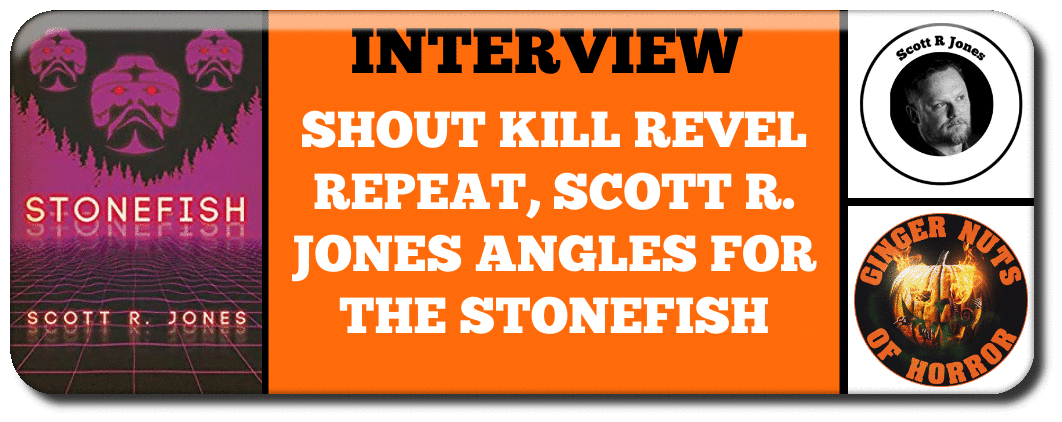
 Occult technology. Mind-bending hallucinations. The very fabric of reality broken down and reconfigured before your very eyes. Oh, and Bigfoot, too. All these things and more have found a home in the transgressive, transhumanist, transcendent syntax of one Scott R Jones: author, cyborg, Canadian. As the head (in every sense of the term) of Martian Migraine Press, Jones has helped preside over dramatic interrogations of Lovecraftian fiction, cosmic horror, and the weird tale. As an anthologist, he’s weaponized some of the most cutting-edge voices in the genre against its own regressive elements. And as an author himself, he has crafted a own uniquely subversive, psychedelic storytelling style designed specifically, one must assume, to turn readers’ psyches inside out. It is in that role of creator that two of Jones’ most recent contributions, his first solo collection, Shout Kill Revel Repeat, and his first novel, Stonefish, have been unleashed. Jones spoke with The Ginger Nuts of Horror to reveal the spiritual roots of his fiction, how the global coronavirus pandemic is impacting the publishing world, and what he really thinks of everyone’s favorite foot-in-mouth capitalist tech-daddy Elon Musk. Wear a helmet for this one, kids. In terms of publishing 2020 has been a big year for you, with the release of your first collection Shout Kill Revel Repeat coming right at the very end of last year and your first novel Stonefish coming out a few months later. Was there any planning on your part to come into 2020 all guns blazin’ or is that just how coincidentally fell together? That is the way it all fell together, indeed. No planning on my part anyway; I can’t speak for my publishers, maybe they knew better? I’d like to think so. But yes, it’s been a bit of an accelerated timeline since last December. Feels all right, too, if that makes sense. I feel I’m on a decent track now and I can plan for more progress in future. Releasing not one but two new books has got to be exciting, but 2020 has turned out to be a pretty chaotic year all around with coronavirus and all the global political drama. Has that taken the wind out of your sails at all? My allostatic load is HUGE, not gonna lie. Reading other material is difficult. I don’t think I’ve read a book cover to cover since March. And creating new stuff has had its challenges, although in recent weeks I’ve found reason to go on, writing-wise. Finally, new stories are rising out of the mire of my mind, so that’s nice to experience. But yes, it has been rough. Do you think the current world climate has had a positive or negative impact on these releases? On one hand, with the lockdowns people have had more time to stay indoors and read. On the other hand, people have less spending money and have a lot of other things vying for their attention. Exactly. No, I think the overall impact is negative and I think, given the world situation, that we should expect that and normalize that. Finding other ways to connect with and provide entertainment for readers is a key issue now. But then, I’m not privy to all the sales information (as I was when I ran Martian Migraine Press) so I’m quite comfortable with the idea that I am completely wrong on this and the impact of plague and cultural disaster has been a boon for books and those who read them. Who knows? We’ll find out as the years pile on, I guess. So since Shout Kill Revel Repeat came out earlier, let’s talk about that first. The stories included are very eclectic, but many of them share, at least on some level, a kind of cosmic scope and/or questioning of the nature of reality. Are these themes intentional fixtures of your work or is it something that just naturally finds its way into your stories? What is it about these themes that speaks to you? Nice question. I would say that there’s a definite lean in my work towards those perspectives first, and other themes second. For myself, I think we don’t question reality enough because here we are, as a species, on the brink of extinction largely due to our own unthinking manipulation of the planet and its resources, and on the brink of social and economic catastrophe because we can’t seem to think differently enough to fix these dangerous issues. We have the capability but we don’t seem to use it to its full capacity. So, humbly, I present these small fictions as a tonic. I hope they help readers to start seeing the planet in a new, dangerous, alien way. It’s weird here! The bulk of the stories included in Shout Kill Revel Repeat were originally published elsewhere. You’ve certainly been around the block a few times, having your work appear in various magazines and both themed and non-themed anthologies. Compiling the stories for this collection, see them all together in one place and having them laid out one right after another, were you surprised by any recurring motifs or, alternately, vast differences? Do you feel like the stories in the collection revealed any stylistic or thematic evolution for you, as a writer or just a person? I wasn’t surprised. I mean, I knew what was in there. Certainly seeing them all in one place created a kind of solidifying effect. If I didn’t know what my themes were before, then I do now! I like transhumanist narratives. I like writing about drugs, monsters, things unseen that nevertheless have a deep impact on the world, hyperobjects, the occult, AI science, camouflage. These are the big items in my bag! On a similar note, were there any stories you wanted to include but for whatever reason just didn’t fit? How well do you feel the three original pieces published for the first time in Shout Kill Revel Repeat pair with the others? I wanted to include “The Damage” as it’s my latest written story and honestly, it feels more like my recent work than, say, “Turbulence,” which was the first story of mine someone published. In case you are looking for someone to blame for that instance, look to the inestimable Silvia Moreno Garcia; “Turbulence appeared in one of the last issues of her Innsmouth Free Press. As such, “The Damage” I think points to a spot on the horizon where I seem to be heading, which is to say more intimate narratives between close characters as they come up against the world in all its strangeness. Moving on from Shout Kill Revel Repeat to your first ever novel Stonefish, I have to ask what it was like making the leap into long-form storytelling. Many authors seem to find writing their first novel a daunting task. How was it for you? And what made you want to try your hand at a novel? Why would this idea only work as a novel and not as a short story? Well, Stonefish isn’t my first kick at the can. There is a novel called The Waiting Deeps which is as awful a piece of Lovecraftian pastiche as you can imagine. In fact, it’s more Brian Lumley than ol’ HP, if that makes any sense. I have gone through my Innsmouthbreather phase, as have we all. And there’s another disaster, missing body parts and generally a shambling Burroughs-influenced metanarrative called The Boy’s Own Guide to Sorcery which I hope will never see the light. So I was ready for the grueling aspects of writing a novel when I began Stonefish. As for size and length of it, I’d approached some of the themes before, in stories like “Assemblage Point,” and I knew if I wanted to lay down the full Gnostic horror of the situations the characters Den and Gregor find themselves in, I would need more spacetime/pages in which to do it. Stonefish is set in a near future world devastated by unchecked climate change, and it tells the story of a journalist following the trail of a tech industry wunderkind gone missing, in the process plunging himself into a cyber/cosmic horror nightmare that includes sentient artificial intelligence systems, interdimensional entities, the fundamental hostility of the universe itself, and even Bigfoot. A less respectable interviewer might jokingly ask “What are you smoking?” As a professional, however, I am going to sincerely ask “What are you smoking?” It’s a special blend of my own devising. Thanks for asking! The climate change and tech guru themes are obviously very relevant to the current social climate. What made you want to explore these ideas in Stonefish? Did the process of working on this novel refine your understanding of these matters in any way? I’m especially curious how you feel about real-life figures like Elon Musk and Mark Zuckerberg. I wanted to explore them because they are there to explore and hugely relevant to our continued existence on this planet. Despite being surrounded by PNW hippies and lightworkers, despite living most of my life so far in one of the more socially and environmentally progressive places in Canada, I realized also that I didn’t know all that much about climate change, so I contacted the climate science department of the University of Victoria and sat down a couple of times with two researchers there and boy, did they help me dig down. Dig down into the terrifying meat of the problem! It’s gross in there, the situation is incredibly heinous, but they find themselves in the uncomfortable position of having to trot out the data in a way that won’t cause people to panic and yet the data is, when looked at objectively, worthy of a panic response. Or at best, a better response than what is currently being offered. I can’t do much as one man, and maybe a little bit more a writer, so in it goes. I’m writing about the 2070s, after all. I went to the experts to learn what that decade is going to be like; I made nothing up in Stonefish, that’s all legit climate science. As for Musk and Zuck and all those greedy boys, I say string em up, raid their larders, deal out the dollars to the rest of us. I mean, hell, also let them go to Mars and put chips in our brains, that’s un fait accompli anyway, and we kind of need them to do it because like it or not, historically, its wealthy whack jobs like them that are going to push the species in novel directions, BUT there’s more than enough to go around. Stonefish does not mark the first time your work has combined high-tech science with occult mysticism. What fascinates you about these topics? And what do you think the crossover is between the two? How are they connected? I’ve been a classic head for decades now, so I cut my teeth on those early psychedelic pioneers who’s main deal was the overlap between, say, poorly understood quantum physics and oh I dunno, the frequency differentials found in the angelic Keys of John Dee. Or the kabbalistic Tree of Life mapped onto the drive train for an automatic transmission automobile. At the end of the day, this is all we operate with: a series of mapped thought pathways that we can superimpose on any physical (or social, or environmental, or spiritual) system (yes, you can get all layered up with your religion and magic, it’s called the syncretic approach) with a greater or lesser degree of accuracy. In truth, I don’t think there are many actual things in the world, that much of it is camouflage in some higher-dimensional way, and that much of reality works more due to habit than anything else. Habits change, and tech (whether material and physics-based or occult ie. mental and spiritual techniques) can help change them. In both Stonefish and Shout Kill Revel Repeat, you revisit Lovecraftian ideas and themes without just rehashing the standard Mythos Iconography, tropes, and stereotypes. In addition to your own writing, you’ve also edited and published several anthologies inspired by Lovecraft. What is your own history with Lovecraft, what impact has his work had on you, and what do you think is different about the way you approach his influence compared to those who have basically just rewritten his tales under their own names? Like I said earlier, I went through my Innsmouthbreather phase as a younger man. Yes, I fantasized about having a dinner of tinned spaghetti, coffee, and ice cream with Grandpa Howie like everyone else, I’m not special! But even during the early days, it was more Lovecraft’s ideas, his way of looking at the cosmos, and the things he peopled it with (things that continue to increasingly resonate today) than the writing itself that attracted me. Right now, my connection with Lovecraft is, like many others, a kind of love/hate thing. By writing the things I do, and by editing the Martian Migraine Press anthologies, I feel I’m taking those ideas and either pulling them into the present so they can speak to our heightened sense of impending horror/knowledge or firing them from a cannon into the future where they can express themselves in bizarre and fulfilling ways. Pastiche is for, literally, the last century. We all had our fun, but no one wants to spend another minute in Arkham or Innsmouth or goddamn Dunwich. Well, speaking for myself, of course. Your mileage may vary. Referring to another Lovecraft-related work in your bibliography that predates both Stonefish and Shout Kill Revel Repeat, you’re also the author of the non-fiction book When the Stars Are Right: Towards an Authentic R'lyehian Spirituality, a kind of hybrid of a critical analysis and a philosophical manifesto. How do you feel works like Stonefish and the stories in Shout Kill Revel Repeat embody or echo your R'lyehian spirituality? Simple. We aren’t what we think or believe ourselves to be. We’re something stranger, stronger, and far more capable of navigating weirdness than we’re taught. Owning that, becoming what we are meant to become, that is survival, that is the clear-eyed appraisal of our place in the cosmic mechanism, that is the moment we can embrace our humanity in all its strangeness and put it to real, transformative work. In the stories of SKRR and to a lesser degree in Stonefish, I give my characters a path to that becoming. To put it in the faux-glib fashion of When The Stars Are Right, I try to open up the possibility that they, too, could be Keeping It R’lyeh! Some have greater success than others. Like Lovecraft, I am hampered, sometimes, by the conventions of the “horrifying weird tale”. You’ve written a fiction novel, a fiction collection, and a non-fiction book. In your own words, how would compare the processes of writing each? For you, what purpose does one serve that the other can’t? I found the writing of WTSAR to be the most relaxed process, as it’s basically a collection of essays on Lovecraftian-derived mysticism. Short fiction is intense and finishing a piece usually takes me anywhere from a couple of days to a month and change; I like writing these because they help me flesh out ideas for the longer works. The short story Assemblage Point was the moment I became really interested in the ideas of higher-order camouflage which led to Stonefish. The non-fiction lays out the philosophy and the short fiction builds on it in a specific way before handing over the results to the novel(s). It’s clunky but it works for now. Piggybacking off that last question, of those three types of writing (short fiction, long fiction, and non-fiction) what can we expect to see coming from you in the near future? I know Stonefish and Shout Kill Revel Repeat only just came out, but do you have any plans or projects in mind? I am currently digging down into the next novel, which will hold such things as religious and environmental hyperobjects, cults, memetic viral disease, and social engineering. In it, an estranged mother and daughter become victims of a group that is taking advantage of people who are hearing a “call” from the ocean. It’s not what you think, though. And in between bouts with the novel, I’m starting to pump out some more short fictions, the rona be damned! Finally, I just wanted to say thank you for taking the time to talk to The Ginger Nuts of Horror. How can readers best stay up to date with you and your work online? Best to follow me on Twitter @PimpMyShoggoth. I also exist virtually on the ol’ Facebook! My god, talk about a hyperobject! Also there is a website scottrjoneswriter.com but like most writer types I maintain it only sporadically. Thanks for having me! Interview by William Tea  A missing tech mogul... ...a jaded reporter... ...a damaged AI returned from a horrifying reality... ...and something lurking in the woods. When journalist Den Secord is tasked with locating enigmatic tech guru Gregor Makarios, he soon finds his understanding of reality under threat. At the edge of the world, surrounded by primeval forests, in the paradisiacal environs of Gregor's hi-tech hermitage, Den learns of the true nature of our Universe. This is the way the world ends. Heart of Darkness meets The Magus meets bleeding-edge psychedelic gnosticism in Stonefish, the debut novel from Scott R. Jones (When Stars Are Right, Shout Kill Revel Repeat).   Comments are closed.
|


Archives
May 2023
|
 RSS Feed

|

|