

LEE FRANKLIN GOES THROUGH GREEN HELL
27/9/2019
 After ten years in the Australian Army , Lee Franklin has been a personal trainer, logistics officer, and the mother of three boys. Recently moved from Western Australia to the Yorkshire countryside with her family, and with the full support and belief of her husband Marcelo, Lee is finally able to focus on her writing, exploring across genres with her words. This is just the beginning… Could you tell the readers a little bit about yourself? I’m not your regular woman. I would rather be throwing axes than cooking, discussing the best ways to kill zombies than homework, and hiking through the woods for hours with my dogs than walking through a shopping mall. My husband is from Argentina, and together we are raising three amazing boys. Originally from Western Australia, we have moved to beautiful North Yorkshire and we are loving it. I supported my husband to get to where he is now, and now he says it’s my turn. I’ve always been a massive reader; it was my way to escape a tumultuous childhood. I always dreamt of writing, but my English teacher informed me I would never make it as a writer, and so I never really emerged past teen-angst poetry before life took over. I studied Tae Kwon Do and boxing and served in the Australian Army in logistics. I was deployed twice to East Timor. I have driven all around Australia, both personally and in semi-trailers for the Army. After my second child, I left to become a personal trainer. Being fit and active have always been massively important to me; I find it easier to write action and fight scenes if I am better connected and in tune with my body. I’ve worked a variety of jobs in logistics, mostly for the government. Some I can’t tell you about, or I might have to kill you. But this Yorkshire writing life is definitely for me. To get the ball rolling and get everyone relaxed, here is a hopefully lighthearted question to break the ice. Which one of your characters would you least like to meet in real life and have them complain to you about the way you treated them in your work. OMG, who would I start with? I treat them all a bit bloody awful, even my favourites. Especially, my favourites. I guess maybe Doc from Green Hell. He’s a priest turned medic, nabbed by some beastly alien, and had his rib cage ripped open only to be shredded by a landmine. He is a sweet guy, decent human being, no matter how much I messed him up. My only defense would be: the more I like the character, the spectacular exit plan I have in store for them. Wear it as a badge of honor…I guess. Other than the horror genre, what else has been a major influence on your writing? I have to say horror hasn’t been a massive influence in my writing. Not consciously anyway. I never read horror growing up. I grew up watching action flicks. Anything with Arnie or Stallone was my bread and butter. I consumed pretty much any book that came my way, starting with Enid Blyton at age four. Historical fiction (any period prior to guns) I thoroughly get lost in. I discovered horror as a byline of the action flicks with movies like Predator and Aliens leading the charge. Which is funny in itself as I’m not particularly into sci-fi. I guess if it has enough action it will hook me. Looking back, all of the above has created the hot mess that is me as a writer and undoubtedly comes out in my work. The term “horror,” especially when applied to fiction, always carries such heavy connotations. What’s your feeling on the term “horror,” and what do you think we can do to break past these assumptions? I believe the knee-jerk reaction to “horror” is slasher films. Stupid teenagers making inexplicable decisions followed by copious amounts of blood and gore. I believe Peter Laws non-fiction book The Frighteners tackles these assumptions nicely. Essentially, horror is healthy, grounding, and a part of the natural order. Horror through film and books help us deal with our fears in a safe space. How do we get this to a reluctant audience with pre-conceived ideas is tricky. Maybe it lies in the merging and blurring of genres that will lead them in, who knows? Besides, horror is subjective as we each have different fears and squeamish tolerances. A lot of good horror movements have arisen as a direct result of the socio/political climate, considering the current state of the world. Where do you see horror going in the next few years? I doubt any horror I could write at the moment could surpass what’s happening to the world politically, environmentally, or technologically. There’s a plethora of horror fodder to be explored as the world sits on the precipice of a new era. I believe we’ll move more away from the human psyche (serial killers) and into the potential consequences of where we are headed –dystopia, social collapse, evolution of new creatures for the new world, etc. Given the dark, violent and, at times, grotesque nature of the horror genre, why do you think so many people enjoy reading it? I believe people enjoy reading horror as it grounds us in our own mortality. It allows us to experience pain and misery through others in a safe space. If your life is only ever full of sunshine and rainbows, you will never appreciate and embrace the beauty of it. What is the saying, the best thing about pain is you know you are still alive. What, if anything, is currently missing from the horror genre? I feel we have the horror genre pretty well covered. Well, that is if you read from a broad range within the genre, and it’s a very broad genre. There are so many new voices being heard now, with fresh stories. There is something for everyone if you look hard enough. I would definitely like to see more folklore from indigenous communities. For example, the Australian Aboriginal community has some outstanding stories and characters that are truly horrific. It probably is there but I’m not looking hard enough. If you know of any, please send them my way. In the past, authors were able to write about almost anything with a far lesser degree of the fear of backlash, but this has all changed in recent years. These days authors must be more aware of representation and the depiction of things such as race and gender in their works. How aware are you of these things, and what steps have you taken to ensure that your writing can’t be viewed as being offensive to a minority group? This was very important to me in the writing of Berserker – Green Hell. My main character is a bi-racial Australian Aboriginal male in 1960s Australia. I wrote how things were, not how I wanted them to be. I did actively seek out collaboration from within the Aboriginal community and I was fortunate to find it. I didn’t want the story to be focused on race; there are many other themes that drive the story forward. Pinny’s race, while important to the story, is only a thread in a larger tapestry. I found it a precarious line to balance, but believe I have, with collaboration and support, found the right balance. I did seek collaboration with Australian Vietnam Veterans but didn’t have such luck. Undoubtedly, I will offend somebody, more likely a Texan or an American. But, I believe it’s my job as a writer to be as accurate as possible regardless if we like the truth of it or not. Does horror fiction perpetuate its own ghettoization? For example, Julia Armfield’s latest collection Salt Slow has a cover that most horror fans would walk past in a book shop and one that probably is not marketed as horror. Does the genre’s obsession with horrific covers cause more harm than good? I think like in any industry, we play to what works. What the market recognizes. I wouldn’t say it’s an obsession as much as a habit. The cover of Berserker Green Hell is definitely stock-standard horror and is more the publisher’s vision than my own. Maybe we could be more subtle, but then we might end up with more complaints in our reviews by misled readers. I’ve seen it happen. What new and upcoming authors do you think we should take notice off? Ummm me? I’m new and upcoming. No, seriously, DJ Doyle is somebody to watch for in the splatter scene with her Red books. She also dabbles in a fair bit of Irish folklore and hosts an awesomely funny Irish priest. Luc Vors, I really enjoyed his Let Sleeping Dogs Lie, a grey psychological twisted mess. I think he’s in the process of releasing a revised edition. What are the books and films that helped to define you as an author? Anything pumped full of action adventure. Predator, Indiana Jones, Conan the Barbarian. My biggest inspiration, writing wise, would be Australian author Matthew Reilly. While not horror, his pieces are reminiscent of Indiana Jones on steroids; it’s fast paced, head spinning, neck-snapping action with some really great characters and Dan Brown-esq storylines. Are there any reviews of your work, positive or negative, that have stayed with you? So far I have only been blessed with positive reviews. I am certain that will change at some point because I don’t expect everybody to like my style or story, and some will just find fault with it, because that is what they do. It is my first novel though, so I would be bummed out if it was perfect because then there would be no room for growth or improvement. I will always put out my best work, I just hope that my work keeps getting better. I must say that my first ARC reviews from Karen Perkins (an European Awarding winning author of Yorkshire Ghost Stories), Simon Clark (Night of the Triffids, Blood Crazy, etc), and Peter Laws (The Frighteners and his Matt Hunter series) were amazing and blew me out of the water. Not only their reviews of my work, but the personal notes I received on my writing were a truly amazing experience. All of these are well established, experienced writers within the industry, that owed me nothing. The fact that they loved my work is very encouraging and still makes me buzz. What aspects of writing do you find the most difficult? Self-belief. I am still pretty new to this game, and I am constantly asking if I’m an imposter. But, mainly editing. I really truly suck at editing. Punctuation and grammar are definitely my Achilles heel. I am improving, but why I never learned it through school or reading is beyond me. I blame it on a life of speed reading. Is there one subject you would never write about as an author? I haven’t found it yet. Hence a pen name. How important are names to you in your books? Do you choose the names based on liking the way they sound or the meaning? Names are important to me. In Berserker – Green Hell, a lot of my characters are named after people I know, or a play on their names. My main character Pinny is actually named after my father. I used it as a placeholder and then it just stuck. But a few more are named after my eldest and youngest sons. The middle son is missing out so far, but that’s okay. He’s the middle child and used to it. Writing is not a static process. How have you developed as a writer over the years? Well as I’ve not really been writing yet for years, it’s hard to gauge, so far. I guess I’m more confident in my voice and comfortable with my style. I’m transitioning from that fine line of purple prose into what has been suggested as great imagery. What is the best piece of advice you ever received with regard to your writing? Your first draft is putting sand in the sandpit. You can’t make a sandcastle without any sand. And, don’t get bogged down with the first perfect sentence, or chapter. It will change with each draft. Worry about it at the end. For to many writers, the characters they write become like children. Who is your favourite child, and who is your least favourite to write for and why? There’s a lot of me in Pinny; he is reactive, non-confrontational, and just tries to keep life as simple as possible. That’s probably why he’s not my favourite child, he reflects my weaknesses. He will evolve, or I might just do what you do with all recalcitrant children and lock him in the basement. Jacinta Harding is definitely my favourite child and everything I would love to be. Smart, sexy, and assertive. Okay, yes, she has some psychotic “Thanos” type tendencies, but no one is perfect. For those who haven’t read any of your books, which of your books do you think best represents your work and why? My short stories are quite diverse as I am trying new things all the time. But definitely my favourite is my novel Berserker - Green Hell. They say write the book you want to read, so I did. It’s action packed, yet still deals with relevant themes and is deeper than just a gore splatterfest. It combines everything I enjoy: action, conspiracy, cryptids, and others I can’t say too much about without giving it away. Do you have a favourite line or passage from your work, and would you like to share it with us? “The jungle rippled out towards us just before the shockwave kicked me in the solar plexus and carried me bodily over the lip of the gorge. Aviation fuel roared in a huge, blistering explosion and flickering tongues of orange flame blotted out the endless green as we rolled down the side of the steep embankment like sacks of meat and bone in some ghoulish pinball machine.” Can you tell us about your last book, and what you are working on next? Well I’ve talked enough about Berserker – Green Hell. I’ve started work on its sequel. I’m thinking Berserker-Sand Fire or something to that effect and it will be much more international. We’ll be in a Russian gulag, the Australian Outback, and tearing through the U.S. I would love to have this ready for Stoker-Con 2020 in Scarborough, UK. Will there be more Berserker after that? Only the readers can decide. If you could erase one horror cliché, what would be your choice? That stupid people making stupid decisions that are obviously going to get you killed. What was the last great book you read, and what was the last book that disappointed you? I’ve just finished reading Them by James Watts and quite enjoyed it. The last book that disappointed me was Pieces of Her by Karin Slaughter. It’s a great premise and should have been so much more, I feel she really just pulled the punches What's the one question you wish you would get asked but never do? And what would be the answer? “Hey Lee, can we make your book into a movie?” “Sure, let’s talk.” Berserker: Green Hell by Lee Franklin A terrifying debut novel set during the Vietnam War.Australian Lance Corporal Terence 'Pinny' Pinfold and his squad find themselves in the midst of the living hell of the Vietnam War.Known as Reapers, their job is to go in after the firefights, collect dog tags and any evidence of war crimes.As each soldier tries to make some sense out of a senseless war, there are more questions than answers as mutilated, butchered bodies are discovered the further to the North they venture.Pinny soon finds himself at the very core of the real war - in a secret underground facility amongst hybrid creatures which belong only in the very worse nightmares.With Pinny's aboriginal bloodline, the enigmatic Doctor Jacinta Harding believes she has found the perfect specimen...Pinny might survive the war, but he might not save himself.    Stephanie M. Wytovich is an American poet, novelist, and essayist. Her work has been showcased in numerous venues such as Weird Tales, Gutted: Beautiful Horror Stories, Fantastic Tales of Terror, Year's Best Hardcore Horror: Volume 2, The Best Horror of the Year: Volume 8, as well as many others. Wytovich is the Poetry Editor for Raw Dog Screaming Press, an adjunct at Western Connecticut State University, Southern New Hampshire University, and Point Park University, and a mentor with Crystal Lake Publishing. She is a member of the Science Fiction Poetry Association, an active member of the Horror Writers Association, and a graduate of Seton Hill University’s MFA program for Writing Popular Fiction. Her Bram Stoker Award-winning poetry collection, Brothel, earned a home with Raw Dog Screaming Press alongside Hysteria: A Collection of Madness, Mourning Jewelry, An Exorcism of Angels, Sheet Music to My Acoustic Nightmare, and most recently, The Apocalyptic Mannequin. Her debut novel, The Eighth, is published with Dark Regions Press. Follow Wytovich on her blog, on twitter @SWytovich, Instagram @swytovich, or find more about Stephanie on her Amazon Author page or her website. Could you tell the readers a little bit about yourself? Hi there! My name is Stephanie and I’m a pretty serious bibliophile with a writing problem. My focus is all things horror, and I write poetry, fiction (short stories and novels), and essays—typically about women in horror (both in literature and film) and the craft of speculative poetry. I’ve been writing professionally for about ten years now, and by day I work as a Student Success Coordinator for Point Park University as well teach in two MFA programs (Southern New Hampshire University and Western Connecticut State University), and in 2016 I took home the Bram Stoker Award for my erotic horror poetry collection Brothel. To get the ball rolling and get everyone relaxed, here is a hopefully lighthearted question to break the ice. Which one of your characters would you least like to meet in real life and have them complain at you about they way you treated them in your work? Oh, this is an easy one: Paimon from my novel The Eighth. I’ve done some pretty down-right horrible things to that man, and I would not like to have a real conversation with him any time soon. Plus, he still has two more journeys ahead of him, so knowing what he’s about to go through wouldn’t make that conversation any easier for me. Other than the horror genre, what else has been a major influence on your writing? I obviously really enjoy poetry and I read a lot of memoir and true crime as well, but fantasy and science fiction sneak in every once in a while for me, too. I love world-building, creating monsters and legacies, and playing with mythology, but I also like the machines and technology of advanced societies, too. However lately, I’ve been reading a lot about death rituals and funerary practices throughout history and across cultures, and it’s been widely influential on my work. For example, right now I’m reading a book by Caitlin Doughty, my favorite mortician—people have those, right? —titled: Will My Cat Eat My Eyeballs? Big Questions from Tiny Mortals About Death. The term horror, especially when applied to fiction, always carries such heavy connotations. What’s your feeling on the term “horror,” and what do you think we can do to break past these assumptions? I love horror and the genre has always brought me immense comfort and catharsis throughout my life. I tend to think the fact that we get associated with monsters, trauma, evilness, and mental illness is a sad, weak excuse perpetuated by someone who is afraid of looking into and exploring their own demons and is willing to make any excuse not to do so. I mean, you can’t have light without darkness, right? Personally, I think anyone who is willing to confront what scares them is not only brave but admirable. Those working in this industry have been some of the nicest, most compassionate, and intelligent people I’ve met, and in a world where everyone is so quick to stereotype and judge a book based on its cover, I think the best thing that we as artists and fans can do is speak out and share stories and art to combat that prejudice. A great example of that is the #horrorishealthy hashtag on twitter and Instagram that fans and artists have been using to combat the trigger warning message that comes up when someone uses #horror in their post. My suggestion? Read, write, view, and immerse yourself in the genre and talk about it across your various social networking platforms. Review art. Tell your friends about it, spread the word! The more we share and discuss why horror has a noteworthy place in society, the less taboo it will become. A lot of good horror movements have arisen as a direct result of the socio/political climate, considering the current state of the world. Where do you see horror going in the next few years? I think we’re moving into the next era of the Satanic Panic, and it’s why we have movies like Hereditary, The VVitch, Satanic Panic, and shows like Chilling Adventures of Sabrina, and AHS: Apocalypse, and documentaries like Hail Satan? being pumped out like crazy. People are on edge, angry, and looking for a different way of handling x, y, and z, and as a result, conservative fears about alternate ways of thinking start to rise. The scapegoat for that is evil and artists are deliciously exploring it. Given the dark, violent and at times grotesque nature of the horror genre, why do you think so many people enjoy reading it? For me, horror has always been about survival. I think we flock to it because we like confronting our fears in a safe place where we can observe terrible things, but not be directly threatened by them. On the whole, it’s a blunt genre that doesn’t sugarcoat things, and I think it allows us to examine our faults and instincts in an environment that’s actually teaching us about our values, morals, and faith so we can constantly reevaluate the person we are inside as well as learn how to navigate the world and the people around us. Furthermore, I think we’re all looking for that magical equation that shows why evil exists, i.e. something happened during our childhood, our mothers didn’t love us enough (or too much), etc. Horror attempts to answers those questions—oftentimes not in the most flattering light, especially for women---but nevertheless, it’s giving us a chance to try to understand evil, death, trauma, and grief. After all, if we understand it, then we know how to overcome it, right? If we know why the monster exists, we could prevent it from becoming a monster in the first place, maybe learn how to fight it, better survive against it if it gets loose. If we know what happens after we die, then perhaps the notion of death became less scary and we’re better able to handle our grief when we lose someone we love. At the end of the day, we’re all just trying to live a comfortable, safe life, so it makes sense that we would be drawn to a genre that tries to teach us how to make those things happen and prepare for the moments when life is anything but. What, if anything, is currently missing from the horror genre? Personally, I’d like to see more diversity and inclusivity in the genre. While there are countless male horror writers (see, that sounds awkward doesn’t it?) that I love and will read, review, and sing the praises of, I want to read more stories by people of color, by people of varying genders and sexual orientations. I want to read a story about an asexual succubus that’s written by someone who has the experience every day of identifying as asexual, or watch a lesbian vampire movie that isn’t written for the male gaze and is directed by—you guessed it! —a lesbian. I want to learn about different monsters from different cultures explored by people who grew up hearing those bedtimes stories. It doesn’t seem like it should be that hard, but for some reason it is. Currently, I think it’s great that we have Women in Horror Month in February to help raise awareness and shine a light on all the rad women working in the genre, but I also really have to hand it to the Ladies of Horror Fiction, who forever work (regardless of what day/month it is) to make sure that there is both a directory for and of female horror writers so the conversation surrounding us can happen at all times. The horror #bookstagram community is also ridiculously on point with spreading a message of diversity and inclusivity whether they’re opening a dialogue about certain authors, participating in Pride, promoting new releases, etc. I also want to take a moment to give a shout out to the Night Worms, who constantly bring a smile to my face and give me hope for everything that the genre can become. Honestly, for the first time in a really long time, I’m starting to feel like just a horror writer…. not a woman who writes horror. In the past authors were able to write about almost anything with a far lesser degree of the fear of backlash, but this has all changed in recent years. These days, authors must be more aware of representation and the depiction of things such as race and gender in their works. How aware are you of these things and what steps have you taken to ensure that your writing can’t be viewed as being offensive to a minority group? I’m very aware of this, and like I said above, I think diversity and inclusivity is something that horror is in desperate need of, and while we’re taking steps in the right direction, I think a bigger renaissance is on the horizon for the genre. Having said that, I tend to write with a strong, feminist—and at times, LGBTQIA+—bent to my prose in order to restructure old clichés and stereotypes that are usually attached to female characters in horror. I also want to shed a more sex-positive light on the genre because there’s such an engrained fear surrounding female bodies, their power, and a new angle of thought could and would be beneficial to the genre as a whole. If I’m concerned about how something is coming off, I’ll send it out to my beta readers and some friends to get their take on it before I send it out into the world. I always like to have a bunch of eyes on my work because others will see stuff that I can’t or refuse to see because I’m too close to the material. It’s a nice safeguard to have in place and the feedback is truly invaluable. Does horror fiction perpetuate its own ghettoization? For example, Julia Armfield’s latest collection Salt Slow has a cover that most horror fans would walk past in a book shop and it’s one that probably is not marketed as horror. Does the genre’s obsession with horrific covers cause more harm than good? Truthfully, I’m not sure how I feel about this. I think I would have to take it on a case-by-case basis, but I agree that by looking at Armfield’s collection that I wouldn’t think it was horror based off the cover alone. Is that necessarily a bad thing? If I’m browsing the store looking for a horror novel, then yes, but the truth behind that is that most stores don’t even have a horror section so that doesn’t really come into play. I think the title for it is far more important here, and when it’s coupled with the color scheme and mystical nature of the cover, I’d probably pick this one up to investigate it more. However, when it comes to horror-laden covers in general, I think it’s fine to an extent, i.e. no explicit violence, naked women, abuse, etc., but this type of exploitation isn’t only in horror; it’s something that the romance genre deals with as well. Having said that, a cover that is generally of a dark, weird, and/or macabre nature will certainly draw me in and cause me to investigate more compared to something that’s open to interpretation like Armfield’s book. What new and upcoming authors do you think we should take notice off? Some favorites I can fully recommend are: Gwendolyn Kiste, Christa Carmen, Sarah Read, Brian Kirk, Todd Keisling, Zoje Stage, Usman T. Malik, Lee Murray, Gabino Iglesias, and Claire C. Holland. What are the books and films that helped to define you as an author? My cannon starting out looked something like this: A Nightmare on Elm Street, directed by Wes Craven Hellraiser (movie), The Hellbound Heart by Clive Barker Carrie by Stephen King Exquisite Corpse by Poppy Z. Brite The Girl Next Door by Jack Ketchum The Brood directed by David Cronenberg Frankenstein by Mary Shelley The Haunting of Hill House by Shirley Jackson Lost Boys directed by Joel Schumacher Rosemary’s Baby directed by Roman Polanski These days, I’d say my inspiration and influence comes from stuff like: The VVitch directed by Robert Eggers The Babadook directed by Jennifer Kent Suspiria directed by Dario Argento Dead Ringers directed by David Cronenberg Midsommar directed by Ari Aster You by Caroline Kepnes My Best Friend’s Exorcism by Grady Hendrix A Head Full of Ghosts by Paul Tremblay Baby Teeth by Zoje Stage Are there any reviews of your work, positive or negative, that have stayed with you? Oh, god yes. There is a review for one of my books out there that says something like I’m glad I bought the kindle version of this so I didn’t kill a tree reading this awful book. Who told this woman she could write? Fun stuff. I obviously never think of it… *shifts eyes in denial* What aspects of writing to do you find the most difficult? All of it, ha! Writing fiction is rough for me, and it’s something that I’ve been focusing on more and more lately in an effort to release some of the pressure I associate with it. I tend to write prose rather slow, so cranking out that first draft is always a bear for me. I am taking steps in my life to alleviate some of my day-to-day workload so that I can focus more on writing fiction, so I’m hoping that more practice in the craft will lead to less stress about sitting down and writing. Is there one subject you would never write about as an author? I am a huge animal lover, and my dogs are my life. Animal abuse isn’t something that I plan on tackling any time soon—if ever, really—and in the one story that I’ve even lightly touched on it, the readers don’t see or experience it in any way. How important are names to you in your books? Do you choose the names based on liking the way it sounds or the meaning? Most of my choices are made on auditory appeal—must be the poet in me or something. So yeah, this is something that I typically agonize over until I find the one that fits just right. Writing, is not a static process. How have you developed as a writer over the years? Writing is work and it’s a craft that demands a lot of practice and a lot of hours. In addition to setting myself up with a fairly consistent routine of reading and writing, I’ve also started to outline these days, which is something that I never did when I was starting out. While I still enjoy writing off the cuff as it were, my schedule these days demands a more rigorous routine in regard to time management, and outlining helps me stay on track and make the most of my time. What is the best piece of advice you ever received with regards to your writing? Write for you, not for anyone else. It’s not always easy advice to follow, but I do find myself happier, more productive, and more at ease with my writing when I consider my wants and creative aspirations first. To many writers, the characters they write become like children, who is your favorite child, and who is your least favorite to write for and why? I think to some extent that Hysteria will always be my favorite child because she is what unleashed the madness, started the blood flow, and let the demons run wild. Honestly, between you and me, I think there’s a little bit of her in each of my books. The least favorite for me to write to was Jolene from my collection Sheet Music to My Acoustic Nightmare, and it’s not because I didn’t enjoy writing alongside her but rather that that book took a lot out of me emotionally. Because it was half-genre and half-memoir, I chose to relieve some trauma and less-than-delightful memories, so this was an exercise in turning exposure therapy into art. For those who haven’t read any of your books, which of your books do you think best represents your work and why? I’m going to have to go with my latest release, The Apocalyptic Mannequin. I think it showcases my strengths as a poet, and the imagery in this one feels more palpable to me when compared to some of my other work. Do you have a favorite line or passage from your work, and would you like to share it with us? I wrote a lot of reverse prayers when working on The Eighth and I love Paimon’s chant before/after his confessions: “Bless me my sins.” Can you tell us about your recent book, and can you tell us about what you are working on next? My most recent book is The Apocalyptic Mannequin from Raw Dog Screaming Press. It’s a post-apocalyptic poetry collection that straddles the line between science fiction and horror as it works to redefine the definition of body after life and everything as we know it has been taken away. As to future projects, I have a couple irons in the fire. I have some short stories I’m looking to finish up and I’m also looking forward to putting the final touches on a weird fiction novelette titled The Dangers of Surviving a Slit Throat. I’m also working on a non-fiction project and flirting with an idea for a horror comic. What’s sleep, you ask? Sorry, couldn’t tell you. It does sound nice though! If you could erase one horror cliché what would be your choice? That women who embrace their sexuality and independence in any way, shape, or form, are evil sluts who are not only a threat to the general populous but need to be destroyed. I’m not a fan of the damsel-in-distress, dumb blonde, or bad mother trope either. Whew. I guess I clearly have a lot of opinions on this one. Side bar: If you share these opinions, or want to learn more about them, because hey, education is always a good thing, I recommend reading Dead Blonds and Bad Mothers: Monstrosity, Patriarchy, and the Fear of Female Power by Sady Doyle. What was the last great book you read, and what was the last book that disappointed you? I recently read The Witches of New York by Ami McKay, which I absolutely loved and highly recommend to everyone. However, I was pretty disappointed by Stephen King’s Elevation. However, I’m super looking forward to The Institute! What's the one question you wish you would get asked but never do? And what would be the answer? Q: What’s the scariest thing you’ve ever done? A: While I was doing research for my first book, Hysteria, I explored, investigated, and spent the night in a bunch of abandoned and/or out-of-operation prisons, hospitals, and asylums such as: Trans-Allegheny Lunatic Asylum, Hill View Manor, and West Virginia State Penitentiary. In fact, Trans-Allegheny Lunatic Asylum became such a big part of my life then that I almost became a tour guide for them. What can I say? I’m a girl who loves her ghosts! About The Apocalyptic Mannequin 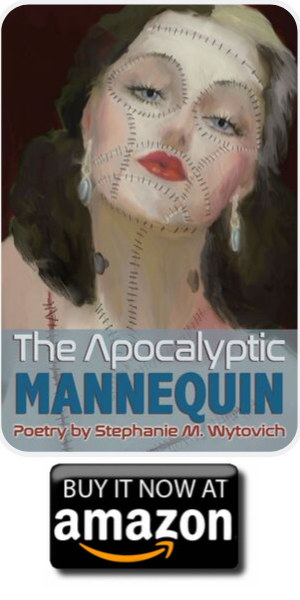 Doomsday is here and the earth is suffering with each breath she takes. Whether it’s from the nuclear meltdown, the wrath of the Four Horsemen, a war with technology, or a consequence of our relationship with the planet, humanity is left buried and hiding, our bones exposed, our hearts beating somewhere in our freshly slit throats. This is a collection that strips away civilization and throws readers into the lives of its survivors. The poems inside are undelivered letters, tear-soaked whispers, and unanswered prayers. They are every worry you’ve had when your electricity went out, and every pit that grew in your stomach watching the news at night. They are tragedy and trauma, but they are also grief and fear, fear of who—or what—lives inside us once everything is taken away. These pages hold the teeth of monsters against the faded photographs of family and friends, and here, Wytovich is both plague doctor and midwife, both judge and jury, forever searching through severed limbs and exposed wires as she straddles the line evaluating what’s moral versus what’s necessary to survive. What’s clear though, is that the world is burning and we don’t remember who we are. So tell me: who will you become when it’s over? What They’re Saying - “Like a doomsday clock fast-forwarding to its final self-destruction, Wytovich’s poetry will give you whiplash as you flip through page after page. The writing here is ugly yet beautiful. It reads like a disease greedily eating up vital organs. The apocalypse has arrived and it couldn’t be more intoxicating!” —Max Booth III, author of Carnivorous Lunar Activities “In this hauntingly sensuous new collection of poetry, you’ll long to savor every apocalyptic nightmare you have ever feared. Blooming in the beauty of destruction and the terror of delight, Stephanie M Wytovich’s poems remind us that we feel the world better, love the world better, when we recognize the ephemeral nature of everything achingly alive beyond our mannequin minds. Here, we are captive to our deepest velvet snarls, zombie songs, and radioactive wishes, at the mercy of a neon reaping. Reading this collection is like dancing through Doomsday, intoxicated by the destructive, decadent truth of desire in our very mortality. In these poems, you will find revelry in the ruins of everything you once held dear — and you will love it to the last as you watch the world unravel around you.” —Saba Syed Razvi, author of Heliophobia and In the Crocodile Gardens “Beautifully bleak, Stephanie M. Wytovich’s latest collection posits scenarios of the apocalypse and the horrors to come thereafter with language like fragrant hooks in your skin. Vivid, each word a weight on your tongue, these poems taste of metal and ash with a hint of spice, smoke. She reminds us the lucky ones die first, and those who remain must face the horrors of a world painted in blisters and fear. Leave it to Wytovich to show us there’s beauty in the end, just beneath all that peeling, irradiated skin.” —Todd Keisling, author of Ugly Little Things and Devil’s Creek “Set in a post-apocalyptic world that at times seems all too near, Wytovich’s poems conjure up frighteningly beautiful and uncomfortably prescient imagery. Populated by a cast of unsettling, compelling characters, this collection is one that stuck with me.” —Claire C. Holland, author of I Am Not Your Final Girl “A surreal journey through an apocalyptic wasteland, a world that is terrifyingly reminiscent of our own even as the blare of evacuation alarms drowns out the sizzle of acid rain, smiling mannequins bear witness to a hundred thousand deaths, and “the forest floor grows femurs in the light of a skeletal moon.” Stephanie M. Wytovich’s The Apocalyptic Mannequin is as unsettling as it is lovely, as grotesque as it is exquisite.” —Christa Carmen, author of Something Borrowed, Something Blood-Soaked    Author Roma Gray has been setting the horror world on fire with her series of books as part of her "Trick or Treat Thrillers." She continues to write and publish books much to the delight of her fans. She just released three - count ‘em three! - new books in less than a week! a new short story collection called "Celebration of Horror 2”, “Celebration of Horror 3” and a “Celebration of Horror 4” subtitled “The Best of Roma Gray.” Her fourth book, “Extreme Hauntings: Valentines from Hell.” All of them will be found on Amazon.com. We asked Roma a few questions about her new books! Congrats on your new collections! How excited are you? I’m always excited to do something special for Halloween. (However,) I’ve had a busy schedule lately and got behind in publishing, but I’m planning on getting four collections and one novel out this Fall. How long does it take you to write a short story? It usually takes one to two weeks to write and one week to edit. What kind of response did you get from the first "Celebration of Horror" collection? Do your stories have a unique theme? People liked (the first one) and I had several requests for a second one. (When I write) short stories, I always aim at a "Twilight Zone" style. So whether or not it is a zombie, werewolf or whatever, as long as I get that spooky mood and an ending that leaves the reader thinking about it for days I’m happy. Nothing is more thrilling than that for me. I also tend to go for the emotional situation. Horror is so much more satisfying when the reader can sympathize with the character. Is this why you write horror? I write what I read. I have a few romances and murder mysteries that I like, but mostly I read horror. Lately I’ve gotten into haunted house stories so expect to see more of those. Speaking of "what you read", who do you like? Ambrose Ibsen and Darcy Coates. And for writers out there struggling not just finding a home for the story, but completing a story, do you have any advice for them? Self-publish! Go on Facebook and find some people who can help you with a cover and editing then put out your own stuff. Keep looking for anthologies, but don’t wait for them. Just publish, publish. But make sure you’re putting out good work. Thank you so much! Check out Roma Gray's website here: and her Amazon page Extreme Hauntings: Valentines from Hell by Roma Gray What Is an Extreme Haunting? Cyndi has been pursued since childhood by a ghostly presence known as the Shadow Man and cannot escape his creative cruelties. Emily has been sadistically tormented for years by her violent ex-husband—even after his death. Both of their persecutors have one thing in common: They send their victims Valentines. Both of these women have one thing in common: They are suffering from an extreme haunting, a rare phenomenon that inflicts terrible suffering upon the victim—and it is completely inescapable. Can noted ghost hunter Professor Douglas Adair and white witch Brenda Wedge help Cyndi and Emily escape this terrible curse? DON EVERETT SMITH JR. Don lives in Central Pennsylvania with his wife, Laura, five cats and a tortoise. Don is a comic book and horror writer. He has written history books and thousands of articles for local newspapers, magazines and online publications. Pick up his new book “Blood from a Tombstone” found at Facebook.com/TombstoneStories and visit his comic book imprint at PinionComics.com and pick up some free horror comic books!   Daniel Braum is the New York based author of the short story collections The Night Marchers and Other Strange Tales (Cemetery Dance E books 2016), The Wish Mechanics: Stories of the Strange and Fantastic (Independent Legions 2017) and the chapbook Yeti Tiger Dragon (Dim Shores 2016). His third collection is forthcoming from Lethe Press. The Serpent’s Shadow is his first novel. He is the editor of the Spirits Unwrapped anthology from Lethe Press (forthcoming October 2019) and the host and founder of the Night Time Logic reading series in New York City. He can be found at www.facebook.com/DanielBraumFiction and https://bloodandstardust.wordpress.com Could you tell the readers a little bit about yourself? DB: I’m an American writer based in New York. I’ve been publishing horror stories for about a decade and a half now. One of my first short stories Across the Darien Gap appeared in Cemetery Dance Magazine back in Issue 54. My work tends to be in the borderlands between genres, though all if it is dark. To get the ball rolling and get everyone relaxed, here is a hopefully lighthearted question to break the ice, which one of your characters would you least like to meet in real life and have them complain at you about they way you treated them in your work. DB: I’ll choose the character Francois, from my short story How to Make Love and Not Turn to Stone which appears in my second short story collection The Wish Mechanics from Independent Legions Publishing. He faces a lot of loss. Other than the horror genre, what else has been a major influence on your writing? DB: A lot of my inspiration comes from the natural world. Nature. Animals. Travel. A lifetime of animal and people watching has provided a multitude of inspiration. Music is also a big influence. In many of my stories music plays a big part. In my short story Music of the Spheres from The Night Marchers, there is a song that might have the power to end the world. In This Is The Sound of Your Dreams Dying from The Wish Mechanics book the two main characters are obsessed with the supernatural properties of music. Also in the Wish Mechanics is a story called An American Ghost in Zurich which is inspired by songs from the bands The School of Seven Bells and The Smashing Pumpkins. The term horror, especially when applied to fiction always carries such heavy connotations. What’s your feeling on the term “horror” and what do you think we can do to break past these assumptions?. DB: In general, I am not certain breaking past anything is needed. Perhaps it could be more widely known that horror is more than any one thing. Horror is such a broad, general term, inclusive of many kinds of stories. There are more opportunities now for people to try horror than there has ever been. We are in a time when there is so much horror and so many kinds of horror out there in popular culture. This is an excellent thing. I’m aware of some horror shows, movies, and books (that while they might not be my taste or preference) that act as a gateway to new comers This is a great thing to see. A lot of good horror movements have arisen as a direct result of the socio/political climate, considering the current state of the world where do you see horror going in the next few years? DB: The exciting thing is that I have no idea! It is such a great time for horror. I can not predict the heights that it is going to go. Shows like Stranger Things and others have captured the mainstream public’s attention. Film studio A-24 is putting out films like The Witch and Hereditary and Midsommar that bring such a high level of artistry and storytelling. Interest in the work of Stephen King is perhaps at an all time high. And of course, there are so many authors working in Independent and Small Presses who are doing fantastic work. I think horror will continue to have something for everyone. I look to publishers such as Cemetery Dance and Lethe Press who put out a wide selection of books and stories both from masters of the genre and exciting new comes just starting out. In the UK, Black Static and Black Shuck Books are publishers I look to for outstanding work. Given the dark, violent and at times grotesque nature of the horror genre why do you think so many people enjoy reading it? DB: As a reader, I find a sense of wonder is often present right there alongside the sense of horror, dread, and those darker elements. My favorite stories are character stories where the human elements take center stage. I love to see the human reactions and human stories as affected by the supernatural. The darkness and supernatural are great catalysts for story. What, if anything, is currently missing from the horror genre? DB: I don’t have a sense that anything is missing. It is an incredible feeling to know that one has a lifetime of reading ahead. My reading list is that long. There is an excitement knowing there is so much great material out there that I have yet to be immersed in. Some things are more common that others. One “monster” I always wanted to see more of are mummies. I always wondered why the portrayals were soley set in Egypt and seemed to follow the same storylines. This inspired me to put together an anthology of mummy stories set in places all around the world. The book is called Spirits Unwrapped and it is coming in October 2019 from Lethe Press. What new and upcoming authors do you think we should take notice of? In film, I’m impressed with Ari Aster’s work. Hereditary and Midsommar are two I’ve enjoyed greatly. Other recent film favorites of mine are It Follows and The Neon Demon. Kelly Link and Karen Russell are two authors that I think horror fans will enjoy. They are both successful writers. Authors such as Joanna Parypinkski, Inna Effress, and Casilda Ferrante are new writers who are doing excellent work. I am excited that I had the opportunity to publish these three authors in the Spirits Unwrapped anthology. What are the books and films that helped to define you as an author? DB: Dreams of Dark and Light by Tanith Lee and The Jaguar Hunter by Lucius shepard are two books that are foundational to me. More recently the work of Robert Aickman and Kelly Link have been influential. I read Lucius Shepard’s work as a teen. Many of his stories are set in Central America, a place I had not yet been. The stories did more than entertain, they transported me to these far away places. I was able in a way to experience these different places and different cultures. My novel The Serpent’s Shadow from Cemetery Dance Publications is set in the Yucatan Peninsula in Mexico. I hope that the story has the same transporting effect on readers that Lucius Shepard’s writing had on me. Are there any reviews of your work, positive or negative that have stayed with you? DB: I remember one of the first positive reviews. Author and Editor Matthew Cheney reviewed my short story Hurricane Sandrine as part of his review of an issue of the zine Full Unit Hook Up about a decade and a half ago on his blog the Mumpsimus. This review gave me confidence that the slow build and subtle kind of stories I was interested in creating had an audience. For that I am grateful and think I will always remember it. Here is an excerpt from the review. “The strength of Daniel Braum’s writing is the strength that comes from patience, from a writer trusting his audience with a steady, slow pace that allows details to accumulate in the mind so that the story becomes consistently more vivid until it reaches a conclusion that is profound in its subtlety and restraint.” -Matthew Cheney from the Mumpsimus Hurricane Sandrine was reprinted most recently in my short story collection The Night Marchers and Other Strange Tales from Cemetery Dance. What aspects of writing to do you find the most difficult? DB: For me many stories come to life in the editing and re-editing stages, so that is my favorite part. I consider myself a slow writer so getting a story the way I want takes time. Often this can mean postponing other things when I am in the process of writing, especially when writing to a deadline. So I suppose this means I think the time commitment is what I think is the most difficult. Is there one subject you would never write about as an author? DB: I’m not sure that I have a subject I would never write about. I know for certain I am much less interested in writing stories that do not have a supernatural aspect in them ! I am very interested in writing stories that explore the tension as to whether an experience is psychological or supernatural. For stories that have no supernatural experience in them, I don’t see myself writing any of those soon. Writing, is not a static process, how have you developed as a writer over the years? DB: I’ve become a more confident writer. I’ve also become more educated about and immersed in genre. When I first started out I was not very well read in genre fiction nor did I have much awareness of the histories and current states of the different genres, especially horror. On the one hand I do not think that being learned about genre is a prerequisite for writing genre fiction. However for me, once I did start learning and become aware it did bring me a certain confidence that came with feeling like my work had a “home” and was part of a lineage and tradition of stories. This gave me confidence to keep writing the kinds of stories I wanted to write along with a new level of control and ability. What is the best piece of advice you ever received with regards to your writing? DB: If I must pick one I’ll choose “put in the time”. I mentioned that I am a slow writer. No matter what kind of a writer one is, things take time. It is part of the craft. Stories do not write themselves. Part of the path of success is being there in the chair, writing. This advice might seem deceptively simple, but there are so many aspects to achieving this, and I imagine they differ depending on one’s lifestyles and writing goals. For those who haven’t read any of your books, which of your books do you think best represents your work and why? DB: My short story collections The Night Marchers and Other Strange Tales and The Wish Mechanics: Tales of the Strange and Fantastic are both excellent places to start. They were both written over a decade and a half and are fine examples of the kind of stories I write. Can you tell us about your last book, and can you tell us about what you are working on next? DB: My most recent book is called The Serpent’s Shadow. It is my first novel and it is out now from Cemetery Dance Publications as an E Book. In short you could say it is a cosmic horror coming of age story set in Mexico in the 1980s. The book is the story of two teenagers, David and Ann Marie who are caught in the middle of a mystical war between Mexicans and Mayans. A mysterious killer known as The White Lady is murdering tourists in the resort town of Cancun. David and Ann Marie find themselves in the crossfire strange and otherworldly happenings related to the White Lady and Sante Muerte, Saint Death. The book coming out next is my third short story collection which is coming in 2020 from Lethe Press. It is a book of strange tales in the tradition of Robert Aickman. The Serpent's Shadow by Daniel Braum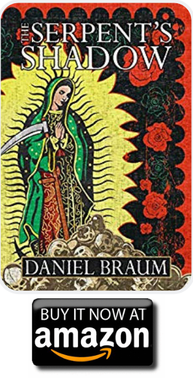 In Cancun 1986, Mayans and Mexicans are fighting each other using strange powers they do not understand. A young American, alive with his first taste of star-crossed love, finds himself caught in the crossfire. Who is the mysterious and deadly White Lady murdering tourists? What strange, otherworldly things wait in the jungle? Will our young hero beware or heed Saint Death’s call? Braum's debut novel delivers a smart, character-driven adventure in the unique and powerful style readers encountered in his story collection, The Night Marchers and Other Strange Tales. Richly depicted Central American settings combine with strange cosmic forces, including a monster large enough to knock the moon out of orbit with a brush of its tail. Enter the jungle where The Serpent’s Shadow looms over the fate of an embattled city and a young man’s dream. "An expertly plotted coming-of-age story where love isn't just blind, but horrific." Sarah Langan. Author of Audrey’s Door. "A chilling apocalyptic brew of myth and murder. Braum immerses the reader in a Mayan paradise torn by spiritual conflict where all roads and rivers lead to a stunning climax.” -Douglas Wynne Author of Black January "The Serpent’s Shadow is a tale that slithers under your skin and grips you until the last sentence." -Michelle Garza, Coauthor of Mayan Blue “The increasing desperation and dread of the characters pulled me in. From the pulsing clubs to the deep cenotes, Braum holds our hands as we dive together into a maze of suspense.” -David Wellington Author of Monster Island   Pop quiz: What’s the first thing you think of when you hear the word “horror”? Do you think of monsters? Madmen? Suffering? Disease? Death? The horror genre is fundamentally fixated on the darker side of human experience, on traumatic events, malevolent characters, and terrifying conflicts. But just because it explores negativity, does that mean horror is itself negative? Does that mean the only effect it can have on the world is negative? If you’re a longtime horror reader, you’re probably throwing up your hands right now and saying “Of course not!” Well, Robert and Jen Wilson, the husband-and-wife duo behind independent genre publishing house Nightscape Press, certainly agree with you. That’s why Nightscape Press is currently in the process of assembling Horror for RAICES, an upcoming charitable anthology benefiting the Refugee and Immigrant Center for Education and Legal Services. Horror for RAICES is set to feature stories by Laird Barron, Paul Tremblay, Ramsey Campbell, Gwendolyn Kiste, Billy Martin (formerly Poppy Z. Brite), Livia Llewellyn, Matthew M. Bartlett, Farah Rose Smith, and many more. In the meantime, the Wilsons have set up a GoFundMe campaign to raise funds for RAICES. But you didn’t come here to listen to me give you the details on this promising project, did you? You want to get the information straight from the people putting this thing together. Read on, then, and find out what inspired the creation of Horror for RAICES, when it’s coming out, and how you can get your hands on an early ebook copy. First of all I just wanted to say thanks to both of you for taking the time to talk to us here at The Ginger Nuts of Horror. Robert: Thank you for having us! It's our pleasure. Jen: Hi, we're big fans of GNOH! Thanks for having us. Before we get too deep into things, I was wondering if you would both take a minute to introduce yourselves for any readers who might be unfamiliar with your work. How long have you been involved in the genre fiction community? Can you give a little background on Nightscape Press and where the company is today? Robert: I'm Robert S. Wilson, Co-Editor in Chief of Nightscape Press and editor of anthologies such as Ashes and Entropy, Nox Pareidolia, Blood Type, and others. I also write things when I think nobody's looking. Nightscape Press was originally founded by Jennifer, myself, and Mark C. Scioneaux on the heels of the success of Horror For Good, edited by myself and Mark. Jennifer was actually one half of our beta reading team for that one as well. Nightscape was started in 2012 but I originally became active in the community in 2011. I had been writing for a number of years before that but hadn't yet published anything until that year. Jen: I'm Jen, Co-Editor in Chief of Nightscape Press and co-editor of Nightscapes: Volume 1. I got involved in the community through Nightscape. We have always had an interest in doing works for charity, but not until our relaunch in 2018 did we develop a model that we think can be successful for not only advocating for our authors but also contributing to charity. We published the first in our line of Charitable Chapbooks in October of last year. That was The Broker of Nightmares by Jon Padgett. The physical edition, upon selling out, raised $1,000 for the ACLU, Jon's chosen charity. The eBook edition, currently available, gives 40% to the ACLU per copy sold. The physical edition of our second Charitable Chapbook, If It Bleeds by Matthew M. Bartlett, also sold out resulting in a $1,000 donation to The Dakin Humane Society. We have five additional Charitable Chapbooks in various stages of production. We also have plans for Charitable Novels and Charitable Collections starting in 2020, and we will continue our "For Good" line of anthologies. One of the big projects Nightscape Press is currently working on is Horror for RAICES, an anthology benefiting the Refugee and Immigrant Center for Education and Legal Services. What exactly does RAICES do? What made you want to put this anthology together to benefit that organization? Robert: RAICES provides free and low cost legal services to immigrants and refugees in the United States. So, in circumstances where an immigrant escapes a dangerous situation and then enters the US seeking asylum, and, given that the current legal climate for those folks is rather hostile here, RAICES works to advocate legally for them to try and help them accomplish that. I came up with the idea for this anthology because I was sick of feeling like there was nothing I could do about the current crisis at our Southern border. And by that I mean the one in which the US government is traumatizing children by ripping them from their families and putting them in cages. The crisis of morality that our nation, which claims itself a refuge of freedom, is currently struggling with. At this very moment the President of the United States, the "home of the brave" and the "land of the free" is actively working to dehumanize innocent human beings and cutting those same people off from any chance of a better life than the ones they left behind in search of the fulfillment of a promise our forefathers made when founding this nation. There was a time I would have called it a great nation but when you turn your hungry and helpless neighbors away in favor of those who can "stand on their own two feet" and won't "become a public charge" I don't know too many people who would call you great. So, Jen and I started reaching out to authors who we knew would not only be extremely gracious in contributing stories, but who we also knew would bring a level of quality to this project so as to give it a real fighting chance to not only raise money for RAICES, but also make a statement of resistance against the disgusting actions that ICE and the current US administration are perpetrating. How much of the proceeds will go to RAICES? Do you have a goal amount in mind that you’re hoping to make? Jen: All net proceeds. We have a GoFundMe that gives directly to RAICES with a goal of $10,000. That amount is likely only a drop in the bucket of what they need. So, if we could raise significantly more than that, it would be phenomenal. You’re currently raising money for the book’s publication via GoFundMe. What made you decide to seek crowdfunding for this project? When are you hoping to have the book ready for release? Is the crowdfunding campaign going to have an effect on the release date at all? Robert: Well, the thing about publishing is, even when you put together a project quickly, it can take a long time for money to funnel from distributor to publisher and then to the charity. So we were trying to think of a way to start getting money to RAICES right now and it dawned on me, you know, we don't make any money from these anthologies, so why couldn't we just give eBook copies to people who donate directly to the charity. But then you have this extra burden of having to make people show proof of their donation and having to manage a lot of email conversations in order to pull that off and that's when it hit me. What if we did it on GoFundMe and the money went directly to the charity? I didn't even know for sure that GoFundMe offered that but after researching a similar option with eBay auctions, I searched to see and sure enough, not only can you set it up to give to a charity but RAICES was one of the options we could choose. Jen: We're hoping to publish it by September 15th at the latest, and an early uncorrected eBook edition will go out sooner than that to people who donate $10 or more to the GoFundMe. Despite the quick turnaround, you already have some very big names contributing stories: Paul Tremblay, Laird Barron, Ramsey Campbell, Gwendolyn Kiste, etc. In general, how has the response to this project been from writers in the genre fiction community? How about from readers? Robert: All the writers we reached out to were quick to get us something to consider. They all share in feeling the very real sense of urgency with this cause. For example, Paul Tremblay specifically asked how quickly we could get this book out so it could be raising money for the cause as soon as possible. Laird Barron sent us two stories to choose between. Livia Llewellyn had just finished a story for me for Nox Pareidolia and specifically asked for Jen and I to instead consider it for Horror For RAICES even though the pay would be significantly lower, because she felt that this was more important. Jen: And we have had an amazing response to the GoFundMe by way of both donations and people taking the time to leave comments about the importance of the project and their personal connections to the cause and those who are affected by it. Nightscape Press has always had its roots in charity. Your debut anthology in 2012, Horror for Good, benefiting amfAR, The Foundation for AIDS Research, is that correct? You’ve also published books benefiting such organizations as the ACLU, The Cystic Fibrosis Trust, and The Colorectal Cancer Alliance. Why have these kind of charitable projects remained such a fixture of Nightscape’s output? Why is it important to you to do these kinds of projects? Jen: For me, the opportunity to publish amazing fiction is a great privilege. In our personal lives helping others even in small ways is something we strive to do. So, being able to combine the two makes it that much more fulfilling and allows us the means to hopefully have more of an impact than we would be able to on our own. Especially in light of how much negativity and injustice there is, I think it makes it that much more important to do what we can for others. The publishing industry is a tough business. Even tougher, I imagine, if you’re giving away big chunks of your proceeds to charity. How do you balance the need to make a profit with the desire to help all these different causes? What’s the hardest part? And what is it that ultimately make it worthwhile? Robert: Profit? What is this profit thing of which you speak? Seriously though, while it would be lovely to make a living from publishing, managing to do so as an independent publisher is a rare accomplishment and one likely fraught with at least some level of inevitable instability. It requires a passion for the work you're doing and as such, we are just pleased at this point to be able to afford to break even, when we can, while paying authors and giving to charity. Jen: While the answer to the question to what is the "hardest part" can change from day to day, one thing that often stands out is the desire to be doing more but being limited by resources. That being said, I think stopping to look at some of the things we've helped accomplish with authors and editors, such as raising over $10,000 for the Colorectal Cancer Alliance from sales of Fantasy For Good, it seems that, with the help of some fantastic people, we've managed to light a spark that, with the right resources and support, and by continuing to work with amazing writers with big hearts, could truly catch fire and make some real change in the world. Finally, how can readers best follow developments with Horror for RAICES, and with Nightscape Press in general? Besides donating to the GoFundMe campaign, do you have recommendations for horror fans who want to support your charitable endeavors, or perhaps go about getting involved in charity work themselves? Robert: The best way to keep up with news on Horror For RAICES is to follow the updates on the GoFundMe campaign at https://www.gofundme.com/f/1nzaom7wg0. All author announcements and other big news items related to the anthology are now going there first. As for Nightscape, the best way to keep up with what we're doing is to sign up for our newsletter at or to follow us on Twitter at or on Facebook at and on the web in general at www.nightscapepress.pub. Jen: One way that people can support the work that we're doing is via our Patreon at www.patreon.com/nightscapepress. Robert: And of course buying our books is always helpful! Jen: As to how people can get involved with charities— it can be really discouraging when you don't have a lot of financial resources to work with. However, if there is a charity that you are passionate about, I think it's important to go ahead and donate what you can, even if it's as little as $5, when you can and realize that if everyone were to do that it would accumulate into something rather significant. Robert: But if you feel strongly about taking the next step and volunteering or even orchestrating your own project or organization for charity, the best way to go about that is to first take a good hard look at what your skillset is and then do your best to think creatively about how you can use that to accomplish work for others, whether that be by getting down into the trenches of the causes that are most important to you or by raising money to contribute to the needs of those causes. Thank you both again for your time. Jen: Thank you for the opportunity to talk about our company and projects. Robert: Thank you, William. It was our pleasure for sure and very much appreciated!   Emilie Knight is a constant writer, and author of her debut Era of Undying. After years of reading fantasy and horror she combines them together into her own dark fantasy writing. Using her BA in Classical Civilizations and fascination in Ancient Greek mythology she blends it well into her fiction. Other then reading in her spare time she plays video games quite often. Could you tell the readers a little bit about yourself? Hello, first of, just to get it off my chest, I am very shy. I’m an introvert who lives in a basement duplex apartment with two cats. It’s a good life though, it’s a cozy place with an awesome reading corner, and it’s super easy to clean. I am into all things fantasy and horror related, and love taking walks on nice days. What do you like to do when you're not writing? Other then reading, I also play video games. Some of my favourites are Skyrim, Witcher 3, the Sims, even Stardew Valley. I also watch Youtube, and Netflix to pass the time. Other than the horror genre, what else has been a major influence on your writing? Fantasy. I found the fantasy genre in high school, shortly after I “discovered” horror too actually. I picked up Eragon by Christopher Paolini and fell in love with magic, dragons, and intense worldbuilding. I grew up with Harry Potter but I was too young to see the art behind the craft then. The term horror, especially when applied to fiction always carries such heavy connotations. What’s your feeling on the term “horror” and what do you think we can do to break past these assumptions?. When most people think of horror they think of gore and easy jump scares. Clowns or demons bursting from behind the corner with a loud bang in the music to make you jump. Those are the cheap scares. We need more slowly build stories around people and their minds, really get inside the characters head and understand why they are scared, so we then feel scared for them. We need more physiological terror, rather than simple gory horror. A lot of good horror movements have arisen as a direct result of the socio/political climate, considering the current state of the world where do you see horror going in the next few years? I’m not really sure, it’s been mainly small monsters, like dolls or single ghosts and demons. But I think, horror coming from more people just being scary people will grow. What are the books and films that helped to define you as an author? Harry Potter by J K Rowling, Eragon by Christopher Paolini, The Dark Tower series by Stephen King, and the Broken Empire series by Mark Lawrence (that one opened grimdark for me, and proved you can combine horror and fantasy.) What new and upcoming authors do you think we should take notice off? Mark Lawrence, he deserves a bigger audience. Also Christina Henry, her dark blends of classic fairy tales are wonderful. How would you describe your writing style? Fast paced. I write in short sprints, so that helps me get to the point when it comes to descriptions or plot points. Are there any reviews of your work, positive or negative that have stayed with you? One reviewer compared my debut novel, Era of Undying, to the Odyssey and Beowulf. I was immensely flattered because I love those ancient classic stories, as well as anything related to Greek Mythology. Those elements still come through in my current novels too. What aspects of writing to do you find the most difficult? Physical descriptions sometimes, I just was to get on with the story so I tend to forget them until the editing phase. Is there one subject you would never write about as an author? Heavy romance or erotica. There is a romance in my current novel, Dagger and Scythe, but it’s not a heavy handed or steamy romance. It’s about those two getting used to their new relationship, working together, and taking down a god. How important are names to you in your books? Do you choose the names based on liking the way it sounds or the meaning? A little of both, I pick names from words in Ancient Greek based on the meaning of them, and if they fit the characters traits. I make a list of traits, and then pick the best sounding translation. Well, that’s the case for most of them. Dagger and Scythe are named after the weapons they fight with. Writing, is not a static process, how have you developed as a writer over the years? I’ve gotten better as grounding my descriptions (even physical appearances), and getting to the point. My characters are a lot more dynamic too, more defined in a way. What tools do you feel are must-haves for writers? A well developed imagination (also a pen and paper just in case your computer breaks down). What is the best piece of advice you ever received with regards to your writing? Take your time, there’s no rush to get the book out. The story itself needs to take its time to develop while you write it, so enjoy the ride. Getting your worked noticed is one of the hardest things for a writer to achieve, how have you tried to approach this subject? By interacting with people on Facebook, Twitter, and Instagram. I also have an Amazon Author profile, Goodreads, and Bookbub accounts. Contacting reviewers in general too, it’s intimidating but necessary and really not that scary. To many writers, the characters they write become like children, who is your favorite child, and who is your least favorite to write for and why? Scythe is probably my favourite so far, she’s bold and ruthless, but insecure at times, especially involving her personal life. I don’t have a least favourite but the hardest is Pen, from Era of Undying. She’s elusive and secretive, even to me sometimes. What piece of your own work are you most proud of? At the moment it is my current one, Dagger and Scythe. It’s fun, it’s ruthless, and I loved these two characters ever since I thought them up almost a decade ago. And are there any that you would like to forget about? I would never forget about Era of Undying, but it does need to be tweaked a bit. I’m still proud of it being by first novel, but it needs one more round of edits I think. For those who haven’t read any of your books, which of your books do you think best represents your work and why? Dagger and Scythe, they are the gothic and fantasy combination I want to continue on with. Do you have a favorite line or passage from your work, and would you like to share it with us? It’s morose but one that really sticks in my head from Dagger and Scythe is “silence hung over them like a patient noose.” It’s so quiet and intimidating. Can you tell us about your last book, and can you tell us about what you are working on next? My last book, Era of Undying, was also a blast to write, but I finished it too quickly. I love Pen, the Blood Warrior, as a character and person. And I can’t wait to explore more of her story. I’m currently working on something different, though. It’s called Fractured Memories, and is more of a physiological thriller (I hope anyway.) It’s about a noblewoman, Frona, getting revenge on people who attacked her in an alley by going straight to the king, and another woman, Varga, who works as a prostitute turned assassin in the poorer end of the city. Their stories intertwine, and chaos ensues. If you could erase one horror cliché what would be your choice? Cheap jump scares, that I talked about before, but also found footage movies. I just get annoyed when the camera is watching the feet of the person run away rather than focus on the actual scare. What was the last great book you read, and what was the last book that disappointed you? The last great book was probably Emperor of Thorns by Mark Lawrence (the last in the Broken Empire series). It may have been for the third time, but I still love the final story for Jorg Ancrath. The last one the disappointed me, was a while ago. It was Alice by Christina Henry. I know I mentioned her before and one of my favourites, and she is, but in her dark Alice book the ending was a bit anti climactic. What's the one question you wish you would get asked but never do? And what would be the answer? I’m not sure, but it would probably about the craft of storytelling in general. I love talking about the art behind the stories. To find out more and to follow Emilie on social media check out the links below Social Media Links Goodreads Website https://www.emilieknight.com/ Amazon Author Page https://authorcentral.amazon.com/gp/profile Dagger and Scythe: The Ichorian Epics Book 2 by Emilie Knight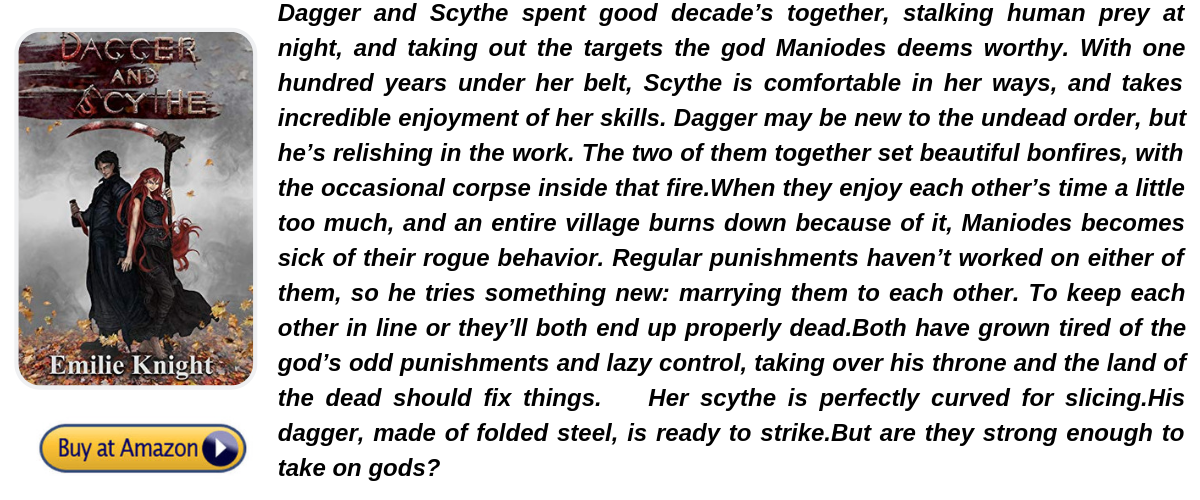  |


Archives
May 2023
|
 RSS Feed

|

|