

 Stephanie M. Wytovich is an American poet, novelist, and essayist. Her work has been showcased in numerous venues such as Weird Tales, Gutted: Beautiful Horror Stories, Fantastic Tales of Terror, Year's Best Hardcore Horror: Volume 2, The Best Horror of the Year: Volume 8, as well as many others. Wytovich is the Poetry Editor for Raw Dog Screaming Press, an adjunct at Western Connecticut State University, Southern New Hampshire University, and Point Park University, and a mentor with Crystal Lake Publishing. She is a member of the Science Fiction Poetry Association, an active member of the Horror Writers Association, and a graduate of Seton Hill University’s MFA program for Writing Popular Fiction. Her Bram Stoker Award-winning poetry collection, Brothel, earned a home with Raw Dog Screaming Press alongside Hysteria: A Collection of Madness, Mourning Jewelry, An Exorcism of Angels, Sheet Music to My Acoustic Nightmare, and most recently, The Apocalyptic Mannequin. Her debut novel, The Eighth, is published with Dark Regions Press. Follow Wytovich on her blog, on twitter @SWytovich, Instagram @swytovich, or find more about Stephanie on her Amazon Author page or her website. Could you tell the readers a little bit about yourself? Hi there! My name is Stephanie and I’m a pretty serious bibliophile with a writing problem. My focus is all things horror, and I write poetry, fiction (short stories and novels), and essays—typically about women in horror (both in literature and film) and the craft of speculative poetry. I’ve been writing professionally for about ten years now, and by day I work as a Student Success Coordinator for Point Park University as well teach in two MFA programs (Southern New Hampshire University and Western Connecticut State University), and in 2016 I took home the Bram Stoker Award for my erotic horror poetry collection Brothel. To get the ball rolling and get everyone relaxed, here is a hopefully lighthearted question to break the ice. Which one of your characters would you least like to meet in real life and have them complain at you about they way you treated them in your work? Oh, this is an easy one: Paimon from my novel The Eighth. I’ve done some pretty down-right horrible things to that man, and I would not like to have a real conversation with him any time soon. Plus, he still has two more journeys ahead of him, so knowing what he’s about to go through wouldn’t make that conversation any easier for me. Other than the horror genre, what else has been a major influence on your writing? I obviously really enjoy poetry and I read a lot of memoir and true crime as well, but fantasy and science fiction sneak in every once in a while for me, too. I love world-building, creating monsters and legacies, and playing with mythology, but I also like the machines and technology of advanced societies, too. However lately, I’ve been reading a lot about death rituals and funerary practices throughout history and across cultures, and it’s been widely influential on my work. For example, right now I’m reading a book by Caitlin Doughty, my favorite mortician—people have those, right? —titled: Will My Cat Eat My Eyeballs? Big Questions from Tiny Mortals About Death. The term horror, especially when applied to fiction, always carries such heavy connotations. What’s your feeling on the term “horror,” and what do you think we can do to break past these assumptions? I love horror and the genre has always brought me immense comfort and catharsis throughout my life. I tend to think the fact that we get associated with monsters, trauma, evilness, and mental illness is a sad, weak excuse perpetuated by someone who is afraid of looking into and exploring their own demons and is willing to make any excuse not to do so. I mean, you can’t have light without darkness, right? Personally, I think anyone who is willing to confront what scares them is not only brave but admirable. Those working in this industry have been some of the nicest, most compassionate, and intelligent people I’ve met, and in a world where everyone is so quick to stereotype and judge a book based on its cover, I think the best thing that we as artists and fans can do is speak out and share stories and art to combat that prejudice. A great example of that is the #horrorishealthy hashtag on twitter and Instagram that fans and artists have been using to combat the trigger warning message that comes up when someone uses #horror in their post. My suggestion? Read, write, view, and immerse yourself in the genre and talk about it across your various social networking platforms. Review art. Tell your friends about it, spread the word! The more we share and discuss why horror has a noteworthy place in society, the less taboo it will become. A lot of good horror movements have arisen as a direct result of the socio/political climate, considering the current state of the world. Where do you see horror going in the next few years? I think we’re moving into the next era of the Satanic Panic, and it’s why we have movies like Hereditary, The VVitch, Satanic Panic, and shows like Chilling Adventures of Sabrina, and AHS: Apocalypse, and documentaries like Hail Satan? being pumped out like crazy. People are on edge, angry, and looking for a different way of handling x, y, and z, and as a result, conservative fears about alternate ways of thinking start to rise. The scapegoat for that is evil and artists are deliciously exploring it. Given the dark, violent and at times grotesque nature of the horror genre, why do you think so many people enjoy reading it? For me, horror has always been about survival. I think we flock to it because we like confronting our fears in a safe place where we can observe terrible things, but not be directly threatened by them. On the whole, it’s a blunt genre that doesn’t sugarcoat things, and I think it allows us to examine our faults and instincts in an environment that’s actually teaching us about our values, morals, and faith so we can constantly reevaluate the person we are inside as well as learn how to navigate the world and the people around us. Furthermore, I think we’re all looking for that magical equation that shows why evil exists, i.e. something happened during our childhood, our mothers didn’t love us enough (or too much), etc. Horror attempts to answers those questions—oftentimes not in the most flattering light, especially for women---but nevertheless, it’s giving us a chance to try to understand evil, death, trauma, and grief. After all, if we understand it, then we know how to overcome it, right? If we know why the monster exists, we could prevent it from becoming a monster in the first place, maybe learn how to fight it, better survive against it if it gets loose. If we know what happens after we die, then perhaps the notion of death became less scary and we’re better able to handle our grief when we lose someone we love. At the end of the day, we’re all just trying to live a comfortable, safe life, so it makes sense that we would be drawn to a genre that tries to teach us how to make those things happen and prepare for the moments when life is anything but. What, if anything, is currently missing from the horror genre? Personally, I’d like to see more diversity and inclusivity in the genre. While there are countless male horror writers (see, that sounds awkward doesn’t it?) that I love and will read, review, and sing the praises of, I want to read more stories by people of color, by people of varying genders and sexual orientations. I want to read a story about an asexual succubus that’s written by someone who has the experience every day of identifying as asexual, or watch a lesbian vampire movie that isn’t written for the male gaze and is directed by—you guessed it! —a lesbian. I want to learn about different monsters from different cultures explored by people who grew up hearing those bedtimes stories. It doesn’t seem like it should be that hard, but for some reason it is. Currently, I think it’s great that we have Women in Horror Month in February to help raise awareness and shine a light on all the rad women working in the genre, but I also really have to hand it to the Ladies of Horror Fiction, who forever work (regardless of what day/month it is) to make sure that there is both a directory for and of female horror writers so the conversation surrounding us can happen at all times. The horror #bookstagram community is also ridiculously on point with spreading a message of diversity and inclusivity whether they’re opening a dialogue about certain authors, participating in Pride, promoting new releases, etc. I also want to take a moment to give a shout out to the Night Worms, who constantly bring a smile to my face and give me hope for everything that the genre can become. Honestly, for the first time in a really long time, I’m starting to feel like just a horror writer…. not a woman who writes horror. In the past authors were able to write about almost anything with a far lesser degree of the fear of backlash, but this has all changed in recent years. These days, authors must be more aware of representation and the depiction of things such as race and gender in their works. How aware are you of these things and what steps have you taken to ensure that your writing can’t be viewed as being offensive to a minority group? I’m very aware of this, and like I said above, I think diversity and inclusivity is something that horror is in desperate need of, and while we’re taking steps in the right direction, I think a bigger renaissance is on the horizon for the genre. Having said that, I tend to write with a strong, feminist—and at times, LGBTQIA+—bent to my prose in order to restructure old clichés and stereotypes that are usually attached to female characters in horror. I also want to shed a more sex-positive light on the genre because there’s such an engrained fear surrounding female bodies, their power, and a new angle of thought could and would be beneficial to the genre as a whole. If I’m concerned about how something is coming off, I’ll send it out to my beta readers and some friends to get their take on it before I send it out into the world. I always like to have a bunch of eyes on my work because others will see stuff that I can’t or refuse to see because I’m too close to the material. It’s a nice safeguard to have in place and the feedback is truly invaluable. Does horror fiction perpetuate its own ghettoization? For example, Julia Armfield’s latest collection Salt Slow has a cover that most horror fans would walk past in a book shop and it’s one that probably is not marketed as horror. Does the genre’s obsession with horrific covers cause more harm than good? Truthfully, I’m not sure how I feel about this. I think I would have to take it on a case-by-case basis, but I agree that by looking at Armfield’s collection that I wouldn’t think it was horror based off the cover alone. Is that necessarily a bad thing? If I’m browsing the store looking for a horror novel, then yes, but the truth behind that is that most stores don’t even have a horror section so that doesn’t really come into play. I think the title for it is far more important here, and when it’s coupled with the color scheme and mystical nature of the cover, I’d probably pick this one up to investigate it more. However, when it comes to horror-laden covers in general, I think it’s fine to an extent, i.e. no explicit violence, naked women, abuse, etc., but this type of exploitation isn’t only in horror; it’s something that the romance genre deals with as well. Having said that, a cover that is generally of a dark, weird, and/or macabre nature will certainly draw me in and cause me to investigate more compared to something that’s open to interpretation like Armfield’s book. What new and upcoming authors do you think we should take notice off? Some favorites I can fully recommend are: Gwendolyn Kiste, Christa Carmen, Sarah Read, Brian Kirk, Todd Keisling, Zoje Stage, Usman T. Malik, Lee Murray, Gabino Iglesias, and Claire C. Holland. What are the books and films that helped to define you as an author? My cannon starting out looked something like this: A Nightmare on Elm Street, directed by Wes Craven Hellraiser (movie), The Hellbound Heart by Clive Barker Carrie by Stephen King Exquisite Corpse by Poppy Z. Brite The Girl Next Door by Jack Ketchum The Brood directed by David Cronenberg Frankenstein by Mary Shelley The Haunting of Hill House by Shirley Jackson Lost Boys directed by Joel Schumacher Rosemary’s Baby directed by Roman Polanski These days, I’d say my inspiration and influence comes from stuff like: The VVitch directed by Robert Eggers The Babadook directed by Jennifer Kent Suspiria directed by Dario Argento Dead Ringers directed by David Cronenberg Midsommar directed by Ari Aster You by Caroline Kepnes My Best Friend’s Exorcism by Grady Hendrix A Head Full of Ghosts by Paul Tremblay Baby Teeth by Zoje Stage Are there any reviews of your work, positive or negative, that have stayed with you? Oh, god yes. There is a review for one of my books out there that says something like I’m glad I bought the kindle version of this so I didn’t kill a tree reading this awful book. Who told this woman she could write? Fun stuff. I obviously never think of it… *shifts eyes in denial* What aspects of writing to do you find the most difficult? All of it, ha! Writing fiction is rough for me, and it’s something that I’ve been focusing on more and more lately in an effort to release some of the pressure I associate with it. I tend to write prose rather slow, so cranking out that first draft is always a bear for me. I am taking steps in my life to alleviate some of my day-to-day workload so that I can focus more on writing fiction, so I’m hoping that more practice in the craft will lead to less stress about sitting down and writing. Is there one subject you would never write about as an author? I am a huge animal lover, and my dogs are my life. Animal abuse isn’t something that I plan on tackling any time soon—if ever, really—and in the one story that I’ve even lightly touched on it, the readers don’t see or experience it in any way. How important are names to you in your books? Do you choose the names based on liking the way it sounds or the meaning? Most of my choices are made on auditory appeal—must be the poet in me or something. So yeah, this is something that I typically agonize over until I find the one that fits just right. Writing, is not a static process. How have you developed as a writer over the years? Writing is work and it’s a craft that demands a lot of practice and a lot of hours. In addition to setting myself up with a fairly consistent routine of reading and writing, I’ve also started to outline these days, which is something that I never did when I was starting out. While I still enjoy writing off the cuff as it were, my schedule these days demands a more rigorous routine in regard to time management, and outlining helps me stay on track and make the most of my time. What is the best piece of advice you ever received with regards to your writing? Write for you, not for anyone else. It’s not always easy advice to follow, but I do find myself happier, more productive, and more at ease with my writing when I consider my wants and creative aspirations first. To many writers, the characters they write become like children, who is your favorite child, and who is your least favorite to write for and why? I think to some extent that Hysteria will always be my favorite child because she is what unleashed the madness, started the blood flow, and let the demons run wild. Honestly, between you and me, I think there’s a little bit of her in each of my books. The least favorite for me to write to was Jolene from my collection Sheet Music to My Acoustic Nightmare, and it’s not because I didn’t enjoy writing alongside her but rather that that book took a lot out of me emotionally. Because it was half-genre and half-memoir, I chose to relieve some trauma and less-than-delightful memories, so this was an exercise in turning exposure therapy into art. For those who haven’t read any of your books, which of your books do you think best represents your work and why? I’m going to have to go with my latest release, The Apocalyptic Mannequin. I think it showcases my strengths as a poet, and the imagery in this one feels more palpable to me when compared to some of my other work. Do you have a favorite line or passage from your work, and would you like to share it with us? I wrote a lot of reverse prayers when working on The Eighth and I love Paimon’s chant before/after his confessions: “Bless me my sins.” Can you tell us about your recent book, and can you tell us about what you are working on next? My most recent book is The Apocalyptic Mannequin from Raw Dog Screaming Press. It’s a post-apocalyptic poetry collection that straddles the line between science fiction and horror as it works to redefine the definition of body after life and everything as we know it has been taken away. As to future projects, I have a couple irons in the fire. I have some short stories I’m looking to finish up and I’m also looking forward to putting the final touches on a weird fiction novelette titled The Dangers of Surviving a Slit Throat. I’m also working on a non-fiction project and flirting with an idea for a horror comic. What’s sleep, you ask? Sorry, couldn’t tell you. It does sound nice though! If you could erase one horror cliché what would be your choice? That women who embrace their sexuality and independence in any way, shape, or form, are evil sluts who are not only a threat to the general populous but need to be destroyed. I’m not a fan of the damsel-in-distress, dumb blonde, or bad mother trope either. Whew. I guess I clearly have a lot of opinions on this one. Side bar: If you share these opinions, or want to learn more about them, because hey, education is always a good thing, I recommend reading Dead Blonds and Bad Mothers: Monstrosity, Patriarchy, and the Fear of Female Power by Sady Doyle. What was the last great book you read, and what was the last book that disappointed you? I recently read The Witches of New York by Ami McKay, which I absolutely loved and highly recommend to everyone. However, I was pretty disappointed by Stephen King’s Elevation. However, I’m super looking forward to The Institute! What's the one question you wish you would get asked but never do? And what would be the answer? Q: What’s the scariest thing you’ve ever done? A: While I was doing research for my first book, Hysteria, I explored, investigated, and spent the night in a bunch of abandoned and/or out-of-operation prisons, hospitals, and asylums such as: Trans-Allegheny Lunatic Asylum, Hill View Manor, and West Virginia State Penitentiary. In fact, Trans-Allegheny Lunatic Asylum became such a big part of my life then that I almost became a tour guide for them. What can I say? I’m a girl who loves her ghosts! About The Apocalyptic Mannequin 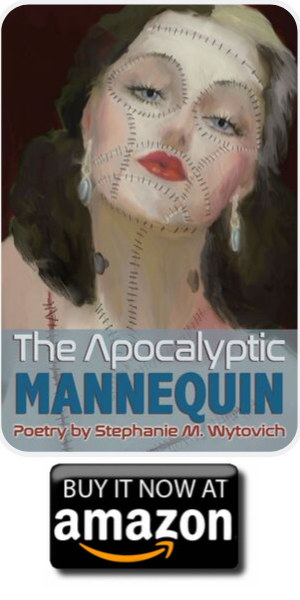 Doomsday is here and the earth is suffering with each breath she takes. Whether it’s from the nuclear meltdown, the wrath of the Four Horsemen, a war with technology, or a consequence of our relationship with the planet, humanity is left buried and hiding, our bones exposed, our hearts beating somewhere in our freshly slit throats. This is a collection that strips away civilization and throws readers into the lives of its survivors. The poems inside are undelivered letters, tear-soaked whispers, and unanswered prayers. They are every worry you’ve had when your electricity went out, and every pit that grew in your stomach watching the news at night. They are tragedy and trauma, but they are also grief and fear, fear of who—or what—lives inside us once everything is taken away. These pages hold the teeth of monsters against the faded photographs of family and friends, and here, Wytovich is both plague doctor and midwife, both judge and jury, forever searching through severed limbs and exposed wires as she straddles the line evaluating what’s moral versus what’s necessary to survive. What’s clear though, is that the world is burning and we don’t remember who we are. So tell me: who will you become when it’s over? What They’re Saying - “Like a doomsday clock fast-forwarding to its final self-destruction, Wytovich’s poetry will give you whiplash as you flip through page after page. The writing here is ugly yet beautiful. It reads like a disease greedily eating up vital organs. The apocalypse has arrived and it couldn’t be more intoxicating!” —Max Booth III, author of Carnivorous Lunar Activities “In this hauntingly sensuous new collection of poetry, you’ll long to savor every apocalyptic nightmare you have ever feared. Blooming in the beauty of destruction and the terror of delight, Stephanie M Wytovich’s poems remind us that we feel the world better, love the world better, when we recognize the ephemeral nature of everything achingly alive beyond our mannequin minds. Here, we are captive to our deepest velvet snarls, zombie songs, and radioactive wishes, at the mercy of a neon reaping. Reading this collection is like dancing through Doomsday, intoxicated by the destructive, decadent truth of desire in our very mortality. In these poems, you will find revelry in the ruins of everything you once held dear — and you will love it to the last as you watch the world unravel around you.” —Saba Syed Razvi, author of Heliophobia and In the Crocodile Gardens “Beautifully bleak, Stephanie M. Wytovich’s latest collection posits scenarios of the apocalypse and the horrors to come thereafter with language like fragrant hooks in your skin. Vivid, each word a weight on your tongue, these poems taste of metal and ash with a hint of spice, smoke. She reminds us the lucky ones die first, and those who remain must face the horrors of a world painted in blisters and fear. Leave it to Wytovich to show us there’s beauty in the end, just beneath all that peeling, irradiated skin.” —Todd Keisling, author of Ugly Little Things and Devil’s Creek “Set in a post-apocalyptic world that at times seems all too near, Wytovich’s poems conjure up frighteningly beautiful and uncomfortably prescient imagery. Populated by a cast of unsettling, compelling characters, this collection is one that stuck with me.” —Claire C. Holland, author of I Am Not Your Final Girl “A surreal journey through an apocalyptic wasteland, a world that is terrifyingly reminiscent of our own even as the blare of evacuation alarms drowns out the sizzle of acid rain, smiling mannequins bear witness to a hundred thousand deaths, and “the forest floor grows femurs in the light of a skeletal moon.” Stephanie M. Wytovich’s The Apocalyptic Mannequin is as unsettling as it is lovely, as grotesque as it is exquisite.” —Christa Carmen, author of Something Borrowed, Something Blood-Soaked   Comments are closed.
|


Archives
May 2023
|
 RSS Feed

|

|