

FIVE MINUTES WITH AUTHOR CALEB WILSON
29/5/2018
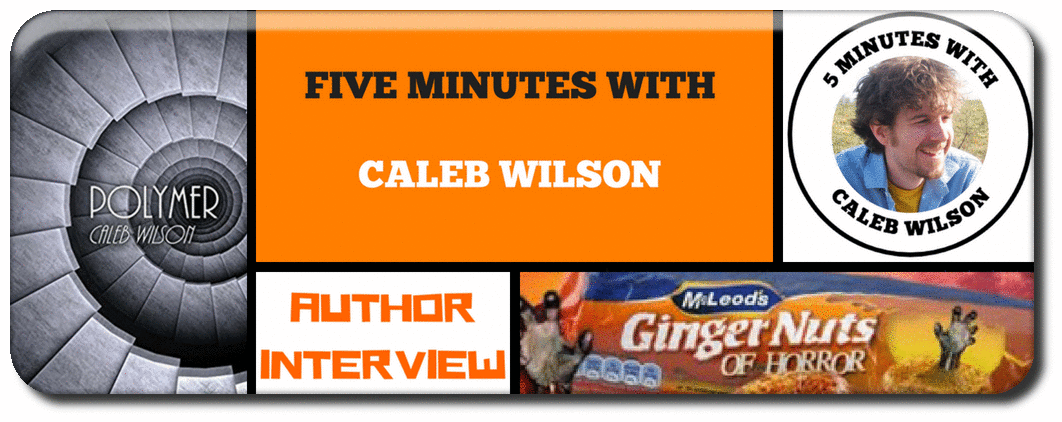
Caleb Wilson is a writer of weird fiction and designer of weird games.
Could you tell the readers a little bit about yourself? Sure! I live in the American Midwest -- Illinois -- in a college town that feels small and large at the same time. I work at a public library, so I'm always surrounded by books. Before that, I worked in a number of different bookstores, so I was always surrounded by books then. My house is full of bookshelves, but also more books than fit on the bookshelves. Books are one of my favorite things. What do you like to do when you're not writing? Apart from books, I love games, of many kinds: board games, card games, videogames. So when I'm not writing I play a lot of games, and I design them too. I've published some text-based computer games, and created a few board games for local competitions and for fun. Other than the horror genre, what else has been a major influence on your writing? Weird literary fiction, writers like Samuel Beckett and Thomas Bernhard. Bernhard in particular has a very addictive style, so after I read him I always write like him for a while. I read a lot of fantasy too, and I've taken inspiration from authors who mix fantasy and horror, like Michael Shea and Clark Ashton Smith. Interactive Fiction, which I write and play, has also influenced my fiction writing in weird ways: I really like writing descriptions of rooms, places, and evocative inanimate objects, probably because that's what I started with in those games. The term horror, especially when applied to fiction always carries such heavy connotations. What’s your feeling on the term “horror” and what do you think we can do to break past these assumptions? I think that like "fantasy", "horror" is broad enough to include almost anything. It doesn't really give you any information about whether it's going to scare you or scar you or make you laugh/cringe/shiver, and I think that's a good thing. By weaving in all kinds of other elements, we just broaden the horizons of horror. A lot of good horror movements have arisen as a direct result of the socio/political climate, considering the current state of the world where do you see horror going in the next few years? Good question, and it would be nice if I knew! Dystopias have already been popular for a while, so it would be great to figure out what the next big popular thing is going to be ahead of time. In general, stories of resistance are always appreciated. I don't mind happy endings, either. What are the books and films that helped to define you as an author? Kelly Link, Stranger Things Happen, which showed me that there aren't really rules for or limits on what fantasy fiction can be. Flash Gordon, which I'd usually rather watch than Star Wars, and which reminded me of the joy that comes from the right combinations of color, sound, and silliness. The stories of Jack Vance, which combine a wild imagination with a love of words. What new and upcoming authors do you think we should take notice off? Farah Rose Smith. Her book The Almanac of Dust is out now, and Eviscerator comes out in July. Her writing reminds me of my favorite decadent authors, with really great imagery and beautiful phrases. How would you describe your writing style? Ornate alternating with blunt. Dark humor. I write a lot about seething, hostile environments, and I write a lot of monsters. Are there any reviews of your work, positive or negative that have stayed with you? Someone once wrote in a review that they weren't sure what country I was from, but what I was describing wasn't civilized behavior. I think that has to be a compliment, right? What aspects of writing to do you find the most difficult? Realistic dialogue, and moving stories ahead in a smooth and controlled way. Probably part of why I like writing computer games: the story is distributed across the player's actions, and to some extent the order of events is up to them, so I'm a little bit off the hook! Is there one subject you would never write about as an author? I don't write extreme violence (compared to other horror writers, anyway!) I prefer clammy, subdued weirdness. How important are names to you in your books? Do you choose the names based on liking the way it sounds or the meaning? I love naming characters when its easy and hate it when its hard. For me it's easy about 75% of the time. I choose based on meaning, sound, and sometimes just random syllables that appeal to me. I often look up words in ancient languages and then blend them together a bit, or change a letter or two in a normal name. Writing is not a static process. How have you developed as a writer over the years? I finish more projects these days. Learning how to do that was a big deal for me. I've also gotten better at seeing how writers I enjoy perform their magic, and figuring out how to use the same tricks in my own writing. What tools do you feel are must-haves for writers? I think the only indispensable tool is time: everything else you can work around. And even five minutes chunks of time can be stitched together, if nothing else. (Though for me, writing in two-hour-long chunks is the most efficient.) What is the best piece of advice you ever received with regards to your writing? Finish things. Make yourself finish things by having markets in mind to send them to from the start. Don't ever stop reading, and reading new things. Getting your work noticed is one of the hardest things for a writer to achieve, how have you tried to approach this subject? It's been a very slow process for me. These days I'm trying out the social media thing, trying to be "fun" and "engaging" online, which doesn't come naturally to me, at least with people who aren't already my friends. To many writers, the characters they write become like children, who is your favourite child, and who is your least favourite to write for and why? I really liked writing for my pair of sword and sorcery characters, Charops the Strategist and Ichneumon the Weird. (They're in a story called "Bow Down Before the Snail King!", published in Swords v. Cthulhu.) I enjoy their sour humor and refusal to give up in the face of disaster, though it might not do them much good. There are plenty of characters I didn't end up liking writing about, and their fate has been that I never finished writing their stories, and so they don't actually exist. What pieces of your own work are you most proud of? Polymer, my novella with Eraserhead Press, and Cannonfire Concerto, a text-based computer game I wrote for Choice of Games. And are there any that you would like to forget about? Not really. There are some old pieces floating around, which are probably embarrassing in certain ways, but they've got some good lines, too, so I don't mind. For those who haven’t read any of your books, which of your books do you think best represents your work and why? Again, I'd go with Polymer. It ties together a lot of my loves and obsessions, and I think manages to not feel like anything else I've read. Do you have a favorite line or passage from your work, and would you like to share it with us? "Like all of us except for sociopaths or actors, Liero had always been slave to the expressions that moved the surface of his skin." That's from Polymer. Can you tell us about what you are working on next? Right now I'm working on a dark fantasy/cosmic horror novella. It's about a city experiencing a very strange invasion, and it has a peculiar narrator. But that's all I really want to say about it for now! If you could erase one horror cliché what would be your choice? How about "guy rescues helpless girl in peril". Other than that, I sort of love horror clichés. Almost anything can be used interestingly, given the surrounding context. What was the last great book you read, and what was the last book that disappointed you? I just finished reading Doctor Faustus by Thomas Mann, a "great book" in the old classic sense. I can hardly imagine writing something so detailed and knowledgeable: it's 500+ pages of dense, thoughtful, solid information. I can't remember the last book that disappointed me, because I've gotten very good at searching out books I'm fairly sure to like! With a huge reading pile of books like that, I hardly ever finish something I'm not enjoying, and if I don't finish it, I don't really consider it disappointing, just not for me. What's the one question you wish you would get asked but never do? And what would be the answer? Question: What are some of your favorite monsters? Answer: The Beast from Over the Garden Wall (a miniseries that aired on Cartoon Network.) It's mysterious for most of the story, manifesting mostly as creepy operatic singing in a cold forest, and when it finally appears, there's a great tragic and faintly horrible misunderstanding about the way it operates and has been operating that I find really delicious. The hyena from Jesse Bullington's The Enterprise of Death. It's a monster who speaks with a human voice to get you to come closer so it can eat you. Imperfect simulacra are creepy anyway, and the hyena is the perfect monster for the Dark Ages, where the world has so little light that you can't see three feet into the night to know for sure what sounds so friendly, just a bit disoriented. The slake moths from Perdido Street Station. China Mieville has one of those megawatt imaginations and the slake moths are one of his most horrifying creations. They're these sort of huge demonic vaguely moth-like things covered with hypnotic swirling patterns that will make you docile if you so much as glance at them, and then they eat your personality and volition, leaving just a still-breathing empty shell.


YOUNG BLOOD: OUR LATEST ROUND UP OF THE BEST IN YA HORROR AND DARK FICTIONFIVE MINUTES WITH DAN PADAVONA
23/5/2018

I'm a meteorologist with the United States government. I began writing in February 2014 and published my first novel, Storberry, in August of the same year. I live with my wife, our two children, and three dogs in Upstate New York. Could you tell the readers a little bit about yourself? For as long as I can remember, I've loved music and horror. My musical tastes are pretty eclectic – I listen to everything from Tool to old REM to The Sex Pistols and Enya. My Spotify playlists would make most people label me as insane. I grew up with the old Universal monster movies, graduated to the Hammer films, then came of age during the slasher craze of the late-70s and early-80s. John Carpenter's Halloween probably influenced me as much as any movie from my youth. What do you like to do when you're not writing? Besides spending time with my wife, Terri, I hit the gym four to five times per week, and during the warm season I love to bike and watch college lacrosse. My wife and I both love Renaissance fairs – one of the northeast's best fairs resides in Sterling NY, about a two hour drive from our home – and we're confirmed ice cream nuts. Other than the horror genre, what else has been a major influence on your writing? Over the last decade I probably read more fantasy than horror, and I'm a big fan of Patrick Rothfuss, JK Rowling, and Terry Brooks. Nobody creates characters as well as Rowling, and Rothfuss is a master storyteller. The term horror, especially when applied to fiction always carries such heavy connotations. What’s your feeling on the term “horror” and what do you think we can do to break past these assumptions? I suppose, to the general public, the term “horror” conjures images of monsters, killers, demons, and blood, and to be perfectly honest, those themes predominate my storytelling. But horror can be “quiet,” as well. Think Straub and Poe. My story, “One Autumn in Kane Grove,” can be defined as quiet and a tad ethereal. Among more recent writers, Chad Lutzke writes intelligent, quiet horror. But I see no reason to break public assumptions. Every horror fans gets something different from the sub-genres they prefer. A lot of good horror movements have arisen as a direct result of the socio/political climate, considering the current state of the world where do you see horror going in the next few years? Various stages in our political history have inspired golden ages in horror, including the legendary Godzilla franchise, which was borne out of atomic bomb fears and the destruction of Japanese cities. The 1970s were a terrible economic period: excess unemployment, runaway inflation, stratospheric interest rates, and neither the democrats or republicans had answers in the United States. And out rolled horror classics such as The Texas Chainsaw Massacre, Black Christmas, Jaws, Halloween, and many more. Now we have the most toxic political climate of my lifetime. It seems no one can agree on anything, and the media is replete with extremists screaming at one another. It's enough to make you lose faith in humanity. Where will this lead? I sincerely hope creatives won't write to the political climate to too high a degree, as horror also serves as an escape for many of us, but I wouldn't be surprised if bleak, apocalyptic horror themes dominate the next several years. What are the books and films that helped to define you as an author? Black Christmas (1974) is the most frightening movie I've ever watched, and in my opinion it is the greatest slasher in horror history. I credit Black Christmas, along with Halloween, for giving me a lifelong love of horror. Jack Ketchum's Hide and Seek greatly affected my storytelling, as did Richard Laymon's Night in the Lonesome October and The Traveling Vampire Show. I love all three books and reread them at least every few years, and I believe my terse writing style was most influenced by Ketchum and Laymon. What new and upcoming authors do you think we should take notice off? Matthew Brockmeyer's “Kind Nepenthe” rocked me back on my heels. Very bleak and inventive. I'm keeping an eye on Brockmeyer. He's hardly a new commodity, but Paul Tremblay is knocking the ball out of the park with his storytelling. “Head Full of Ghosts” is one of the best horror novels of the last decade. How would you describe your writing style? My emotional state upon initiating a new writing project drives my writing style. Sometimes I am quite hopeful and Koontz-like, other times somber and horrific. Quilt is an example of the latter. Are there any reviews of your work, positive or negative that have stayed with you? I try not to look too closely at reviews, as the Internet tends to be a very negative place. Certainly I appreciate the positive reviews I've received from readers, but I pay closest attention to my peers and mentors. The kind words Brian Keene wrote about my novel, “Crawlspace,” will stay with me forever. What aspects of writing to do you find the most difficult? Believe it or not, kill and stalk scenes are very difficult for me to write, and this is coming from someone who leaves a lot of blood and body parts in his wake. I most enjoy character building and conversation, and find those scenes and chapters to be the easiest to write. Kill scenes require so much attention to detail and pacing. It usually takes me several drafts before I feel good about those scenes. Is there one subject you would never write about as an author? Never say never, but I have a soft spot for children and would have a hard time murdering a child. For that matter, it would hurt me deeply to kill a dog, too. My wife is a breast cancer survivor, and I've lost friends and family to that disease. Although I've referred to cancer in a few or my works, I don't think I could bring myself to write about someone dying of cancer or a similar disease. How important are names to you in your books? Do you choose the names based on liking the way it sounds or the meaning? Both, though I try not to go overboard with meaning. Too many names with obvious meanings appear tedious to readers. Writing, is not a static process, how have you developed as a writer over the years? I suppose every novel I've enjoyed over the last several years has influenced my style in some small way, though the development is probably too gradual to be noticeable. I owe the most gratitude to my editors, Jack Musci and Chad Lutzke, for building my prose and keeping me on point with my plots. What tools do you feel are must-haves for writers? A 26-hour day is a must. But since we can't have that, I recommend a quality piece of writing software compatible with multiple platforms. My personal favorite is Scrivener, which runs on my PC, iPad, and iPhone. Perfect if you are standing in line at the store and feel inspired to crank out a quick paragraph. Seriously, I've done this. What is the best piece of advice you ever received with regards to your writing? Chad Lutzke bashed me with a mallet until I agreed to trust my readers and “show” instead of “tell.” Getting your worked noticed is one of the hardest things for a writer to achieve, how have you tried to approach this subject? Oh, dear. If someone figures out how to get noticed, I hope they tell me. I do low-level advertising through Amazon and Bookbub, and I'm pretty active on Twitter and Facebook. Otherwise, I churn out new books with the hope of expanding my small reader base. I've begun submitting to anthologies, as well, and I'll appear at Scares That Care in August. To many writers, the characters they write become like children, who is your favourite child, and who is your least favourite to write for and why? I can't say I have a least favorite character to write, but my favorite was Becca from “The Face of Midnight.” Here was a girl who had nothing but found an incredibly inventive way to survive and stay off the streets. I have to tread carefully here, lest I appear unsympathetic to the homeless, who I care deeply for. But Becca's freedom was intoxicating. I would like to write about her again soon. What piece of your own work are you most proud of? The early feedback I received on Quilt is that it surpassed Crawlspace, but Quilt is a novella, whereas Crawlspace is a full novel. I love Crawlspace's characters, and the plot is truly unique. I suppose it remains my favorite. And are there any that you would like to forget about? No. I'm proud of every story I've written, but my suspense-horror novel, “Severity,” bombed at the proverbial box office. Those who read it gave Severity strong reviews, but not many people discovered that book. For those who haven’t read any of your books, which of your books do you think best represents your work and why? Crawlspace, The Face of Midnight, and Quilt best represent my style and themes. I'm unabashed about being a back-to-basics horror writer. I rarely get cerebral. My goal is that you enjoy my stories the way you would a late-night horror flick while munching popcorn. I believe all three are frightening, and inventive in their own way, and many readers have told me the stories stuck with them and even provoked a few nightmares. Do you have a favorite line or passage from your work, and would you like to share it with us? Remember Severity, the book nobody read? “The silence was all wrong, like the sound the night makes when a shadow passes by.” That line came to me and immediately provoked a smile. Simple and effective. Can you tell us about your last book, and can you tell us about what you are working on next? My last story, “Murray's Pier,” is a post-apocalyptic tale that focuses on two young people trying to survive while living in an ocean-side amusement park. “Murray's Pier” is easily the most emotional story I've ever written. The storyline surprised a lot of people. The story was submitted to an anthology and is unavailable in print, but you can read it on Patreon. I'm currently working on “Camp Slasher,” an homage to the backwoods slashers of the early-80s. The early chapters are available as works-in-progress on Patreon, and I hope to have the novel published before August. If you could erase one horror cliché what would be your choice? The worst cliché in horror is that of the female victim, who must ostensibly be rescued by the heroic male. I'd like to see that cliché skewered with a machete. What was the last great book you read, and what was the last book that disappointed you? The last great book I read was “Widow's Point,” by Richard and Billy Chizmar. Brilliant, old school ghost horror with a found footage twist. I loved it so much I read it in one sitting. I also got too much Florida sun and ended up with a burn. Thanks, Richard and Billy. I don't like to be negative about other people's books, so instead I'll use this public forum to complain that Patrick Rothfuss still hasn't published book three in the Kingkiller trilogy. Hey, Patrick. While we're alive, okay? What's the one question you wish you would get asked but never do? And what would be the answer? Would you like a free ice cream cone? Why, yes. Yes, I would.

FILM REVIEW: HELL'S KITTY
|


 |  |
How did you first get into book design?
I sort of fell into the industry. I’ve been an artist for as long as I can remember, and I originally wanted to draw for Marvel Comics. . Author Adam Cesare was one of the first folks to draw me into the cover artist profession. See what I did there? Draw? Anyway, he approached me online after I had drawn a poster for fun for a then new facebook friend whom he was also friends with.
Going to the annual Scares that Care convention is what cemented the idea of being a cover designer for me. I got to meet a ton of fantastic authors, some who I had read, others that were completely undiscovered to me, and became good friends with them over the years.
In my first year, I saw that many small press horror books were lacking a unique touch. I felt that they weren’t doing a good enough job at representing the fantastic works found within them. So, I set about changing that, and business has been good.
Would you say you have particular style or does it vary between projects?
I’m told my style is recognizable, but I like to offer varying styles dependent on what the author or publisher is looking for to draw attention to their book. I’ve done cartoonish looking work, gritty realism, and heavy photoshopped images. For the “Kaiju Revisited” series I did for Jacob Haddon and Apokrupha Books, I kept to an animated theme that I wanted to invoke 80’s Saturday Morning Cartoons in the style. I particularly enjoyed drawing the big monster on Author Jessica Mchugh’s book, “Home Birth”
I absolutely enjoy doing heavily inked black and white illustration, and that’s what people recognize the most of my work Mostly that ends up in interior art, like my signature pages for the “Clicker Forever: A tribute to J.F Gonzalez” Collector’s Edition from Thunderstorm Books and “T.V Dinners from Hell”, by Author Amber Fallon.
What’s your preferred medium to work with?
I mostly work digitally. It’s a more affordable medium for folks, and it's much easier to communicate back and forth with authors and publishers as I design. It also saves on shipping.
And what’s your process from initial concept to final proof?
The first thing I like to do is speak with the author and see what they’re visualizing in their head for a cover. Some folks know what they want, and I want to make sure I visually communicate that in the best way for them. I like to send progress reports as I work to show the author or publisher how I’m progressing. I usually sketch out a mess of an image and send it, and I’m not entirely sure people can make sense of it right away, but it works for me.
Once I get the green light on the design, I begin doing line work to build form and make sense of the mess I doodled. Depending on the style called for, I may then fill the lines with color and do shading, or start blocking out colors and do a painter-style. I tend to use reference images if something needs to look a specific way, but for the most part, I draw everything from off the top of my head.
What specific challenges or constraints do you face in designing a book cover, as opposed to a poster, an album cover, or other print design platforms?
The biggest challenge I face with book covers is conveying what the author is trying to tell you in his or her book all in one little image. Someone might be writing a book about killer slugs that take over your brain and make you feel intense pain whenever any part of you is touched. How do you make that into a cover, at least, a cover that makes you want to read the book?
My job is to grab your attention when you’re perusing the book aisle, or browsing online. I need you to want to find out more about “Slug Touch". I’m going to use this as the title. Sorry. The go-to obviously would be to draw a nasty slug beast crawling on the ground. But, you’ve probably seen that already. Probably more than once. So I’m not going to go that route with my design. I instead focus on something simple or abstract. I might try to use nerve clusters from the human body in a unique way. There are lots of possibilities.
 |  |
Is working with an independent author different than working for a publisher?
I think so. When I’ve worked with publishers, they tend to be very open to letting me create the concept from scratch and I don’t really ever have interactions with the author themselves. With self-publishing authors, they often already know what they want, they just need help bringing their ideas to light. The independent authors are very passionate about their ideas, and I spend a lot of time bouncing ideas back and forth with them.
What do authors need to know to have the best outcome when working with a professional cover designer?
Don’t be afraid to tell me if you don’t like what I’m doing. It’s as simple as that. I want you to be happy with the final result. I do my best to explain why something may or may not work aesthetically, but in the end, you are the client and you are the one who decides what goes on your book.
Do you usually read the book before designing the cover?
At first I read every book I drew for. Of course, that was when I would get one or two covers a month. As I started to take on more work, reading them all became increasingly difficult. I am incredibly honored to get the chance to read stories by the very talented people I work for before their book goes to print. I wish I had the time to read them all. If one has my particular interest, I will read it when I find the time to. For the most part, I ask for a summary, or skim chapters to get a feel for what I should put on the cover.
Your job can sometimes be frustrating, when the publisher pursues a direction that you’re not 100% in agreement with, and you still have to comply. Do you think that designers should have more creative freedom?
I think every artist dreams of a job where they can do whatever they want. It can be frustrating doing a cover you yourself are not into. I know when I was just starting out that I had to earn the trust of publishers to be able to have the creative freedoms I enjoy. My work felt forced because I was trying to make something that to me, visually, didn’t work.
What in your opinion is your favorite book cover? And why is it your favorite?
This is a tough one. I have a few favorites. If I had to choose from what is out now- I would say the Thunderstorm Books Edition of “Exponential” by Adam Cesare. He and publisher Paul Goblirsch gave me a lot of freedom on that, and I just went crazy with it. I don’t want to spoil the book for anyone that hasn’t read it-if you haven’t, go check it out, but the premise of the story involves a blob-like creature. I didn’t want to do a cover with a gel or blob thing, because it’s been done to death. I wanted to make it bright and trippy. Needless to say, it turned out pretty great. Toot toot.
And what is the one cover from another artist that you wish you had designed?
Narrowing it down to one specific cover is tough because there are a lot of iconic covers out there. Going with my love for the bronze age of comic books, I would have to say “Giant Size X-Men #1” by Dave Cockrum and Gil Kane. It’s just so recognizable and it’s been redrawn and used for so many things to say, “Look at this! It’s something you remember, but better!”. Just the other day I saw it used for a horror poster. I think the Universal Classic monsters were in the background, and the “new” monsters like Freddy were bursting forth from the pages.
What’s the one design feature that annoys you the most on book covers?
One design feature? I have a few that annoy me, but if I have to pick I would say bad font placement. That’s almost as important as the art. Also related to that, I don’t like it when a cover has too much text on it. A good cover should sell itself with the art, in my opinion.
Do you have any tips for authors who are self-publishing when it comes time for them to start thinking about their book covers, hiring designers, or any other part of the process?
First, as in any industry, you get what you pay for.
Save up for that cover artist that you really want. Also a lot of artists will do payment plans, or work with you. You may balk at the artist’s price, but remember that it is an investment. A bad cover will turn a lot of people off before they even bother to see what your book is about.
Second, try to find an artist that has a style that you think represents the story you want to tell.
Third, and this is one that I enjoy seeing, CREDIT your artist when promoting your book. They take as much pride in it as you do. You and your cover artist are a team working together to put out something you can both be proud of.
What is the best way for any prospective clients get in contact with you?
You can find my portfolio on the internet at www.chrisenterline.com, or email me directly at christopherenterline@gmail.com. My website has all of my contact information as well.

FICTION REVIEW: SHILOH BY PHILIP FRACASSI
MY LIFE IN HORROR: WE WILL BURY YOU PART 2


 RSS Feed
Archives
May 2023
April 2023
March 2023
February 2023
January 2023
December 2022
November 2022
October 2022
September 2022
August 2022
July 2022
June 2022
May 2022
April 2022
March 2022
February 2022
January 2022
December 2021
November 2021
October 2021
September 2021
August 2021
July 2021
June 2021
May 2021
April 2021
March 2021
February 2021
January 2021
December 2020
November 2020
October 2020
September 2020
August 2020
July 2020
June 2020
May 2020
April 2020
March 2020
February 2020
January 2020
December 2019
November 2019
October 2019
September 2019
August 2019
July 2019
June 2019
May 2019
April 2019
March 2019
February 2019
January 2019
December 2018
November 2018
October 2018
September 2018
August 2018
July 2018
June 2018
May 2018
April 2018
March 2018
February 2018
January 2018
December 2017
November 2017
October 2017
September 2017
June 2017
April 2017
March 2017
February 2017
January 2017
December 2016
November 2016
October 2016
September 2016
August 2016
June 2016
May 2016
April 2016
March 2016
February 2016
January 2016
December 2015
November 2015
September 2015
August 2015
July 2015
June 2015
May 2015
April 2015
March 2015
February 2015
January 2015
December 2014
November 2014
October 2014
September 2014
August 2014
July 2014
June 2014
May 2014
April 2014
March 2014
February 2014
January 2014
December 2013
November 2013
October 2013
September 2013
August 2013
July 2013
June 2013
May 2013
April 2013
March 2013
June 2012

|

|