

 Gary started his career with the U.S. Army and served in Desert Storm. Upon completion of his tours of duty, he was then recruited by a security contractor firm to conduct clandestine operations for a number of years. He is now Director of Operations for an IT company in Northern VA. He has been a martial arts/self-defense instructor for twelve years. Gary has narrated a number of books that are available on Audible. He hosts a weekly show on Facebook, Twitter and YouTube that averages over 5k viewers a week, worldwide. When not working, he spends time with his wife Wendy and their three kids; Carly, Noah and their boxer Mingo. He and his family live in central Maryland. WEBSITE LINKS amazon.com/author/ghickman https://lightreapersmedia.com/ https://twitter.com/LightReapers Could you tell the readers a little bit about yourself? In addition to my bio, I love horror movies and have always been a big fan of zombie movies. That started when I was thirteen and my uncle took me to see Dawn of the Dead at the midnight movies. After that, I saw Texas Chainsaw Massacre and it just grew from there. To get the ball rolling and get everyone relaxed, here is a hopefully lighthearted question to break the ice, which one of your characters would you least like to meet in real life and have them complain at you about they way you treated them in your work. Sergeant Abarra, because he is a hot head and a former drill sergeant. Other than the horror genre, what else has been a major influence on your writing? Being in the military had a major impact on me. The comradery with the other guys and the adrenaline of being in action. I think that the military aspect adds another element to a story. Not in all situations, but in some. The term horror, especially when applied to fiction always carries such heavy connotations. What’s your feeling on the term “horror” and what do you think we can do to break past these assumptions? I hope I have done some of that in this book. Horror, good horror has every element that makes a good movie. Drama, love, struggle, friendship, etc. I think that horror can be all those things and still scare the hell out of you. I think some plot twists to keep people on their toes is important as well. A lot of good horror movements have arisen as a direct result of the socio/political climate, considering the current state of the world where do you see horror going in the next few years? I am not one who likes to have movies, books or other mediums separate people and pit them against one another based on socio/political lines. I think people are too easily influenced by bs and tend to believe most things they hear or read. Obviously, I think the whole Covid-19 situation will generate new subject matter for the horror genre. I do believe horror should move toward more of a mind screw than just straight up slasher films. The problem is we seem to have one or another. We need to be able to mess with people’s head and still bring the violence as well. Given the dark, violent and at times grotesque nature of the horror genre why do you think so many people enjoy reading it? I think people use horror as an extension of their emotions. Basically, if they feel slighted or wronged (bullied maybe), they can project their feelings into the story and when someone who “has it coming” gets whacked graphically, I think there is a bit of personal satisfaction achieved. What, if anything, is currently missing from the horror genre? I think we should leave it up to the minds of the writers to change, add or subtract things in their stories and then the fans can gauge what they are interested in. In the past authors were able to write about almost anything with a far lesser degree of the fear of backlash, but this has all changed in recent years. These days authors must be more aware of representation and the depiction of things such as race and gender in their works, how aware are you of these things and what steps have you taken to ensure that your writing can’t be viewed as being offensive to a minority group? I think writers should feel free to compile their stories however they want without having to walk on egg shells. If they spend so much time worrying about how their work might offend someone, then the creativity is completely stifled and we end up with books full of garbage. That being said, if something is straight out racist or defiling, then I am not down with that. There are so many different groups or certain degrees of separation, that you can’t negotiate that minefield and produce a decent and well thought out story. Does horror fiction perpetuate it’s own ghettoization? In some aspects I do. I think there are people out there who get “lazy” when it comes to writing and they use the perception of fiction to produce something not well thought out. Whether that be a book, movie script, etc. What are the books and films that helped to define you as an author? As mentioned above, Dawn of the Dead, Texas Chainsaw Massacre, along with The Thing and Escape from New York. Even though EFNY wasn’t an actual horror movie, it was really dark and had some horror type elements. Writers like DJ Molles and Stephen Knight have heavily influenced me to pull the trigger and finally write my first book. What new and upcoming authors do you think we should take notice off? Edward Castle has some good momentum going and I am in the middle of reading some new books I became aware of, but don’t want to discuss that until I have a chance to read more of their material. Are there any reviews of your work, positive or negative that have stayed with you? Yes, this was a review from Sandra in the UK. 5.0 out of 5 stars GORY, GRAPHIC BRILLIANCE Reviewed in the United Kingdom on 14 May 2020 Just finished reading this book and it's awesome..I stayed up most of the night just so I could finish it lol.... gory, bloody, graphic. Characters that you really become involved with.....only one bad thing about this book...it's finished and I want more!!! It is most definitely worth reading people. bring on the next one please What aspects of writing to do you find the most difficult? I basically write the story in an outline format. I have the main flow of the story written and then go back and fill in more content. I feel the filler content and the scene transitions are quite hard for me. Getting from one situation to another is something I struggle with. Is there one subject you would never write about as an author? Yes, rape or molestation. Those are things that I can’t deal with and would not enjoy writing about, no matter how the story turns out. How important are names to you in your books? Do you choose the names based on liking the way it sounds or the meaning? Yes, I spend a lot of time coming up with names that match their background stories. I have issues reading some fantasy books which make up some crazy names and places. Writing, is not a static process, how have you developed as a writer over the years? Even though this is my first published book, I have been writing for many years. Short stories, poetry and journals I have written for 20+ years. Experience and time alive have enabled me to relate to so many different people and situations, that I didn’t have when I was younger. What is the best piece of advice you ever received with regards to your writing? Write what is on your mind and don’t feel you have to fall into any lane that already exists. If you do, then the things you write sound too similar to everything else in that lane. To many writers, the characters they write become like children, who is your favorite child, and who is your least favorite to write for and why? My favorite is Lia, because she has beauty, but is also a badass. I feel like protecting her at times even though she doesn’t need it. My least favorite is Bettington, because he can’t seem to get his head straight with what is going on. For those who haven’t read any of your books, which of your books do you think best represents your work and why? I have only written one, but I think The Light Reapers: End of the World defines me pretty well. So many years of writing has culminated into this first published book and I made sure that what I wanted in a story was added. Do you have a favorite line or passage from your work, and would you like to share it with us? “Guess what, you fuck? I am not going to kill you. You will exist for a little while, lying in your own disgusting filth, not being able to move and not being able to see. Whether it’s dehydration, hunger, exposure, being ravaged by animals or shredded apart by the infected, you will die eventually, and you won’t see it coming. The only thing you will know is that death is coming. Can you tell us about your last book, and can you tell us about what you are working on next? Next book will be The Light Reapers – Book 2, which I have a third written so far. After that, I am switching it up and will work on a book about the prostitutes during 1880’s London, during the time of Jack the Ripper. The story will be much different that what people might expect. If you could erase one horror cliché what would be your choice? The dumb, indestructible killer who just walks around. I like the smart and calculating villain. What was the last great book you read, and what was the last book that disappointed you? Great - The Retreat Series: By: Craig DiLouie, Stephen Knight, Joe McKinney Bad - Yesterday's Gone: Season One: By: Sean Platt, David Wright What's the one question you wish you would get asked but never do? And what would be the answer? Can we make this into a movie? YES! The Light Reapers: End of the World by Gary Hickman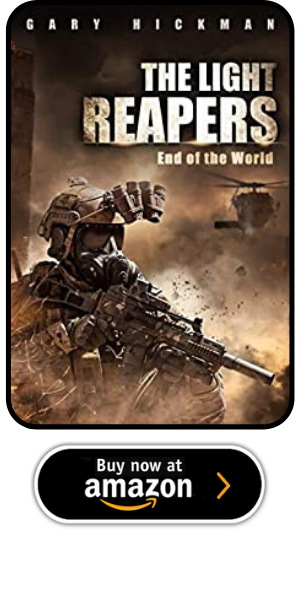 The Light Reapers are a Special Operations Unit who had served numerous campaigns together. They were an expertly trained and elite group, but could they ever prepare for what was to happen next. Under a shroud of darkness and maliciousness, a viral weapon was being produced by an alliance of terrorists bent on the destruction of their respective enemies. When double-crossed by an ISIS faction, the viral weapon is stolen and prematurely unleashed on the planet. Now facing a worldwide epidemic, The Light Reapers are deployed to rescue a scientist who may be able to develop an antidote. If that wasn't difficult enough, they also must track down the ISIS faction and eliminate them. All while battling hordes of the infected. the heart and soul of horror interviews JAMIE DELANO Who are you? Jamie Delano – writer: comics and novels. (Hellblazer, 2020 Visions, Leepus series.) Your signature style: Idiosyncratic. I dislike commas. Toot your own horn: Somehow making a living through word manipulation for thirty-five years. Books read: William Gibson: The Peripheral, Richard Smyth: An Indifference of Birds, Peter Davidson: The Idea of North, Alessandro Baruffi: The Poems of Giovanni Pascoli (translated). Movies watched: No movies. Series 1 & 2 of Britannia (Amazon Prime). Games and/or music played: These New Puritans: Field of Reeds, Patti Smith: Trampin’. Words written: Words written…? None; I’ve done enough fucking damage already. Future stuff: A short story – “Finn of the Islunds”— tangential to my Leepus novels, just published in Rituals & Declarations zine @RitualsZine Brain worms: Three robins have formed a ménage à trois to raise an early brood of chicks in my garden. Jamie Delano Born: 1954 Jamie Delano was variously employed before becoming a professional comic book scriptwriter in the early 1980s. In addition to diverse comics work Delano has experimented with screenwriting and in 2012 published “Book Thirteen”, a novel. His new novel, “Leepus: DIZZY” was published in April 2014 and is available from his Lepus Books imprint now. Jamie lives with his partner, Sue. They have three adult children and five grandchildren. Jamie Delano at GOODREADS Tweets by @jamiedelano "Leepus | THE RIVER" by Jamie Delano “Leepus | THE RIVER” is the second novel by Jamie Delano featuring Leepus and his peregrinations among the odd peoples and landscapes of Inglund. While it builds upon some characters and the environment introduced in “Leepus | DIZZY”, it is nonetheless a stand-lone story. In THE RIVER, Leepus embarks on board the Black Sow for an upriver odyssey into the murky heart of the wetlunds in support of a pal in trouble. Things get increasingly dark and intriguing as he is forced to juggle the blance of power between such competing interests as the OurFuture elitist youth militia; hardcore monk extremists, the Grey Brothers; and the mysterious Eeley Temple to achieve a ramshackle justice and stay out of the World of the Drownded. File under: Weird fiction. Ripping yarn. Alternate reality dystopia. Black comedy. Picaresque adventure. Brutal mystery. Poetic action.  the heart and soul of horror interviewsSPAWN: WEIRD HORROR TALES ABOUT PREGNANCY, BIRTH AND BABIES: INTERVIEW AND CALL FOR STORIES
26/5/2020
 Interview with Deborah Sheldon (editor) and Gerry Huntman (publisher) of Spawn: Weird Horror Tales About Pregnancy, Birth and BabiesSpawn: Weird Horror Tales About Pregnancy, Birth and Babies, edited by award-winning author Deborah Sheldon and released by renowned small press IFWG Publishing Australia, will comprise stories from Australian writers obtained via commission and on-spec callout. The commissioned writers are the multi-award-winning and bestselling authors Isobelle Carmody, Jack Dann, Kaaron Warren and Sean Williams. Submissions are now open and will close midnight 31 August 2020, Australian EST. Deborah Sheldon: I’ve wanted to edit my own horror anthology for a couple of years now. In my 34 years of professional writing, I’ve helmed various non-fiction projects—such as the script portion of SomaZone, the internationally award-winning CD-Rom on adolescent health—but never a fiction project. I thought I had a cracking idea for an anthology but my lack of hands-on experience made me hesitate to approach a publisher. Then out of the blue, Greg Chapman, president of the Australasian Horror Writers Association, invited me to guest-edit the 2019 issue of their flagship publication, Midnight Echo. Serendipity…of course I said yes! That invitation gave me the nudge I needed to find a home for my own anthology. After preparing a pitch, my first choice was IFWG Publishing Australia. IFWG champions anthologies, and has released a few of my titles such as the award-winning Perfect Little Stitches and Other Stories, and the award-nominated novel Contrition. Gerry Huntman: Yes, anthologies are very important to IFWG. When we formed as a publishing company one of our drivers was the concept of assisting writers who were underrepresented in the industry. The short story platform is one such dimension, and besides, we love short fiction! We published over a number of years SQ Mag, an ezine that made a strong splash in the speculative fiction fields internationally. We have also published narrower subject matter in monograph format, such as our Cthulhu Deep Down Under anthology series including the New Zealand-oriented Cthulhu: Land of the Long White Cloud. More recently we published Sherlock Holmes and Doctor Was Not, an anthology injecting strongly into speculative fiction by having each story assume Holmes’ side-kick was a famous Nineteenth-century historical figure, or literary character. Anthologies are big investments for small press (at least to do them justice), so we throttle the frequency to one or two a year—but we will never let go of this format. Deborah Sheldon: The idea for Spawn: Weird Horror Tales About Pregnancy, Birth and Babies sprang from one of my more gruesome stories: “Hair and Teeth”. It was first published in Aurealis magazine in 2018, reprinted in Year’s Best Hardcore Horror #4, and mentioned in Ellen Datlow’s “Recommended List for 2019” in Best Horror of the Year. “Hair and Teeth” is about a middle-aged woman who suspects that her relentless vaginal bleeding is not due to menopause but an infestation of monsters inside her uterus. The story’s bizarre images and themes wouldn’t leave me alone. I decided that Spawn: Weird Horror Tales About Pregnancy, Birth and Babies would invite strange, disquieting tales in a similar vein, including both metaphorical and literal interpretations of reproduction. In July 2019, I approached Gerry Huntman, IFWG’s managing director, and his immediate response was enthusiastic. Gerry Huntman: I supported the project idea for a number of reasons, right from the start. First and foremost, Deb is a trusted creative and professional within IFWG’s stable of authors and it was a simple step to expand her role to editor. We work hard to develop strong relationships with reliable artists and technicians and trust is a natural by-product of this process. It is also no secret to those who have read our catalogue that we have a strong affinity with the horror and dark fantasy genres and sub-genres of speculative fiction, and Deb’s ideas were original and exciting. I certainly saw this project as a seed for something the market will lap up. Deborah Sheldon: Gerry’s vision for the anthology turned out to be grander than mine. He suggested that we approach and commission a few big-name Australian authors. We chose Isobelle Carmody, Jack Dann, Kaaron Warren and Sean Williams. All four are on-board and I can’t wait to read their contributions. Spawn: Weird Horror Tales About Pregnancy, Birth and Babies will be an Australian-only anthology because I believe that every society should have the space to tell its own stories. We have tremendous writing talent in this country and I want to showcase it! I’ve long admired the United States for its passionate commitment to telling American stories—in fiction, TV and film—and I believe Australia should celebrate its own homegrown perspectives with the same fervour. Our “cultural cringe” needs to be beaten to death, and I’ll happily wield one of the clubs. Gerry Huntman: I share Deb’s idea that this particular project should showcase Australian writing talent, and from a consumer point of view, I believe that US, UK and other non-Australian readers would also see this as positive, if not ‘exotic’. IFWG, an Australian-based publishing company, has supported Australian talent for years and this project is a logical extension of this philosophy. My idea of having a core set of prominent Australian commissioned authors was in part to set a strong base for the anthology, but I viewed these great writers as having the credentials needed to attract non-Australian readers to the anthology in the first instance. Deborah Sheldon: Gerry floated the idea of including artwork commissioned by Australian artists. Thrilling! Is there an editor alive who wouldn’t want original illustrations for their anthology? At this stage, we’re depicting the work by our four lead writers, and including decorative drop-caps for every story that makes it into the anthology. Gerry Huntman: Adding illustrations to an anthology is always a carefully considered option for me. For some anthologies, particularly generally-themed, it is possible that the illustrations won’t add sufficient value to the prose. In my experience, where carefully placed illustrations add value demonstrably to anthologies (and other fiction formats) is where there are strong themes, or where there is a cross section of style that can be enhanced by complementary artwork. Deb’s project has a strong literary/artistic bent to it and by attracting the right, sensitive artists to this anthology, would add cream to an already tasty pie. We don’t want to cram illustrations into this work—our usual approach is to be sparing and very effective with placement. Deborah Sheldon: Prior to the coronavirus outbreak, we planned to crowd-fund a hardback edition, which would’ve had full-page commissioned artwork for each and every story. That may still happen, but only time will tell. Due to the economic turndown, Gerry decided that IFWG would delay release of upcoming titles, including this anthology, until the marketplace is healthy again. However, IFWG intends to get its books “print ready” as if there were no delay, and have them waiting in queue for release when this crisis is over. Gerry and I have also talked about sequels to my anthology—Australasian first, then international—but these projects will ultimately depend on the robustness of the market in future years. Gerry Huntman: The publishing industry has not been robust for decades and over recent years publishers have had to adapt and settle on business models that make sense to thrive—those that don’t fall into oblivion. IFWG had worked hard to get to the right model prior to this current crisis, and fortunately is well placed to weather the storm. Our decision to delay releases of new titles until we have a good handle on what the ‘new normal’ will look like is driven by sales (our decision was vindicated by sales and return figures coming out of our largest marketplaces), but we also want to give our authors the best possible chance to earn income and get credit for their amazing work. Fortunately, this anthology was slotted from the start to be released in 2021, and it is looking like we only have to move it back several months. Deborah Sheldon: When I was guest-editing Midnight Echo #14, every submission that hit my inbox gave me a buzz of anticipation. Before opening a story, I was already on the writer’s side. After decades of selling feature articles, non-fiction books, medical writing, scripts, short stories, novellas and novels, I’ve had literally hundreds of rejections, so I know how it feels to send work into the void with fingers and toes crossed. Honestly, I wanted to love every submission. It pained me to deliver rejection emails, but the editor’s job is to be ruthless. Pitiless. (Even though doing so gave me sleepless nights.) My master is the Reader, who quite rightly deserves high-quality writing and doesn’t care a fig about the disappointment and hurt that rejected writers may feel. So, potential contributors be advised--Spawn: Weird Horror Tales About Pregnancy, Birth and Babies will set a high bar. Aussie writers, bring your A-game! How to submit:Full submission details are on the IFWG Publishing Australia website: https://ifwgaustralia.com/2020/04/30/taking-submissions-spawn-weird-horror-tales-about-pregnancy-birth-and-babies/ Send on-spec submissions to Deb at spawnsubmissions@gmail.com Submissions will close midnight 31 August 2020, Australian EST. DEBORAH SHELDON Deborah Sheldon is an award-winning author from Melbourne, Australia. She writes across the darker spectrum of horror, crime and noir. Some of her titles include the novels Body Farm Z, Contrition and Devil Dragon; the novellas Thylacines and The Long Shot; the collections Figments and Fragments: Dark Stories, and the award-winning Perfect Little Stitches and Other Stories (Australian Shadows “Best Collected Work 2017”). Her short fiction has appeared in many well-respected magazines such as Quadrant, Island, Aurealis, Midnight Echo and Dimension6. Her fiction has been shortlisted for numerous Aurealis and Australian Shadows awards, long-listed for a Bram Stoker award, and included in “best of” anthologies. She guest-edited the 2019 edition of Midnight Echo. Other credits include TV scripts such as Neighbours, feature articles for national magazines, non-fiction books, stage plays and award-winning medical writing. Visit Deb at http://deborahsheldon.wordpress.com GERRY HUNTMAN Gerry Huntman is the Managing Director of SQ Mag Pty Ltd, trading as IFWG Publishing Australia and IFWG Publishing International. He has over a decade of professional editing under his belt (a full member of Editor’s Australia) and is also an author himself, with over 50 short fiction sales, and has a two-book deal with Meerkat Press in the US for a middle grade novel series. His personal site can be found at https://gerryhuntman.com. IFWG PUBLISHING AUSTRALIA IFWG Publishing Australia, and its US-oriented imprint, IFWG Publishing International, are based in Melbourne Australia and has been operating for 10 years. The Australian imprint’s releases are distributed through Novella in Australia and Gazelle in the UK and Europe. Most Australian publications are co-released through the International imprint and distributed through Chicago-based IPG, to our North American and Latin American readers. The Australian/UK imprint website: https://ifwgaustralia.com THE HEART AND SOUL OF HORROR PROMOTION ALAN BAXTER Who are you? Alan Baxter, author. Your signature style: Horror and dark fantasy, liberally mixed with crime, noir, and mystery, heavily spiced with the weird. Toot your own horn: Author of (so far) seven novels, five novellas, two short story collections, and more than 80 published short stories. I’m also a seven-time finalist in the Aurealis Awards, a six-time finalist in the Australian Shadows Awards and a seven-time finalist in the Ditmar Awards. From those shortlistings I won the 2014 Australian Shadows Award for Best Short Story (“Shadows of the Lonely Dead”), the 2015 Australian Shadows Paul Haines Award For Long Fiction (“In Vaulted Halls Entombed”), and the 2016 Australian Shadows Award for Best Collection (Crow Shine). I’m also a past winner of the AHWA Short Story Competition (“It’s Always the Children Who Suffer”). Books read: Recently The Cipher by Kathe Koja, which was amazing. Currently The Only Good Indians by Stephen Graham Jones, which is so far fantastic. Movies watched: Not many movies recently, but I have been enjoying The Chilling Adventures of Sabrina on Netflix. It’s like Buffy the Vampire Slayer for this generation. Games and/or music played: I’ve been playing loads of Minecraft. My son wanted it, so I set up a world of my own to learn and help him. But I’ve found it incredibly therapeutic, so I’ve been losing myself there a lot. Words written: I’m finding writing very hard during this pandemic, not least with so much else going on with homeschooling my son and trying to run my martial arts classes online. But I have started work on a novel for my son. I plan to write it for him and read it for him. If it ever also gets published, then great. But that’s not why I’m doing it. Future stuff: I’ve got a sequel to Manifest Recall coming out in July (called Recall Night). Meanwhile, after I finish the book for my son, I plan to redraft a new horror novel I finished at the end of last year. Brain worms: I recently came up with a creepypasta story idea based on Zoom meetings, after teaching my online classes, so I typed it up as a twitter thread. It’s gone a bit viral, which made me realise people are hungry for stuff relevant to our current situation. You can read it here: https://twitter.com/AlanBaxter/status/1247844822833979392  Alan Baxter is a multi-award-winning author of horror, supernatural thrillers, and dark fantasy. He’s also a martial arts expert, a whisky-soaked swear monkey, and dog lover. He creates dark, weird stories among dairy paddocks on the beautiful south coast of NSW, Australia where he lives with his wife, son and hound. Find him online at www.warriorscribe.com or find him on Twitter @AlanBaxter and Facebook. Click on any book cover to learn more about it, or click here for an overview of all my published fiction. The Roo by Alan Baxter Something is wrong in the small outback town of Morgan Creek. A farmer goes missing after a blue in the pub. A teenage couple fail to show up for work. When Patrick and Sheila McDonough investigate, they discover the missing persons list is growing. Before they realise what’s happening, the residents of the remote town find themselves in a fight for their lives against a foe they would never have suspected. And the dry red earth will run with blood. THE HEART AND SOUL OF HORROR PROMOTION  Holly Rae Garcia is an author and photographer. Her short work has appeared online, and her debut novel releases on March 27th, 2020 from Close to the Bone Publishing (UK). Holly lives on the Texas Coast with her family and three large dogs. Author Website: https://www.hollyraegarcia.com/ Amazon Author Page: https://www.amazon.com/Rae-Garcia-Holly/e/B07XY6J9T3/ref=dp_byline_cont_ebooks_9 Twitter: https://twitter.com/HollyRaeGarcia Instagram: https://www.instagram.com/hollyraegarcia/ Facebook: https://www.facebook.com/HollyRaeGarciaAuthor/ Could you tell the readers a little bit about yourself? I’m definitely the clichéd writer type (introverted/socially awkward/pale), though I do love a good pub crawl or reading a book on the beach. I’m down to one child at home so I have a lot more time to write than I used to. My daughter will be 21 this year, and my son is 17. To get the ball rolling and get everyone relaxed, here is a hopefully lighthearted question to break the ice, which one of your characters would you least like to meet in real life and have them complain at you about they way you treated them in your work. Oliver Crow, the four-year-old with four death scenes in my book, Come Join the Murder. He probably doesn’t like me very much. Other than the horror genre, what else has been a major influence on your writing? My mother read a lot of True Crime when I was growing up, so these were the books I would pick up when bored as a child. This is probably what influenced my desire to read and write mostly human horror instead of ghosts or vampires, etc. Man is the most horrific creature I can think of. The term horror, especially when applied to fiction always carries such heavy connotations. What’s your feeling on the term “horror” and what do you think we can do to break past these assumptions? I’m not sure it’s our responsibility to hold the hands of others when it comes to appreciating horror. The die-hard fans have always been fans, and those who frown at the term “horror” will probably not like most of what’s inside. And that’s okay, not everyone can handle it. A lot of good horror movements have arisen as a direct result of the socio/political climate, considering the current state of the world where do you see horror going in the next few years? I see more climate-change and apocalypse-related horror coming out in the next few years. The US is extremely divided politically so possibly more stories highlighting the extremism of each side. Given the dark, violent and at times grotesque nature of the horror genre why do you think so many people enjoy reading it? It’s a safe place to get close to horrific things/situations but still maintain control. You can close the book at any time. It’s like that condition where people have an urge to drive off bridges but don't. They toe the line of that self-preservation instinct because they know they’ll always bring themselves back from it. But flirting with it, and with horror, releases endorphins and excitement much like a real-life situation would, but in a controlled environment. What, if anything, is currently missing from the horror genre? I don’t think anything is missing from the horror genre, there’s such a wide breadth of sub-genres and styles to choose from. Is horror its own worst enemy? What do you think keeps horror from being regarded as a valid genre by the public at large? I think, by definition, it’s a boundary-breaking and emotionally charged genre. Most people like to play it safe or have a happy ending, and horror doesn’t always do that. As for why traditional publishing houses don’t consider it as often as they do other genres, I have no idea. But seeing the passion for the genre in small and Indie presses is exciting. The sub-cultures will always be the torch-bearers for horror. What are the books and films that helped to define you as an author? I saw Flowers in the Attic in the theatre when I was eight-years-old and I fell in love with that feeling you get from watching a tense horror film. Though technically I think it was considered Psychological Thriller at the time, it was horrific to this eight-year-old. For books, I made my way through most of the Christopher Pike and R.L. Stein novels when I was younger. What aspects of writing to do you find the most difficult? The first draft is the most difficult and the most rewarding. I can stare at a blank page for an hour, starting and stopping ten times, before finally letting myself get into the story. But once you’ve finished that first draft, you’ve created a world and people that weren’t there before, and it’s extremely satisfying. Is there one subject you would never write about as an author? As a parent, it’s difficult for me to write about sexual abuse of minors. I touched on it for a few paragraphs in Come Join the Murder, and it was the most uncomfortable thing I’ve ever written. Aside from that, I try not to place limitations on subject matter. Anything goes. How important are names to you in your books? Do you choose the names based on liking the way it sounds or the meaning? I tried to make sure each main character had a name unique enough that it didn’t sound like another’s (that’s confusing sometimes as a reader). I also pored over baby-name lists and US Consensus lists. My main character’s name, Rebecca, was pulled from the Daphne Du Maurier novel of the same name. It’s one of my favorite books. I also look up popular names in whatever setting the book takes place in. I don’t take it as far as looking up the meaning of a particular name, but instead choose based on how it sounds/looks/fits in the region. What is the best piece of advice you ever received with regards to your writing? It’s okay for the first draft to be a giant ball of shit. Can you tell us about your last book, and can you tell us about what you are working on next? Come Join the Murder is one of those twisted, dark thrillers about a mom who is seeking revenge for her son’s death. Told in both her perspective and that of the killer, the chapters dance around each other until the two finally meet. As the novel progresses, we see Rebecca’s downward spiral as she obsesses over her mission. I’m currently working with my husband on a Bigfoot horror novella tentatively titled, “Easton Falls Massacre.” I love sci-fi or cryptozoological horror, even the cheesy B-story stuff. I realize Bigfoot is very different from Come Join the Murder, but the dark themes are prevalent throughout both. If you could erase one horror cliché what would be your choice? The Final Girl cliché What was the last great book you read, and what was the last book that disappointed you? I really enjoyed The Cabin at the End of the World by Paul Tremblay. He is a master of tension. As for disappointment, I would have to say The Alienist by Caleb Carr. The plot was fantastic, but pacing was too slow and overly descriptive. Normally I wouldn’t talk ill of other novels, but this one was such a success that I’m sure my opinion won’t count anywhere. What's the one question you wish you would get asked but never do? And what would be the answer? I’ve never been asked about my dogs. We have a one-year-old Great Dane named Jager who is 130 pounds of lap-dog and slobber. Then there’s the one-year-old Black Lab named Lucy who is obsessed with frisbees, water, and anything else that means she gets to run. Our older girl Maggie is a mutt we adopted, and she’s pretty cranky most of the time but she’ll do anything for a biscuit. Come Join The Murder by Holly Rae Garcia "This is a novel I would read and reread and recommend to others. Fans of vigilante and desperado revenge will delight in this horror story." — Horror Tree. Rebecca Crow’s four-year-old son is dead, and her husband is missing. Divers find her husband’s car at the bottom of a canal with their son’s small, lifeless body, inside. The police have no suspects and nothing to go on but a passing mention of a man driving a van. Guilt and grief cloud Rebecca’s thoughts as she stumbles towards her only mission: Revenge. James Porter knows exactly what happened to them, but he’ll do anything to keep it a secret. James didn’t plan to kill Rebecca’s son, but he’s not too broken up about it, either. There are more important things for him to worry about. He needs money, and his increasing appetite for murder is catching the attention of a nosy detective.   Emma J. Gibbon is a horror writer, speculative poet and librarian. She is the author of the short fiction collection, Dark Blood Comes from the Feet (Trepidatio Publishing, 2020) and her stories have appeared in various anthologies and she has a story upcoming in Would but Time Await: An Anthology of New England Folk Horror from Haverhill Publishing.. In 2020, she was nominated twice for the Rhysling Award for “Fune-RL” (Strange Horizons) and “Consumption” (Eye to the Telescope). Her poetry has also been published in Liminality, Pedestal Magazine and is upcoming in Kaleidotrope. Emma is originally from Yorkshire and now lives in Maine in a spooky little house in the woods with her husband, Steve, and three exceptional animals: Odin, Mothra, and M. Bison (also known as Grim). She is a member of the New England Horror Writers, the Science Fiction & Fantasy Poetry Association, the Angela Carter Society, and the Tuesday Mayhem Society. Her website is emmajgibbon.com. Could you tell the readers a little bit about yourself? I’m a writer, poet and public librarian. I’m originally from Yorkshire but have lived in Maine in the U.S. for the past ten years so no automated phone service from either country can understand me. I end up screaming “I just want to talk to a person” repeatedly (it usually works). To get the ball rolling and get everyone relaxed, here is a hopefully lighthearted question to break the ice, which one of your characters would you least like to meet in real life and have them complain at you about they way you treated them in your work. It’s hard to say without giving away spoilers of my new book but let’s just say there are a few characters in the stories in Dark Blood Comes from the Feet that get eviscerated by monsters of different shapes and sizes. I imagine they’d be pretty annoyed with me. I also imagine they wouldn’t be pleasant to look at, at that stage. Other than the horror genre, what else has been a major influence on your writing? Just generally existing. I often draw on the emotional experiences of my life when I write. I also use a lot of the places that I lived in and visited as settings. I’m horrible spatially so when I describe buildings and such, I usually loosely base it on a real life place so I can get my bearings. I also read a lot outside of horror so that comes into play too, but inspiration can come from anywhere. I’ve had more ideas from watching Ghost Adventures than I ever want to admit. The term horror, especially when applied to fiction always carries such heavy connotations. What’s your feeling on the term “horror” and what do you think we can do to break past these assumptions? It does, and I think for some people, you will never persuade them otherwise. Being a librarian in Maine, I come across people who emphatically don’t like horror…but have read everything Stephen King has ever published or others who are really into thrillers that in the 80s would have absolutely been marketed as horror but won’t try a horror book. I think that the regular reading public has little of a sense of how broad and varied and diverse horror can be, especially in the indie presses. I think the recent resurgence in interest in horror helps that a little but I think in general, all we can do is keep producing good work, lifting each other up by talking about stuff we enjoy, recommending them to folks and doing all we can to make sure diverse voices are heard. A lot of good horror movements have arisen as a direct result of the socio/political climate, considering the current state of the world where do you see horror going in the next few years? That’s a good question. I don’t know where it will take it, but I think the impact will be big. Just the fact of the pandemic, trauma and fear on a global scale, coupled with some of the most intense collective selfless acts that many of us will see in our lifetimes will have a profound effect on our psyche. It’s be interesting to see how it all turns out. Given the dark, violent and at times grotesque nature of the horror genre why do you think so many people enjoy reading it? I think there are many reasons people enjoy it. Catharsis can certainly be part of it. Horror can be a psychological trial run. Life is often chaotic and terrifying and horror is a way of experiencing fear that can be controlled and contained. For me, I’m attracted to dark themes. I’m deeply suspicious when everything is all sunshine and light. What, if anything, is currently missing from the horror genre? Well, you don’t know what you don’t know, right? I’m sure something will come along and we will be like “THIS! This is what was missing!” In the past authors were able to write about almost anything with a far lesser degree of the fear of backlash, but this has all changed in recent years. These days authors must be more aware of representation an the depiction of things such as race and gender in their works, how aware are you of these things and what steps have you taken to ensure that your writing can’t be viewed as being offensive to a minority group? I would say that I am aware of it and I do take steps to ensure that I am not being offensive but that I am also fully aware that I have room for improvement. For example, I have changed certain terms and words that were fine in the U.K. but are considered much more offensive in the U.S. I also try to read and research as much as I can when writing outside my own experience, and I do interrogate my own work to see if I’m falling back on my own experience as default. For example, my work at this time is entirely too white, and that is something I have to work on in the future. I don’t think it is such a burden to make sure that our fiction reflects the world we live in in this way. I would have no problem hiring a sensitivity reader, for example, or putting trigger warnings on my books if needed. Does horror fiction perpetuate it’s own ghettoization? I don’t know. I don’t think so, but then I’m probably biased. What new and upcoming authors do you think we should take notice of? I’m a bit behind the curve when it comes to new stuff as I have a TBR pile up to the ceiling but there are certain publishers who I always watch out for when they have new authors. One is Trepidatio (full disclosure: they’re the publisher of my new book), another is Undertow. I keep a close eye on what Nightscape Press is doing too. What are the books and films that helped to define you as an author? I know I will forget something key so I’m just going to list them as they come to me and hope for the best! Books: One Flew over the Cuckoo’s Nest, We Have Always Lived in the Castle (anything by Shirley Jackson, really), The Gormenghast Trilogy, Daphne du Maurier’s short stories, Salem’s Lot, The Secret History, My Sweet Audrina, House of Leaves, The Bloody Chamber, The Name of the Rose, Moby Dick Movies: Heathers, The Lost Boys, Dangerous Liaisons, Amadeus, Nightbreed, May, The Howling, Beetlejuice, The ‘Burbs, Donnie Darko, Bram Stoker’s Dracula, Bill and Ted’s Excellent Adventure Are there any reviews of your work, positive or negative that have stayed with you? There is one that kind of follows me around and I don’t mind, but it’s funny how people zone in on it. My story, “St. Scholastic’s Home for Children of the Sea,” was reviewed for a podcast when it came out in the anthology, Wicked Weird, and it was a pretty good review! The reviewers were, you know, grizzly horror dudes and they were really taken by what they saw as a happy ending. I mean, I think it’s a happy ending too, but I’m kind of grisly if not grizzly—there’s a lot of rending and tearing and blood mist in that story. They compared it to a “Horror Sound of Music”. The other part of this is, being a Brit in the U.S., people tend to think I’m a bit Mary Poppins, which I’m really not and anyone who knows accents at all knows I’m not but the fact is, any kind of Brit accent can mean you can get away with murder and they just think you’re being super charming. So somehow, the phrase “Mary Poppins of Horror” starts getting bandied around, and I don’t mind. I loved Mary Poppins as a kid, because she was clearly a witch and did what she wanted. So now, I get my first blurb for Dark Blood Comes from the Feet in from Morgan Sylvia and it literally makes me cry, when I see who she’s compared me to. But at the end she says “The Mary Poppins of Horror has arrived!” and I swear, as soon it was posted on the preorder site I got loads of messages that said “THE MARY POPPINS OF HORROR!” And I’m like, you did see I got compared to Shirley Jackson, like, twice? What aspects of writing to do you find the most difficult? Honestly, I find writing hard. I have to get out of my own way to do it. Ray Bradbury compared it to trying to make friends with cats, and it makes sense to me. I have to pretend to not care about how it turns out to do it. I think what it boils down to is that I know that I will never be able to translate the story in my head perfectly on the page. That said, I’ve tried just not writing, quitting, and I’ve never been as miserable. Is there one subject you would never write about as an author? I don’t know. The key word is never. There may be something that I wouldn’t touch right now that in the future I may change my mind about. How important are names to you in your books? Do you choose the names based on liking the way it sounds or the meaning? So, I’ve always found it weird when people struggle with this, because I just kind of know. I know what they’re called. I don’t look into the meaning or anything because it’s as if they already have their name. Writing, is not a static process, how have you developed as a writer over the years? I think that I have more of a sense of what makes a story, how it is structured and I think that has come from writing but also from a hell of a lot of reading. I also think I’ve got better at poking those sore spots, emotionally, slowing it down when it hurts. That just comes from living, I think. What is the best piece of advice you ever received with regards to your writing? I can’t say which story because it is a spoiler but my husband (who is also a writer but not a horror writer) said to me “But what if they weren’t all dead though?” and at first I told him he was being ridiculous and of course they were all dead but the more I thought about it, it lead to me writing the most satisfying end to a story of my career thus far. To many writers, the characters they write become like children, who is your favorite child, and who is your least favorite to write for and why? I really like Janine from “Janine” in Dark Blood Comes from the Feet. She’s had a really hard life and made some bad choices but she has a clear view of who she is and the only person she has ever really hurt is herself. I have a lot of sympathy for her. I’ve not met a character that I really dislike writing, even though there are some objectively awful people in my stories. I usually kill them off if they get too annoying. For those who haven’t read any of your books, which of your books do you think best represents your work and why? As I only have one book that is coming out on May 22 (and available for preorder now), I’ll go3 for that one. Dark Blood Comes from the Feet is my debut fiction collection out from Trepidatio. Do you have a favorite line or passage from your work, and would you like to share it with us? The beginning of “Black Shuck Tavern” which is in my new collection. I don’t think I’ve ever got to the heart of a story so quickly: “I’m being followed by a huge fucking dog of potentially supernatural origin.” Can you tell us about your last book, and can you tell us about what you are working on next? My last book is Dark Blood Comes from the Feet as mentioned above and as to what next…I’m still mulling it over. Quarantine brain has not helped that process. If you could erase one horror cliché what would be your choice? It’s an outdated one now, but I hope it goes away for good—the “bad” girl who always gets killed early on. This idea that they have to be virginal to live, give me a break. What was the last great book you read, and what was the last book that disappointed you? The last great book I read was Gideon the Ninth. It was just a fantastic, fun book—like Gormenghast but in space with skeletons and lesbians and a locked room mystery and SO MUCH snarky humor. The last book that disappointed me…I don’t remember anything specific but I tend to not like many popular fiction books that hit the bestseller lists that are about upper middle-class families who live in the suburbs, etc. They just don’t speak to me at all. I have a hard time connecting with their concerns or sympathizing with them. What's the one question you wish you would get asked but never do? And what would be the answer? I haven’t really been interviewed enough to be able to know. I guess since we’re still locked in at home, it would be “Would you like Indian food delivered to your door with a couple of beers?” And my answer would be: “More than all the world!” DARK BLOOD COMES FROM THE FEET Dark Blood Comes from the Feet is a strange and eclectic collection of seventeen stories from horror author and speculative poet, Emma J. Gibbon. Within its pages, you will meet secret societies who contract deadly diseases on purpose, dancers helping each other avoid "below," monstrous children who must be loved before they return to the sea, a taxidermy-obsessed mother, small blue devils in the Maine woods, a black cat that retrieves the dying, the last witch in Florida, and "a huge fucking dog of potentially supernatural origin." Visit haunted houses, a Hollywood nightclub, limbo, Whitechapel, and other stops on a death tour, and a childhood hangout that spells destruction for kids and dogs alike. Listen to a punk rock sermon in a post-apocalyptic matriarchal society, witness crustaceans that have trouble staying dead, a cannibalistic romance, a gothic love story to tuberculosis and a downtrodden wife's transformation.  the heart and soul of horror interviews Tabby: Good morning, Penny! Penny: Evening, Tabby. How are you doing in the Upside Down? Tabby: Mostly good. It was my youngest’s birthday yesterday so I’m trying to decide if I want to eat leftover trifle for breakfast. Penny: Oooh, I love trifle. I made rhubarb trifle last week. Before we start the interview properly I have an important question: Do you keep your trifle pure or adorn it with hundreds and thousands? People want to know. Tabby: It’s not a proper trifle unless it’s teeming with hundreds and thousands. It has to have that 70’s flair. Penny: Nooooo! Next you'll be telling me you put glacé cherries on. Tabby: Definitely not. I do have some standards. I do like kirsch though... Penny: I like kirsch, though not in trifle. I like baby trifle (no booze). Well, following on from trifle-gate. I suppose we should actually talk a bit about the reason why we’re actually here, your upcoming charity anthology, “Black Dogs, Black Tales” First things first. Where did the idea for the anthology come from? Tabby: The idea came about after a writer friend of mine, Mark Matthews (author of “Milk-Blood”, “All Smoke Rises” and the editor of “Lullabies for Suffering”) made a Tweet talking about doing his own editing for a collection. He had his dog, Rocky, by his side and it had a terrified expression on its face. The tweet went: “I’m sorry, it’s a grim subject, people get killed. But don’t worry, the dog never dies.” I replied jokingly, saying I wanted an anthology of horror where the dog doesn’t die, and that’s what set the ball rolling. Penny: The term “black dog” is often used to describe depression. Was mental health always going to be a central part of the anthology? Or did the idea grow from the concept that the dog never dies, and then grow to encompass depression and mental health? Tabby: The mental health part came first. It’s something I’ve always been very passionate about. I apologise that this might get a little long. I emigrated to New Zealand from the U.K. in 2017, and as much as I absolutely adore living here, making a new life away from all your family and friends is really hard. Probably even harder than you expect. Culture shock comes in waves and in unexpected ways, and as soon as you think you’re settled, something else will always happen. It tests your resilience, your ability to be flexible and forces you to find ways to cope. For me, my way was through writing. I reminded myself why we made the move, and gave myself permission to acknowledge the frustrations and the difficult parts of emigrating. I started a writing group called Well-Written that same year — a play on writing for wellness, and the Well part, a nod to Wellington (Welly). It started small, with most things happening online, but eventually it grew to include workshops and writing classes in real life. But in June 2018 I lost a friend in the U.K. due to mental illness. And it absolutely devastated me. Being so far away, there was nothing practical I could do. Mutual friends in the U.K. had each other, while time zones made it harder for me to connect and talk with people. So writing became not only helpful but crucial. It helped me make sense of my feelings when I couldn’t talk about them. Well-Written became the support network I hadn’t realised I needed, and I was also able to help others who needed a similar place to be honest and raw. Penny: I’m aware that the anthology is being published to raise money for a mental health charity. Which charity did you choose to go with? Tabby: The charity is The Mental Health Foundation of New Zealand. They do a lot of work for people who are living with mental illness, and for their families too. They work holistically and they do what they know makes and keeps people mentally well. In New Zealand, 1 in 6 adults will experience mental illness at some point in their lives. Penny: That is a staggering number, but not surprising, and unfortunately I expect it will rise with the world's current situation. How did the charity react to the concept of it being a horror anthology? I'm aware that sometimes the word "horror" can have charities quaking in their boots. Tabby: The charity were, I think, a bit bemused when I first contacted them. And obviously they were concerned that any stories which contained mental health issues were handled sensitively. But ultimately, I think they were happy that we wanted to do something to help support them. Penny: Have they seen the final stories, were there any contentious ones? Tabby: They have not. The anthology is not specifically affiliated with what the MHF do, it is separate from the charity and does not necessarily reflect their views. It is to raise money for the charity. I honestly don’t know how it will be received, I suspect it could even be quite polarising. If you don’t like dogs you might not be keen to read about them, for example. But I am massively proud of this project, and the work that everyone involved has done to make it happen. I don’t like to talk about favourites anyway, but in this case, I love every single story, poem and piece of art work that has been included. All I really wanted was to do some good, to honour the people in my life who have been hounded by their own black dogs, and in some cases have been led away by them. And I think I’ve done that. Penny: All of the stories obviously have a dog in them, but were many of the submissions directly linked to mental health? Tabby: Yes, some were. And I’d like to think even the darker ones were sensitive and very cleverly crafted. The anthology is horror, so obviously there are going to be some dark themes, but overall the anthology is hopeful and honest about mental illness. Penny: I think that's the most important purpose of fiction, and horror in particular. The ability for the author to be honest about subjects that maybe the general populace don't want to acknowledge. I do wonder sometimes if rather than it being that creative types are chased by the black dog, if it is instead that when you have been chased by him and seen the other side, it makes you want to look for answers and get those questions and explanations out there. Tabby: I can only really speak from my own experiences, but I suspect a great many creative people don’t just see things as they are, they can see the bits in between as well. The negative space which is often ignored. They can reach into that space and see how it holds everything together. They understand that you can’t have light without shadows, and also that those shadows are not always bleak and troublesome, they can have their own beauty as well. Penny: That’s lovely. So, you started your writing group locally, did you find that the majority of the submissions you received were from New Zealand, or were they more international? Tabby: The Black Dog team were based in New Zealand, the U.K., America and Canada. Ultimately, we wanted a diverse mix of stories, and it paid off. We ended up having 176 submissions from all the over the world. Penny: That nicely brings me on to my next question. You had a large and diverse editing group working with you on “Black Dogs, Black Tales”. What was the reason behind that decision? Tabby: I’d always envisioned this as a team project. It’s a large part of how I do anything. I believe in collaboration and diversity and I’m always eager to see what other people will bring to the table. I’m going to name-drop here as they were all absolutely amazing. My team was made up of co-editor Cassie Hart and sub-editors; Melanie Harding-Shaw, Jessey Mills, A.S. Mackenzie, Aiden Merchant, J.A. Sullivan, Ben Walker, Miranda Crites, Ankh Spice and publisher Steve Dillon. And of course, you! Penny: How did you manage to balance differing ideas and opinions? Tabby: Remembering the saying, “A rising tide lifts all boats” I suppose... Listen to everyone. Really listen. Sometimes decisions had to be made via the majority, other times we would collaborate and find a compromise. Penny: So it was more a case of many hands make light work, rather than too many cooks? Tabby: That’s how I felt it was. I love every single one of the team and they all had something unique and essential to offer. Obviously, I knew my team before I started this, some personally, some via online interactions. I was very lucky to work with a U.K. review site for a short while, and I got to know some excellent writers and reviewers through that. I chose people I knew I could work well with, who were talented and diligent, had shown that the quality of work they produced was of high quality, and had a good sense of humour. Penny: A good sense of humour is always needed in publishing. “Black Dogs, Black Tales” is published by Things in the Well. How did you go about choosing them? Tabby: Again, it was by happy accident. I know Steve Dillon, having been published by him in his other charity anthologies before, and I was musing the idea behind putting together a canine, charity anthology. He thought it was a great idea and offered to publish. It’s a common theme in my life that I tend to fall into doing things, or just happen to speak to the right person at the right time. Penny: Karma. Tabby: You could say that. I’m not afraid of asking for help when I need it too. I think that’s an important thing. Sometimes people get nervous about seeming needy, or looking like they can’t do things on their own. You should never be ashamed or nervous about asking for guidance or advice. There are some amazing people in the horror writing community, and everywhere else in the writing world. Penny: Can you tell me a little more about the submissions process? Tabby: All submissions were passed on to the team anonymously. Only I knew who had sent in what. In the early stages, having a large team was beneficial as we had a lot of stories to read. Each team member decided if the sub was a yes, no or maybe and added their own thoughts. I also had my own ideas, but ultimately every decision was a team one. Penny: So the anthology is a mix of short stories, poems, and illustrations. What made you decide to look at different mediums, rather than stick to it being purely short stories? Tabby: When we chose the stories, we wanted a strong, varied selection. Some of the stories deal with grief and loss, some take a metaphorical look at depression and other mental illnesses. The only rule was that the dog could not die, which some writers told me was quite a challenge. There is a trope in horror where killing off the dog can amplify emotion or serve as a motivator to further the plot. I wanted to avoid that. When we put out the callout, I only asked for stories, but when people got in touch and said, “I want to support this anthology and charity, but I want to donate a poem or art,” I was more than happy to accept those mediums. And I think it adds something extra to the final project. Penny: I agree, and the cover art is very atmospheric. Tabby: I love the cover! It was designed by François Vaillancourt, a Canadian artist who has also worked with Steven King and Richard Chizmar. He got in touch and offered to design the cover to support the charity. He is an incredibly talented artist and lovely person. I have been so honoured to work with him. Penny: Tabby, your story “Night Wolves” is included in the anthology. I'm aware that it had to go through the blind submission process, how did that feel seeing it going through the different stages of the reading process? Were you watching it with you editor or your writer head on? Tabby: Okay, so I never actually intended to include my own story, I was persuaded by the team to do so, and I was initially going to add it under a pen name. Pretty much everyone on the team threw something into the ring, and that was quite hard, because of course I knew whose stories they were but no one else did. When I added mine I had zero expectations. It was honestly a massive surprise that the whole team liked it. Because they were a tough crowd! Even then, I had a lot of anxiety over whether I should include it. Because as I said, this anthology is not about me, it’s about the team, and about doing something good. Penny: What made you overcome that anxiety and decide to include it? Tabby: When ten different people are telling you “this is a good story, it needs to be included” you stop listening to the anxiety demons and impostor gremlins and start listening to the voices of those who support you. It’s very easy to fall into that trap of self-sabotage. It’s important to believe in yourself and your work, and do all you can to rise above any doubts. Penny: When you were finalising the contents of the anthology, were the team still working blindly or did they know who the authors were? Were they happy with the mix of authors? Tabby: The team knew some of the authors by that point. For example, I approached Australian authors Kaaron Warren and Alan Baxter for stories directly, and Alan also wrote the Foreword. Diversity was something I was really keen to ensure, but I had an interesting experience with that. I would say that maybe two-thirds of submissions were from white males, and these were also the stories that the team liked the most. All the stories were read anonymously, and I did start to worry a little bit, because I really wanted to have a good, varied selection. I didn’t want to influence my team’s decisions, so it was a bit of a moral quandary! Luckily, I didn’t need to. When it came down to final choices, the stories were a good, strong mix of voices. Every single story was picked on merit and the strength of the storytelling, and we had an amazing selection to choose from. Whittling it down to only seventeen stories was a real challenge. Penny: What were your most and least favourite bits of the process? Tabby: My most favourite bit was reading the stories. We had so many brilliant submissions from a wealth of diverse voices. My least favourite was sending rejection emails. I know how that feels, receiving the email in your inbox and that rush of excitement and terror, only to have your hopes dashed. I utterly hated being the one to do that to someone. I did as much as I could to ensure any bad news was as kind as possible. There were definitely a few moments where I was a little worried about the team not liking a story, and subsequently having to be that person who tells a well-respected, popular author we don’t want their story. That was pretty daunting. Penny: What are you working on now, and would you do this again? Tabby: I’m planning a nonfiction horror project at the moment which will hopefully become a book next year. I’m also working on some stories to submit to some other charity anthology call outs, and I’m writing a YA fantasy books for my kids, because in the midst of all this world chaos and uncertainty, they are my most important audience. Would I do this again? Probably. I suspect the universe will nudge me into doing something similar in the future. Penny: Finally, is there anything else you'd like to add? Tabby: Yes... Buy the book! Support the charity! Black Dogs, Black Tales - Where the Dogs Don’t Die: A Charity Anthology for the Mental Health Foundation of New Zealand From the Introduction by Tabatha Wood: "What follows is a varied collection of dark canine tales that will excite, thrill and captivate readers, while supporting a truly worthwhile cause. And above all else, you know the dog won’t die." CONTENTS: Foreword by Alan Baxter Introduction by Tabatha Wood Nero by Shannon Elizabeth Gardner (Artwork) Hunted by Dion Winton-Polak (Poem) Black Cloud Sunshine by Dan Rabarts  The Dead Way by J.C. Hart Vision Thing by Matthew R. Davis Shifting in the Black by L.L. Asher Synaesthete by Melanie Harding-Shaw Fossil Bluff by P.J. Blakey-Novis A Handshake in Darkness by Miranda Crites (Artwork) Night Wolves by Tabatha Wood The Honeymoon’s Over by E.E. King Black and Tan by M.E. Proctor Ding Dong Bell by Steve Dillon (Poem) The Gaze Dogs of Nine Waterfall by Kaaron Warren Park Life by Ian J. Middleton Grey Dog by John Linwood Grant Use a Shovel by Galina Trefil Banjo by Chloe Herczeg (Artwork) I am Become by Hari Navarro Yellow Dog by Alan Baxter Redbone by Justin Guleserian The Feather Wall by Octavia Cade This Dog’s Life by Dion Winton-Polak (Poem) And Don’t You Ever Look Back by Falco Verholen (Artwork) From the Foreword by Alan Baxter: "As the stories in this book point out, dogs are the best, and we should all try to be a little bit more like them. Except the butt-sniffing. We don’t need that. Unless it’s your personal kink, in which case, enjoy! Meanwhile, read this book, be transported by the dark tales, and enriched by the wagging tails. And remember, you are awesome." 17 short dark fiction stories, some poems, some illustrations. featuring dogs that you know won't die...   THE HEART AND SOUL OF HORROR INTERVIEWS Who are you? Hi, I’m Hailey Piper! I’m the author of horror novellas Benny Rose, the Cannibal King, An Invitation to Darkness, and The Possession of Natalie Glasgow. Your signature style: Horror stories with sincere tone, often queer characters, and as in real life, there’s always some kind of monster. Toot your own horn: My debut novel, The Verses of Aeg, releases in late 2020, so I’m pretty excited about that. Books read: Recently I’ve enjoyed Food Fright by Nico Bell and The Empress of Salt and Fortune by Ngih Vo. Movies watched: Recently I’ve watched The Girl With All The Gifts and The Dragon Dentist, and I liked both of them. Games and/or music played: I finished the Resident Evil 2 remake the other day, and I’ve been on a pretty strong Janelle Monae kick of late. Words written: I finished a short story last week, and revisions and editing are going strong on bigger projects. Future stuff: Two stories coming up soon are “Fitting Room for Two” in the anthology Not Just a Pretty Face and “Jormungandr’s Dance” on The Arcanist. Brain worms: There’s a species of squid where the female is a couple hundred times larger than the male. I think dimorphism is really interesting. Hailey Piper Hailey Piper is a writer of horror and dark fantasy and a member of the Horror Writers Association. She is the author of horror novellas The Possession of Natalie Glasgow and Benny Rose, the Cannibal King, and her short fiction appears in publications such as Daily Science Fiction, The Arcanist, The Bronzeville Bee, Tales to Terrify, Planet Scumm, Blood Bath Literary Zine, and many more. Her debut dark fantasy novel, The Verses of Aeg, will be published by Bronzeville Books in late 2020. Having grown up in the creepy woods of New York, she now lives with her wife in Maryland, where she haunts their apartment making spooky noises. Find her on Twitter via @HaileyPiperSays and on Instagram via @haileypiperfights. Benny Rose, the Cannibal King (Rewind or Die Book 3) by Hailey Piper Blackwood, Vermont has one legend to its name--Benny Rose, the Cannibal King. Every local kid knows him and tells his stories, especially on Halloween. When a new girl moves to town in the autumn of 1987, the legend inspires high school junior Desiree St. Fleur and her friends to pull a Benny Rose-themed prank. A few laughs and screams, and they'll have a Happy Halloween. But a vicious storm crashes into Blackwood and interrupts the festivities. Soon the girls find themselves trapped and hunted in a strange neighborhood where no one will help them. There's nothing made-up about Benny Rose this Halloween night. The truth is coming, and it's hungry. "Hailey Piper is a major new voice in the horror genre, and Benny Rose, the Cannibal King is the perfect place to start with her work. A short and magnificent shock to the system, this one has got everything: great characters, fantastic vintage horror vibes, and a terrifying urban legend at the center of it all. Keep an eye on Hailey's work; she is seriously going places." --Gwendolyn Kiste, Bram Stoker Award-winning author of The Rust Maidens   BIO Joe Albanese is a writer from South Jersey. His work can be found in publications across the U.S. and in ten other countries. Joe is the author of Benevolent King, Candy Apple Red, For the Blood is the Life, Caina, Smash and Grab, and a poetry collection, Cocktails with a Dead Man. WEBSITE LINKS https://twitter.com/JoeAlba88 https://www.goodreads.com/author/show/17770507.Joe_Albanese https://www.amazon.com/Joe-Albanese/e/B07B6SVZ4G/ref=dp_byline_cont_book_1 Could you tell the readers a little bit about yourself? I first started writing about six or seven years ago when my friend asked if I’d write a screenplay with him. He was high at the time. I was only drunk. It didn't turn out so well. Our only script together was terrible. He stopped shortly after our first script. I tried a couple more on my own. Since then I switched to writing books and poetry where I found more success and enjoyment. Most of my books are some sort of crime fiction, from crime-horror, crime-comedy, to even erotic-crime. To get the ball rolling and get everyone relaxed, here is a hopefully lighthearted question to break the ice, which one of your characters would you least like to meet in real life and have them complain at you about they way you treated them in your work. The vampire in For the Blood is the Life is not someone I’d want to run into. He’s not a big fan of having his secrets revealed, so I doubt any form of writing about him would get me on his good side. If you read the book, you’d know how that would turn out for me. Other than the horror genre, what else has been a major influence on your writing? I went to college for Criminal Justice. I lost interest in getting a “real” job in that field, but since most of my stories have some sort of criminal element to them, I guess it stuck with me. So my parents didn't waste their money, at least not entirely. The term horror, especially when applied to fiction always carries such heavy connotations. What’s your feeling on the term “horror” and what do you think we can do to break past these assumptions? I certainly watch more horror movies than read horror stories because of time constraints, so most of my opinions come from that. Horror tends to be low-budget, which means more people can make them, which means there are so many of them. My Netflix account (aka my sister’s account that I stole) is filled with horror recommendations because I watch so many. Much like how action movies seem to be mindless, horror tends to be emotionless: a bunch of characters you don’t care about, just waiting to see who will be offed next. I tried to put more emotion in For the Blood is the Life. While there are certainly horror influences to be found in it, the biggest influence was Kramer vs. Kramer. I hope more writers put an emotional element in their stories. A lot of good horror movements have arisen as a direct result of the socio/political climate, considering the current state of the world where do you see horror going in the next few years? I’d like to give an original answer to this that will enlighten everyone, but all I can do is point to Black Mirror. That’s way ahead of anything I could even guess. Given the dark, violent and at times grotesque nature of the horror genre why do you think so many people enjoy reading it? I can only say whey I enjoy it, and maybe others will feel the same way. I need to feel something when I read. I almost never feel secondhand sadness or joy from characters on books, I don’t know why. But i do feel fear. Nothing gets your heart racing like reading a scary passage in the middle of the night and all of a sudden something goes bump in the night. What, if anything, is currently missing from the horror genre? If I knew what was missing, I’d have written it already to be ahead of the game. In the past authors were able to write about almost anything with a far lesser degree of the fear of backlash, but this has all changed in recent years. These days authors must be more aware of representation an the depiction of things such as race and gender in their works, how aware are you of these things and what steps have you taken to ensure that your writing can’t be viewed as being offensive to a minority group? You need to represent people accurately…but only if it’s in a positive light. Everyone says they hate stereotypes, but you’ll never hear someone complain that they were stereoptyped in a way that makes them look good. There are gay or lesbian characters in all but one of my fiction books. Sometimes they’re good, others bad. So I just write what I think will be best for the story. If people think it’s good representation, good. If not, oh well. You can't please everyone. Does horror fiction perpetuate it’s own ghettoization? Bad or unoriginal horror fiction certainly does. Thankfully there are plenty of innovative creators who are breaking the mold when it comes to horror that it’s no longer restricted to what we’ve seen or read so much of and grown tired of. What new and upcoming authors do you think we should take notice off? I recently read a book by Chris DeVito, Kakorrhaphiophobia. Yes, I had to look up the spelling. No, I don't know how to pronounce it. That was really scary and I look forward to reading more of his work. Honestly I don’t read as many new authors as I should. I always complain not enough readers read my work because I’m a new author. I guess I’m part of the problem. What are the books and films that helped to define you as an author? My poetry was greatly influenced by Charles Bukowksi. Not that our styles are that similar, but I was never a fan of poetry until I read several of his books. My fiction is probably an amalgam of all the fiction I’ve ever read, from R.L. Stine as a kid to James Joyce as an adult. Are there any reviews of your work, positive or negative that have stayed with you? The review I enjoy the most came form a nice young girl who read Caina. She said something along the lines of “As a young, Christian girl I did not like having those words in my head as I tried to go to bed.” Which words exactly, I have no idea, because Caina is probably the least offensive book I’ve written. Sure there’s some profanity, but it’s pretty tame. She gave it three stars though, which is much better than I expected considering how damaging it was to her emotionally. What aspects of writing to do you find the most difficult? “Where do you get your ideas?” Fuck if I know! If I knew that, I’d be there more often and never run out of ideas or get writer’s block. Is there one subject you would never write about as an author? I’d always try to stay away from politics. Either seriously or with a jokes. People are so defensive nowadays that if you write something they agree with, they’ll automatically give it more credit than it deserves, saying it’s great writing or hilarious. If you write something they disagree with, they’ll automatically dismiss it and call it bad writing or not funny. There’s little to no objectivity when it comes to politics. How important are names to you in your books? Do you choose the names based on liking the way it sounds or the meaning? Sometimes names are important to me, other times they’re not. For the Blood is the Life has several characters that are named after some of the earliest real-life vampire hunters and researchers. Here’s one: The protagonist, Evan Summers, is named after Montague Summers. The original name for the vampire was going to be Paul, named after Arnold Paul, one of the earliest “real” vampires. It was also a nod to the old Hammer Films where there was always a random characters named Paul in the Dracula movies. But in the end I decided to keep him unnamed to keep his history more mysterious. Writing, is not a static process, how have you developed as a writer over the years? I stopped writing with fear. “Will agents like this? Will publishers like it? Will readers?” When you ask yourself too many of these questions doubt will fill your mind and you’ll never make progress. The more I write for myself, the more freely I write, and the better it tends to be (at least in my mind). What is the best piece of advice you ever received with regards to your writing? “Don’t write what you know, write what you enjoy.” To many writers, the characters they write become like children, who is your favorite child, and who is your least favorite to write for and why? Lee from Caina tends to be my favorite and most hated. Caina is written in the first person, so it’s the closest to my own personality, which means he is closest to me. I guess when you have children, the one closest to your personality is the one you are toughest on. For those who haven’t read any of your books, which of your books do you think best represents your work and why? Smash and Grab is probably the best representation of who I am as a writer. It’s pure crime, but there are hints of my comedy and the type of mysteries I like to have unfold. It’s also my shortest book at only 13,000 words. My training was in screenwriting, so I’m used to getting straight to the point. If I know you personally, I’m most likely to recommend Caina though. It matches my personality and sense of humor best. Do you have a favorite line or passage from your work, and would you like to share it with us? I’m not good at judging my own work. But I’ve been told the opening paragraph from Candy Apple Red is really good. I don't know. you tell me. “New York City is most honest in those early hours—when yesterday is over but today has yet to begin. You can see which couples are a hot flame that will burn too quickly. You can see which ones have or will stand the test of time. It’s all in how they hold each other’s hands. You can see how much love costs per hour in the prostitutes leaning into car windows. How many strip club marquees are there? Never enough on these transitional nights. Are the strangers on the street corner simply chatting, or are they reaching for something more? You can witness a couple’s fist kiss followed by their embarrassed smiles that soon follow. Immediately after you may see a couple fight it out, oblivious or unconcerned with the judging eyes on them. Late nights are for sex. Late nights are for love. Late nights are when the world is most alive.” Can you tell us about your last book, and can you tell us about what you are working on next? My latest book, Benevolent King, was just released September 25th, 2019. It’s a crime novel about a gang leader who steals a shipment of Colombian Devil’s Breath and tries to grow the most powerful gang in Baltimore, but a blackmailer and fissure within the organization may get in the way. It’s the longest book I’ve ever written by far, so I’m really excited about getting it out there. If you could erase one horror cliché what would be your choice? Horror gets too predictable with who will live. It’s always the nice, pretty girl. It takes away all suspense whenever she is in danger. “Oh no, the killer is in the house 20 minutes in. Will she survive?” Of course she will. It goes back to the old adage, “Only a virgin can outsmart the killer.” They’re no longer virgins, but the basics remain. What was the last great book you read, and what was the last book that disappointed you? I’m reading October Dreams now and am really enjoying it. It’s a collection of short stories, fiction and nonfiction, that have to do with Halloween. It’s October now, so as much as I enjoy the fiction, it’s the stories having to do with the writers’ favorite Halloween memories that really get me in the autumn or Halloween spirit. Not gonna lie. I couldn't get through 20 pages of Pride and Prejudice. I don’t know why, but it couldn't hold my attention. Normally I wouldn't care about not liking a book, but I’m a big fan of You’ve Got Mail, so I feel like I need to like it. What's the one question you wish you would get asked but never do? And what would be the answer? Q: “Joe, how do you stay so handsome?” A: “Joe, you’re talking to yourself again.”  Travis, a gangbanger, has aspirations of being the most powerful gang leader in all of Baltimore. After boosting a shipment of Colombian Devil's Breath, his goals may become reality. That is until Isaac, a small-time drug dealer, finds out a secret about Travis that may ruin his plans. When Shannon, torn between the two and herself, becomes a fissure in the gang, there is no telling who will come out the victor, and where each may end up. A story of drugs, guns, loyalty, blackmail, betrayal, and identity.  the heart and soul of horror interviews about megan taylorMegan Taylor is the author of four dark novels, How We Were Lost (Flame Books, 2007), The Dawning (Weathervane Press, 2010), The Lives of Ghosts (Weathervane Press, 2012), and We Wait (Eyrie Press, 2019). She has also had a short story collection released, The Woman Under the Ground (Weathervane Press, 2014). In addition, her more recent short stories have been placed in several competitions, and appeared in a variety of publications, including Dark Lane’s 6th and 7th anthologies and Neon. Megan lives in Nottingham, where, when she’s not playing with her own fiction, she enjoys running creative writing workshops and courses. Could you tell the readers a little bit about yourself? I’m very lucky that a lot of my life involves writing. As well as being the author of four novels and a short story collection, I also run creative writing workshops and courses. While my writing has often been described as dark, a few years ago, I found that the short stories I most enjoyed writing were increasingly horror stories. Once I gave into the urge, I couldn’t stop. My latest novel, We Wait (Eyrie Press), is unashamedly a ghost story. I enjoyed writing it so much. Why horror? What is appeal of the genre to you as both a fan and as a writer? Why? I’m not entirely sure, but I’ve loved horror since childhood. The thing I enjoyed the most about sleepovers with friends was swopping spooky stories, and I’m also very grateful to my dad. His packed bookshelves included a lot of horror classics and he’d often let me stay up late watching scary films. Looking back, I think the appeal was originally about the shivery thrill, as well as a fascination with the things that might be hiding in the dark, a desire to look beyond the everyday. I’m not sure much has changed… As LBGTQ+ fan and writer of horror, how did you first became immersed in the genre? I think it could be argued that Gothic literature, with its history of playful transgression, was perhaps one of the earliest genres to address ideas of sexuality that didn’t conform to the supposed norm. Sheridan Le Fanu’s Carmilla was published in 1872, and the homoerotic threads running through Dracula aren’t exactly subtle. While these days LGBTQ+ characters are clearly no longer excluded from literature in the way that they once were (and in contemporary horror, they’re certainly thankfully not all monsters anymore), I like to think that horror, with its fascination with particular psychologies, and drawing issues, often literally, out of the shadows, still has the potential to be powerfully inclusive. The term horror, especially when applied to fiction always carries such heavy connotations. What’s your feeling on the term “horror” and what do you think we can do to break past these assumptions? Obviously, the field is huge, ranging from body-shock to the uncanny, and we all have different preferences, but I have no personal issues with the term “horror”. As one of my first loves, which I’ve kept on returning to, and that now seems to have me firmly back in its grip, I’m very happy to declare myself a horror fan. I’m also always happy to argue with strict mainstream/ literary readers who have no idea about how they might be missing out. A lot of good horror movements have arisen as a direct result of the socio/political climate, considering the current state of the world where do you see horror going in the next few years? My first thought when answering this question was about how zombies became such a huge symbol for mass consumerism in the twentieth century. While the raw impact of those ever-hungry, mindless creatures might have started to wear off, consumerism doesn’t appear to be going anywhere, and it will be interesting to see where horror takes this next. And with the ecological disaster that we’re all facing no longer confined to the realms of science fiction, I have no doubt that many horror creators, like everybody else, will have no choice but to respond. The role of women in horror has also changed remarkably over the last century, and is continuing to change, and I find that incredibly exciting, particularly when it comes to film. I was thinking about this recently re-watching Jennifer Kent’s The Babadook and Julia Dorcournau’s Raw. I also only just got around to watching Alice Lowe’s comedy-horror, Prevenge, which I really loved, a dark and weirdly joyous film. What are the books and films that helped to define you as an author? There are so many – too many to name them all! I like to try to read widely, including a lot of contemporary literature and psychological thrillers as well as horror, but most of my favourite films remain horror, including classics like Rosemary’s Baby, The Shining, The Birds and Don’t Look Now. I also love a lot of Daphne Du Maurier’s writing, and I’ll always be grateful for the time I spent as a teenager devouring both Stephen King and Joyce Carol Oates. But one of the biggest influences on many of my recent short stories, and certainly my latest novel, is Shirley Jackson’s The Haunting of Hill House. I first came across the story through Robert Wise’s 1963 film version, The Haunting. It was one of the films I watched as a child and it had a profound effect. As much as I totally loved all the garish Hammer Horrors and spent a sleepless night after watching Carrie, there was something about the black and white and all that pounding on the walls that got to me in a way that no other film ever had. When I came to read Jackson’s incredible book a few years later, the effect was even more extreme. As I sat in bed reading by lamplight, even at the beginning of the novel as Eleanor winds her strange fairytale-like way to Hill House, I had the most unsettling physical sensation of a black cloth descending over the back of my head, or as if there was somebody watching me from behind – although there was only the bed frame and the wall at my back. By the time I came to the novel’s famous hand holding scene, I felt almost as completely undone as Eleanor. Without realising it, I learnt so much about the psychological resonance of ghost stories when I read The Haunting of Hill House. With its blurring of reality and emotion, it’s had an enormous and enduring influence on my writing. What aspects of writing to do you find the most difficult? I think the hardest part is dragging yourself out of the writing hole and back into the day-to-day when you’ve been totally immersed. Are there any subjects that you would never write about? That’s a really interesting question. Although I have particular themes I find myself returning to, I don’t think I’d ever like to put any rigid restrictions on my imagination. It can often feel like ideas find you, rather than the other way around, and I wouldn’t like to turn any away. Having said that, it’s quite unlikely that you’ll find me writing a neatly tied-up, overtly happy ending – but you never know… Writing, is not a static process, how have you developed as a writer over the years? I like to think we don’t ever stop learning. As well as leading creative writing workshops and courses, I still like to attend them, and I believe that there’s something to be gleaned from every story we read, whether good or bad. Each narrative demands its own way of telling, whether that’s about point of view or tone or style, and I think it’s important to keep reminding myself of that, to treat every piece of writing as something new. And at the same time as I’ve hopefully learnt to gain a little more perspective about my stories, I think it’s essential to never forget why I wanted to write in the first place – for the sheer love of disappearing into it. Many CIS white male authors use LGBTQ+ characters in their works, what’s the mistake that they make when trying to portray these characters? Apart from being an uneven and problematic film on other levels, I found my eyes continuing rolling while watching Pascal Laugier’s Martyrs. There’s an outmoded, tired sense of a predictable type of male gaze in the way the female leads are repeatedly depicted – far too many clinging bloody vests. A good example, I think, can be found in Paul Tremblay’s The Cabin at the End of the World. To have two central gay protagonists was an interesting choice and I think Tremblay managed it well. Moving on to getting your work read by unwashed masses, what do you think is the biggest misconception about LGBTQ+ fiction? That it’s niche and will only appeal to LGBTQ+ readers. Such a very old fashioned, narrow view will keep readers trapped when there’s so much diverse and amazing work out there. There are as number of presses dedicated to LGBTQ+ fiction, do you view these as a good thing, or do you think they help to perpetuate the ongoing exclusion from mainstream presses? As an author who is very grateful to have been published by several incredibly supportive independent presses, I think the more presses and opportunities out there the better. Independent publishers often back books out of a love for the work rather than having to be confined by the sometimes rigid or cynical decisions made by marketing departments that have come to dominate so much of mainstream publishing. I’m not saying there aren’t incredible books still coming out of the mainstream – there clearly are – but many independent presses can be particularly proud of showcasing alternative perspectives and marginalized voices, adding to the richness of what we read. And here is the million dollar question do you agree with movements like this and things such as Women in Horror Month? If so how would you like to see sites such as Ginger Nuts of Horror tackle diversity? As a reader, I feel excited by movements like Women in Horror as they’ll often mean discovering new writers, and that’s always brilliant. It’s great that Ginger Nuts of Horror is striving to be inclusive and wide ranging, and I’m very grateful to have this opportunity to talk about LGBTQ+ issues in horror. The most common phrase you hear when people object to active movements to encourage all forms of diversity is “I don’t care about the sexuality, gender, color etc etc of the writer I only care about good stories” what would you like to say to these people? I have some sympathy with the sentiment – ideally, I think that art, in whatever form it takes, should stand separately from the artist – but it becomes more complicated if used as a defense against active movements that are striving to provide a balance that is still sadly lacking in the mainstream. If there was an even playing field out there, things might be different, but while voices remain sidelined because of issues such as gender, sexuality, race, disability and class, I think movements championing diversity aren’t only positive, but essential. To many writers, the characters they write become like children, who is your favorite child, and who is your least favorite to write for and why? I love them all, even my more seemingly unlikable characters (actually, sometimes I love those ones the best), but my favourites are always the characters I’m currently writing. Once a novel or short story has been published and my characters have been sent off into the world, they no longer belong to me in the same way that they once did. For those who haven’t read any of your books, which of your books do you think best represents your work and why? I’d love people who enjoy horror (obviously the majority of people reading this) to give We Wait a try, particularly if you like a haunted house story. If you prefer short stories, you might like my holiday horror, Waiting for the Rat, released as a chapbook single by TSS Publishing. Can you tell us about your last book, and can you tell us about what you are working on next? We Wait, recently released from Eyrie Press, is a ghost story that explores awakening sexuality and repression, family secrets and betrayal and love. Here’s the novel’s blurb: The wealthy Crawleys can’t abide a scandal, so when fifteen-year-old Maddie’s behaviour causes concern, she’s packed off to the family’s country estate, along with her best friend, Ellie. But while Maddie is resentful, Ellie is secretly thrilled. A whole summer at Greywater House, which she’s heard so much about – and with Maddie, who she adores… But from the moment the girls arrive, it’s clear there’s more to the house and the family than Ellie could ever have imagined. Maddie’s aunt and her bedridden grandmother are far from welcoming – and something has been waiting at Greywaters, something that flits among the shadows and whispers in the night. As the July heat rises and the girls’ relationship intensifies, the house’s ghosts can’t be contained, and it isn’t just Ellie who has reason to be afraid. Three generations of the Crawley family must face their secrets when past and present violently collide. I’m currently working on my fifth novel, which was meant to be a psychological thriller but is becoming increasingly paranormal. I’m also still writing and releasing short stories. I have nearly enough for a second collection, which would be exclusively horror, so I’d love to start putting that together soon. What was the last great book you read, and what was the last book that disappointed you? I don’t want to talk about a book that’s disappointed me as I’m very aware that one reader’s poisoned chalice is another’s cup of delicious tea, but I think, for me, one of the most exciting voices in contemporary horror belongs to Catriona Ward. I enjoyed her debut, Rawblood, so much that I started reading her second novel, Little Eve, with trepidation – only to possibly love it even more. I’m looking forward to her next book very much. We Wait by Megan Taylor The wealthy Crawleys can’t abide a scandal, so when fifteen-year-old Maddie’s behaviour causes concern, she’s packed off to the family’s country estate, along with her best friend, Ellie. But while Maddie is resentful, Ellie is secretly thrilled. A whole summer at Greywater House, which she’s heard so much about – and with Maddie, who she adores… But from the moment the girls arrive, it’s clear there’s more to the house and the family than Ellie could ever have imagined. Maddie’s aunt, Natalie, and her bedridden grandmother are far from welcoming – and something has been waiting at Greywaters, something that flits among the shadows and whispers in the night. As the July heat rises and the girls’ relationship intensifies, the house’s ghosts can’t be contained, and it isn’t just Ellie who has reason to be afraid. Three generations of the Crawley family must face their secrets when past and present violently collide.  the heart and soul of horror interviews |


Archives
May 2023
|
 RSS Feed

|

|