

 I was honoured to interview D A Watson as part of a panel at the fabulous Cymera Festival, and has kindly answered some of the questions I posed to them on the panel. D.A. Watson was halfway through a music and media degree at the University of Glasgow when he discovered he was actually better at writing. He unleashed his debut novel, In the Devil's Name, on an unsuspecting public in the summer of 2012, and plans of a career in music education left firmly in the dust, later gained his masters degree in Creative Writing from the University of Stirling. He has since published two more novels; The Wolves of Langabhat and Cuttin' Heads, plus several prizewinning articles and stories, including Durty Diana, which was nominated for a Pushcart Prize in the US in 2016, and the Burns parody Tam O' Shatner, a competition winner at the Falkirk Storytelling Festival, runner up in the Dunedin Burns Poetry Competition in New Zealand, and nominated for the People's Book Prize in 2018. "The Christoper Brookmyre of horror. Readers will be very very afraid." - Louise Welsh, bestselling author of the Plague Times trilogy "Ambitious and spectacular." - Undiscovered Scotland As an icebreaker here is a light-hearted question to get the ball rolling, with modern horror being more than things that go bump in the night, if we were to look under your beds what monster would we find lurking there? There’s a fair to even chance you’d find my eight-year-old son skulking there, possibly armed with a lightsabre and looking for misplaced Nerf darts. Horror has always been a genre that has reflected the world we live in, how do you see the horror genre developing with regards to the current state of the world? Well I know that I personally have a couple of stories in progress that are influenced by the events of the past few years, and have a very apocalyptic eco-horror flavour. With the political climate as it is, I can imagine a lot of writers will be looking at similar themes, and I wouldn’t be surprised to see more material akin to The Dead Zone (mental president) and The Death of Grass (environmental disaster). You just need to look at more modern novels like Adam Nevill’s Lost Girl or Stephen and Owen King’s Sleeping Beauties to see how current affairs are reflected in horror. Horror like many other genres always seems to have a foot firmly stuck in the past with regards to style and inspiration, why do you think authors such as Lovecraft, Poe, Shelly and Hill still have such an influence on modern writers, and who do you think of the more recent writers will become the inspirations for style and themes for future generations of writers? I think any art form, whether it be painting, music, sculpture, film or literature, always has its greats that produce work that’s so good it simply stands the test of time. For example I personally think music peaked in the late 60’s to early 70’s, what I refer to as the Age of Heroes. When you get people as good at what they do as Jimi Hendrix, Vincent van Gogh, or Edgar Allen Poe, the sheer quality of the output has a timeless factor that might not always be so appreciated in that moment, but that will eventually be recognised as being benchmark quality and go on to influence the people who come after them and who learn from them. As for modern masters, outside of the obvious pick of Stephen King, I think people will be talking about guys like Adam Nevill, Robert McCammon, Joe R Lansdale and Dan Simmons. How do you deal with any negative feedback you have received? Personally, I’m happy to get any reviews at all! The thing with publishing with indie presses like I’ve done so far is there’s very little if any budget for marketing, meaning you’ve got to take on the bulk of the selling work, and it’s hard to sell the books, and consequently get reviews from people, even friends and family. Add to that the Amazon policy of deleting reviews if they discover it was written by anyone with a connection to you and it’s an absolute drag. It’s great if you can get a review site or book blogger to pick up your story, but that’s a time consuming process which can be just as lengthy as submitting the book to publishers. Plus these types of sites and bloggers a lot of the time have huge to be read piles, and are so snowed under with requests they’re closed to new ones. As for negative feedback, I’ve been in the game long enough to know a troll from someone who honestly read the book and just didn’t dig it, which is fine. I’d much rather receive an honest two star review from someone who knows what they’re talking about and who has something worthwhile to point out than get a 5 star review that says nothing Another aspect that the modern day horror author has to deal with is the murky waters of fandom, the uproar over the final season of game of Thrones is a prime example of this, and one of the most basic forms of advice for a writer is write about what you know and love, how do you ensure that you get as close to staying true to your writing while at the same time ensuring that the final product is as accessible to your fans as possible? I think you can tie yourself in knots if you start writing with the goal of appeasing any set of people, even your own fans. I thought that whole Game of Thrones reaction and the online petition to have it re-written was a real toys oot the pram moment. I believe you just have to write what feels right to yourself, do the story justice above all, and just trust / hope that the folks who liked your previous work will also be into the new one. If they don’t, then fair enough. Far as I’m concerned readers don’t owe writers any loyalty any more than writers are obligated to write what their fans want to read. In the past authors were able to write about almost anything with a far lesser degree of the fear of backlash, but this has all changed in recent years. These days authors must be more aware of representation an the depiction of things such as race and gender in their works, how aware are you of these things and what steps have you taken to ensure that your writing can’t be viewed as being offensive to a minority group? I did worry about some of the terminology I was using in the book I have out on submission just now as there’s a large Native American element in it. I had to do a fair bit of Googling to find out what were and weren’t offensive terms, and when it was appropriate to use them and not. Weird thing is I worried the most about referring to Native Americans as Indians, but found out later that’s not really an issue with them. Using terms like ‘squaw’ and ‘brave’ however, which I thought were okay, aren’t as it turns out, and in the book, these were terms used by a character who’s half native himself. Strangely, I worried less about using blatantly racist terms like ‘skins’ and ‘timber niggers’, which were common derogatory names among whites in the 1880s when the book is set. It’s being offensive when I don’t mean to that’s the problem! The modern world is scary place, as horror authors do you feel horror is in danger of losing its power to scare when your readership is bombarded with images and stories from real life that are way more scary than anything that you have committed to paper? Not really. The day I see a report on Sky News about an outbreak of vampirism or a zombie outbreak, then I’ll know the jig is up. Or if Donald Trump’s revealed to be a hostile alien in disguise, conducting some sort of nefarious social experiment, which I’m not 100% convinced is not the case, then maybe I’ll start worrying about my ability to come up with freakier than real life storylines. It’s true though. Life is scarier than any book. Put it this way, I’ve never read anything that’s scared me so bad as when my kid gets sick. Genre fiction has allowed us to look at the world, do you think writers have an obligation to tackle socio and political topics in their writing, and if so what topics are close to your heart or should you just be concerned with creating a fun read? I don’t think there’s an obligation. If you want to write about politics and societal problems, fire in, but I don’t think any writer should feel that they have a duty to take on these kinds of things. Like I said before, yeah, I’ve been playing about with a bit of eco-horror based on what I’ve seen on the news, but I’m doing it because it’s interesting to me, it’s fun, and I think there’s an entertaining read there. I’m certainly not doing it because I feel I have any sort of obligation. David you are Scottish writer whose main body of work is set in and features Scottish characters, how do you feel when you encounter Scottish characters from authors who aren’t Scottish? Why in this more enlightened age does it seem like it is still acceptable to have the cultural representation of groups of people such as the Scots based on the auch aye the noo cliché? As long as a character’s believable and their dialogue comes across as genuine, I don’t care where the writer’s from. I think outside of Scotland there’s probably a healthy reluctance to write and even act Scottish characters as the accent’s notoriously tricky to get right, verbally and on the page. I’m sure there’s plenty of really bad ones out there, but luckily I’ve not come across many. That said, I’ve heard very disturbing things about Steve Alten’s locals in his Nessie creature feature The Loch! I know what you mean though. When there was the big stink about Apu being stereotyped in The Simpsons, who was sticking up for poor Groundskeeper Willie? But I think in a way we kind of like the stereotype. Look at the Tartan Army at any Scotland game and the sea of See You Jimmy hats and kilts. I think we just don’t take ourselves that seriously and mostly see take it in good humour. Plus, in my experience we certainly don’t mind the stereotype when people equate heroic hunky Braveheart and Outlander type characters with your average Scot. David, in Cuttin’ Heads you have written about the modern phenomenon of the desire for instant fame, and the willingness to do almost anything to achieve it, and it can be found within the horror fiction community, what are the things that new writers should avoid or take on board to ensure they don’t fall victim to this? Don’t expect to become famous at all. If you’re writing to become famous, you’re in the wrong game. Measure your expectations I say, prepare for endless rejection and disappointment, and if you keep at it long enough, keep improving, keep writing and sending out your work and you don’t kill or at least cripple yourself with self-doubt, you might, you just might, get a book published. If you’re super super lucky you might even publish one with one of the big publishers instead of a small indie press. Even then, you can throw out any notions about being mobbed in the street by legions of adoring fans. Even Stephen King doesn’t get that. You’re a scribbler, not a rock star. As author you have crossed genre boundaries with your writing, how do you ensure that you gain new readers, while at the same time maintaining your fanbase from your previous genre outings? I think the only thing you can do as a writer is work on your craft, keep trying to improve as a storyteller, and hope that whatever attracted any fans you already have doesn’t get lost in the process, because different people respond to and like different things. Look at the backlash Bob Dylan faced when he picked up an electric guitar. He lost a lot of fans, but his stories, his lyrics were as good as ever, and they only improved as his career went on. To wrap things up before we open up to the questions to the audience, can you tell us about your latest books and what you are working on next? That offensive 1880s set western of mine is currently being looked at by a number of publishers, so hopefully that’ll be out sometime this year, and I’m currently well into the first draft of a novel dealing with the witch trials that took place in my home village of Inverkip in the 17th century. There’s also a post office robbery somehow involved in it. And a giant snake. My son’s helping me with some of the ideas on this one. To find out more about D A Watson and to follow him on social media check out the links below Amazon Youtube Cuttin' Heads by D.A. Watson    Grant Price is a British-German author currently living in Berlin, Germany. After spending too many years translating and writing copy, he started writing fiction full time in 2015. His first novel, Static Age, appeared dead on arrival on Kindle in 2016. His second novel, By the Feet of Men, is a dystopian road novel due to be published by Cosmic Egg Books in September 2019. His work has appeared in The Daily Telegraph and a number of magazines and journals. He has taught writing at the University of Giessen. Website: https://www.grantrhysprice.com Twitter: @MekongLights Amazon author page: https://www.amazon.co.uk/Grant-Price/e/B0753K4ZNL/ref=dp_byline_cont_book_1 Could you tell the readers a little bit about yourself? You see in my profile where it says I started writing fiction full time in 2015? That’s kind of a lie. I still do translations and write copy. There’s no money in fiction. I just consider ‘full time’ in this sense to mean three hours a day, every day. What do you like to do when you're not writing? A few months ago I started boxing and I’m nice and mediocre at it. I tried being a ‘professional’ photographer for a while, but I didn’t like doing what customers told me to do and I started to fall out of love with it, so now I keep it strictly as a hobby (and maintain a little website for the shots). Other than that, I’m in a band that just signed with Assault Records in the US. I get to chill out on the bass and make as many mistakes as I want. Other than the horror genre, what else has been a major influence on your writing? Too many white males, I’d say. In terms of authors, the big three are Hubert Selby, Jr., Jack Kerouac and Tom Wolfe, though Lucia Berlin is knocking at the door. A few lovely reviewers have said I write in a ‘cinematic’ way, which I would attribute to directors like Walter Hill, John Carpenter and William Friedkin, all of whom explore simple ideas while cranking the imagery up to outlandish. The term horror, especially when applied to fiction, always carries such heavy connotations. What’s your feeling on the term “horror” and what do you think we can do to break past these assumptions? It’s a wonderful term because you can pair it with so many other concepts and ideas. Body horror. Psychological horror. Gory horror. Paranormal horror. Apocalyptic horror. Zombie horror. Even climate horror. It’s an infinitely malleable supergenre, albeit one whose properties are so intangible that it can creep up on you without you even realizing that you’re reading a horror novel or watching a horror movie. Horror has been confounding and resetting peoples’ expectations for centuries (all the way back to The Castle of Otranto), and it will continue to do so until we all perish in The Climate Wars. A lot of good horror movements have arisen as a direct result of the socio/political climate. Considering the current state of the world where do you see horror going in the next few years? Leaving aside politics because it’s just too depressing to get into, I think we’re seeing a strong shift toward climate-themed novels (The Wall, American War, Station Eleven, Blackfish City, etc.) and Black Mirror-esque narratives (Recursion, Famous Men Who Never Lived, The Malaise). The environment and AI are the two things we can all be terrified about, so horror writers have a goldmine to work with over the next few years. What are the books and films that helped to define you as an author? This could be the only question and I’d manage to fill ten pages. I’ll do 3+3. For novels: Johnny Got His Gun by Dalton Trumbo (the most horrific book I’ve ever read), The Electric Kool-Aid Acid Test by Tom Wolfe and Cross of Iron by Willi Heinrich. Films…Rumble Fish, The Thing and The Warriors. What new and upcoming authors do you think we should take notice of? I haven’t read it, but I’ve heard that Ration by Cody Luff is a grim piece of work. And I will give a shout out to The Malaise by David Turton (who is on the same imprint as me), because people can snap his book up on the cheap right now. How would you describe your writing style? For By the Feet of Men, I’d call it economical staccato (ah, this pretentious guy). It worked for the subject matter, but I don’t know if I can write like that again. I prefer to be more expository in general. Spending time painting a picture rather than making a pencil sketch, you know. Are there any reviews of your work, positive or negative that have stayed with you? Getting a starred review from Publisher’s Weekly was pretty much one of the best days of my life. You spend two years writing and revising a novel, sign with the world’s smallest publisher out of desperation, and wait nearly a year for it to come out. Then one of the most prestigious trade magazines in the business says that you “employ clever, precise writing that’s evocative and atmospheric without venturing into gory horror”. That alone has made those years totally worth the effort. What aspects of writing to do you find the most difficult? I’m still trying to find the balance between CASH and ART. In the beginning, I was so wide-eyed and full of Belief in the Artistic Process that I turned down most paying jobs so I could work on my magnum opus (spoiler: it turned out not to be my magnum opus). Now, though, I’ve calmed down a bit – maybe too much – and I’ve come to understand that the Starving Writer is a trope that doesn’t work too well in real life. Is there one subject you would never write about as an author? The city of Braunschweig. It’s like a high-yield interest bomb was detonated there and destroyed anything remotely entertaining. Forever. How important are names to you in your books? Do you choose the names based on liking the way it sounds or the meaning? Always the meaning. I christened the protagonist in my first novel Clark because he was a menial worker whose general office duties pushed him to adopt a destructive live-for-the-weekend mentality. In By the Feet of Men, the most obvious one is Ghazi, whose name is the active participle of gaza in Arabic, which means “to strive for” or “one who struggles” (he’s looking for meaning out on that big old road). But there’s also Brandt (middle high German for ‘to burn’), Hearst (named after Patty Hearst), Cassady (stolen from On the Road), Katharina (‘pure’), Hideki (‘excellent’), Wyler (‘farmstead’ – he lived from a farm) and Victor (you know….as in victory). Writing, is not a static process, how have you developed as a writer over the years? I think I’ve changed from being the guy who desperately wishes people would see him as a writer to the writer who kind of wishes people wouldn’t keep bringing it up any time there’s a lull in conversation. I’m no longer in love with the idea of writing something; I just sit down and write because I have to. The romance surrounding it is dead, but the passion is definitely alive. What tools do you feel are must-haves for writers? A thorough understanding of the minutiae of the language they are writing in. It isn’t enough to just be able to speak and write it; you have to be able to weigh up every single word and tell if it’s too light, too heavy or just right for the phrase, sentence, paragraph and so on. Patience is also essential – unless you’re Brett Easton Ellis, Françoise Sagan or S. E. Hinton, your work isn’t going to be picked up overnight. It takes years of dedication. And while patience is a difficult thing to master in our instant gratification society, it makes the process of rejection/revision/resubmission much easier to handle. What is the best piece of advice you ever received with regards to your writing? Storyboard each scene in your mind. See it happening before you start to write it. There’s a great word in German for this: Kopfkino. Pay for a ticket to the cinema in your head, take a seat and allow your imagination to work its magic so that you can work yours on the page. Getting your worked noticed is one of the hardest things for a writer to achieve. How have you tried to approach this subject? By contacting literally anyone and everyone online who I think might be interested in reading my novel. It’s nice and soul-destroying for the most part. To many writers, the characters they write become like children. Who is your favorite child, and who is your least favorite to write for and why? Clark from Static Age is both my favorite child and my least favorite. The poor sucker was so self-absorbed and a vessel for toxic masculinity, but there was potential in him to change. He just needed to be around people who would encourage rather than intimidate him. What piece of your own work are you most proud of? Maybe a short story called Diamonds on Jupiter, which was published in The Nabu Review. It was the first time I managed to properly use a metaphor to explain the meaning behind the story I was telling, which I’d been trying to do for years. And are there any that you would like to forget about? I guess not. They have all helped me advance and become better at what I’m doing. I mean, I’m not super keen on the short story I had printed in The Daily Telegraph, but I have to look at it every time I visit my parents because they had it framed. For those who haven’t read any of your books, which of your books do you think best represents your work and why? I only have two, and By the Feet of Men is the one that matters. The climate crisis. Existentialism. Survival. The preservation of the world by embracing wildness. All the things that keep me up at night. Do you have a favorite line or passage from your work, and would you like to share it with us? “We sacrifice the old for the new. Always chasing after the future, always convinced we can push on and think our way out of a jam. When we butt our heads against the trunk of the tree to knock it down, we blunt our ability to understand what the tree actually means.” Can you tell us about your last book, and can you tell us about what you are working on next? My next novel is called Mekong Lights and it’s a political satire (I think) that desperately wishes it was Pynchon, but is more like Eric Ambler after getting drunk on two strawberry daiquiris. If you could erase one horror cliché what would be your choice? The whole “Based on a true story” thing. I think The Amityville Horror used it first, but the only time it had any artistic value was in Fargo. What was the last great book you read, and what was the last book that disappointed you? The last great book was The Dark Forest by Liu Cixin. What a horrific trip. The last one that disappointed me was Under the Volcano by Malcolm Lowrie, and that’s because two guys came up to me in a bar a year apart from one another and both recommended it to me, and I thought it was a cosmic sign that it’d be the best book ever. But it wasn’t. What's the one question you wish you would get asked but never do? And what would be the answer? “Grant, I’m the editor of The New Yorker. Will you write a story for us?” “Yes.” BY THE FEET OF MEN BY GRANT PRICE    Today at Ginger Nuts of Horror Benjamin Langley takes over the site with this brilliant interview, an excerpt from his latest novel Dead Branches, and the chance to win a copy of Dead Branches. (Details on how to win a copy of the book can be found at the end of this interview and at the end of the excerpt shares and comments on both articles and the pinned tweet count as multiple entries in the prize draw) Benjamin Langley has been writing since he could hold a pen and has always been drawn to dark tales. His debut novel, Dead Branches, was released by Bloodshot Books in June. He has had short stories published in over a dozen publications including Crescendo of Darkness, Deadman’s Tome, and The Manchester Review. He has also written Sherlock Holmes adventures that have featured in Adventures in the Realm of H.G. Wells, Adventures Beyond the Canon, and Adventures in the Realm of Steampunk. Benjamin has also written comedy sketches that have been performed on stage, radio and television. He lives, writes, and teaches in Cambridgeshire, UK. WEBSITE LINKS https://twitter.com/B_J_Langley https://www.facebook.com/BenjaminLangleyWriter/ https://www.amazon.co.uk/-/e/B07C3Q1LT3 Could you tell the readers a little bit about yourself? I’m a fiction writer and teacher from Cambridgeshire. I’ve always lived in the area and that’s probably why it ended up as the setting for my first novel, Dead Branches. With the release of my novel I’ve started considering myself a writer who teaches rather than a teacher who writes. I reckon that’s a significant step forward. I’ve been writing as long as I can remember. I’ve always been a storyteller. One of my earliest memories is writing a story in an exercise book about a group of people who flew the Earth and crash landed on another planet. None of the characters had names, so they were referred to by things like, ‘the man with the ladder’. Why one would decide to take a ladder when fleeing the Earth, I don’t quite remember… To get the ball rolling and get everyone relaxed, here is a hopefully lighthearted question to break the ice, which one of your characters would you least like to meet in real life and have them complain at you about they way you treated them in your work. The older Andy Carter. Dead Branches has a modern day timeline and one from 1990. In 1990 Andy’s only young; he’s obsessed with the Teenage Mutant Ninja Turtles (he dresses as Michaelangelo) and he’s full of enthusiasm. He doesn’t appear in the present sections of the novel, but he is mentioned, and I think he’d be pretty upset about how the events in 1990 affected him, and what it turned him into. Other than the horror genre, what else has been a major influence on your writing? When I was a kid, I used to read a lot of Fighting Fantasy books, and some of the early stories I wrote (in the latter years of primary school) were sword and sorcery epics with enormous casts of characters. I invented a new Fighting Fantasy gamebook for Dead Branches called The Secret of the Scythe which influences some of the decisions the protagonist, Thomas Tilbrook, makes. I was also really into transgressive fiction in my 20s and early 30s – Chuck Palahniuk, Craig Clevenger, Irvine Welsh – a favorite was Will Christopher Baer’s Phineas Poe trilogy. Other than that, music. I’m a bit stuck in my ways, the bands I loved in my teens in the mind 90s are still some of my favourites. The term horror, especially when applied to fiction always carries such heavy connotations. What’s your feeling on the term “horror” and what do you think we can do to break past these assumptions? This is a really interesting point, and something which I’ve been thinking about a lot recently. It came up in some of the interviews at Edge-Lit – Neil Spring and Stephen Volk were discussing how ‘horror’ is almost a dirty word in publishing. If you look at something like The Chalk Man by C.J. Tudor, you’ll see that it’s got a cover quote by Stephen King, and most of the reviews compare the work to King’s, but the word ‘horror’ is never used in its publicity. I’ve been guilty of avoiding the term horror in some of the publicity I’ve done for my novel to avoid putting people off, sometimes calling it a mystery, a thriller, or saying that it’s full of suspense. And I’ve had people come up to me asking if the novel will scare them, if it’s gory and things like that. What can we do to break it? I think we need to embrace the term (and I’ve already said that I’m guilty of eschewing it). Stop treating horror novels as guilty pleasures. Horror films now seem to be getting a little more respect and are able to carry that label, so it’s only a matter of time before the horror novel is accepted in the same way, hopefully. With my next novel there will be no hiding. It’s straight up supernatural and much more obviously belonging to the horror genre. A lot of good horror movements have arisen as a direct result of the socio/political climate, considering the current state of the world where do you see horror going in the next few years? I think we could see the rise of the dictator character, or horrors that crossover into dystopian worlds. We also seem to be thinking more about what happens after – post-horror, maybe. Look at the recent adaptation of The Haunting of Hill House. Much of the TV series took place in the present, and it wasn’t about a new horror emerging, but about how the horrors of the past had affected the characters. Kealan Patrick Burke’s Kin was largely about recovery from a horror and a return to it. The novel I’m currently working on is about the aftermath of an event, and I’m pondering whether the event needs to be fully realised in the novel at all if the actual story is in what happens afterwards. Given the dark, violent and at times grotesque nature of the horror genre why do you think so many people enjoy reading it? I’d like to think it was more to do with escapism than any repressed desire to commit horror. Coming back to the previous question about the state of the world, maybe if we can escape to a fictional world which is truly horrific helps us to either put the reality into perspective, or to see characters overcome greater horrors, making ours seem surmountable. What, if anything, is currently missing from the horror genre? As a genre, horror has more than its fair share of tropes, but we’re seeing more and more authors either subvert those ideas or reject them altogether. It would be great if some of these tales broke through into the mainstream. What else is missing? Really good TV adaptations of some of the recent great horror novels we’ve seen. You get the movie adaptations which sometimes hurry through the plot and miss huge chunks, but there’s so much out there which would make a great one-season TV series (I don’t want to see my favourite tale dragged out over as many seasons as they can thin it out to.) In the past authors were able to write about almost anything with a far lesser degree of the fear of backlash, but this has all changed in recent years. These days authors must be more aware of representation an the depiction of things such as race and gender in their works, how aware are you of these things and what steps have you taken to ensure that your writing can’t be viewed as being offensive to a minority group? I think we have to (and always should have been) respectful in regard to whatever or whoever we’re writing about. Do your research. If you need to, get someone who knows more than you to have a read-through to make sure that you’re not about to make a fool of yourself. What new and upcoming authors do you think we should take notice off? As a newbie myself, I feel a little on the outside of things, so I don’t tend to pick up on what’s new and upcoming until it’s here, but I can tell you about a couple of books I’m looking forward to. As Bloodshot Books took a chance on me, I always keep an eye on their releases. Adam Millard’s The October Boys is due out in August. It’s promise of a sinister ice-cream man has me intrigued. Jeremy Helper’s The Boulevard Monster was great, and he’s got a new one out later this year called Cricket Hunters which I’m really looking forward to. Also, I recently met Phil Sloman at at horror reading event in Norwich – Midsummer Macabre, and his reading of a short story from his collection Broken on the Inside in which a man swallowed a fly was an amazing bit of visceral body horror that has me excited to see what he does next. What are the books and films that helped to define you as an author? I grew up reading a lot of Stephen King, but before that, Robert Westall’s stories used to scare me. I think through both of those I started to write using young narrators as they tend to see the world in a different way. Stephen King does the small community horror so well, and I think that was on my mind when I tried to create the village of Little Mosswick for Dead Branches. Film-wise, Romero’s Night of the Living Dead and Dawn of the Dead, made me think about humans as the cause of the horror, and I get a touch of black humour from Sam Raimi’s work. Are there any reviews of your work, positive or negative that have stayed with you? Not yet. Not official reviews. I remember writing stories as a kid though, and having them read out to the whole class, and being complimented on them. That was nice. That kind of thing sticks with you – might explain why I’m still writing now. What aspects of writing to do you find the most difficult? Time. I enjoy all aspects of the writing process. I love writing a first draft, and seeing the ideas come alive. I’m not much of a plotter, outside of the general skeleton of the work, so sometimes it can surprise me. I like editing, taking something I’ve written and trimming some parts out and polishing others. I guess the parts that are most difficult are the bits external to that process. Writing can be an introverted process, so going to events and networking, meeting people, can be really tough for me. Promotion too. How do you know if what you’re doing is the right thing? When is it too much? Am I pissing everyone off by tweeting another quote from a review? How important are names to you in your books? Do you choose the names based on liking the way it sounds or the meaning? I tend to think about how they and try to get them to reflect the character to some degree. I’m a fan of the unusual forename, common surname combo. I wrote a story once featuring a guy called Lexington Fox, for example. Writing, is not a static process, how have you developed as a writer over the years? Reading outside of your genre and your comfort zone is massively important for this, and being made to do so by studying a BA in Writing and English and then an MA in Creative Writing forced me to do an awful lot of that. So much of what I’ve done over the last 10 years has helped me to grow as a writer, whether that be going to university, attending writers’ groups, or even going into teaching where I had to think about some of the fundamentals of what makes great writing, and condense it into something meaningful and useable by secondary school students. Ideas have never been a problem for me, but the real development has come in how those ideas are crafted. What is the best piece of advice you ever received with regards to your writing? Get it written; then get it right. You know, allowing yourself to have that crappy first draft which you can then shape into what you really want. For those who haven’t read any of your books, which of your books do you think best represents your work and why? Due to lack of choice, it’ll have to be Dead Branches. That said, I’ve got lots of short stories out there, some in anthologies, some which can be found online, but it’s my first novel which really showcases what I can do as a writer. I suppose I’ve been working on it for so long, that it feels like it represents a part of me. Do you have a favorite line or passage from your work, and would you like to share it with us? I have a story in the horroraddicts.net anthology Crescendo of Darkness. I still chuckle at its ridiculous title, ‘While my Guitar Gently Bleeds’. Here’s a line from it to give you a taste: “The guitar caught enough of his head to slice off a chunk of hairy flesh from his scalp and send it flying to the studio floor with a wet plop.” Can you tell us about your last book, and can you tell us about what you are working on next? My debut novel, Dead Branches, was released by Bloodshot Books in June. It’s a coming-of-age horror set in the Cambridgeshire Fens. The protagonist, Thomas Tilbrook receives a letter revealing that his estranged father is dying. He decides that he needs to see him for one last time, which forces him to return to the place he grew up, and forces him to remember the summer of 1990. Everything was going great: the days were long, the sun was shining and the World Cup was on TV. But then his best friend, John, went missing. Adults in the community refuse to tell the kids what was going on, so they decide to investigate for themselves, using a deck of horror Top Trumps to guide them as they search for clues. Later this year I’ve got a short story in a forthcoming H.G. Wells tribute anthology, which is a take on The Invisible Man. I recently finished a supernatural novel with the working title Is She Dead in Your Dreams? which I’d like to see released next year, and I’m currently writing a novel called Normal which is about the aftermath of a disappearance. I suppose the three novels make up a thematic missing kids trilogy. If you could erase one horror cliché what would be your choice? The twist – and it turns out the killer is not the person that all the clues led you to believe, but this irrelevant character who was mentioned briefly in chapter 2, and subsequently absent from the plot. Your reader might be surprised, but it’s not satisfying unless the writer has gone to the trouble of foreshadowing it and making it logical. What was the last great book you read, and what was the last book that disappointed you? Paul Tremblay’s The Cabin at the End of the World is the novel that’s stuck with me most over those I’ve read recently. I hate to say it, but I was left a little disappointed by NOS4R2. I’ve loved the other Joe Hill novels I’ve read (Horns and Heart-Shaped Box) but this one left me a little cold. I read it at a terrible time when I was down to about 20 minutes reading a night when I was absolutely exhausted, so that didn’t help, but it felt a little like he was being pressured to write like his father rather than being allowed to do his own thing. What's the one question you wish you would get asked but never do? And what would be the answer? Q: “Would you like to write a story for our horror anthology?” A: “Yes.” DEAD BRANCHES BY BENJAMIN LANGLEY  COMPETITION1. Share this post using the share button at the side of the article 2. Dead Branches is set in 1990. Leave a comment below telling us your most horrific memory of the 1990's. 3. Like and Retweet our pinned tweet - https://twitter.com/GNHorror/status/1161524142308548609 1 copy, UK only. Entries on both articles count and the pinned tweet as multiple entries in the prize draw, so share and comment on both articles and the tweet      BIOGRAPHY Michael Aloisi is the author of eight books, including Unmasked: The True Story of the World’s Most Prolific Cinematic Killer and Mr. Bluestick, and has written under the penname Michael Gore for his horror collections Tales from a Mortician and Skeletons in the Attic.  Rebecca Rowland is the editor of the Halloween anthology Ghosts, Goblins, Murder and Madness and author of the collection The Horrors Hiding in Plain Sight, and her stories appear in the recent and soon-to-be-released anthologies The Year’s Best Hardcore Horror: volume 4 (Red Room Press), Strange Stories (Forty-Two Books), and Strange Girls (Twisted Wing Productions). Both make their homes in an unassuming corner of the United States not unlike the one in which Dennis Sweeney in their new novel, Pieces, resides. WEBSITE LINKS www.AuthorMike.com www.RowlandBooks.com Amazon pages: https://www.amazon.com/Michael-Aloisi/e/B003Q935WM/ref=dp_byline_cont_ebooks_2 https://www.amazon.com/Rebecca-Rowland/e/B07GCBFCXP/ref=dp_byline_cont_book_1 Could you tell the readers a little bit about yourself? MIKE: I’m an author with a filmmaker’s heart. I’ve written nine books, mostly in the horror vein, because I’m obsessed with all things dark and twisted. REBECCA: I’ve always pursued jobs where I can employ some creativity: teaching, ghostwriting, designing, but I’m drawn to the dark and twisted as well. That’s probably why we work so well together: just like what Lydia in Beetlejuice says, “I, too, am strange and unusual.” MIKE: We’re friends as well as writing partners, and that always helps in a working relationship. To get the ball rolling and get everyone relaxed, here is a hopefully lighthearted question to break the ice. Which one of your characters in your newest release, Pieces, would you least like to meet in real life and have them complain at you about they way you treated them in your work? MIKE: In Pieces, a killer cuts his victim into thirty pieces and mails the sections to random people around the country. The novel explores what happened to the recipients of the twelve body parts that were not turned into authorities. Of those characters, I’d choose George from Piece #3: he is a cranky old man who’d punch you in the face just for wearing clothing he disagrees with, so I’m not sure I’d want to ever meet him! REBECCA: I actually have a soft spot for most of the protagonists in the missing-piece chapters, as flawed as they all are… except Mark from the Atlanta story. He’s a real tool, but he’s such a narcissistic misogynist that no matter how we penned him, he’d likely bitch and moan. MIKE: Outside of Pieces, I’d say the mother in my short story, “Four Halloweens.” The horrors I put on her are so awful, I still feel like I should not have written the story. If she were real, I’d be terrified of her wrath. REBECCA: (laughs) There aren’t many characters in my short stories that are nice people, and I don’t pull many punches, but if I had to choose, I’d say Jesse in “Bent.” He’s not the scariest character of the bunch, but I’d say he’s one of the smartest. He’d find a way to make me pay. Other than the horror genre, what else has been a major influence on your writing? MIKE: Movies! For me, all movies: sappy, silly, gory, or serious are what made me fall in love with storytelling and why I started writing. Reading was a later love in life. REBECCA: I’d have to agree. I remember being a freshman in college and taking my first film class and watching Exterminating Angel. Here was a black and white film, in Spanish with subtitles, about dinner party guests who become trapped in the parlor: understandably, I was dubious at first. And yet, I left the class feeling like I was on a drug: I had become completely mesmerized by the bizarre universe Bunuel created. It was my first experience with surrealism. I’d love to have that power, the ability to completely suspend a reader’s belief, no matter how outrageous the storyline. If you could erase one horror cliché what would be your choice? MIKE: Idiot characters. I can’t stand characters that you get mad at because of their stupidity. REBECCA: In film, women who wear ridiculously uncomfortable clothing only to be chased down steep inclines or broken sidewalks and fall about a million times. In written fiction, tidy, happy endings. What was the last great book you read, and what was the last book that disappointed you? MIKE: I borderline hated Doctor Sleep by Stephen King but I have fallen in love with Peter Swanson’s novels thanks to Rebecca. REBECCA: Yes, I really like Swanson’s stuff. I know it’s a popular choice, but deservedly: My Lovely Wife by Samantha Downing was really well done. As far was what disappointed me…I guess I’d say Donna Tartt’s The Little Friend. I love her other stuff, but the ending of that one irritated me quite a bit. What are the books and films that helped to define you as an author? MIKE: As a horror author, everything I have ever seen or read has made me the author I am; however, Richard Laymon gets the biggest credit. REBECCA: Off the cuff, I’d say two stories in particular: Stephen King’s “The Boogeyman” and A.M. Homes’ “Adults Alone.” The first scared the bejesus out of me--I still can’t sleep with the closet door ajar—and I love the build and twist ending. Homes’ story is one of my all-time favorites. The satirical tone, the realism of the characters…I can only hope to achieve what Homes creates there. Are there any reviews of your work, positive or negative, that have stayed with you? MIKE: Any time I feel like giving up, I think of some letters I have gotten from readers and one reviewer in particular that said I could be the next H.P Lovecraft if I had a good editor. Things like that really help motivate me. REBECCA: Someone once wrote that I had “an ear for dialogue,” that what I write rings true. I never forgot that. Now, when I read other people’s work and I recognize that ability in someone else, I make sure to tell him or her. I think the capability to create authenticity is one of the best tools a writer can wield. I hope I still have it. What aspects of writing to do you find the most difficult? REBECCA: I get caught up in the language. I want to make my prose sound pleasing when it runs through a reader’s inner monologue. Sometimes I get so jammed up in how I want to say something that the what stalls. MIKE: Re-writes. I have so many stories I want to tell, and once a story is out of my head, I never want to touch it again. Writing is pure fun to me. Editing is torture. How important are names to you in your books? Do you choose the names based on liking the way it sounds or the meaning? REBECCA: Sometimes I obsess over infusing a symbolic meaning in a name I select. Other times it’s just what’s handy. There are quite a few character names in Pieces that are “borrowed” from friends in our lives, but the main protagonist, Dennis Sweeney, was selected very methodically. His surname Londoners might recognize from The Canal Murderer John Sweeney who also disarticulated his victims. MIKE: Overall, though, names are hard for me and unlike most authors, most of the time there is no meaning behind the names I choose. Is there one subject you would never write about as an author? MIKE: Politics REBECCA: You don’t think your work is political in some ways? MIKE: Not intentionally. I don’t set out with an agenda or message, if that’s what you mean. REBECCA: I think I’d be worried to portray things I’m not qualified to discuss, like racial oppression. I’ve been asked if I think men are able to communicate a female experience accurately, and I think, yes, I’ve read plenty of stories by male writers where the female character is believable. I myself just feel more comfortable creating characters I can relate to. MIKE: Like Dennis Sweeney, a male serial killer? (laughs) REBECCA: You betcha. (winks) That brings up another question. In the past, authors were able to write about almost anything with a far lesser degree of the fear of backlash, but this has all changed in recent years. These days authors must be more aware of representation and the depiction of things such as race and gender in their works. How aware are you of these things and what steps have you taken to ensure that your writing can’t be viewed as being offensive to a minority group? MIKE: I think every author now second guesses what they write for fear of backlash. Just because a character does something awful, it does not mean the writer has those beliefs or thoughts…it’s fiction. REBECCA: I agree with you. I mean, here we are, releasing a book about a murderer who stalks and kills women, even blames them for not being savvy enough to protect themselves. In this age of #metoo and #TimesUp, that might be considered misogynistic. Do I personally feel that victims of violent crimes deserve what they get? Of course not. But do I think the perpetrators might believe they do? Absolutely. A few years ago, a good friend of mine read my story “Boundaries” and said to me, “I really don’t like him,” meaning the protagonist. I took it as a compliment. He was meant to be an odious monster, so I did my job. Some of the worst horrors aren’t hiding under the bed: they are walking beside us on the street or being featured prominently in the media. They are re-enacted for us on the old, damp pages of history books. Sometimes the best way to take away their power is to expose them to the sunlight. Given the dark, violent and at times grotesque nature of the horror genre, why do you think so many people enjoy reading it? MIKE: Horror is a way of experiencing scares and facing mortality in a safe way. Horror is the same as a roller coaster: what is the point? To feel fear and adrenaline in controlled environment. REBECCA: That’s a good analogy. It gives our anxieties a place to go. Does horror fiction perpetuate its own ghettoization? REBECCA: Horror has always been shunned to the back of the line as far as literary acclaim. I think the only other genres that garner less “street cred” in the realm of highbrow literature are, perhaps, fantasy and erotica. Do I think horror as a genre is its own worst enemy in that sense? Sometimes. Horror writers deal with a very visceral, somewhat taboo, emotion: fear. I think critics who dismiss horror as a “lesser” genre neglect to consider the importance of fear in how it shapes both individuals and society as a whole. And, popularity is considered incongruous with art in some circles. Thomas Harris is a best-selling author, so he must not be “literary?” Ridiculous. MIKE: The sad thing is that horror is consistently, since the start of time, one of, if not the most profitable genres there is. Everyone is fascinated with horror, but they don’t realize it. Every cop, lawyer, or medical show revolves around death… which is a horror we all face. People might think a slasher film is gross, yet they will watch a medical show with someone dying a horrific death. Both mediums release the same emotions, they just present them in different ways. If more people realized this, maybe they would be a bit more open to horror as a respectable genre. REBECCA: Some of the best writers in the literary canon have written horror: Poe, Joyce Carol Oates, Flannery O’Connor, Roald Dahl… and two of the best filmmakers working today, Jordan Peele and Ari Aster, are making horror. I don’t mind being in the back of the line with fantasy and erotica, though. Imagination and sex: you couldn’t ask for better roommates! Writing is not a static process. How have you developed as a writer over the years? MIKE: I’ve matured and gotten better and try to with everything I do. I think Pieces is my most mature writing and I have Rebecca to thank for that, she really pushes me to be better. REBECCA: Mike pushes me as well. Even before we collaborated on Pieces, he and I shared our stories, bounced ideas off one another. He’s an amazing father to two great kids, but as everyone knows, parenting is a fulltime job—it’s work. Hard work! When they were younger, sometimes—I hope it’s okay to share this? MIKE: Oh, God. What? REBECCA: Sometimes, he’d joke to me, “Don’t ever have children!” It became like this mantra for two months straight. He loves his children more than anything in the universe, but he was exhausted all the time. MIKE: And you turned it into a short story with a narrator named Michael who begins, “Don’t ever have children.” REBECCA: (laughs) The guy is a good dad! Even though his wife turns into a cannibal… What is the best piece of advice you ever received with regards to your writing? REBECCA: You can’t worry about what people will think of you when they read it. MIKE: Just write. Shut up and write. For those who haven’t read any of your books, which of your books do you think best represents your work and why? MIKE: I think Pieces, not because it’s new, but because we worked more on forming the book than I have ever in the past. REBECCA: I think I’d agree. Mike and I have collaborated on short stories before, but this is our first work of length together. We each have our own strengths, and I think this partnership in particular forced us to pull those out from each other. MIKE: And what’s nice about it is readers will see a little bit of everything we can offer: some darkness, some gore, some “literary prose,” some suspense. REBECCA: Some nice plot arcs too. And a decent pace. We’re both short story writers, so we’re used to getting the point across in a short amount of time. I think we keep Pieces moving rather well because of that. Can you tell us about what you are working on next? MIKE: Right now, I’m working on a non-fiction book with a television star as well as another collection of horror short stories. We also have another collaboration in the works: another horror/thriller, but much darker than Pieces. REBECCA: Yes, we have that next novel in progress now. Hopefully we’ll see it out in a year or so? I’ve been writing short stories for open anthology calls and journals and a handful are being published this autumn and winter. It’s been a different experience, writing for outside collections rather than one cohesive group for one publisher. It’s freeing to not feel confined by a unifying theme, but it’s also a sobering experience to collect my share of rejection letters. MIKE: I always remind her of Stephen King’s anecdote about the pile of rejections he used to collect on a diner spike. REBECCA: I try to wear them like a badge of honor, a collection of bruises on a roller derby jammer’s thigh. (laughs) What's the one question you wish you would get asked but never do? And what would be the answer? MIKE: Why do you write? Answer: Because I have to. REBECCA: What’s Michael Aloisi like in real life? (laughs) MIKE: You really want to be asked that? REBECCA: You really want me to answer it? MIKE: (laughs) Pieces by Rebecca Rowland, Michael Aloisi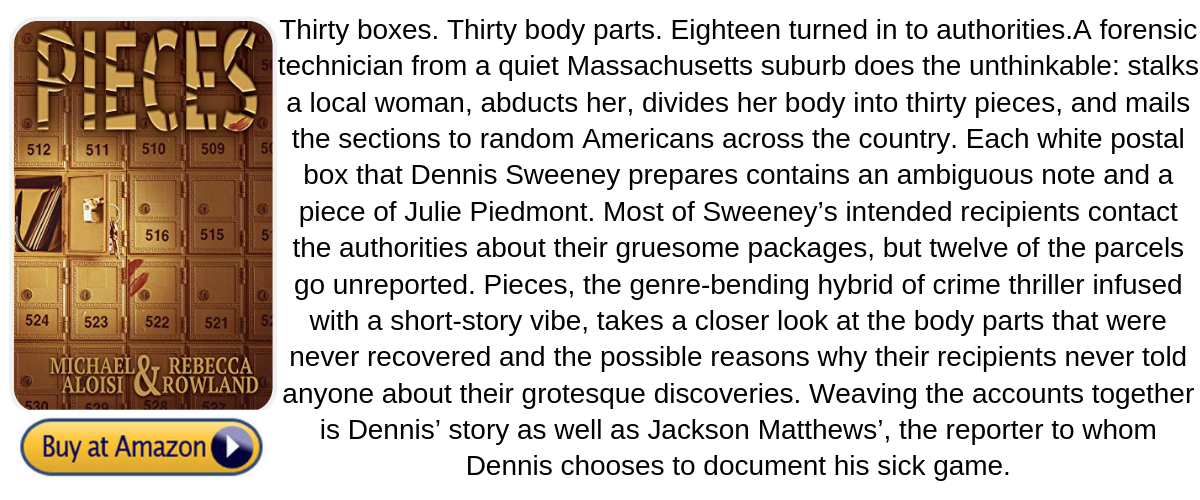   Lucie McKnight Hardy grew up in rural West Wales, the daughter of London immigrants. She grew up speaking Welsh and her education was through the medium of Welsh. She studied English at the University of Liverpool and after falling in love with the city, stayed on to work for an advertising agency there after graduating. From there she moved to Cardiff to study journalism, and then worked for a not-for-profit organisation as public relations and corporate policy officer. She then moved to Zurich where she worked, for four years, in marketing. After moving back to the UK, she worked as a freelancer before taking a break from work to have a family. During this time she studied creative writing with the Open University and then completed the MA in Creative Writing at Manchester Metropolitan University. She has now settled in Herefordshire with her family. Her debut novel Water Shall Refuse them has just been released by Dead Ink Press to huge critical acclaim, Ginger Nuts of Horror's Jonathan Thornton was honoured to be able to sit down with Lucie at one of the events to mark the launch of her book, and chat about her book. Your debut novel Water Shall Refuse Them (2019) is out now with Dead Ink Press. Would you be able to tell us a bit about it? Yes, it’s the story of 16-year-old Nif, who goes to stay in a borrowed cottage on the border between England and Wales with her younger brother Lorry, her mother Linda, and her father Clive. And this is an attempt by them to come to terms with their grief after the accidental death by drowning of Lorry’s twin sister Petra. The story takes place over the course of a few weeks during the heatwave of 1976, and we see how Nif makes friends with a local boy Mally, and how their various secrets come to light. What was it about the story that it had to be set during that particular summer of 1976? I think the summer of 76 was almost the catalyst of the story itself. I came at it, rather than wanting to set a horror story or, as it started off, as a ghost story, in your traditional, dark, wet windy castle or something like that, I wanted to turn that on its head. So I thought, well the opposite to that is a heatwave, and that in itself presented certain opportunities because of the oppression of the sun, the drought, this idea that once you put pressure on your characters they start to do interesting things, and so I thought a heatwave was a perfect opportunity for that. That met with the story I had of Nif, and the book grew out of those two ideas coming together. The landscape plays a very big part in the novel, it’s almost a character in itself. Was that a deliberate choice? It was, yeah, I’m glad you said that. I came at it with that view of wanting to have the landscape, this village that they go to, as a character in itself. So this very barren arid landscape, the characters are stuck there, there’s very little input from the outside world, and the village itself is very remote from a city and all the administrative centres. It does take on this kind of foreboding atmosphere which I think does characterise it as a very strong element in the book. Was using horror as a way of coming to terms with grief something you were interested in exploring from the beginning? To be honest with you no it wasn’t, that kind of grew out of it as I was writing. In order for you to have a ghost, forgive me if this sounds trite, but you have to have a dead person. If you have a dead person, you have grieving. And so it all kind of parcelled itself up together. So it wasn’t a conscious decision, no. The novel has been categorised as folk horror. How do you feel about that as a categorisation of what you’re doing in this book? I think it’s pretty accurate in terms of, as you said the landscape plays a very large part in the book, it’s set in a rural community, there are obvious elements of horror. It’s also been called a literary thriller. I think it possibly sits somewhere between the two. I’d like to think that it doesn’t completely follow all the tropes of folk horror. So yeah, folk horror/literary thriller mash up. Nif starts to slowly fall into her own version of witchcraft and magic after her sister’s death. Where did that come from? It started with her mother Linda basically losing her faith. She was a staunch Catholic, with all the trappings of guilt that go with that. And after Petra died, she lost her faith, renounced it. And even though Nif admits that she isn’t particularly fond of the church for the church’s sake, she liked all the rituals, and all the trappings of the Catholic church that went with it. The things that make it slightly mysterious, slightly enticing to a teenage girl. So I think that’s what she’s trying to recreate with her own version, the Creed, something with routines, with rituals, and possibly with a little bit of glamour. There’s a historic link between witchcraft as a feminine power against patriarchal societies. You can see elements of that in the book with Nif trying to gain agency for herself in a situation where her mother, the major female influence in her life, has completely withdrawn because of the trauma of losing the child. That’s true, yes. From very early on Nif has looked after Lorry her little brother when he’s been rejected by their mother, so she has assumed that matriarchal role, and yeah I think that’s a good parallel. Historically, one of the reasons that the witch hunts of history were so prevalent is because men viewed women as being sexually voracious with their increased sexual appetites, which made them more susceptible to interference by the devil. So, yeah I think that’s an interesting historical parallel. The novel opens with that quote from the Malleus Maleficarum, “All witchcraft comes from carnal lust, which in women is insatiable,” which I was thinking of when you said that. The awakening of the character into her adult sexuality is a big part of the story. Yes, that’s a really good point. The reason that quote is there, is a slightly tongue in cheek take on it. And in my mind it was more to do with Janet, the neighbour, who is this very voluptuous, sexual being, who is vilified by the mostly male chapel goers. And that’s hinting at what’s happened in history to Janet and Mally’s ancestors, who were persecuted by the village because they were accused of witchcraft, so it’s resonating through history, that’s what I’m trying to achieve there. The book starts off tense and keeps piling tension on its characters. Do you feel that when you’re writing these characters, in order to see what they’re made of you have to drive them to breaking point? Yeah, it’s mean isn’t it? I think so, yeah that’s a really good way of putting it. Like I said before, the pressure you put on your characters makes them do interesting things, so to put them in this situation where there’s no escape, their environment is an incredibly cruel one, and their interactions with each other are cruel, and you’re kind of pushing them to their limits to see what they’re going to do. The book’s really taken off, which is really nice to see. Was this something you were expecting to see with the interest in it pre-release? Not at all, no, I mean it surpassed all my expectations, it’s amazing. I’m so thrilled. Couldn’t have hoped for more, really. What is it about the book that’s struck a chord with people? I really don’t know. You’ve just been speaking to Naomi [Booth] about climate change, and obviously that’s less relevant to my book than it is to hers, but there is again this parallel, historical parallels, and I think people are seeing at the moment this rise of intolerance and misogyny, that’s worldwide now. And I think possibly there are aspects of that reflected in my book. So maybe that’s struck a chord with people. What’s your experience been working with Dead Ink Press? All good I have to say, it’s been great. It’s been really nice being able to be that close to the front face of publishing. I’ve never worked with a traditional publisher, but I get the impression there’s so many different layers of hierarchy that, I’ve just been dealing with Nathan [Connolly] and there’s one other person at Dead Ink. So it’s actually been a really nice personalised experience. It’s been great. I’ve really enjoyed it. The novel was shortlisted for the Mslexia Novel Competition 2017 and longlisted for Caledonia Novel Award 2018… Both of those competitions were for unpublished novels. I wrote the book as my dissertation for my MA in creative writing, and submitted it for that in September 2017. And I happened to see that Mslexia had a novel competition. So I thought, what is there to lose really? So I submitted it to that, and later the Caledonia Novel Award opened, and I thought I’d give that one a go as well. I was very very lucky to receive listings for both. And I think it really really helped when I sent my submission to Nathan at Dead Ink, to get his attention. I think anything like that put into a submission covering letter, just to spark a bit of interest, really helps. What are you working on at the moment? I’m tentatively circling another novel. I’ve got a lot of ideas, a lot of notes, written a couple of chapters. So that’s underway but really since finishing Water Shall Refuse Them I’ve been working on short stories. So I have a few of those in the pipeline. There’s one in Best British Short Stories that came out with Salt, and I’m very pleased with that. I’ve got one coming from The Shadow Booth, in volume 4, and I’ve had a story out through Nightjar Press, which is another tiny indie press which does limited edition chapbooks, so that came out earlier this year as well. Do you find a big difference between how you approach short stories compared to how you approach novels? Yes, it’s funny, obviously for a novel you’re in it for the long haul. With a short story it’s a lot more intense, the writing experience. And the prose style I find as well. The novel I find it’s difficult to hold everything that’s been going on in your head. That’s a very different experience from with short stories, it’s get in, get out quick, let it simmer for a couple of weeks, and then go back, and I just keep on picking away at them, until I think they’re in a state to be submitted somewhere. For your new work will you be keeping with the folk horror theme? The ideas have got not so much folk horror, in that it’s set in a town rather than a village. It’s still a fairly little backward place. But it’s coastal, sort of on the welsh coast, and its set in the 1980s rather than the 1970s. Maybe I shouldn’t mention that because I might not get it finished! But yeah those are the ideas I have at the moment. It won’t be set during a heatwave. I think the environment will play a large part in it. In order to enjoy writing a novel, you need to be very very conscious of a backdrop to where the action’s happening, because that influences so much of people’s behaviour, so I think having a very solid and interesting location for the book definitely helps the writing process. Thank you Lucie McKnight Hardy for talking with us! Water Shall Refuse Them by Lucie McKnight Hardy
  CUTTING THE BONES AN INTERVIEW WITH AUTHOR RENEÉ S. DECAMILLIS Renee S. DeCamillis is a dark fiction writer & editor, an Editorial Intern at Crystal Lake Publishing, an “on-hiatus” horror movie reviewer, a lyricist and poet, a hard rock/blues rhythm guitarist and singer, and a member of the Horror Writers Association. Her debut book, The Bone Cutters, is set for release on September 1, 2019 through Eraserhead Press, AND it is available for pre-order on Amazon-- (https://www.amazon.com/Bone-Cutters-Renee-S-Decamillis/dp/1621052931 ) Renee’s short fiction has been published in Deadman’s Tome: The Conspiracy Issue, Sirens Call eZine Issue 37 The Sixth Annual Women In Horror Month Edition, on The Other Stories Podcast—along with an interview. Her poetry appears in the HWA Poetry Showcase Vol. IV. Her horror movie reviews have been published on AllHorror.net and Horror-Movie-Reviews.com, as well as on her websites: reneesdecamillis.com and http://phantom1333.wixsite.com/renee-young-decamillis/horror-movie-reviews. She has also been a podcast guest twice on Deadman’s Tome Podcast, where she discusses her views and research about the mysterious death of rock legend Chris Cornell. You can find that work and research on her website reneesdecamillis.com . Renee earned her MFA in Creative Writing from the Stonecoast Graduate Program, she has her BA in psychology, and she attended Berklee College of Music as a music business major with guitar as her principle instrument. Music has been a huge part of Renee's life ever since she was a young child. She has been in a number of bands where she took on various roles, including hand percussionist. Renee is also a former model, school rock band teacher, creative writing teacher, private guitar instructor, A&R rep for an indie record label, therapeutic mentor, psychological technician, and pre-school teacher. (Yes, she loves to wear many hats; she is known to have worn thirteen hats all at once—literally.) She is also a former gravedigger; she can get rid of a body fast without leaving a trace, and she is not afraid of getting her hands dirty. Renee lives in the woods of southern Maine with her husband, their son, and a house full of ghosts. Social media links & website: website: reneesdecamillis.com Facebook Author Page: www.facebook.com/ReneeDeCamillis/ Twitter: https://twitter.com/ReneeDeCamillis Instagram: https://www.instagram.com/renee_s._decamillis/?hl=en Could you tell the readers a little bit about yourself? I’m a dark fiction writer with my debut book--The Bone Cutters--set for release on September 1st through Eraserhead Press. It’s classified as bizarro horror, but, overall, I like to describe my work as dark fiction, though there is a lot of horror within, and often some sprinkles of weird. (It’s tough for me to classify my work; it doesn’t fit neatly into any one genre-box. I don’t like boxes—they feel like cages.) I’m also an Editorial Intern at Crystal Lake Publishing, a lifelong musician, a mother, a wife, a friend, and a nature lover. (Yes, I’m a tree-hugger, and I talk to them and thank them often.) You can often find me drumming in the middle of the woods, staring off into another dimension. I’m a hippie at heart, with a sort of sharp metal edge. My husband calls me “an enigma wrapped in a riddle.” (Yes, he borrowed and tweaked that quote; he’s a quote machine.) I earned my MFA in Popular Fiction Writing at the Stonecoast Graduate Program. That was a life-changing experience. I also have a B.A. in psychology (or should I say BS?). I was lucky enough to attend my dream college—Berklee College of Music. That was an amazing experience that taught me a hell of a lot about music and music business. It also made me NOT want to get into the music business—which was my major, with guitar as my principle instrument. (The music industry: don’t even get me started on all that’s wrong there—such a beat-you-down world.) I now just play music for the pure love of it. I’ve got some short story work out there floating around in the void: “Sunshower Death”—inspired by the mysterious death of rock legend Chris Cornell—appears in Deadman’s Tome: The Conspiracy Issue. I was also a 2x-guest on Deadman’s Tome Podcast, discussing my views and extensive research on the whole case of Chris Cornell’s death. For anyone interested, much of that work & research appears on my website reneesdecamillis.com. “The Unemployed Neighbor” is another short story I wrote, and I read that one on The Other Stories Podcast. That piece is best, I think, read aloud. So much more of the creepy vibe comes through when it’s heard. You can hear it here. “The Unemployed Neighbor” also appears in Sirens Call eZine Issue 37 The Sixth Annual Women In Horror Month Edition. Well, that’s more than just a little about me. Moving on . . . What do you like to do when you're not writing? I absolutely love spending time with my husband and our young son. Playing with our Little Dude is the best, and it creates a great spark for my imagination. If we’re lucky, my husband and I try to take in a horror or comedy movie one night a week, or watch a couple episodes of a good horror series. I also like to spend as much time in nature as possible, and I dabble with gardening. The musician in me screams & fights for scraps of time to do something, anything, musical: belt out some tunes, strum sweet melodies, bang out funky rhythms on any one of my multiple hand drums. Music always lights a fire under my ass and makes me feel great—just like nature. I read with as much alone-time as I can steal, though it never feels like I get enough. My “want to read” list grows much faster than my “already read” list. Honestly, there really just isn’t enough time to do all that makes me happy. Other than the horror genre, what else has been a major influence on your writing? I have a great love for thrillers, especially psychological thrillers. I have a background in psychology, and I find abnormal psychology very intriguing. I’ve dealt with many psychos & sociopaths & criminally-minded people in my life—and not just from working in the psych. field—so stories about these types of real life characters spark my inspiration a lot. Dark and quirky satirical stories, as well as some sci-fi, also have an impact on my writing. I’m a snarky & sarcastic person by nature, and I love to work in dark humor when I can. I greatly admire Kurt Vonnegut’s & Chuck Palahniuk’s works, and if I could ever write anything remotely as dark and humorous as those two satirical geniuses I would count myself blessed and very happy. And, of course, music is a huge influence for me. Much of what I listen to is heavy rock & metal (as well as those classics), though I do love rhythm & blues, funk, & reggae as well. (Well, I really enjoy all sorts of different music—just absolutely no country or pop.) The moods and stories in the songs I love often find their way into my writing. And as much as I can, I like to form rhythm with my words; after all, my first creative writing started with poetry and song lyrics. The term horror, especially when applied to fiction always carries such heavy connotations. What’s your feeling on the term “horror” and what do you think we can do to break past these assumptions? Being a Mainer, any time I tell someone I’m a horror writer they immediately ask me about Stephen King, and they think I’m striving to be some rock star horror writer like King. And, of course, with those assumptions they kind of laugh and look at me like I’m a starry-eyed kid saying, “I want to be a rock star when I grow up.” Yes, I do love King, but King is not the be-all-end-all of what a horror writer is and can be. (As I said above, now I call myself a dark fiction writer.) Plus, many, if not most, writers will never reach King’s level of fame. At the end of the day, fame is not what writing is or should be all about. I also find that many people think of horror as an inferior form of storytelling. A quick flashback to my college days: as an undergrad English major/Creative Writing minor students were not allowed to write a genre of any kind, especially not horror or anything with weapons or graphic violence or monsters/demons. In one fiction writing class I took, the professor actually gave the class a long list of things we could not have in our stories—a knife or a gun or a supernatural monster were at the top of the list. WTF is that?! Also, when I was looking into which MFA program I wanted to attend, it was hard to find a school that was not completely focused on literary fiction—with no place for genre writing. I’ve got to give a BIG shout out to the Stonecoast MFA Program—where I attended—for offering a Popular Fiction focus. That saved me as a writer. My feelings about breaking past the assumptions about horror: I see that “The Times They are a-Changin’”, and people are starting to look at horror through different eyes, sort of speak. The assumptions are already getting broken. Look at King, who is bigger than he ever was—if that’s even possible. And his son Joe Hill is hitting great heights as well. Plus, we’ve got big publishers picking up more horror writers, or should I say “literary horror” writers--whatever that means. (There are so many sub-genres—if that’s even the correct term here—it’s hard to keep it all straight.) Look at Victor LaValle and Paul Tremblay—Great stuff and great successes right there! And then there are films like Get Out that have received more respect than previously expected in the horror world. And look at the success of the horror series Supernatural, which has been huge for quite a few years now—and my absolute favorite, and the Netflix original series Stranger Things. And that’s only a snippet; there are so many others to add to this list. I keep seeing new horror titles popping up everywhere. It’s fucking great! I’ve also noticed a ton of horror merchandise everywhere lately. I think these are some exciting times for horror, and I am very excited to now be a part of that, even if I’m only a small part at this point in my career. Plus, just look at the state of the world—horror: it’s everywhere, not just in fiction. So, of course, more and more people are going to identify with and come to appreciate horror fiction even more in these times. A lot of good horror movements have arisen as a direct result of the socio/political climate, considering the current state of the world where do you see horror going in the next few years? Our current state of affairs in the U.S., with Trump and his cronies, is a big horror story of the day. What is going on, especially at the border (though there are many other examples), is nothing but horror. And don’t even get me started on the sex trafficking going on, well, everywhere—all over the world. Horror! But back to thinking of Trump in office, well, that’s where some dark humor also gets sprinkled in. Before this whole border issue, I saw Trump as POTUS as a fucking joke. He has made [my] country the laughing stock of the world. He gives us Americans an even worse rep. than we had prior to him. (Well, that excludes the days of slavery, where there’s no room for laughter of any kind. Holy Hell! Can’t the U.S. ever get it right?) With Trump getting in office, I feel it really shows how much the U.S. people value entertainment. (Well, then again, we did have Reagan, but I was so young then that I had no idea what was going on in politics.) If nothing else, Trump is entertaining and good for a few laughs—he makes no sense whatsoever. Ridiculousness! He gives comedians and shows like Saturday Night Live a lot to work with—(though SNL has been lacking in the humor as of lately). I can’t help but laugh at Trump; just listen to the ignorance he spews on a daily basis. And he uses Twitter as his sounding board. What a joke of a president! Finding the many bits of humor, as dark as it is, is the only thing that helps me maintain any kind of sanity with all of this. It’s all a sad, sick & twisted joke. And there is so much horror mixed with that humor. These are very scary times. Then there’s the whole white supremacists getting compliments from Trump, and rising in the ranks of people’s opinions and acceptance. WTF?! (Horror!) There are too many social issues going on right now, with inequality everywhere, and not just the U.S. It’s downright horrific the way various people get treated as inferiors—whether it’s due to the color of their skin (I purposefully don’t use the word “race” for a reason. I don’t believe in “race”. Race is an ideology, an illusion, created by man and his many fears and confusion, (Or, to quote Ziggy Marley, “What divides us is an illusion, made up by men in their confusion.”) or their sexual orientation, or their gender, etc. The list goes on. Too many people are afraid of the many varied differences among people. (I find that our many differences make the world much more interesting.)Their fears take over and create the horrific social issues going on all over the place. (Personally, the way women are STILL treated as inferiors, and as objects, angers me more than I know how to express. And if you’re a woman of color, the treatment . . . holy shit, that pisses me off!) And all of this is finding its way into horror fiction. There’s no better genre for it than horror. Again, look at the success of the horror film Get Out. BOOM! There it is—Horror at its finest. (Can you tell I absolutely love that film?) Okay, that was a scattered answer. Moving on . . . What are the books and films that helped to define you as an author? Going back to the beginning of my horror movie consumption, the original versions of The Exorcist, Texas Chainsaw Massacre, and Hellraiser are all big influences. These are movies that have greatly shaped me as a writer, and as a devoted horror fan. And then there’s Alfred Hitchcock— I love every story I’ve consumed by him! More recently, Rob Zombie’s horror films also greatly influence me. I absolutely love The Devil’s Rejects, and Halloween I & II. (I’m psyched to see 3 From Hell!) And Get Out is big on my list. (Yes, I said it again.) As for books, I’d have to say that my first complete collection of Poe stories, passed down to me from my Nana Jo, was my first influence as a horror fiction and dark fiction writer when I was pretty young. But that was just the beginning of my dark path. Then came Stephen King, of course. I also love Gothic horror and Victorian ghost stories and supernatural tales from such authors as—Henry James, J. Sheridan LeFanu, Edith Nesbit, Margaret Oliphant, H.G. Wells, Mary Shelley, Nathanial Hawthorn, Bram Stoker, Algernon Blackwood . . . the list goes on. My current favorite writers of dark fiction and horror are Elizabeth Hand, Joe Hill, Victor Lavalle, and Paul Tremblay. Work by all four of them fed my inspiration when writing The Bone Cutters, especially LaValle’s The Devil in Silver and Hill’s NOS4A2. As I mentioned in a previous question, I also love the dark satirical work of Kurt Vonnegut and Chuck Palahniuk. When done right, humor allows the reader a place to breathe when immersed in dark, heavy material. What new and upcoming authors do you think we should take notice off? Julie C. Day—Author of the short story collection Uncommon Miracles. She also has a novella coming out on October 1, 2019 called Rampant. I haven’t had a chance to read that one yet, but Victor LaValle, one of my favorite authors, blurbed it so you know it’s great. Julie has a unique voice and writes creatively weird prose. Check her out! David Simms—Author of the horror novel Fear the Reaper. He has another horror novel for middle-grade –Dark Muse--on the publishing train as well. This next one is all about music and the Crossroads, so I’m extra-psyched to check that out! Dave and I have many similar interests, so his work really clicks with me. It just works out perfectly that he’s also a great horror writer. Damian Angelica Walters, definitely. She’s not quite so new-new, but I do love her work! Chad Lutzke—He’s new to me, though looking at his long list of publications, he doesn’t seem quite as new in the field as I’d first thought. I read a recent novella of his titled The Pale White, yet to come out through Crystal Lake Publishing, that is a superb example of writing more with less. I now think of that work as I’m writing my own work. It’s an excellent piece of writing! I really need to read more of his work, and soon. How would you describe your writing style? I don’t really know how to answer that. I try to say more with less. I used to, and sometimes still do, have a problem with writing too much, then needing to trim the fat, sort of speak. Now I try my best to go at it the opposite way, (“Try” is the key word here.) though I do find that cutting the excess is easier than adding in more of what’s needed. So now my different writing projects are a bit of a mixed bag—some lean and some not so lean. I write what I feel and what I see and observe, and then I spin it with my imagination—like putting it all into a blender. (I was going to say, like a weaver, but that’s too cliché, and it sounds too pretty.) Many ideas come to me from nightmares, as is the case with the main idea of The Bone Cutters. I’ve lived through many horrors, and dealt with many horrible people, and this all finds its way into my work. I also have a bit of an obsession with serial killers and sociopaths/psychopaths, and those types of characters often end up in my work. Many of the villains I like to create don’t see themselves as villains at all; they often see themselves as the “good guys” and see others as “the evil ones”. Are there any reviews of your work, positive or negative that have stayed with you? So far I only have two reviews of my upcoming release, my debut book (though, I hear another is in the works). One review is on Kendall Reviews and one is on here—GNOH, so, of course they have both stayed with me. The fact that my book isn’t even out yet, I feel quite happy to have two reviews, and they’re pretty good ones. I have no complaints. (But I know you can’t please everyone, so I’m sure some bad reviews will pop up at some point in the future.) What sticks out for me with the two reviews: “It’s actually refreshing to be able to enjoy a book so much that you were miffed when it was over…As the debut novella from Renee S. DeCamillis it’s a fantastic beginning to what could prove to be a career to watch…I’m giving this a solid 4 out of 5…considering that I’ve never read anything which rated a 5 I think The Bone Cutters is doing just fine.” ~~~from GNOH’s Joe X Young And from Miranda Crites on Kendall Reviews: “I immediately fell in love with Dory, the writing style, the story…This is a terribly heart-wrenching story…I didn’t want to put this book down.” What aspects of writing to do you find the most difficult? Finding the time to write is the hardest. As a stay-at-home mom with a young son, & having a part-time work-from-home Fiction Editor job, I barely have time to take a deep breath and take a shower let alone write. And then throw in the promotion aspect of being a new writer—it seems like I spend more time finding ways to promote my work/my debut book than I do writing new stuff and working on my works-in-progress. But with that lack of time I find that it is also a constant test of my dedication to my craft, and a test of my creativity—how creative I can get with finding snippets of time for my writing and creating. You can count on finding many notebooks and scraps of paper all over my house and car with story ideas, character sketches, cool lines of dialogue, setting descriptions, etc. Any second I can find to write anything, I take it—Even if that means I’m driving down the road with a notebook and pen in my hand, swerving all over the place while I write down that next idea—anything to keep the ideas and work flowing. (No, I don’t ever do this with my son in the car.) If I didn’t carve out these little pockets of time for my writing, I’d surely go mad. Is there one subject you would never write about as an author? Myself: There is no memoir in my future, though, because of the crazy shit I’ve lived through, many people have told me that I should write a memoir. But I don’t want my dirty laundry out for the world to scrutinize. (I already have quite a bit of experience with my “stuff” getting used against me in some very evil and twisted ways. I don’t want to inadvertently invite anymore of that to happen.) You can count on autobiographical info. woven into my fiction, even if it’s heavily masked. It’s in there, always lurking in the shadows. How important are names to you in your books? Do you choose the names based on liking the way it sounds or the meaning? Sometimes names are random, popping out from whatever is going on in my life at the time—maybe a cartoon I’ve recently watched with my son, or a movie that pops to mind because of what I’m writing, or a song that I just can’t get out of my head, or maybe something in my real life influences it. But there are other times when the names do have meanings. It varies a lot. There are many times that I have no idea where the name(s) came from until well after the story has been created. Then it can hit me like an epiphany, and I’m like, “Oh shit! Now I see why I named that character that way.” Hindsight and all that. Writing, is not a static process, how have you developed as a writer over the years? I used to sometimes try too hard to create story ideas, but then those stories, once on paper, would sound forced. I have now learned to just live life and get inspiration from everywhere and everyone. I listen very closely and watch everything going on around me. Watch out what you say and do around a writer—it will end up in a story. What tools do you feel are must-haves for writers? A pen and a notebook. No pencils. No erasers. Even what you cross out might end up getting used. I also like to use the voice memo on my phone. It’s always a good idea to hear your writing out loud. My Bible: A Writer’s Reference by Diane Hacker. (Know how to write a fucking grammatically correct sentence! Don’t rely on editors to do it for you. ) I also often refer to Save the Cat! The Last Book on Screenwriting You'll Ever Need by Blake Snyder. This is an excellent book! I think all writers should read it. What is the best piece of advice you ever received with regards to your writing? I can’t choose just one. “Rules were made to be broken.” Well, really, that’s the best piece of advice that I’ve ever been given for life in general. Many writing teachers I’ve had have told me many times, “You need to know the rules before you break the rules.” I understand that. But I’ve always broken rules before I even knew there were any rules to begin with. Fuck the rules! Just write! Another piece of advice that I cherish and give to others: “Be yourself, don’t censor yourself, and always find your voice and use it.” That’s another piece of life-advice as well. It’s advice that has also helped me as a singer and musician. It’s perfect for most everything! But maybe the best advice for fiction writing is—Don’t force the story in any specific direction; let the story lead you where it needs to go. Getting your work noticed is one of the hardest things for a writer to achieve, how have you tried to approach this subject? I approach it with a Cheshire smile (the cat, not the cheese), Einstein hair, and a constant banging of my head against the wall. It’s maddening how much time it takes to try to promote myself and my work. And holy shit!—don’t even get me started on all the time I have to spend on social media. Ugh!!! If it wasn’t for being a writer, and a newbie in the field, I probably wouldn’t be on social media at all, or at least not on as many sites as I am right now. And a website—I’m technologically challenged as it is. That shit is hard! And it’s a huge time-suck, sucking away all my writing time! And hire someone to do it all for me? With what money? This social media and online stuff—it’s so impersonal, and hugely deceiving. It’s really hard, I find, to be myself online. People don’t get me through the impersonal aspects of computers and social media. There’s no body language to convey my messages. (After all, body language makes up over 90% of all communication.) I’m a hugely sarcastic person, with a big dark humor edge, but online that comes across as—I’m a big insensitive & inconsiderate asshole. (But I’m really not anything like that all. I’m probably one of the most empathetic people you’ll ever meet—if you could meet me in person and know me in the real world.) So, I often find myself censoring what I put online to avoid getting attacked, though I still get attacked a lot. (I hate arguing, and I avoid it as much as possible, but what’s funny about that--My mother often told me I should’ve been a lawyer because of my arguing abilities—I stick to the facts, and I stay at it until I prove my side. But I always told her, “A lawyer? Hell no! I don’t want to be hated by everyone! And I’d rather not end up on the edge of a roof wanting to jump.”) I don’t like censorship at all. So, all this social media activity is very tough for me to manage. And I can’t help but see it as another huge time-suck. It’s just maddening, all of it! Is there somewhere I can buy some more time? Oh, wait—I’m a writer and I’m broke. Never mind. To many writers, the characters they write become like children, who is your favorite child, and who is your least favorite to write for and why? I really love Dory in The Bone Cutters, but I think the main character in my current novel-in-progress is my favorite. His name is simply—The Dude. (There’s a reason for no name, but that’s hard to explain. Just read the book when it comes out.) He’s a fighter and stands up for what he believes in. He’s not afraid of anything—especially speaking his mind and fighting to expose the truth. My least favorite child to write for is in a story that I have not found a home for quite yet. She is a mean and nasty bitch who thinks everyone else is evil and out to get her. And she is capable of horrendous acts. (Her character-type is actually inspired by a family member that I simply refer to as Satan.) Though I do love writing bad guys, this one is the toughest. She’s an unreliable narrator, and, well, that’s a tough one to handle, though I do love the challenge. What piece of your own work are you most proud of? I’m very proud of my debut book--The Bone Cutters. I think it’s a really good example of my voice. But then there is my current novel-in-progress, though I’m not quite finished with the first draft. The title is not set in stone yet, but right now it’s called i Is All that Matters. The story is very strong, and I feel it’s a unique take on its subject matter. (I know many writers think their story is unique, but I dare say this about mine mainly because other writers and avid readers of horror who have read drafts of this novel have told me this as well.) That’s the main reason I’m very proud of it. Plus, as I said above, the main character—The Dude—is my favorite character I’ve created so far. Now I just need to get to the final draft and get it out into the world. Oh, wait, I still have that promoting thing to do. FUCK! For those who haven’t read any of your books, which of your books do you think best represents your work and why? Well, I’ve only got the one so far on the publishing train, set for release on September 1st. The Bone Cutters—buy it. It’s even available for pre-order on Amazon. Go click. Now! And, yes, this is a great representation of my work, and a great example of my voice. My short story “The Unemployed Neighbor” is also a good representation of my work. It’s a good example of how I try to write more with less. But, like I said, I think it’s creepier to hear me read it. (http://www.theotherstories.org/episodes/episode-143-unemployed-neighbor-renee-s-decamillis/ Go have a listen.) As for other books: As I said above—I do have a new novel-in-progress, so there will be more to come, and I’m hoping that’ll be soon. And to let you in on a secret—though not so secret now—I’m also planning a sequel to The Bone Cutters. So keep your eye out for more of my work in the near future. Do you have a favorite line or passage from your work, and would you like to share it with us? That’s a tough one. But one passage that sticks out in my mind, one I try to live by, is from The Bone Cutters: “Never judge. I don’t know where they’ve traveled. Their shoes don’t fit me.” Can you tell us about your last book, and can you tell us about what you are working on next? My debut book, The Bone Cutters: It’s about a young woman who wakes up in the padded room of a psychiatric hospital and soon finds out she’s been Blue-Papered—involuntarily committed. She gets sent to the wrong counseling group and discovers a whole new world of psychiatric patients she’d never known existed. At first she just thinks they’re cutters, all marked by similar scars, but then she finds out that those scars are from carving into their own bodies where they chisel and scrape their bones. What they’re after is the bone dust—it’s highly coveted and sought after. When they find out she’s never been “dusted”, she becomes their target. She desperately tries to prove to the psych. hospital staff that she’s not delusional about these particular patients, but they don’t believe her. They all think she’s crazy. She ends up on the run, trying to avoid getting “dusted” by The Bone Cutters. What I’m working on next: I already mentioned my current novel-in-progress, but here’s more about it: The working title: i Is All That Matters. It’s about the evil intentions behind the invention of the iPhone. The story follows The Dude, a mindreading music engineer and musician on a mission to finish the work of his murdered father and to get justice for his death. He vows to find a way to reveal to the masses the brainwashing tactics at work with the use of Smartphones and iPhones. With a team of like minded individuals—The Old Hippie, The Shaman, and The Amazon—The Dude ends up fighting forces much bigger and much more powerful than he’d ever imagined, and he uncovers a master plan much more sinister than he’d originally thought possible. Inspired by George Orwell’s prophetic novel 1984, as well as real life experiences and observations, i Is All that Matters will make you think twice before turning on your phone. If you could erase one horror cliché what would be your choice? Hot and sexy vampires—get rid of them. Definitely. What was the last great book you read, and what was the last book that disappointed you? As I mentioned already, there’s a book I’ve recently read by Chad Lutzke, The Pale White—Holy shit! That is some great writing! I believe it may be available come September through Crystal Lake Publishing. I guess I should share a book I love that you can read now--The Ballad of Black Tom by Victor LaValle. I read this a while back, but I sure do love that book, and everything I’ve read from LaValle! Disappointing: I Wish I Was Like You by S.P. Miskowski –I did enjoy this book overall, but there is a character that conveniently shows up out of the blue in the middle of the book that unrealistically pushes the plot forward, and that part feels forced and too convenient/coincidental for my taste. But I mean no disrespect toward this book or the author; like I said, I do like the book overall and did enjoy it. What's the one question you wish you would get asked but never do? And what would be the answer? I’m not sure about what I wish people would ask me, but I do know what I don’t want to hear or get asked anymore. If I hear it one more time, this is how it’s going to go: Question: “You’re a horror writer from Maine—Do you know Stephen King?” My answer: “Nope. Never heard of him.” Then I’ll turn and walk away. The Bone Cutters by Reneé S. DeCamillis Dory wakes up in the padded room of a psychiatric hospital with no recollection of how she wound up there. She soon finds out she’s been Blued-Papered—involuntarily committed. When she is sent to the wrong counseling group, she discovers a whole new world of drug addicts she’d never known existed. When she learns that those grotesque scars they all have are from cutting into their own bodies, it makes her skin itch. Why do they do it?—They get high off bone dust. They carve down to the bone, then chisel and scrape until they get that free drug. When they realize Dory’s never been “dusted”, she becomes their target. After all, dust from a “Freshie” is the most intense high, and pain free—for the carver. By the end of that first meeting Dory is running scared, afraid of being “dusted”, though the psych. hospital staff doesn’t believe a word she says. She’s delusional—at least that’s what they tell her. They end up sending her to that same counseling group every day, though Dory knows that all those junkie cutters want is what’s inside of her, and they won’t give up until they get what they’re after. Like Girl Interrupted and “The Yellow Wallpaper”, The Bone Cutters is one woman’s dark and surreal experience with a madness that is not necessarily her own.  |


Archives
May 2023
|
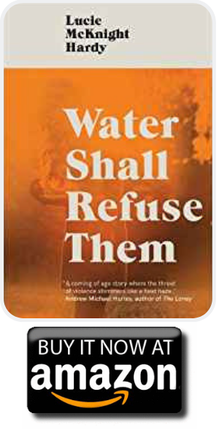
 RSS Feed

|

|