

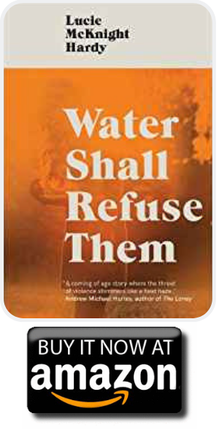
 Lucie McKnight Hardy grew up in rural West Wales, the daughter of London immigrants. She grew up speaking Welsh and her education was through the medium of Welsh. She studied English at the University of Liverpool and after falling in love with the city, stayed on to work for an advertising agency there after graduating. From there she moved to Cardiff to study journalism, and then worked for a not-for-profit organisation as public relations and corporate policy officer. She then moved to Zurich where she worked, for four years, in marketing. After moving back to the UK, she worked as a freelancer before taking a break from work to have a family. During this time she studied creative writing with the Open University and then completed the MA in Creative Writing at Manchester Metropolitan University. She has now settled in Herefordshire with her family. Her debut novel Water Shall Refuse them has just been released by Dead Ink Press to huge critical acclaim, Ginger Nuts of Horror's Jonathan Thornton was honoured to be able to sit down with Lucie at one of the events to mark the launch of her book, and chat about her book. Your debut novel Water Shall Refuse Them (2019) is out now with Dead Ink Press. Would you be able to tell us a bit about it? Yes, it’s the story of 16-year-old Nif, who goes to stay in a borrowed cottage on the border between England and Wales with her younger brother Lorry, her mother Linda, and her father Clive. And this is an attempt by them to come to terms with their grief after the accidental death by drowning of Lorry’s twin sister Petra. The story takes place over the course of a few weeks during the heatwave of 1976, and we see how Nif makes friends with a local boy Mally, and how their various secrets come to light. What was it about the story that it had to be set during that particular summer of 1976? I think the summer of 76 was almost the catalyst of the story itself. I came at it, rather than wanting to set a horror story or, as it started off, as a ghost story, in your traditional, dark, wet windy castle or something like that, I wanted to turn that on its head. So I thought, well the opposite to that is a heatwave, and that in itself presented certain opportunities because of the oppression of the sun, the drought, this idea that once you put pressure on your characters they start to do interesting things, and so I thought a heatwave was a perfect opportunity for that. That met with the story I had of Nif, and the book grew out of those two ideas coming together. The landscape plays a very big part in the novel, it’s almost a character in itself. Was that a deliberate choice? It was, yeah, I’m glad you said that. I came at it with that view of wanting to have the landscape, this village that they go to, as a character in itself. So this very barren arid landscape, the characters are stuck there, there’s very little input from the outside world, and the village itself is very remote from a city and all the administrative centres. It does take on this kind of foreboding atmosphere which I think does characterise it as a very strong element in the book. Was using horror as a way of coming to terms with grief something you were interested in exploring from the beginning? To be honest with you no it wasn’t, that kind of grew out of it as I was writing. In order for you to have a ghost, forgive me if this sounds trite, but you have to have a dead person. If you have a dead person, you have grieving. And so it all kind of parcelled itself up together. So it wasn’t a conscious decision, no. The novel has been categorised as folk horror. How do you feel about that as a categorisation of what you’re doing in this book? I think it’s pretty accurate in terms of, as you said the landscape plays a very large part in the book, it’s set in a rural community, there are obvious elements of horror. It’s also been called a literary thriller. I think it possibly sits somewhere between the two. I’d like to think that it doesn’t completely follow all the tropes of folk horror. So yeah, folk horror/literary thriller mash up. Nif starts to slowly fall into her own version of witchcraft and magic after her sister’s death. Where did that come from? It started with her mother Linda basically losing her faith. She was a staunch Catholic, with all the trappings of guilt that go with that. And after Petra died, she lost her faith, renounced it. And even though Nif admits that she isn’t particularly fond of the church for the church’s sake, she liked all the rituals, and all the trappings of the Catholic church that went with it. The things that make it slightly mysterious, slightly enticing to a teenage girl. So I think that’s what she’s trying to recreate with her own version, the Creed, something with routines, with rituals, and possibly with a little bit of glamour. There’s a historic link between witchcraft as a feminine power against patriarchal societies. You can see elements of that in the book with Nif trying to gain agency for herself in a situation where her mother, the major female influence in her life, has completely withdrawn because of the trauma of losing the child. That’s true, yes. From very early on Nif has looked after Lorry her little brother when he’s been rejected by their mother, so she has assumed that matriarchal role, and yeah I think that’s a good parallel. Historically, one of the reasons that the witch hunts of history were so prevalent is because men viewed women as being sexually voracious with their increased sexual appetites, which made them more susceptible to interference by the devil. So, yeah I think that’s an interesting historical parallel. The novel opens with that quote from the Malleus Maleficarum, “All witchcraft comes from carnal lust, which in women is insatiable,” which I was thinking of when you said that. The awakening of the character into her adult sexuality is a big part of the story. Yes, that’s a really good point. The reason that quote is there, is a slightly tongue in cheek take on it. And in my mind it was more to do with Janet, the neighbour, who is this very voluptuous, sexual being, who is vilified by the mostly male chapel goers. And that’s hinting at what’s happened in history to Janet and Mally’s ancestors, who were persecuted by the village because they were accused of witchcraft, so it’s resonating through history, that’s what I’m trying to achieve there. The book starts off tense and keeps piling tension on its characters. Do you feel that when you’re writing these characters, in order to see what they’re made of you have to drive them to breaking point? Yeah, it’s mean isn’t it? I think so, yeah that’s a really good way of putting it. Like I said before, the pressure you put on your characters makes them do interesting things, so to put them in this situation where there’s no escape, their environment is an incredibly cruel one, and their interactions with each other are cruel, and you’re kind of pushing them to their limits to see what they’re going to do. The book’s really taken off, which is really nice to see. Was this something you were expecting to see with the interest in it pre-release? Not at all, no, I mean it surpassed all my expectations, it’s amazing. I’m so thrilled. Couldn’t have hoped for more, really. What is it about the book that’s struck a chord with people? I really don’t know. You’ve just been speaking to Naomi [Booth] about climate change, and obviously that’s less relevant to my book than it is to hers, but there is again this parallel, historical parallels, and I think people are seeing at the moment this rise of intolerance and misogyny, that’s worldwide now. And I think possibly there are aspects of that reflected in my book. So maybe that’s struck a chord with people. What’s your experience been working with Dead Ink Press? All good I have to say, it’s been great. It’s been really nice being able to be that close to the front face of publishing. I’ve never worked with a traditional publisher, but I get the impression there’s so many different layers of hierarchy that, I’ve just been dealing with Nathan [Connolly] and there’s one other person at Dead Ink. So it’s actually been a really nice personalised experience. It’s been great. I’ve really enjoyed it. The novel was shortlisted for the Mslexia Novel Competition 2017 and longlisted for Caledonia Novel Award 2018… Both of those competitions were for unpublished novels. I wrote the book as my dissertation for my MA in creative writing, and submitted it for that in September 2017. And I happened to see that Mslexia had a novel competition. So I thought, what is there to lose really? So I submitted it to that, and later the Caledonia Novel Award opened, and I thought I’d give that one a go as well. I was very very lucky to receive listings for both. And I think it really really helped when I sent my submission to Nathan at Dead Ink, to get his attention. I think anything like that put into a submission covering letter, just to spark a bit of interest, really helps. What are you working on at the moment? I’m tentatively circling another novel. I’ve got a lot of ideas, a lot of notes, written a couple of chapters. So that’s underway but really since finishing Water Shall Refuse Them I’ve been working on short stories. So I have a few of those in the pipeline. There’s one in Best British Short Stories that came out with Salt, and I’m very pleased with that. I’ve got one coming from The Shadow Booth, in volume 4, and I’ve had a story out through Nightjar Press, which is another tiny indie press which does limited edition chapbooks, so that came out earlier this year as well. Do you find a big difference between how you approach short stories compared to how you approach novels? Yes, it’s funny, obviously for a novel you’re in it for the long haul. With a short story it’s a lot more intense, the writing experience. And the prose style I find as well. The novel I find it’s difficult to hold everything that’s been going on in your head. That’s a very different experience from with short stories, it’s get in, get out quick, let it simmer for a couple of weeks, and then go back, and I just keep on picking away at them, until I think they’re in a state to be submitted somewhere. For your new work will you be keeping with the folk horror theme? The ideas have got not so much folk horror, in that it’s set in a town rather than a village. It’s still a fairly little backward place. But it’s coastal, sort of on the welsh coast, and its set in the 1980s rather than the 1970s. Maybe I shouldn’t mention that because I might not get it finished! But yeah those are the ideas I have at the moment. It won’t be set during a heatwave. I think the environment will play a large part in it. In order to enjoy writing a novel, you need to be very very conscious of a backdrop to where the action’s happening, because that influences so much of people’s behaviour, so I think having a very solid and interesting location for the book definitely helps the writing process. Thank you Lucie McKnight Hardy for talking with us! Water Shall Refuse Them by Lucie McKnight Hardy
  Comments are closed.
|


Archives
May 2023
|
 RSS Feed

|

|