

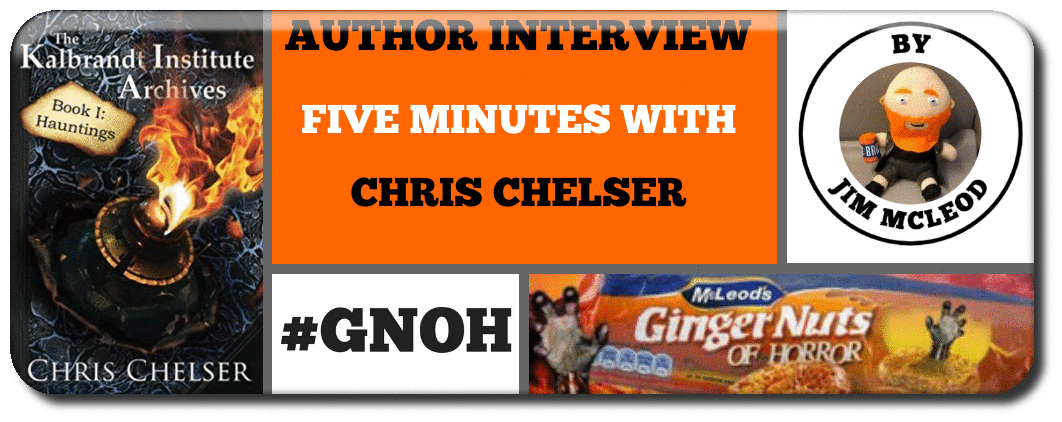
 Chris lives in the Netherlands with her family and the demons under her bed. The latter have inspired her since childhood to write dark stories about ghosts, monsters, history and the human soul, which she shares to appease other people’s demons. Her books are available in various formats for paper and screen. You can find all titles and respective links at http://chrischelser.com/books. She would also love to have your company on Twitter at http://www.twitter.com/chrischelser. Could you tell the readers a little bit about yourself? When I was six, I scrawled and illustrated my first story to keep the demons under my bed at bay. For the better part of three decades, dark stories and psychological puzzles kept me sane while I went through the motions of school, multiple university degrees and a corporate career. By my mid-thirties, the demons won. I have dedicated myself to feeding the little bastards ever since, while being a wife and a mother between the lines. In other trivia: I’m Dutch by birth, bilingual by nature, and live in the Netherlands. I believe this is the point in the biography where writers mention their pets, but we don’t have any. Although my son does very convincing impressions of puppies, kittens, and the occasional pterodactyl. Does that count? What do you like to do when you're not writing? Always something that is somehow related to storytelling or creative arts. Either I’m fabricating things with arts & crafts or digital imagery, or I play around with storytelling (roleplaying is a favourite game). Even when I’m lazing on the couch, I will be watching movies or reading under the guise of research. Other than the horror genre, what else has been a major influence on your writing? European surrealist graphic novelists of the 20th century. Like Patrick Ness does in his And the Ocean Was Our Sky, they take magical realism to an almost psychedelic level that requires the reader to not just suspend but relinquish disbelief. I enjoy that immensely, and it’s a goal to strive for in my own work. The term horror, especially when applied to fiction always carries such heavy connotations. What’s your feeling on the term “horror” and what do you think we can do to break past these assumptions? To me, it seems the term is often interpreted as a synonym for brainless carnage and gore. A great pity, since I feel everything from suspense to thrillers can – and at times should – be included in the genre. I’m a fan of occult horror myself, but history has proven that real life is sometimes more horrifying than fiction. There are so many stories and concepts that qualify, yet so many bookstores and even libraries showcase only a narrow selection. But the public can’t discover what they don’t know is out there. Fortunately, many reviewers of the genre highlight the enormous diversity of horror stories and authors. It may take time, but I believe that will go a long way to help break the mainstream prejudice that horror is just one type of story. A lot of good horror movements have arisen as a direct result of the socio/political climate, considering the current state of the world where do you see horror going in the next few years? Given the unhinged state of society at present, I expect developments in two directions. On one hand, people are angry and they want to see that anger translated in their entertainment. In the shape of more and increasingly violent dystopian zombie fics, I imagine. On the other hand, there will be people who want to escape from reality, to a time when things seem simpler. So I believe we will also see more gothic horror stories with historical settings in the near future. What are the books and films that helped to define you as an author? I took my cues from such a wide range of works in all kinds of genres and styles. None of those defined me, yet they all did. If I must name one, it would have to be the surrealistic graphic novels by the Belgian artist Eric. What new and upcoming authors do you think we should take notice off? I loved Laura Purcell’s The Silent Companions. Her second book is just out, and it promises to be of the same high quality. R.H. Hale impressed me with Church Mouse. Usually I’m not into vampire stories, but I was drawn in by how Hale focused on the psychological aspects of serving predators when you are the prey. M.N. Seeley’s A Flicker of Shadows is brilliant and so very entertaining. I like my stories to be puzzles, and he delivers. How would you describe your writing style? My stories tend to be complex, confronting and at times demanding. I weave multiple layers through the plot, and details are important. Despite all that, many people tell me my books have a filmic flow that is easy to read. It does make sense, since for me writing is transcribing the movie that plays in my mind. Are there any reviews of your work, positive or negative that have stayed with you? I’m not a native speaker of English, so every time a reader comments on the high quality of the language in my work, that fills me with joy. One review that still puzzles me a bit was a reviewer rating my novel The Devourer with two stars, saying it was because one of the side characters was “so horrible”. That despicability was the whole point of the character, so I took this to mean I had done a good job. What aspects of writing to do you find the most difficult? Mustering the necessary concentration and focus. My mind bounces all over the place, all the time! Is there one subject you would never write about as an author? Graphic child death. I write, and have written, about children who died of natural causes, but never gratuitously. Corpses and horrendous deaths in general are not a problem. But not children. How important are names to you in your books? Do you choose the names based on liking the way it sounds or the meaning? I select names based on sound, but also the time and the context of the story. Name-spotting in film credits is always a source of inspiration. And if I can find a name that has a suitable meaning to boot, that is a nice bonus. Writing, is not a static process, how have you developed as a writer over the years? Because of my visual-oriented nature, I had to actively learn to engage all senses of the characters to make a scene come to life for the reader. I love to experiment with different story structures, settings, styles... There is always something new I want to try out in a project, just to see if I can pull it off. What tools do you feel are must-haves for writers? An extensive vocabulary, a dictionary and a thesaurus. Replacing a generic word with a more accurate if more obscure one makes all the difference to a story’s impact on the reader. What is the best piece of advice you ever received with regards to your writing? “Be concise.” My background in law and business often acts up, and I’m constantly trying to break that habit of needlessly convoluted speech. Getting your work noticed is one of the hardest things for a writer to achieve, how have you tried to approach this subject? A reader-author relationship – like any relationship, commercial or otherwise – is built on trust. But trust doesn’t spring from nothing. It needs a solid foundation. That is why I give away my stories to interested readers (my ebooks are all permanently free). They can decide whether my work is worth their trust, and in turn I trust them to reciprocate if they do. It is a slow road, but the only one that feels right for me. To many writers, the characters they write become like children, who is your favourite child, and who is your least favourite to write for and why? If I don’t like writing a character, they have no business being in my stories. I do have several problematic children, the ones I love to hate, but I still like writing them. One of my absolute favourites is Cael Kalbrandt from The Kalbrandt Institute Archives series. He is such a bastard! The challenge with him is to let his better traits shimmer through his arrogant nature, without suggesting that these make him anything else than a psychotic manipulator. What piece of your own work are you most proud of? All my stories make me proud in one way or another. In some cases simply because I mustered the courage to write them at all, never mind finish them. And are there any that you would like to forget about? I have written my share of embarrassments, to be sure. None of them ever saw publication, not even online. Those that still exist sit in the oubliette that is my external hard drive. For those who haven’t read any of your books, which of your books do you think best represents your work and why? I’d say Book II of The Kalbrandt Institute Archives series. Book I gives a taste, but Book II is where things get my kind of gnarly. Both books are short, creepy, and more profound than they seem at first glance. Do you have a favorite line or passage from your work, and would you like to share it with us? One man’s trash is another man’s treasure, and vice versa. That said, if I must choose, it would be the scene in The Devourer where Mercedes is trapped inside the devourer’s mind. It’s a long passage, but an excerpt of it is on my website: http://chrischelser.com/preview-devourer-xxi/ Can you tell us about your last book, and can you tell us about what you are working on next? The Kalbrandt Institute Archives is about Eva, a young woman who is a psychometrist. This means she can ‘read’ objects and retrieve information from their past. The Institute hired her for that reason. In the first book, Eva realises she fell down a rabbit hole, but now in Book II, she discovers that hole is much deeper than she thought and that her boss is a monster. In more ways than one. There are two more books planned in this series. While writing those, I’m also working on a surrealistic novel about a ship in deep, deep trouble. If you could erase one horror cliché what would be your choice? To each their own, but personally I can do without zombies, animated skeletons, and other corporeal undead. What was the last great book you read, and what was the last book that disappointed you? Laura Purcell’s The Silent Companions was the last book that truly captured me. The latest disappointment was Terry Pratchett’s Dodger. I love Pratchett’s work, but this one just wouldn’t click with me. What's the one question you wish you would get asked but never do? And what would be the answer? “Do you want another coffee?” Yes. Yes, I do. 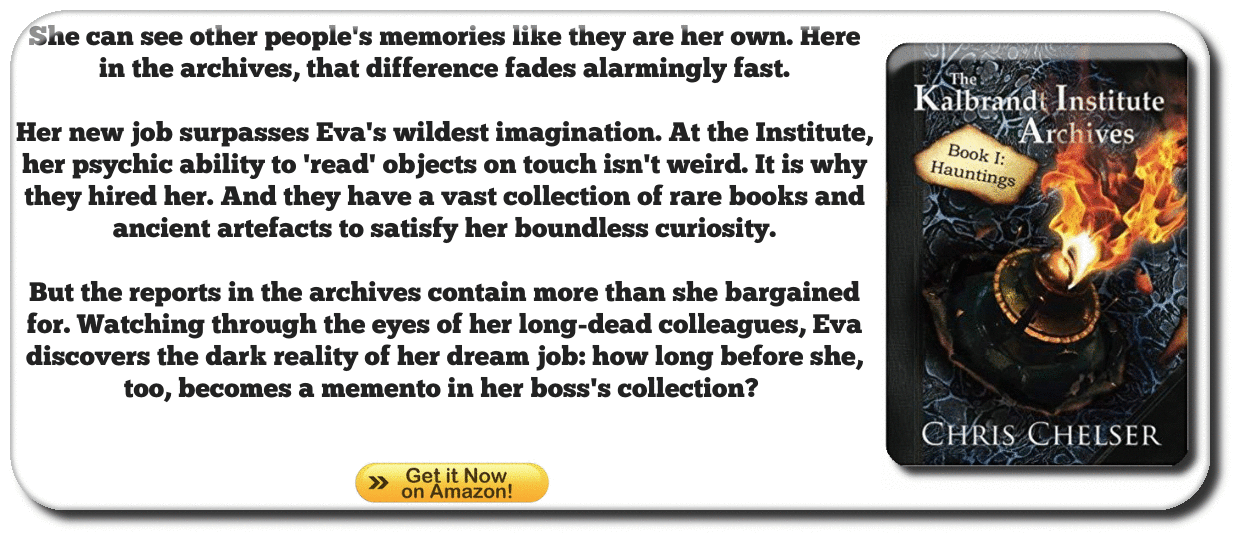 
FIVE MINUTES WITH AUTHOR ERIC IAN STEELE
19/10/2018
 Eric Ian Steele is a screenwriter and novelist. He has written the sci-fi feature film "Clonehunter" (2012) and the horror/thriller feature film "The Student" (2017). His horror novels “The Autumn Man” and “Experiment Nine” are published by Solstice Publishing, and his collection of short stories "Nightscape" was published by Parallel Universe Publications. His short fiction has appeared in numerous anthologies and zines such as "The Lovecraft E-Zine", "Horror Without Victims" and "Beyond the Infinite" alongside stories by Neil Gaiman, Ramsey Campbell, Kim Newman, and Steve Rasnic Tem. Could you tell the readers a little bit about yourself? I was born in a crossfire hurricane. Sorry… wrong interview. Actually, I was born in Manchester, England, where I still live. I wrote my first novel at the age of sixteen but, due to a lack of publishing outlets at the time, shelved it for twenty-six years. In the meantime I had a career in law enforcement, went back to university, finished a law degree, and became a freelance writer. Phew! Just thinking about it makes me tired. I need a lie down now... What do you like to do when you're not writing? Read. Watch (old) films. Watch (old) TV. Play roleplaying games. Travel. Listen to music. Sleep (occasionally). Other than the horror genre, what else has been a major influence on your writing? Music has been a huge influence, both lyrically (classic rock) and in terms of listening to electronic music and classical music to get ideas. Comic books and sci-fi books and films have also influenced me over the years. I grew up with British comic “2000AD”. As a result a lot of my work crosses over into sci-fi, and the supernatural stories I wrote often have a scientific explanation. The poetry of William Blake also influences all my writing. And Dickens. I like Dickens. The term horror, especially when applied to fiction always carries such heavy connotations. What’s your feeling on the term “horror” and what do you think we can do to break past these assumptions? Horror is one of the most stigmatized and misunderstood genres. Primarily, when people think of horror, they think of slasher films and zombie films. But horror is such a massive genre. If we were talking in Robert McKee terms I’d say it was a super-genre. I don’t think it’s possible to define it adequately. I’ve heard people focus on the emotions it arouses: fear, disgust, shock, existential dread. But that still doesn’t cover it. Many “mainstream” and even children’s stories contain elements of horror. I think that “genre” is primarily a marketing tool used to categorize things so they can be sold to the right audience. However, this has worked against horror, in that there is a lot of snobbery about the genre. Nevertheless, some of the most imaginative and insightful movies and books of all time have been horror (“Curse of the Cat People”, “Psycho”, “Frankenstein” etc.) Overall, I wish people would give horror the respect it deserves. A lot of good horror movements have arisen as a direct result of the socio/political climate, considering the current state of the world where do you see horror going in the next few years? Difficult to say. The world is changing so rapidly. But basic human wants and needs remain constant. The kind of books and films I see becoming classics in the future are those which appeal to the primal fears within us all. In fifty years people may not remember a particular political movement but they will always fear the dark. I do think that horror is making a resurgence lately in terms of fiction thanks to a loyal fan base, the internet and quality independent publishers. In terms of movies, of course, horror has never gone out of style. The biggest grossing Hollywood films of the past few decades have all been horror. What are the books and films that helped to define you as an author? My favourite question! James Herbert really got me into horror. I loved Stephen King’s short stories, “IT” and his non-fiction book “Danse Macabre”. Clive Barker for his operatic apocalyptic-ness (new word). Anne Rice for her gothic Romanticism. Ray Bradbury for his style. Lovecraft is still a huge influence. Charles Dickens (don’t laugh) and Philip K Dick. As for movies, “‘Salem’s Lot” (1979) was unforgettable. And I love “Frankenstein Meets the Wolf Man” and all those great horror films of the 1970s and 1980s. What new and upcoming authors do you think we should take notice off? I’m a bit stuck in the 70s and 80s with regards to horror fiction so I’m not a great source of information about new or up-and-coming writers. But current authors I’ve thoroughly enjoyed include Laird Barron, Paul Tremblay, Marie O’Regan, Sarah Pinborough and Ralph Robert Moore. In terms of movies Ti West has made some terrific low budget films. I also enjoyed the “Conjuring” movies as great examples of the genre, and “It Follows” was one of the best original horror movies of recent years. How would you describe your writing style? My novels are often about immortal outsiders. I like to explore what people find fascinating about established horror tropes like vampires, werewolves, demons, and ghosts, etc. In “The Autumn Man”, for instance, I try to really get under the skin of a werewolf (pun intended) and find out why they fascinate us. Essentially, of course, it’s about the divided self. So the two contradictory halves of the werewolf’s personality – his reason and his desire – are personified in the two main characters of Amon and Von Daniken, two werewolves who have been battling each other for centuries. One character is cold and calculating, the other lustful and murderous. But both are really two sides of the same coin. I also like to provide a scientific explanation for the supernatural. Again, in “The Autumn Man” I explain why a werewolf is always hungry – it’s to fuel the transformation which requires the generation of excess mass from somewhere! I’m also told that I tend to be a bit poetic at times. But readers can expect plenty of action as well. Are there any reviews of your work, positive or negative that have stayed with you? People have told me my work has given them nightmares, which I think is great! Some have even said they’ve had to go around locking the doors and windows after reading my novels. Music to my ears! What aspects of writing to do you find the most difficult? Stopping. Seriously. I have to pace myself and take care of my health more these days. But once I get going I don’t want to lose that surge of creativity. I have written throughout the entire night on several occasions. Not any more, though. At least not for a while… Is there one subject you would never write about as an author? No. How important are names to you in your books? Do you choose the names based on liking the way it sounds or the meaning? Names can add atmosphere, realism and an extra level of meaning, so I try to choose them carefully. That’s not to say I conduct Internet research to find the perfect name for “Cop #1” or “Hooker #3”. Those are real characters, by the way. Writing, is not a static process, how have you developed as a writer over the years? I like to think I’ve improved at least a little! I’m more aware now of common pitfalls and amateur errors like point of view slips and speaker tags. My screenwriting has changed the most. I plan everything now. I’ve written as both a planner and a pantser, and both have advantages. But in my experience not having a plan makes the rewriting process a whole lot longer… What tools do you feel are must-haves for writers? The desire to tell a good story regardless of what it may reveal about yourself. Writing is self-revelation. The worst writing I’ve seen is that which tries to shoe-horn a story into a preconceived set of ideas. Let the story unfold in a logical manner and leave your preconceptions at the door. What is the best piece of advice you ever received with regards to your writing? From Eric Red, screenwriter of “The Hitcher”: “Be an original”. Getting your worked noticed is one of the hardest things for a writer to achieve, how have you tried to approach this subject? It’s been tough. It took twenty-six years to get my first novel published. The second one took a bit less, thankfully. I sold my first screenplay after only six years of screenwriting. My method is: send off as many queries as you can and don’t worry about getting a response. Eventually, it will find the right person. And you only need to find that one person to make it happen. To many writers, the characters they write become like children, who is your favourite child, and who is your least favourite to write for and why? Argh! Don’t make me choose! Okay… Amon in “The Autumn Man” was very enjoyable to write because in many ways he is much like myself. Luke in “Experiment Nine” was another favourite character, because he goes on this fantastic journey from being naïve and idealistic to becoming a jaded, immortal monster. If I’m honest, my least favorite character was Stanley Hardacre, a character in my feature film “The Student”. He’s the husband of the heroine, who is a law professor being stalked by a sociopathic student. Stan was supposed to be a shoulder for her to cry, but I never really got him right. He sounded shrill and unsympathetic onscreen. No fault of the actor, by the way. He did a good job. I have to take the blame for that one. What piece of your own work are you most proud of? My novels. Both of them. Also, my first successful screenplay sale. And are there any that you would like to forget about? No. Everything is a learning experience. If something doesn’t work, you have to find out why. The only things I regret are the stories I don’t finish. For those who haven’t read any of your books, which of your books do you think best represents your work and why? “Experiment Nine” is my most personal book. It’s about genetically engineered vampires who escape into America’s backwoods (That’s not the personal bit, by the way). The main character, Luke, is lost and depressed when he comes across one of the escapees and falls in love with her so completely that he becomes blind to her flaws. Only too late does he realize he’s lost his own humanity in the pursuit of total happiness. I think everyone at some stage experiences infatuation and disillusionment. Also, the book has some quite poetic language, as well as lots of action. It also explores what it would really be like to endure this existence. And it explains how you make a vampire scientifically! So for those reasons I think it probably has everything I could possibly put into a book. Do you have a favorite line or passage from your work, and would you like to share it with us? There’s a chapter in “Experiment Nine” where Luke, now a vampire, is searching the city for Lynne, the vampire he has fallen in love with, because he’s paranoid about losing her. The chapter starts at 2.15am and has regular time updates… 2:30am... 2:45am… etc. The twist is that she has been hiding so he can’t see how horrible she looks when she feeds. After they feed on an unfortunate human victim he comes to realize what they have both lost by becoming immortal. When he finishes feeding it feels like an eternity has passed, but when he checks his watch it’s only 3a.m. I was quite pleased with that part. Can you tell us about your last book, and can you tell us about what you are working on next? My last book was “Experiment Nine” (see above). I’m currently finishing rewriting a horror novel called “Hellbound”, which is about a group of kids in the late 1980s who summon a demon and steal its powers. Thirty years or so later, they are all highly successful people in different fields as a result of what they did. Then the demon comes back for revenge. Think “IT” meets “The Great Gatsby”! If you could erase one horror cliché what would be your choice? All of them. What was the last great book you read, and what was the last book that disappointed you? “The Adventures of Tom Sawyer” by Mark Twain. How’s that for unexpected? I’d been meaning to read it for a while and thoroughly enjoyed its depiction of childhood. As for a disappointing book, I recently read “The Lair of the White Worm” by Bram Stoker and found it utterly confused and a bit of a mess. The film was much better! What's the one question you wish you would get asked but never do? And what would be the answer? Q: “What film made you decide to become a screenwriter? A: “Near Dark”. It’s one of the best vampire films ever made. To me it’s a perfect film in every sense. And I love that Tangerine Dream soundtrack! 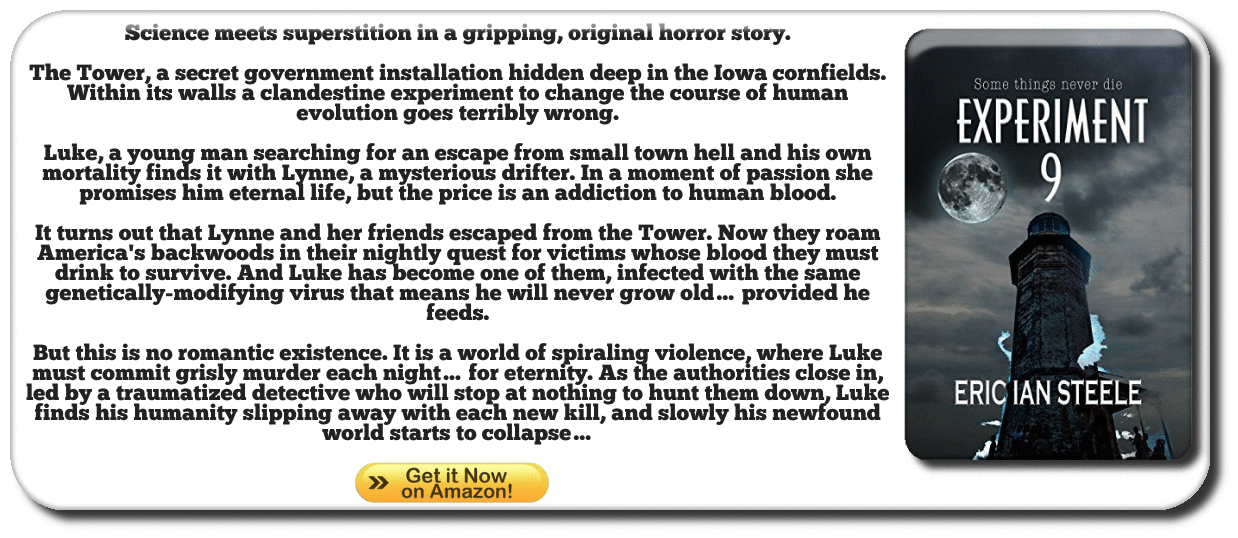 
 Patrick James Ryan is a native of Columbus, Ohio and the popular author of the diverse short story collection, "Blood Verse," the bestselling novel at Black Bed Sheet Books ~ "The Night It Got Out" and his most recent release, "The Maggots Underneath The Porch." Patrick has appeared in numerous radio interviews and blogs and is a recognized as a popular new voice in the horror/suspense/thriller genre. Patrick is currently contracted with Black Bed Sheet Books and Publisher, Nicholas Grabowsky. Could you tell the readers a little bit about yourself? I am happily married to Molly, and we are blessed with three wonderful children: Colleen, Michael and Patrick. All three are Champion Irish Step Dancers and have been blessed with athleticism, participating in Football, Baseball, Basketball, Softball, Volleyball and Martial Arts. I have been in Martial Arts for 20+ years and I hold a second degree black belt in Shaolin Tiger Kung Fu. My school is run by the legendary Greg Greene and has a reputation for being rather barbaric in our training and fighting. I am a huge fan of Bruce Lee and I am supposedly considered to be an expert with Nunchakus, Knives, Sickles, Staff and many other classical Martial Art Weapons. What do you like to do when you're not writing? I come from a traditional Irish Catholic family, so Irish culture and heritage is a big part of life. We celebrate St. Patrick’s Day in a big way and I proudly carry my Great-Grandfather’s Blackthorne Stick in the parade that came over from County Kerry in 1868. I love to read a diverse swath of fiction from a variety of genres, in addition to a plethora of talented horror writers. I love sports, especially College football. I love classic rock music (Beatles, Led Zeppelin, Kansas, Black Sabbath, Heart, AC/DC, Def Lepard, etc.) I also love a wide variety of good movies, especially “Thriller/Suspense.” Family is very important, and we have a lot of fun together! Other than the horror genre, what else has been a major influence on your writing? As stated earlier, in addition to a huge spread of horror fiction, I love the following authors: John D. MacDonald (No one. I mean no one, can describe a scene and leverage prose like Macdonald. Try his Travis McGee series!) Others include: Michael Crichton, Stephen King, John Grisham, Tom Clancy, Lee Child, Mark Twain, Robert Heinlein, J.R.R Tolkien, HG Wells, and Robert Louis Stevenson. The term horror, especially when applied to fiction always carries such heavy connotations. What’s your feeling on the term “horror” and what do you think we can do to break past these assumptions? As the question suggests, I think some people can be turned off on horror. They erroneously view it as gratuitous violence and gore for the sole purpose to repulse or stimulate a cheap visceral shock effect. In reality, Horror is very eclectic and transcends many genres, including suspense, drama, thriller, science fiction, fantasy, irony and mystery. There is something very instinctive and feral about the emotions of fear and terror that hits strongly and impacts our psyche as human beings in all of the aforementioned genres that all contain elements of “Horror.” Horror is both arousing and revolting simultaneously. Part of us does not want to know, but we can’t help wanting to see if the Boogey Man is in the closet, what caused the creak on the stair step in the wee hours of the morning, and if the heavy breathing coming from the woods is a monster wanting to lash out at the person strutting down the path. Horror conjures the powerful mental conflict of “Fight vs. Flight” like no other genre. It pits good versus evil. While a cliché, the term Truth is stranger than fiction is very true and sometimes horror gets too close to the morbid reality of life. Horrific things happen in the world and when we read horror fiction we are reminded of, and, humbled by, our vulnerability and human frailty. As authors, we can weave the virtues and actions of justice, empathy, nobility, redemption, punishment, honor, and morality into our horror fiction to touch readers on a deep emotional level in lieu of just mere carnage and terror. A lot of good horror movements have arisen as a direct result of the socio/political climate, considering the current state of the world where do you see horror going in the next few years? Wow! Great question and tough to answer. So many potential topics. I think Apocalyptic fiction will be very popular. Things are getting pretty crowded around the world, so I could see a resurrection of stories like Soylent Green; I am Legend and many Twilight Zone episodes. Likewise, technology is moving so fast and seems to be getting out of control. I could envision stories about technology running amuck and creating horror. Finally, we could see a Sci-Fi/Horror story that is futuristic that showcases a collapse of the global economy where there are two classes of people: Ultra-rich and those reduced to a barbarian horde battling against each other. What are the books and films that helped to define you as an author? JAWS ~ the movie, The Exorcist ~ both, Stephen King’s work (especially Night Shift), Jack Ketchum’s: Off Season, John D. Macdonald’s books plus too many others to name! What new and upcoming authors do you think we should take notice off? Of course I would love to be in this category, but I really like the work of Tim Curran, Hunter Shea, Craig Dilouie, and Joe McKinney. Brian Keene is very good, but he is pretty established. I also would recommend many of my brethren authors from Black Bed Sheet Books! How would you describe your writing style? My published work does not contain very much fluff. It grabs the reader immediately by the throat and is packed with non-stop action. I’ve been coined as very descriptive, especially when crafting a scene of gut wrenching suspense and violence. As I evolve, I am putting more investment into more in-depth character development and trying to hit a more mainstream audience. Are there any reviews of your work, positive or negative that have stayed with you? I was honored to get a very great review from Horror After Dark on my novel, The Night It Got Out: http://www.horrorafterdark.com/2016/02/4914/ I also was most intrigued at the feedback I received from Char’s Horror Corner on my Short Story collection, Blood Verse: http://charlene.booklikes.com/ What aspects of writing to do you find the most difficult? Editing! I think we all make our own worst proof readers. Additionally, the occasional writer’s block when the words just suddenly seem to dry up. Is there one subject you would never write about as an author? Graphic sex. It just doesn’t do anything for me and I don’t like writing about it, although I am not a prude! Just ask Molly! LOL! How important are names to you in your books? Do you choose the names based on liking the way it sounds or the meaning? Character names range from very important to a quick combination of things I see around the room or a song I am jamming to while writing. The former are well thought out in an effort to resonate well with my audience while the latter would be akin to extras on a movie set. Writing, is not a static process, how have you developed as a writer over the years? I believe school is never out in this profession. I am constantly open to feedback from other authors, professional reviewers and readers. I have learned to be thick skinned and vigilant about being coachable and receptive to criticism. I believe I am at a stage now where future work will not only be very grammatically sound, but characters will be much more developed and empathetic to my readers. Additionally, get rid of your ego! Listen to your readers, for without them we would have no audience. Finally, write, write, write, and write more! Like any trade, skill or physical endeavor, writing requires practice. The more one writes, the better one gets! What tools do you feel are must-haves for writers? We all have blind sides, so a great editor is a must! I am fortunate to now have a retired University English Professor getting her magic red pen out and ripping my prose and grammar where appropriate! Social Media is also a must in our contemporary society. Short of several thousand dollars for you or your publisher to park an ad about your book in a major newspaper, social media is the best way to promote your work! I have also enjoyed the privilege of networking with other authors. What is the best piece of advice you ever received with regards to your writing? “Believe in yourself. Don’t listen to the naysayers, cynics or troll-like critics. They are not going anywhere, you are!” Getting your worked noticed is one of the hardest things for a writer to achieve, how have you tried to approach this subject? As mentioned in the previous question, I have navigated the crazy waters of Social Media on all of the following: Facebook, Twitter, Good Reads.com, and Linked-In. Additionally, reaching out to quality reputable reviewers has been a great process for me along with numerous appearances on radio blog shows. To many writers, the characters they write become like children, who is your favorite child, and who is your least favorite to write for and why? The vicious monster in the The Night It Got Out became like a family pet when I was writing that fast paced novel. The more I developed the creature, the more I loved conjuring up each bloodthirsty characteristic. I was also very fond of Barney Johnson in the novella, Road Rage Bigot from Blood Verse. Imagine Archie Bunker on Steroids and that is Barney. It was both daring and a little fun to step outside myself and my own beliefs and be an obnoxious bigot when writing that story. (Don’t worry, Barney turns out ok, but I won’t say how or why!) At the risk of sounding arrogant, I don’t have a least favorite character yet! What piece of your own work are you most proud of? The Night It Got Out is the most commercially successful with its fast paced action and plenty of blood and guts. It is a real page turner. However, I am most proud of the short story collection, Blood Verse because of the wide range of stories. It contains suspense, irony, horror, terror, gore and a variety of traditional and non-traditional horror characters. And are there any that you would like to forget about? So far, no! For those who haven’t read any of your books, which of your books do you think best represents your work and why? Blood Verse as mentioned above. I think there is something in the collection for everyone with its diversity of subject material and many risks taken in tackling a variety of non-traditional themes. Do you have a favorite line or passage from your work, and would you like to share it with us? Here is a scene from The Night It Got Out where the monster enters a grocery store from the back warehouse room: The young man gasped having difficulty breathing as blood filled the punctured lung. “Must…call…….police…….Get….………a……g-ggun…. qui….qui…..quick!” “Get a what?” Mr. Business Suit said. “Did he say gun?” The pounding got steadily louder with each blow. “What’s that pounding noise?” Bonnie asked. Everyone stopped talking and simultaneously turned toward the stock room door. THUNK………THUNK..….…..THUNK…...… …THUNK….…..THUNK. “What is that noise?” a petite redheaded housewife new to the scene asked. “We better call an ambulance and the police,” Mr. Business Suit said. The butcher, Alex Pursell from the meat department, walked over to examine the noise coming from the door; a look of irritation marked his full, round face. “What the hell is going on here? Who in the hell is banging on that god damned door? Why is the door shut?” he asked in a booming voice to everyone and no one; the latter responding to his boisterous questions. THUNK…….…THUNK…….…THUNK….… …THUNK….……THUNK………THUNK. More people from other aisles started to gather from a distance, curious about the unusual scene unfolding in the store. The injured man choked and struggled to move, grabbing the arm of Mr. Business Suit. “Don’t…..let…..it…..get……out…must….get…….” The man gasped again and abruptly coughed up blood on the hem Bonnie Hufstetler’s cream colored dress. With a final sigh, the gasping stopped and his eyes stayed open staring up at the large ceiling duct work. The relentless pounding continued and intensified. THUNK….…THUNK…THUNK…THUNK…… ….THUNK…THUNK. Mr. Business Suit reached for his cell phone to call the police. Suddenly, another large THUNK was accompanied by the ripping noise of metal hinges rupturing out of the door frame. Bonnie jumped back and grabbed the donuts to her chest in a defensive posture. “What the fuck!” the butcher said, moving away from the door. The THUNKS continued until the door exploded outward with several large bolts clattering to the floor. The collective group of shoppers jumped back and watched in amazement and horror as a hairy caricature of an ape with canine features, covered in blood, hopped through the door and landed right next to the butcher. Bonnie dropped the donuts. The Millers clung to each other shaking, and Mr. Business Suit gurgled out spittle onto his tie and dropped the cell phone. Sharp intakes of breath and cries were heard all around as people froze at the spectacle before them. The butcher stared at a bloody beast that was unfathomable for his limited imagination; all he could do was stand there and stare. The monster’s arms began to move like helicopter propellers, claws tearing into the butcher’s flesh. A bloody dismembered arm landed in the Miller’s shopping cart on top of a six pack of Pepsi and a bag of frozen corn. A second later, the head sailed between Bonnie and Mr. Business Suit like a missile, striking a door in the frozen chicken section with such velocity and force that the glass shattered and the head flopped down on a stack of bagged chicken tenders. Can you tell us about your last book, and can you tell us about what you are working on next? My last book was a novella, titled: The Maggots Underneath The Porch. It is a coming of age story about a nucleus of 13-14 year old boys in a rural neighborhood circa 1975. They are playing Little League Baseball, collecting baseball cards and beer cans, dazzled by the phenomenon of the first summer movie blockbuster ~ JAWS with raging hormones responding to physical developments with their female classmates over the summer. This is all set against a horrific event that shatters their friendships forever. It was my attempt to replicate something like Stephen King’s “The Body” but in the 1970’s versus the 1950’s. I am currently waiting for the release of a second short story collection that has been completed, and working on the first of in a series of 10 novels about a Warrior who fights demons from Hell, and a mainstream thriller novel about a homicide detective who is trying to stop a horrible serial killer. If you could erase one horror cliché what would be your choice? I have a couple: The overuse of dark settings. Wouldn’t it be nice to have some horror during the daytime? Overutilization of horror books with Zombies. While there are many great Zombie books out in publication ~ many of which I have read and enjoyed, they are becoming a little trite. While I have thought of writing my own version of a Zombie story, I can’t bring myself to do it with this level of saturation. What was the last great book you read, and what was the last book that disappointed you? Interestingly, the last really great book I read was NOT fiction. It was Viktor Frankl’s, Mans Search For Meaning. Very powerful! As for disappointing, I won’t say as I don’t want to discourage a fellow author! What's the one question you wish you would get asked but never do? And what would be the answer? “Mr. Ryan, would you like a $250,000 advance with 2% movie royalties for The Night It Got Out?” ……………….And of course, my response would be a resounding, “YES!!!!”  Jimmy Turner is terrified. Very frightening things are happening in the neighborhood and he can’t figure out why. The Maggots Underneath the Porch is a powerful coming-of-age novella circa 1975. In the midst of a mid-West group of teens who are collecting baseball cards and beer cans, experiencing the cultural impact of JAWS, playing little league baseball, blasting guitar God rock music on ghetto blasters, a ravenous abomination is about to unleash death and mayhem on their unsuspecting rural community! Will any of them survive? And how many in the town will become victims before its carnage can be stopped? Beware the lurking danger that festered and formed amidst the rotting filth of The Maggots Underneath the Porch!     Vic Kerry is the author of the novels: Jubilee, The Children of Lot, and Revels Ending, as well as, the story collection Thorazine Dreams. He lives in Alabama. Could you tell the readers a little bit about yourself? I’m a bit over-educated. I have two undergraduate degrees and two graduate degrees. For the area I live in, that’s a lot. I’m married with four dogs and two cats. I hold an MFA in writing popular fiction from Seton Hill University where I studied under great horror writers like Michael Arnzen and Tim Waggoner. It also allowed me to study under some non-horror authors like Victoria Thompson, who I think of fondly. What do you like to do when you're not writing? I teach psychology in night school. I’m also student teaching to become a certified high school English teacher. Both of those take up a large amount of my time. Other than the horror genre, what else has been a major influence on your writing? I worked for a long time (15 years) in public mental health. The majority of that time was spent locked in a psychiatric unit working with people with severe mental illness. When you are exposed to psychosis and deep depression long enough, it affects you. That life experience has gone into many works of fiction in some shape or form. I really don’t know how it wouldn’t have. The term horror, especially when applied to fiction always carries such heavy connotations. What’s your feeling on the term “horror” and what do you think we can do to break past these assumptions? I don’t shy away from the term horror, even though I live in a very conservative “Christian” area. Many people around here equate what I do with devil worshipping. I think that not worshipping Satan is a good start to breaking some assumptions. I also feel that attempting to write quality stories that show a certain level of craftsmanship helps to break the “schlock” assumption that people have. A lot of good horror movements have arisen as a direct result of the socio/political climate, considering the current state of the world where do you see horror going in the next few years? I’m not 100% sure that horror can keep up with real life in this case. The genre may have to take a Twilight Zone approach and make normal scary since we live in a world that has strayed so far from the norm. I also think that cult horror could be on the rise, since everyone seems to be joining some kind of cult-like movement. What are the books and films that helped to define you as an author? I really consider a lot of what I write to have a Southern gothic flavor to it. I think that Faulkner would be in influence on that, as well as, Eudora Welty. I think Faulkner’s Sanctuary and “A Rose for Emily” are defining works of fiction. Welty’s “A Worn Path” and “Why I lived at the PO” would be others. I also liked Jack Ketchum’s way of keeping things moving in a plot. In some ways, it’s breezy but disturbing at the same time. What new and upcoming authors do you think we should take notice off? I think fellow Southerner, Brian Kirk, is someone to notice. Kristin Dearborn is a friend, but I feel that she is someone people need to watch out for too. How would you describe your writing style? As I mentioned, I feel that a lot of my work has a Southern gothic flavor to it. It kind of has to have that quality because I live the Southern gothic lifestyle. It’s flags in the dust around here. Are there any reviews of your work, positive or negative that have stayed with you? Not really. There are some critique points that have taken to heart, but I try to take reviews with a grain of salt. Some people are going to love you, and some are going to hate you. It all works out in the wash, and I don’t want to start believing hype one way or the other. However, I was called a “mother-fucking cum-guzzler” by a student one time. I suppose that was a negative review that stayed with me. What aspects of writing to do you find the most difficult? I hate editing. This is ironic because I consider it the most important part of writing. Ideas are great. The first drafting is great fun, but neither of those make a work polished and pretty. Editing does that, and every single time I do it, it’s like tearing off 100 Bandaids. Is there one subject you would never write about as an author? Animal cruelty for the sake of animal cruelty disturbs me. How important are names to you in your books? Do you choose the names based on liking the way it sounds or the meaning? I find picking names difficult most times in books. I feel that they can be very important. In The Children of Lot, there is a very calculated reason why characters have the names they have. I won’t mention it because it might spoil the plot. In Revels Ending, I wanted the main character to have the name Ashe because the book was going to end on Ash Wednesday. In my latest Jubilee, I named the Bellflower sisters after flowers, until I realized in the deep editing (like when it was too late to change it) that I misspelled the main sister’s name. She was supposed to be Camellia but ended up Camilla. Oftentimes, I name characters after people I know just to put their name in a book. Minor characters are often named this way. Writing, is not a static process, how have you developed as a writer over the years? I hope that I’ve gotten better. It’s hard for me to answer this question because I don’t necessarily notice the change because I’m living with it. What tools do you feel are must-haves for writers? A strong grasp of grammatical rules is a necessity. I also think having a good idea for what is out there in print already is another good tool. Knowing the tropes and clichés of your genre is another tool. Then there is good, old fashion will power. Writing is one of the hardest things a person can ever do. What is the best piece of advice you ever received with regards to your writing? I don’t know. There have been so many that I cannot pinpoint one. Getting your worked noticed is one of the hardest things for a writer to achieve, how have you tried to approach this subject? This is an area that I’m not very good at in my opinion. I am an extroverted person, but when it comes to drawing attention to my work, I clam up and pattern the wallpaper. I truly feel that being raised not to brag has interfered with my ability to self-promote. To many writers, the characters they write become like children, who is your favourite child, and who is your least favourite to write for and why? I like writing villains. My favorite villain that I’ve ever written is Solomon Hassle from The Children of Lot. He is pure evil. Every minute writing him was a joy. My least favorite child to write is usually some secondary character, especially non-villainous secondary characters. They get tedious after a little while. What piece of your own work are you most proud of? The Children of Lot is my debut novel. It was my thesis for my MFA. I also wrote it during some of the darkest times in my life. When I look at that book, I think about the storm I weathered and how I came out on the other side, scarred but alive. After this, I was diagnosed with a serious illness and almost died. I wrote two books during the recovery from the acute stages of this disease. One remains unpublished, but I shop it around. The other is Jubilee. I’m proud of those two too. And are there any that you would like to forget about? There are a few short-stories I wished I’d never published. I’m thankful that they are long out of print. For those who haven’t read any of your books, which of your books do you think best represents your work and why? I think that The Children of Lot is a great example of my work. My wife thinks it’s Revels Ending. Do you have a favorite line or passage from your work, and would you like to share it with us? I don’t remember it word for word, but it’s from The Children of Lot. It involves one of the villainous characters who is a rather large woman. She makes a joke and comes on to a male character. She pulls her shirt up, grabs her fat belly, and shakes it at him. It was disgusting and hilarious to write. Can you tell us about your last book, and can you tell us about what you are working on next? My latest book is Jubilee. It’s a thriller set in a small Alabama town. A man is looking for his prodigal daughter and stumbles upon three old maids with skeletons in their closet. To make things even more complicated, a roving serial killer shows up in town, looking for a good time. I don’t usually talk about what I’m currently writing. I find it bad luck. However, I will say that like so much of my other work, it is set in Alabama. It takes place at Halloween and is one of the goriest things I’ve ever written. If you could erase one horror cliché what would be your choice? “I’m going to search this old abandoned whatever it is. I’ll be back.” Also people making stupid decisions for no apparent reason, and PG-13 horror movies. What was the last great book you read, and what was the last book that disappointed you? I read a fantastic YA novel called Aristotle and Dante Discover the Secrets of the Universe. I have recommended to people every chance I get. I couldn’t stop thinking about that book after I read it. I recently reread Catcher in the Rye. I disliked the first time I read it years ago. I still do. What's the one question you wish you would get asked but never do? And what would be the answer? What is the velocity of un-laden swallow? You know the answer.  In a small Southern town, a father desperate to find his prodigal daughter will meet a man driven by an insatiable lust to kill and three cash-strapped old maids with something to hide. Welcome to Jubilee, Alabama, where death comes to stay for a spell. “Brutal and honest, 'Jubilee' is depraved in the best possible ways. It’s every father’s nightmare.” -- Scott A. Johnson, author of 'Shy Grove: A Ghost Story' “A thriller that simmers to a satisfying, explosive boil!” – Russell James, author of 'The Playing Card Killer'  
 Following the tremendous success and critical acclaim for Whitstable and Leytonstone, Stephen Volk has returned to the past for the final part of what he is calling his Dark Masters Trilogy with his new novel, Netherwood. Ahead of the launch of a new edition from PS Publishing containing all three books, Stephen Volk sits down with Ginger Nuts Of Horror to talk about the genesis of the final part, his writing process, and what the future holds. Stephen Volk was previously interviewed for this site on the subject of the two novellas that also form this book - the interview on Whitstable is here, and Leytonstone here Note: Some of the following contains spoilers for Leytonstone and Netherwood. Questions and answers containing spoilers are clearly flagged for ease of avoidance. Stephen, great to be talking with you again. I’d like to start by asking if you’d always envisioned these tales forming a trilogy, and what made you decide to pick Crowley as the main subject for the third book? First of all, no, it wasn’t a trilogy to begin with. I wrote the Peter Cushing one (Whitstable) as a stand-alone in 2013, and in fact wrote the Hitchcock one (Leytonstone) in 2015 the same way. As you might know, the latter was an embellishment and expansion of a short story I’d written called “Little H”. It was only when I’d finished it and was searching for a title did I realise they shared a certain amount thematically together – in both cases I was using real people as fictional characters and they were both practitioners in horror or terror. Of course I realised later I’d been using real people “like forever” in my stories. I’d written a screenplay about Poe thirty years ago, and my first produced screenplay, Gothic, was about Mary Shelley. And, as with the two novellas, they were always about characters facing horror and terror in the real world and about the relationship between genre fiction/film and real life. And so I called the Hitchcock novella Leytonstone, so that the two place names would unite them (I’ve loved place names as titles ever since Chinatown), not really thinking any more than that it might be a trilogy one day. It’s funny. People have nagged me over the years: “Who is the next one going to be?” and suggested Boris Karloff or Lon Chaney Sr. – both of whom are very interesting people, but I was waiting for someone who was a bit different and not the obvious Number Three. The thing that I wanted to be common to them all was the question, “What put these people on the road to their involvement in the genre – was it randomness, some flaw, some psychology, or something else?” I didn’t want to write a thesis about it. I wanted to explore it in fictional terms, in dramatic terms, and see where it led me. I realised I could use people from horror history to examine what I do myself, which is, essentially, scaring people for a living. Also to ask: what is the relevance of this culture of horror and dark fiction that we are such fans of? Is it a bad or good thing? Where does the urge, the need, come from? What is it for? At that point I started to wonder if there could be a trilogy here: something that could add up to more than the sum of its parts. I thought of The Dark Room by Rachel Seiffert. But particularly The Hours by Michael Cunningham. I thought: “If you can do a trio of stories about Virginia Woolf, or about German history, why the hell can’t I do three stories about the horror genre?” There were really two routes to my choosing Crowley. First of all, I read that he had died in Hastings in 1947 and I immediately saw the old black magician on the beach at Hastings and straight away that reminded me of the image of Peter Cushing at the beginning of Whitstable, so I started to read more about Crowley, sketching in a story about who he meets, etc. I soon discovered he lived his last few years at a guest house called “Netherwood” – which I thought was fantastic, because it sounds like the “Nether World” but also “Nether Regions” meaning the sexual organs. Perfect for Crowley! However, the more I read, I realised I couldn’t write from Crowley’s point of view. He is such a complex, unknowable trickster, and possibly very nasty, character, there was no way I could get inside his head intellectually, or really want to. So I briefly abandoned that idea. Meanwhile I was pitching ideas to BBC Drama and one idea they liked very much was the idea of a series about Dennis Wheatley working for British Intelligence (as he did) during WW2, in a (made up) secret unit with Aleister Crowley and Dennis’s friend Ian Fleming, amongst other factual characters including Churchill’s astrologer and Maxwell Knight (the original for Bond’s “M”). The BBC commissioned a pilot script, so I had the benefit of being paid to do a lot of research, and even though the project eventually got the vet’s needle from people higher up than those I was working with, by then I had a real handle on how to write a relationship between Wheatley and Crowley. So it enabled me to discover I couldn’t write from a magician and predatory seducer’s point of view but I could write from a horror author’s point of view. So that was the key, and soon the story began to take form, with Wheatley as the main character and Crowley in a co-starring role, thus enabling me to keep him intangible, unknowable, mysterious. The two characters for me were much more interesting than Crowley alone. Above, you ask ‘what is the relevance of this culture of horror and dark fiction that we are such fans of? Is it a bad or good thing?’ . . . Well, people who don’t like horror think of it being born of nasty urges and being the fodder of sadistic people, and I don’t think it is. I think horror is how we voice and face our fears in a symbolic form. Nevertheless, I can’t help but reflect on the duality of Crowley and Wheatley in this regard; Wheatley, who writes about fictional dark forces as metaphors for real ones (Fascism and Stalinism, for example) and Crowley, who at least acts as a sincere believer in magic as a real force. Do you feel that your versions of Crowley and Wheatley represent the ‘good’ and ‘bad’ sides of horror culture, in some ways? I didn’t want to be as simplistic as that. I didn’t want a hero and villain, black hat and white hat. Dennis isn’t the perfect hero. He’s not an innocent and he’s deeply insecure about almost everything. Crowley is vile, sick, repulsive but I think he has sympathetic elements too: he’s clever, witty, he’s an outcast of society, and he has lost a child he loved. I do believe that Wheatley represents a more benevolent spirituality than Crowley did. As I wrote, albeit through Dennis’s eyes, towards the end of the story, Crowley’s driving force was in a large part based on ego and power and selfishness and pleasures of the flesh. Is that a bad or good thing? The reader can decide. They might think “Do What Thou Wilt” is a desirable creed to live by. Wheatley’s was more Christ’s philosophy of “Do Unto Others...” Regarding horror culture though, I don’t think Crowley represents “horror gone wrong”. As a personality he became an archetypal villain, and I suppose he wrote occult fiction, but it was Wheatley who interested me most. The black magic writer who wrote about what he feared. All three protagonists in the trilogy turn what they fear into something creative. When I say “Is that a bad or good thing?” partly I mean, the cost. Yes, the genre does us good, the fans, but it is sometimes made by damaged individuals. Flawed people. Hurt people. And the turning of that hurt and fear into something valuable is what interests me. Because I know it’s what I do, all day, every day. ***The next two questions contain spoilers for the end of Netherwood and Leytonstone. If you don’t wish to be spoiled, please scroll down to the section headed ‘spoiler questions end’*** Regarding that central mystery, what do you find to be the challenges of preserving this kind of narrative tension throughout a novel length work, where the opacity of the pro/antagonist’s motivations make it impossible for Wheatley (and by extension, the reader) to be entirely sure of what’s really going on? How do you keep that pressure escalating without giving too much away? Well, Crowley isn’t the protagonist or point of view (except for a short interval, the authenticity of which one might question later on). Wheatley is 100% the protagonist, and his being unsure what is really going on is vitally important. I always think a sense of doubt is important in a supernatural story (I always say that “doubt” and “belief” are the twin engines of a supernatural story) – if you plunge right in with everyone believing the supernatural you have fantasy. You have Harry Potter. In this, and most of my kind of fiction, I strive for psychological realism as best I can, so I’m constantly thinking: “How would I react if this was me?” And most people in such situations would react with scepticism and hesitation. Even though Wheatley was knowledgeable about the occult – I couldn’t portray him as a total ignoramus – I did want him to have a certain naivety about what he was getting mixed up in. As for how to keep that escalating, I suppose it’s a push-me pull-you approach. You pull the reader a nudge towards acceptance, then counterbalance with a dose of disbelief. I think that keeps the story lively, and believable. But it’s really in the plotting out, and writing from inside the head of someone on shifting sands. The big reveal towards the end (SPOILER) where Wheatley realises he has been lied to by Crowley (...or has he?...) was really vital in the writing process. I was worried that Dennis being now largely unknown and unloved as a novelist could be a severe problem. It gave me a lot of anxiety, like: who cares, never heard of him, who is he? Then it suddenly occurred to me to turn that to my advantage as a plot point and have the cost of the ritual being Wheatley’s literary immortality. This is why he is now forgotten. You expect the demon’s price to be a life or soul, and it isn’t. Like the evil policeman’s “price” in Leytonstone – the rape of Fred’s mother – it suddenly made the story about a bit more than it was. It hiked the story up a few notches, for me. It was about the value of a writer’s work against the value of a life, or lives. And that rhymed with Wheatley’s war work, where he wrote literally to save lives. The idea fell out of the sky and I grabbed it! As we’re talking spoilers (and I’ll clearly mark this portion of the interview as such so it can be avoided as needed), I thought the plot point of Wheatley’s relative obscurity was such an astonishing payoff, I’d assumed that’s why you’d picked him! Did you make this discovery in the plotting process, or during the draft? And did it cause much disruption for the rest of the story? No. It actually happened quite late. About three years into working on Netherwood in fact! Dennis is one of Christopher Fowler’s “Forgotten Authors” isn’t he? So that bugged me. Younger horror fans don’t know him, so the challenge was to turn that to a plus. I don’t know where it came from. Possibly thinking that there has to be a price paid to the Devil, so to speak. There has to be a price paid for doing the right thing. Otherwise it’s too easy. Is anything worth achieving in life without some sort of sacrifice? (In working in the film industry, I certainly feel I’ve given part of my soul away in dealings with the Devil.) But I never want empty heroics in a story: that action movie type stuff. There’s no drama or interest in that for me. There has to be pain, doubt, hurt, struggle, for it to matter. And it was important to me that Dennis doesn’t simply do good and come through unscathed. In order to do good he has to do something awful, something that churns him up. Then he has to recover as best he can. That’s part of the price, too. ***Spoiler questions end*** With all three books, the time period feels such an integral part of the story; almost a character in its own right. Can you talk a bit about how you go about researching a specific period for a piece like this; and also what stylistic choices you make to convey a sense of time and place? It begins with an awful lot of reading! Of course it would take decades to be any sort of expert on either Crowley or Wheatley, let alone both, but I did as much reading as I could to take me to the point of “not faking it”. I had to know their life stories in a lot of detail as a base line – even though loads of it wouldn’t be used – I had to know their relationships with women, their attitude to children, even what cigarettes they smoked or the medications they took: most important of all, what would motivate them? It was really similar to the process I underwent with Cushing and Hitchcock. I love it, because the knowledge starts to become second nature and you start to intuit what they would do, what they would say under such and such a circumstance and that is a great deal of fun. For me, anyway! So getting into the period begins with researching the characters, book after book after book. making a massive document of about 500 pages long, and you get gold nuggets along the way, in small, telling details of language, or about restaurants or – one example is Crowley calling the white rabbits at Netherwood “the chrysanthemums” – which is true, and you could never make up! I also looked at the photographs of Wolf Suchitsky from 1946. I grew up in the late fifties and the war was still, even then, part of the national consciousness. There were US marines and “Japs” in Commando comics. There were postwar things I remember, like the “Chad” graffiti. My mum told me about the library that was bombed up in Merthyr, with books all over the street – so I used that image in the story. Then there is also the fiction of the time, which is always worth dipping into – Graham Greene (Brighton Rock), Patrick Hamilton (Hangover Square): those give terrific pointers – and films such as Brief Encounter, The Third Man. From the latter I purloined the conversation in the lift to the beach in Hastings, where Lamont talks about small, irrelevant people, which is straight from Harry Lime up in the big wheel in Vienna. Night of the Demon, though it came in the 1950s, had a character based on Crowley, so I gave a nod to that with the magician scene – justified, I think, since Crowley did, in fact, entertain the children whilst staying at Netherwood. The key is, though, to find your own Wheatley and Crowley. Those who work as fictional characters in the story. It’s not a work of biography, after all. So, while I want them to feel authentic, very much so, I also make a lot of choices about what to leave out, what to pull out and what to push back. (For instance the circumstances surrounding Victor Neuberg are terribly simplified. Then again, I liked that the reader can only just believe what they are being told by Crowley at any one time. That seemed fitting.) Dennis has a sweet tooth – I didn’t need that. Crowley had a dental plate – useful. But his exploits as a mountaineer or with the Golden Dawn are reduced to almost irrelevant. Even Cefalu is a margin note, really. I had to pick and choose or I’d be overrun with enough material for a fifty hour TV series! Stylistically, my main choice was that I did not want to emulate the prose of Dennis Wheatley. He isn’t writing it. And I thought if I attempted that, I might fail. Or, worse, I might succeed and write something really turgid and boring! So I wanted something that wasn’t modern or post-modern, that would inevitably reflect my present day sensibility, but not so ridiculously as to make the narrative implausible. They still had to be 1940s people who had been through the war. Like Cushing and Hitch they were both, for my purposes, traumatized. I think, in retrospect, during the writing the story became about Britain at a certain time – beaten, rebuilding, wounded. Recovering from trauma itself. And of course at the end of the book Wheatley is very definitely recovering from his trauma too. There are also key things that come from research outside of books. I found the “Devel Sasabonsam” in the Boscastle Museum of Magic and Witchcraft. Staying with friends in Hastings, I was taken to the bonfire parade and thought: “I have to include this! It is just too good!” Luckily I found out 1947 was the first Hastings bonfire after the war. It’s silly, but I probably couldn’t have included it if I found out there wasn’t one. That’s how research affects you! It sounds like a daunting and potentially bottomless task! At what point during the process do you feel ready to start writing? Is it when you start to gain that intuition about the characters? It’s totally intuition. As I say, It’s not about becoming an expert, it is totally about finding your Dennis Wheatley, your Aleister Crowley. I said the same about Peter Cushing and, way back, I said the same about Byron and Shelley and Mary Shelley in Gothic. I’m not writing a rounded, all-encompassing biographical portrait. It’s casting these people in a fictional story and how your fictional Wheatley or Crowley enable the story to work – when you feel secure with that, you can get going. And how much of the research goes into the first draft - do you find that you can use a polish to add in detail, or is most of it there from the start? On this one I did a very long, bulky draft in one document with all my factual notes and sporadic ideas allocated to specific scenes. It was hundreds of pages long. A gruelling and in some ways arduous process, and I jettisoned some ideas and research along the way (e.g. Wheatley liked joss sticks on his writing desk – that seemed too “Crowley”), but essentially just kept forging forward. There’s always the moment when you get to the end and you lay it aside and think phew and then, “Oh shit. When I read it back will it be rubbish? I think it’s okay, but what if it isn’t?” But I didn’t do too much revising until I put it out to a half a dozen trusted readers and got some feedback. All immensely reassuring and remarkably positive, thank God – most said it was the best of the trilogy – but with a few really good, sharp pointers to improvements. Similarly, the detail of the occult rituals within this book ring with authenticity. How much of that was research and how much intuition? And did anything you came across in your research for that aspect disturb you? I made lots of notes from all over the place but it’s not based on any one ritual. I actually wanted it to feel shifting and uncertain, and I thought if I put in loads on incantations the effect would be in danger of becoming ludicrous. Hey, it might well be ludicrous now, but that is a risk I’m prepared to take, and I don’t mind if you find it all a bit silly – as Wheatley does – or it sounds mad, or that it’s beyond your grasp, as long as you believe that Crowley would be saying and doing it. I took the plunge in thinking that you have to deliver a fair bit of detail in the area of magic, and gods, and mythic names, just as Le Carre has to convince the reader of his absolute knowledge in terms of espionage, I had to convince of Crowley’s heft as a magician. I don’t see it as any different. Plus, of course, that was one of the hallmarks of Dennis Wheatley’s novels: “He makes the impossible seem absolutely real.” Not much was pure imagination on my part, except for the cutting of the skin; somehow I felt there had to be a physical hurt as part of what you offered the demon in return for what you are asking. Regarding the demon himself/herself – I took what I needed and abandoned what I didn’t. If I offended some dark being in doing so, I expect I shall pay for it one way or another! As far as disturbing me, there was something about the malignant narcissism of Crowley that got to me the more intensely I was reading about him over the four years I was researching this, but not in a supernatural sense, more a weird malaise. I came down with a cold, sore throat, red eyes. My wife said at one point: “Is reading about him getting to you?” I said, “No, it’s just eye strain from reading all these damned books!” – but maybe there was a psychosomatic element. The funny thing is, while I was reading about Crowley living in Jermyn Street whilst it was being bombed during WW2, the whole house shook. I felt that the floor was going to collapse under me. I rushed outside to see what the heck was going on. Were builders using a pile driver or something? No. Nothing. The street was empty. Later on I found out there had been an earthquake with its epicentre in Bristol and that is what it had been. (That was 17th February 2018, if anyone wants to fact check!) Wheatley always warned his readers about getting involved too deeply in black magic, and it’s strange that there is something unique about working on stories about the Devil, above and beyond general supernatural subjects. I don’t know why. When I was working on Midwinter of the Spirit for TV, with its mixture of sexual abuse, exorcism and Satanism, there was something uniquely upsetting about the mix. It puts people on edge. It’s weird. I suppose you touch on the sordid depths to which human beings can sink, in a way. The contradiction in Crowley of course being that he, presumably, wanted to scale transcendental heights. To what degree do you think Crowley believed in his own hype? It strikes me that one of the trickiest things about such charismatic, malignant personalities is pinning down what is sincerely held delusion, and what is calculated ‘showmanship’. Or does it not matter? The short answer is that I think it’s unanswerable. Everyone will have their own opinion on the grey scale between charlatan and messiah. He was certainly manipulative. Some say he was harmless. I didn’t really want to come down completely on one side of the argument. Not through any inherent love of Crowley, or anything he stood for, but because the story works better that way. I tried to stick to portraying him as best I could and letting the individual reader decide. I think in modern nomenclature we would have to say he was an attention seeker, though. But you could list a dozen nouns and adjectives, as I did when I pitched my original idea to the BBC! Wheatley is also a huge part of this narrative. Do you feel he’s a writer that is now undervalued? What of his work would you recommend those unfamiliar with his output should seek out? I do think he is undervalued. De-valued, you could say. Listen, I’m not an apologist for any perceived (or actual) racism or right-wing views on his part – but he is the hero of my story so naturally I am here to defend him to some extent, and I think he did his patriotic duty and was, in essence, a “good man”. I think he was terrified of communism and terrified of forces that threatened to undermine the British values he held dear. I do think his prose has not weathered well, but heck, we should remember he was once called “The Prince of Thriller Writers”, his books were never out of print, The Devil Rides Out was called “the best novel of its kind since Dracula” and, to me, he was, without doubt, the Stephen King of his era. I will go out on a limb and say – since I grew up on those Arrow paperbacks with their yellow spines all through the sixties – his ideas are far more imaginative than those of, say, James Herbert, who I have to say was a terrible writer yet horror fans still revere him – perhaps because of his working class credentials and settings they can easily identify with. From King onwards nobody was interested in what happened in English country houses after the champagne was quaffed. The world moved on. But it has moved on for many great literary figures we go on holding in high esteem, so I think that is unfortunate. I think we should cut Dennis some slack. His plots are enormously thrilling and inventive, and his black magic stories are terrific feats of the imagination. For the beginner I would recommend Strange Conflict (a weird drama about astral projection I have a very soft spot for) or The Devil Rides Out, his masterpiece, with the greatest coup de theatre in all horror. Of course, I have a hard time separating it from my love of the film of the same name, from Hammer, starring Christopher Lee as the Duke – still my favourite of all their output. And in many ways, those scenes in the magic circle are the inspiration for Netherwood. I wanted to return to those books that excited me so much as a young reader of horror. Actually, I just remembered that one of the first positive things that was ever said about my creative writing was in Secondary School when I wrote a haunted house composition and my teacher wrote in red ink at the end: “You obviously want to be the next Dennis Wheatley!” – and I did! Picking up on your point about fear of undermining values informing Wheatley’s work, do you think that has a deeper resonance in 2018, what with similar fears underpinning Brexit and much else in British (and indeed US) politics? I’m struck by your observation of Wheatley as ‘a good man’ who nonetheless held some clearly reactionary positions... It’s funny reading back all three stories in the trilogy, back to back. In Whitstable Peter Cushing asks Les Gledhill to “do what is good, for once”. In Leytonstone, the young Fred Hitchcock asks himself constantly, “Am I good?” And Netherwood begins with a request from Crowley to Wheatley because he is a “good man”. I like this unconscious theme – who is good? What does it mean to be “good”? During the thinking/planning process for Netherwood I did a lot of ruminating about Wheatley’s inner motivation for writing his black magic stories, but not for the sake of indulgence. I had to find out why his fictional confrontation with Crowley would be so important to him. And – strangely reflecting those Arrow book covers - I found it was to do with sexual abuse and fear of it. A terror of it happening to those he loved – even to himself. So now I put him in the thrall of the arch sexual predator, and suddenly it all came into focus. It was about masculinity under threat – and that made it modern. “Of now.” At least to my mind. And this lit a fire under me. “My” Wheatley was a man who feared, deeply, the loss of morality, a man hanging onto a sense of doing good and what was right (the exact opposite of Crowley: who is motivated by ego and self). But look, his hatred of Nazis aside, I don’t share Wheatley’s politics. Far from it! However, who amongst us isn’t aware of, and afraid of, threats to our values? In my case, not from communists or foreigners, but the scumbags of the far right, lying politicians, and small-minded Little Englanders who preach hysterical isolationism. To some people the threat is terrorists, or those of a faith they don’t agree with. Wheatley was born of a certain time, and I couldn’t distort his opinions into my own left wing, Humanistic value system: that would have been abhorrent, and wrong. Instead, I wanted to, hopefully, posit the question to the reader: okay, what “values” do you have? What would you die for? Risk your soul for? – Anything? The enemy is, possibly, not having any values at all, other than callous self-interest. That is almost what Wheatley accuses Satanism of being towards the end of my story – a kind of uncaring “anti-humanity” – and boy, do you see that in British politics at the moment. I didn’t want to be blatant about it, but that was there for a reason. Thanks so much for taking the time to talk to us again, Stephen, and the very best of luck with the Dark Masters Trilogy, it’s a superb set of tales. I understand it’s launching at FCon in October? And what does the rest of 2018 hold for you? Yes. PS Publishing is launching it at at FantasyCon in late October, all being well. I’ve a few things on the go. One is a novella called The Squeamish, about a woman working for the British film censor in Soho in 1968, who comes into conflict with a belligerent and headstrong director of horror films. That’s part of another PS project called Studio of Screams which will feature books by Mark Morris, Tim Lebbon and Christopher Golden, as well as material by Steve Bissette. On top of that, right now I am on the foothills of developing a new TV series, a reboot of a horror classic for a non-terrestrial channel. I can’t say any more than that, because it’s very early days, but if it comes off it will be very exciting! Be sure to check in next Tuesday for our review of Netherwood, but in the meantime you can read read our reviews of Whitstable and Leytonstone, and i you can purchase The Dark Masters Trilogy from PS Publishing by clicking here 
 Could you tell the readers a little bit about yourself? I am an author with a penchant for the dark and macabre. My earliest memory is of eighties Horror on VHS video which ignited a fire within. I excelled within English at school, and went on to study film and scriptwriting at University. I wrote my dissertation was on Italian Giallo director, Dario Argento, and used this inspiration to make my own short films, some of which were nominated at International Film Festivals. What do you like to do when you're not writing? When I am not writing, I read philosophy, I like to travel and lose myself in a film. Other than the horror genre, what else has been a major influence on your writing? My influences are Clive Barker, Bret Easton Ellis and Chuck Palahniuk, outside of those authors, Philip K Dick is a big influence with the Valis trilogy being my favorite novels. The term horror, especially when applied to fiction always carries such heavy connotations. What’s your feeling on the term “horror” and what do you think we can do to break past these assumptions? Horror can come from all sources, it isnt just the scary monster or demon, the biggest horror of all is how people relate to one another, to quote Satre, “Hell is other people.” Some of the scariest stories are characters like Patrick Bateman, he looks normal, successful and he seems polite, yet is a raging psychopath underneath the mask. A lot of good horror movements have arisen as a direct result of the socio/political climate, considering the current state of the world where do you see horror going in the next few years? Following on from my previous answer, we as humans face a potentially horrific time with the threat of war, state sponsored terrorism and an Owellian future where we are observed 24/7. We are sadly 90% there already with devices and surveillance. I think there is also a general, “dumbing down” of our children through social media and television that would make a good story, quite literally they will be the evolution of the zombie from folk-law. What are the books and films that helped to define you as an author? As I have mentioned, on the literary side, Philip K Dick and Clive Barker was a big influence, but within film, my love is of all the classic Horrors, John Carpenter, Wes Craven and George A Romero. I also branched out into Italian Horrors, with Dario Argento, Lucio Fluci and alike. What new and upcoming authors do you think we should take notice off? Don’t write something to be famous or sell lots, write your story. New writers should write without fear, don't censor or be afraid. Take readers into the darkness and gore. Show the reader just how awful they are. This isn’t to say that you can’t weave in commentary on society, you can, but horror comes first. How would you describe your writing style? I write, plain and simple. I don’t plan or have any idea what happens in my story. I let the narrative form itself. I start with a strong character and let whatever happens to them, happen. My subconscious roams freely which I hope is as exciting for me as the reader. Are there any reviews of your work, positive or negative that have stayed with you? None so far. What aspects of writing to do you find the most difficult? The times when I feel tired but have to push myself. Is there one subject you would never write about as an author? No, everything is fair game. The execution is key. How important are names to you in your books? Do you choose the names based on liking the way it sounds or the meaning? Sometimes I pick names based of people in real life, sometimes they are connected to historic or cultural meaning. Writing, is not a static process, how have you developed as a writer over the years? I am much more detailed now, early works were so keen to get to the payoff or end, that I skipped scenes. Now my writing builds. What tools do you feel are must-haves for writers? A desire to write. No tools, no expensive laptop. Just a mind that wants to be free. What is the best piece of advice you ever received with regards to your writing? Do it, and don’t lose this passion. Getting your worked noticed is one of the hardest things for a writer to achieve, how have you tried to approach this subject? I set up my own website mdmuller.co.uk but also use social media. I was very lucky that I found, Ink Hills who are a new company that was open to unrepresented authors. What piece of your own work are you most proud of? My first novel. And are there any that you would like to forget about? I wrote a Science Fiction short story that has morphed into a new idea, but the original was terrible. For those who haven’t read any of your books, which of your books do you think best represents your work and why? Well, the first one. But stay tuned for more later on including a sequel. Do you have a favorite line or passage from your work, and would you like to share it with us? It is a line from the bible that the demon uses, “And thou mourn at the last when thy body and thy flesh are consumed.” It also appears in the game, Doom. Can you tell us about your last book, and can you tell us about what you are working on next? I am working on two, a sequel which focuses more on the aftermath of the first book and a science fiction novel called Human 2.0. The science fiction novel has an Orwelian feel to it but is again steeped in Philosophy. It is the Nietzschean ideal of the Ubermensch or Superman. One man against the system. If you could erase one horror cliché what would be your choice? Falling over when being chased. What was the last great book you read, and what was the last book that disappointed you? The last great book was Bruce Dickinson’s biography. The worst was Dice Man, it just felt too long and lost me halfway through. What's the one question you wish you would get asked but never do? And what would be the answer? What is your favourite video game would be the question, and the answer would be Super Metroid on the SNES. I am a sucker for retrogaming.  Clara knew no limit to her desire for flesh. The impulse led her to love, to hate and to kill. Under a Faustian pact with a Demon called Andras, Clara is drawn into a surreal nightmare of graphic sex and brutal murder, where the boundaries of reality and taste are shattered. While each despicable act satisfies the mutual hunger, questions arise. Where does this warped fantasy end and what will become of Clara? A novel by MD Muller. Challenging in both narrative and style, it is an adult visceral experience that has led some to describe it as, "so gory and disgusting, I had to put the book down."  
 Ginger Nuts of Horror is proud to present an interview with Darryl Jones the author behind the book that we described as "Sleeping With The Lights on is to Horror as A Brief History of Time by Stephen Hawking was to popular science." Darryl Jones is Professor of English and Dean of the Faculty of Arts, Humanities, and Social Sciences at Trinity College Dublin, where he teaches nineteenth-century literature and popular fiction. His books include Horror: A Thematic History in Fiction and Film, the Oxford World's Classics editions of M. R. James's Collected Ghost Stories, and Horror Stories: Classic Tales from Hoffmann to Hodgson. He has also written numerous articles on nineteenth-century fiction and supernatural literature. Hello, Darryl congratulations on the release of your new book. For those who haven’t read our review of Sleeping With the Lights on, could you tell us what the book is about? It’s a book about the function of horror in civilization, how it’s inextricably bound up with human culture, from the very earliest literature. But it’s also a book about how horror works, what it is, what’s the nature of the appeal. One of the things I’m very insistent upon throughout it that horror is a form of radical art, that it has to be confrontational. What was the genesis of the book? Did the idea to write it come about from doing research into something else, or did you have the idea for the book and carry out the research for it? The book has a lot of roots, some of them very deep. In one way, these are ideas and questions I’ve been wrestling with for decades, perhaps all my adult life. But in a more local sense, I found myself watching Pasolini’s Medea a few years ago. It’s a wonderful, thought-provoking film – a free adaptation of Euripides’s tragedy, starring the great operatic diva Maria Callas. So this is definitely high culture – and yet it begins with a very graphic human sacrifice, a scene so visceral and disturbing that it immediately put me in mind of Ruggero Deodato’s Cannibal Holocaust. And so I thought to myself: what’s going on here? The book is one part of the answer. How long did it take to research and write it? It’s a short book, so I guess it took me about six months to write, once I’d applied the seat of the trousers to the surface of the chair, as the old adage goes. But honestly – I’m 50 years old, so I would say over 40 years of exposure to horror, and probably 25 years’ formal research in the field. Sleeping With the Lights on is something of a busman’s holiday, have you ever considered publishing a book outside of the realms of your day job, and if so what would be your ideal subject matter? I’m lucky enough that I get paid to do what I would be doing anyway. But as far as my university is concerned, I am a specialist in 19th-century English literature – which means I’ve written books on Jane Austen, and on poetic theory, and articles on Dickens and George Eliot. But mostly these days I’m in the world of late-Victorian and Edwardian genre fiction – M. R. James, H. G. Wells, Arthur Conan Doyle. I’ve got a new edition of The Hound of the Baskervilles for Oxford University Press on the go at the moment, and my next major project is a biography of M. R. James. Research in itself is something that a lot of writers have an aversion to, what are your tips for efficient and fruitful research? Develop a routine, take lots of notes, be curious, love libraries. Despite the efforts of yourself and many other scholarly fans of the genre horror never seems to be taken seriously by the public at large. What do you think is the largest stumbling block that the genre faces with regards to getting out of the cultural ghetto? Well, one of the arguments I make is that horror should never become too respectable, too mainstream. It needs to be edgy, to piss people off, to make them want to censor, purge or ban it. I don’t always agree with Clive Barker, but I share his sense that running battles with censors and authority can be an artistically fruitful thing. Sleeping With the Lights on you have an excellent passage on the differences in meaning of Horror, Gothic, and Terror, do you think that we have become too tied up on genre titles? Yes I do. They can sometimes be useful if we want to make precise distinctions – for example between the kind of horror that sets out to make your flesh creep, the kind that sets out to make you shiver, the kind that keeps you awake at night, the kind that harrows your soul, and the kind that makes you puke. They’re all horror, but they’re not the same and we need to recognize that. Do you like the term horror as a descriptor for the genre, and do think there is a better term for it? I do, and I tend to insist on it, because it’s blunt and crude. ‘Gothic’ is an overused term these days, and liable to be emptied of meaning if we’re not careful. Anyone who uses the term ‘Dark Fantastique’ should have their tongue torn out by the roots. Like most of us, you were first introduced to horror in your adolescence, why do you think that adolescents are attracted to horror at that age? There are many theories about this. Overwhelming sexuality; bodily metamorphoses; uncontrollable moods, desires, and urges; the sense of being strangers to ourselves, or that those around us are suddenly alien; subcultures and identity politics. But also, I think, the fact that there is something transgressive and confrontational about horror – it exists to annoy your parents (unless I happen to be your parent). Horror is more accessible to the masses than ever before, at the risk of sounding like every other older generation that has gone before, do you think the younger generation has become spoiled by the ease at which they can access it? No, I think each generation needs to find its own horrors – the reason vampires cast no reflection in the mirror is because it is ourselves we see looking back at us. The book ends with an account of post-millennial horror, and my great anxiety in writing it was that I would sound like a superannuated old git. That said, there has unquestionably been an acceleration of culture over the past decade or so. One of the pleasures (though it didn’t seem so at the time) of the video nasty era was actually getting your hands on copies of some of these films. The fact that they were banned added a real element of taboo and danger, as though by watching them you were actually taking a risk. Horror has evolved and mutated over the years to represent the cultural zeitgeist of the era, and most of the significant periods of output has been in a period of great social and political unrest, do you think we are now due for another bumper era of horror? And how do you think it will be represented? Futurology is a mug’s game, and I try not to do it. That said, I fully expect a wave of monstrous Trumps to come our way – if indeed it’s possible to out-monster Trump himself, who every day beggars my imagination by proving himself grosser than I could ever have believed. (My Trump movie would have strong overtones of Brian Yuzna’s Society.) Ecohorror is firmly established as a response to our times, of course – and I think that the renewed interest in British folk horror is a domestic version of the same tendency. Most people encounter horror in the cinema when watching the latest big blockbuster movie, do you think these sanitised, created with a checklist, cookie-cutter films are harming the genre? Yes. In the book I call this ‘unhorror’ – an ugly, unsatisfying word for an ugly, unsatisfying phenomenon. Of course, popular culture has always been deeply interwoven with capitalism – hence the term ‘culture industry’. And cinematic horror franchises have existed since at least the 1930s. It also depends where you look. A 20-year-old who grew up with Asian and Hispanic horror might fairly conclude that this was a golden age. A middle-aged observer 30 years ago might have thought that all these Nightmares on Elm Streets, Halloweens, and Fridays the Thirteenth were a sign of imaginative bankruptcy, whereas I was having a blast. A middle-aged observer 50 years ago might have thought that Hammer Studios recycling the same films really was tedious, and that Boris Karloff and Bela Lugosi had so much more style. So we need to be careful. Despite some of the biggest films in recent years being horror films, the written word side of the genre has never seemed to have been able to capitalise on the success of the movie, why do you think people are so reluctant to cross the divide? I think things are improving. Ten years or so ago, horror sections were literally disappearing from bookshops, but now they’re back. We all have our qualms about the monolith that is Amazon, but it’s made horror fiction available again. So I’m optimistic. In a feature for Fivebooks.com you list your five favourite horror books, all of which were published before 1940, why do these books still hold such high place in your opinion? If you had to make a list of books published in the 50 years what would be on that list? Well, I did tell you I was a 19th-century specialist, and really I like my horror fiction written by men in smoking jackets. But if we must:
You have also said that you find ghost stories to be more terrifying than zombie stories, could you elaborate on why you feel that way? Atmosphere. On the whole, ghost stories work better in the short story form, because can pack a concentrated wallop and observe the unities of time, place, and action. These are very old-fashioned artistic virtues, and the ghost story tends to be a rather conservative form. But it works for a reason. Zombie culture is sometimes satisfyingly gory, and often satisfyingly thought-provoking, but rarely scary as such, at least not for me. Horror is probably at its worst when it has nothing to say when it has just been created for a cheap scare, what do you think has been the one film that is guilty of this? I’m afraid I find the entire oeuvre of Rob Zombie to be an exercise in empty, mean-spirited, cheap nihilism. This is a shame, because Mr. Zombie and I are more or less the same age, and obviously grew up watching and loving the same films – The Texas Chain Saw Massacre, The Hills Have Eyes, Halloween. I love the fact that he casts people like Judy Geeson and Ken Foree in his films. All the elements are right, but the films are horrible. Horror and comedy, share a common base psychological response, and yet horror comedies are on the whole not very successful at either being scary or funny, what do you think is the biggest mistake made when trying to do horror comedy? Not sure I know the answer to this! The League of Gentlemen works so well because it’s funny and scary in precisely equal measures. I suppose my advice would be: set out to make a horror movie, and let the laughs take care of themselves, as they did in An American Werewolf in London, or Gremlins, or Braindead. (Rather showing my age with that list, aren’t I?) Sleeping With the Lights on is released on 11 October, are you doing anything regarding book signings etc. to support its launch? – from Anna Gell: Forthcoming events:
Halloween is just over a month away, how will you be celebrating the genre’s Christmas Day? I will be reading from my book in Blackwell’s in Oxford! And then going out for dinner with my wife and daughter. Then probably a black mass somewhere, spot of cannibalism, tucked up in my bed by midnight. It has been an enormous pleasure chatting with you Darryl, do you have any final words for the readers of the website? They are the weirdos, not you.  Four o'clock in the morning, and the lights are on and still there's no way we're going to sleep, not after the film we just saw. The book we just read. Fear is one of the most primal human emotions, and one of the hardest to reason with and dispel. So why do we scare ourselves? It seems almost mad that we would frighten ourselves for fun, and yet there are thousands of books, films, games, and other forms of entertainment designed to do exactly that. As Darryl Jones shows, the horror genre is huge. Ranging from vampires, ghosts, and werewolves to mad scientists, Satanists, and deranged serial killers, the cathartic release of scaring ourselves has made its appearance in everything from Shakespearean tragedies to internet memes. Exploring the key tropes of the genre, including its monsters, its psychological chills, and its love affair with the macabre, Darryl Jones discusses why horror stories disturb us, and how society responds to literary and film representations of the gruesome and taboo. Should the enjoyment of horror be regarded with suspicion? Are there different levels of the horrific, and should we distinguish between the commonly reviled carnage of contemporary torture porn and the culturally acceptable bloodbaths of ancient Greek tragedies? Analysing the way in which horror manifests multiple personalities, and has been used throughout history to articulate the fears and taboos of the current generation, Jones considers the continuing evolution of the genre today. As horror is mass marketed to mainstream society in the form of romantic vampires and blockbuster hits, it also continues to maintain its former shadowy presence on the edges of respectability, as banned films and violent internet phenomena push us to question both our own preconceptions and the terrifying capacity of human nature.  
 Sean M. Thompson is the author of the collection Too Late from McManbeast Books, and Hate From The Sky, a novella in the bizarro genre, from Eraserhead Press. He’s also the cohost of a comedic horror/weird fiction podcast, Miskatonic Musings. Thompson’s latest book, Farmington Correctional, is available now from Planet X Publications. The synopsis states: “Chuck is new to Farmington Correctional, in for assaulting a man trying to steal his car. He talks with his social worker Sarah once a week, and he's started to get used to life inside. Except, he's starting to hear a voice in his head, and starting to see things. And he can't shake the sense that God wants him to kill. There's a reason the woods surrounding the prison are called Whispering Pines. Chuck, Sarah, and the rest of the prison are about to find out why.” Thompson sat down with The Ginger Nuts of Horror to talk about Farmington Correctional, religious symbolism, violence in entertainment, and fellow author Matthew M. Bartlett’s toothbrush. Before anything, Sean, I wanted to take a minute to say thank you for taking the time to talk with The Ginger Nuts of Horror. Well, it is a pleasure, sir. Always glad to work with fellow gingers. Your new novella, Farmington Correctional, just came out from Planet X Publications. In your own words, could you tell us what it’s about and maybe a little about what inspired it, what made you want to tell this particular story? Back around 2010 I was working in a garden center. It was one of a long line of menial customer service jobs I was to work until a few years back. Anyway, in this garden center there was a candle, and the scent was “Whispering Pine.” I’d been writing short stories since 2006, and the moment I picked up that candle I knew I had to use the name in a story. I grew up with conservation land right behind my house, in central Massachusetts. I wrote about the version of these woods I had inside my head. The early stories, like anyone's, weren't great. But the seed was there. Eventually I moved on and picked other locales, but Whispering Pines has lived inside me since. I had the idea for a full Whispering Pines collection for many years, but after a few false starts I put the project aside. I came back to a story from the early draft recently, and decided to expand it. Around 2012 I first heard about the Bridgewater Triangle, and started incorporating a little of that into the universe. So, this early draft of Farmington was tweaked a bit based on the mutation of the fictional landscape and history. The town of Farmington is my version of Framingham, one of the towns I grew up in. Of course, the really funny thing is turns out there’s a bunch of Farmington’s, so it’s almost like my Springfield. Whispering Pines is located in a few towns; other stand-ins for real places from my childhood, such as Lincoln, Hudson, Marlborough, Maynard, and Sudbury. I kind of mash them all together in my head and use whatever aspects of each place accordingly. So flash forward to December of 2017, and my seasonal depression is in high gear. I’d been struggling a bit with social media addiction, and I needed a bit of a break. Having a project to get lost in helps. For some reason expanding the Farmington story seemed to fit, in that moment in my life. I was thinking about the collection again, which was why I choose to use a story from that. As to why I wanted to tell this story in particular? Honestly, I have self image issues. I’ve felt like an outsider for a lot of my life; like a deviant, a freak, a weirdo, like maybe people look at me like I might be some sort of deranged serial kidnapper or the like. I don’t always get great sleep, and I have RBF, I get it, I can look kinda creepy. So I wanted to take that sort of character and ramp them up so they actually were a deranged, very violent individual. I also wanted to approach a ghost story, a supernatural story, in a unique way. Prison narrative seemed to be the way to go. Right off the bat, one of the most attention-grabbing things about Farmington Correctional is its prison setting. How important to you is setting in general and what does this one in particular offer as a storyteller? How was the process of researching the setting? I chose to write about a prison because I have a fascination with the darker aspects of life polite society doesn't want to talk about. I don’t say this to seem edgy, I legitimately find myself drawn to researching these terrible, violent, disturbing things; I think it’s because I have a morbid streak. When I began to research I found the stats for the mentally ill in prison are staggering. Also, at some point in researching the Bridgewater Triangle I read about the abuse in The Bridgewater State Hospital, which housed the criminally insane. I think there was another case also, but I’m blanking on the name of the facility. New England has a wonderfully sordid history of absolutely terrifying cases of patient abuse in those old asylums and prisons. Setting is very important to me. It informs whatever story I decide to tell. Often I have an image in my mind, and I go from there. In this case the image was this massive old prison in the middle of the woods. Staying on the subject of setting for a moment, Farmington Correctional itself sits in the shadow of your fictional Whispering Pines region. It has an ominous presence of its own, lurking in the background. What can you tell us about Whispering Pines and can readers expect another visit there sometime in the near future? If I get off my ass, there's a whole lot more you'll be seeing. As to when, I'm not sure yet. Whispering Pines is a hot spot of paranormal activity, or at the very least reports of such activity. I drew inspiration from, funny enough, an old Are You Afraid of the Dark episode called “Watcher’s Woods.” That’s being a tad reductive in terms of the influences, but the seed of the place definitely started early with that episode. I love the concept of a haunted forest, ala The Blair Witch Project (original) or more recently the work of Matthew M. Bartlett, in particular his Leeds stuff. Getting off on a tangent, I remember when I first read Gateways to Abomination I hopped on the Facebook messenger and told Matthew about my Whispering Pines stuff; he was very kind and didn’t outright ignore me. For the record I’d written many Whispering Pines stories before Gateways came out, but I still thought it was cool someone basically wrote haunted forest in Massachusetts stories. We’ve since become close, Bartlett and I, so close I often use his car, use his toothbrush, and sleep in his bed (all lies). There’s some very striking imagery in Farmington Correctional, stuff that seems to evoke both Old Testament “wrath of god” Christian mythology and good ol’ diabolical backwoods folk-horror occultism. What is your view of the supernatural in your fiction? For this project, what was the appeal of this particular kind of iconography? I am obsessed with the intersection of the psychological and the supernatural. Both deal with perception; if you can really trust what you're seeing, hearing, feeling. Religion, faith, is all perception. I don't know what I believe. But I know if I were to have a supernatural experience I would wonder about the spiritual. As for the appeal of the fire and brimstone, the cross, the wings, and the halos… This imagery surrounds me all the time as an American. What I like to do is use this some would say played out iconography and infuse it into a story in which the paradigm is shifted. So, the cross in this case is not a sign of salvation, but rather an image of profound mental illness, or doom. You’re starting to see this trend in a lot of horror, The Witch for example. Also, in prison many inmates turn to God, so it seemed an obvious choice of imagery. There’s also some very striking violence in Farmington Correctional. Not in the sense of being graphic or gory, because it isn’t. Rather, in the sense of having a kind of raw, real-world ugliness to it. There’s a palpable air of menace when it pops up. How much of that is intentional? How do you feel about the push and pull between explicit violence versus more suggestive violence? It’s all very intentional. My early work was very splatterpunk; limbs torn off, guts used to strangle, hell, I had a story where some guy broke his wrist while fisting someone. So my early work was much more, almost cartoonish violence. In these early years, I discovered something very important: If you go too over the top with the violence, and if there’s a lot of it, it becomes funny. It becomes this fun ride. And don’t get me wrong, I think this sort of over the top playful pulp violence does have its place. However, if your intent is to scare and disturb, over the top doesn’t work. Or rather, if it does, it works sparingly. More often than not nowadays I like to hint at a terrible mutilation rather than show it. I have some truly awful stuff hinted at in my first novel TH3 D3M0N which I left up to the reader’s imagination, but pretty much spelled out. For instance: the scene in the shower with the cheese grater. Yeah. Let that one soak in. Awful, right? Okay, well right now, whatever you pictured, that’s way more effective than any explicit description I could give. The violence becomes more intimate, more personal, because in the hinting of it each person goes on to fill in the gaps in their own unique way. Real violence is ugly. Real violence is quick. Real violence is chaotic. Yet, what I’m writing isn’t entirely real violence; it’s in a story, so it is still fictional. Basically, what I try to do is mix real, devastating violence with more outlandish over the top stuff. But as stated, when using over the top violence, a little sprinkle is all you need. Too much and the scene loses its impact. I want the violence in my stories, above all, to disturb. Because I think all too often in our media we see violence that is so far from being real that it downplays actual violence. People get shot in a movie and it’s just a little groan and they fall down. You have to think about how it would really happen. The person would probably wail in awful pain, and they might not die all that quickly. How would the blood pump out of the wound? It most likely wouldn’t gush, it would slowly pump out. Your hearing would most likely be bad if a shot went off in an enclosed space, or if the bullet was fired close to you without ear protection. So I try to take all this into account, as often the base of my work is realism. I am greatly inspired by Jack Ketchum. That man knew how to have the violence in his work hit hard. And I think anyone who wants to write about violence, no matter what genre, needs to read his essay “Splat Goes the Hero: Visceral Horror.” I like to have my work breathe. In and you take the reader in, in real close, close enough to smell the breath of the person or thing panting before you. Out, pulling it back so you see the wider scope, the whole tableau. I also like to control the cuts, switching from, for lack of a better term quick cuts (no pun intended) to slow cuts. So in one scene we only see bits and pieces of the violence. In the next, we hold, hold for an uncomfortable amount of time on some aspect of brutality. TL;DR in all things, balance. Planet X Publications is a relatively new press. How did Farmington Correctional end up coming out through them? What has been it like working with them? I had been talking to Michael Adams over at Planet X a lot online. I’d had a story in the anthology they put out Test Patterns. My last project I self published, so this time around I wanted to work with a small press, because self publishing correctly can run you back, and as a writer my retirement plan is a box, and I’m a broke son of a bitch. I looked at it practically: Michael was someone I had a good working relationship with, and he seemed hot to trot, so I asked him, and he said he’d look at what I gave him. It’s been nice working for Planet X. I got a lot of creative input, and had a bit of experience from self publishing so I knew a bit about artists, interior layout, etc. I knew the right people for the job, and requested them. George Cotronis made us an incredible cover, and I want to thank him again because I know I was a huge pain in the ass. Ultimately, the cover came out incredible. It’s one of my favorites out of all of my books. I’d recommend them. Buy their books. Write them books. Long live Planet X. Having read some of your other work, you seem to have a pretty diverse bibliography. You’ve written things that run the gamut from what some might call straightforward Stephen King-style horror to bleak Thomas Ligotti-esque weird fiction to completely surreal bizarro, all while retaining a unique voice of your own. What to you is the common through-line that unites them all? Do you see distinctions between the different kinds of stories you write? What are your thoughts on the concept of “genre” in general (and horror as a genre specifically)? Genre, as a concept, is a tool for organization. Terms are created to differentiate this work from that work. Otherwise the fucking book store you’d go in and be like “what do you recommend that’s scary?” and they’d just point at a big ass pile of books in no fucking order. I go back and forth with whether I love the concept of genre, or fucking hate it. I love horror, and usually if people ask me what I write I say horror, because that’s usually the mode I go into a story with. My intent is often to scare, or unsettle. But the more I write, and the older I get, the more I just want to tell a good story, to write engaging characters, and to impart personal philosophy. There are of course distinctions between my work at times, yes. I see them. My more traditional horror I tend to be a bit drier, buttoned up, operating in a more or less realist mode, though I do sprinkle in transgressive and surrealistic elements at times. My bizarro work I try to operate entirely in dream logic, so it tends to move a lot faster, and can be a bit more manic and genre hoppy. For instance, my bizarro novella Hate From The Sky moves very quickly (even for me) and one page might be a crime scene, while the next could be urban fantasy, the next page comedy. In a dream, you don’t always have these rigid lines separating story and tone. So I back off a bit with my bizarro, let the story hop across borders a lot; I think of it as absurdist slipstream, but bizarro is how I market it. I feel like I’ve never written weird fiction, but maybe I have? Again, we get into how genre is, at the end of the day, a way to market and organize. Less of a tool for the writer than for the audience. Ultimately, a Sean M. Thompson story has a distinct sensibility, and view of the world. I like to write characters who feel like their lives are falling apart, or whose lives are actually falling apart, because I think in these moments you can see someone for who they really are; when everything is falling apart, a person can be at their most beautiful. Tragedy can have this way of pushing the extraneous out, letting the real, the true, shine through. Yet, I’m not afraid of the darkness, and to show the ways the world can be a truly awful and brutal place. I do think in my long form fiction this optimism peeks its head out, because at the end of the day I am an optimist, I just refuse to hide from the uglier aspects of the world. Though at the moment I’m struggling to remember if Farmington has said optimism. Perhaps. I love the horror genre because to my mind it deals with the most important things, namely life and death, the struggle for survival. Survival is at the heart of every story, but a horror story won’t obfuscate this fact by dressing it in the clothes of a forty something New Yorker who’s unlucky in love. The horror I love strips away the bullshit, and leaves you with the simple truth: you survive or you die. Now that Farmington Correctional is out, can you tell us what else you’re working on, where readers should look for your work in the coming months, and how they can best follow you going forward? I’m on twitter @spookyseant, and my new website is seanmthompsonfiction.com. I am a cohost of the comedic horror and weird fic podcast Miskatonic Musings, and I’m on Facebook because apparently I’m a glutton for punishment. I’m currently in the process of shopping my first full length short story collection, which I would say is mostly supernatural horror informed by my recent love of absurdism and surrealism. And soon I would like to start my second novel, a western which is a continuation of the story “Dust” from my chapbook Too Late. However, best laid plans and all of that, so who knows, in a year I might have a literary novel about ducks. Thanks again for taking the time to speak with The Ginger Nuts of Horror. Thank you. It’s been a pleasure. Be sure to tune in on Friday for William Tea's review of Farmington Correctional

|


Archives
May 2023
|








 RSS Feed

|

|