

FIVE MINUTES WITH AUTHOR ERIC IAN STEELE
19/10/2018
 Eric Ian Steele is a screenwriter and novelist. He has written the sci-fi feature film "Clonehunter" (2012) and the horror/thriller feature film "The Student" (2017). His horror novels “The Autumn Man” and “Experiment Nine” are published by Solstice Publishing, and his collection of short stories "Nightscape" was published by Parallel Universe Publications. His short fiction has appeared in numerous anthologies and zines such as "The Lovecraft E-Zine", "Horror Without Victims" and "Beyond the Infinite" alongside stories by Neil Gaiman, Ramsey Campbell, Kim Newman, and Steve Rasnic Tem. Could you tell the readers a little bit about yourself? I was born in a crossfire hurricane. Sorry… wrong interview. Actually, I was born in Manchester, England, where I still live. I wrote my first novel at the age of sixteen but, due to a lack of publishing outlets at the time, shelved it for twenty-six years. In the meantime I had a career in law enforcement, went back to university, finished a law degree, and became a freelance writer. Phew! Just thinking about it makes me tired. I need a lie down now... What do you like to do when you're not writing? Read. Watch (old) films. Watch (old) TV. Play roleplaying games. Travel. Listen to music. Sleep (occasionally). Other than the horror genre, what else has been a major influence on your writing? Music has been a huge influence, both lyrically (classic rock) and in terms of listening to electronic music and classical music to get ideas. Comic books and sci-fi books and films have also influenced me over the years. I grew up with British comic “2000AD”. As a result a lot of my work crosses over into sci-fi, and the supernatural stories I wrote often have a scientific explanation. The poetry of William Blake also influences all my writing. And Dickens. I like Dickens. The term horror, especially when applied to fiction always carries such heavy connotations. What’s your feeling on the term “horror” and what do you think we can do to break past these assumptions? Horror is one of the most stigmatized and misunderstood genres. Primarily, when people think of horror, they think of slasher films and zombie films. But horror is such a massive genre. If we were talking in Robert McKee terms I’d say it was a super-genre. I don’t think it’s possible to define it adequately. I’ve heard people focus on the emotions it arouses: fear, disgust, shock, existential dread. But that still doesn’t cover it. Many “mainstream” and even children’s stories contain elements of horror. I think that “genre” is primarily a marketing tool used to categorize things so they can be sold to the right audience. However, this has worked against horror, in that there is a lot of snobbery about the genre. Nevertheless, some of the most imaginative and insightful movies and books of all time have been horror (“Curse of the Cat People”, “Psycho”, “Frankenstein” etc.) Overall, I wish people would give horror the respect it deserves. A lot of good horror movements have arisen as a direct result of the socio/political climate, considering the current state of the world where do you see horror going in the next few years? Difficult to say. The world is changing so rapidly. But basic human wants and needs remain constant. The kind of books and films I see becoming classics in the future are those which appeal to the primal fears within us all. In fifty years people may not remember a particular political movement but they will always fear the dark. I do think that horror is making a resurgence lately in terms of fiction thanks to a loyal fan base, the internet and quality independent publishers. In terms of movies, of course, horror has never gone out of style. The biggest grossing Hollywood films of the past few decades have all been horror. What are the books and films that helped to define you as an author? My favourite question! James Herbert really got me into horror. I loved Stephen King’s short stories, “IT” and his non-fiction book “Danse Macabre”. Clive Barker for his operatic apocalyptic-ness (new word). Anne Rice for her gothic Romanticism. Ray Bradbury for his style. Lovecraft is still a huge influence. Charles Dickens (don’t laugh) and Philip K Dick. As for movies, “‘Salem’s Lot” (1979) was unforgettable. And I love “Frankenstein Meets the Wolf Man” and all those great horror films of the 1970s and 1980s. What new and upcoming authors do you think we should take notice off? I’m a bit stuck in the 70s and 80s with regards to horror fiction so I’m not a great source of information about new or up-and-coming writers. But current authors I’ve thoroughly enjoyed include Laird Barron, Paul Tremblay, Marie O’Regan, Sarah Pinborough and Ralph Robert Moore. In terms of movies Ti West has made some terrific low budget films. I also enjoyed the “Conjuring” movies as great examples of the genre, and “It Follows” was one of the best original horror movies of recent years. How would you describe your writing style? My novels are often about immortal outsiders. I like to explore what people find fascinating about established horror tropes like vampires, werewolves, demons, and ghosts, etc. In “The Autumn Man”, for instance, I try to really get under the skin of a werewolf (pun intended) and find out why they fascinate us. Essentially, of course, it’s about the divided self. So the two contradictory halves of the werewolf’s personality – his reason and his desire – are personified in the two main characters of Amon and Von Daniken, two werewolves who have been battling each other for centuries. One character is cold and calculating, the other lustful and murderous. But both are really two sides of the same coin. I also like to provide a scientific explanation for the supernatural. Again, in “The Autumn Man” I explain why a werewolf is always hungry – it’s to fuel the transformation which requires the generation of excess mass from somewhere! I’m also told that I tend to be a bit poetic at times. But readers can expect plenty of action as well. Are there any reviews of your work, positive or negative that have stayed with you? People have told me my work has given them nightmares, which I think is great! Some have even said they’ve had to go around locking the doors and windows after reading my novels. Music to my ears! What aspects of writing to do you find the most difficult? Stopping. Seriously. I have to pace myself and take care of my health more these days. But once I get going I don’t want to lose that surge of creativity. I have written throughout the entire night on several occasions. Not any more, though. At least not for a while… Is there one subject you would never write about as an author? No. How important are names to you in your books? Do you choose the names based on liking the way it sounds or the meaning? Names can add atmosphere, realism and an extra level of meaning, so I try to choose them carefully. That’s not to say I conduct Internet research to find the perfect name for “Cop #1” or “Hooker #3”. Those are real characters, by the way. Writing, is not a static process, how have you developed as a writer over the years? I like to think I’ve improved at least a little! I’m more aware now of common pitfalls and amateur errors like point of view slips and speaker tags. My screenwriting has changed the most. I plan everything now. I’ve written as both a planner and a pantser, and both have advantages. But in my experience not having a plan makes the rewriting process a whole lot longer… What tools do you feel are must-haves for writers? The desire to tell a good story regardless of what it may reveal about yourself. Writing is self-revelation. The worst writing I’ve seen is that which tries to shoe-horn a story into a preconceived set of ideas. Let the story unfold in a logical manner and leave your preconceptions at the door. What is the best piece of advice you ever received with regards to your writing? From Eric Red, screenwriter of “The Hitcher”: “Be an original”. Getting your worked noticed is one of the hardest things for a writer to achieve, how have you tried to approach this subject? It’s been tough. It took twenty-six years to get my first novel published. The second one took a bit less, thankfully. I sold my first screenplay after only six years of screenwriting. My method is: send off as many queries as you can and don’t worry about getting a response. Eventually, it will find the right person. And you only need to find that one person to make it happen. To many writers, the characters they write become like children, who is your favourite child, and who is your least favourite to write for and why? Argh! Don’t make me choose! Okay… Amon in “The Autumn Man” was very enjoyable to write because in many ways he is much like myself. Luke in “Experiment Nine” was another favourite character, because he goes on this fantastic journey from being naïve and idealistic to becoming a jaded, immortal monster. If I’m honest, my least favorite character was Stanley Hardacre, a character in my feature film “The Student”. He’s the husband of the heroine, who is a law professor being stalked by a sociopathic student. Stan was supposed to be a shoulder for her to cry, but I never really got him right. He sounded shrill and unsympathetic onscreen. No fault of the actor, by the way. He did a good job. I have to take the blame for that one. What piece of your own work are you most proud of? My novels. Both of them. Also, my first successful screenplay sale. And are there any that you would like to forget about? No. Everything is a learning experience. If something doesn’t work, you have to find out why. The only things I regret are the stories I don’t finish. For those who haven’t read any of your books, which of your books do you think best represents your work and why? “Experiment Nine” is my most personal book. It’s about genetically engineered vampires who escape into America’s backwoods (That’s not the personal bit, by the way). The main character, Luke, is lost and depressed when he comes across one of the escapees and falls in love with her so completely that he becomes blind to her flaws. Only too late does he realize he’s lost his own humanity in the pursuit of total happiness. I think everyone at some stage experiences infatuation and disillusionment. Also, the book has some quite poetic language, as well as lots of action. It also explores what it would really be like to endure this existence. And it explains how you make a vampire scientifically! So for those reasons I think it probably has everything I could possibly put into a book. Do you have a favorite line or passage from your work, and would you like to share it with us? There’s a chapter in “Experiment Nine” where Luke, now a vampire, is searching the city for Lynne, the vampire he has fallen in love with, because he’s paranoid about losing her. The chapter starts at 2.15am and has regular time updates… 2:30am... 2:45am… etc. The twist is that she has been hiding so he can’t see how horrible she looks when she feeds. After they feed on an unfortunate human victim he comes to realize what they have both lost by becoming immortal. When he finishes feeding it feels like an eternity has passed, but when he checks his watch it’s only 3a.m. I was quite pleased with that part. Can you tell us about your last book, and can you tell us about what you are working on next? My last book was “Experiment Nine” (see above). I’m currently finishing rewriting a horror novel called “Hellbound”, which is about a group of kids in the late 1980s who summon a demon and steal its powers. Thirty years or so later, they are all highly successful people in different fields as a result of what they did. Then the demon comes back for revenge. Think “IT” meets “The Great Gatsby”! If you could erase one horror cliché what would be your choice? All of them. What was the last great book you read, and what was the last book that disappointed you? “The Adventures of Tom Sawyer” by Mark Twain. How’s that for unexpected? I’d been meaning to read it for a while and thoroughly enjoyed its depiction of childhood. As for a disappointing book, I recently read “The Lair of the White Worm” by Bram Stoker and found it utterly confused and a bit of a mess. The film was much better! What's the one question you wish you would get asked but never do? And what would be the answer? Q: “What film made you decide to become a screenwriter? A: “Near Dark”. It’s one of the best vampire films ever made. To me it’s a perfect film in every sense. And I love that Tangerine Dream soundtrack! 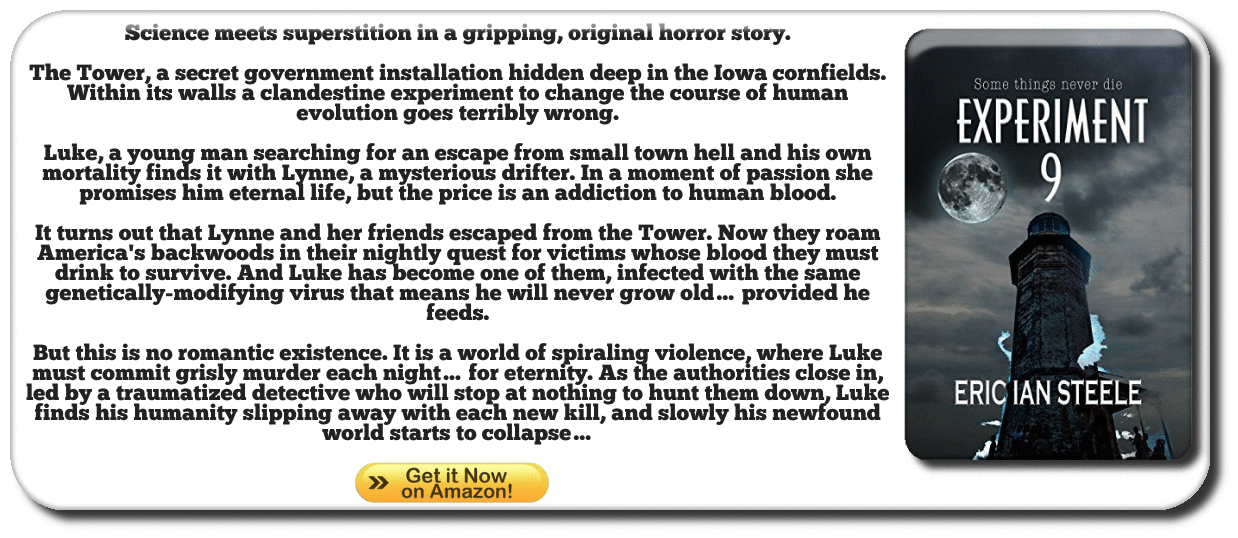 
Comments are closed.
|


Archives
May 2023
|

 RSS Feed

|

|