

  BIOGRAPHY Michael Aloisi is the author of eight books, including Unmasked: The True Story of the World’s Most Prolific Cinematic Killer and Mr. Bluestick, and has written under the penname Michael Gore for his horror collections Tales from a Mortician and Skeletons in the Attic.  Rebecca Rowland is the editor of the Halloween anthology Ghosts, Goblins, Murder and Madness and author of the collection The Horrors Hiding in Plain Sight, and her stories appear in the recent and soon-to-be-released anthologies The Year’s Best Hardcore Horror: volume 4 (Red Room Press), Strange Stories (Forty-Two Books), and Strange Girls (Twisted Wing Productions). Both make their homes in an unassuming corner of the United States not unlike the one in which Dennis Sweeney in their new novel, Pieces, resides. WEBSITE LINKS www.AuthorMike.com www.RowlandBooks.com Amazon pages: https://www.amazon.com/Michael-Aloisi/e/B003Q935WM/ref=dp_byline_cont_ebooks_2 https://www.amazon.com/Rebecca-Rowland/e/B07GCBFCXP/ref=dp_byline_cont_book_1 Could you tell the readers a little bit about yourself? MIKE: I’m an author with a filmmaker’s heart. I’ve written nine books, mostly in the horror vein, because I’m obsessed with all things dark and twisted. REBECCA: I’ve always pursued jobs where I can employ some creativity: teaching, ghostwriting, designing, but I’m drawn to the dark and twisted as well. That’s probably why we work so well together: just like what Lydia in Beetlejuice says, “I, too, am strange and unusual.” MIKE: We’re friends as well as writing partners, and that always helps in a working relationship. To get the ball rolling and get everyone relaxed, here is a hopefully lighthearted question to break the ice. Which one of your characters in your newest release, Pieces, would you least like to meet in real life and have them complain at you about they way you treated them in your work? MIKE: In Pieces, a killer cuts his victim into thirty pieces and mails the sections to random people around the country. The novel explores what happened to the recipients of the twelve body parts that were not turned into authorities. Of those characters, I’d choose George from Piece #3: he is a cranky old man who’d punch you in the face just for wearing clothing he disagrees with, so I’m not sure I’d want to ever meet him! REBECCA: I actually have a soft spot for most of the protagonists in the missing-piece chapters, as flawed as they all are… except Mark from the Atlanta story. He’s a real tool, but he’s such a narcissistic misogynist that no matter how we penned him, he’d likely bitch and moan. MIKE: Outside of Pieces, I’d say the mother in my short story, “Four Halloweens.” The horrors I put on her are so awful, I still feel like I should not have written the story. If she were real, I’d be terrified of her wrath. REBECCA: (laughs) There aren’t many characters in my short stories that are nice people, and I don’t pull many punches, but if I had to choose, I’d say Jesse in “Bent.” He’s not the scariest character of the bunch, but I’d say he’s one of the smartest. He’d find a way to make me pay. Other than the horror genre, what else has been a major influence on your writing? MIKE: Movies! For me, all movies: sappy, silly, gory, or serious are what made me fall in love with storytelling and why I started writing. Reading was a later love in life. REBECCA: I’d have to agree. I remember being a freshman in college and taking my first film class and watching Exterminating Angel. Here was a black and white film, in Spanish with subtitles, about dinner party guests who become trapped in the parlor: understandably, I was dubious at first. And yet, I left the class feeling like I was on a drug: I had become completely mesmerized by the bizarre universe Bunuel created. It was my first experience with surrealism. I’d love to have that power, the ability to completely suspend a reader’s belief, no matter how outrageous the storyline. If you could erase one horror cliché what would be your choice? MIKE: Idiot characters. I can’t stand characters that you get mad at because of their stupidity. REBECCA: In film, women who wear ridiculously uncomfortable clothing only to be chased down steep inclines or broken sidewalks and fall about a million times. In written fiction, tidy, happy endings. What was the last great book you read, and what was the last book that disappointed you? MIKE: I borderline hated Doctor Sleep by Stephen King but I have fallen in love with Peter Swanson’s novels thanks to Rebecca. REBECCA: Yes, I really like Swanson’s stuff. I know it’s a popular choice, but deservedly: My Lovely Wife by Samantha Downing was really well done. As far was what disappointed me…I guess I’d say Donna Tartt’s The Little Friend. I love her other stuff, but the ending of that one irritated me quite a bit. What are the books and films that helped to define you as an author? MIKE: As a horror author, everything I have ever seen or read has made me the author I am; however, Richard Laymon gets the biggest credit. REBECCA: Off the cuff, I’d say two stories in particular: Stephen King’s “The Boogeyman” and A.M. Homes’ “Adults Alone.” The first scared the bejesus out of me--I still can’t sleep with the closet door ajar—and I love the build and twist ending. Homes’ story is one of my all-time favorites. The satirical tone, the realism of the characters…I can only hope to achieve what Homes creates there. Are there any reviews of your work, positive or negative, that have stayed with you? MIKE: Any time I feel like giving up, I think of some letters I have gotten from readers and one reviewer in particular that said I could be the next H.P Lovecraft if I had a good editor. Things like that really help motivate me. REBECCA: Someone once wrote that I had “an ear for dialogue,” that what I write rings true. I never forgot that. Now, when I read other people’s work and I recognize that ability in someone else, I make sure to tell him or her. I think the capability to create authenticity is one of the best tools a writer can wield. I hope I still have it. What aspects of writing to do you find the most difficult? REBECCA: I get caught up in the language. I want to make my prose sound pleasing when it runs through a reader’s inner monologue. Sometimes I get so jammed up in how I want to say something that the what stalls. MIKE: Re-writes. I have so many stories I want to tell, and once a story is out of my head, I never want to touch it again. Writing is pure fun to me. Editing is torture. How important are names to you in your books? Do you choose the names based on liking the way it sounds or the meaning? REBECCA: Sometimes I obsess over infusing a symbolic meaning in a name I select. Other times it’s just what’s handy. There are quite a few character names in Pieces that are “borrowed” from friends in our lives, but the main protagonist, Dennis Sweeney, was selected very methodically. His surname Londoners might recognize from The Canal Murderer John Sweeney who also disarticulated his victims. MIKE: Overall, though, names are hard for me and unlike most authors, most of the time there is no meaning behind the names I choose. Is there one subject you would never write about as an author? MIKE: Politics REBECCA: You don’t think your work is political in some ways? MIKE: Not intentionally. I don’t set out with an agenda or message, if that’s what you mean. REBECCA: I think I’d be worried to portray things I’m not qualified to discuss, like racial oppression. I’ve been asked if I think men are able to communicate a female experience accurately, and I think, yes, I’ve read plenty of stories by male writers where the female character is believable. I myself just feel more comfortable creating characters I can relate to. MIKE: Like Dennis Sweeney, a male serial killer? (laughs) REBECCA: You betcha. (winks) That brings up another question. In the past, authors were able to write about almost anything with a far lesser degree of the fear of backlash, but this has all changed in recent years. These days authors must be more aware of representation and the depiction of things such as race and gender in their works. How aware are you of these things and what steps have you taken to ensure that your writing can’t be viewed as being offensive to a minority group? MIKE: I think every author now second guesses what they write for fear of backlash. Just because a character does something awful, it does not mean the writer has those beliefs or thoughts…it’s fiction. REBECCA: I agree with you. I mean, here we are, releasing a book about a murderer who stalks and kills women, even blames them for not being savvy enough to protect themselves. In this age of #metoo and #TimesUp, that might be considered misogynistic. Do I personally feel that victims of violent crimes deserve what they get? Of course not. But do I think the perpetrators might believe they do? Absolutely. A few years ago, a good friend of mine read my story “Boundaries” and said to me, “I really don’t like him,” meaning the protagonist. I took it as a compliment. He was meant to be an odious monster, so I did my job. Some of the worst horrors aren’t hiding under the bed: they are walking beside us on the street or being featured prominently in the media. They are re-enacted for us on the old, damp pages of history books. Sometimes the best way to take away their power is to expose them to the sunlight. Given the dark, violent and at times grotesque nature of the horror genre, why do you think so many people enjoy reading it? MIKE: Horror is a way of experiencing scares and facing mortality in a safe way. Horror is the same as a roller coaster: what is the point? To feel fear and adrenaline in controlled environment. REBECCA: That’s a good analogy. It gives our anxieties a place to go. Does horror fiction perpetuate its own ghettoization? REBECCA: Horror has always been shunned to the back of the line as far as literary acclaim. I think the only other genres that garner less “street cred” in the realm of highbrow literature are, perhaps, fantasy and erotica. Do I think horror as a genre is its own worst enemy in that sense? Sometimes. Horror writers deal with a very visceral, somewhat taboo, emotion: fear. I think critics who dismiss horror as a “lesser” genre neglect to consider the importance of fear in how it shapes both individuals and society as a whole. And, popularity is considered incongruous with art in some circles. Thomas Harris is a best-selling author, so he must not be “literary?” Ridiculous. MIKE: The sad thing is that horror is consistently, since the start of time, one of, if not the most profitable genres there is. Everyone is fascinated with horror, but they don’t realize it. Every cop, lawyer, or medical show revolves around death… which is a horror we all face. People might think a slasher film is gross, yet they will watch a medical show with someone dying a horrific death. Both mediums release the same emotions, they just present them in different ways. If more people realized this, maybe they would be a bit more open to horror as a respectable genre. REBECCA: Some of the best writers in the literary canon have written horror: Poe, Joyce Carol Oates, Flannery O’Connor, Roald Dahl… and two of the best filmmakers working today, Jordan Peele and Ari Aster, are making horror. I don’t mind being in the back of the line with fantasy and erotica, though. Imagination and sex: you couldn’t ask for better roommates! Writing is not a static process. How have you developed as a writer over the years? MIKE: I’ve matured and gotten better and try to with everything I do. I think Pieces is my most mature writing and I have Rebecca to thank for that, she really pushes me to be better. REBECCA: Mike pushes me as well. Even before we collaborated on Pieces, he and I shared our stories, bounced ideas off one another. He’s an amazing father to two great kids, but as everyone knows, parenting is a fulltime job—it’s work. Hard work! When they were younger, sometimes—I hope it’s okay to share this? MIKE: Oh, God. What? REBECCA: Sometimes, he’d joke to me, “Don’t ever have children!” It became like this mantra for two months straight. He loves his children more than anything in the universe, but he was exhausted all the time. MIKE: And you turned it into a short story with a narrator named Michael who begins, “Don’t ever have children.” REBECCA: (laughs) The guy is a good dad! Even though his wife turns into a cannibal… What is the best piece of advice you ever received with regards to your writing? REBECCA: You can’t worry about what people will think of you when they read it. MIKE: Just write. Shut up and write. For those who haven’t read any of your books, which of your books do you think best represents your work and why? MIKE: I think Pieces, not because it’s new, but because we worked more on forming the book than I have ever in the past. REBECCA: I think I’d agree. Mike and I have collaborated on short stories before, but this is our first work of length together. We each have our own strengths, and I think this partnership in particular forced us to pull those out from each other. MIKE: And what’s nice about it is readers will see a little bit of everything we can offer: some darkness, some gore, some “literary prose,” some suspense. REBECCA: Some nice plot arcs too. And a decent pace. We’re both short story writers, so we’re used to getting the point across in a short amount of time. I think we keep Pieces moving rather well because of that. Can you tell us about what you are working on next? MIKE: Right now, I’m working on a non-fiction book with a television star as well as another collection of horror short stories. We also have another collaboration in the works: another horror/thriller, but much darker than Pieces. REBECCA: Yes, we have that next novel in progress now. Hopefully we’ll see it out in a year or so? I’ve been writing short stories for open anthology calls and journals and a handful are being published this autumn and winter. It’s been a different experience, writing for outside collections rather than one cohesive group for one publisher. It’s freeing to not feel confined by a unifying theme, but it’s also a sobering experience to collect my share of rejection letters. MIKE: I always remind her of Stephen King’s anecdote about the pile of rejections he used to collect on a diner spike. REBECCA: I try to wear them like a badge of honor, a collection of bruises on a roller derby jammer’s thigh. (laughs) What's the one question you wish you would get asked but never do? And what would be the answer? MIKE: Why do you write? Answer: Because I have to. REBECCA: What’s Michael Aloisi like in real life? (laughs) MIKE: You really want to be asked that? REBECCA: You really want me to answer it? MIKE: (laughs) Pieces by Rebecca Rowland, Michael Aloisi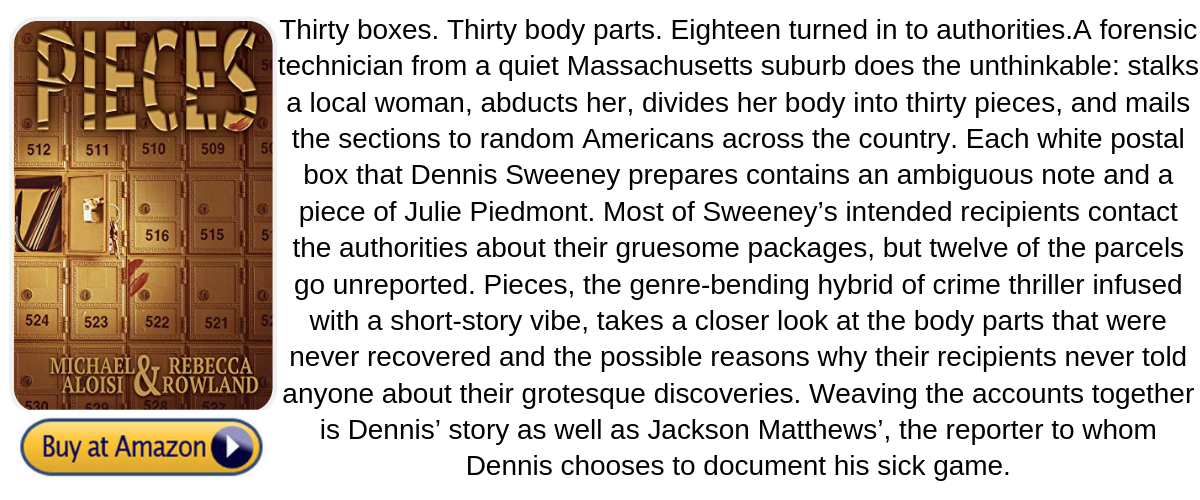   Comments are closed.
|


Archives
May 2023
|
 RSS Feed

|

|