


  Spirits haunt us. It’s what they do, whether they’re the kind that come from beyond the grave, or from a brown paper bag with a liquor store logo on the side. S. L. Edward’s debut collection, Whiskey and Other Unusual Ghosts, is well-named, because just like a whisper from the dark or an all-too-familiar dryness in your throat, this book haunts. We’re not just talking about leave-a-nightlight-on heebie-jeebies here, but real haunting, the kind that comes from memories you can’t lose, heartaches you can’t mend, and secrets you can’t share. It is a haunting that comes from intimacy. Though few of Whiskey’s 12 stories are told from the first-person point of view, every one of them feels like a confession. That tone is set right from opener, “Maggie Was a Monster,” which is actually told in second-person POV, making the reader a participant in the narrative. Hard to get more intimate than that. Said narrative is oblique, somewhat hard to describe, more so than many of the stories that follow; it concerns a pair of siblings—although either or even both of them might not be entirely “real,” at least not in the traditional sense—playing a game. One is chosen to be the “monster” and the other its victim. What exactly happens from there is open to interpretation (indeed, one view could arguably make the story’s own title a spoiler), but overall the piece deals with themes of growing up, of family dysfunction, of innocence lost. Similar themes and images reoccur in “I’ve Been Here a Very Long Time,” a more straightforward tale about a boy who discovers something living in his closet, something that refuses to be seen but yearns to make the boy’s every wish come true, whether it be his childhood prayer for parents that don’t fight or his adolescent desire for the girl he loves to loves him back. Even still, happiness proves elusive, and what “happiness” is in the first place eventually finds itself under interrogation. None of these themes may be especially fresh (there’s nothing new under the sun, after all), but they are still themes which every person—and every author—must grapple with at some point or another. What makes these themes resonate so strongly in Whiskey, though, is how Edwards opens up himself to the reader. Universal allegories feel more like personal revelations when presented with this much sincerity and emotion. Surprisingly enough, the emotion that dominates this horror collection is not fright, but sadness. Edwards employs the trappings of the horror genre—monsters, murder, madness—in service of more than just lurid thrills (though there are surely enough of those to be had, as well as the occasional macabre grotesquery). To wit, the loss of loved ones and the effects of such loss on those left behind is revisited again and again throughout. Characters frequently struggle in the shadows of their lost husbands and lost wives, lost fathers and lost mothers, lost siblings, lost children. And through a diverse assortment of characters, a diverse assortment of experiences are reflected. There’s grief which can eat a person alive with the same ferocity as a clowder of feral felines, as explored in “And the Woman Loved Her Cats” (a collection highlight which just so happens to house the creepiest kitty since Stephen King’s “The Cat from Hell”). There’s rage which can make a man into a machine fueled by vengeance against an unseen enemy, as explored in “We Will Take Half” (which begins with one of the most bluntly heartbreaking first lines you may well ever read). There can even be a kind of morbid fascination that threatens to supplant one’s capacity to value life, as explored in “A Certain Shade” (the first published appearance of an enigmatic assassin called The Matchmaker, whom Edwards teases as a character with many more tales to tell). In stories such as these, “horror” as many tend to think of it comes second to sorrow or bitterness or obsession. Still, there is plenty in Whiskey to horrify any reader. The worst horrors rarely arise from the supernatural elements, however; those are often just mirror images of characters’ individual traumas. The real horror is in what causes those traumas or what further traumas are eventually caused. Looming largest in this regard are the specters of war and political violence. Compared to the vain young men who idolize killers and dream of battlefield glory without understanding the true cost of conflict (as in “Cabras,” another collection highlight) or to the mountains of nameless prisoners from Stalin’s Gulags whose bodies fill mass graves of ice and snow (as in “The Case of Yuri Zaystev”), ghosts seem downright agreeable, no matter how unusual they may be. For all its virtues, though, Whiskey proves a curious beast. A somewhat uneven mix, almost split down the middle, the first half of the book comprises stories that are likely more relatable to the average North American or UK reader. Yes, they feature organ-stealing puppets and haunted forests, but they also feature suburban families and wealthy widows. They take place in dive bars and crowded movie theaters. The second half, meanwhile, comprises stories with a more international, politically charged flavor, stories which delve deep into the histories of Latin-American civil wars and the lives of jungle-dwelling guerilla fighters. Both sides of the coin are equally enjoyable, but one wonders if a slightly rearranged table of contents would’ve reduced reader whiplash. In any case, even with the contrast between its two halves, S.L. Edwards’ first collection finds common ground among even the most dissimilar scenarios. Whether transporting readers to some war-torn country halfway around the world or to the bedroom closet of a lonely little boy clinging to his teddy bear, there remains a unifying through-line in the author’s empathetic treatment of his characters. It is that empathy, and the genuine emotion it provokes in the reader, which makes Whiskey and Other Unusual Ghosts such an intimate, earnest, and affecting debut. WILLIAM TEA  WHISKEY AND OTHER UNUSUAL GHOSTS BY S. L. EDWARD 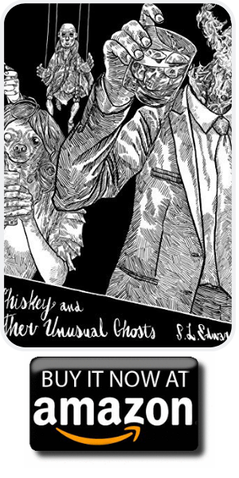 Whiskey and Other Unusual Ghosts debuts a meteoric new voice in modern dark fiction. In these tales, you’ll discover the humanity of horror, and the traumas that birth ghosts of all kinds. From inner demons to the bloodied fields of war, Edwards maintains his unique voice while whispers of classic writers such as Arthur Machen and Thomas Ligotti shine through. Edwards enters the contemporary dark fiction crowd with a standout collection that is likely to cement his position amongst the modern greats. "S.L. Edwards is a natural storyteller, with a keen command of voice, a delightfully twisted imagination and a wily, prodigious intellect. Whiskey and Other Unusual Ghosts lives up to its inventive title with tales of hauntings that are chilling, funny, moving and—quite often—all three at once. I loved this collection." - Jon Padgett, Author of THE SECRET OF VENTRILOQUISM “In these perfectly constructed, intimately detailed, and emotionally charged tales, Edwards isolates the silent horrors underscoring our lives and woven into our closest relationships, urging them to take psychological and physical form. In the cold hours before dawn his creatures rise, arch their backs, and begin the search for sustenance, feeding off of childhood fears and lifelong grievances. Hidden in memories, abandoned rooms, and forgotten trails, adorned with the fantasies we invent to conceal their nature, our monsters merely postpone the moment of revelation until we’re far too vulnerable to escape.” — S.P. Miskowski, author of THE WORST IS YET TO COME   Comments are closed.
|


Archives
May 2023
|

|

|
 RSS Feed