

FIVE MINUTES WITH AUTHOR CALEB WILSON
29/5/2018
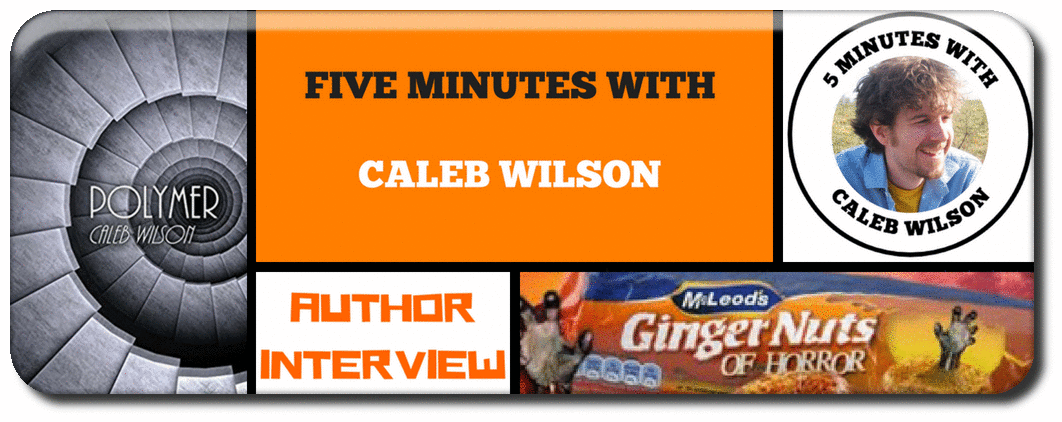
Caleb Wilson is a writer of weird fiction and designer of weird games.
Could you tell the readers a little bit about yourself? Sure! I live in the American Midwest -- Illinois -- in a college town that feels small and large at the same time. I work at a public library, so I'm always surrounded by books. Before that, I worked in a number of different bookstores, so I was always surrounded by books then. My house is full of bookshelves, but also more books than fit on the bookshelves. Books are one of my favorite things. What do you like to do when you're not writing? Apart from books, I love games, of many kinds: board games, card games, videogames. So when I'm not writing I play a lot of games, and I design them too. I've published some text-based computer games, and created a few board games for local competitions and for fun. Other than the horror genre, what else has been a major influence on your writing? Weird literary fiction, writers like Samuel Beckett and Thomas Bernhard. Bernhard in particular has a very addictive style, so after I read him I always write like him for a while. I read a lot of fantasy too, and I've taken inspiration from authors who mix fantasy and horror, like Michael Shea and Clark Ashton Smith. Interactive Fiction, which I write and play, has also influenced my fiction writing in weird ways: I really like writing descriptions of rooms, places, and evocative inanimate objects, probably because that's what I started with in those games. The term horror, especially when applied to fiction always carries such heavy connotations. What’s your feeling on the term “horror” and what do you think we can do to break past these assumptions? I think that like "fantasy", "horror" is broad enough to include almost anything. It doesn't really give you any information about whether it's going to scare you or scar you or make you laugh/cringe/shiver, and I think that's a good thing. By weaving in all kinds of other elements, we just broaden the horizons of horror. A lot of good horror movements have arisen as a direct result of the socio/political climate, considering the current state of the world where do you see horror going in the next few years? Good question, and it would be nice if I knew! Dystopias have already been popular for a while, so it would be great to figure out what the next big popular thing is going to be ahead of time. In general, stories of resistance are always appreciated. I don't mind happy endings, either. What are the books and films that helped to define you as an author? Kelly Link, Stranger Things Happen, which showed me that there aren't really rules for or limits on what fantasy fiction can be. Flash Gordon, which I'd usually rather watch than Star Wars, and which reminded me of the joy that comes from the right combinations of color, sound, and silliness. The stories of Jack Vance, which combine a wild imagination with a love of words. What new and upcoming authors do you think we should take notice off? Farah Rose Smith. Her book The Almanac of Dust is out now, and Eviscerator comes out in July. Her writing reminds me of my favorite decadent authors, with really great imagery and beautiful phrases. How would you describe your writing style? Ornate alternating with blunt. Dark humor. I write a lot about seething, hostile environments, and I write a lot of monsters. Are there any reviews of your work, positive or negative that have stayed with you? Someone once wrote in a review that they weren't sure what country I was from, but what I was describing wasn't civilized behavior. I think that has to be a compliment, right? What aspects of writing to do you find the most difficult? Realistic dialogue, and moving stories ahead in a smooth and controlled way. Probably part of why I like writing computer games: the story is distributed across the player's actions, and to some extent the order of events is up to them, so I'm a little bit off the hook! Is there one subject you would never write about as an author? I don't write extreme violence (compared to other horror writers, anyway!) I prefer clammy, subdued weirdness. How important are names to you in your books? Do you choose the names based on liking the way it sounds or the meaning? I love naming characters when its easy and hate it when its hard. For me it's easy about 75% of the time. I choose based on meaning, sound, and sometimes just random syllables that appeal to me. I often look up words in ancient languages and then blend them together a bit, or change a letter or two in a normal name. Writing is not a static process. How have you developed as a writer over the years? I finish more projects these days. Learning how to do that was a big deal for me. I've also gotten better at seeing how writers I enjoy perform their magic, and figuring out how to use the same tricks in my own writing. What tools do you feel are must-haves for writers? I think the only indispensable tool is time: everything else you can work around. And even five minutes chunks of time can be stitched together, if nothing else. (Though for me, writing in two-hour-long chunks is the most efficient.) What is the best piece of advice you ever received with regards to your writing? Finish things. Make yourself finish things by having markets in mind to send them to from the start. Don't ever stop reading, and reading new things. Getting your work noticed is one of the hardest things for a writer to achieve, how have you tried to approach this subject? It's been a very slow process for me. These days I'm trying out the social media thing, trying to be "fun" and "engaging" online, which doesn't come naturally to me, at least with people who aren't already my friends. To many writers, the characters they write become like children, who is your favourite child, and who is your least favourite to write for and why? I really liked writing for my pair of sword and sorcery characters, Charops the Strategist and Ichneumon the Weird. (They're in a story called "Bow Down Before the Snail King!", published in Swords v. Cthulhu.) I enjoy their sour humor and refusal to give up in the face of disaster, though it might not do them much good. There are plenty of characters I didn't end up liking writing about, and their fate has been that I never finished writing their stories, and so they don't actually exist. What pieces of your own work are you most proud of? Polymer, my novella with Eraserhead Press, and Cannonfire Concerto, a text-based computer game I wrote for Choice of Games. And are there any that you would like to forget about? Not really. There are some old pieces floating around, which are probably embarrassing in certain ways, but they've got some good lines, too, so I don't mind. For those who haven’t read any of your books, which of your books do you think best represents your work and why? Again, I'd go with Polymer. It ties together a lot of my loves and obsessions, and I think manages to not feel like anything else I've read. Do you have a favorite line or passage from your work, and would you like to share it with us? "Like all of us except for sociopaths or actors, Liero had always been slave to the expressions that moved the surface of his skin." That's from Polymer. Can you tell us about what you are working on next? Right now I'm working on a dark fantasy/cosmic horror novella. It's about a city experiencing a very strange invasion, and it has a peculiar narrator. But that's all I really want to say about it for now! If you could erase one horror cliché what would be your choice? How about "guy rescues helpless girl in peril". Other than that, I sort of love horror clichés. Almost anything can be used interestingly, given the surrounding context. What was the last great book you read, and what was the last book that disappointed you? I just finished reading Doctor Faustus by Thomas Mann, a "great book" in the old classic sense. I can hardly imagine writing something so detailed and knowledgeable: it's 500+ pages of dense, thoughtful, solid information. I can't remember the last book that disappointed me, because I've gotten very good at searching out books I'm fairly sure to like! With a huge reading pile of books like that, I hardly ever finish something I'm not enjoying, and if I don't finish it, I don't really consider it disappointing, just not for me. What's the one question you wish you would get asked but never do? And what would be the answer? Question: What are some of your favorite monsters? Answer: The Beast from Over the Garden Wall (a miniseries that aired on Cartoon Network.) It's mysterious for most of the story, manifesting mostly as creepy operatic singing in a cold forest, and when it finally appears, there's a great tragic and faintly horrible misunderstanding about the way it operates and has been operating that I find really delicious. The hyena from Jesse Bullington's The Enterprise of Death. It's a monster who speaks with a human voice to get you to come closer so it can eat you. Imperfect simulacra are creepy anyway, and the hyena is the perfect monster for the Dark Ages, where the world has so little light that you can't see three feet into the night to know for sure what sounds so friendly, just a bit disoriented. The slake moths from Perdido Street Station. China Mieville has one of those megawatt imaginations and the slake moths are one of his most horrifying creations. They're these sort of huge demonic vaguely moth-like things covered with hypnotic swirling patterns that will make you docile if you so much as glance at them, and then they eat your personality and volition, leaving just a still-breathing empty shell.


YOUNG BLOOD: OUR LATEST ROUND UP OF THE BEST IN YA HORROR AND DARK FICTIONComments are closed.
|


Archives
May 2023
|

 RSS Feed

|

|