• HOME
  • CONTACT / FEATURE
  • FEATURES
  • FICTION REVIEWS
  • FILM REVIEWS
  • INTERVIEWS
  • YOUNG BLOOD
  • MY LIFE IN HORROR
  • FILM GUTTER
  • ARCHIVES
    • SPLASHES OF DARKNESS
    • THE MASTERS OF HORROR
    • THE DEVL'S MUSIC
    • HORROR BOOK REVIEWS
    • Challenge Kayleigh
    • ALICE IN SUMMERLAND
    • 13 FOR HALLOWEEN
    • FILMS THAT MATTER
    • BOOKS THAT MATTER
    • THE SCARLET GOSPELS
GINGER NUTS OF HORROR
  • HOME
  • CONTACT / FEATURE
  • FEATURES
  • FICTION REVIEWS
  • FILM REVIEWS
  • INTERVIEWS
  • YOUNG BLOOD
  • MY LIFE IN HORROR
  • FILM GUTTER
  • ARCHIVES
    • SPLASHES OF DARKNESS
    • THE MASTERS OF HORROR
    • THE DEVL'S MUSIC
    • HORROR BOOK REVIEWS
    • Challenge Kayleigh
    • ALICE IN SUMMERLAND
    • 13 FOR HALLOWEEN
    • FILMS THAT MATTER
    • BOOKS THAT MATTER
    • THE SCARLET GOSPELS
GINGER NUTS OF HORROR
horror review website ginger nuts of horror website

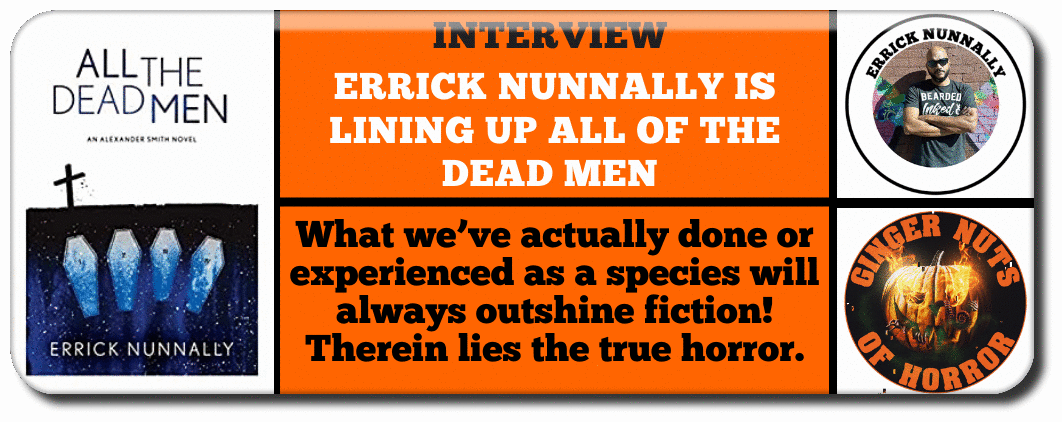
INTERVIEW - ERRICK NUNNALLY IS LINING UP ALL OF THE DEAD MEN

3/9/2020
INTERVIEW - ERRICK NUNNALLY IS LINING UP ALL OF THE DEAD MEN
I’m currently working on something I can’t easily explain just yet. It’s about a young man who’s mother and father met under mysterious and tumultuous circumstances. As he’s coming of age in the 1970s, he learns more about his mother’s and father’s murky background and the past comes rushing forward to drag them all down. It’s a mix of SciFi and horror with a love, black power, and COINTELPRO backdrop.
Errick Nunnally was born and raised in Boston, Massachusetts, he served one tour in the Marine Corps before deciding art school would be a safer—and more natural—pursuit. He is permanently distracted by art, comics, science fiction, history, and horror. Trained as a graphic designer, he has earned a black belt in Krav Maga/Muay Thai kickboxing after dark. Errick’s work includes: the novels, blood for the sun, All the Dead Men, and Lightning Wears a Red Cape; Lost In Transition, a comic strip collection; and first prize in one hamburger contest. The following are some short stories and their respective magazines or anthologies: Uniform (Fiyah Literary Magazine), Penny Incompatible (Lamplight, v.6, #3 and the Podcast Nightlight); Jack Johnson and the Heavyweight Title of the Galaxy (The Final Summons); Welcome to the D.I.V. (Wicked Witches); A Few Extra Pounds (Transcendent); and A Hundred Pearls (PROTECTORS 2: stories to benefit PROTECT.ORG). Eventually, Errick came to his senses and moved to Rhode Island with his two lovely children and one beautiful wife. Visit erricknunnally.us to see his work.
WEBSITE LINKS
http://www.erricknunnally.us
Could you tell the readers a little bit about yourself?
 
I was born and raised in Boston, Massachusetts, but currently prefer Rhode Island. Married with two children, my career is built around graphic design. I’ve been writing most of my life, but seriously leaned in around 2012 before getting my first publications in 2014. I have served in the Marine Corps, graduated from art school, and earned a black belt in Krav Maga. Somewhere in there I won a hamburger contest by 5 Napkin restaurant. I’m a big fan of cocktails, food, and comics—sometimes all at the same time.

Which one of your characters would you least like to meet in real life?

The Lathe. It is a dystopian cyborg built to demoralize and kill the state’s perceived enemies. There’s only one way to stop it and I ain’t it.

Other than the horror genre, what else has been a major influence on your writing?
 
I started out reading quite a bit of SciFi, but I was undirected. Since I lived in something of a book desert, there wasn’t a network of friends, family, or classmates reading and recommending reading. As a result, I sort of missed most of the “must read” books in various genres. Still, I’d say some milestones would be Bradbury’s The Illustrated Man, Asimov’s Caves of Steel and sequels, Gerrold’s War Against the Chtorr series, Collins’ Sonja Blue novels and the first few of Hamilton’s Anita Blake series.
 
The term horror, especially when applied to fiction always carries such heavy connotations.  What’s your feeling on the term “horror” and what do you think we can do to break past these assumptions?
 
As the only genre titled after a feeling, I consider horror to be a thrilling escape. Whatever people envision for their novels and short stories can’t outdo history. What we’ve actually done or experienced as a species will always outshine fiction! Therein lies the true horror.

A lot of good horror movements have arisen as a direct result of the socio/political climate, considering the current state of the world where do you see horror going in the next few years?
 
I hope folks stay away from pandemic stories for a while. That said, I bet there’s going to be even more wily stuff that deals with the socio-political conflicts in societal cultures around the world. We’re seeing the rise of writers from a far more diverse pool and their experiences are coming with them.

Given the dark, violent and at times grotesque nature of the horror genre why do you think so many people enjoy reading it?
 
It’s an escape. As I mentioned earlier, I consider horror—and other genres—an escape from reality. Our existence is the most soul-crushing thing we experience, fiction is our release, our way out for a while.
 
What, if anything, is currently missing from the horror genre?

A broader diversity of experiences. What is it that engenders horror in people who are not like us?
 
What new and upcoming authors do you think we should take notice of?
 
Cadwell Turnbull, Chesya Burke, John Goodrich, Gerald Coleman, Erin Roberts, Kenesha Williams, Zin E. Rocklyn, Teri Clarke, uh…
 
Are there any reviews of your work, positive or negative that have stayed with you?
 
It’s the random reviews that always stick with me, regular readers taking a moment to share their feelings. Recently, I’ve had a few pop up on Twitter for my short story, Uniform in FIYAH Lit Mag and it has been super-cool.

What aspects of writing to do you find the most difficult?

Consistency. For a number of factors. Family responsibilities, work, exercise, other obligations. It’s tough enough to manage all that and write at the optimal times with a damned pandemic and protests against police brutality ravaging the nation, insisting that it change. It’s a powerful force that certainly draws the attention.

Is there one subject you would never write about as an author?

Probably rape or child abuse. But if it fits a story and eventually satisfies my basest needs for vengeance…
 
Writing, is not a static process, how have you developed as a writer over the years?

Getting better at pinpointing the emotional condition of characters and conveying it. It seems to be what people find most compelling. The stories that seem to get the most attention are the ones that dwell in the suffering of the characters the most.

What is the best piece of advice you ever received with regards to your writing?

I think, as it pertains to editing, what to cut away in order to leave the most streamlined story. It’s definitely difficult and takes time to hone. I’m not all the way there just yet!
 
Which of your characters is your favourite?

Alexander Smith from the Blood for the Sun/All the Dead Men/The Headless Woman trilogy.

Which of your books best represents you?

I haven’t completed them yet, but a series of short stories intended to make up two novellas. One is a horror-thriller about a woman who works in animal control and finds herself up against unusual aspects of nature. The other is science-fiction about a Marine Warrant Officer serving as the head security officer on an orbiting combat satellite in Earth’s on-the-brink future. I wrote it as a piece of military-noir, flinging the detective role into a crumbling future where joining the military (or an international corporation) is the best option for survival.

Do you have a favorite line or passage from your work, and would you like to share it with us?
 
Maybe this one, for now:
 
He didn’t have to look up to see the night sky stretching forever in all directions, a pitched blanket smothering the world.
 
Can you tell us about your last book, and can you tell us about what you are working on next?
 
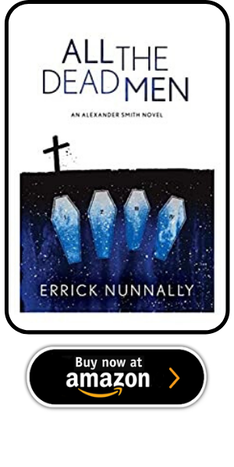
My last book was, All the Dead Men, a sequel to Blood for the Sun, both books are about a werewolf with a kind of supernatural Alzheimer’s who puzzles out cases of missing or murdered children in order to keep his mind intact. They’re supernatural crime, noir, pulp, and horror. I’m looking forward to writing the third book!
 
I’m currently working on something I can’t easily explain just yet. It’s about a young man who’s mother and father met under mysterious and tumultuous circumstances. As he’s coming of age in the 1970s, he learns more about his mother’s and father’s murky background and the past comes rushing forward to drag them all down. It’s a mix of SciFi and horror with a love, black power, and COINTELPRO backdrop.

If you could erase one horror cliché what would be your choice?

Weak-ass flashlights.

What was the last great book you read, and what was the last book that disappointed you?
 
The last book that I felt was truly great—above and beyond entertaining, well-written, etcetera—was probably The Lesson by Cadwell Turnbull. I mentioned my origins with SciFi earlier and this one was on par with Childhood’s End, by Arther C. Clarke. Better, in fact, considering where we are in history. It’s a modern and engaging take on first contact and the consequences of Colonialist empires.

What's the one question you wish you would get asked but never do?  And what would be the answer?
 
Oh, shit…
Picture
The plot was broken, but something more sinister has taken its place: a vampire church built around the image of a woman who seems strangely familiar to Alexander. These zealots are hellbent on restoring what they believe the status quo to be, one of vampire over human, and Alexander wants nothing to do with it. Until a child—one he’d rescued decades ago, now an adult—turns up in a pornographic video made by a film crew that has been slaughtered. His adopted daughter, the vampire Ana, seems to be missing. At wit's end, Alexander has few allies. With Majispin in hiding, the pack decimated, and only a few willing to both hate and help him, Alexander must confront The Church of Our Lady of Perpetual Death and deal with the unexpected threat of Ana’s grandsire, an old and powerful vampire who has consumed his own soul. The monster wants nothing more than to possess the only love Alexander has left in the world.

THE HEART AND SOUL OF HORROR REVIEW WEBSITES ​
​

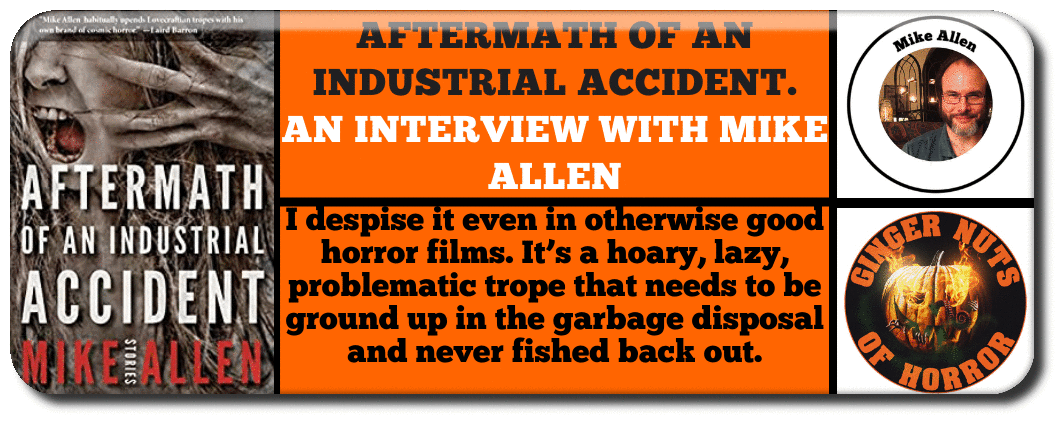
AFTERMATH OF AN INDUSTRIAL ACCIDENT AN INTERVIEW WITH MIKE ALLEN

2/9/2020
Picture
I don’t know that I have a remedy to suggest other than continuing to put our best work out there. And we should keep doing what we can to lift each other up. Celebrate horror authors who are women, who are POC, who are QUILTBAG. We should venture out of our comfortable lanes and explore work beyond the latest product from a long-time bestselling author and even outside the latest writings from the circle of friends you quaff beers with at cons every year, fine as all those books undoubtedly are.
Nebula, Shirley Jackson and two-time World Fantasy award finalist Mike Allen wears many hats. As editor and publisher of the Mythic Delirium Books imprint, he helmed Mythic Delirium magazine and the five volumes in the Clockwork Phoenix anthology series. His own short stories have been gathered in three collections: Unseaming, The Spider Tapestries and newly-released Aftermath of an Industrial Accident. He’s won the Rhysling Award for poetry three times. A dark fantasy novel, The Black Fire Concerto, appeared in 2013. His novella “The Comforter,” a sequel to his Nebula Award-nominated horror story “The Button Bin,” has just appeared in an anthology of four dark long-form tales, A Sinister Quartet.
​
For more than a decade he’s worked as the arts and culture columnist for the daily newspaper in Roanoke, Va., where he and his wife Anita live with a cat so full of trouble she’s named Pandora. You can follow Mike’s exploits as a writer at descentintolight.com, as an editor at mythicdelirium.com, and all at once on Twitter at @mythicdelirium.
WEBSITE LINKS
Aftermath of an Industrial Accident: https://mythicdelirium.com/our-books-9#Aftermath

A Sinister Quartet: https://mythicdelirium.com/our-books-8#Sinister

Mythic Delirium Books: https://mythicdelirium.com/

Mike Allen’s home page: http://descentintolight.com/

Twitter: https://twitter.com/mythicdelirium

Facebook:
https://www.facebook.com/time.shark

Amazon author page: https://www.amazon.com/Mike-Allen/e/B004G81HLS

--
Mike Allen
Author/Editor/Publisher
http://www.clockworkphoenix.com
http://www.mythicdelirium.com
http://descentintolight.com
Could you tell the readers a little bit about yourself?
 
I was born in Minneapolis, spent my early childhood on Guam, my formative years in a tiny coal-mining town in far Southwest Virginia and most of the rest of my life in a not-quite-as-Southwest Virginia city called Roanoke, which is not the same Roanoke where all the colonists disappeared, though my city get mistaken for that one all the time. I’ve been married to my best friend and creative partner, Anita, for 28 years.

I work in a collapsing industry: I’m a newspaper reporter. I’ve stubbornly stayed on board when many others have bailed because I really love my job. I had a love-hate relationship with horror fiction in my childhood, at first mostly hate, that bloomed into starry-eyed adoration in my teen years once I encountered Clive Barker’s Books of Blood.

Which one of your characters would you least like to meet in real life?

There are few that I would want to meet, as so many of them originate in my nightmares. But. In a way this feels like the too obvious answer, but it rings true: encountering the being that goes by the name “Lenahan” in “The Button Bin” and “Maria” in the sequels “The Quiltmaker” and “The Comforter” would likely either give me a heart attack, or, if it had its way with me, make me desperately wish that I’d had one and that I’d died from it.

Other than the horror genre, what else has been a major influence on your writing?
 
Like a million other people I first became fascinated with genre as a kid via the books of J.R.R. Tolkien and C.S. Lewis. From there my reading went in many directions, though it always stuck to the otherworldly in some way. Non-horror writers who loomed huge in my formative years included T. S. Eliot, Ursula K. Le Guin, Roger Zelazny, Madeleine L’Engle, Lloyd Alexander, Susan Cooper, Stephen R. Donaldson and William Gibson.

Reading Cormac McCarthy’s Blood Meridian in my late thirties was a transformative experience in its own way. I had for years struggling to complete what’s now my best known story, “The Button Bin.” Something about the gorgeous language and horrific violence of Blood Meridian jarred the necessary pieces loose.
 
The term horror, especially when applied to fiction always carries such heavy connotations.  What’s your feeling on the term “horror” and what do you think we can do to break past these assumptions?
 
I feel like I have been especially lucky among journeyman horror writers. In the city where I live, where I work as a newspaper reporter and write the weekly arts column, and where I have in the past done a smidge of amateur theater acting, no one seems to bat an eyelash when I call myself a horror writer. I mentioned this at a convention in February -- an honest to god in-person convention, remember those? -- and heard from other panelists that, especially for women creators, a stigma against the genre still rears its sneering head when the subject comes up. That’s certainly troublesome.
​
I don’t know that I have a remedy to suggest other than continuing to put our best work out there. And we should keep doing what we can to lift each other up. Celebrate horror authors who are women, who are POC, who are QUILTBAG. We should venture out of our comfortable lanes and explore work beyond the latest product from a long-time bestselling author and even outside the latest writings from the circle of friends you quaff beers with at cons every year, fine as all those books undoubtedly are.

A lot of good horror movements have arisen as a direct result of the socio/political climate, considering the current state of the world where do you see horror going in the next few years?
 
I’d be hesitant to make concrete predictions given how fast world events shift from week to week, even day to day. I have encountered reactions from a couple of potential readers who were reluctant to even engage in horror because of the stress generated by the daily news cycle.

In the United States, at least, the geeks have won the pop culture war, and horror is a beneficiary of that, but not to the extent that horror as a commercial publishing category has made a comeback. Horror must have started looking lucrative to someone in the New York publishing world, considering that Tor is launching a horror-only imprint, and I hope that those circumstances get better rather than worse.

On the writing side, the creative side, in terms of where horror can go, there are so many top-notch talents writing horror these days, from grizzled veterans to bright-eyed up-and-comers, I think the possibilities are endless.

Given the dark, violent and at times grotesque nature of the horror genre why do you think so many people enjoy reading it?
 
I feel like this question almost answers itself, hahaha.

Humanity stays preoccupied with death and decay in its many forms, whether we as individuals wish to admit it, and horror uses imagination to explore these topics, whether for relatively light-hearted thrill ride fun or for serious and grim meditation on injustice and brutal cosmic absurdity.

What, if anything, is currently missing from the horror genre?
 
Aside from a lucrative income for all its worthy practitioners?

An online article last year posed the question “Where is the Jordan Peele of horror literature?” The framing of the question made me cringe a bit because it seemed to me to erase decades of contributions made to horror by POC authors, but there’s a legitimate point embedded in there about failures in the publishing industry and even in the broader horror community to give these creators the wide renown that they deserve.

What new and upcoming authors do you think we should take notice of?
 
I have to proffer a caveat here. As a full-time journalist who moonlights as a publisher as well as a fiction writer -- and who never learned to speed read -- I haven’t broadly consumed the many options the genre offers. My bookshelves and my Kindle are full of titles that caught my eye that I still haven’t read!

I had the pleasure last year of writing blurbs for Craig Laurance Gidney’s novel A Spectral Hue, A. C. Wise’s novella Catfish Lullaby and Christina Sng’s poetry book A Collection of Dreamscapes. All three of these titles approach the tropes of horror with fresh and refreshing perspectives.

For the sake of enlightened self-interest, I’d like to single out the two debut novellas included in the latest anthology from my Mythic Delirium Books imprint, A Sinister Quartet. Jessica P. Wick’s “An Unkindness” is a dark fantasy that includes one of the most harrowing depictions of the faerie kingdom that I’ve ever read. Amanda J. McGee’s “Viridian” is a cinematic evocation of the Gothic horror story that also reworks an old folktale in a way that restores its full gruesome glory.

Are there any reviews of your work, positive or negative, that have stayed with you?
 
Generally, yes. I mean, one shouldn’t pay too much attention to reviews, but we writers sometimes just can’t help ourselves.

Most of my publications have appeared in places outside of the dominant genre markets, so I’ll confess that it was incredibly gratifying when the first review that appeared for my debut horror collection Unseaming was a starred review from Publishers Weekly, and even more gratifying when it happened again in May for my follow up horror collection Aftermath of an Industrial Accident.

I think my favorite negative review to date was a reader review that complained about my story collection Unseaming because, to paraphrase, the “chapters” didn’t tell a continuous story.

What aspects of writing to do you find the most difficult?

Finding the time to do it, mainly. All other issues are secondary to that.

Is there one subject you would never write about as an author?

No, but as fiction writer, I am reluctant to build a story around subjects with which I don’t have at least a little bit of “in real life” familiarity. In this sense I consider myself lucky to have the day job I do, as my career as a reporter has brought me into contact with many walks of life outside my own. That said, those brief contacts don’t instantly make me an expert on the things I’ve experienced, so I try to be mindful of that as I write.

If, within the context of horror, the “subjects” that this question refers to are taboos: obviously horror at its core involves addressing and exposing things not discussed in polite company, I guess you could say. Different stories have different needs. Some require the unspeakable to be left unspoken. Some require that the writer pull out all the stops.
 
Writing is not a static process, how have you developed as a writer over the years?

My first poetry publication appeared in 1991, my first short story in 1992, and I’d like to think my writing has evolved significantly in the interim. However, all three of my story collections published over the past six years (in addition to Unseaming and Aftermath, there’s The Spider Tapestries, which compiles some of my surreal science fiction and fantasy tales) contain works I wrote in the 1990s, and it’s been kind of a surprise to me how little I’ve changed in terms of my appetite for poetic language, doomed characters and gleeful carnage.

I can report something that many other writers have reported, that as I’ve gotten more experienced as a writer, the process has gotten trickier rather than easier, because I’m super-conscious of my previous bad habits and taking pains to avoid them. Even though I am a firm believer in cranking out that first draft, whatever it takes, and fixing it up later, I can’t help but be more self-critical as I go.

What is the best piece of advice you ever received with regards to your writing?

I can’t settle on just one.

First, from my much missed friend Nelson S. Bond: always know what your ending is going to be. Your characters and plot might move toward or away from that ending, but you should have their goal in mind to start with.

Second, from Thomas Ligotti: when you’re putting a collection together, use it as a chance to make your stories better, even if they’ve been previously published.

Third, the “three sentences rule,” a technique I learned from Elizabeth Bear’s blog: Whether you’re stuck or exhausted or short on time, you can always add at least three sentences to a work in progress.
 
Which of your characters is your favourite?

My favorite character these days is a fellow named John Hairston, that not many folks have had a chance to meet just yet. He’s African American and a Korean War veteran and he’s been through Hell (in a more literal way than most) and has a bit of Hell burning permanently inside him.

He ended up playing a major role in “The Comforter,” my horror novella included in A Sinister Quartet -- which was something I was not planning to do when I started that story.

He also appears in my story “Nolens Volens” in the Broken Eye Books anthology Nowhereville and his origin story, “The Sun Saw,” is the first story in my newest collection, Aftermath of an Industrial Accident.

“The Sun Saw” is also scheduled to appear in the Chaosium anthology The Leaves of a Necronomicon, edited by the late Joseph S. Pulver Jr., whose loss everyone in the horror community is still feeling. That book, alas, is kind of in limbo for the moment, like so many others right now.

Which of your books best represents you?

I’m going to say it’s my newest collection, Aftermath of an Industrial Accident. It’s definitely a horror collection, but it draws in examples from all the different modes I’ve worked in, whether that’s gritty noir or surrealism or secondary-world fantasy or science fiction or satirical humor or even poetry. There’s even a couple of poetry collaborations, something I used to do on the regular, one with World Fantasy Award winner C. S. E. Cooney and one with Bram Stoker Award winner Christina Sng.

Do you have a favorite line or passage from your work, and would you like to share it with us?
 
I am particularly fond of the opening paragraph of my story “Burn the Kool Kidz at the Stake,” which first appeared in the venerable zine Not One of Us and is reprinted in Aftermath of an Industrial Accident:

Michelle says, “Nobody’s going to die tonight.” She puts her squat silver revolver right up against Darren’s temple. “And you’re nobody.”
 
Can you tell us about your last book, and can you tell us about what you are working on next?
 
I suppose I’ve been dropping hints about my latest books all through this interview.  Mythic Delirium Books, a.k.a. Anita and I, are releasing two books in June and July, originally timed to go with a number of events that are no longer happening because of the shutdown brought about by the pandemic.

The first, A Sinister Quartet, is a collection of four long dark fantasy and horror tales, modeled after past compilations like Stephen King’s Different Seasons, but with four different authors contributing stories. C. S. E. Cooney supplied a new short novel, “The Twice-Drowned Saint,” set in an ice-walled city ruled by tyrannical angels, and there’s three novellas that I’ve already mentioned, Jessica P. Wick’s “An Unkindness,” Amanda J. McGee’s “Viridian” and my own “The Comforter,” which is officially the sequel to my stories “The Button Bin” and “The Quiltmaker” and ties into several of my other works.

The second, Aftermath of an Industrial Accident, is a new collection of my horror stories, and I consider it a follow up to Unseaming, which came out in 2014 and remains my most successful book to date, at least in terms of sales. Aftermath even has the same cover artist (Danielle Tunstall) and cover model (Alexandra Johnson) but I think it’s a wilder book, in that while Unseaming kind of sticks with pieces that mostly fit within the parameters of the traditional horror story, Aftermath pushes those limits.

The next thing I’m going to working on is the second draft of a new novel, working title These Bloody Filaments, that also features my current favorite character, John Hairston.

If you could erase one horror cliché what would be your choice?
 
I’m thinking more of horror movies here: I detest the cliche of having the sympathetic black character be an inevitable victim. Especially if they’re written to sacrifice themselves to save the white heroes. I despise it even in otherwise good horror films. It’s a hoary, lazy, problematic trope that needs to be ground up in the garbage disposal and never fished back out.

What was the last great book you read, and what was the last book that disappointed you?
 
I already mentioned the ones I’ve recently blurbed, and I also have written an introduction for a terrific collection of speculative fiction, Anthems Outside Time by Kenneth Schneyer, and another blurb for a truly twisted thriller, The American by Jeffrey Thomas.

Books that I have read just for kicks in the past five years that have absolutely galvanized me include Gemma Files’ Experimental Film, Paul Tremblay’s A Head Full of Ghosts and Kij Johnson’s The Dream-Quest of Vellitt Boe.

I don’t think I’m going to single out anyone’s book as a disappointment, especially as I’m quite aware that any criticism I might offer can probably be used against my own writing with equal verve, heh. I will say in general that, when reading a book that has been extensively hyped by fans and reviewers alike, even showered with awards -- I’ve frequently found myself puzzling what exactly the big deal was, as whatever resonance and emotional power it supposedly had just isn’t there for me.

What's the one question you wish you would get asked but never do?  And what would be the answer?

Dang, it’s really hard for me to think up a question that I haven’t been asked at some point over the past thirty years. I’m going to run with this one, which I have been asked before but never quite with this phrasing:
 
Did you have plans for sequels to your novel The Black Fire Concerto?
 
My only published novel to date, a dark fantasy called The Black Fire Concerto, was the only book ever released by Haunted Stars Publications. It’s still available because John O’Neill with Haunted Stars graciously handed all the rights over to me before he closed up shop. There’s at least a dedicated few who have read it and loved it -- fanfic even exists -- but it did not find a large audience.

I love the anti-heroines of that book, Olyssa and Erzelle, my spin on many classic sword-and-sorcery duos (were it not for John Hairston, they would be my favorites) and I did in fact write a complete draft for a sequel, The Ghoulmaker’s Aria, but I left it sitting when it became clear other projects had better potential for sales and acclaim. If some freak twist of good fortune cleared my schedule and relieved me of the need to hustle for money, I would go back to that draft, complete it, and continue the series, which I’ve for years imagined as a tetralogy. I even know the titles of the still-unwritten books, The Vulpine Variations and The Stormblight Symphony.
​
Perchance to dream! I suppose I could have phrased the question “What is your dream project?” and come up with the same answer.
Check out our review of Aftermath of an Industrial Accident here 

Picture
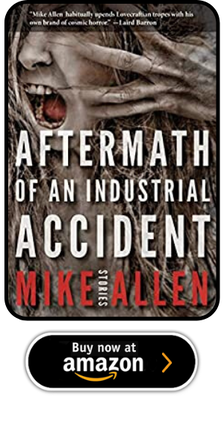
In these twenty-three stories and poems, two-time World Fantasy Award nominee Mike Allen spins twisted narratives, some wound through the fabric of our world, some set in imagined pasts or futures, all plumbing the depths of human darkness. “The consistency, here, is simply excellence,” writes Bram Stoker Award finalist and Punktown creator Jeffrey Thomas in his introduction. “You are holding in your hands an overflowing cornucopia of monstrous goodness.”

"Each tale in Aftermath of an Industrial Accident packs a punch that will keep you willingly pinned to the wall."
—Christina Sng, author of A Collection of Nightmares

"Mike Allen habitually upends Lovecraftian tropes with his own brand of cosmic horror."
—Laird Barron, author of Swift to Chase

the-best-website-for-horror-promotion_orig
book-review-misfits-by-hunter-shea_orig (1)

THE HEART AND SOUL OF HORROR REVIEW WEBSITES ​

Forward
    Picture
    Picture

    RSS Feed

    Archives

    May 2023
    April 2023
    March 2023
    February 2023
    January 2023
    December 2022
    November 2022
    October 2022
    September 2022
    August 2022
    July 2022
    June 2022
    May 2022
    April 2022
    March 2022
    February 2022
    January 2022
    December 2021
    November 2021
    October 2021
    September 2021
    August 2021
    July 2021
    June 2021
    May 2021
    April 2021
    March 2021
    February 2021
    January 2021
    December 2020
    November 2020
    October 2020
    September 2020
    August 2020
    July 2020
    June 2020
    May 2020
    April 2020
    March 2020
    February 2020
    January 2020
    December 2019
    November 2019
    October 2019
    September 2019
    August 2019
    July 2019
    June 2019
    May 2019
    April 2019
    March 2019
    February 2019
    January 2019
    December 2018
    November 2018
    October 2018
    September 2018
    August 2018
    July 2018
    June 2018
    May 2018
    April 2018
    March 2018
    February 2018
    January 2018
    December 2017
    November 2017
    October 2017
    September 2017
    June 2017
    April 2017
    March 2017
    February 2017
    January 2017
    December 2016
    November 2016
    October 2016
    September 2016
    August 2016
    June 2016
    May 2016
    April 2016
    March 2016
    February 2016
    January 2016
    December 2015
    November 2015
    September 2015
    August 2015
    July 2015
    June 2015
    May 2015
    April 2015
    March 2015
    February 2015
    January 2015
    December 2014
    November 2014
    October 2014
    September 2014
    August 2014
    July 2014
    June 2014
    May 2014
    April 2014
    March 2014
    February 2014
    January 2014
    December 2013
    November 2013
    October 2013
    September 2013
    August 2013
    July 2013
    June 2013
    May 2013
    April 2013
    March 2013
    June 2012

https://l.facebook.com/l.php?u=https%3A%2F%2Fmybook.to%2Fdarkandlonelywater%3Ffbclid%3DIwAR1f9y1sr9kcIJyMhYqcFxqB6Cli4rZgfK51zja2Jaj6t62LFlKq-KzWKM8&h=AT0xU_MRoj0eOPAHuX5qasqYqb7vOj4TCfqarfJ7LCaFMS2AhU5E4FVfbtBAIg_dd5L96daFa00eim8KbVHfZe9KXoh-Y7wUeoWNYAEyzzSQ7gY32KxxcOkQdfU2xtPirmNbE33ocPAvPSJJcKcTrQ7j-hg
Picture