

 Sascha Stronach is an author from Wellington, New Zealand. His debut novel, The Dawnhounds, is a genre-bending fantasy-horror-noir that won the 2020 Sir Julius Vogel Award for Best Novel. You can find him in the forest, chanting in a language that seems to leave fish-hooks under your skin, his face wet and red with the blood of ... a deer? It is hard to say, it is not quite right, its limbs are too long, its eyes too dark, its arrangement too spiderlike, but it will have to do. Best leave the way you came, and do not under any circumstances heed the call of the bone pipes. Amazon Goodreads Blog Could you tell the readers a little bit about yourself? I’m Sascha. I’m an author and poet from Wellington, New Zealand. My debut novel, The Dawnhounds, won the SJV Award for best novel just last month, and I won the SJV for Best New Talent. I’m Greek, Māori (Kāi Tahu), and Scottish so I’m a bit of a mutt, and I think that syncretism often influences my writing: I’m a little bit horror, a little bit sci-fi, a little fantasy, a whole big pile of miscellaneous fungi. Which one of your characters would you least like to meet in real life? A woman came up to me at the launch of The Dawnhounds and said “Monkey’s the guy you see when you try to kill yourself, right?” and I’m still not sleeping right after that. I slammed Hastur into a sleep paralysis demon into, well, yeah that woman at the launch wasn’t wrong. It’s probably just a coincidence or a random fact about human neurochemistry or the power of storytelling to bridge two peoples’ traumatic experiences to provide cathartic release-- but also I’m going to live the rest of my life wondering whether I created Monkey or whether he was there already, just waiting for me to call him. Other than the horror genre, what else has been a major influence on your writing? Well, my debut novel was speculative fiction with a nice horror glaze and I feel like that’s often the direction I come from—I write a lot of short horror and it bleeds over into my longform work aesthetically and thematically, but SF/F is really where my heart lives. I love me some dark fantasy or sci-fi horror: I’ve been chasing the rush I got from the first Dead Space for over a decade now. Outside of that, I think it’s important to read broadly: literary fiction, poetry, music criticism, engineering manuals, labels on soup cans etc. There’s a sort of genre tunnel vision that rookie writers can fall into where they only consume the genre they want to produce, and it ends up … too tropey? A reflection of a reflection of a reflection. Read everything. If you had to rank the seasons of Community from best to worst, what would your ranking look like? 3, 2, 1, 6, 5, 4. We all know why the first three seasons are great and why the fourth is awful. Five, despite a few knockout episodes, still hasn’t quite figured out what it wants to be doing post-gas-leak. Six is highly underrated, it rings with real grief and I think that sudden turn to darkness caught a lot of people by surprise. It’s remembered as bad because it didn’t go where people expected it to, but if you take it on its own terms it is genuinely very powerful television. Also spy paintball is best paintball. Fight me. The term horror, especially when applied to fiction always carries such heavy connotations. What’s your feeling on the term “horror” and what do you think we can do to break past these assumptions? There’s often this assumption that horror is cheap, that it’s the exclusive domain of hack authors putting out airport schlock. We often tack it on as an afterthought: “Science Fiction and Fantasy, oh and horror can come too”. I dislike the term ‘elevated horror’ because it comes with this assumption built in: oh well I know you don’t like horror, but The Babadook is different. My personal response has always been that I just don’t care. I feel like the distinction between ‘high’ and ‘low’ art is fundamentally classist; I don’t think a book goes from ‘art’ to ‘not art’ if you put a zombie in it, y’know, it’s what you do with that zombie. It’s a person infected with a disease that forces people around them to make complex moral and ethical decisions—if you can’t see a way to make a statement with that I don’t know what to tell you. Maybe it’s coming from SF/F, which has been dealing with this same shit since forever (see: “Never Let Me Go cannot be science fiction, because the prose is good, that’s what makes it literary fiction”) but I say just write the words and let your audience find you. The baggage of being Low Art is just weighing you down, so why not just throw it out? It never meant much. A lot of good horror movements have arisen as a direct result of the socio/political climate, considering the current state of the world where do you see horror going in the next few years? Obviously we’re going to start seeing a lot of plague books (oh god I locked myself in for a plague trilogy in 2017, I swear I didn’t do it on purpose) but, more than that, I’m really curious about the idea of cop horror, which is starting to be explored a little, which flips a lot of standard cop book genre conventions on their head by making the cops monstrous, which is a lot scarier than a lone slasher to me because it has implicit support from the state. What do you do when fighting back against the monster is a crime? It leads to some fascinating explorations of sociopolitical power that could also be some damn good horror. Given the dark, violent and at times grotesque nature of the horror genre why do you think so many people enjoy reading it? I was fascinated by Cory Doctrow’s horror panel at coNZealand: my friend and colleague Sek Han Foo spoke at length about his time in a Chinese Vernacular School in Kuala Lumpur and how all those schools are haunted (which contained the incredible line “the toilet is very dirty, and by dirty I mean filled with ghosts”, and which he has since turned into a Twitter thread). He talked about being forced to go to the toilet in a room reputedly haunted by a headless Japanese soldier, and how the experience of being able to do that made him feel brave, and he took that courage with him out into the world. Horror can inoculate us against suffering; we take a little in a safe way, and it builds up an immunity. We live in dark, grotesque times, and—quite apart from catharsis, which is also crucial but gets enough attention in these discussions already—and horror can empower us to survive them by granting us resilience and teaching us tools to survive. If you’re not scared of the headless toilet ghost, then pandemic and political corruption and police brutality become things that you can maybe stand up to and defeat. What, if anything, is currently missing from the horror genre? COP HORROR DO IT, YOU BEAUTIFUL NERDS MAKE IT HAPPEN What new and upcoming authors do you think we should take notice off? My wheelhouse here leans much more to sci-fi and fantasy, but I feel like I should shout out the old Seksan Gallery grew from Kuala Lumpur, many of whom are crushing it right now (Zen Cho in particular, and I think Cassandra Khaw used to also hang out there but I admit that might just be something my memory made up to trick me), but I’m also really excited about Eeleen Lee, Zedeck Siew, and Sek Han Foo, who all seem to be having a moment right now. Back home in NZ, I’m enjoying Melanie Harding-Shaw’s Censored City books, a series of dystopian novelettes which are tickling that cop horror itch for the time being. The journey from starting Dawnhounds to finishing came close to ten years to complete, taking in many rewrites to find your own voice. How did you keep your motivation up during this period, and was there anything that stopped you from throwing in the towel? Well, it wasn’t really ten years. I wrote the first draft in 2013–2014, but it sat mouldering in a folder until 2018 when I picked it up again. It’s more like two years, just very spread out. There is also almost nothing of the first draft remaining in the final book, not in the least because my attitude towards the police changed a lot in those four years and I couldn’t write a book about hero cops saving the world by breaking the rules any more. I think if I did try to write something for ten years I might just chuck it in. That sounds torturous. The world changes too fast these days: if you take ten years to finish, you’ll be a relic by the time you debut. The first draft was based on Sanderson's rule system, what was the initial appeal of using his methods as a template for your own? I was a young writer and I wanted rules, you know? I wanted scaffolding to help me build. Eventually the thing grew like the Winchester House, busted out of the scaffolding, became something strange and new that the old shape couldn’t contain. Part of finding your voice is learning to impersonate writers you like, but at some point you can’t keep doing it if you want to be honest with yourself. I have to admit that I don't read a lot of fantasy, but The Dawnhounds for me has one of the most unique settings I have ever come across. How did you create this unique world? After years of trying to write to market, I sorta just jammed all the crap I love into one place. “You can’t have engineered bioweapons in the same book as old-fashioned sailing ships! You can’t just write a revenant warlock noir set in Wellington-Kuala Lumpur, those aren’t European cities at all! You have to draw from the Western canon, what’s this Journey to the West I’m just now hearing about for the first time?! And it worked. It worked significantly better than all my failed attempts at generic Euro fantasy, because it was about things I cared about, things I’d grown up with, things that genuinely inspired and moved me. It was rooted in my real experiences of the world rather than second-hand accounts of a fantastical England. If you want to start building a fantasy world, first you need to go outside. I assure you, there's enough fantasy in the cracks in the sidewalk to power a thousand stories. Historically fantasy fiction is rooted in the European dark ages, but The Dawnhounds doesn't fall into this setting. Was this something that you were keen to avoid throughout its development? We write what’s around us, and I wrote the first draft half while living in rural Indonesia and half while living in Kuala Lumpur. The first seed of the book came while I was in a plane descending over Singapore at dusk, and there were so many ships approaching the port that they formed a single contiguous line over the horizon, all trying to get into the harbour. The first draft had a sort of floating city made of boats welded together, sort of like The Scar, which ultimately complicated things too much and didn’t work with the rest of the book so it got cut, but it was a hard thing to cut. Then I came home and revised and totally rewrote the thing while living in Wellington. The first draft was very Malaysian, and I felt a little bit uncomfortable with that—it was a culture I'd lived in, but only temporarily, only as an outsider. I'd written a world of first impressions, it was all too surface-level. The rewrites dug deeper into my Greek, Māori, and New Zealand European cultures, and I think that synthesis really brought it to life. KL is still very much visible in the mix, but whenever I felt out of my depth, I could lean on something I'd actually grown up with. With that in mind I don’t think it was ever going to be traditional Tolkien-esque fantasy. I particularly loved the magic system in your book, could explain the basic rules of it to the readers? It’s electricity, except instead of circuits it powers life. Organic material is a conductor and nonorganic material is a resistor. Capacitors get blown out, sufficient voltage can arc, two people turn themselves into a lightning rod, at one point I explicitly use the metaphor of a lightbulb blowing when somebody tries to pull too much. My dad’s an electrical engineer and I grew up building circuits and devices with him, and it apparently rubbed off on me more than I thought. I only realised any of this after the book came out. Now that I’ve realised what I was doing, book 2 explores it in ways that are a ton of fun to write. Ladowain is a city that requires some new tricks. My notes referred to Ajat as “cool trans hacker mum” and book 2 is the one where she gets to actually hack things. I had a fun sitdown with some hacker pals and I asked them with a very straight face “so how would you hack a golem?” and it was like throwing steak into a lion enclosure—the minds on these folks, I love them all. People love to pigeonhole books into genres and sub-genres, how would you describe The Dawnhounds? How about MycoPunk? Mycopunk is exactly what we called it! “Biopunk” leaned much more heavily towards sci-fi like The Windup Girl and “Funguspunk” didn’t flow off the tongue as well, and I figured my fellow mushroom nerds would recognise “myco” anyway. Not that the books aren’t sci-fi but uh, leave that for book 2. I think one of the reasons I was fascinated by the book was the inspired way in which mycology is such an integral part of the story, (I'm a microbiologist by training) where did your love of mycology come from? On what was meant to be one of my last nights in Indonesia, Kelud blew. I woke up and looked out the window and the world was black and white, and I thought I was dreaming and went back to sleep. I would later realise the whole town was under an ankle-deep blanket of volcanic ash. If you look up the eruption you’ll see shots of heavy ashfall in Jogja, which is about twice as far away as I was in Kota Sidoarjo. That whole day had a strangely dreamlike quality, and one thing I distinctly remember is that, somehow, a mushroom had come up through the floor and punched its way into my nightstand. I’d never seen that sort of explosive plant growth before. It didn’t feel real. Before that, there was a cordyceps plague because I saw the same BBC documentary as everybody else in 2009, but the fungi weren’t super integrated into the setting otherwise. That bizarre dreamlike day got me reading more about mushrooms and things sort of snowballed from there. They’re not plants! They’re not animals! They have a lot of potency as a metaphor about connectivity and civilization! You can sometimes even eat them! Fungi are the best. Apart from the main themes of the novel, the one thing that grabbed me right from the start was the "worm gun", what in the world inspired the development of that tech? When I was a kid my parents came back from eXistenZ and my mum couldn’t stop talking about the gristle gun. It obviously really freaked her out, and she was bringing it up for weeks. This was in the 90s when it was hard for a kid to watch a restricted movie, so for years and years it occupied this place in my mind as The Scariest Movie Ever, the one with the gun made of meat and teeth. I spent years working it up in my head, and when I eventually saw it at 17 it actually managed to at least partially live up to the hype. It’s that AND one of my big formative experiences with science-fiction being my friend’s 3rd edition Tyranid codex, which had an extensive section on biomorphs; they were my favourite part, and I’m still praying for a ‘nid codex that goes into that level of detail on them again. I took the Cronenberg gristle gun and smashed it into a tyranid devourer and bam, borer rifle. The narrative wears its LGBTQ themes proudly on its sleeves, were you ever concerned that by having these as such an integral part of the story would put off the substantial core of conservative fantasy fans? Not really. Nobody’s forcing them to read it, and I’m more interested in telling good stories than pandering to any particular group of fans. How much of Yat's story is based on your experiences? Parts of it here and there. I’m also a deeply neurotic queer who has spent most of their life sad and broke, and I think naturally I’m overprotective of people and had to teach myself to stop policing their actions. That’s her damage, right? She wants to help everybody but she doesn’t listen to anybody, she sort of just charges in and slams her solution down on top of them regardless of what they want and ends up hurting them. I think that’s definitely something I’ve had to learn in my own life, that it is a fine thing to care and want to keep people safe but there are toxic ways of going about it. The other thing in there is her response to the terrorist attack in the first half of the book. I wrote that scene in 2018, then when I was querying in 2019 the Christchurch Mosque Attacks happened. I hastily went back and rewrote the scene to make it less similar, to pull away from this thing that I couldn't bear to look at, but with hindsight it’s very clear to me that I rewrote it in the white-hot horror of the moment, that I made it something closer to reality than I’d started. That scene is still hard for me to read; I think there’s a real pain coming from real experience, and I still don’t know how to feel about it. Typically until recent times the "gay" character in fantasy fiction served more of a noble sidekick who ends up dying to save the hero role, was this something that you were keen to address in The Dawnhounds? The sidekick thing was less of an issue to me than the Burying Your Gays. I made a decision that I was going to write about gays who refused to stay buried, who woke up in darkness, punched their way through coffin lids and clawed back up into the light. They’ve got that regenerative healing factor that makes them hard to kill in the first place, and if you successfully take them down they just pop straight back up angrier. Which leads to some tension problems: how do you keep the stakes engaging if the characters can’t die? Well, you get creative. And talking of characters in the novel, none of them are your clear cut stereotypes, was this something you were keen to avoid? One thing I find really interesting is that LGBT+ characters are often expected to be perfect. I don’t like that, I think it’s putting us on a pedestal that we can’t hope to achieve. It’s dehumanising, just from the other direction. We’re not angels, we’re just folks like everybody else. I wasn’t out to write queer-coded villains either, but I wanted everybody to be messy, you know? I wanted them to have neuroses and unresolved trauma and I wanted them to make bad calls sometimes. I got very nervous when I saw the venom in criticism around Gideon the Ninth calling Harrow an abuser because like … yeah Harrow’s a mess, Harrow’s this knot of scar tissue, Harrow is spiky and difficult. Why can’t she be? Why are queer characters expected to be paragons of virtue? Harrow’s thorniness and refusal to communicate with Gideon is a big part of the mystery that pulls the book through its first half, and the crumbling of her walls is a cathartic—and often deeply painful—emotional arc. Harrow is awful, and watching her realise that is sort of the point. My protagonist is gay so I started there, with this idea of taking us off the shiny pedestal and depicting us as vulnerable, flawed and human, and the rest of the world developed around that. If Yat was a bit messy, then her straight colleague Sen was going to be messy too, and the world sorta blew outwards from those two. Everybody was a lot more straightforwardly heroic in the first draft, but I started playing with Yat’s characterisation during the big rewrite and the boulder rolled downhill. That first draft is a much less interesting book than what I ended with, which is about a world of fucked up people doing their honest best. Were there any compromises that you had to make in terms of how you approached the themes of the book to make it more commercial? Thanks to the Little Hook team consisting entirely of me and my mate Dave, I managed to retain a shocking amount of editorial control. I suspect if this gets picked up by a US publisher (hi! Please contact littlehookpress [at] gmail [dot] com!) I’m going to be asked to make Sen less incomprehensibly Australian. Yeah nah yeah mate, not keen on all these bloody bin chickens, just gonna punch the fuckin bundy aye. So long as I get the final say, he is gonna be a big soft bogan and there’s nothing anybody can do about it. For those looking for more examples of good "gay fantasy" who would you recommend we check out? If you’re in the mood for more New Zealand dark science-fantasy with mushrooms and gay people, might I suggest Into the Mire? It was a finalist at the SJVs and while it didn’t win, Casey won Best Short Story for a separate piece called A Shriek Across the Sky. I’m glad Casey is finally getting the attention she deserves, partly because she’s a great writer and a dear friend, and on a more mercenary level because Mire is a great comp title for me and suddenly a bunch of agents recognise it. I know it’s bending a little to call it fantasy, but I absolutely loved The Amberlough Dossier. It’s a trilogy about a gay spy who falls for a cabaret MC in Weimar Berlin and they get caught up in the rise of the Nazi Party, except they’re about none of those things because they happen in a fantastical secondary world. I’m finally getting around to AJ Lancaster’s Lords of Stariel as well, and if gay regency fae is your vibe then I’d highly recommend them. On the more horror-adjacent side of things, I really dug The Monster of Elendhaven, a wicked little book about a warlock who summons a demon to help him get revenge on the men who wronged his family, and who falls in love with the demon. It ends … well, uh, let’s just say it ends and leave it at that. Are there any reviews of your work, positive or negative that have stayed with you? Octavia Cade described The Dawnhounds as ‘a cross between Ankh-Morpork and Ambergris’ and that really made me smile: both Pterry and Jeff VanderMeer have been massive influences on my writing. Tamsyn Muir saying nice things about it was also a massive boost—I’d sold about 30 copies at that point, mostly to friends and family, and I was starting to think I’d made a huge mistake by publishing, and then the woman who wrote Gideon the Fucking Ninth told me she loved it and I went “well she’s got better instincts than me, so I guess she’s right? Better keep on grinding” and that grinding paid off. I don’t think we’d be having this interview without Tazza. What aspects of writing to do you find the most difficult? Getting the ball rolling. I find once you hit the 50–65% mark, it’s all just flying downhill; I wrote the first 40,000 words of The Dawnhounds in eight months and the last 40,000 words in three weeks, because I hit a point of critical mass where the thing basically just piloted itself. Getting there is agony, though. It’s a truly bizarre process, it’s like … you just keep lying at your keyboard until the lies unionize and you let them have whatever they want. Is there one subject you would never write about as an author? People being sad for a long time and then drowning. That was the default mode of New Zealand literary fiction for a long time and it drives me up the wall.Not that sadness and drowning are off limits (I am a New Zealand author, and my influences are gonna make themselves known) I just don’t think they’re inherently deep or interesting on their own. I won my first major award for a short story that I wrote by pinning a bunch of NZ fiction cliches to a dartboard--sad child wise beyond years, the nice people aren’t helping, death in/near water, drinking tea miserably—and twisting them into something that didn’t make me hate myself. It’s not a bad story, but that’s not who I want to be as a writer. Or at least, I’m fine with being that author but only if I can throw in a bunch of gay warlocks on a teleporting fungal pirate ship and maybe a Cronenberg plague or two. Writing, is not a static process, how have you developed as a writer over the years? God, I used to be pretentious. I wrote poems with names like Fall Out Boy songs. Baby What You’re Gonna Learn Is That I Make My Friends By The Milligram, that’s an actual title I wrote, which made SSRIs sound like heroin because it was so vague. Don’t get me wrong I’m still pretentious, but it’s more manageable now. At some point I transitioned from “you just don’t get my art” to appreciating that writing is an act of communication and if you’re failing to communicate then you’re not doing your one job. I’ve written about this at length, but learning to embrace the things I actually like was also huge. I spent a solid four years trying to basically rewrite Mistborn with the serial numbers filed off before realising that I wasn’t Brandon Sanderson and trying to write like him wasn’t working for me. It works for him (I’m not here to start a fight with BS: I loved Write About Dragons my dude), but trying to emulate that rather than explore all the weird little things I’m passionate about—mycology, old sailing ships, cosmic horrors as metaphor for personal trauma—was holding me back. What is the best piece of advice you ever received with regards to your writing? I ended up having a chat with Neil Clarke at WorldCon and I told him I’d been working on a piece for Clarkesworld for five years and he was shocked and he told me to just, y’know, submit something. I’ve come to realise that ‘perfectionism’ is a way to cover up anxiety—you never have to risk rejection if you just tinker forever. You never have to have a bad date if you just never go on dates, but I’m not sure it’s any way to live. Which of your characters is your favourite? One of my beta-readers started referring to Wajet as DADDY in all caps and it was then that I realised I was in big gay trouble: “What if I made this strongfat gay man with lots of facial hair who is extremely chaotic and definitely fucks? This is a fun background character who isn’t going to steal every scene he’s in and eventually derail the entire plot. I am smart and know how writing works.” I spent a solid hour just crafting the insult he hurls at the Cronenberg Dog Monster, and it’s still my favourite line in the whole book. Wajet is a force of nature, destined to take over any text he appears in. He is my Jack Sparrow, which is why I am going to use him extremely sparingly in future books; we all know what happened with Jack Sparrow. It’s worth noting that in the first draft, way back in 2013, Wajet is the protagonist. I cut his role down a lot in rewrites but I think that’s why he has so much life: he has his own whole novel the reader never sees, and every time he’s offscreen I know exactly where he is. I honestly don’t know why I ever thought I could control him: I just sort of grab a hold and try not to get bucked off. Which of your books best represents you? Well I’ve only got the one right now: everything else I’ve put out is short stories, and I feel like The Dawnhounds represents my whole vibe pretty well: it’s gross and weird and hopeful and extremely gay. There was also that time I got home drunk at 3am and found an email from my editor at Esquire Malaysia asking for a short story for ROCKTOBER and I immediately sat down and smashed out 2000 words about a band of Heavy Metal Wizards who use the power of sick guitar solos to literally melt demon faces. It’s called And All Hell Rode With Them, it’s in the October 2015 issue of Esquire Malaysia and it is basically impossible to get your hands on these days, but people still ask if I’m “the heavy metal demon slayer guy” occasionally so apparently it made an impression. I think on some level, The Dawnhounds is my ego but And All Hell Wrote With Them is pure id. Do you have a favorite line or passage from your work, and would you like to share it with us? The part of my shouting about THE BRAND wants to do something deep and powerful and strange but … No, it’s totally the Wajet going off at a horrifying flesh-melted dog monster. [quote] A few officers with rifles pushed past them, and threw open the windows. Their borers opened up with a series of wet thumps, and she heard a ghastly, inhuman shriek from the street below, followed by a familiar voice. “GODS-DAMNED JELLY-ARSED MISMATCHED GALLOWS-BIRD,” boomed Wajet. “COWARD! WEAKLING! ARISTOCRAT! I’M NOT DONE WITH YOU, SIR.”[/quote] Can you tell us about your last book, and can you tell us about what you are working on next? The Dawnhounds is a book about a gay cop who gets murdered by her fellow officers, and comes back as a revenant to solve her own murder while on the run for a crime she barely understands. It’s a fantasy-horror noir about plague, about police brutality, about the slim possibility of light piercing the darkness. I inexplicably wrote it in 2017 so I guess I’m a precog. It’s got queer found family, the gradual-but-unstoppable revelation that all cops are bastards, a pirate ship made out of mushrooms, two (count ‘em, two!) horrifying flesh-melting Cronenberg dog monsters. Y’know, normal stuff. I’m currently working on the followup, which has the tentative working title Lions & Ghosts. It is … spectacularly ambitious on a level that is worrying me, but dammit Harrow the Ninth pulled off something similar, and Tazza believes in me so I guess I’ve gotta believe in myself too. There was a blink-and-you’ll-miss-it line in The Dawnhounds about lights in the sky over Ladowain, which is what the crew of The Kopek are drawn in to investigate. Why did the villain-apparent never show up in book 1? You’re about to find out, and I warn you: it’s about to get weird. If you could erase one horror cliché what would be your choice? Clichés are patterns, right? They’re the best-loved-bear, they’re this idea that resonates so deeply with readers that they use it and use it until they break its spine and it becomes meaningless. You don’t slow down for the phrase falling in love, it’s pedestrian, but the instant somebody asks why do we talk about love as though we were falling? it hits you like a truck. I don’t want to erase any clichés, I want to breathe new life into them. Now tropes are a different matter: I’m sick of queer-coded villains and I’m sick of how much we rely on sexual assault and I wish our depictions of trauma were more willing to actually explore trauma rather than exploiting it, but I do think we’re seeing positive change on that front and I’m happy to be part of the cohort making that change. What was the last great book you read, and what was the last book that disappointed you? God, Harrow the Ninth is such a thing. It’s a Swiss watch, it’s a minefield, it’s spinning a hundred plates at once. It may test your tolerance for memes and/or dad jokes (the line is becoming increasingly blurry as my generation ages), but it’s this absolutely superb piece of craft, this masterwork of tension, this strange delicate puzzle box. I liked Gideon a lot, but I understand why Taz lost to Arkady Martine (A Memory Called Empire is simply incomparable, I’m a Greek-But-Not-Classical-Greek history nerd and the instant you say ‘Space Byzantines’ I get shot into goddam orbit) but if Harrow doesn’t win next year I’m starting a riot. For whatever reason I really didn’t click with Nevernight. People have been telling me for ages it’s a great comp title, it’s exactly the sort of thing I like, and somehow I just had a difficult time engaging with it. I’m not so arrogant to say I’m an objective barometer of taste and I don’t have anything negative to say about Jay’s craft, but it just wasn’t working for me somehow. I think maybe it hit the gas too hard, too early, and I found myself getting run down? It was just sort of relentlessly brutal and I was in a very dark place when I was reading it, and it was too much. Which is a selling point for a lot of people (and maybe me on a good day: I intend to circle back to it), so you get a 2-for-1 on recommendations in this section. Go nuts, throw Jay a few bucks. What's the one question you wish you would get asked but never do? And what would be the answer? Right now, as New Zealand goes back into lockdown and I wasted all this beautiful freedom I was granted, I wish a stranger would come up and ask “would you like to pat my dog?” to which I would respond “fuck yes I have not patted a dog for the entire year of 2020, thank you stranger, I will pat your dog.” Cats are good too, but they know too much; cats have secrets. I love cats, but I do not trust them and I think they prefer it that way. Winner of the Sir Julius Vogel Award for Best Novel 2020. "...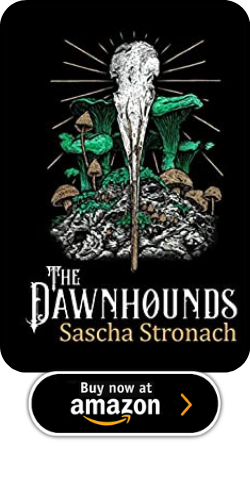 a wonderful queer noir fever dream"–Tamsyn Muir, author Gideon the Ninth. A ship rolls through the fog, its doomed crew fallen victim to a fungal plague that melts and repurposes flesh. Yat Jyn-Hok—disgraced cop and former thief—stumbles across its deadly trail. As the spores spread through the city, she pulls at the threads of conspiracy, and the threads pull back; powerful men will do anything to keep their secret. They kill her. It doesn’t stick. An ancient intelligence reanimates her, and sends her back into the city to enact its mysterious designs. She has her own plans: she’s going to find the source of the plague before it turns her home into a charnel house. On the run from her own colleagues, she follows the thread down into the ruins of her old life, where she finds unexpected allies, ancient magic, and a secret that could leave the world in ruins. Set in Hainak Kuay Vitraj, where the miracle of alchemical botany makes flesh as malleable as clay, The Dawnhounds is a story of rebirth, redemption, and the long road home.“The Dawnhounds packs hard-hitting, mind-bending weirdness into a story that’s still touching and human. If you’re looking for gritty queer spec fic that isn’t unrelentingly grim, you’ve found it.” –Casey Lucas, author of Into the Mire   the heart and soul of horror review websitesComments are closed.
|


Archives
May 2023
|
 RSS Feed

|

|