


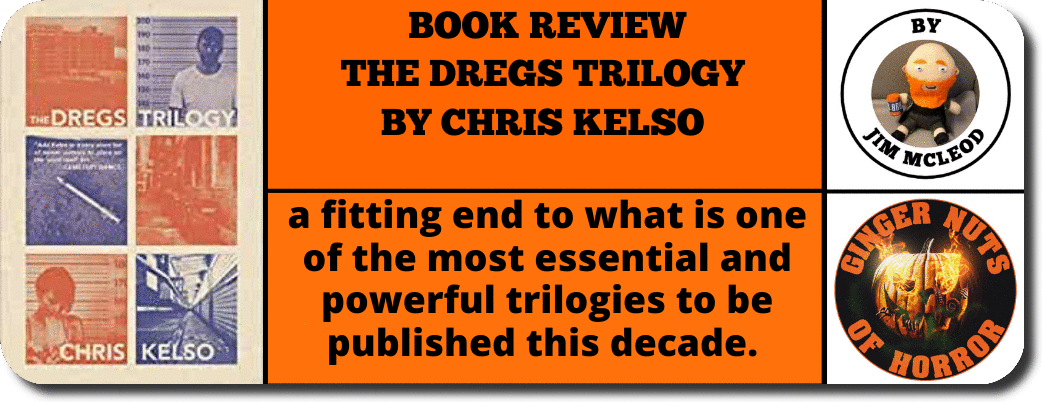
 The Dregs Trilogy by Chris Kelso has sadly had a slightly bumpy ride over the years, the first two parts of this stunning trilogy were published by a company who took the money and ran and never gave the two books a chance to get noticed by reading community at large. Which is a colossal crime, as both Unger House Radicals and Sharpnel Apartments became my reads of the year for two years in a row, by a clear country mile. Kelso pushed the boundaries of both storytelling and narrative structure with these two novels, to the point where he broke almost every writing convention going. Mindbending and mindblowing, they were a pair of difficult reads, that demanded your complete attention to comprehend why and how they were written. I'll admit when I first started reading Unger House Radicals I almost threw the book away in anger, but then something clicked, and the sheer brilliant bravado of Kelso's literary prowess was plain to see. So when the first two books in this trilogy sank without a trace, I was heartbroken, these are books that deserve to be read far and wide, as they smash through the confines of genre, elevating themselves onto a shelf all of their own. Thankfully Chris found a new publisher with Black Shuck Books, owned by Steve Shaw, and if there is one thing I can say about Steve, he sure as hell knows how to run a publishing company that treats its authors and readers with the respect that they due. I'm going to cheat a little bit here, and recycle my reviews for both Unger House Radicals and Shrapnel Apartments, (hey recycling is the new in thing isn't it?), before talking about the final part of the trilogy. Unger House Radicals Writing reviews should be natural, especially after almost seven years of doing it. A varied and widespread reading within the gene should prepare a reviewer for nearly anything the genre throws at them, or so I thought. Yes, there has been the odd struggle with a bothersome sentence or a poorly worded paragraph, but in the main, the reviews have come relatively quickly. That was until I came upon Unger House Radicals by Chris Kelso, it is a book that made me question my abilities both as a reader and as a reviewer. It pushed me to the limit, knocked my confidence for six and cost me close to 12 hours of deep thought just to get the opening paragraph of the review down on paper. It's a book that will prey on my mind for a long time, but is this for good or bad reasons? Did I find the book challenging, or was the book just a challenge?..... Unger House Radicals is, in essence, a simple tale; When aspiring and nihilistic filmmaker Vincent Bittacker falls in love with mercurial serial-killer Brandon Swarthy they decide to embark upon a bloody journey to re-define cinema and create their own sub-culture - Ultra-Realism. However, if you have read any of Chris Kelso's previous works, you will know that Chris doesn't like to take the simple approach. He prefers to take the reader on a journey that while never overly pleasant; it will be a journey that the reader will never forget, thanks to a powerful and unique narrative voice. Make no mistakes this is not an easy read, in part due to the in your face descriptions of the atrocities that Bittacker and Swarthy commit. Kelso doesn't mince words here; these sections of the story are grimy, gruesome and upsetting. They are designed to shock without any sense of titillation, unlike similar scenes in horror movies where you can get a rush of excitement, Unger House beguiles you into feeling dirty and shocked for having read such a thing. Nevertheless, these scenes are vital to the narrative and its constant pushing of your boundaries as a reader. Bittacker, and Swarthy are two of the vilest characters ever committed to a page; I'll leave it you to decide who is the worst, Bittaccker the semi-privileged filmmaker, who despite his belief that he was born evil, is more of a spoiled brat. Or Swarthy, an avatar of depravity and corruption, born in the gutter, yet alluring and bewitching to all who meet him. Their story and deeds will become so intertwined that you will have trouble deciding who is the real evil. The narrative itself is a thing of beauty shining out against the grime that is attached to it. A fractured story that shifts from person to person, time and space, and narrative perspective, this mix of such things as the first person, found letters and police reports could so easily have been a mess, and yet it just works. Kelso has taken the theories of "ultra-realism" and applied it to the way he has written this novel. This is a dangerous and ambitious move on the part of the author, and one that works perfectly. There will be times where you are confused as to what exactly is going on. You may even get frustrated with the book at times with its ethereal way in which it is structured, but when you get it when the penny drops, then you will applaud the author for his audacity. This is without a doubt, the work of a genius, everything thing about this book should have had me screaming at the page in anger. There are some big concepts on display here from the sense of identity, the role of a documentary maker and their detachment from what they are documenting, religion, psychology, the nature of evil, the nature of humanity, I won't be so bold as to say I understood everything that the author was saying. Unger House Radicals is a challenging book, and like all great things, the reward is more than worth the challenge of the reading experience. This is an outstanding book, brutal, unrelenting and mind-bending in its scope. Shrapnel Apartments Marillion once asked "WHERE ARE THE PROPHETS, WHERE ARE THE VISIONARIES, WHERE ARE THE POETS TO BREACH THE DAWN OF THE SENTIMENTAL MERCENARY." We live in a world where, as the song title suggests, has gone totally FUGAZI. As consumers of art, we have fallen into the trap of settling for the safe and secure, a world where vanilla and magnolia artists are hailed as geniuses. It is also a world where some of us strive instant fame no matter what the cost is. Where are the successors to Brett Easton Ellis, Irvine Welsh, Chuck Palahniuk, and Hunter S Thompson? Where are the writers who make us, as readers, challenge ourselves while they dissect the human condition, and the failings of modern throwaway pop culture, and instant fame-obsessed mentality? In a world where extreme ideologies sit side by side on the news with the vacuous modern celebrity culture, we need our prophets, poets and visionaries more than ever, and luckily for us, we have writers like Chris Kelso ready to take up the mantle. Shrapnel Apartments is the follow up to Kelso's excellent Unger House Radicals, which ended up being my top read off 2016. Where Unger House Radicals challenged us to examine what we considered art with the use of his Ultra-Realism art movement of the two central protagonists, Shrapnel Apartments takes this one stage further and forces us to examine the almost animalistic urge for some of us to seek fame no matter what the cost to our souls will be. Are we evil for desiring it, are we evil for watching others in their quest for it, or is the media who enable it evil? As with Unger House Radicals, Shrapnel Apartments has a complex and at times challenging narrative style. This isn't a novel that you can read while something else is going on in the background. And this is in no way meant as a criticism, as this is a book that rewards the reader who pays it full attention. Narratively speaking it is as though Kelso has let off a literary grenade and allowed some of the shrapnel to embed itself onto the pages of this novel. The fractured nature of the story unfolds from multiple personal accounts, and while at first, they may seem unconnected and somewhat disorientating, they entwine around each other with a brutal and majestic beauty to reveal a twisted tapestry of human nature. There are three main narrative threads in Shrapnel Apartments Bobby Reilly, a corrupt cop who is even viler than the child-killer Beau Carson that he is relentlessly chasing. Rielly is the pure distillation of every corrupt cop from Joe Cooper to the Bad Lieutenant himself, Rielly actions and appetites are so repugnant that you almost end up rooting for Carson. Then there is the neverending struggle of Florence Coffey, an eternal victim, destined to be used abused and tossed aside for all eternity. It is here that Kelso's used of the shrapnel narrative shines the brightest, told from various first-person viewpoints while also throwing in such things as coroner reports, police statements and various other intelligent techniques. It is as bold as it is brash, and it could so easily have come across as more style over substance. However in Kelso's more than capable hands this narrative thread becomes the main thrust of the stories look at the disposable nature of fame and lengths at which those who seek it will go to grab it is heartbreaking in its intensity. Finally, we have an almost humorous account of the fight between a pair of critics/ writers Gottlieb and Mancuso. This section of the story is a darkly humorous look at the pointlessness of feuds, vendettas, and how media and those who we think of as friends can so easily manipulate the course of events. In a genre that doesn't seem capable of going one day without some feud breaking out, Kelso looks at the futility of this will raise a sly chuckle on may a reader. Tying all of these shrapnel threads together is Black Cap and his apprentice King Misery, two possible supernatural or cosmic entities whose surreptitious machinations are behind everything that goes on in the book. You can see Black Cap's fingerprints all over the individual pieces of shrapnel, manipulating the lives of everyone for his own sneering entertainment. Blackcaps disdain for humanity and his view that we are entirely insignificant is a perfect metaphor for the uncaring world around us. As we strive to be noticed, endeavour to find fame and adulation, Black Cap and the world at extensive just views us like ants, completely insignificant, and worthless to those in charge. Shrapnel Apartments is a triumphant return to the world of Unger House Radicals, Kelso as carried over many of the themes and narrative styles that made the first book such a success and turned then up to eleven. Kelso dares to make us step out of our comfort zone, confronts us to pay attention for fear of missing a vital tidbit, and dares us to be repulsed at the dark nature that resides in all of us. Kelso forces us to lift our heads and take a look at "the Time-Life-Guardians in their conscience bubbles, Cast adrift as their side-show, peepshow, we are drowning in the reel. He is a prophet and a visionary for our times. Ritual America Out of the three stories presented here, this final novella is the most straightforward in terms of storytelling technique, with a mounting sense of dread, dread doom and fast approaching devastation, Kelso may have pulled the stylistic punches somewhat, but he doesn't waiver from presenting a story that is deeply uncomfortable to read. Does it answer any of the questions brought up in the previous two stories, well that would be telling, but remember, great stories don't always have a fully resolved conclusion? What it will do is make you think, ponder and ruminate on what you have just read. It's best to look upon this trilogy as three stories from the same universe, loosely connected by but reliant on each other for full effect. Ritual America is a fitting end to what is one of the most essential and powerful trilogies to be published this decade. THE DREGS TILOGY BY CHRIS KELSO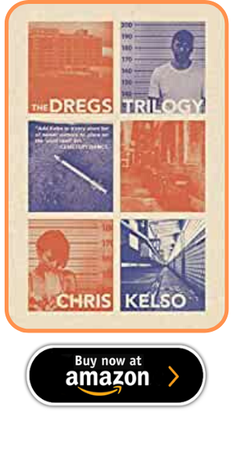 From British Fantasy Award-nominated author Chris Kelso comes the DREGS trilogy, comprising three instalments: Shrapnel Apartments Unger House Radicals and Ritual America in a transgressive odyssey that will leave you dazzled, fascinated and shocked in equal measure.   Comments are closed.
|


Archives
May 2023
|

|

|
 RSS Feed