

 Another moment that you all most likely know, one that recurs again and again on “scary moments” lists, and with good reason: Amnesia: The Dark Descent was, in its day, part of a new wave of video game horror occurring in independent markets, largely as a response to the saturation (and fomentation) of Survival Horror, that had started to become extremely weary in its familiarity. Rather than placing the player in the position of an ex soldier or police-trained bad-ass, Amnesia takes an approach more redolent of Silent Hill, in that the player character, Daniel, is a lurching, schizophrenic mess of a man, insanely vulnerable to any danger he encounters, to the point whereby attempting to fight in this game is a fast-track to suicide. The game is one of escalating paranoia and psychological disturbance: when creatures and distressing phenomena are encountered, the best course of action is to run, find some shuttered room or sealable hiding place and wait for them to pass. Even the dark is enough to set Daniel wibbling, with escalating visual effects and slurred controls emulating his descent into insanity. This is a far cry from Survival Horror titles, in which, generally, player characters don't react outside of cut scenes to the horrific situations and phenomena they encounter. Here, even looking at something distressing is enough to affect Daniel's state of mind, and thereby make the game that much more difficult (if Daniel descends all the way into insanity, it is effectively a game over). The game also does what all good horror-on-a-budget does when it comes up against technical constraints and limitations: it errs on the side of subtlety. 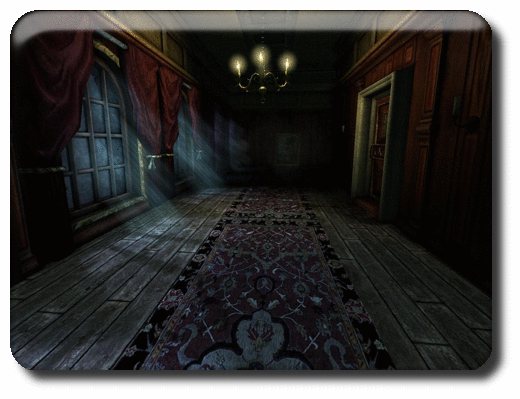 What few actual creatures and entities actually exist in the game are rare and sporadic, making encounters with them all the more fraught. Furthermore, they tend to occur randomly, and can seek Daniel out by sound, by scent, obliging the player to locate hiding places to which they can flee should they be spotted. Even then, if the creatures spy them slipping into a particular room, they can still wrench the door from its hinges and discover the cowering player, leaving the entire game an exercise in escalating paranoia. This is before we even consider Daniel's relative state of mind, which can produce visual and auditory hallucinations, conjure phantoms of smoke and shadow that linger at the edges of sight before dispersing, even cause cockroaches and beetles to swarm across the screen, as though Daniel is in the midst of a schizophrenic episode. It's therefore problematic for the player discerning what's real and what isn't; what constitutes an actual threat and what is symptomatic of Daniel mentally dissolving. It is a brilliant and beautiful example of how subtle horror can be in video games, and one of its most infamous moments is also one of its most conservative: There's an old cliché in independent horror films that: if you lack the budget or means to make the monster, just make it invisible. More often than not, this is a cheap and ineffective device, that comes off as wearisome and absurd rather than distressing. However, Amnesia utilises it to brilliant effect during one of its early stages: Deposited into a series of flooded hallways, Daniel is forced to traverse the stinking, debris-littered water in search of an escape. At first, the corridors seem ominous but empty, nothing but the flooding itself to cause the player concern. However, progressing deeper into the dark, we start to hear strange splashes, as of something lurching through the water. Daniel reacts with rapid breathing and panicked whimpers. Peering into the shadows, we see nothing; no sign of an approaching monstrosity, nothing to indicate what it might be. 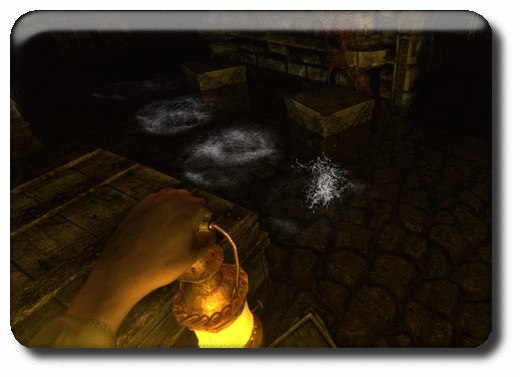 Then, the first splash. Seemingly nothing, just a disturbance in the water, as though some chunk of debris has fallen from the ceiling. Then another. And another. Like footsteps approaching. If the player has anything about them at this point, they might take the oportunity to leap out of the water onto a piece of floating debris. If they do so, the splashes (or “footsteps”) stop nearby, as though whatever unseen entity is responsible waits just beyond reach. Isolated on an island of rubble in an expanse of water that is now profoundly threatening, the player must guide Daniel in a manner redolent of children's games (“The floor is lava!”) from island to island, all the while avoiding the entity that follows wherever he goes. Should the entity catch up with him whilst he's in the water, the player doesn't see precisely what happens: all we hear is a tormented, inhuman growl as the creature starts ripping into us, though via what means we can't precisely say. The sophistication of the encounter in terms of its horror is manifold: first of all, the moment takes full advantage of the aforementioned independent, budgetary trope of the “invisible monster,” not only making it legitimate but insanely terrifying. Second, it has the effect of making a fairly innocuous environmental factor extremely threatening. Thirdly, like many of the creatures in this and other horror titles, it is designed to evoke raw panic, to make the player flail around in terrified confusion rather than acting rationally. The situation itself is not terribly difficult or dangerous, so long as the player keeps to the pathway of debris set out through the water, so long as they do not allow the darkness, the splashes and Daniel's hallucinations get the better of them. But this is incidental: the moment is obscenely powerful and uniquely threatening, especially since, up to this point, Daniel has encountered very little in the way of direct threats to his person. The unseen entity in the water relies upon the player's imagination, allowing them to conjure all manner of Lovecraftian obscenities from the pits of their own subconscious. Nor does the game make the mistake of allowing them to eventually see the entity: the invisible stalker remains so throughout the game, though it recurs again and again, in various different situations. Not only is this one of the most immediately terrifying moments in a profoundly terrifying game, but it also marks a significant departure from the tropes and mechanics familiar to Survival Horror. Were similar to occur in a Resident Evil title or maybe even the infinitely more sophisticated Silent Hill series, it's likely that the unseen stalker would become a combat encounter of sorts, perhaps some form of “boss fight” in which the player is obliged to find a means of combatting and slaying the creature before they are allowed to progress. Here, Daniel is utterly defenceless before the beast, which makes its refusal to touch him when he is not in the water confusing and terrifying: it's as though the entity is playing a game, like a cat with its prey or a psychotic child with an insect. Though it could easily, easily clamber up and dismember him at its leisure, when he is not in the water, the entity simply waits in absolute stillness and silence. Yet, as becomes evident if he tries to venture away from his sanctuary, the creature is still very much present, and will resume its pursuit the instant he steps back into the water. This “cat and mouse” quality renders the entity capricious and cruel, as well as mysterious: it isn't some mindless monster hungry for human flesh, but a conscious, considering and patient entity, that seems to thrive on the fear it causes and revel in the game it plays. One of the most terrifying entities in this entire series, all the more so because we are given no explanation by which it can be defined, and thereby known. (By the by, if you'd like to see firsthand just how terrifying this game is, come and check out my let's play of it at: https://www.youtube.com/watch?v=ayhtpoKbDgw, especially if you'd like to hear me scream like a little girl). 
BOOK EXCERPT: LITERARY STALKER BY ROGER KEEN
13/11/2018
 This week are highlighting the work of the author Roger Keen, starting with an excerpt from his novel Literary Stalker , followed buy and interview with Roger tomorrow and culminating with my review of his book on Thursday. Intro: Lesser horror writer Nick Chatterton is obsessed with superstar horror writer Hugh Canford-Eversleigh and has been stalking him for over a year. The big horror get-together Medusacon is Nick’s opportunity to take things further…so he hopes. Excerpt: Medusacon 2006 was held at a big swish hotel in London’s Docklands, with commanding views of the Thames, Canary Wharf and the pristine Docklands Light Railway providing a cool backdrop to the proceedings. All the ‘usual suspect’ horror, fantasy and sci-fi writers were present, including Stan, Darren, Crimpy, Otto and Darius, together with more illustrious scribes and the Guests of Honour. Film critic and writer Kim Newman attended, in Victorian Gothic mode as usual, with his long flowing hair and full moustache, silk waistcoat and cravat. Horror veteran Brian Lumley enlivened the atmosphere, looking awesome in a white suit and shirt with silver collar tips, and a leather bolo tie and ornate aiguillette around his neck. And horror newcomer Joe Hill floated around enigmatically, with his jet black hair and equally jet black full beard, having recently come out as the son of Stephen King. I liked the look of him, but of course he was married and straight. And besides I was after bigger fish, as the Guests of Honour were Neil Gaiman and the man himself: Hugh Canford-Eversleigh. At the Friday night initial gathering I watched Hugh circulating and pumping hands in the red-carpeted main bar space. His chestnut hair had grown out and was a little curly at the edges, in need of a cut, which made him appear more boyish. He wore an open waistcoat over a loose shirt and close-fitting jeans, showing off his ass and legs majestically and giving him the air of a tights-clad duellist. If only I could have injected him with some memory-wiping drug and then re-programmed him to be as I wished – but that was impossible. Instead I could just ogle and savour, which contented me for the while, and when he happened to pass my way and we made eye contact, I said ‘Hi Hugh’ in the most natural casual non-invasive way ever. ‘Hello…’ he replied under his breath, moving on without a break of stride, his face falling like a building under the wrecking ball. I was expecting this and I didn’t let it faze me, quite the opposite in fact. The rules here were different to those of the general outside world, where Hugh could walk away and keep walking, jump in a cab or shut the door on me in some other way. We were within the bubble of the convention, circumscribed by the walls of the hotel and the commitments that bound Hugh to the event, and to his larger career. He was limited in the distance he could put between himself and me, and he would have to manage the situation accordingly. Because I knew this, and knew he knew I knew it, I was prepared to cut him a bit of slack and go easy and not be an annoying stalker. In a sense I had ‘collected’ him temporarily, and I wanted to rub along well in these circumstances – and perhaps even overcome earlier bad impressions I might have created. That was the theory at any rate, but of course in practice it always works out differently. Like a bad gambler I had to keep doubling up the stake in an attempt to cover earlier losses, and after Hugh kept cutting me dead when I tried to contribute towards shared chats, I got that old urge to ‘have it out’ and put everything to rights. Fuelled by alcohol late on the Friday, I circled and waited to pounce. When I spied Hugh walking on his own, I sprang out from behind a pillar and blocked his path in a no-nonsense manner. ‘Hugh…why are you avoiding talking to me? Lets just be normal – two writers at a convention.’ He gave me a deadpan stare, like a gunslinger in a western. ‘Normal? That is a word you know the meaning of, is it?’ ‘Ha, ha. Very funny! Is that one of Wilde’s or one of Shaw’s? How about you let me get you a drink and we’ll sit down and have a proper chat?’ ‘How about a solution of cyanide – and have one for yourself?’ ‘Oh very good! I like it!’ At that moment Neil Gaiman strode past and Hugh quickly latched on to him, turning his back on me, putting an arm around Neil’s shoulder and walking away. Nonetheless I felt pleased that I’d got a reaction out of Hugh. I’d burrowed my way under his skin sufficiently for him to be critically aware of me, no doubt thinking about me a lot of the time. I was a feature in his life and he couldn’t easily make me go away. In several letters and greetings cards I’d made my amorous position clear, and I’d tried to engage on a literary level with the ongoing stalker story – which was at this moment having its next chapter written. I knew he’d continue fighting our love, and I knew his denial was very strong, but I remained undaunted. He must be feeling the love too on some level, I reasoned, it seemed a logical impossibility that he wasn’t. Every rebuff registered as a disguised expression of desire – he was doing the opposite of what he actually wanted. In fact it didn’t really matter what Hugh did or didn’t do, I applied a heads-I-win-tails-you-lose rationale to it all. The fortress of my obsession was impregnable…or so I thought. One particular element that had buttressed it up to this moment was the idea that Hugh couldn’t countenance being unfaithful to Melody or facing up to his bisexual side, which together constituted an enormous barrier to be overcome. But as Medusacon wore on into the Saturday, I discovered I was being naïve – certainly in regard to the former aspect of this trait. * * * * * There are certain people, often beautiful people, who naturally stand out in a crowd, making you register their presence, sometimes peripherally or subliminally when you are occupied with other things. Hugh was such a person, naturally, and another who caught my attention for the first time at Medusacon was Gretchen Mulhoney – who would become a watershed figure in the trajectory of my obsession. Tall, gauntly thin, with heavy make-up on her angular features and big curly copper hair, she was given to extravagant gesticulations and made for a kinetic focus of hand-waving and elbow-pointing, accompanied by animated facial expressiveness. I found myself studying her frequently, and I asked who she was, finding out about the tetralogy of fantasy novels she’d then published. I must have been slow on the uptake because it took me until the Saturday to deduce that the reason I was often in Gretchen’s vicinity was because I was shadowing Hugh and she was working the same circles – more regularly than by pure chance. By Saturday, when Hugh was mercilessly cutting me dead, he and Gretchen were talking more effusively and at greater length, sometimes in one-to-one situations. At a mid-morning panel on the future of the horror novel, I saw them sitting side by side in the audience. And later in the afternoon when Hugh was interviewed on stage in his main appearance as a Guest of Honour, I couldn’t help but notice the eye contact and smiles he exchanged with Gretchen, sitting in the audience front row, and it took me right back to our first meeting in Blackwells and the attention he’d given me then and had now transferred elsewhere. Watching them flirt so sweetly, I became engulfed with jealousy and instantly felt the fabric of my starry-eyed delusions about Hugh begin to tear. The bitch was trying to pick him up and he was clearly game! So infidelity was not a barrier, it was just me he didn’t want. The simple fact that I was of the wrong gender didn’t press at this point – in order to keep the flame of hope burning, I had convinced myself that Hugh was bisexual. I had no other choice! The pieces had to be made to fit together, by force if necessary – but witnessing Gretchen and Hugh paired up had caused the whole jigsaw to fall apart in disarray. As the false picture I’d created broke down still further, I saw that my mind had two distinct modes. The first was the rational one, which having computed the information told me that my quest to have Hugh was hopeless. And the second was the obsessive one, which suppressed the former and thundered on regardless like a train with no brakes, making up its own rules and pushing aside anything contrary to its wishes. Now I had achieved clarity and it was unbearable. The obsessive runaway train had switched points and could only go in one direction. I’d been angry with Hugh and his recalcitrant attitude many times before, but I’d always managed to beat it down and return to looking on the bright side. Now rage erupted as never before and I felt myself twitching as I visualised beating him, kicking him and eventually pummelling him to death with a variety of weapons as I explained in detail what a total bastard he was. My equilibrium had been rent asunder and I was no longer in the groove of the convention happenings and just wanted to go home. Even my mates, such as Stan and Darius, remarked that I seemed downcast and out of the flow. Later on the Saturday night, when Neil Gaiman gave a talk and a reading from his story collection, Fragile Things, Hugh and Gretchen were sitting together again in the audience front row, cosily close to one another, and once I spied them surreptitiously holding hands. He would fuck her tonight, no doubt in his suite in the penthouse upstairs, whilst a clueless Melody minded the kids back at the Chelsea home. Following Neil’s reading, everyone converged on the launch party for some fat fantasy novel whose title I’ve forgotten, and I got stuck into the punch that was on offer, and it tasted good and strong. Hugh, still with Gretchen, flashed me a victory smile from across the other side of the tightly-packed throng. I sensed he was challenging me in a What are you going to do about it? manner. I’d been drinking beer steadily all day and after the punch and another couple of pints I was well loaded and had reached that couldn’t-give-a-damn stage. Sauntering around the bar space, I saw Hugh and Gretchen talking with Neil Gaiman and Kim Newman in a lovely animated grouping, these talented successful people interacting so wondrously, as they do. Hugh was now wearing a silk waistcoat and black leather trousers, and was seemingly having a waistcoat-comparing session with Kim. I passed right next to them and waved my index finger in a naughty naughty rebuke towards the couple. ‘Hugh!’ I exclaimed. ‘If only Melody could see you now!’ And I smacked my lips in mock disapproval, shaking my head. Hugh, Gretchen, Neil Gaiman and Kim Newman stopped talking, and with a synchronised shared expression they looked at me as though I had a live lobster crawling out of my mouth. Then they turned away, huddled together and recommenced their conversation, making a point of acting as if I didn’t exist.  
 Not a series you'd perhaps expect to find in an article relating to horror. Whils the Metroid franchise does boast a powerful horror pedigree (the original game was inspired by the Alien franchise and borrows much of its imagery and core subjects from it, not least of which the conceit of having the protagonist be one of the first female playable characters in history), it generally finds itself more at home in science fiction or futurist categories. However, all of the games from Super Metroid onwards boast at least one element or encounter that borrows heavily from certain popular horror films and franchises. From the disturbing emergence of the statue-bound Torizo in Super Metroid to the revelation of Meta-Ridley in Metroid: Prime, the games wear their influences on their sleeves, largely serving as a collation of science fiction and horror movie tropes that are all the more impressive given the general technical limitations of the early games. Metroid: Fusion is one of two titles from the Gameboy Advance system that echo the two-dimensional side-scrolling format of the original games but flourish them with superior graphics and story-telling. Fusion in particular is distinct in that it has a much more concerted narrative element than previous games, along with plot arcs for both protagonist Samus Aran and the various characters and creatures she meets along the way. Almost all of the major enemies and encounters are built up and suffused with degrees of atmosphere both through written records and visual cues in the various environments: wandering through a series of subterannean caverns, for example, Samus encounters various forms of alien fungi sprouting all over the walls and spores dancing in the air. Trespassing deeper, she finds that those fungi have an aggressive, predatory quality, ensaring and infesting more complex creatures, rendering them down to empty shells and dust as they drain them of vital matter. However, some creatures aren't merely infested with the fungi, but mutated by them: several boss-creatures emerging from coccoons of the rancid matter or being aided by more complex structures of it. Likewise, when Samus trespasses through an industrial area of the station that most of the game is set on, she finds a condition of absolute devestation, the walls and floors rent open, vital systems destroyed, presaging an encounter with something savage and profoundly violent. It isn't until much later that we learn the culprit is a military-grade security robot that has gone insane under some alien influence and must be stopped before it inflicts critical damage on the station. Another profound horror element derives from a prototype for what would become the Dark Samus antagonist in the Metroid: Prime series: an alien duplicate of Samus that stalks the station, seeking her out in order to destroy her. The sense of being hunted, of the duplicate's potential presence behind any sealed door or barrier, lends an air of tension to proceedings, especially given that the alien has duplicated a much more powerful version of Samus than the one we play as. In such encounters, the only option is to run and hide, placing as many obstacles between Samus and the duplicate as possible.  However, perhaps the most tense and disturbing encounter occurs towards the end of the game, foreshadowing layered and layered from its earlier stages, when we are informed by the ship's on board computer that an experimental creature, partially organic, partially machine, that was designed for military application as a bio-mechanical weapon, has escaped its holding cell and come under influence from the alien infestation. Whilst we never truly see the entity until we fight it, we find evidence of its rampages throughout the ship, from entire wings and cloisters that have been reduced to ruin, to areas where the various alien lifeforms have all been slaughtered. In one area, we even catch glimpse of it hurtling around in the background: a titanic silhouette that roars by on occasion, without much in the way of warning or foreshadowing, which makes it all the more threatening. The fact that this encounter occurs early in the game, when Samus is still under-equipped and still quite vulnerable, enhances the sense of dread by the power of N. Again, given that this is a 2D, side-scrolling adventure game, operating under sincere technical limitations, makes this exercise in escalating atmosphere all the more sophisticated: it would have been easy to just have a text-screed explaining what the Nightmare actually is, but the game instead provides numerous environmental and visual cues as to its presence and nature, emphasising the sense of danger, of potential calamity, as the creature rampages throughout the station, occasionally damaging vital systems that Samus must then rush to repair or risk the destruction of the entire station.  When we finally encounter the Nightmare, it's in an immense holding pen, a black abyss in which the creature floats, a distressing, malformed, bio-mechanical homonculus that, in terms of design, is entirely incongruous with many of the creatures we've already encountered and that transforms into successively more disturbing incarnations as it is damaged: First, the beast reveals a bizarre, organic head beneath its armoured shell, its eyes leaking alien ichor the more damage we do to it. Then, the face itself begins to melt and malform, becoming a mass of eyes and a gaping, fang-lined maw, the creature's structure seeming to grow increasingly unstable the more damage we inflict upon it, until it finally melts from its mechanical super-structure altogether, the creature exploding after an intensely fraught and difficult battle. It's a strange encounter from the very beginning, the design and immensity of the creature incongruous enough to excite a degree of shock and disturbance in the player. That the entity has been built up throughout the game as a nigh-ustoppable engine of lunatic destruction makes it all the more unsettling, before it even begins to cycle through its various transformations. And this is only one of numrous encounters in the game that exercise similar degrees of atmosphere and implied mythology: something that the Metroid games gave excelled at from their very inception.  
 I’m not one for giving advice. Most of the writers I know have forged their own path, and apply the disciplines and methods that work for them, which doesn’t mean they’ll work for everybody. I do believe new writers should listen seriously to suggestions dispensed by more experienced writers and publishing professionals, and try everything—keep trying until they find their groove, a process that can take many years. So the following is not advice, per se ... it’s a little tip I’ve developed over the years, one that I find works nicely for me. Interview your characters. Yeah, I know that sounds crazy, but don’t be shy. These are your characters, after all. They live inside your head. You have 24-hour access to them. Take advantage of that. Of course, the interview can be as low-key as you like. A written interview, perhaps. Or maybe it’ll take place in a small, dim room in your mind. Two creaky chairs, you sitting opposite your protagonist, asking the questions that allow you to probe deeper into his or her psyche. My preference, though, is to go full-on Tonight Show, complete with the live audience and the band, and with me—the host—dressed in a snappy suit, offering a comedic opening monologue before introducing my first guest. This is clearly the result of an overactive imagination. I know that, and I embrace it. There’s method to my madness, after all. There are, in fact, three advantages to interviewing your characters. 1) You can do it anywhere. On a transatlantic flight. Lounging on the deck. In the shower. Just leap into that studio in your mind and go to work. 2) You stay in the book. Even though you’re not sitting at your computer or writing longhand in your favourite bar or cafe (which is something else that works for me; it’s nice to get away from tech for a while), you’re keeping your work in progress active. I can’t begin to tell you how valuable that is (although it’s important to take a step back every now and then; you don’t want the story to choke you). 3) You learn more about your characters. It may be in something they say, or the way they say it, or perhaps a certain mannerism or look in their eyes, but you can search their soul more fully when they’re sitting opposite you. My new novel, Halcyon, features a host of characters, some good, some evil (some of them are very evil), but all different. Spending time with them, getting to know them, was an integral part of the creative process. I found these characters were a little reticent to begin with—as was I—but as we adjusted to one another, the comfort level increased and that all important connection was more deeply established. Martin Lovegrove, the novel’s main protagonist, showed me the truth in his heart and the brilliant love he had for him family, so conveying that on the page became much easier. His daughter, ten-year-old Edith, spoke openly about her psychic experiences and the “garden” she created in her mind to escape them. Mother Moon ... well, she just gave me nightmares. Terrible nightmares. The wild and dangerous hunger in her expression haunts me to this day. And don’t get me started with the man in the tiger mask ... Okay, yeah, this is probably why I don’t offer advice all that often. The path I’ve forged over the last twenty years or so is an arrangement of crazy quirks and odd disciplines, but they work for me. And even if this one quirk—interviewing your characters—doesn’t work for you, I can assure you it’s still a lot of fun. So give it a try. Dress in your snappiest outfit, get the band warmed up, and step into the spotlight. Go on … unleash your inner Jimmy Fallon. The applause might well be deafening.   
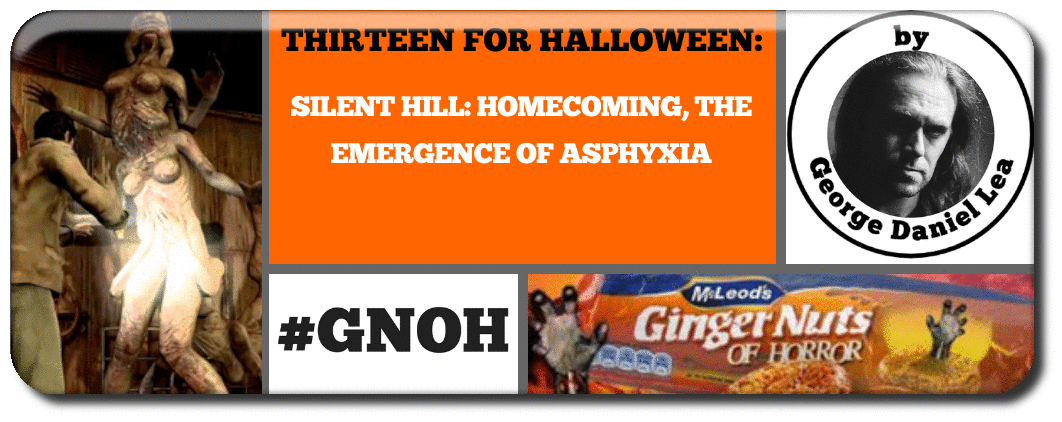 I know, I know: hardly one of the most beloved horror titles in existence, hardly one of the best entries in the franchise, but, for all its faults (and there are quite a few), Silent Hill: Homecoming does manage to scrape together some surprisingly horrific moments and images, as well as mythological concepts that mount in sheer grotesquery the more the player uncovers. One of the few titles not set directly in the eponymous town, Homecoming instead takes place in the neighbouring settlement of Shepherd's Glen, a town which, so it seems, is suffering from much the same curse as Silent Hill itself, when we first arrive. Shrouded in the now iconic mist, the town is abandoned, haunted by strange figures and sounds, those few of the townsfolk that still remain paranoid figures who speak obliquely and with reference to tragedies the player has yet to uncover. As returning soldier Alex Shepherd, it's the player's business to uncover the hideous truth of the town and its curse, not to mention the more personal issues that plague his family. That there's something far beyond the ordinary occurring is made overt very early on, when Alex happens across now familiar phenomena (roads and pathways crumbled away into an aching abyss, preventing escape from the town), strange creatures that may or may not be entirely real prowling the streets. Much of what occurs in Homecoming, just as in the other Silent Hill games, is somewhat ambiguous, given Shepherd's precarious state of mind. We know from the off that he suffers from a number of psychological conditions and traumas that saw him hospitalised, that he experiences significant hallucinations that sometimes obliterate his perception of reality altogether. Most centre around his dead brother, Joshua, who was killed in a freak accident years ago. As such, it's difficult to determine with any degree of certainty how much of what we see and experience in Homecoming is real, how much is a product of Alex's diseased mind and where that boundary lies (if it means anything at all, certainly towards the end of the game). A story of paranoia and conspiracies, of eldritch forces and bleak-as-Hell metaphysics, Homecoming paints a portrait of just how far human beings will go to ensure their own survival, even if that survival is twisted and degraded out of all proportions, how the sins of the Fathers do indeed become the laments of the children. Through his journey, Alex uncovers a secret history in which a splinter of the iconic Order from the original Silent Hill games has been prominent within Shepherd's Glen since its founding, a cult that, unlike its parent, isn't dedicated to facilitating the birth of a new and dark god, but in appeasing that which holds sway over Silent Hill itself, and may or may not be responsible for its peculiarly psychosomatic condition.  Rather, the splinter that holds sway over Shepherd's Glen -and has been directing the town's history in one way, shape or form since forever- is a far more conservative, survivalist sect, who seek only to preserve what they know against the forces that have ravaged their neighbouring town. As such, we discover, there exists a covenant between the elders of Shepherd's Glen and the nameless dark god of Silent Hill: An appeasement that consists of blood sacrifice. Every family within Shepherd's Glen owes a blood debt to the deity, their first born children forfiet to the creature. Worse, it isn't merely satisfied with simple sacrifice: the creature is sustained by pain, by suffering, by the mortification of innocence. As such, the player discovers various examples of the most hideous abuse as they wander the town: first-born children who were born and cultivated for sacrifice, whose parents knew from the moment they were born that they would have to be tortured and tormented and finally allowed to expire. From a child buried alive and allowed to smother to death beneath the roots of a great tree to a little girl surgically lacerated and allowed to bleed out, the torments these children suffer is beyond description, the gradual revelation of this obscene truth one of the game's most notable and distressing qualities. Worse, the infection of the nameless force from Silent Hill brings those far from forgotten sins to life, suffusing the memories of torment that still echo with vengeful and sadistic animus. 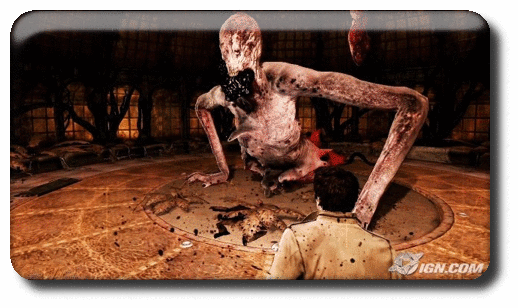 The various “boss” encounters that occur throughout the game are all manifestations of the sacrificed children, each one informed by qualities and characteristics of the children themselves, not to mention the various means and manners of their deaths. From the lacerated, doll-like Scarlet to the hulking, cancerous behemoth of Sepulcher, each of these creatures is a kind of avenging angel, a dark manifestation of suffering and cruelty, returned to claim the bodies and souls of those that betrayed them. All are uniquely disturbing, that quality escalating as the player becomes more and more aware of what they are, but perhaps the most distressing of all is the caterpillar-like homunculus, Asphyxia. A manifestation of memories of Nora Holloway (who was smothered to death by her Mother as a sacrifice to the dark god), the creature resembles a caterpillar owing to Nora's love of Alice in Wonderland, her reborn form consisting of distressingly female bodies sewn and fused together into a single, scrabbling entity, a pair of hands interlaced over its mouth, forcing it to perpetually suffocate (echoing the manner of its death). The creature is a lurid and distressing monstrosity, exquisitely designed to emphasise the purest desecration of innocence. To think that this entity is partially born from the soul of a murdered child is one of the sincerest moments of quiet horror in the game, and one that can only be experienced if one is willing and able to read between the lines, to appreciate that these entities operate on heavily symbolic levels to maintain their presence. An even more distressing level of symbolism is implied by the creature's form and motions: the various bodies that comprise Asphyxia are all clearly adult women, naked, yet not exposed; their breasts and genital regions covered with hands in the same manner as the creature's mouth. Whilst not certain, this may suggest the age at which Nora Holloway was sacrificed: on the outset of puberty, the creature she has become manifesting the state of womanhood that she herself was denied. Furthermore, the creature sways and sifts in a luridly suggestive manner when it walks, its hideous sexualisation perhaps even implying some more intimate form of abuse before she was eventually murdered.  Whilst much of Homecoming is nowehere near as subtle or effective as previous titles in the franchise, the “boss” encounters and the mythology that surrounds them is what elevates the game from simply being a weary cash-in on an ailing series: the creatures are not only gloriously designed, but rank with implied mythology, a form of symbolic storytelling that involves the player on a far more intimate level than if they were just monsters or obstacles to overcome. The gradual revelation of their true conditions renders them obscenely fascinating, not just terrifying and distressing, but uniquely tragic: are the souls of the murdered children still somehow present within their rent and malformed shells? What manner of torments did the children suffer after death in order to become these abominations? In a cavalcade of pure, human wickedness, of metaphysical nihilism and abyssal depths, Asphyxia is perhaps amongst the most abominable specimens, not because of what she is, but because of what she implies. 
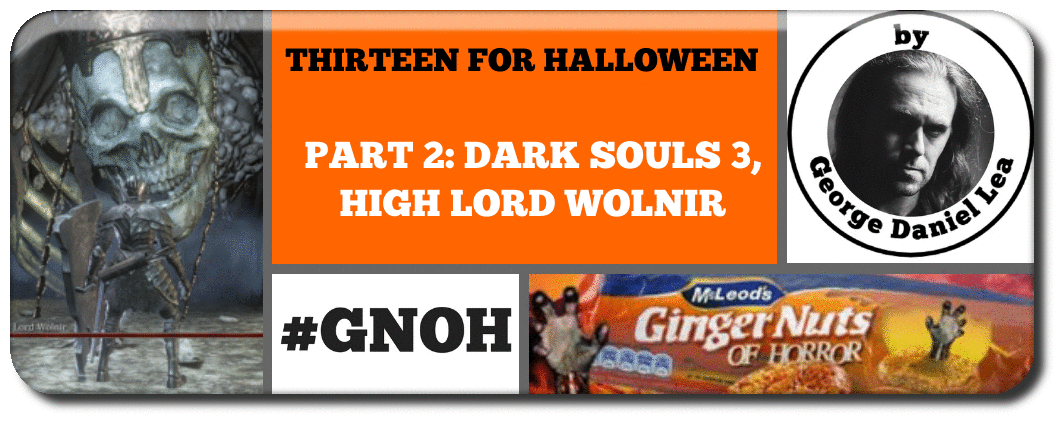 The Dark Souls series (and its sibling, the incadesently brilliant Bloodborne, which will also be featuring in this series. Likely more than once) introduces us to a very different form of horror from the likes of Resident Evil, Silent Hill or Amnesia: The Dark Descent: Whereas those titles draw on immediately identifiable horror traditions, Dark Souls is of an entirely different breed and lineage: Its setting, its mythology, its aesthetics are those of bleak fantasy, as opposed to B-movie horror traditions (a la Resident Evil) or Lovecraftian metaphysics (Amnesia: The Dark Descent). At first glance, it might be difficult to tell why the game features so prominently on lists of horror titles or why it is so widely regarded by fans of more overt and evident horror. The fantastical settings, with their castles, dungeons, undead hordes, their dragons, their minotaurs and monsters, are, superficially, more redolent of The Lord of the Rings, the fantastical works of Ray Harryhausen or classical myth than, say, the works of Poe, Lovecraft or Shelley. It isn't until the horror fan sits and immerses themselves in the games that the source of their horror becomes clear: Whilst they do utilise some classic horror tropes and methods for their set pieces, the true horror of Dark Souls is far more epic and expansive: a species of mythological horror that evokes despair rather than dread, that suggests surrender to the inevitable rather than reactions of survivalist fright. The Dark Souls series is set not in a single world or plane of existence, but myriad states of being none of which are entirely “real” or abstract: it is a metaphysical state by its very nature, in which a state of mutual entropy exists between antithetical, elemental forces (symbolised in the game by The Void and The Fire respectively). However, this is not a clear cut moral situation in which Fire, redolent of light, life and creation, is unambigously positive or The Void, a power of death, entropy and darkness, is entirely negative: in this reality (and all the realities attached thereto), both forces are capricious, corrupting and potentially destructive, the gods and followers of both engaging in some truly horrendous, world-shattering acts that change the state of play long before the player character ever emerges into the world. As a result, the environments the player traverse are not in a state of mid-apocalypse or even post-apocalypse: this is a realm that is already dead a thousand times over, in which gods and elemental powers have all failed, died, become tainted or corrupted by encroaching madness. Nothing you encounter in this reality is truly alive, and even that which is has lost all sense of itself, from gods to great dragons, from primal powers to the antecedents of all humanity. Here, reality itself is breaking down and bleeding into itself, resulting in rents and warps in time, space and creation, a condition of sputtering entropy in which the dead rise, outnumbering the living, the denizens of both Heaven and Hell pour from their respective abodes (both of which are in mutual states of collapse) and there is nothing, nothing that can bring about the salvation of creation: only that which can hasten it, whether a new state will be born from the ashes or not. Even the player begins the original game as a wretch: undead, cast into an asylum at the edge of creation, with no hope of even death to release them from the turgid decay and madness escalating all around. In such a scenario, there are many and varied opportunities for turning the ostensibly fantastical images and settings to the purposes of evoking dread, horror or distress, and the games go out of their way to do so. But perhaps the most effective for me occurs in the latest (and perhaps last) game in the series: Dark Souls 3, which escalates the situation to the point that realities begin to literally dissolve around the player by game's end: Having navigated the ancient, buried city of Carthus, infested as it is by undead of numerous shape and size, the player comes across the burial chamber of what was clearly the kingdom's ruler: Recalling pagan barrows and necropolises of ancient Egypt and Sumeria, the hall is immense, elaborate, festooned with treasures and the most beautiful artefacts imaginable. But one in particular draws the player's eye: A goblet set prominently on an altar at the heart of the chamber, its shape sculpted to resemble bones and skulls, overflowing with what appears to be a misty darkness; the very stuff of the void. 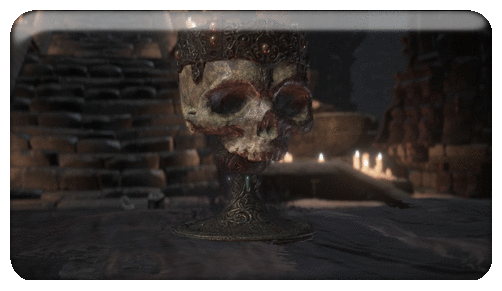 If the player approaches the goblet and interacts with it, a cut-scene occurs in which the goblet begins to overflow with the shadow-stuff, eclipsing the chamber, enveloping the player, snatching them away to some limbo state, in which all is darkness and silence, only the desolate ground beneath their feet visible. Being not only fans of this series but also aficinados of horror, we know what is coming, so we progress carefully, testing the outer boundaries of the arena, until the darkness won't let us progress any further, then retracing our steps back to the starting point. All that provides any clue as to a potential route is a distant light, flickering like a star in the darkness. We approach with all trepidation, waiting for the dark to peel away, for something to loom from it. And loom the inhabitant of this void most certainly does: From the darkness emerges an immensity so huge, it all but fills the screen: a skeletal titan, bedecked in jewels, bangles and a golden crown, its maw and eyes bleeding darkness, its limbs lashing out to pulverise us. This is High Lord Wolnir, one of the most terrifying entities in all of Dark Souls. Again, his design wouldn't necessarily suggest something genuinely frightening: he is, after all, simply a skeletal figure, for all of his immensity. But the nature of his framing, the mythos it suggests, makes him far more impressive than he would otherwise be: When he first emerges from the darkness, it is so close to the player he momentarily eclipses the entire screen, forcing the player to pan the camera up to take in the full scale of him. There's also something peculiar about his positioning and motions; the manner in which he scrabbles at the ground, crawling towards the player away from the abyss itself, suggesting that he is not merely some ancient evil, but is in a state of terror himself. 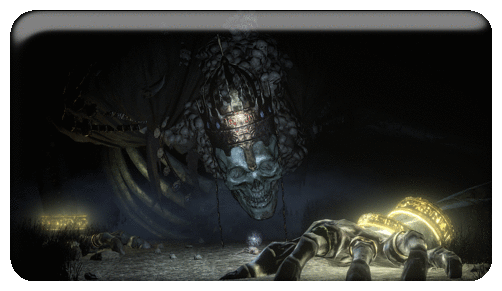 And that is exactly the case: whilst it isn't made overt in the encounter, delving into Wolnir's background suggests that he was originally terrified of dying and of the abyss that he knew awaited beyond death. Thus he utilised ancient sorceries to transform and suspend himself beyond the lip of the abyss. That's where we find him: suspended beyond death and living on the very edge of his own truest nightmare, clinging to light and life by the slimmest of margins. Whilst Wolnir himself is terrifying, the state surrounding him, the semi-sentient darkness attempting to drag him into the Void, is far worse. It also provides some clue as to how to beat the boss: normal attacks do nothing against Wolnir, barely even chipping away at his health. However, the eye is drawn to the sources of light that illuminate his form: two bracelettes decorating his wrists, that the player can attack whenever he strikes. These are the means by which he has shackled and suspended himself beyond death, magical artefacts that he uses to anchor himself not exactly in the land of the living, but beyond the full reach of the Void. In and of themselves, they suggest a species of mythological horror: that the Void is something so hideous, so terrifying, as to drive this Sorcerer-King to such extremes, to make a true abomination of himself. The player must therefore shatter each of the bracelettes, at which point Wolnir screams and is dragged away by the Void. By what means, the player can't precisely make out, but the manner of his disappearance into darkness is almost as terrifying as his emergence from it. Wolnir epitomises the various, subtle forms of horror that pervade the Dark Souls series, and is perhaps the most pertinent example of how metaphysically moribund its reality is.   |


Archives
April 2023

|



 RSS Feed

|

|