

 'If Horror is the province of the non-conformist, then lately it also feels like the last bastion of queer catharsis in genre literature.' A Rainbow At Night: Reappraising the ‘Bury Your Gays’ trope in terms of modern queer expression. by James Bennett Recently, I had a story out in ‘The Book of Queer Saints’ (edited by Mae Murray), a well-received anthology touted as ‘thirteen tales of queer villainy’. While ‘Morta’ is a straight-up Horror story, it also serves as a tongue-in-cheek dig at the queer teen high school romance that seems so prevalent in LGBTQ+ entertainment these days. Forgive me. I’m not the only gay with a bad sense of humour. Right up front I’ll say I have no problem with queer romance. Hell, I enjoyed Heartstopper (despite its somewhat squeaky-clean approach). Granted, I’m a middle aged queen and perhaps a more jaded member of the target audience. My school years under Section 28 and later during apartheid in South Africa are a horror that still evades my own fingertips on the keyboard. Besides, according to Amazon, I write ‘Erotic Horror’, don’t I? In this essay, Horror is the place I’m coming from, but I think the same applies to all queer entertainment as a broader discussion. An idea I keep seeing, as I venture into the darker recesses of queer lived experience in fiction, is that ‘people don’t want negative queer-themed stories’. Yes, it’s a thing. The odd review that one-stars a story as a ‘downer’ (it’s a Horror story, come on). Other writers who tweet to say that our genre stories should all have happy endings. In its most hostile manifestation, I’ve even been told – and I quote – to ‘f*** off with your gay trauma’. A few have suggested – and to a writer who’s published a fair amount of ‘dark shit’ – that publishers ‘don’t want’ these kinds of stories anymore. Still others say that this stuff won’t sell because of ‘negative’ themes. If Horror is the province of the non-conformist, then lately it also feels like the last bastion of queer catharsis in genre literature. To my mind, it’s important to note a fundamental distinction in the ‘Bury Your Gays’ trope and be mindful not to weaponise it against queer creatives of any stripe. Honestly, it’s fine if folks don’t want to read or watch dark queer entertainment. No one needs my permission. In light of the historical scope, I have to say I often find the notion that darker queer stories aren’t welcome or somehow detrimental a gross oversimplification. And one that’s usually – and oddly – advanced in an exclusionary manner. On the whole, folks appear to be referring to the ‘Bury Your Gays’ trope that has lingered long into the modern era. For those who don’t know, the ‘Bury Your Gays’ trope is the portrayal of LGBTQ+ characters in entertainment that generally tends to result in the suffering and/or death of one or both of the characters in question. In its worst iteration, one of the characters may come to realise that they aren’t queer at all and have merely fallen under the spell of ‘perversion’ or ‘seduction’ (‘queer seduction/corruption’ being a prevailing delusion among bigots everywhere), then continuing life along the heteronormative lines that have ‘saved’ them once this or that troublesome queer is out of the picture. Either way, it’s clear in the presentation that being queer is seen as morally wrong and not to be supported. In 1948, Alfred Hitchcock’s Rope frames his implicit gay characters as heartless villains. Brandon and Phillip strangle poor David, their former classmate, to death in their Manhattan apartment – and as an intellectual exercise to boot! The film hints that the murder had a gay motivation, either unspoken jealousy or desire. Another classic example is the 1961 film The Children’s Hour (also a Horror movie), adapted from Lillian Hellman’s play of the same name. Two schoolteachers in a private boarding school are accused of having an ‘unnatural relationship’ by one of the resident girls. It doesn’t end well. The leads (a young Audrey Hepburn and Shirley MacLaine) undergo an ordeal of doubt, confusion and guilt, which culminates in suicide. In the 80s, we find Tom Hanks in Philadelphia, which frames queer experience in the shadow of AIDS as a dreary and inevitable act of martyrdom. Throughout this period, we find the queer-as-villain employed the most enthusiastically, from Mrs Danvers in Rebecca to Norman Bates in Psycho to Frank-N-Furter in The Rocky Horror Picture Show to Dr Robert Elliot in Dressed to Kill to Buffalo Bill in The Silence of the Lambs. Even Jareth, the gender-bending Goblin King in Labyrinth, is portrayed as a child-snatching baddie. And don’t get me started on Disney. Such renditions were the direct result of twentieth century laws and their enduring aftermath. The Hays Code was the informal name for The Motion Picture Production Code, adopted in 1930 and advancing a set of rules to govern Hollywood movies for over three decades, the toxic effects of which prevail to this day. Along with a general ban on portraying crime and violence in a positive light, the code outlawed topics considered ‘perverse’ and stated that they couldn’t be depicted in any tolerant, affirmative or compassionate way whatsoever. Quelle surprise that such topics included homosexuality – and unsurprisingly, up there alongside bestiality, paedophilia and rape. Historically, that was the gutter where society at large placed queer people, heedless of the danger it placed them in or the suffering it caused. I wish I could say we’ve entirely shaken off such outlooks since. Art and entertainment reflect the times. The times reflect art and entertainment. It’s a cycle that has dictated much of queer rep for the past hundred odd years. In terms of visibility, queer folks have never enjoyed an egalitarian status and been excluded from much of the industry, especially in terms of creative influence and corporate power, which has played a big part in how we’re regarded and thus treated i.e. as less than human. Living in the here and now, we can all thank our lucky stars that times have changed for the better in our own era, however tenuously it may seem at times. All the same, and to illustrate the point of this essay, it’s advisable to remember our history. And to honour the voices of those who’ve come before us. All queer artistic expression under systemic oppression has been marshalled, censored, criminalised and directed by bigots and their enablers. That’s simply a fact. The above is one aspect of the ‘Bury Your Gays’ trope, historically speaking, but the issue invites deeper inspection. Going further back, it was the Criminal Law Amendment Act of 1885 that condemned homosexuality outright as an unlawful ‘perversion’, and which set the tone for oppression and exclusion in the modern era. Back then, in a climate of investigation, paranoia and arrest, some queers were disseminating pornography under pseudonyms (The Sins of the Cities of the Plain, Jack Saul) while Oscar Wilde himself went to prison (and later died in poverty) thanks to the scandal surrounding his affair with Lord Douglas. It was Wilde’s ensuing case for libel that triggered the outrage that saw out the Victorian age, much of the condemnation stemming from public reaction to his ‘shameful’ gothic Horror novel The Picture of Dorian Gray. Looking into the past, we see that Wilde wasn’t the only queer writer attempting to express himself in a highly reserved, sanctimonious and punitive society. Virginia Woolf, E. M. Forster, James Baldwin, Truman Capote, Christopher Isherwood, Pat Barker, Allen Ginsberg, Patricia Highsmith – to name but a few... All speak to us from those times, in varying shades of experience, and grace the long and fine tradition of queer literature. They shine like a rainbow at night, bright in the darkness. Present even when one couldn’t see them. It’s important to note that all of these writers (and filmmakers, artists and actors besides), were working under the enforced bigoted laws and exclusionary codes described in this essay. All of them, in fiction and elsewhere, were forced to ‘bury their gays’. To bury themselves. These heroes and heroines of a much less enlightened age speak to us and symbolise the line between ‘positive’ and ‘negative’ queer representation. It’s a line one suspects is often overlooked, or ignored, or that modern readers are simply unaware of. Sure, there are plenty of pernicious ‘Bury Your Gays’ tropes out there, from Braveheart where Prince Edward’s lover is flung out of a window to the violent dispatching of a Two Spirit character in Lovecraft Country. On the more sympathetic side, we have Brokeback Mountain, A Single Man and Moonlight. Your mileage may vary in relation to these cinematic outings, sure. There are a wealth of examples out there which I leave to readers to explore. The above serves to illustrate the different aspects of the ‘Bury Your Gays’ trope in the mainstream and to highlight the significance of gaze, approach and intent – nuances that often seem lost in the drive to advance the current evangelicalism of ‘positive’ queer rep. We need to acknowledge that there’s a world of difference between ‘spectacle’ and ‘catharsis’. These days, the two are often conflated. Queer artists writing under oppression and taking care not to portray anything remotely positive about queerness because it was illegal and dangerous to do so isn’t the same as majority voices portraying queer folks in entertainment for ‘shock value’. Or framing our experience as inherently negative. Or punishing queer characters simply for being queer due to a bigoted outlook, religious, legal or otherwise. The latter fall under the heading of ‘spectacle’. The queer as ‘pervert’. The queer as a perpetrator/victim of immorality. The queer as a cautionary tale. Or a punching bag. These are works inspired by prejudice and hate, chock-full of stereotypes and in most cases an effort to enforce queerphobia via cultural means. On the other hand, queer artists portraying trauma in their work qualifies as ‘catharsis’. We see the queer artist making sense of their world, reaching out from the shadows, creating a record or a guide. Perhaps these works are a plea for understanding or a way to wrestle with one’s pain and thereby exorcise it. Perhaps it’s a call for a better world. Whatever. It is valid. Ultimately, The Children’s Hour condemns queerness as an aberration, a moral misstep that can only lead to suffering. Brokeback Mountain depicts the experience of gay love in a socially hostile environment (hence the ‘wilderness as refuge’ motif). The first film hails from a biased point of view in the hope of impressing fear of the other and provoking moral panic. The second, while undeniably a downer, portrays a grim reality in the hope of fostering understanding and compassion. Today, we have Heartstopper to impress on us that being queer is something that everyone should aspire to, because it’s fabulous, fun and most of all, fashionable. The evangelicalism, admittedly, is understandable. Brave New World by Aldous Huxley is also a book that all young queer folks should go and read. What does all this have to do with Horror, you may ask? Well, approach matters when it comes to queer representation, as much as it matters who gets to tell our stories and why. We should ask why some say that our experiences under oppression no longer matter. We should be able to ask why queer sex and the daily reality of homophobia are deemed inherently ‘negative’ when shown in entertainment. Is their erasure for the comfort of creatives who fear their works won’t fly if they feature them? Or for the comfort of a mainstream audience who’d prefer not to be reminded of the world we actually live in and how queer people get off? It’s OK to ask these questions. We should look to the past and be careful we’re not falling into the same trap. Of course, history is changing. It’s changing all the time. Now we get to see queer characters in Horror films in healthy, loving relationships (Nia DaCosta’s Candyman). We get to see queer Horror novels on the shelves of bookshops (Manhunt Gretchen Felker-Martin, Red X David Demchuk, The Book of Queer Saints Mae Murray). In mainstream entertainment, we see iterations of queerness that aren’t focused on trauma or darkness at all – and that’s all well and good. I mean it. I embrace, respect and support the space for queer joy. Even if I don’t always write it. Still, there’s a danger in applying standards and expectations to queer artistic expression, and for the reasons mentioned above. A long history of censorship and suppression at the hands of a prejudicial regime and a morally averse society doesn’t recommend that we accept further restriction and shepherding in art and entertainment. For obvious reasons. Purity culture and the sanitation of queerness too closely echoes the laws and codes that have come before. Given time, such rigid standards could easily work against us. Why not? They always have in the past. In conclusion, it isn’t good enough to say that all queer rep has to be sweetness and light these days in order to qualify as ‘positive’. Any more than it is to frame the darker, more cathartic works of our imagination as ‘negative’ – and by extension, culturally verboten. Queer catharsis has its place too. Queer Horror has its place. As in all things, it’s how you go about it. Queer stories can act as a torch in the darkness and a survival guide. Where would I be without the phantasmagoria of Clive Barker and Poppy Z. Brite, for instance? I balance those books with Armistead Maupin and others. I’m open to all the shades of the rainbow. These authors not only inspired me to write. They told me I wasn’t alone. More than that, they told me my trauma was valid. And more than that, they showed me it was possible to succeed regardless. Hear me out. I put it to you that queer expression itself is inherently positive. Queer survival, that innate act of rebellion, is positive. The fact I’m sitting here as a gay man and writing this for a prominent Horror website is the definition of positivity. When you get your words published, when people read your stuff, all of it flies in the face of oppression, you see. Criminal Amendment Acts, Hays Codes and ongoing bigotry et al. The truth is we live in days that millions before us would’ve wept to see. We honour and celebrate that with every single piece of art we make. Hopefully, we can foster a genre in which all queer expression is welcome and regarded in that light: no less than the first time in history where queer voices get to express themselves in the mainstream without fear of oppression, legal punishment and widespread moral condemnation. Write without chains. Write free. Enjoy Pride. The Dark Magazine June 2022 |


 |  |
THE HEART AND SOUL OF HORROR PROMOTION
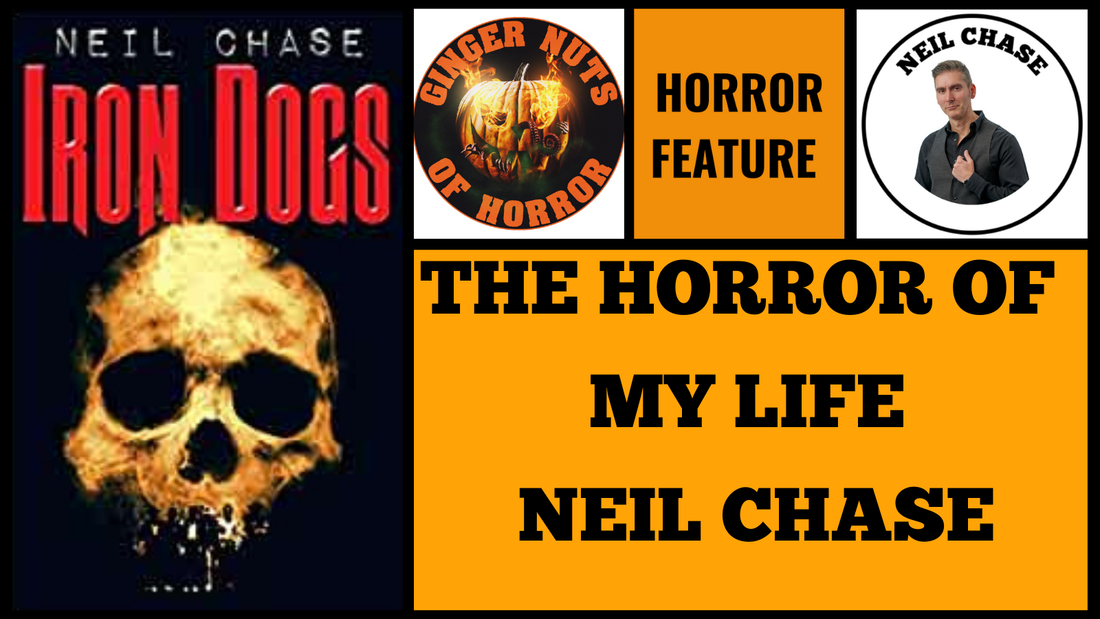
THE HORROR OF MY LIFE: NEIL CHASE
25/5/2022
THE FIRST HORROR BOOK I REMEMBER READING
The first horror book I remember reading was The Telltale Heart by Edgar Allan Poe. I think it was as part of a school assignment, and though it wasn’t particularly scary, I found the concept fascinating – this idea that your own guilt could manifest in a physical way. More than that, it opened the door to the works of Poe and the world of horror in general.
THE FIRST HORROR FILM I REMEMBER WATCHING
There are two horror films I remember watching when I was little, and was probably too young to have seen them when I did, though I can’t recall exactly which I saw first. One was The Omen and the other was The Prophecy, both of which played on late night TV and scared me silly for different reasons.
The Prophecy was a standard 70’s creature-feature (and not to be confused with the great 90’s Christopher Walken movie of the same name), about a couple in the woods trying to survive attacks by horrifically mutated animals. The mutated grizzly that is the big bad, in particular, gave me nightmares for weeks.
The Omen, on the other hand, was scary on a whole other level. It was more disturbing and cerebral than the jump scares and creatures of The Prophecy, and showed that evil could come from seemingly innocent sources as much as the obvious big monsters. To me, this was far scarier than any amount of gore and fake blood that slashers or monster movies could conjure.
THE GREATEST HORROR BOOK OF ALL TIME
It’s hard for me to argue against Bram Stoker’s Dracula as the greatest horror book of all time, since it directly influenced countless horror writers and fans alike since it was first published. Without this seminal work, vampire lore would not be what it is today, and it was one of the first books to romanticize the monster in such a way as to make it desirable (though the Sirens in Greek legend could give Dracula a run for his money in that department).
Count Dracula is as iconic today as he was when first introduced to the world in 1897, and there are few, if any, monsters who can unseat him from the throne.
THE GREATEST HORROR FILM OF ALL TIME
For me, there are few horror films that are rewatchable, not only for the story, but the direction, cinematography, music, and especially the acting, as Stanley Kubrick’s The Shining.
Jack Nicholson and Shelley Duvall give a masterclass in acting in their respective performances, and the Overlook Hotel is as much of an iconic character as the rest of the wonderful cast. The first time I saw it, I was immediately pulled in and had to watch it through to the end. That’s as true on the 30th viewing as it was on the first.
THE GREATEST WRITER OF ALL TIME
With so many prolific writers throughout history, it’s difficult to narrow the title of “greatest writer of all time” to just one. Shakespeare, Cervantes, Dante, Twain, Dostoevsky, Dumas… the list is as varied as their bodies of work.
But since this site is all about horror, I’ll narrow my choice to the greatest horror writer – the one and only, Stephen King. With 64 novels under his belt, and no signs of slowing down, the titles read like a who’s who of horror icons. Carrie, Cujo, The Shining, The Dark Tower, The Stand, Misery, It, Pet Sematary, The Outsider, Salem’s Lot, The Mist, The Institute, Doctor Sleep, and so many others over the nearly five decades since his debut as a novelist.
With each book, and the countless movies based on them, being a household name for horror enthusiasts, it begs the question - really, is there any other choice?
THE BEST BOOK COVER OF ALL TIME
The one book cover that comes to mind as the greatest of all time is Peter Benchley’s Jaws, featuring a lone female swimmer at the top of the page, directly under the title in bold letters, while a menacing figure rises from the depths like a torpedo with teeth. It’s instantly recognizable, while at the same time evocative of the subject material and the terror that awaits the reader. In fact, the image was so effective, it was essentially copied as is for the iconic movie poster for Stephen Spielberg’s Jaws that we all know and love.
THE BEST FILM POSTER OFF ALL TIME
While it can be argued that the best movie poster of all time is also Jaws, it feels as bit of a cheat, since it was basically a copy of the book cover, which came out first.
That said, the title of greatest would have to then go to the theatrical poster for Star Wars, featuring Luke thrusting his lightsaber toward the heavens, with Leia kneeling at his side, blaster in hand, while Darth Vader looms large in the background as an armada of X-wings race toward the Death Star. It is as iconic as the film itself, and has been copied and parodied countless times for films of all genres.
THE BEST BOOK / FILM I HAVE WRITTEN
The best book I have written is Iron Dogs, a gothic horror-western, about a band of outlaws on the run, who find themselves trapped in a deserted town, at the mercy of a supernatural evil. I poured my heart and soul into this work, from the research into the 1870’s time period and the American Southwest regions depicted, in terms of the people, customs, dialects and clothing, to the backstories and character development of the main and supporting characters, and especially for the monster that plagues our anti-heroes, which I wanted to be both unique and memorable.
Following its success in terms of fans and awards alike, it was my pleasure to expand my skillset in narrating the audiobook as well, which has been well-reviewed on Audible and is consistently in the top 10 for its category on Amazon.
THE WORST BOOK / FILM I HAVE WRITTEN
The worst film I have written is likely my debut short film, Devil’s Due, about a man forced to kill to win back his soul from the Devil. While it was well received in its very limited run, I knew there was so much I could have done better, and it inspired me to write the feature version of the story.
Making the short taught me so much about screenwriting, over and above the basics you find in a book or a course. I was able to apply these lessons when it came to the feature screenplay and the end result made for a much stronger story with fleshed out characters, better dialogue, and dynamic action scene descriptions focusing on strong visuals and character development.
THE MOST UNDERRATED FILM OF ALL TIME
In terms of horror, the most underrated film I can think of is Dog Soldiers, a fantastic blend of creature horror and gritty action, about a squad of British soldiers training in the Scottish Highlands, who are beset upon by werewolves and must fend them off until dawn, when they’ll revert back to human form. It’s a fun and gory ride, with plenty of action, blood, and humor to satisfy any genre movie fan.
With a very limited theatrical run and low box office, it’s at best a cult classic, and it’s a shame it isn’t more well-known and appreciated. Everyone I know who has seen it, loves it, and it rivals American Werewolf in London and The Wolfman as a true werewolf classic.
THE MOST UNDERRATED BOOK OF ALL TIME
The most underrated book that comes to mind is Spider Season, written by Billy Hanson, a friend of mine and fellow author / filmmaker. It’s a collection of dark short stories, ranging from unsettling to downright terrifying. Billy’s work has a cinematic feel, and he switches easily from cerebral, inner fear to gruesome, exterior horror. Do yourself a favor, and read a copy today!
And if you ever get the chance, check out Billy’s brilliant short film adaptation of Stephen King’s Survivor Type. You’ll never look at deserted islands or drug use the same way again.
THE MOST UNDERRATED AUTHOR OF ALL TIME
An author who was at one time well known, but whose popularity has dropped off in recent years, is Jack L. Chalker, a fantasy and science fiction author, whose work I very much enjoyed when I was young.
My favorite of his works has to be And the Devil Will Drag You Under, a fantasy novel about an alcoholic demon who recruits two humans to collect pieces of a mystical artifact in order to save the Earth from an imminent asteroid. It’s as crazy and wonderful as it sounds, and I don’t know a single person who has read it.
THE BOOK / FILM THAT SACRED ME THE MOST
I’ve always been more affected by creeping horror than by gore, so slow burns like It Comes at Night or The Devil’s Backbone tend to build terror more effectively than, say, Friday the 13th or Halloween. That said, one recent film that has stuck with me since the initial viewing is the fantastically creepy Ghost Stories (2017), an anthology horror film about a professional supernatural debunker who is faced with three chilling and inexplicable cases, each scarier and more unsettling than the last.
THE BOOK / FILM I AM WORKING ON NEXT
Currently, I am working on both a new novel and a new film. My novel, Dead Strays, is an adaptation of my unproduced horror screenplay of the same name that won Best Screenplay awards at Screamfest LA, Hollywood Horrorfest, FANtastic Horror Film Festival, Script Summit, and Las Vegas Screenwriting Competition, among others; about four robbers who pick the wrong household to hold hostage while hiding from the police.
On the film side, my production company, Brimstone Pictures, is in post-production on Spin the Wheel, a supernatural thriller I wrote and co-directed, about a group of strangers playing Russian Roulette at the end of the world. It’s been a labor of love by an unbelievably talented cast and crew to bring this script to life, and I can’t wait to share it with the world. My goal is to have both projects completed by this fall.
Iron Dogs
by Neil Chase
When evil dies, it doesn't always stay dead.
Six outlaws, barely a day ahead of their pursuers, find shelter in a freshly deserted New Mexico town. With no water, and one of them gravely wounded, they realize too late they're trapped inside the lifeless town.
As they soon discover the grisly truth behind the disappearance of the townsfolk, the outlaws find themselves hunted by something far worse than anything they've faced yet - an unspeakable evil that seemingly cannot be killed. When the malevolent creature targets them in turn, the previously tight-knit group begin unraveling past the breaking point. Thinking it to be a Strigoi Morti, a monstrosity that can only be harmed while feeding on the living, the surviving few are faced with an agonizing choice. Who will they sacrifice so the others may live?
Spine-chilling, poignant, and action-packed, Iron Dogs is an instant classic for Horror, Thriller, and Western fans everywhere.
Neil Chase
Neil Chase is an award-winning novelist, screenwriter, actor, and story coach, with extensive experience in a variety of genres, including action, sci-fi, drama, horror, and comedy. Neil has won over 90 international writing awards, and is most proud of winning the FilmMakers International Screenwriting Awards Grand Prize.
Neil's screenplays have been produced for film and TV, and he is the author of the award-winning horror novel, Iron Dogs.
When not working, he's drawing inspiration from his amazing family, thinking up new worlds and adventures, and helping aspiring authors follow their dream of writing something great. You can find helpful articles about writing, information on story coaching for writers, as well as tips and tricks for writing in the horror genre on his website.
Social Links
Website: https://neilchasefilm.com/
Facebook: https://www.facebook.com/neilchasefilm/
Instagram: https://www.instagram.com/neilchasefilm/
TikTok: https://www.tiktok.com/@neilchasefilm
Goodreads: https://www.goodreads.com/book/show/39970695-iron-dogs
Amazon Author Page: https://www.amazon.com/Neil-Chase/e/B07DH35S56
check out today's other articles
 | |
The Heart and Soul of Horror Promotion
As I have declared many times before, “writing for mental health is not the same as writing about mental health.” My own Black Dog is still with me—all the fictional horror in the world could never rid me of them for good—but horror has got me, and will continue to get me, through the very worst of days.
How do you begin an essay on a subject you have written so much about before? How can you possibly say something new about a topic you feel you have exhausted? Worse, what if you have worn out your readers by continuing to hark back to old words?
These were the questions I asked myself when Jim McLeod invited me to write, once again, about mental health for Ginger Nuts of Horror. In January 2020, when I wrote about the TAO OF THE BLACK DOG for the site, I talked at length about how depression had affected my creativity and how people treated me when I was honest about my struggles. I spoke about how losing a friend to suicide drove my urge to be more open about mental illness and how we can better support those in need. I concluded that essay by explaining how, “I write to make myself feel better, and I believe that writing for mental health is not the same as writing about mental health.”
In February of that same year, I spoke with fellow New Zealand horror author and Bram Stoker winner, Lee Murray, for an interview entitled STARING DOWN THE DARKNESS. We discussed how we thought writing horror stories was ultimately beneficial to our mental health. How embracing the reality of how we felt gave us the strength to tame our Black Dogs.
Two years later, after editing a canine-themed charity anthology benefiting the Mental Health Foundation of New Zealand, and somehow surviving a worldwide epidemic, what could I possibly say about mental health and horror that wasn’t a re-hash of what had come before?
The thing about sequels, good ones that is, that they always give a brief nod to the original before they go off on their own path and do their own thing…
I realised, while ruminating on how to continue talking about mental health, I needed to acknowledge how a truly staggering number of us are feeling right now, and address a real-life horror taking place on a worldwide scale.
So anyway, about that plague.
Unless you have been in a coma or under a rock for the past two years, you have lived through one of humanities’ greatest horrors. Many of you may not have come out unscathed. Some may even be suffering from its effects (and after-effects) right now. Yet, I have seen surprisingly little creative media that addresses it in depth. Sure, there is the Netflix “mockumentary” DON’T LOOK UP, which is not a horror movie, but is a horror movie. (Kit Power has already written at length about it in his brilliant response on GNOH) and also on Netflix is THE BUBBLE, which also isn’t a horror movie, it’s just a bad one. There’s a few other offerings that either address the COVID outbreak or take place during, like SONGBIRD, LOCKED DOWN and THE END OF US, but horror movies seem pretty thin on the ground.
Where are the zombie movies, the contagion movies, the it’s-the-end-of-the-world-and-there’s-a-heckin-monster movies? I’ve been told that THE SADNESS, a Taiwanese zombie film by Canadian director Rob Jabbaz is probably one of the best at depicting the real gut punch of the pandemic (although I’ve admittedly not yet seen it) while anthology movies like RABID and ISOLATION weave together terrifying tales themed around, unsurprisingly, isolation and anxiety. I’m certainly not saying there are no cinematic responses to the virus, but there are not as many as I expected.
The lack of pandemic-themed horror movies is even more surprising because the history of horror movies is strongly entwined with history itself. Specific trends in horror genres tend to arise as a response to societal unease. Horror has a knack for drawing upon what we are afraid of, and that fear changes across different eras.
There has been a far bigger response in literature, as writers use their words to process their experiences and make sense of the trauma they’ve endured. Lee Murray’s award-winning anthology BLACK CRANES: TALES OF UNQUIET WOMEN and Silvia Cantón Rondoni’s pandemic poetry collection INFECTIOUS HOPE: POEMS OF HOPE & RESILIENCE FROM THE PANDEMIC are just two very fine examples of this. There is also the LOCKDOWN HORROR series from Black Hare Press, PANDEMIC: HORRORS WRITTEN IN LOCKDOWN by Matt Shaw and LOCKDOWN: STORIES OF CRIME, TERROR, AND HOPE DURING A PANDEMIC from Polis Books, all of which were released as the first wave of the virus hit. I am sure there are many more I could add.
Pre-2020, there was a range of plague novels to choose from that dove headfirst into imaginary pandemic realities. Titles such as Chuck Wendig’s WANDERERS, Paul Trembley’s SURVIVOR SONG, and Stephen King’s THE STAND amongst others. In fact, it felt like pre-pandemic, writers were far more eager to explore the germy subject. Perhaps because if we could imagine it, we could solve it. Something we don’t seem to have been able to do in real life. But I digress.
I imagine by this point you are asking, “Hold up, wasn’t this essay supposed to be about mental health and horror, not a critique of pandemic horror?” I hear you, and yes, it is. But the pandemic part is relevant because what I really want to address is our resilience to real-life nightmares, and most importantly, how horror itself helps us build that impressive mental strength.
A study of 322 participants conducted in early 2020 claimed that, “fans of horror films exhibited greater resilience during the pandemic and that fans of ‘prepper’ genres (alien-invasion, apocalyptic, and zombie films) exhibited both greater resilience and preparedness.” (Scrivner, et al.) This wasn’t exactly news to any of us who had been micro-dosing ourselves on a steady diet of gore and dread well before we had to deal with it in the real world. Those critical of the horror genres have tried to equate love of the nasty stuff with people more likely to act sadistically, show a lack of empathy or even turn a blind eye to real suffering. Barring a tiny minority of assholes (and there are always a tiny minority of assholes) psychological studies have shown that the reverse is true. Horror fiction can actually make us more sensitive to injustice, inequality and general unkindness
Consuming fictional horror allows us to experience feelings of fear in a safe and controlled environment. Consequently, frequent consumption allows us to develop personalised strategies that help us regulate our emotions. These strategies can lead to stronger and more improved coping skills when faced with real-world trauma. Like I said, micro-dosing. Yum, yum…
None of this means that horror fans were immune to the emotional effects of COVID, any more than they were to the physical, but it meant they were perhaps in a stronger place mentally to deal with such a cataclysmic event. I wrote about how horror could be cathartic for The Spinoff New Zealand (an online magazine and news website) in WHAT YOU NEED RIGHT NOW IS A NICE SOOTHING HORROR STORY, where I also asked other antipodean authors to share why they thought people were turning to horror to help them cope with lockdown anxiety. Suggestions ranged from consuming horror media acted as a release valve that reduced tension; fictional horrors provided distractions from the real ones; and that the best kind of horror was also seeded with hope. Rather than losing ourselves in a pit of despair, horror lifts us out of the darkness by offering us solutions, potential weapons and ways to fight back.
The Scriver study surmised that, “Fiction allows the audience to explore an imagined version of the world at very little cost. Through fiction, people can learn how to escape dangerous predators, navigate novel social situations, and practice their mind-reading and emotion regulation skills.” As incredible as it sounds, horror fiction can help prepare us for scenarios we hope we will never have to face. Thus, the genre is not only confronting, it is comforting too.
We have lived with (although I hate to use the phrase) COVID-19 for over two years. I want to be optimistic and hope that perhaps in the not too distant future we will get it under complete control. But who really knows? It would be remiss of me to talk about mental resilience and not acknowledge the insurmountable loss the entire world has faced in terms of both human lives and quality of life. I also need to mention burnout, Zoom fatigue, long-COVID and government gaslighting. These things contribute to our mental loads on a constant, daily basis, and they are a LOT. There have been many days when I have fought the terrible urge to go out to the ocean, put my head underwater and scream…
As I have declared many times before, “writing for mental health is not the same as writing about mental health.” My own Black Dog is still with me—all the fictional horror in the world could never rid me of them for good—but horror has got me, and will continue to get me, through the very worst of days. Whether that has been returning to old, nostalgic favourites from my youth, or exploring brand new cherry-flavoured frighteners, micro-dosing fictional terror helps keep my own at bay. Just as writing about how the pandemic has affected me has helped me process the emotional trauma and strengthen my resilience, immersing myself in imaginary horrors helps me explore my anxieties so that I can find ways to overcome them.
Whatever you’re going through, however you’re feeling, I hope the same can be true for you too.
These were the questions I asked myself when Jim McLeod invited me to write, once again, about mental health for Ginger Nuts of Horror. In January 2020, when I wrote about the TAO OF THE BLACK DOG for the site, I talked at length about how depression had affected my creativity and how people treated me when I was honest about my struggles. I spoke about how losing a friend to suicide drove my urge to be more open about mental illness and how we can better support those in need. I concluded that essay by explaining how, “I write to make myself feel better, and I believe that writing for mental health is not the same as writing about mental health.”
In February of that same year, I spoke with fellow New Zealand horror author and Bram Stoker winner, Lee Murray, for an interview entitled STARING DOWN THE DARKNESS. We discussed how we thought writing horror stories was ultimately beneficial to our mental health. How embracing the reality of how we felt gave us the strength to tame our Black Dogs.
Two years later, after editing a canine-themed charity anthology benefiting the Mental Health Foundation of New Zealand, and somehow surviving a worldwide epidemic, what could I possibly say about mental health and horror that wasn’t a re-hash of what had come before?
The thing about sequels, good ones that is, that they always give a brief nod to the original before they go off on their own path and do their own thing…
I realised, while ruminating on how to continue talking about mental health, I needed to acknowledge how a truly staggering number of us are feeling right now, and address a real-life horror taking place on a worldwide scale.
So anyway, about that plague.
Unless you have been in a coma or under a rock for the past two years, you have lived through one of humanities’ greatest horrors. Many of you may not have come out unscathed. Some may even be suffering from its effects (and after-effects) right now. Yet, I have seen surprisingly little creative media that addresses it in depth. Sure, there is the Netflix “mockumentary” DON’T LOOK UP, which is not a horror movie, but is a horror movie. (Kit Power has already written at length about it in his brilliant response on GNOH) and also on Netflix is THE BUBBLE, which also isn’t a horror movie, it’s just a bad one. There’s a few other offerings that either address the COVID outbreak or take place during, like SONGBIRD, LOCKED DOWN and THE END OF US, but horror movies seem pretty thin on the ground.
Where are the zombie movies, the contagion movies, the it’s-the-end-of-the-world-and-there’s-a-heckin-monster movies? I’ve been told that THE SADNESS, a Taiwanese zombie film by Canadian director Rob Jabbaz is probably one of the best at depicting the real gut punch of the pandemic (although I’ve admittedly not yet seen it) while anthology movies like RABID and ISOLATION weave together terrifying tales themed around, unsurprisingly, isolation and anxiety. I’m certainly not saying there are no cinematic responses to the virus, but there are not as many as I expected.
The lack of pandemic-themed horror movies is even more surprising because the history of horror movies is strongly entwined with history itself. Specific trends in horror genres tend to arise as a response to societal unease. Horror has a knack for drawing upon what we are afraid of, and that fear changes across different eras.
There has been a far bigger response in literature, as writers use their words to process their experiences and make sense of the trauma they’ve endured. Lee Murray’s award-winning anthology BLACK CRANES: TALES OF UNQUIET WOMEN and Silvia Cantón Rondoni’s pandemic poetry collection INFECTIOUS HOPE: POEMS OF HOPE & RESILIENCE FROM THE PANDEMIC are just two very fine examples of this. There is also the LOCKDOWN HORROR series from Black Hare Press, PANDEMIC: HORRORS WRITTEN IN LOCKDOWN by Matt Shaw and LOCKDOWN: STORIES OF CRIME, TERROR, AND HOPE DURING A PANDEMIC from Polis Books, all of which were released as the first wave of the virus hit. I am sure there are many more I could add.
Pre-2020, there was a range of plague novels to choose from that dove headfirst into imaginary pandemic realities. Titles such as Chuck Wendig’s WANDERERS, Paul Trembley’s SURVIVOR SONG, and Stephen King’s THE STAND amongst others. In fact, it felt like pre-pandemic, writers were far more eager to explore the germy subject. Perhaps because if we could imagine it, we could solve it. Something we don’t seem to have been able to do in real life. But I digress.
I imagine by this point you are asking, “Hold up, wasn’t this essay supposed to be about mental health and horror, not a critique of pandemic horror?” I hear you, and yes, it is. But the pandemic part is relevant because what I really want to address is our resilience to real-life nightmares, and most importantly, how horror itself helps us build that impressive mental strength.
A study of 322 participants conducted in early 2020 claimed that, “fans of horror films exhibited greater resilience during the pandemic and that fans of ‘prepper’ genres (alien-invasion, apocalyptic, and zombie films) exhibited both greater resilience and preparedness.” (Scrivner, et al.) This wasn’t exactly news to any of us who had been micro-dosing ourselves on a steady diet of gore and dread well before we had to deal with it in the real world. Those critical of the horror genres have tried to equate love of the nasty stuff with people more likely to act sadistically, show a lack of empathy or even turn a blind eye to real suffering. Barring a tiny minority of assholes (and there are always a tiny minority of assholes) psychological studies have shown that the reverse is true. Horror fiction can actually make us more sensitive to injustice, inequality and general unkindness
Consuming fictional horror allows us to experience feelings of fear in a safe and controlled environment. Consequently, frequent consumption allows us to develop personalised strategies that help us regulate our emotions. These strategies can lead to stronger and more improved coping skills when faced with real-world trauma. Like I said, micro-dosing. Yum, yum…
None of this means that horror fans were immune to the emotional effects of COVID, any more than they were to the physical, but it meant they were perhaps in a stronger place mentally to deal with such a cataclysmic event. I wrote about how horror could be cathartic for The Spinoff New Zealand (an online magazine and news website) in WHAT YOU NEED RIGHT NOW IS A NICE SOOTHING HORROR STORY, where I also asked other antipodean authors to share why they thought people were turning to horror to help them cope with lockdown anxiety. Suggestions ranged from consuming horror media acted as a release valve that reduced tension; fictional horrors provided distractions from the real ones; and that the best kind of horror was also seeded with hope. Rather than losing ourselves in a pit of despair, horror lifts us out of the darkness by offering us solutions, potential weapons and ways to fight back.
The Scriver study surmised that, “Fiction allows the audience to explore an imagined version of the world at very little cost. Through fiction, people can learn how to escape dangerous predators, navigate novel social situations, and practice their mind-reading and emotion regulation skills.” As incredible as it sounds, horror fiction can help prepare us for scenarios we hope we will never have to face. Thus, the genre is not only confronting, it is comforting too.
We have lived with (although I hate to use the phrase) COVID-19 for over two years. I want to be optimistic and hope that perhaps in the not too distant future we will get it under complete control. But who really knows? It would be remiss of me to talk about mental resilience and not acknowledge the insurmountable loss the entire world has faced in terms of both human lives and quality of life. I also need to mention burnout, Zoom fatigue, long-COVID and government gaslighting. These things contribute to our mental loads on a constant, daily basis, and they are a LOT. There have been many days when I have fought the terrible urge to go out to the ocean, put my head underwater and scream…
As I have declared many times before, “writing for mental health is not the same as writing about mental health.” My own Black Dog is still with me—all the fictional horror in the world could never rid me of them for good—but horror has got me, and will continue to get me, through the very worst of days. Whether that has been returning to old, nostalgic favourites from my youth, or exploring brand new cherry-flavoured frighteners, micro-dosing fictional terror helps keep my own at bay. Just as writing about how the pandemic has affected me has helped me process the emotional trauma and strengthen my resilience, immersing myself in imaginary horrors helps me explore my anxieties so that I can find ways to overcome them.
Whatever you’re going through, however you’re feeling, I hope the same can be true for you too.
T.L. (Tabatha) Wood
T.L. (Tabatha) Wood is an Australian Shadows award-winning author of weird, dark horror fiction and uplifting poetry from Aotearoa, New Zealand. They like strong coffee, cats and spending time by the sea.
You can read more of their stories, essays and blog posts at tabathawood.com.
You can read more of their stories, essays and blog posts at tabathawood.com.
Seeds
by Tabatha Wood
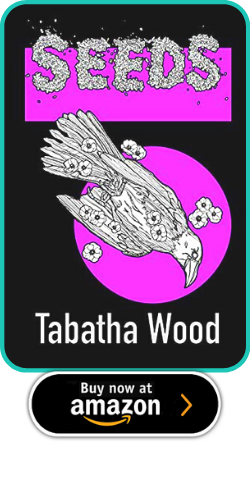
It begins with a seed. A dream. An idea, planted and encouraged to grow. A thought that buries deep down inside and puts out monstrous roots. Until at last, the bloom erupts and showers the land with life.
It begins with a seed…
The menopause brings some unusual and unexpected changes, a woman wakes up after a party in a body that isn’t hers, a teen’s life changes forever when they embrace the truth about who they are, and a lone mother tries to bury her traumatic past but instead grows a terrible future.
An unsettling selection of quiet horror and dark speculative fiction brought together in a brand new collection from Australian Shadows Award-winner, Tabatha Wood.
It begins with a seed…
The menopause brings some unusual and unexpected changes, a woman wakes up after a party in a body that isn’t hers, a teen’s life changes forever when they embrace the truth about who they are, and a lone mother tries to bury her traumatic past but instead grows a terrible future.
An unsettling selection of quiet horror and dark speculative fiction brought together in a brand new collection from Australian Shadows Award-winner, Tabatha Wood.
Articles referenced:
Murray, L. & Wood, T. Staring Down the Darkness: Discussing Horror and Mental Health with Lee Murray and Tabatha Wood
https://gingernutsofhorror.com/interviews/staring-down-the-darkness-discussing-horror-and-mental-health-with-lee-murray-and-tabatha-wood
Power, K. Don’t Look Up: a Response by Kit Power
https://gingernutsofhorror.com/features/dont-look-up-a-response-by-kit-power
Scrivner, C. et al Pandemic practice: Horror fans and morbidly curious individuals are more psychologically resilient during the COVID-19 pandemic
https://www.ncbi.nlm.nih.gov/pmc/articles/PMC7492010/
Wood, T. The Horror or Humanity and the Tao of the Black Dog
https://gingernutsofhorror.com/features/the-horror-of-humanity-tabatha-wood-and-the-tao-of-the-black-dog
Wood, T. What You Need Right Now is a Nice Soothing Horror Story
https://thespinoff.co.nz/books/19-08-2021/what-you-need-right-now-is-a-nice-soothing-horror-story
Murray, L. & Wood, T. Staring Down the Darkness: Discussing Horror and Mental Health with Lee Murray and Tabatha Wood
https://gingernutsofhorror.com/interviews/staring-down-the-darkness-discussing-horror-and-mental-health-with-lee-murray-and-tabatha-wood
Power, K. Don’t Look Up: a Response by Kit Power
https://gingernutsofhorror.com/features/dont-look-up-a-response-by-kit-power
Scrivner, C. et al Pandemic practice: Horror fans and morbidly curious individuals are more psychologically resilient during the COVID-19 pandemic
https://www.ncbi.nlm.nih.gov/pmc/articles/PMC7492010/
Wood, T. The Horror or Humanity and the Tao of the Black Dog
https://gingernutsofhorror.com/features/the-horror-of-humanity-tabatha-wood-and-the-tao-of-the-black-dog
Wood, T. What You Need Right Now is a Nice Soothing Horror Story
https://thespinoff.co.nz/books/19-08-2021/what-you-need-right-now-is-a-nice-soothing-horror-story
check out today's other articles on ginger nuts of horror
| | |
the heart and soul of horror

There is no doubt in my mind that the act of writing these stories was a significant part of the exorcism and healing process that allowed me to survive and transcend that condition. Without it, I am equally certain that I would not be here to analyse the phenomena now with the benefit of hindsight; a fact for which I am ineffably grateful.
It's an established cliché in psychological horror; the protagonist who dances on the jagged edge of sanity, haunted by phantom voices and hallucinations of their troubled pasts, their internal worlds, clutching at their temples, screwing their eyes shut, proclaiming to the voices in their heads (not to mention us, the audience): “Shut up, shut up, shut up!”
Cliche though it might be, many of us who suffer with mental health conditions understand the fundamental truth it expresses: Speaking from my own experience, it's a rare day indeed some intrusive, unwelcome voice doesn't pipe up in my thoughts, reminding me of past shames and disgraces, embarrassments and less-than-ideal encounters. In my instance, those unwelcome echoes take various forms; as well as spectral voices -which are often so clear and intrusive, they have a habit of broaching on waking reality- to visual recreations (the nature of my imagination is such that it recreates visual experiences in explicit and obsessive detail). But voices -mine, others, those of creatures, characters and entities that don't even exist- are the most common manifestations.
As an adolescent and teenager, that aspect of my mind was thrown into overdrive by the hormonal imbalances of transition into adulthood, not to mention escalating awareness of a world that -then as now- seemed more and more insane to me the more of it I encountered and explored.
Those voices and visions had a habit of becoming most active at night, the moment I turned off the light to sleep. Night time, from the age of 11 up to around 25, was a consistent horror show; a sleepless parade of ruminations, distressing stories, absurd theatres; labyrinths of thought without end or solution. I distinctly recall experiencing a strange sense of disassociation during the era; attempting to argue or reason with my own mind as though it were a separate or possessing entity intent on driving me mad:
“Look, you know we need sleep, so why won't you shut up and let me?”
Sometimes, rarely, it would acquiesce. But, for the most part, it would continue to turn and whir unabated, as though it didn't even acknowledge me, carrying me into stranger depths and dimensions, down paths of thought where atrocity, absurdity, edenic conditions and hellish dystopias, all occurred at once, where no distinction existed between demons and angels, and reality was a kaleidoscopic nightmare, apt to shatter and rearrange in the next heartbeat.
The unendurable purgatory of those nights still haunts me to this day in the form of memories; unpleasant recollections of nights deeper, darker and longer than any I've ever endured since, that seemed to stretch into eternity while I twisted in my own skin, hosted arguments that for all the world seemed parasitic, as though ghosts and demons used my skull as a furious parliament.
That species of insomnia leaves you a frayed and spectral thing in waking life. Nerves unravel, thoughts become muddled and paranoid. Everything feels jagged and hostile. The day is too bright, the world too chaotic and noisy. And yet, at the same time, everything becomes distant: you grow disinterested, dislocated; a thing apart.
Which is precisely what happened to me.
Throughout that period, I wandered half-living, half-dreaming, a thing that didn't know itself and didn't know where it was or why. On rare but extreme occasions, sleeplessness, resultant anxiety and depression conspired to make the world a demon-haunted nightmare, a place where hideous things danced at the edges of perception, where phantoms whispered all the very worst of me and the world into my mind and every moment seethed with unspoken threat. Social engagements and interactions became nigh impossible, inducing panic attacks so extreme, they often had me quivering on the ground, struggling to breathe or see through the smeared, uncertain faces of those who gathered around. University, jobs, all became sources of profound dread, the fear of my own anxiety ironically feeding that very factor, the paranoia it induced becoming self-fulfilling prophecy.
Life was not good.
It was during the latter part of this period that I began to write seriously, establishing for myself patterns, habits and routines that would evolve and endure up to this day. The first pieces to come out of that process were undoubtedly expressions -conscious or otherwise- of my own condition; a form of self-therapy that was undoubtedly essential to my survival. Had I not had that outlet, that means of expression, then I dread to think of what might have occurred (especially given that suicidal ideation was a sincere by-product of the conditions I was experiencing. A particularly insidious sub-species of the internal ghosts made it their business to make oblivion seem not only welcome, but a reasonable and rational response to a world that could do nothing but disappoint). The stories I wrote -some of which eventually became the first I ever had published- became the vessels into which I poured whatever black, metaphysical waste swilled and boiled in the alembic of my skull. They allowed me to articulate what the phantoms manifested in voice and vision, but for others, outside of my diseased, hermetic Wonderland. I don't know to what degree that experience helped to facilitate my transition out of that despairing, insomniac phase and to what degree it was an expression of it, but the chattering, insect-hive sleeplessness that bedevilled me since childhood began to recede, a slow healing process occurring in its wake.
It has taken a long, long time, a great deal of therapy, self-care and meditation on my part to get to my present state of mind, where I feel more robust and whole than I ever have. Many of those old scars and fractures still exist, and flare up from time to time, but never to the same degree or with the same self-destructive power as they did back then.
The stories that came out of that period are, perhaps unsurprisingly, all explorations of despair, dissatisfaction and diseased states of mind. Every protagonist is damaged, dislocated, divorced from themselves and the world in some fundamental way (some to such extremes that they take pains to actively break and reinvent it). Some are more direct than others, some more deliberate (for the most part, I would say that the issues they broach are subconscious, not actively occurring to me until after the fact of their writing). Perhaps the most direct and deliberate of all is the short story Brain Food, originally published in 2013 by the then Dark Moon Books. Brain Food was originally my attempt to lampoon the standard “zombie story” by conflating the condition of zombie-ism with insomnia (part of the experience for me was that sense as of being the walking dead, shuffling, mindless, unfocussed and inarticulate, vaguely resembling humanity but in the most dishevelled, disgraceful way imaginable). However, the story swelled into a more sincere confessional than I initially hoped:
Here, the insomniac protagonist not only conflates his condition with that of the living dead, he begins to succumb to his paranoia, believing that his own brain is some alien parasite slowly driving him mad with its constant chatter. In the grizzly climax, he takes kitchen knives, screwdrivers and eventually a power-drill to his skull in an effort to extirpate the parasite. What certainly surprised me at the time of writing was the conclusion: far from expiring, he wakes in his newly liberated condition to find that he was right all along: the alien parasite that he'd been conditioned to call his own brain flops feebly on the ground, while he rises to a new condition in which he is sublimely connected to the world and all humanity via systems and circuits he'd heretofore been blinded to. Before setting out on his quest to emancipate the rest of humanity, he messily devours the parasite, ensuring it can never take hold of him again (“Braaaiiins. Brrraaaaaiiiinnsss!”).
Though I didn't realise it at the time, the story served as far more than a deep dive into whatever psychological issues I was experiencing: Though it certainly stands as one of the most direct confrontations of those issues, it also expands into concerns beyond the merely personal (a fact I did not realise until the story was published and others pointed it out to me). As with most of the stories comprised within Strange Playgrounds, there is a Utopianism born of the intense despair and extreme states of mind the story explores. The protagonist -as in many of the other stories- uses the innate disassociation of their condition to draw back from society, from culture and realise that they are insufficient to his needs, his wants, his visions of today and tomorrow, and thereby transforms himself, setting out to initiate a more profound and expansive renaissance that -the story implies- will change the very definition of humanity.
In this, the story acts as an unconscious confessional; consigning to paper the concerns and unspoken preoccupations that are part and parcel of who I am and that have never dimmed or died away. That fundamental dissatisfaction with the states and conditions we are born to, with the templates of identity and destiny that tradition proscribes, is a fundamental factor in determining the shape and nature of my own state of mind, not to mention the stories that spew from it. If there is anything I intend -conscious or otherwise- through my writing, it is to initiate transformation: to alter and unpick assumptions, to initiate cataclysms across the mental topographies of my readers (and myself, during the act of writing).
Brain Food, alongside most of my other published works, evinces, at its core, a profound dissatisfaction with the state of things, that may be insolulable, as it is not only a dissatisfaction with the traditions on which society is built, but also with the fundamental states of our humanity. Almost every character in every story of Strange Playgrounds experiences some shift away from that state, for better or worse, and, whilst those transitions are often traumatic, they are also potent and celebratory, suggesting states of being and operation beyond those the characters can no longer abide. The violent self-mutilation of Brain Food's protagonist is not merely a matter of prurience or a desire to shock with its graphic nature, but an expression of the traumas and agonies that are part and parcel of such transformations; when old assumptions of who we are and what we should be are cast off. All too often, it requires trauma or catastrophe of one kind or another to facilitate those transformations, to speed them on their ways. As I did shortly before the time of writing, the protagonist reaches a depth of despair, a state of extremis, that is unendurable, in which survival in the same state becomes untenable. In that, he also encapsulates the suicidal ideation that has been part and parcel of my psychology since around the age of 8 years old. All too often, the condition is insidiously reasonable, as it is here; part of its particular virulence is that it does not make itself feel necessarily extreme or unreasonable. If anything, it takes pains to ensure it is the perfect reflection of sanity and consideration; the only sane option in an insane world.
There is no doubt in my mind that the act of writing these stories was a significant part of the exorcism and healing process that allowed me to survive and transcend that condition. Without it, I am equally certain that I would not be here to analyse the phenomena now with the benefit of hindsight; a fact for which I am ineffably grateful.
Cliche though it might be, many of us who suffer with mental health conditions understand the fundamental truth it expresses: Speaking from my own experience, it's a rare day indeed some intrusive, unwelcome voice doesn't pipe up in my thoughts, reminding me of past shames and disgraces, embarrassments and less-than-ideal encounters. In my instance, those unwelcome echoes take various forms; as well as spectral voices -which are often so clear and intrusive, they have a habit of broaching on waking reality- to visual recreations (the nature of my imagination is such that it recreates visual experiences in explicit and obsessive detail). But voices -mine, others, those of creatures, characters and entities that don't even exist- are the most common manifestations.
As an adolescent and teenager, that aspect of my mind was thrown into overdrive by the hormonal imbalances of transition into adulthood, not to mention escalating awareness of a world that -then as now- seemed more and more insane to me the more of it I encountered and explored.
Those voices and visions had a habit of becoming most active at night, the moment I turned off the light to sleep. Night time, from the age of 11 up to around 25, was a consistent horror show; a sleepless parade of ruminations, distressing stories, absurd theatres; labyrinths of thought without end or solution. I distinctly recall experiencing a strange sense of disassociation during the era; attempting to argue or reason with my own mind as though it were a separate or possessing entity intent on driving me mad:
“Look, you know we need sleep, so why won't you shut up and let me?”
Sometimes, rarely, it would acquiesce. But, for the most part, it would continue to turn and whir unabated, as though it didn't even acknowledge me, carrying me into stranger depths and dimensions, down paths of thought where atrocity, absurdity, edenic conditions and hellish dystopias, all occurred at once, where no distinction existed between demons and angels, and reality was a kaleidoscopic nightmare, apt to shatter and rearrange in the next heartbeat.
The unendurable purgatory of those nights still haunts me to this day in the form of memories; unpleasant recollections of nights deeper, darker and longer than any I've ever endured since, that seemed to stretch into eternity while I twisted in my own skin, hosted arguments that for all the world seemed parasitic, as though ghosts and demons used my skull as a furious parliament.
That species of insomnia leaves you a frayed and spectral thing in waking life. Nerves unravel, thoughts become muddled and paranoid. Everything feels jagged and hostile. The day is too bright, the world too chaotic and noisy. And yet, at the same time, everything becomes distant: you grow disinterested, dislocated; a thing apart.
Which is precisely what happened to me.
Throughout that period, I wandered half-living, half-dreaming, a thing that didn't know itself and didn't know where it was or why. On rare but extreme occasions, sleeplessness, resultant anxiety and depression conspired to make the world a demon-haunted nightmare, a place where hideous things danced at the edges of perception, where phantoms whispered all the very worst of me and the world into my mind and every moment seethed with unspoken threat. Social engagements and interactions became nigh impossible, inducing panic attacks so extreme, they often had me quivering on the ground, struggling to breathe or see through the smeared, uncertain faces of those who gathered around. University, jobs, all became sources of profound dread, the fear of my own anxiety ironically feeding that very factor, the paranoia it induced becoming self-fulfilling prophecy.
Life was not good.
It was during the latter part of this period that I began to write seriously, establishing for myself patterns, habits and routines that would evolve and endure up to this day. The first pieces to come out of that process were undoubtedly expressions -conscious or otherwise- of my own condition; a form of self-therapy that was undoubtedly essential to my survival. Had I not had that outlet, that means of expression, then I dread to think of what might have occurred (especially given that suicidal ideation was a sincere by-product of the conditions I was experiencing. A particularly insidious sub-species of the internal ghosts made it their business to make oblivion seem not only welcome, but a reasonable and rational response to a world that could do nothing but disappoint). The stories I wrote -some of which eventually became the first I ever had published- became the vessels into which I poured whatever black, metaphysical waste swilled and boiled in the alembic of my skull. They allowed me to articulate what the phantoms manifested in voice and vision, but for others, outside of my diseased, hermetic Wonderland. I don't know to what degree that experience helped to facilitate my transition out of that despairing, insomniac phase and to what degree it was an expression of it, but the chattering, insect-hive sleeplessness that bedevilled me since childhood began to recede, a slow healing process occurring in its wake.
It has taken a long, long time, a great deal of therapy, self-care and meditation on my part to get to my present state of mind, where I feel more robust and whole than I ever have. Many of those old scars and fractures still exist, and flare up from time to time, but never to the same degree or with the same self-destructive power as they did back then.
The stories that came out of that period are, perhaps unsurprisingly, all explorations of despair, dissatisfaction and diseased states of mind. Every protagonist is damaged, dislocated, divorced from themselves and the world in some fundamental way (some to such extremes that they take pains to actively break and reinvent it). Some are more direct than others, some more deliberate (for the most part, I would say that the issues they broach are subconscious, not actively occurring to me until after the fact of their writing). Perhaps the most direct and deliberate of all is the short story Brain Food, originally published in 2013 by the then Dark Moon Books. Brain Food was originally my attempt to lampoon the standard “zombie story” by conflating the condition of zombie-ism with insomnia (part of the experience for me was that sense as of being the walking dead, shuffling, mindless, unfocussed and inarticulate, vaguely resembling humanity but in the most dishevelled, disgraceful way imaginable). However, the story swelled into a more sincere confessional than I initially hoped:
Here, the insomniac protagonist not only conflates his condition with that of the living dead, he begins to succumb to his paranoia, believing that his own brain is some alien parasite slowly driving him mad with its constant chatter. In the grizzly climax, he takes kitchen knives, screwdrivers and eventually a power-drill to his skull in an effort to extirpate the parasite. What certainly surprised me at the time of writing was the conclusion: far from expiring, he wakes in his newly liberated condition to find that he was right all along: the alien parasite that he'd been conditioned to call his own brain flops feebly on the ground, while he rises to a new condition in which he is sublimely connected to the world and all humanity via systems and circuits he'd heretofore been blinded to. Before setting out on his quest to emancipate the rest of humanity, he messily devours the parasite, ensuring it can never take hold of him again (“Braaaiiins. Brrraaaaaiiiinnsss!”).
Though I didn't realise it at the time, the story served as far more than a deep dive into whatever psychological issues I was experiencing: Though it certainly stands as one of the most direct confrontations of those issues, it also expands into concerns beyond the merely personal (a fact I did not realise until the story was published and others pointed it out to me). As with most of the stories comprised within Strange Playgrounds, there is a Utopianism born of the intense despair and extreme states of mind the story explores. The protagonist -as in many of the other stories- uses the innate disassociation of their condition to draw back from society, from culture and realise that they are insufficient to his needs, his wants, his visions of today and tomorrow, and thereby transforms himself, setting out to initiate a more profound and expansive renaissance that -the story implies- will change the very definition of humanity.
In this, the story acts as an unconscious confessional; consigning to paper the concerns and unspoken preoccupations that are part and parcel of who I am and that have never dimmed or died away. That fundamental dissatisfaction with the states and conditions we are born to, with the templates of identity and destiny that tradition proscribes, is a fundamental factor in determining the shape and nature of my own state of mind, not to mention the stories that spew from it. If there is anything I intend -conscious or otherwise- through my writing, it is to initiate transformation: to alter and unpick assumptions, to initiate cataclysms across the mental topographies of my readers (and myself, during the act of writing).
Brain Food, alongside most of my other published works, evinces, at its core, a profound dissatisfaction with the state of things, that may be insolulable, as it is not only a dissatisfaction with the traditions on which society is built, but also with the fundamental states of our humanity. Almost every character in every story of Strange Playgrounds experiences some shift away from that state, for better or worse, and, whilst those transitions are often traumatic, they are also potent and celebratory, suggesting states of being and operation beyond those the characters can no longer abide. The violent self-mutilation of Brain Food's protagonist is not merely a matter of prurience or a desire to shock with its graphic nature, but an expression of the traumas and agonies that are part and parcel of such transformations; when old assumptions of who we are and what we should be are cast off. All too often, it requires trauma or catastrophe of one kind or another to facilitate those transformations, to speed them on their ways. As I did shortly before the time of writing, the protagonist reaches a depth of despair, a state of extremis, that is unendurable, in which survival in the same state becomes untenable. In that, he also encapsulates the suicidal ideation that has been part and parcel of my psychology since around the age of 8 years old. All too often, the condition is insidiously reasonable, as it is here; part of its particular virulence is that it does not make itself feel necessarily extreme or unreasonable. If anything, it takes pains to ensure it is the perfect reflection of sanity and consideration; the only sane option in an insane world.
There is no doubt in my mind that the act of writing these stories was a significant part of the exorcism and healing process that allowed me to survive and transcend that condition. Without it, I am equally certain that I would not be here to analyse the phenomena now with the benefit of hindsight; a fact for which I am ineffably grateful.
Born in Blood: Volume Two
by George Daniel Lea
Part of: Born in Blood (2 books)
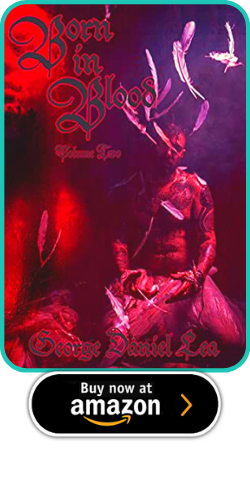
The second volume of George Daniel Lea’s Born in Blood, a collection of beautiful horror stories guaranteed to burn a hole in your heart.
SOMEWHERE BETWEEN HIGH HEAVEN AND LOW HELLBorn in blood . . . the first breath and all that follow, tainted by original trauma, echoing throughout every thought, every heartbeat; blossoming into more profound pain, until breath and thought both cease . . .
What we grow accustomed to . . . what we can endure:
The days bleed into one another, as we do; hurt defining every moment.
No more. Now, all instants are one; pulsing brilliant, ecstasy and agony, rendered down; experienced in a heartbeat.
Every shame. Every sorrow. Humanity, history. This is what we are; the God we gave birth to.
Better? Yes. Yes. Now, we all suffer the same; no more division; no privilege or powerlessness. We are the same; sexless, skinless, ex sanguine.
And we celebrate, content in our disgrace.
SOMEWHERE BETWEEN HIGH HEAVEN AND LOW HELLBorn in blood . . . the first breath and all that follow, tainted by original trauma, echoing throughout every thought, every heartbeat; blossoming into more profound pain, until breath and thought both cease . . .
What we grow accustomed to . . . what we can endure:
The days bleed into one another, as we do; hurt defining every moment.
No more. Now, all instants are one; pulsing brilliant, ecstasy and agony, rendered down; experienced in a heartbeat.
Every shame. Every sorrow. Humanity, history. This is what we are; the God we gave birth to.
Better? Yes. Yes. Now, we all suffer the same; no more division; no privilege or powerlessness. We are the same; sexless, skinless, ex sanguine.
And we celebrate, content in our disgrace.
CHECK OUT TODAY'S OTHER HORROR ARTICLES
 | |
THE HEART AND SOUL OF HORROR PROMOTION

The old advice “write what you know” seems to apply here to some extent, but as well as writing about my childhood, a great deal of the High Moor books was me “writing to get to know myself”, although I didn’t realise this at the time.
In many of the guides that I read before starting work on the first High Moor book, the idea of theme was more important than the actual plot of characterisation. The theme corresponded to the message that the book was trying to get across in many ways.
I did not think of it that way when I started writing the books. Themes were, I thought, something for the more literary novel. It was not something that I consciously picked up on most of the time when I read a book for pleasure, and it certainly was not something I intended to put into my own work. However, I had a rough idea of what I wanted each novel to be about and the format of the work. The first High Moor novel was a coming-of-age tale for reasons I mentioned in the first author note. Moonstruck was written as a high-intensity chase thriller for the most part, and Bloodmoon was an epic scale action movie with political and humanitarian overtones. Mostly, though, I was interested in character first, then plot, and that was it.
Despite that, some themes managed to sneak their way into the story. The idea that seemingly small actions can have enormous consequences years later is present throughout all three books. Another is that, despite the fangs and claws of the werewolves, people are often the real monsters (a theme present mainly in High Moor and Bloodmoon). And a large one was that things are rarely black and white – each character is the hero of their own story, and often they can justify their actions in terms of the greater good. There are no purely good or evil characters in this series. Everyone has their own motivations, and things really get interesting when those motivations clash.
However, the central theme of these books and the element of werewolf lore that is the most original to this series is that of mental illness.
There are three types of werewolves in my books. The first ones we encounter are the moonstruck, like Mirela and John. The moonstruck werewolf may not even realise what they are. They fight against the wolf inside of them, trying to suppress it until, under a full moon, the wolf side of their nature becomes too strong to contain. It breaks free – but only partially. The afflicted individuals are caught in a midway state between man and beast – the classic bi-pedal wolf-man. These creatures are all pain, rage, and instinct in a seven-foot frame. So it is hardly a surprise that they are as dangerous as they are, even to other werewolves. With Mirela, she became moonstruck because of her Alzheimer’s - as she lost the ability to remember or understand, the presence of that wolf within her became confusing and terrifying, so she fought against it. In John’s case, perhaps things may have been different if his parents didn’t keep telling him to fight it over and over again when he was a child.
The second type of werewolf in the books are the wolves of The Pack. These werewolves accept that animal part of themselves and live in a symbiotic relationship with it. They are at one with their other half and can transform at will into a huge quadruped wolf. Yet, they retain their human intellect and utilise some of the wolf’s gifts in human form, such as enhanced senses, strength, and endurance.
The last type of werewolf in my mythology is the person that loses themselves entirely to the wolf within. In the first High Moor book, we see this when Malcolm recoils from Lizzy Fletcher’s assault, and the wolf takes over because it sees him as weak. We also see something of this with Marie and Michael in Bloodmoon, where they remain in their Wolfen forms for so long that they begin to forget what it was to be human.
Crucially, these three distinct types of werewolves are all products of the same curse. The only difference between them is the state of mind of the afflicted. I was pretty happy at this definition of my own particular brand of lycanthropy as it neatly tied together the three different cinematic versions of the werewolf. But my fiction was undoubtedly not the first to look at mental illness as part of the werewolf’s curse.
Lycanthropy was referenced as being caused by “melancholia or an excess of black bile” as far back as the seventh century. It was referred to by James VI in his 1597 book Daemonologie “an excess of melancholy as the culprit which causes some men to believe that they are wolves and to ‘counterfeit’ the actions of these animals”. Modern science believes that lycanthropy, rather than being an illness in and of itself, is linked to other neurological conditions. These include schizophrenia, bipolar disorder, clinical depression, and body dysmorphia. Even in fiction and movies, works such as The Howling have explicit themes of the battle between civilised man and the animal within.
When I was writing High Moor, I was not consciously aware that I was looking at mental health as an underlying theme of the book. But when I was diagnosed as suffering from borderline personality disorder in 2018, three years after I finished Bloodmoon, some of the pieces began to click into place.
I want to make something clear at this stage. I do not and have never suffered from lycanthropy. I do not believe I turn into a wolf. Right? However, there are elements of my illness that have certain parallels to the behaviour of a moonstruck werewolf, and I think that may have been something I was trying to explore in the books.
Let me walk you through a borderline episode so that you have a better understanding of what I mean.
First, there is a triggering incident. Until that happens, I am going about my day like anyone else – flawed but normal and functional in most respects. Then something happens. My triggers are often focused on either mass disapproval or me doing something inadvertently that upsets someone that I care about. I will become a little withdrawn at this, smile, and continue to function, but inside, I will be in torment. Because part of the condition is a vastly enhanced emotional range, the trigger is generally anything that feeds into my fear of abandonment. This is what I refer to as Stage 1.
If nothing else happens for a day or so, the Stage 1 attack will fade, and it will be as if nothing happened. But that is rarely the case because my behaviour will have changed to invite a further triggering stimulus. And when the following perceived incident occurs, I metaphorically sprout fangs. Welcome to Stage 2. This is the point where I will be overcome with the self-inflicted torment over what has happened. I cannot think clearly. I am in absolute emotional agony – close to what an average person would feel over, say, the death of a beloved cat or dog. I will try to distance myself from everyone and literally lock myself away in the same manner that John does at the start of the first book. I will literally do anything to make the pain stop. This includes drinking alcohol to excess to numb the emotions and begin fixating on confronting my biggest fear (abandonment) by willing it into existence – getting it over with, in other words.
That is when Stage 3 happens. Once I hit Stage 3, then all bets are off. I have little or no control over my behaviour. I will have fixated on a course of action. Usually, the first “solution” that has presented itself to me, and I will go at it with a single-minded determination that is quite terrifying. At this stage, it is as if I am on rails and will continue along this track until I have achieved my objective. This usually brings about the worst-case scenario and blows my life up. In some instances, that has taken me to a very dark place indeed. As soon as I reach my objective or am prevented from achieving it for a prolonged period (about a day), I start coming out the other side. I am left to survey the carnage that I have created and deal with the consequences. Much like a moonstruck werewolf waking up in the morning, covered in the blood and entrails of his victims, only without the viscera.
It is hardly surprising that before I was diagnosed and treated, I was left trying to make sense of these periodic losses of control and loss of self. And like John, once I had the proper treatment and guidance, I was able to some extent to come to terms with that side of my nature. Recognise the beginnings of a Stage 1 event, and take steps to contain it. These episodes are far less frequent, and generally, when they do occur, they tend not to be as severe. I still have some way to go, but I have made real progress on living with my own beast within. Counselling and therapy have given me the tools to understand the condition and deal with it. Antidepressants keep my emotional range within acceptable parameters. And I’m learning that my need to control things around me to keep myself safe, quite often, is counter-productive.
The old advice “write what you know” seems to apply here to some extent, but as well as writing about my childhood, a great deal of the High Moor books was me “writing to get to know myself”, although I didn’t realise this at the time. Using fiction to explore, express and ultimately understand parts of my nature that terrify me. As a result, even if these books had not sold a single copy, I think they would have been worth the journey because I now understand my own beast that little bit better.
I did not think of it that way when I started writing the books. Themes were, I thought, something for the more literary novel. It was not something that I consciously picked up on most of the time when I read a book for pleasure, and it certainly was not something I intended to put into my own work. However, I had a rough idea of what I wanted each novel to be about and the format of the work. The first High Moor novel was a coming-of-age tale for reasons I mentioned in the first author note. Moonstruck was written as a high-intensity chase thriller for the most part, and Bloodmoon was an epic scale action movie with political and humanitarian overtones. Mostly, though, I was interested in character first, then plot, and that was it.
Despite that, some themes managed to sneak their way into the story. The idea that seemingly small actions can have enormous consequences years later is present throughout all three books. Another is that, despite the fangs and claws of the werewolves, people are often the real monsters (a theme present mainly in High Moor and Bloodmoon). And a large one was that things are rarely black and white – each character is the hero of their own story, and often they can justify their actions in terms of the greater good. There are no purely good or evil characters in this series. Everyone has their own motivations, and things really get interesting when those motivations clash.
However, the central theme of these books and the element of werewolf lore that is the most original to this series is that of mental illness.
There are three types of werewolves in my books. The first ones we encounter are the moonstruck, like Mirela and John. The moonstruck werewolf may not even realise what they are. They fight against the wolf inside of them, trying to suppress it until, under a full moon, the wolf side of their nature becomes too strong to contain. It breaks free – but only partially. The afflicted individuals are caught in a midway state between man and beast – the classic bi-pedal wolf-man. These creatures are all pain, rage, and instinct in a seven-foot frame. So it is hardly a surprise that they are as dangerous as they are, even to other werewolves. With Mirela, she became moonstruck because of her Alzheimer’s - as she lost the ability to remember or understand, the presence of that wolf within her became confusing and terrifying, so she fought against it. In John’s case, perhaps things may have been different if his parents didn’t keep telling him to fight it over and over again when he was a child.
The second type of werewolf in the books are the wolves of The Pack. These werewolves accept that animal part of themselves and live in a symbiotic relationship with it. They are at one with their other half and can transform at will into a huge quadruped wolf. Yet, they retain their human intellect and utilise some of the wolf’s gifts in human form, such as enhanced senses, strength, and endurance.
The last type of werewolf in my mythology is the person that loses themselves entirely to the wolf within. In the first High Moor book, we see this when Malcolm recoils from Lizzy Fletcher’s assault, and the wolf takes over because it sees him as weak. We also see something of this with Marie and Michael in Bloodmoon, where they remain in their Wolfen forms for so long that they begin to forget what it was to be human.
Crucially, these three distinct types of werewolves are all products of the same curse. The only difference between them is the state of mind of the afflicted. I was pretty happy at this definition of my own particular brand of lycanthropy as it neatly tied together the three different cinematic versions of the werewolf. But my fiction was undoubtedly not the first to look at mental illness as part of the werewolf’s curse.
Lycanthropy was referenced as being caused by “melancholia or an excess of black bile” as far back as the seventh century. It was referred to by James VI in his 1597 book Daemonologie “an excess of melancholy as the culprit which causes some men to believe that they are wolves and to ‘counterfeit’ the actions of these animals”. Modern science believes that lycanthropy, rather than being an illness in and of itself, is linked to other neurological conditions. These include schizophrenia, bipolar disorder, clinical depression, and body dysmorphia. Even in fiction and movies, works such as The Howling have explicit themes of the battle between civilised man and the animal within.
When I was writing High Moor, I was not consciously aware that I was looking at mental health as an underlying theme of the book. But when I was diagnosed as suffering from borderline personality disorder in 2018, three years after I finished Bloodmoon, some of the pieces began to click into place.
I want to make something clear at this stage. I do not and have never suffered from lycanthropy. I do not believe I turn into a wolf. Right? However, there are elements of my illness that have certain parallels to the behaviour of a moonstruck werewolf, and I think that may have been something I was trying to explore in the books.
Let me walk you through a borderline episode so that you have a better understanding of what I mean.
First, there is a triggering incident. Until that happens, I am going about my day like anyone else – flawed but normal and functional in most respects. Then something happens. My triggers are often focused on either mass disapproval or me doing something inadvertently that upsets someone that I care about. I will become a little withdrawn at this, smile, and continue to function, but inside, I will be in torment. Because part of the condition is a vastly enhanced emotional range, the trigger is generally anything that feeds into my fear of abandonment. This is what I refer to as Stage 1.
If nothing else happens for a day or so, the Stage 1 attack will fade, and it will be as if nothing happened. But that is rarely the case because my behaviour will have changed to invite a further triggering stimulus. And when the following perceived incident occurs, I metaphorically sprout fangs. Welcome to Stage 2. This is the point where I will be overcome with the self-inflicted torment over what has happened. I cannot think clearly. I am in absolute emotional agony – close to what an average person would feel over, say, the death of a beloved cat or dog. I will try to distance myself from everyone and literally lock myself away in the same manner that John does at the start of the first book. I will literally do anything to make the pain stop. This includes drinking alcohol to excess to numb the emotions and begin fixating on confronting my biggest fear (abandonment) by willing it into existence – getting it over with, in other words.
That is when Stage 3 happens. Once I hit Stage 3, then all bets are off. I have little or no control over my behaviour. I will have fixated on a course of action. Usually, the first “solution” that has presented itself to me, and I will go at it with a single-minded determination that is quite terrifying. At this stage, it is as if I am on rails and will continue along this track until I have achieved my objective. This usually brings about the worst-case scenario and blows my life up. In some instances, that has taken me to a very dark place indeed. As soon as I reach my objective or am prevented from achieving it for a prolonged period (about a day), I start coming out the other side. I am left to survey the carnage that I have created and deal with the consequences. Much like a moonstruck werewolf waking up in the morning, covered in the blood and entrails of his victims, only without the viscera.
It is hardly surprising that before I was diagnosed and treated, I was left trying to make sense of these periodic losses of control and loss of self. And like John, once I had the proper treatment and guidance, I was able to some extent to come to terms with that side of my nature. Recognise the beginnings of a Stage 1 event, and take steps to contain it. These episodes are far less frequent, and generally, when they do occur, they tend not to be as severe. I still have some way to go, but I have made real progress on living with my own beast within. Counselling and therapy have given me the tools to understand the condition and deal with it. Antidepressants keep my emotional range within acceptable parameters. And I’m learning that my need to control things around me to keep myself safe, quite often, is counter-productive.
The old advice “write what you know” seems to apply here to some extent, but as well as writing about my childhood, a great deal of the High Moor books was me “writing to get to know myself”, although I didn’t realise this at the time. Using fiction to explore, express and ultimately understand parts of my nature that terrify me. As a result, even if these books had not sold a single copy, I think they would have been worth the journey because I now understand my own beast that little bit better.
High Moor 10th Anniversary Limited Edition Box Set – Slipcased, Signed and Numbered
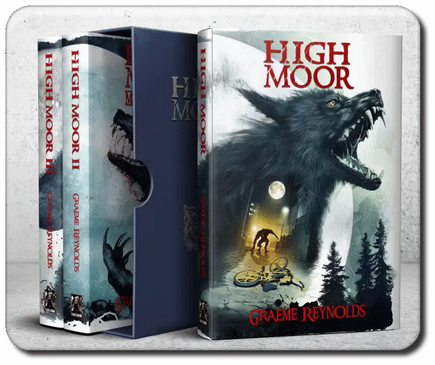
Horrific Tales Publishing are pleased to be able to offer a signed, numbered and slipcased limited edition boxed set of Graeme Reynolds High Moor Trilogy, to celebrate the 10th anniversary of the first novel’s publication.
Each book will be an 8.5 x 5.5 dust jacketed, case laminate edition with new cover art by Ben Baldwin.
In addition, each book will contain illustrations by Michelle Merlini, additional stories and novelettes set in the High Moor Universe (some of which have never before been published) and a series of short essays by the author that explore some of the influences for the novels, and some of the themes used in the series.
High Moor 10th Anniversary Edition Bonus Material:
Blood Relations (A High Moor Story)
Moonstruck 10th Anniversary Edition Bonus Material:
One of Those Things
Beware The Moon
Blood Moon 10th Anniversary Edition Bonus Material
The Hunt
Unnatural (Prologue)
The production of this box set will be limited to One Hundred and Fifty units only.
We now offer the ability to split payments with Klarna for UK based customers.
Purchase a copy here
High Moor
When John Simpson hears of a bizarre animal attack in his old home town of High Moor, it stirs memories of a long forgotten horror. John knows the truth. A werewolf stalks the town once more, and on the night of the next full moon, the killing will begin again. He should know. He survived a werewolf attack in 1986, during the worst year of his life.
It’s 1986 and the town is gripped in terror after the mutilated corpse of a young boy is found in the woods. When Sergeant Steven Wilkinson begins an investigation, with the help of a specialist hunter, he soon realises that this is no ordinary animal attack. Werewolves are real, and the trail of bodies is just beginning, with young John and his friends smack in the middle of it.
Twenty years later, John returns to High Moor. The latest attack involved one of his childhood enemies, but there’s more going on than meets the eye. The consequences of his past actions, the reappearance of an old flame and a dying man who will either save or damn him are the least of his problems. The night of the full moon is approaching and time is running out.
But how can he hope to stop a werewolf, when every full moon he transforms into a bloodthirsty monster himself?
High Moor is the highest rated werewolf horror series on Amazon, and with good reason. Check out the reviews below.
"Graeme Reynolds has written a real-deal werewolf story. In these dull days of nice, friendly lycanthropes, it is refreshing to see some brutality and animal instincts in what is a very fine British horror novel. Reynolds draws vivid pictures with words. His descriptions of High Moor the town is excellent, portraying an area in decay, one that suffered during the 1980s, and has yet to recover into the 21st century. The transformation scenes, where humans become wolves, are brilliantly done, and you can feel every crack of bone, every tear of flesh. High Moor is a worthy addition to the werewolf canon. - Thomas Emson, Author of Maneater, Prey, Skarlet, Krimson, Zombie Britannica"
Ripe for a film or TV adaptation and left open for a sequel, High Moor is an excellent example of great British writing that deserves to be read. - Starburst Magazine. 9/10
If you’re craving some good werewolf action with well-developed characters and a fantastic plot, skip the Hollywood films and go straight for this electrifying novel, which is far more entertaining. - Hellnotes.com
Graeme Reynolds has written a captivating, action packed, this-should-be-a-movie werewolf novel in High Moor and if this is going to be a series of some sort, count me in for the ride. It should be a fun one. - Horrortalk.com
This is an action filled horror novel that also has fully realized characters; the fact that Reynolds brings the characters to life so well just adds to the terror you feel as a reader. - The Horrifically Horrifying Horror Blog
It takes a writer of tremendous skill to imbue a an action packed novel with as much depth, as is displayed here. This book was a joy to read, not just for its ability to transport me back to a time gone by, but also because it is so well written. If this is the level of writing Graeme is capable of producing in a début novel, then I for one cannot wait for his next novel. - Gingernuts of Horror
Each book will be an 8.5 x 5.5 dust jacketed, case laminate edition with new cover art by Ben Baldwin.
In addition, each book will contain illustrations by Michelle Merlini, additional stories and novelettes set in the High Moor Universe (some of which have never before been published) and a series of short essays by the author that explore some of the influences for the novels, and some of the themes used in the series.
High Moor 10th Anniversary Edition Bonus Material:
Blood Relations (A High Moor Story)
Moonstruck 10th Anniversary Edition Bonus Material:
One of Those Things
Beware The Moon
Blood Moon 10th Anniversary Edition Bonus Material
The Hunt
Unnatural (Prologue)
The production of this box set will be limited to One Hundred and Fifty units only.
We now offer the ability to split payments with Klarna for UK based customers.
Purchase a copy here
High Moor
When John Simpson hears of a bizarre animal attack in his old home town of High Moor, it stirs memories of a long forgotten horror. John knows the truth. A werewolf stalks the town once more, and on the night of the next full moon, the killing will begin again. He should know. He survived a werewolf attack in 1986, during the worst year of his life.
It’s 1986 and the town is gripped in terror after the mutilated corpse of a young boy is found in the woods. When Sergeant Steven Wilkinson begins an investigation, with the help of a specialist hunter, he soon realises that this is no ordinary animal attack. Werewolves are real, and the trail of bodies is just beginning, with young John and his friends smack in the middle of it.
Twenty years later, John returns to High Moor. The latest attack involved one of his childhood enemies, but there’s more going on than meets the eye. The consequences of his past actions, the reappearance of an old flame and a dying man who will either save or damn him are the least of his problems. The night of the full moon is approaching and time is running out.
But how can he hope to stop a werewolf, when every full moon he transforms into a bloodthirsty monster himself?
High Moor is the highest rated werewolf horror series on Amazon, and with good reason. Check out the reviews below.
"Graeme Reynolds has written a real-deal werewolf story. In these dull days of nice, friendly lycanthropes, it is refreshing to see some brutality and animal instincts in what is a very fine British horror novel. Reynolds draws vivid pictures with words. His descriptions of High Moor the town is excellent, portraying an area in decay, one that suffered during the 1980s, and has yet to recover into the 21st century. The transformation scenes, where humans become wolves, are brilliantly done, and you can feel every crack of bone, every tear of flesh. High Moor is a worthy addition to the werewolf canon. - Thomas Emson, Author of Maneater, Prey, Skarlet, Krimson, Zombie Britannica"
Ripe for a film or TV adaptation and left open for a sequel, High Moor is an excellent example of great British writing that deserves to be read. - Starburst Magazine. 9/10
If you’re craving some good werewolf action with well-developed characters and a fantastic plot, skip the Hollywood films and go straight for this electrifying novel, which is far more entertaining. - Hellnotes.com
Graeme Reynolds has written a captivating, action packed, this-should-be-a-movie werewolf novel in High Moor and if this is going to be a series of some sort, count me in for the ride. It should be a fun one. - Horrortalk.com
This is an action filled horror novel that also has fully realized characters; the fact that Reynolds brings the characters to life so well just adds to the terror you feel as a reader. - The Horrifically Horrifying Horror Blog
It takes a writer of tremendous skill to imbue a an action packed novel with as much depth, as is displayed here. This book was a joy to read, not just for its ability to transport me back to a time gone by, but also because it is so well written. If this is the level of writing Graeme is capable of producing in a début novel, then I for one cannot wait for his next novel. - Gingernuts of Horror
ABOUT GRAEME REYNOLDS
Graeme Reynolds was born in England in 1971. Over the years, he has been an electronic engineer in the Royal Airforce, worked with special needs children and been a teenage mutant ninja turtle (don't ask).
He started writing in 2008, and has had over thirty short stories published in various ezines and anthologies before the publication of his first novel, High Moor, in 2011.
When he is not breaking computers for money, he hides in a remote Welsh valley and dreams up new ways to offend people with delicate sensibilities.
He started writing in 2008, and has had over thirty short stories published in various ezines and anthologies before the publication of his first novel, High Moor, in 2011.
When he is not breaking computers for money, he hides in a remote Welsh valley and dreams up new ways to offend people with delicate sensibilities.
Check out today's other articles
 | |
the heart and soul of horror websites

Ginger Nuts of Horror presents a giveaway for The House of Drought by Dennis Mombauer, a haunted house tale for the climate change era, as well as an excerpt from the novel and video reading from the book from Dennis.
To entry the giveaway please complete the Rafflecopter entry form at the end if the article.
To entry the giveaway please complete the Rafflecopter entry form at the end if the article.
About the Book
A HAUNTED HOUSE FOR THE CLIMATE CHANGE ERA. On the island of Sri Lanka, at a colonial mansion between the forest and the paddy fields, a caretaker arrives with four children in tow after pledging to keep them safe. When violent thugs storm the house demanding that Ushu repay his debt, young Jasmit and the other children hide in an upstairs bathroom where a running tap opens a gateway to escape. But the Dry House is not the only force at work in the place where the forest and the estate meet—something else stirs in the trees, something ancient, something that demands retribution.
The Sap Mother bides her time, watching and learning from the house’s inhabitants. She burrows beneath the foundations of the Dry House, hungry for atonement. Pulled between these warring powers, Jasmit must choose between saving those trapped in the mansion’s bulging stomachs and preparing the house for when the Mother emerges again.
A HAUNTED HOUSE FOR THE CLIMATE CHANGE ERA. On the island of Sri Lanka, at a colonial mansion between the forest and the paddy fields, a caretaker arrives with four children in tow after pledging to keep them safe. When violent thugs storm the house demanding that Ushu repay his debt, young Jasmit and the other children hide in an upstairs bathroom where a running tap opens a gateway to escape. But the Dry House is not the only force at work in the place where the forest and the estate meet—something else stirs in the trees, something ancient, something that demands retribution.
The Sap Mother bides her time, watching and learning from the house’s inhabitants. She burrows beneath the foundations of the Dry House, hungry for atonement. Pulled between these warring powers, Jasmit must choose between saving those trapped in the mansion’s bulging stomachs and preparing the house for when the Mother emerges again.
Preorder Link: https://www.stelliform.press/index.php/product/the-house-of-drought-by-dennis-mombauer/
Excerpt From The House of Drought
“Uncle Ushu!” Jasmit ran down the stairs to the southern entrance hall. Her feet almost slipped on the hardwood steps, and she clutched the railing. “Uncle Ushu!”
The mansion at the edge of the jungle trembled. Bone china clinked in the cupboards, cockroaches scurried across the bathroom tiles. A lorry rolled over the dirt road from Anathakandu, and its trail of dust rose along the treeline.
“They found me.” Uncle Ushu closed the door and secured the bolt. “Someone told them.”
Jasmit raised herself on tiptoes to look out the window. It was evening, and the tropical night fell quickly into darkness. Twilight flooded through the trees and around the house, but no shadow foraged in its lighted halls.
Narun and the twins huddled around Jasmit, their eyes wide and bright with concern.
“Jasmit, akka, who are they? Who is coming?”
Uncle Ushu rushed to the other side of the room to rummage through the drawers of a cabinet, his balding head glistening with sweat. Above them, a fan turned slowly, and its hum merged with the engine noises roaring outside.
“They’re thugs,” Narun said, seemingly proud that he knew the word. “That’s what uncle Ushu said. Thugs. They’re here for his money.”
The twins shook their heads as one, nervously shifting from one foot to another. They were almost the same age as Jasmit and Narun’s twelve years, but the twins — both the girl and the boy — were smaller, more delicate, with spindly arms and legs. “Uncle Ushu doesn’t have money,” one of the twins said. “And why should he give to them?”
“He owes them. He told me he had a farm in his village, he took a lot of loans. That means he owes them money, doesn’t it?”
“But why? I don’t get it. If he had a farm, why did he need money?”
“He lost the harvest. He —” Narun fell silent as uncle Ushu walked past them with heavy steps, his frame almost as tall as the doorway.
“What do we do? What if they just want to ask questions?” The twins stared at Jasmit and Narun, but Jasmit had no answer. She was only one year older than them but they looked to her like an elder sister or even an adult. She frowned at them until they cast their eyes to the floor.
“The forest,” Narun said, taking Jasmit’s hand and dragging her toward the hallway. The mansion was big enough to have entrances on its southern and eastern side, and the hallways connected them across both floors. “The Sap Mother will protect us.”
“I told you —” Jasmit broke away, and they all stood panting at the edge of the hall. In twenty minutes, the forest would be pitch black and it was already hard to see through the thick foliage. “The Sap Mother doesn’t exist. If you go into the forest, they will find you. Or a leopard will kill you, or a snake, I don’t know. But you won’t survive.”
“She exists.” Narun curled his lips. “I’ve seen her many times. If you won’t come with me, I'll go alone.”
“Don’t be a fool,” Jasmit said, turning away from him. She liked Narun, she really did, but he was the most stubborn boy she had ever met.
The steady shine of the mansion’s lamps brimmed the long corridors. Outside the windows, darkness washed over the grounds and through the high grass, fleeing the lorry’s headlights. Car doors slammed shut, and bootsteps clattered over the verandah.
“Children, listen to me.” The glinting chandelier animated uncle Ushu’s cheeks as he paced toward them. “You have to hide upstairs, you understand? Go to the master bathroom and don’t make a noise. Whatever happens, stay until I get you. I will be there soon. Go!”
Jasmit exchanged looks with Narun and the twins. “What about you, uncle?”
“What about me? Are you deaf? Hurry up, get out of here!”
Someone knocked on the door, the sound of knuckles dulled by a covering of leather. Jasmit felt the house shiver, its walls leaning against each other in search of protection. But there was something else too, a feeling of familiarity. The house had known heavy boots and hard knuckles.
“Open up!”
The kids froze in the entrance hall, and uncle Ushu chased them off before he faced the door. “One minute! I’m coming.”
Jasmit gripped the banister and jumped onto the first step, turning to reassure herself that the others were behind her. The twins hurried past, but Narun stood at the landing and didn’t move. Jasmit held her hand out for him and waited. “Will you please come? I don’t want to see a leopard eat your sorry face.”
“There are no leopards. The Sap Mother is everywhere under the forest. It belongs to her. She will protect me, she promised. I can’t come with you.”
The door shook under the force of repeated knocking. “Open now!”
“Fine.” Jasmit withdrew her hand and took several steps. Narun suddenly seemed small with his thin arms and big ears. His dimples showed when he smiled. His hair stood up in all directions. “Please. Come with me, don’t go into the forest.”
“I’m sorry,” Narun said as he turned and ran, soon sprinting along the hallway toward the eastern entrance.
Jasmit wanted to grab him, but he was gone and she would not follow him. She cast one last glance at uncle Ushu, then followed the twins to the upper floor.
Loud voices rose behind her as soon as she stepped onto the landing. One of them belonged to uncle Ushu, but the others surrounded him like a pride of lions. What were they saying? Something about money, about repayment, about a debt that uncle Ushu owed to them.
“Jasmit. Hurry.” The twins peeked out from the master bedroom and gestured frantically. “Hurry, please.”
They closed the door and locked out the voices. Goosebumps bloomed on Jasmit’s skin, and she pressed herself against a wall. It was warm and soft and seemed to react to her touch as if it were alive.
Outside, the night had risen to the canopies of the kata-kela trees. At the window, Jasmit squinted into the forest, trying to find Narun amidst the broad-leafed ferns of the undergrowth. Questions churned in her belly: what would happen to Narun, now unprotected in the dark wood? What would happen to uncle Ushu? Swallowing hard, Jasmit rubbed her arms as she turned back to the twins.
“Uncle said to go to the washroom, Jasmit. Will you come?”
The master bathroom was huge, its tiles decorated with mosaics of tea leaves and water lilies. Small moss-colored lizards retreated before the children, vanishing below the sink and under a dresser. The two mirrors surrounded Jasmit with her own reflection, and she saw herself standing next to the shivering twins wherever she turned.
“Akka, where can we hide? When the men come upstairs, they will spot us, no? Why did uncle send us here? Has he lost his mind?”
Jasmit searched for a hiding place. The bathtub loomed like a porcelain grave, the under-sink cabinet was filled with pipes. There was no space behind the toilet or the shelves, no exit besides the small window.
The sound of heavy boots on the floor outside the master suite made Jasmit’s heart skip a beat. The staircase moaned under the weight of several men, and the tremor from the impact of their footfalls traveled through the mansion’s upper level. Whatever uncle Ushu had said to stall them, it had failed.
“Close the door.” The twins pulled the bathroom door shut and listened for sound in the adjacent room. Jasmit knew why uncle Ushu had sent them here. She remembered that time she had woken up in the night, soon after they’d arrived at the house. She knew it hadn’t been a dream.
She opened all the taps in the room as far as they went, watching water gush into the sink and the bathtub. The Dry House was real, and it would hide them from these men. But what would it want in return?
Dennis Mombauer

Dennis Mombauer lives in Colombo, Sri Lanka, where he works as a consultant on climate change and as a writer of weird fiction and textual experiments. He is co-publisher of a German magazine for experimental fiction, “Die Novelle – Magazine for Experimentalism.” His first English novel, “The Fertile Clay,” is scheduled to be published by Nightscape Press in 2022. He has also published a collection of short stories under the title The House of the Dark Whale. Find Dennis on Twitter @DMombauerWriter.
Check out Today's other article on Ginger Nuts of Horror

|
|
the heart and soul of horror websites


Archives
April 2023
March 2023
February 2023
January 2023
December 2022
November 2022
October 2022
September 2022
August 2022
July 2022
June 2022
May 2022
April 2022
March 2022
February 2022
January 2022
December 2021
November 2021
October 2021
September 2021
August 2021
July 2021
June 2021
May 2021
April 2021
March 2021
February 2021
January 2021
December 2020
November 2020
October 2020
September 2020
August 2020
July 2020
June 2020
May 2020
April 2020
March 2020
February 2020
January 2020
December 2019
November 2019
October 2019
September 2019
August 2019
July 2019
June 2019
May 2019
April 2019
March 2019
February 2019
January 2019
December 2018
November 2018
October 2018
September 2018
August 2018
July 2018
June 2018
May 2018
April 2018
March 2018
February 2018
January 2018
December 2017
November 2017
October 2017
September 2017
August 2017
June 2017
May 2017
April 2017
March 2017
February 2017
January 2017
December 2016
November 2016
October 2016
September 2016
August 2016
July 2016
June 2016
May 2016
April 2016
March 2016
February 2016
January 2016
December 2015
November 2015
October 2015
September 2015
August 2015
July 2015
June 2015
May 2015
April 2015
March 2015
February 2015
January 2015
December 2014
November 2014
October 2014
September 2014
August 2014
July 2014
June 2014
May 2014
April 2014
March 2014
February 2014
January 2014
December 2013
October 2013
September 2013
August 2013
 RSS Feed

|

|