


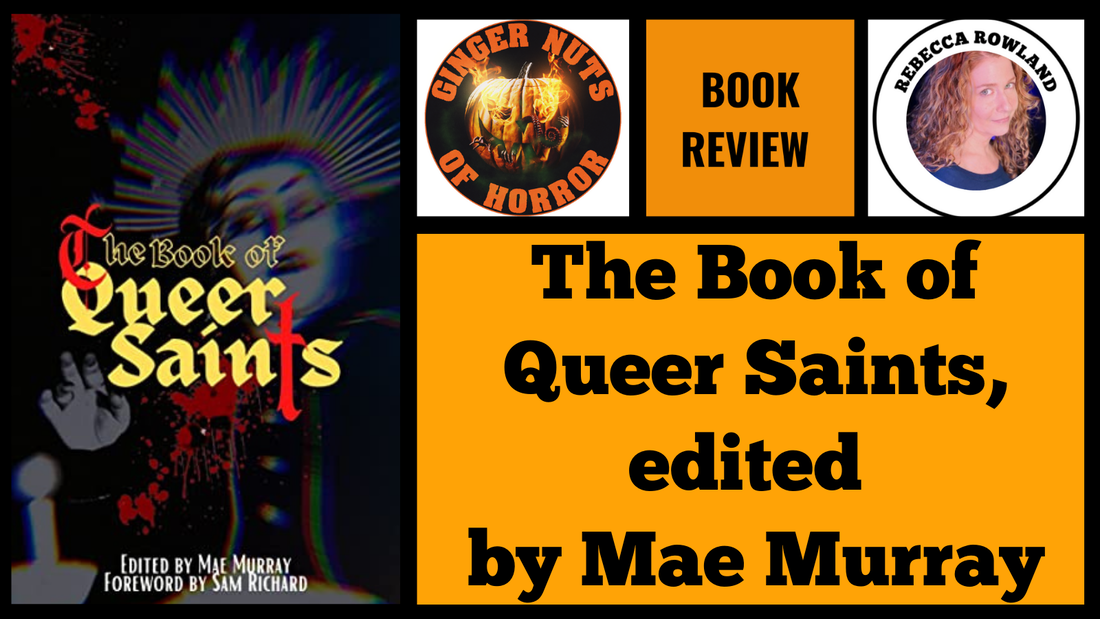
 The Book of Queer Saints, edited by Mae Murray Review by Rebecca Rowland Lea’s cadence is both hypnotic and beautiful, a fitting presentation for a new gothic tale of an ageless predator plucked from the horror canon. Inklings of Mae Murray’s project, an anthology that would “take a stand against the concept of purity in queer representation” (as she notes in her Introduction), first appeared in social media posts shared last year. I remember them well and had been both intrigued and excited at the concept of a queer horror collection that did not cater to web trolls who, from the holes in their ghoulish masks of anonymity, vomit bullying critiques of how LGBTQ+ characters are portrayed in indie literature. Murray promised that The Book of Queer Saints would be a publication where “queers in fiction [would] be nuanced and whole,” and she keeps her word in this thirteen-story compilation that includes Weirdpunk Books’ Sam Richards, award-winning authors such as Joe Koch, Haley Piper, and Eric Larocca, and a smattering of gifted scribes who readers may or may immediately recognize but are certain to investigate further. Among the strongest of the entries is James Bennett’s “Morta,” which begins “Ever since the day I ate Frank, I knew I wasn’t like the other boys. This was in Cinder, Idaho, about two years ago. And I didn’t exactly eat Frank, to be fair. It isn’t like that matters now anyway; no one ever found him and no one is going to find him either.” The story’s protagonist first presents as a gay, second generation Puerto Rican teen trapped in Big Sky country, an outsider looking in, but appearances can be deceiving. “Frank wasn’t going to stop screaming. If I’d tried to free him once digestion had begun, I’d only do damage to myself. There was nothing else to do but drag him into the shadows of the bleachers and devour him whole.” Bennett’s story is a Kafkaesque coming-of-age, the mood of which vacillates between predatory and paranoid, and its conclusion is simply delicious. As Joshua R. Pangborn’s “Crumbs” opens, Ray is trapped, handcuffed to a bed with his lover’s cooling corpse draped across his torso. “I look down at Jeremiah, lying on my chest. He’s still dead, of course. He won’t be much help deciding what to eat today. Which kind of sucks because that’s sort of his responsibility. His face is still buried between my tits. As my mother always said: If they bounce when you run, Ray, they’re tits, don’t matter if you’ve got a cock or not.” Despite Ray managing to buck Jeremiah’s body from the bed, a moment later, the dead man reappears at his side, catalyzing a tale that delightfully straddles the line between bizzaro horror and a contemporary rendition of An American Werewolf in London’s undead Jack jauntily taunting and pestering David Naughton as the latter struggles to escape misfortune. A number of the stories assembled for Queer Saints refuse to be pigeonholed into a singular sub-genre; whether Murray did this intentionally to drive home the theme or it occurred by happy accident, it is this variety that is Saints’ most irrefutable strength. K. S. Walker’s “Three for a Funeral” melds revenge yarn, quiet horror, and creature feature into a tale difficult to put down. “I have to decide if I want to go through with this. I’ll never say it out loud, but there’s a small part of me that is thrilled by the prospect; to put on a monster’s skin, wield all the power, and damn the consequences. And that small voice? It scares the hell out of me. But this is Diana I’m talking about. She’s never asked me for a damn thing she didn’t need. And besides, has there ever been anything I wouldn’t do for her?” Walker’s heartwarming entry is an engaging allegory of the darkly beautiful magic that binds individuals together. If you are already a fan of George Daniel Lea (as I am), reading “The Last Disgrace” will be like slipping into a welcoming, warm bath. His unnamed narrator prowls the streets, searching for his next willing victim: “I like to think that conscious inclination drew me here, the hope of finding a partner I can hate without remorse: a child abuser, a malignant narcissist, a con-artist. Maybe even another Dennis Nilsen. But no. Those who linger here remain stubbornly untainted, barring whatever pretty poisons the world has cultivated in them. Little flashes of malignance, weeds that will die long, long before they have a chance to flower.” Lea’s cadence is both hypnotic and beautiful, a fitting presentation for a new gothic tale of an ageless predator plucked from the horror canon. In his Foreword to the anthology, Sam Richards drives home what makes the collection so satisfying: “The true Saints are all the queer writers, artists, and creators who are making art on their own terms.” Bravo to the editor and to all of the contributors featured in The Book of Queer Saints for creating horror that presents the way horror should: as compelling, personal, and most of all, entertaining as hell. Queer horror, like any horror, shouldn’t have to contort itself to appease formulaic expectations. As one of the characters in Nikki R. Leigh’s “Stage Five Clinger” so aptly notes, “Please stop telling me how to gay. It’s my gay or the highgay.” THE BOOK OF QUEER SAINTS |


Archives
May 2023
|

|

|
 RSS Feed