• HOME
  • CONTACT / FEATURE
  • FEATURES
  • FICTION REVIEWS
  • FILM REVIEWS
  • INTERVIEWS
  • YOUNG BLOOD
  • MY LIFE IN HORROR
  • FILM GUTTER
  • ARCHIVES
    • SPLASHES OF DARKNESS
    • THE MASTERS OF HORROR
    • THE DEVL'S MUSIC
    • HORROR BOOK REVIEWS
    • Challenge Kayleigh
    • ALICE IN SUMMERLAND
    • 13 FOR HALLOWEEN
    • FILMS THAT MATTER
    • BOOKS THAT MATTER
    • THE SCARLET GOSPELS
GINGER NUTS OF HORROR
  • HOME
  • CONTACT / FEATURE
  • FEATURES
  • FICTION REVIEWS
  • FILM REVIEWS
  • INTERVIEWS
  • YOUNG BLOOD
  • MY LIFE IN HORROR
  • FILM GUTTER
  • ARCHIVES
    • SPLASHES OF DARKNESS
    • THE MASTERS OF HORROR
    • THE DEVL'S MUSIC
    • HORROR BOOK REVIEWS
    • Challenge Kayleigh
    • ALICE IN SUMMERLAND
    • 13 FOR HALLOWEEN
    • FILMS THAT MATTER
    • BOOKS THAT MATTER
    • THE SCARLET GOSPELS
GINGER NUTS OF HORROR

SABBATH'S FOURTH, AND HOW I HID THEM ALL FROM MOM BY  CHAD LUTZKE

10/8/2017
BY  CHAD LUTZKE
SUMMER OF SABBATH HORROR FICTION REVIEW WEBSITE
​I was playing Dungeons & Dragons at my neighbor’s house when I first heard the church bell and the thunderstorm, followed by the diminished fifth–the Devil's’ Chord.  It wasn’t until the plea of “Oh, no! Please God help me!” that I stopped all dice rolling and demanded to know who played the soundtrack behind our orc-filled dungeon.  It was 1980.  I was 10.  And Ozzy Osbourne had since been removed from my new favorite band.  The good news was there was a whole catalogue of music by the band to discover, and thankfully my neighbors had acquired the majority of it.  However, the quest to obtain my own collection had only just begun, which my mother prohibited.  It would have to be a tucked away safely out of my concerned parent’s reach.

 
Throughout the late 70s and early 80s, for whatever reason, whenever I bought a new album (or cassette) I would immediately show it to my mother.  It wasn’t a screening process implemented by her, just me playing show and tell with my latest acquisition.  I guess I’d get a little excited about my latest purchase.  But when I realized that Sabbath was to be off limits within the Lutzke household, I stopped with the sharing.  It occurred to me that dear mother needn’t know whether I’d just bought yet another KISS or AC/DC record, or of the forbidden Sabbath.  
 
I’m not sure what tipped her off to Sabbath being dangerous for her pre-teen boy, but I do recall she was not a fan of cussing or blatant satanic imagery.  Well, we can rule out swearing for Sabbath, and with the exception of SABBATH BLOODY SABBATH and the inside of their debut, Satan was nowhere to be found. Perhaps she’d caught wind of various rumors the 80s so loved:  The sacrificing of puppies on stage, the collection of spit, blood, or urine from the audience for various frontmen to drink, the surgically adhered cow of a tongue on a certain bass-playing vocalist and the “real blood” he would spit.  Knights In Satan’s Service and all that.  Urban legends galore.  It was a scary time to be a parent knowing that at any given moment your child could be swept away by Lucifer himself via drunken millionaires with a mic in their hand.  
 
Or perhaps it was just a “feeling” my mother had.  After all, she gave birth to me on Friday the 13th, February 1970.  The very day the mighty Sabbath released their first album, laying waste to flower power and making a bond between child and band that would last a lifetime.  
 
By the time I moved out of my parents house at the age of 16, I had a stack of nine Sabbath cassettes hidden away behind a row of books.  Nine.
 
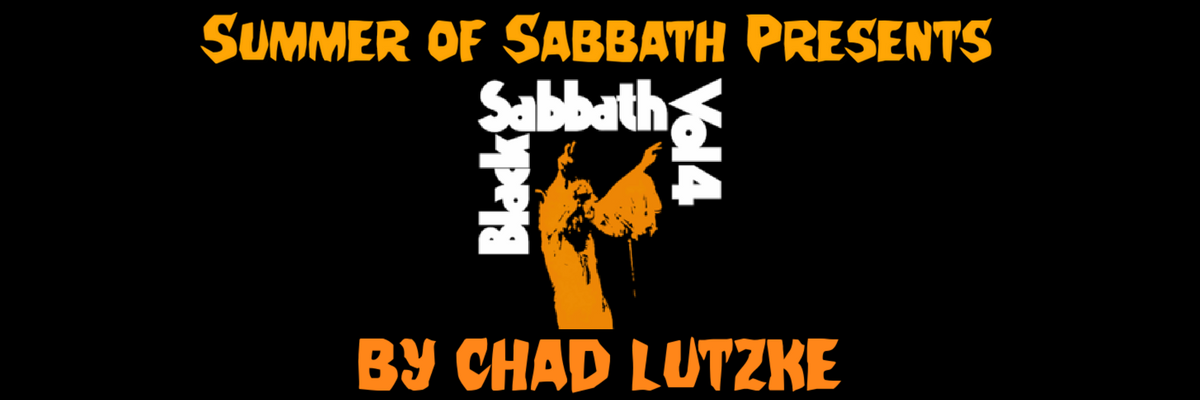
And that, my Sabbath brothers and sister, was my intro into Sabbath.  But this very piece regards my thoughts and history with Sabbath’s fourth release, VOL. 4.  An album whose cover art is an icon in itself to be replicated and parodied countless times for decades to come–the monochrome image of vocalist Ozzy Osbourne standing in front of a microphone, throwing peace signs while clad in fringe that hung like wings.  I owned VOL. 4 both on cassette and vinyl.  I found that slipping the cassette in and out of the hidden Sabbath shrine was much easier than the vinyl, so the record remained squeezed in with the likes of Angus, Gene, and Jagger.  It was paranoia, really, as my mother did not invade my room hunting for satanic propaganda.  Looking back, I probably could have kept everything in the open and she’d have never known.  It was only when I made it a point to show the evil things to her that she’d put her foot down.
 
Often times when one discovers a new band, it’s several albums in.  I think it’s safe to say that most Metallica fans weren’t “awoke” until the Black Album (those poor souls).  And while my introduction to Sabbath was the first album courtesy of a single song, it was not the first that I purchased and heard all the way through.  And while I loved VOL. 4, at the time I did recognize it was different than what I’d heard–that being their debut and Paranoid.  It wasn’t as gloomy as the others.  The production was not the same, and it felt like some experimentation was going on.
 
Nevertheless, there’s no denying VOL. 4 is a classic album that holds up among the best, and you’ll have a hard time finding a Sabbath fan who disagrees.  Allow me to break it down:
 
The guitar tone is noticeably different than earlier records.  But for me, it makes the album no less entertaining.  Ozzy’s ability to create his own melody over Tony Iommi’s thunder is part of what made Sabbath so special for me.  It stung a little when I found out the man wrote almost none of his own lyrics, but even the band members themselves recognize their vocalist has the gift of songwriting and melody which he’s proved countless times.  
 
In the opening song, Wheels of Confusion, the first note from Iommi’s guitar is a dark note drawn out that has an oppressive weight to it, like that of a somber ballad.  The song is packed full of riffs and it just wouldn’t be Sabbath without tempo changes.  I love the drums in the song.  Bill Ward pumps through the song with a beat like that of an irregular heart, only to stop nearly half way through and jump it up with their trademark mid-break bounce.  Eventually we’re treated to an instrumental outro that has its own title, The Straightener–an uplifting track that I’m sure I’ve found myself humming on more than one occasion.  
 
The heavier tone Sabbath is known for is back on Tomorrow’s Dream a mid-tempo romp with some tambourine that fits pretty well, fattening it up a bit.
 
While Sabbath were no stranger to slower songs with Planet Caravan, Sleeping Village, and Solitude, it isn’t until VOL. 4 that we’re given a more traditional “ballad” complete with piano.  Ozzy’s distinct voice makes it work and even as a young kid–hungry for the more aggressive forms of music–I do recall enjoying it.  Even if I was singing it in jest while pointing to my nether regions, parodying it for the stages of puberty I knew I’d be soon going through.  Yes, I’m sure the Sabs had something more meaningful in mind when they recorded it, but try and tell that to a young boy with his mind in the gutter who was "going through changes."
 
The experimentation continues with a 1:39 track called FX.  It’s hard not to think while Sabbath was busy sampling as many drugs as they could find that Pink Floyd’s Echoes didn’t play on somewhere within earshot, because this feels like a completely unnecessary homage to the song, which happens to have been a recent release at the time.  The song never really goes anywhere, but I suppose it does help prepare the listener for the unexpected onslaught that is Supernaut; one of the most memorable tracks on the album, as well as the one Ward gets to let loose on his cymbals full force, much in the same way he would three years later on Symptom of the Universe.  Ozzy gets his range up rather high on this song, and I’d say it’s during this album he’s really pushing things vocally.  Check out the bootleg from this era, “LIVE AT LAST.”  Ozzy has never sounded better–making anything from this particular album all that more difficult to play while shuffling around on stage 40+ years later.
 
If there was a “hit” to have come off this record that was consistently played live right up until Sabbath’s recent end, it would be Snowblind–their tribute to cocaine.  When Ozzy tells us about the snowflakes glistening on the tree and that the sun no longer sets him free, it’s the perfect example of Ozzy’s gift of giving birth to melody.  You can’t help but sing along when the time comes.  
 
What better segue into a sludge-like riff than a song about cocaine.  As though we’re experiencing the coming down with the Sabs themselves, the opening riff in Cornucopia could very well single-handedly have started the doom/sludge subgenre.  Like Sabbath 101, it picks up into a bouncy jam and of course back down again.  A formula that metal bands have emulated for years.  And when you hear them, there is no mistake where their influence draws from.
 
As a pre-teen in pursuit of all things heavy, Laguna Sunrise didn’t exactly scratch that itch, and while the instrumental piece is a beautiful little interlude, it’s never been one of my favorites; however, one of the reasons why I love Sabbath is their ability to give us some of the heaviest riffs we’ll ever hear parked right next to something so calm and soothing with songs like this (and I really do need to mention Planet Caravan and Solitude again) with no apologies.  And we dig it.
 
St. Vitus’ Dance, teases us with an almost southern, Zeppelin twang before giving us what we know is coming:  The heavy.  A relatively short song missing part of the Sabbath equation.  There’s no bounce.  No bridge of any kind with the exception of lowering the verse’s octave.  And that’s really all it is, verses.  While the song is good, it feels like something is missing, as though they needed to wrap the song up without further exploring its potential.
 
Finally, VOL. 4 closes with a sludgy riff followed by–you guessed it–some bounce in Under the Sun.  Tempo changes galore in this song to make up for the lack in the tune before, right down to a progressively slowing outro that ends Sabbath’s fourth effort with a ringing in our ears that heads us back to the turntable (or tape deck) to flip back to side A.
 
If I had any problem at all with this album (besides wishing I could replace FX with some proper heaviness), it would be the production.  While it’s not completely lackluster (I’m looking at you BORN AGAIN), I feel like it’s not quite as good as the first three and for me doesn’t get as much playback when listening to the Osbourne years.  Still a classic with a well-rounded array of tunes.  A timeless recording.
Picture

Comments are closed.
    Picture

    Archives

    January 2019
    December 2018
    November 2018
    October 2018
    September 2018
    August 2018
    July 2018
    June 2018
    November 2017
    October 2017
    September 2017
    August 2017
    July 2017
    October 2016
    September 2016
    August 2016
    July 2016
    June 2016

    RSS Feed

    RSS Feed

https://l.facebook.com/l.php?u=https%3A%2F%2Fmybook.to%2Fdarkandlonelywater%3Ffbclid%3DIwAR1f9y1sr9kcIJyMhYqcFxqB6Cli4rZgfK51zja2Jaj6t62LFlKq-KzWKM8&h=AT0xU_MRoj0eOPAHuX5qasqYqb7vOj4TCfqarfJ7LCaFMS2AhU5E4FVfbtBAIg_dd5L96daFa00eim8KbVHfZe9KXoh-Y7wUeoWNYAEyzzSQ7gY32KxxcOkQdfU2xtPirmNbE33ocPAvPSJJcKcTrQ7j-hg
Picture