

THE HORROR OF MY LIFE: ERIC LAROCCA
12/6/2020
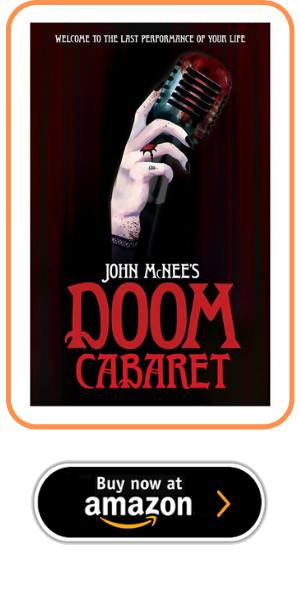
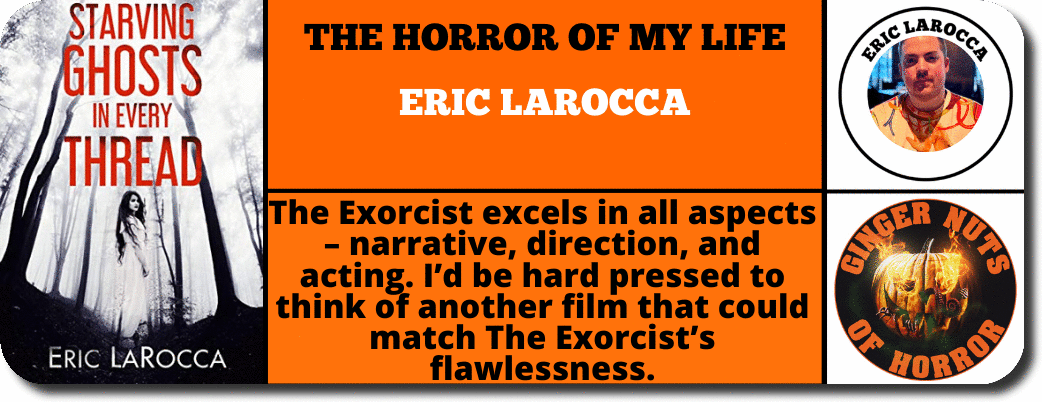  Eric LaRocca holds an MFA in Writing for Film and Television from Emerson College. His fiction has appeared in various literary journals and anthologies published in the US and abroad such as, Stiff Things and Year's Best Hardcore Horror, Volume 2. He is also the author of several plays which have been developed and produced at theaters across the country including, Gadfly Theater Productions, Hartford Stage, La Petite Morgue, and Love Creek Productions. He currently resides in Cambridge, MA. Follow him on Twitter @ejlarocca. Starving Ghosts in Every Thread is his debut novella. THE FIRST HORROR BOOK I REMEMBER READING Although I can recall reading The Monkey’s Paw by W.W. Jacobs and some Lovecraft during my formative years, the first horror book that resonated with me greatly was Coraline by Neil Gaiman. I was not only bewitched by Gaiman’s prose, but I was completely mesmerized by the fantastical world he had created. Though often labeled as a children’s book, Coraline is definitely one of the more unnerving pieces of fiction I’ve ever read. THE FIRST HORROR FILM I REMEMBER WATCHING I’ll never forget watching The Creature from the Black Lagoon per my mom’s recommendation when I was 9 years old. I’m sure my parents later regretted the decision to let me watch the film when I kept them up most of the night because I thought I heard “webbed feet approaching from down the hall.” THE GREATEST HORROR BOOK OF ALL TIME Though I’m inclined to reference one of the immortal classics like Stoker’s Dracula or Shelley’s Frankenstein, I can’t help but think of The Haunting of Hill House by Shirley Jackson. Touted as the pinnacle of the “haunted house” sub-genre (and for good reason), Jackson’s prose is unparalleled and deeply unnerving. Not to mention, Eleanor Vance is such a pitiful and tragic character. One can’t help but become totally engrossed in her plight. THE GREATEST HORROR FILM OF ALL TIME The Exorcist. Without question. Not only is it a deeply harrowing horror film, but it’s quite simply an excellent film in general. The Exorcist excels in all aspects – narrative, direction, and acting. I’d be hard pressed to think of another film that could match The Exorcist’s flawlessness. Perhaps Kubrick’s adaptation of King’s The Shining? THE GREATEST WRITER OF ALL TIME Though he’s undoubtedly one of the most problematic figures in horror fiction, I’ve always been mesmerized by the prose of H.P. Lovecraft. I can’t defend his viewpoints, but I can certainly argue for his talent as one of the finest – if not the finest – authors to operate in speculative fiction. THE BEST BOOK COVER OF ALL TIME The original release of Clive Barker’s magnum opus The Books of Blood has one of the most striking covers I’ve ever seen. Appearing as if it were a modernized rendering of a Hellish painting by Hieronymus Bosch, Barker’s original cover design is a grotesque bacchanal of perversion. Not to mention, The Books of Blood is one of the greatest collections of short horror works ever published. THE BEST FILM POSTER OFF ALL TIME Andrzej Zulawski’s 1981 cult classic Possession has been a favorite of mine for many years. I was initially introduced to the film through its spellbinding poster art. Although the design is relatively simple, the silhouette of a nude Isabelle Adjani is so captivating and alluring as we notice a pair of claws resting on her shoulders. THE BEST BOOK / FILM I HAVE WRITTEN I think my upcoming release, Starving Ghosts in Every Thread, is a decent illustration of my voice as a writer. Although I first completed the work several years ago, I’m very proud of the piece and it’s quite nostalgic for me when I look back at it with fresher eyes. I wrote the piece as I was going through a massive change in my life and it was quite painful. Writing Starving Ghosts healed me in so many ways. THE WORST BOOK / FILM I HAVE WRITTEN When I was in my final semester of my MFA program at Emerson, I wrote a truly dreadful feature length screenplay, entitled Devilment, about a possessed virtual reality simulation chamber. I can’t bring myself to even open the file on my computer because I’m so embarrassed of the project. I wrote it during a very difficult time in my life and I associate a lot of unpleasant memories with the project, unfortunately. I get hives just thinking about it. THE MOST UNDERRATED FILM OF ALL TIME Another hat tip to Zulawski’s 1981 film Possession. One of the most visually striking and bizarre films I’ve ever seen. Not to mention, a frenetic and deeply affecting award-winning performance by actress Isabelle Adjani. Possession is a film unlike any other and definitely does not get enough credit as a truly distressing horror film. THE MOST UNDERRATED BOOK OF ALL TIME One of the most underrated books of all time has to be Tim Lucas’ Throat Sprockets. A deeply shocking tale of obsession, author Tim Lucas’ novel is a chillingly effective descent into madness. It’s no surprise famed anthologist Ellen Datlow selected Throat Sprockets as “The Best First Horror Novel of 1994.” THE MOST UNDERRATED AUTHOR OF ALL TIME Novelist and screenwriter Michael McDowell is top of my list for most underrated authors of all time. Not only did McDowell succeed as a fictionist with highly lauded releases such as The Elementals and The Amulet, but he also wrote several popular Hollywood films like Beetlejuice and Thinner. For those unfamiliar with McDowell’s prose, you won’t be disappointed. I always describe McDowell as “Tennessee Williams meets Clive Barker.” THE BOOK / FILM THAT SCARED ME THE MOST I’ll never forget how haunted I was by Frank LaLoggia’s 1988 cult classic, Lady in White, when I was a child. I recall watching it at my grandparent’s house and being absolutely terrified to even leave the room when the film finished. I felt as if I had seen something I shouldn’t have been watching. Of course I re-watched the film years later and some of its creep-factor no longer resonated with me as some of the special effects are slightly laughable. Regardless, Lady in White remains a genuinely intriguing mystery with some powerfully credible scares. THE BOOK / FILM I AM WORKING ON NEXT After finishing up a short story or two, I’m setting my sights on attempting to write a novel for the very first time. I’ve already spent a decent amount of time outlining and taking notes so that all I have to do now is put pen to paper. I’m very excited to begin working on this idea. It feels like a very natural progression in my creative journey and I sincerely can’t wait to share it with readers in the hopefully not too distant future. STARVING GHOSTS IN EVERY THREAD BY ERIC LAROCCA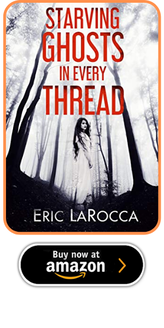 She's so consumed with guilt that it compels her body to literally unravel unless she feeds off the emotions of others. Teddy’s parasitic condition is usually tempered easily and is invisible to most, unless she feeds from them. However, her insatiable hunger has already begun to threaten her safety. Trapped in her tiny Connecticut hometown thanks to a careless mistake which cost her a prestigious scholarship, Teddy grieves her father’s death and cares for her neurotic mother, Mercy, who is convinced scorpion venom is the only remedy for her own peculiar skin ailment linked to her daughter’s sadness. Once an aspiring songwriter, Teddy now merely alternates between shifts at the local market and visits to the house of her eccentric neighbor, Mr. Ridley, for fresh scorpions to bring to her mother. It’s during one of her routine visits to Mr. Ridley’s subterranean grotto of exotic animals that Teddy meets an unusual young girl named Kiiara. Immediately enamored with one another, Teddy soon discovers that Kiiara is hiding a gruesome secret, too – a secret that will threaten to undo everything Teddy has ever known and loved, and violently touch all those who cross their path with disaster.   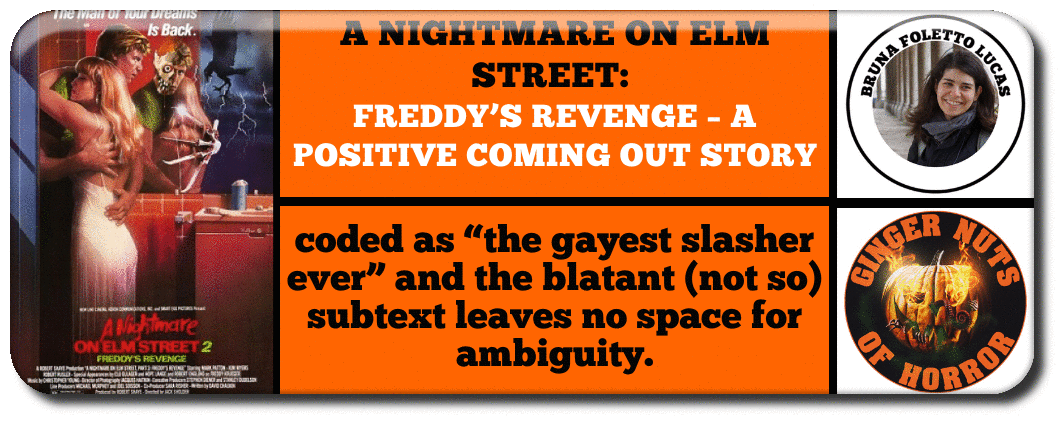 It’s #pride month so... Let’s talk about flying balls, leather garments, BDSM, hot, sweaty bodies, and squirting showers and beer cans with hot liquid... You’d think I’m talking about hard-core porn, but I’m only talking about the second instalment of A Nightmare on Elm Street: Freddy’s Revenge. The second film of the franchise has been coded as “the gayest slasher ever” and the blatant (not so) subtext leaves no space for ambiguity. We’re leaving aside the problematic relationship of the main actor Mark Patton, writer David Chaskin and director Jack Sholder in this essay and we’re turning only to the script. There has been some debate over the years as to “how gay” the film really is, and Patton declared that because of the way his character was treated in the film on top of homophobia in the industry, he ended up being pigeonholed, and eventually made him leave the industry altogether. This article, though, like I mentioned above, will leave the extra-diegetic debate aside and will focus on the text on the screen – what can we see and how we can draw a, to some extent positive, coming out story. The 1985 film focuses on Jesse (Mark Patton) as his family moves to the house that belonged to Nancy’s family in the first film. He slowly starts to have nightmares with Freddy and his relationship with his family, especially his father, starts to deteriorate. Jesse is new in school but he is already Lisa’s “ride to school”, which leads everyone to ask if they have already had sex – “are you mounting her nightly or what?” In baseball practice, a boy named Ron Grady starts a fight with Jesse by pulling down Jesse’s trousers, leaving his ass bare, and wrestling with him on the floor. Before it escalates even more, the two are separated by their gym coach, Coach Schneider. Jesse has trouble sleeping, his room is too hot and he often wakes up covered in sweat – that’s when Freddy Krueger appears for the first time. Freddy grabs Jesse by his collar and caresses his face, especially his lips, with his blades, and tells him – “I need you, Jesse. We’ve got special work to do here, you and me. You’ve got the body, I’ve got the brains”. Here Freddy is asking Jesse to kill for him – when villain and victim become one (when two bodies become one...). Jesse doesn’t fight Freddy, he seems almost in awe, his exaggerated reaction when Freddy pushes him to the wall suggests he is a willing victim – the allure is too much to reject. But that doesn’t stop him from screaming when Freddy reveals himself – when he pushes his skin away to show his asset (I’m talking about the scalp showing his brains, but potato potato). Freddy is monstrous nonetheless. Jesse’s relationship with Lisa starts to unveil slowly, as his friendship with Grady. He falls asleep in class and wakes up with a snake on top of him as well as Grady’s eyes. Lisa, in turn, visits Jesse in his room the only time he is actually fully clothed – polo shirt buttoned up to his neck, tucked inside his jeans, secured by a belt. In contrast, in the following moments that Grady and Jesse share together their clothes seem to be disappearing – in the locker room, they are shirtless, and coincidentally that’s when both of them complain about their coach saying that “Schneider has a stick up his ass today”. The two boys might be complaining about their coach, but I am suggesting here they are “recognising” him. 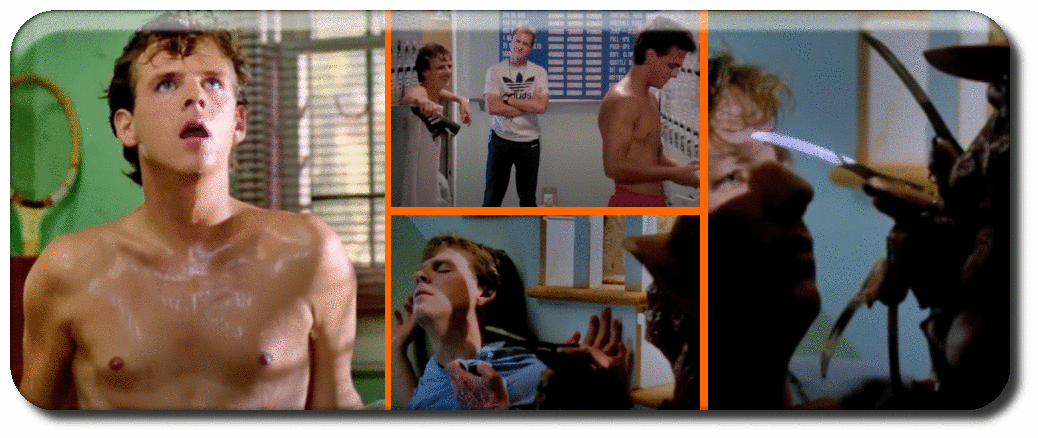 The following night Jesse wanders through town and ends up in a gay bar where he finds Schneider himself in leather garments who takes him back to the gym. Whilst Jesse takes a shower, Schneider is attacked by flying balls and is tied up naked to the showerheads. He is spanked, leaving his butt cheeks red, and then killed by Freddy as Jesse watches. Although the dialogue between Schneider and Jesse doesn’t mention sex, the film itself suggests they were about to have (or had just had) sex – Schneider, then, is the first man who allows Jesse’s homosexuality to come out, and precisely because of that, he must be killed. 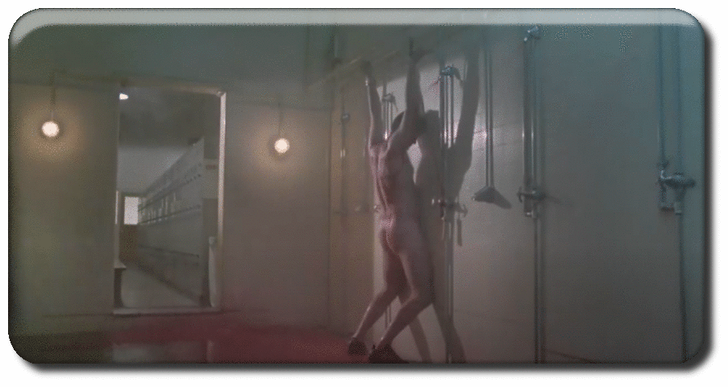 Throughout the film Jesse fights with Freddy, who is “inside” him and wants to fully become him – when Freddy kills, we later see the blood on Jesse’s hands, suggesting they are indeed one. Jesse wants to reject and oppress Freddy, he fights to keep him inside – Jesse is actually trying to decide whether or not to come out. Lisa, his heterosexual coupling, helps him disavow Freddy, shouting for Jesse to resist, that he is not who Freddy says he is. Here it couldn’t be clearer that Freddy Krueger is a stand-in for Jesse’s own sexuality – he is monstrous and he will kill/fuck men who arouse him. That we can see better as the film progresses, when Jesse interrupts a make-out session with Lisa when he realises the presence of Freddy in his body – a phallic, disgusting, and soft tongue that threats his normality with Lisa. (The phallic imagery is introduced to the film a bit earlier in the narrative with phallic dripping candles and it is present up until the end of the film with flaming sausages.) Jesse then flees from Lisa’s house and goes straight to Grady’s room, where Grady sleeps and Jesse jumps on top of him. 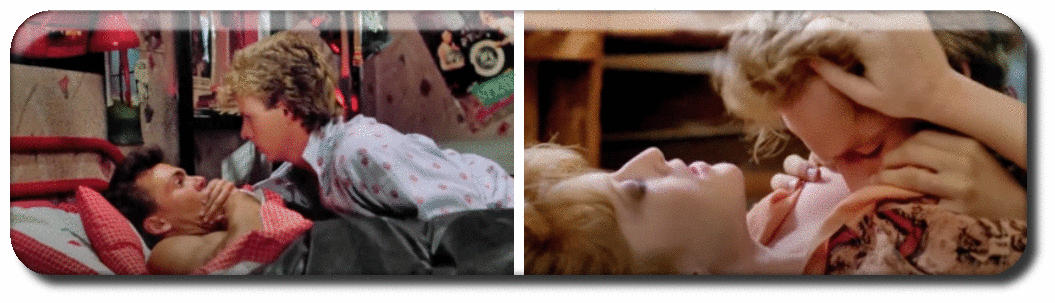 Jesse asks Grady to let him sleep on his room because he is in trouble, Grady rejects it at first, and even suggests he “go home and take a bottle of sleeping pills”, alluding to a suicide that will be proposed in the end of the film. Grady acts more masculine than Jesse, almost as a performance, and his reaction might show Jesse his own internalised-homophobia. Let’s not forget that he was the one who realised Schneider had a “stick up his ass”. The three men talk in codes, but they might form their own club. Jesse confesses he has “killed” Schneider last night, but the word “killed” sounds almost as something else. Jesse: I killed Schneider last night. Grady: You what? Jesse: Only it wasn’t me, see. There’s something inside me. This dialogue, again, alludes to Freddy Krueger/homosexuality being inside of him. The scene is heart-breaking because not only is he confessing to the murder/sex, but he is also vocalising to Grady, for the first time, about “something inside me”. Grady’s response is not what Jesse was expecting – he becomes a bit more macho towards Jesse. Grady: I think you’re seriously losing it, bro. Jesse: I’m scared Grady. Something is trying to get inside my body. Grady: Yeah, and she is female and she is waiting in the cabana, and you want to sleep with me! Grady’s reaction is far from understanding, but when Jesse pleads for help he eventually gives in. Jesse asks Grady to watch him for signs that he is changing, that he is being “strange” and asks Grady to stop him should he see any of those signs – here Jesse’s appeal is more like a pact two homosexual friends/lovers make in order not to be perceived as gay, and in order to “pass” for straight. Unfortunately for Grady, Freddy wins over Jesse. Freddy “comes out” of Jesse’s body, in his all glorious/monstrous form, takes Grady up against the wall and penetrates/kills him. Jesse cries for the death of his friend/lover and shouts to Freddy “you killed him!” The following scene, however, Jesse knocks on Lisa’s door and the first thing he says is “I killed him”. Let’s remember the dual meaning of the word “kill” in this film – Freddy/Jesse killed/fucked Schneider and now Grady, and as he gets more and more hysterical he confesses it all to Lisa, who does not believe him, not even as Jesse is covered in blood. “Christ! What do I have to do to make you understand me?” And the moment Jesse realises it is futile to keep running away, he says – “I’ve got blood on my hands. He owns me.” 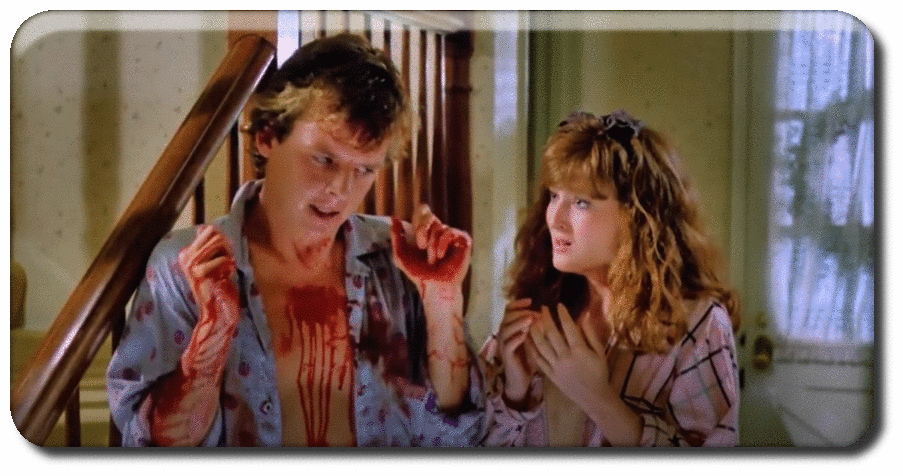 Outside Lisa’s house, there’s a party happening, filled with teenager, heterosexual couples – it is the sausages, though, that burst into fire and the beer cans that squirt foamy liquid. Jesse starts to turn into Freddy one last time and Lisa “coaches” him – “fight it, Jesse”, “you created him, you can destroy him!”, “he is living off of your fear! Jesse, fight him!” But those attempts, however, are pointless and Freddy lives. He tries to kill/fuck Lisa, but he can’t, indeed, he is very bad at it. His glove, which is his signature, is not used when trying to kill Lisa, and his preferred method is biting (her leg!). Lisa tries to defend herself by thrusting a knife into Freddy but he is impenetrable, Lisa has no power over Freddy. It is not until later that he penetrates his blades into another man. 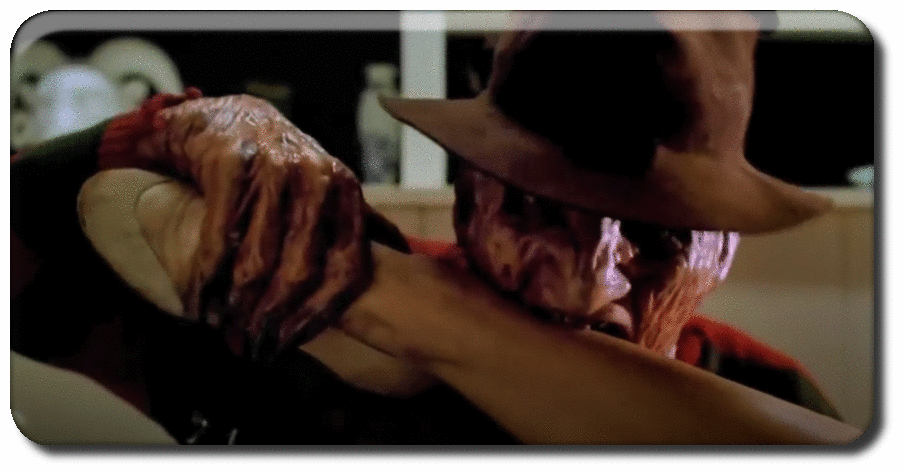 Freddy causes havoc at the party and flees to an isolated place, his new home now that he has allowed his full monstrosity to take place. Lisa does not give up, however, and follows him and by repeating she loves Jesse, she defeats Freddy. Lisa confronts Freddy and she talks to him as if she’s full of remorse, Freddy has taken something that was hers – “He is in there, and I want him back! I’m gonna take him away from you and you are gonna go straight back to hell, you son of a bitch!” Freddy yells that Jesse is dead while he holds on to his new life, but the heterosexual love is too strong for Freddy and he melts, giving space for Jesse to come back. Jesse kneels in front of Lisa, his clothes are torn, he is dirty, and he has a repenting look on his face asking to be reinstated back in his old life. Lisa hugs him and mothers him back to his heterosexuality. The monstrous gay was rejected, repressed and oppressed – all is good in the world! 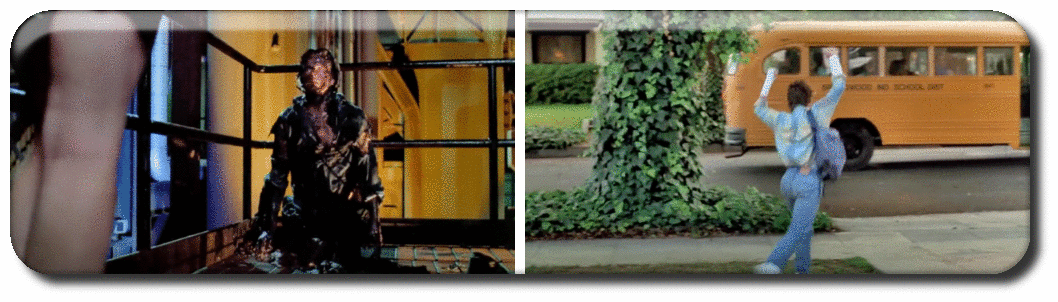 The last scene of the film shows Jesse happy but his wrists are bandaged – suggesting a possible suicide attempt – but with his smile and strolls to the school bus and holds his hands up in the air almost as if trying to say he has won, he shows us that though he has tried to harm himself, he is now victorious. Inside the bus, he talks to Lisa as if she were his friend and not his girlfriend (his beard). Jesse: I can’t believe it’s actually all over. Lisa: Let’s not talk about it. Jesse: Ok. However, not talking about it or rejecting it is not the answer, and Freddy comes back for one last scare – telling Jesse, Lisa and us that he will not be pushed back.  Bruna is passionate about film, especially horror. Her favourite films are Halloween, Scream and Cabaret. She has an MA in Film Studies from Kingston University and she is currently doing her PhD in horror films. Her writing can also be found on London Horror Society and UK Film Review. You can find her ranting on Twitter @Bruna_FinalGirl and posting nonsense stories on Instagram @foletto.b  the heart and soul of horror promotion 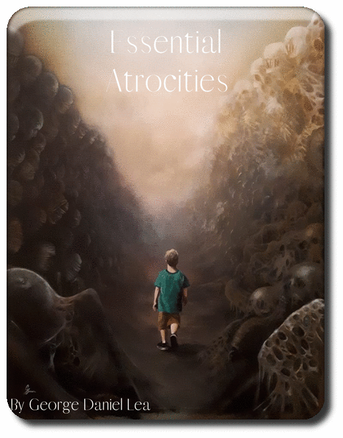 It's something of a psychological cliché that the queers amongst us (of which I am a happy member) suffer from parental conflicts. Since time out of mind, such has been used to demonise and denigrate us, to justify our arrest, imprisonment, our diagonsis as sick and broken. Our torture. Take a cursory look at the history of psychology in the West, in particular the use of “insane asylums” and their ilk, and you'll find a grotesque litany of abuses dating back since the inception of the school itself. The insititutionalised psychological and physical torture that was inflicted on LGBTQ men and women in hospitals and asylums throughout self-described “civilisation” is a horror story in and of itself, as grotesquely disturbing as the treatment of women who enjoyed sex or conducted themselves outside of certain patriarchal expectations (and proscriptions). One particularly lovely example was “aversion therapy,” in which gay men and women were forced to watch homosexual pornography whilst being pumped full of drugs that induced nausea and crippling pain, under the absurd assumption that association would re-write the “fault” in our neurological wiring. Of course, all studies and records demonstrate that it didn't work, save to inflict profound P.T.S.D, suicidal tendencies, self-loathing and depression upon its subjects. Some forms of “therapy” were even more extreme, ranging -but not excluded to- voluntary or involuntary chemical castration (Alan Turing, creator of the Colossus Engine, breaker of the Enigma Code, one of the many reason why the UK survived the Second World War, was ceremoniously condemned to this fate. Roar Britannia). The fundamental assumption has always been one of sickness and perversion; that there is something fundamentally incorrect that requires treatment. This has been glacially eroded over time, but is still a lingering cultural problem, simmering beneath the polite veneer of “enlightened” Western culture. The worst of it is, there are issues to explore here. In an ahistorical environment, without the baggage of abuse and oppression, of torture and intolerance, we may be able to look at the phenomena of parent/child friction when it comes to LGBTQ men and women and explore the reasons why -anecdotally- it seems to be so pervasive. LGBTQ men and women generally seem to be a tribe apart from their biological roots, unanchored and cast adrift, either due to tensions at home or by their own inclinations and natures. There is a marked tendency for us to be distanced from our families, to not identify with them as strongly as our straight siblings. Likewise, many LGBTQ men and women emphasise that status by putting physical distance between themselves and their places of origin. Whilst, stereotypically, it might be easy to draw certain conclusions in that regard -LGBTQ men and women often suffer at home owing to prejudice, lack of understanding or acceptance, outright rejection or abuse-, that isn't always the case. There are complexities to the state of identifying as LGBQT that remove us from certain meta-narratives, at least traditionally; those that “family,” by its very nature, tends to proscribe: before the advancements in civil rights made throughout the late 20th century, we were denied the roles of sibling, wife, husband, parent that our straight siblings would be expected to conform to in some way, shape or form, and that still sustains to certain degrees even now. We tend to be unanchored individuals, lacking in clear focus or state or path, because the onus for identity, for existential narrative, is on us. Those that culture itself has provided are woefully inadequate in their restrictions and expectations, painting cartoon caricatures of what we are SUPPOSED to be to make ostensibly straight, cisgender society more comfortable. They are effectively a means of assimilating our existence through the enshrinment of stereotype, which in turn informs the identities and behaviours of those that wish to find a place or purpose in those structures (the serpent eating its own tail). So, it is left to us to build our identities, our families, our sense of place and purpose from the foundations up, often from the ashes up, for those whose home lives are particularly abusive or dismissive. Where we stand, the myths of self that inform us, are largely our own. Our families tend to be extended, cast wide and cultivated from scraps of others: friends, lovers, exes, associates and acquaintances. We are scarred, ragdoll entities in a world that demands we be unblemished and pristine. It's little wonder, then, that so many of us are afflicted with various forms of psychological illness, from the parental issues that stereotype proscribes to depression and suicidal tendencies, we are a peculiarly afflicted tribe when it comes diseases of the mind, though those same diseases are often also the source of our uniqueness and inspiration. The stereotype that LGBTQ individuals tend to dominate the arts isn't entirely unfounded; there's a reason why you'll find queers of all stripe and feather throughout theatre and publishing, cinema and literature, video games, art galleries and practically every walk of artistic life you'd care to name: That status of lacking anchorage, of being apart from society and culture at large, forces expression and outlet in ways that are non-standard, often essentially so, for the sake of our psychological well being, or at least, our continued function beyond asylum walls. This isn't exclusive to LGBTQ people by any measure, but it is peculiar of us; a pervasive factor that is well testified in psychological record and study. We find other places to be, other means and modes of expressions, to author and paint ourselves beyond what tradition denies and meta-narrative ignores. Any factor, characteristic or circumstance that shunts an individual away from proscribed cultural narratives can have the same effect, the particulars largely incidental next to the mutual implications. When it comes to our own states of mind, that analysis becomes problematic: we might be able to vaguely allude to what we think our issues might be and why, but without the benefit of external observation and perspective, we are largely fumbling in the dark. Part of the problem comes from the limitations of analysis: our own minds become both the instrument and subject under question, resulting in a paradox: mind assessing mind assessing mind assesing mind...it's a process fraught with all manner of insurmountable problems. We cannot separate ourselves from our identities and discern the tangled lines of influence that result in this characteristic, this tendency, that reaction, that belief. To do so would, necessarily, alter the subject and instruments of analysis themselves, the process of dissection proving transformative, thereby making any conclusion one might draw flimsy and ephemeral. But that doesn't make the effort or imperative to do so pointless. Far from it. There might not be any conclusion or answer that might derive from the process, but the engagement itself, the transformations that necessarily result, are imperative to self-discovery, insight and transformation. When we embark on this kind of self-dissection, we tacitly acknowledge our own potential for transformation, to consider and even identify beyond the parameters of old assumptions. The process itself can become the source of so much inspiration and material, such a freight of insight, that we cannot help but be fundamentally transfigured by it. This appears to be peculiarly true when those who express and explore outwardly, creatively, return to their own material and realise that they were expressing concerns that they didn't consciously understand or intend to at the time of recording. Those other writers I regularly associate with often express surprise not only at what others see in their works but what they themselves find upon returning to it after a period of absence. They begin to realise that their subconscious expressions have seeped out onto the page, lingering like invisible stains between the words and punctuation, lending texture, weight and significance where it wasn't consciously considered. This is the process through which theme is born, where the unspoken resonance of a text begins to throb and writhe upon the page, making it living, making it vital and resonant. For the most part, this is what readers identify with and feel resonating inside of their own breasts; the unspoken music of a story, that lies on a layer far and beyond the surface narrative or printed word. It's when a story contains such resonances that we identify with it, because it echoes and sings back to us familiar chords and verses, even when we can't understand or express to ourselves their exact natures. Many express sincere shock at the phenomena, that something they thought about and felt so keenly, that they've spent weeks and months obsessing over, has the capacity to surprise them, that these depths and layers of operation even exist. At their most vital and essential, this is what stories are and what they serve; a form of telepathy, of communicating mind to mind, in a manner more earnest and eloquent than we often can in conversation or waking life. When we read the stories of another, it is a strangely intimate process of being invited to walk in another's mindscapes whilst also opening our own to their invasions and the alterations that might result. Every story we read is parasitic, to a certain degree; it worms its way inside and transforms us fundamentally, without us even realising. In significant moments, some of us find our whole worlds turned upside down by what we experience, our assumptions and expectations undone, our sense of self undermined or irredeemably shattered. This can be both traumatic and joyous, agonising and celebratory. Often, it's all of those at once and more, often taking significant amounts of time to finish its work, and even then, difficult to express or define beyond poetry or vague allusion to experiences that, traditionally, have been coopted and jealously hoarded by religion but denied or denigrated in any other walk of life. Writing is, as many describe it, a form of free therapy. Speaking personally, I know that, without it, I would likely either be long dead, destitute and homeless or strapped down and sedated in some padded cell. This doesn't merely relate to my status as one of the aforementioned “tribe of tribeless,” a gay man in a world that, traditionally, would rather we didn't exist (the feeling is mutual, by the by). There are myriad poisons and traumas, scars and afflictions, swilling around the swamp of my skull. No more or less than any other; my own family life, for example, was far, far less traumatic than many of my queer brothers and sisters. By and large, my relationships with my parents are positive and pleasant, I don't have any great abuse or trauma to report in that regard. But that doesn't make the aforementioned maladies any less severe or significant. As many in my circle know, I was an enormously depressed, misanthropic child who became an enormously depressed, misanthropic, self-loathing and suicidal young man; a creature that sought to retreat from the world at large and had absolutely no love for it whatsoever, harbouring no plans for the future because it seemed perfectly self-evident that it didn't have or want one (that this thirty-something sits in its place now, expounding on its experience, would likely have appalled it). What writing has done for me, nominally writing in horror specifically, is provide an arena in which those states of mind, those despairs and dissasociations, can be explored. Going back to read my first short story collection, Strange Playgrounds (Dark Moon Books, 2013), I find expressions of anxiety and concerns I didn't even realise I had (amongst the storm of myriad mental health issues that afflicted my younger self). The collection ostensibly began while I was at university, a student, largely reclusive, out of love with a world that seemed perpetually on the verge of disaster (climate change, pollution, pandemics, economic collapse, fuel shortages, war in Iraq and Afghanistan, riots, protests, civil unrest, amongst others), that seemed so unworthy of engaging with when compared to the absurd disturbia inside my own head. 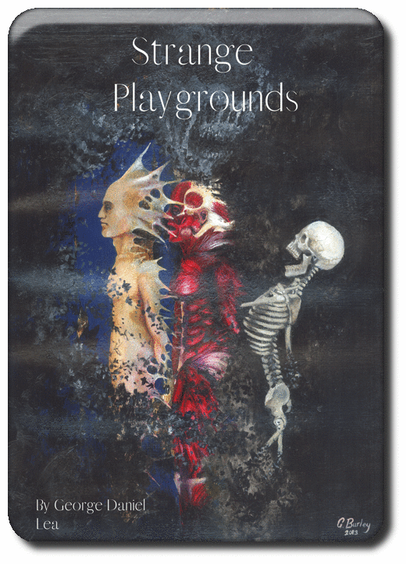 Stories that coalesced with very particular conscious intentions (the title story, Strange Playgrounds, for example, was originally an attempt to write a story with the same starting premise as Edgar Allen Poe's The Pit and the Pendulum, but to take it in a very different direction) clearly express something far deeper and more abiding than I originally intended: there are themes of abandonment and isolation, of being torn from the assumptions of one's life, here, as well as abiding horror at being cast into unknown and unknowable circumstances, flailing out of all control, the breaking down of all we know or assume. It's strange to find that, after so long; to understand that there were fears and concerns consuming my younger self so utterly but that were beyond his conscious expression. This was before he'd sought any genuine psychological help, which would become essential later in life, the stories likely providing his only real outlet for those crippling anxieities and bouts of depression. Other stories explore existential anxiety in a more contained manner: the story The Last Sane Man -based on the old cliché that “If you believe yourself the last sane man in creation, you're likely the lunatic,”- involving something intimately familiar to me; a routine and tradition as old as I can recall: a short train trip between Derby and Birmingham, that I used to take both as a boy to my Grandparent's house and then, later, as a student to and from university. It revels in the familiar detail and sensory qualities of that experience before turning them upside down and inside out, wrenching any comfort away from the protagonist by causing some fundamental mechanism in reality to break down, the train endlessly cycling along the same stretch of track, which other passengers don't seem conscious of, condemning the man as a lunatic, demanding that he sit down, be quiet, until anxiety and despair overcome him utterly. I didn't recognise it at the time, but so many of my own anxieties are expressed through that story, from my terror of being trapped in routines and regimens to the social anxiety that was eating my mind alive at the time of writing. To think that they could express themselves so clearly and yet so unconsciously was surprising, to say the least. That the dead boy writing those words didn't realise how essential it was for him to express them shudders me to my core. Lacking the help that he did at the time, I find myself wondering: what would have happened to him, had he not had that outlet, that form of therapy? Then I begin to wonder: what about those who are born to similar circumstances, similar class structures (in my instance, working class, low income, comprehensive education) but who aren't fortunate enough to find some sort of voice, some mode of expression? Returning to the original topic of friction between children and parents (which is inevitable in any household or family structure, no matter how cohesive, nurturing, provisional etc), beyond whatever issues exist between me and my parents (articulated and otherwise), one thing that has arguably shaped me and my state of mind more than any other is my Mother's love of media in all its forms and the unrestricted access to it I was granted as a boy: I was lucky enough to be reading actual books by the time I went to school (primarily British fantasy such as The Chronicles of Narnia, The Lord of the Rings etc) and had graduated to adult literature in all its forms long, long before I started high school. Books and film and music and video games have always been my life lines, my manna, my raw nourishment. They feed my mind and swell my imagination, provide the fodder it needs to keep from cannibalising sanity and itself. What if I'd never had that? Then, other issues migth have become more prominent, overwhelming. I wouldn't have had diversions from the diseases in my mind but also would have been denied the means of identifying, articulating and fighting them. Graduating to telling stories of my own came quickly, again, largely as a matter of circumstance: I used to write stories down with pen and pencil, but my Grandfather passed down to me an old type-writer, which I adored and upon which I penned the first coherent stories I ever wrote (largely fan-works and derivations of whatever book, cartoon, comic or video game obsessed me at the time). What if that hadn't come to pass? What self-mutilating specimen would be sat here now, in my place (assuming that anything might have survived this long)? Other stories in the collection reveal my concerns and neuroses regarding adult relationships (which, in traditional form, have always been massively problematic for me): The State of Lovers describes a Frankensteinian effort by one woman to dream into being the perfect lover, one who does not frustrate or disappoint, one who fulfils and completes her, but which reveals, in his perfection, more unflattering details about her state of mind than his own. She comes to realise that what she's committed is a form of slavery, that nothing can occupy the contradictory and ambiguous requirements she holds without tearing itself apart, and that, in order to heal, she must let her creation go, and turn the powers she has realised on herself, in order to reshape herself and be born anew. Dissatisfaction with one's state and self, broken assumptions, defeated dreams and a yearning for transition pervade the collection, speaking deeply of my own disatisfaction and dysphoria; not one relating to sex or gender, but my humanity, in which I've never felt comfortable and have had to learn to accept as inalienable (a sense of imposter syndrome amongst my own species has always been very strong, and sustains to this day. I've always felt more like a monster in a human suit than something legitimately belonging to the species). It's a frightening experience, to be the audience for one's own art, a little like being present in some astrally projected state at a particularly invasive surgery one is undergoing, seeing parts of oneself that should probably never be visible, that are far from flattering. A deep dive into the bone and entrails, the boiling muck of subconsciousness, where we can either be smothered and poisoned or coccooned and reborn.  Returning to later works, such as the collection Essential Atrocities, proves equally revealing: stories such as Lost Moments prove to be expressions of frustrations and parental friction that comes from being the “older brother,” tensions which I remember keenly as being traumatic and devestating to my child self and his small, self-contained world. Likewise, The Breaking Down is a somewhat spiteful expression of a desire to see the world built and extolled by our parents torn down, literally invaded and undone by inexplicable calamity, monsters ripping through the stuff of reality and turning it upside down, inside out, reducing their world to rubble whilst their children abandon them, flocking to the monsters with the same glee and enthusiasm as the children of Hamlin to the Pied Piper. There are tensions expressed here that I find difficult to acknowledge or explore in any conscious space, that my mind isn't the equal of outside of the rawly imaginative. Without that expression, it's likely those tensions would have boiled over long ago and either poisoned or destroyed otherwise fruitful relationships, not to mention my own state of mind. Whilst not all of the stories are overtly queer in subject, as other readers have expressed to me, there's little denying the queer tone that runs throughout almost all of them. Whilst the identities and relationships of characters vary, there is a certain fluidity to sex and sexuality within those stories as there is to species, state, even identity and assumptions of self. Metaphorically, the stories express not only a desire for transformation, but a celebration of otherness, of being on the outside, rather than a lamentation of it. It has taken me a long time to realise that in myself, and the writing of these collections has been a key component of that process. With regards to whatever issues and tensions existed and still exist between my parents and I, from the grander, generational conflicts and misunderstandings that are part of cultural meta-narrative to the particular, personal issues that derive from specific events and circumstances, the creation of stories has allowed for an expression and exploration thereof that has proven far more healthy and productive than allowing them to fester inside my mind, potentially becoming cancerous to self and sanity. As for those suffering similar issues as I once did -and still do, from time to time; such diseases don't go away, they merely change shape and become easier to contain-, my only advice would be to find something, anything: a form of expression, a form of reflection. It doesn't have to be as specific as writing stories or painting. Anything that allows for a shift in states of mind, for moments of quiescence and consideration, focus and inspiration will provide the medium and arenas by which the phenomena of “self” might be explored, in which insight and introspection can be practiced. That process in and of itself allows us the means of self-reflection essential to identifying and undoing diseased states of mind, the parasitic illnesses that intertwine themselves with the tapestries of our identities and make themselves inalienable, inextricable. Most lack the means or the imperative; they're never provided the contexts by which such explorations can take place or taught why it is necessary to do so. As such, disease becomes assumed, insidous; synonymous with assumptions of personality, leading the suffere to identify with and defend their own cancer. The means of identifying that phenomena are essential, as essential to the health of our psyches as physical exercise and nutrition are to our bodies. The lack or denial of it ultimately leads to the death of both, all we are or might ever be. Take care of yourselves.  THE HEART AND SOUL OF HORROR I suppose it’d be interesting to argue whether writing fiction involves formulating lies, or conveying the truth. I suppose the simplest answer is: both. It’s making stuff up, isn’t it? But then again, nothing is truly invented – every fictional scenario draws on experience. I could tie myself in knots about this. But writing about writing is another matter. I try to be honest about that. So, I’m going to write about writing Hope Island, a novel which is published in the UK more or less right now, and I’m going to try to be honest. I’m not a writer that has pure ideals about how a writer should work. That is, I’ve never managed to make creative decisions without considering external factors. Perhaps there one or two of my short stories weren’t mediated by thoughts of What do people want to read? or Which venue might publish this? or, more often and more convoluted, What kind of a writer do I want this to make me seem? I’m self-conscious in all aspects of life; writing is no different. I’ve always wanted to be a writer. Now that I’ve had novels published, I want to continue being a writer. I love writing, and all its associated tasks – creating plots, outlining, drafting, editing… all of it. I want to be allowed to keep writing and I want to be allowed to justify spending more and more of my available time writing. A slightly different point, related more to identity than practicalities: I want to continue being able to consider myself a writer – specifically, a novelist. Taking the decision to dive into a new novel project is complex. I’m happy to spend many hours doing what I love – for example, when I started out, I drafted two novels and didn’t submit them anywhere, wanting only to make mistakes and in doing so learn the ropes – but nowadays I need each new novel to fulfil a basic requirement: it mustn’t prevent me from writing the next novel. Now that I’ve got started, I don’t want to stop. My previous published novel, Snakeskins, was intended to appeal to a wider readership than my earlier ones, and it was also intended to secure me an agent. The structure was modelled on the TV shows I’d been binging at the time, such as Deutschland 83, with multiple viewpoint characters and short, snappy scenes. And it worked! I got an agent and it was published by Titan Books. In fact, Titan offered a two-book deal. If they’d requested a follow-up to Snakeskins, I would have written one. Frankly, I would have done my best to turn my hand to anything they might have wanted. But they were happy to let me suggest ideas for the second book. I pitched Hope Island and, with a few tweaks to my synopsis, it was approved a month or so after the initial contract was signed. As it happened, I’d been working on the synopsis for several weeks before the Titan offer, at which point I’d rather lost faith in my Snakeskins manuscript. Initially, this new idea was an even more direct attempt to appeal to a wider readership. In spirit, it would be a follow-up to John Wyndham’s The Midwich Cuckoos, about a group of children behaving strangely. It would feature lots of high-stakes setpieces and what one agent I’d spoken to had called ‘primary-colour storytelling’ – that is, a direct and visceral style, without being drawn into psychological grey areas. I would set the novel in the USA rather than the north-west of England, to avoid alienating the largest readership. It would be called The Children: a blunt title for a blunt book. I don’t know what happened, after I began work on what would become Hope Island. Perhaps the fact that it already had a publisher affected the authorial decisions I was making. Perhaps I recognized, subconsciously, that the book I’d originally envisaged wouldn’t have worked, or that I wouldn’t have liked it. Perhaps I’m just not the sort of writer that thrives on ‘primary-colour storytelling’. Hope Island became a calmer novel, yet also knottier and weirder. The creepy children are present and correct – but somewhere along the line I allowed myself to dwell as much on the agonies of ordinary parenthood as the threat of killer kids. In place of high-stakes setpieces, I succumbed to the whim to make silence one of the themes of the novel, and indulged myself in channelling some of my favourite minimalist and field recording artists such as Alvin Lucier and Chris Watson. The specific threats to the main characters, a British mother and her daughter, became harder to pinpoint; the fact that they couldn’t communicate their fears became their biggest obstacle of all. The final act of the novel became literally groundless, and was written in a flurry of caffeine and to a pounding soundtrack of Mika Vainio. There are two ways to view this transition. Either I lost sight of the original vision that set me off working on the novel… or the novel became what it would always have become. Back when I decided to write an accessible horror novel, I certainly hadn’t intended to produce what early readers would call ‘The Wicker Man directed by David Lynch’ or ‘Midsommar for working mothers’. But there it is. As it turns out, that’s what I wrote. Here’s the thing, though. I’m proud of it. I think it’s good, the best thing I’ve written yet. And I think it’s better than the novel I’d been pretending to write. It’s quiet and quietly weird, rather like me. Though I’m happy to be upfront about my ambition to be a ‘working writer’ – that is, a writer content to (try to) fulfil the requirements of publishers or readers – I’m left wondering if it’s a mirage, this idea of stepping outside of one’s own head while creating something. I suspect that Hope Island is as personal a novel as if I’d set out to ignore the market entirely. How can you spend 200 hours working on a novel and not introduce yourself in every scene, in every sentence? Anyway, there it is. Hope Island is out now, and I think some of you may enjoy it, but I honestly don’t know. Maybe that’s just how these things are. 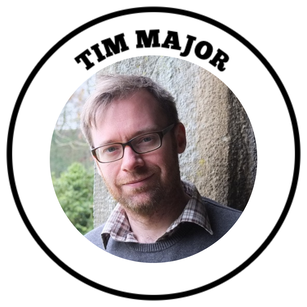 Tim Major’s books include Hope Island, Snakeskins, short story collection And the House Lights Dim and a non-fiction book about the 1915 silent crime film, Les Vampires, which was shortlisted for a British Fantasy Award. His short stories have appeared in Interzone, Not One of Us and have been selected for Best of British Science Fiction and Best Horror of the Year. Find out more at www.cosycatastrophes.com HOPE ISLAND BY TIM MAJOR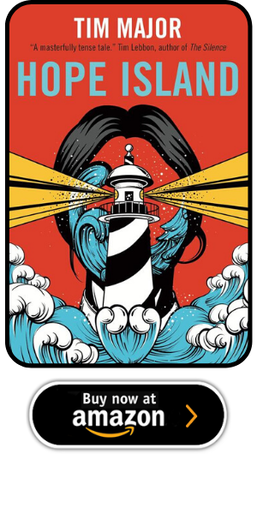 A gripping supernatural mystery for fans of John Wyndham's The Midwich Cuckoos from the author of Snakeskins. Workaholic TV news producer Nina Scaife is determined to fight for her daughter, Laurie, after her partner Rob walks out on her. She takes Laurie to visit Rob's parents on the beautiful but remote Hope Island, to prove to her that they are still a family. But Rob's parents are wary of Nina, and the islanders are acting strangely. And as Nina struggles to reconnect with Laurie, the silent island children begin to lure her daughter away. Meanwhile, Nina tries to resist the scoop as she is drawn to a local artists' commune, the recently unearthed archaeological site on their land, and the dead body on the beach...  THE HEART AND SOUL OF HORROR PROMOTION BACK IN THE CITY: REVISITING URBAN GOTHIC AT 20, EPISODES 2 & 3: VAMPIROLOGY/THE ONE WHERES1.02 VAMPIROLOGY “Rex is a vampire. He has agreed to allow a small film crew to follow him for one night.” That's right. What We Do in the Shadows may get all the attention, but Urban Gothic did it first. A documentary crew exploring the world of a real-life vampire. What a juicy concept. In truth, while it deserves all the plaudits it gets for being one of the best episodes of Urban Gothic, the central idea behind 'Vampirology', directed by Colin Bucksey, isn't all that original. It's just Man Bites Dog with a vampire instead of a serial killer. Still. It works. Rex is a vampire. He lives in London, he has friends, he wanders the streets, hangs out in cafes and bars and every night has to find a new victim. And, while the cameras are on him, he waxes philosophic about the nature of his existence. “What does it mean to be a vampire?” he asks. For Rex, it means a lot of angst about his place in the world. People around him all have their own notions, but no-one really understands what a vampire is. Nor does he, really. Crosses and garlic don't kill him. Sunblock means he can walk around during the day. He's rejected a lot of the cliches of vampirism, but at the same time he relishes them, revealing himself to be highly knowledgable about their portrayals in the media. This is one of the more interesting aspects of Rex's character, his own passion for the filmed versions of the vampire myth. Analysing Dracula by way of Bond, he ranks Christopher Lee the best, the Sean Connery of bloodsuckers. Bela Lugosi? “Roger Moore. Relied on his eyebrows too much.” This is a rarely highlighted quality of the vampire monster itself. It is intelligent and self-aware enough to be able to recognise representations of itself in media and pass judgement on them, perhaps even learning from or attempting to embody them. It makes sense that a true vampire would be interested in how they are perceived by humanity, but it's not an idea that's been played with much. I remember Robert Quarry in The Return of Count Yorga (1976) watching cheap Spanish-language vampire flicks in his crypt (probably only put in as a gag), but 'Vampirology' expands on the idea. In a world awash with vampire stories, how does the real thing assert himself? Does he reject the myth or play up to it? And if he plays up to it, how long before he loses track of where the myth ends and he begins? Rex is a vampire playing at being a vampire. More than that, he's a vampire straining under the weight of a century of tropes, attempting to offer an 'authentic' portrayal of what a vampire is, when the truth is, he really doesn't know. He understands the tropes well enough to reject them, to file down his fangs because they're “a little kitsch”, but he doesn't have anything to replace them with. His number one rule is “know yourself”, but without the castle, the cape, the coffin, he's a little lost. And his frustration in attempting to present some notion of himself with which he's comfortable is readily apparent. “The 80s was a great decade to be a vampire. Insert Thatcher joke here,” he quips, before throwing his head back and groaning: “What a load of bollocks. Can we cut this, please?” Insecure is probably the best way to describe Rex. He's deeply concerned with image. He finds a lot of comfort in Hammer horror and other vampire portrayals, but that's not how he sees himself or how he wants to be seen. And how does he want to be seen? He's not sure. “I'm not sure anyone thinks I'm anyone special, these days,” he says. “Thanks to Sesame Street, if you tell a kid you're a vampire, he'll ask you to count to 10 with him. I'm a cartoon character.” One can only imagine what he would have made of Twilight. Thing is, when 'Vampirology' had its debut, Buffy the Vampire Slayer was still on TV. The first series of Angel had just aired. The romantic notion of the vampire with a soul was already part of the zeitgeist. The slippery slope towards the sexy, sparkling bloodsuckers of Twilight and True Blood was already being carved out. The vampire myth was in the early stages of an identity crisis from which it has still not recovered. Who knows if it ever will? I'm sure I'm not the only one who would love for vampires to become a frightening proposition again, and call me a pessimist, but I don't think another 17 remakes of Dracula (all with very, very clever new spins, I'm sure) will manage it. Rex, then, is the very personification of the vampire myth itself, struggling to find his place in our modern world, deeply embedded in our culture and trying to figure out how not to be seen as a joke. When a potential victim, on the verge of having her throat slit, helpfully explains her blood type is AB because “I thought you'd like to know what flavour you're getting,” Rex storms off in disgust. “What is it with this post-millennial death wish deal?” he rants. “No-one is scared of anything any more!” Amen, Rex. Amen. This meta-narrative reaches its apex when Rex encounters Hammer screen siren Ingrid Pitt in a restaurant and attempts to tell her how much her performances meant to him as a vampire, only for her to laugh him off. In the role of Rex, Keith-Lee Castle is a sardonic, seething ball of anger and resentment. I wouldn't call him charming, but he's certainly a commanding presence, swaggering about like a moody rock star, spitting out one quip after another, but emanating a perpetual fragility, like his bluster will at any moment give way to neurotic panic (which it frequently does). He's not really scary, but... that's part of his character's problem. It's a fantastic performance, but oddly enough not the definitive vampiric role of his career, which would probably have to be the Count in Young Dracula, which ran for eight years on CBBC. Excusing Ingrid Pitt, there are no other well-known faces among the cast, though some horror fans might just recognise Saskia Mulder (Rebecca in The Descent), who shows up to speak two lines and be brutally murdered in a very effective (and bloody) kill scene. When I interviewed writer Tom de Ville ahead of my rewatch of the series, he said 'Vampirology' was one of the episodes they had talked about expanding into a feature. It's not hard to see why. The hook is good, the character is compelling and it's all generally very clever. But I think it would have been a mistake. At 30 minutes it's a slick, arty little slice of entertainment and I doubt very much it could have been improved upon. 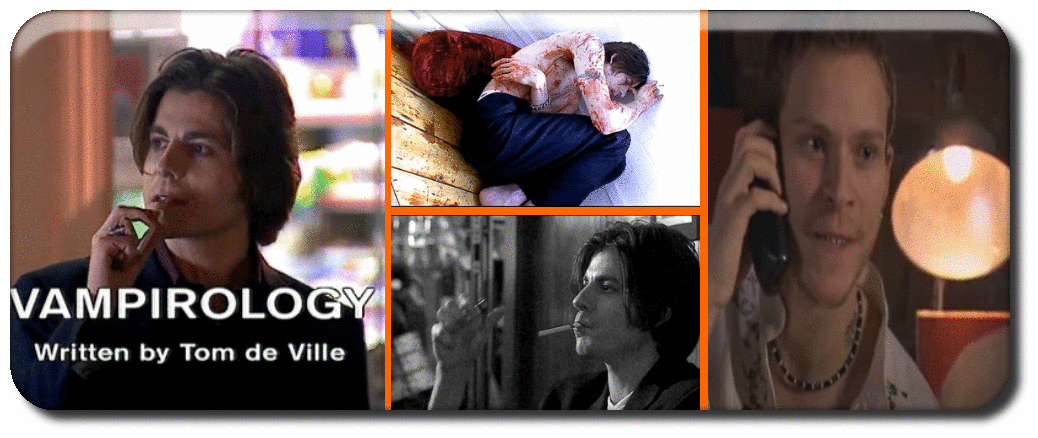 S1.03 THE ONE WHERE “I'm giving people what they want.” It's been a few years, so you'll have to forgive my memory being a bit hazy, but I was sure 'Old Nick' came after 'Vampirology'. Turns out I was wrong, at least as far as the running order on DVD goes. Third episode in the series is 'The One Where'. And if you can't guess by the title, this is the one about having 'friends'. Specifically, the one where an art critic invites a devilish TV executive into her circle of friends, and he begins torturing them for his own (or her own) entertainment. The one where Jude Cunningham off Hollyoaks has graphic sex in front of Tower Bridge (apparently, actress Davinia Taylor called it the most embarrassing acting job of her life, going at it all night on top of Primrose Hill in full view of a bunch of tramps and dog walkers). The one where Robert Webb (Peep Show, Mitchell and Webb, etc) shows up as an artist who paints with the blood of his ex-lovers, puts unborn fetuses in lava lamps and commits suicide when he's revealed to have lied about being molested by his father to make his autobiography more interesting. The one where a woman castrates a man to death in her bathtub for standing her up (“taking Girl Power a bit far” is the way one character puts it). The one where the villain feeds cocaine to a newborn baby before slitting his own throat and assuring the other characters “I'll be there for you”. I think he also kills the baby? Not sure. It all gets a bit vague at the end. I don't know how much more there is to say about 'The One Where'. It's a bit of a mess, frankly. There's the gem of a good idea – basically Brimstone and Treacle meets This Life – but there's way too much happening way too fast to keep track of. Any explanations about who the sinister executive is or his purpose are glossed over with clever-clever lines about our culture's relationship with TV and the like. But if there's a point to be made, it doesn't succeed at all in making it. Between the two, actually, I would have suggested 'The One Where' would have made a better candidate for expansion. A three-part drama told in hour-long episodes could have given the story and its themes room to breathe. As it stands, there's way too much going on to have the time to even learn anyone's name. There's more chance of the final scene – in which Jude Cunningham gives an exclusive interview to camera after poisoning her social circle at dinner – leaving you scratching your head than chilled to the bone. Still, it's got just enough violence, nudity, familiar faces and scenery chewing to make it a fun 30 minutes. They weren't all as much fun as this. Sadly. Join me next time for 'Sum of the Parts' and 'Deptford Voodoo'. John McNee's Doom Cabaret by John McNee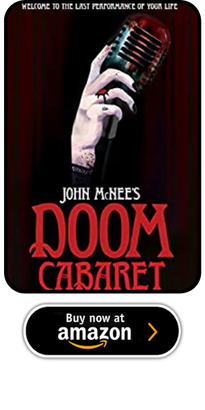 This is the stage. These are the players. A young woman’s sexual appetites prove too powerful to be undone by death. Hedonistic clubbers covet a drug that warps flesh rather than the mind. A wealthy cannibal encounters a meal too beautiful to be eaten. The Lullaby Man ushers another eager victim into his clockwork lair. Here is where such stories are told. Blood and beauty, defilement and deformity, musicians and monsters. Welcome to the Doom Cabaret. READ OUR 5 STAR REVIEW OF DOOM CABARET HERE  THE HEART AND SOUL OF HORROR PROMOTION Bathed in the flickering glow of a flaming torch, a skeleton lies in in an open coffin. Apart from one small detail, the sarcophagus looks like all the others hiding in the darkened recesses of the sealed mausoleum. Yes, centuries of dust drown bas-relief etchings in layers of grime and long-dead grave beetles dangle from ancient cobwebs hung from its decorative corners, but it’s not until you get closer to the coffin that you see the wooden stake. Driven through the corpse’s ribcage, it takes us from the tourist walk of an ossuary to the pages of genre fiction. 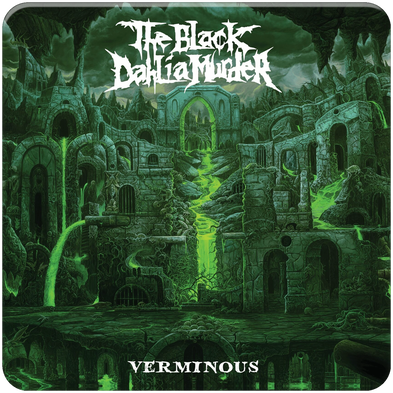 For many of us, it’s the kind of image we’d expect to see in one of our favourite books. For others, it’d be perfectly at home in Full Moon’s Sub-Species movies. For Trevor Strnad, lead-vocalist of The Black Dahlia Murder, it’s the perfect inspiration for a metal song. So perfect in fact that it’s an image he’s kept close to his own heart for some twenty to thirty years. “Removal of the Oaken Stake is definitely my favourite song from the record. It’s influenced by the pen and paper role-playing game Rifts. There was this comic-strip of a vampire who had a stake in his chest. In the first panel, he was just a skeleton, but then somebody pulled it out, and you watched the sinew and skin and muscle and everything grow back over his bones. By the last panel, he was a full-blown vampire again.” The fore-mentioned track is one of the best cuts from the band’s new album Verminous, and given the fact Strnad has sat on that visual for so long, it’s fitting that he sees it as much more than just a macabre image. 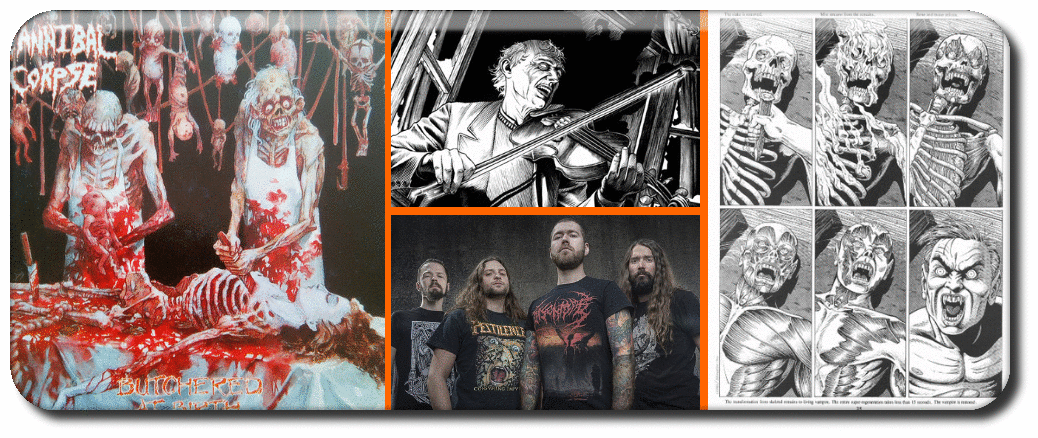 “I heard the song’s melancholic vibe, and I thought of that lyric about being caught in purgatory, just sitting there waiting for somebody to pull the stake out so you could come back and stop just watching human history go by.” Obviously, it’s a damn cool set piece, but that thematic hook is a direct signifier that for many, metal and horror are two sides of the same coin. Strnad is one of those people. With a catalogue that now incorporates nine albums, he’s written about as many types of horror as you’d care to name. “When I was a little kid, I got into horror before metal and I feel like one led to the other. I used to cruise the metal aisle at the record-store and look at all the album covers. I didn’t know what the music was like, but I thought ‘Wow! There’s definitely some common ground here!’ I was definitely drawn to it.” That common ground is one that his band now revels in. For years, they’ve toured the globe and driven moshpits into states of chaotic rapture with songs about werewolves, vampires, zombies, serial killers, cultists, sorcerers, and even the Evil Dead. “Blood and guts go a long way with me, and in the world of death metal; just by being into it, you’re exposed to so many horror aspects. Just as people like to go on a rollercoaster, people into horror like subjecting themselves to something that’s going to scare them. But they know that, and they know that it’s fun. It’s a release in a way. It’s catharsis.” For David Davidson, the man responsible for vocals and lead-guitar in another of modern death metal’s premier acts, Revocation, the fact the two genres go hand-in-hand starts with something basic, the artwork. “We experience everything with our eyes first. When I was a kid going to Blockbuster, I would go straight to the horror section because those videos always had the coolest covers. Then, when I was getting into metal, it was a similar thing. I was like ‘Cannibal Corpse! Butchered at Birth! What the fuck!’ and then obviously, the music matched the brutality of that artwork.” 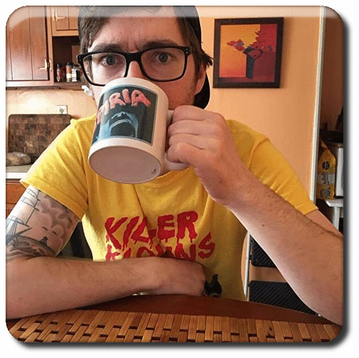 In what’s becoming a recurring theme, and yet another name-check for New York’s biggest death metal export, author Patrick Lacey’s tastes in music and fiction share a similar genesis. “One of my earliest film memories is Nightmare on Elm Street,” he says. “I was five. So the horror seed was planted early. Metal was a natural progression. I remember sifting through CDs at my local FYE and coming across Butchered at Birth and Gallery of Suicide by Cannibal Corpse. I couldn’t get those images out of my head.” It’s only fitting then that Lacey, who’s paid his dues with Decibel Magazine, probably THE death metal publication, has a soft spot for The Black Dahlia Murder. “First off, the neo-classical vibe of the music is basically just Castlevania with double bass. A Hammer film played in C standard. Trevor’s lyrics are the equivalent of a horror movie stripped down to the best kills. It’s nightmare imagery front and centre and it meshes like butter with the music. Much like Decibel, I appreciate that the band loves their genres (metal and horror) but isn’t afraid to shed a light on both of their excesses. It’s that dichotomy I appreciate, like if Carcass and Manowar had a sitcom.” 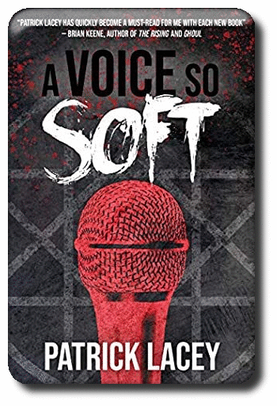 And it’s those excesses offered by the death metal genre that allow Strnad to flip one of horror’s key tropes. Whereas much of the horror that flies off shelves features protagonists succeeding – even if it’s occasionally in pyrrhic fashion – against all-powerful beings or supposedly insurmountable odds, his lyrics often see him assuming the role of the villain. “I hope to take people on a lyrical ride and give them a peek of the forbidden, to portray that all-powerful, evil character. It’s kind of fun to ride shotgun with the bad guy in that world of ultimate power and fearlessness.” Musicians aren’t the only ones who can flip tropes, though. Lacey’s latest novel, A Voice so Soft, deals with one of the classics. There’s no doubt we’re all familiar with that idea of metal bands leading our children down the left-hand path, but for Lacey, the artist in question had to have a much broader appeal. “It’s a riff on the 80’s satanic panic movement, when stuffy politicians were convinced Slayer equalled Satan and the youths were getting skilled at ritual sacrifice. I wish. But in my book, instead of a metal band, it’s a Taylor Swift stand-in who’s won a talent show that’s definitely in no way inspired by American Idol. The number one single that follows makes her fans want to do terrible, terrible things.” 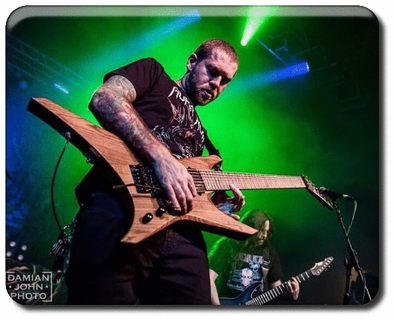 For Davidson, the power of this kind of commentary isn’t to be overlooked. “In thrash there can be this political edge, and they’ll shock you with that. Horror can be political in different ways or provide a commentary on things, and then there’s the gore and the cool special effects.” It’s apt then, that Davidson name-checks Carpenter’s 1982 classic, The Thing, a movie that serves as a perfect allegory for McCarthyism, and it’s apt in more ways than one. Yes, it’s got political tones, but it’s also got something that has become a central component of Revocation’s work. Lovecraftian themes. The band’s most recent album, 2018’s The Outer Ones pays as much homage to Lovecraft’s elder gods as Carpenter’s film does to At the Mountains of Madness. “When you think about supernatural creatures, they pander to the earthly realm. You have the ghost of a person, or a werewolf is a person who turns into a creature, and even the vampire is a human being that’s turned into a creature. With Lovecraft bringing in this idea that his beings are outside of the boundaries of what we consider reality, it’s always such a mindfuck. It all makes great fodder for metal music: the speed, the brutality, the lyrics, and it marries so well.” 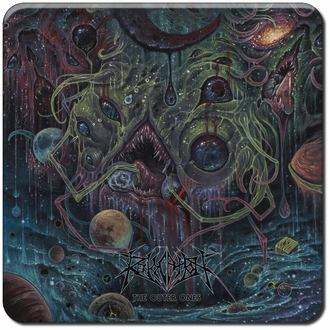 Of course, whether you’re talking about the visceral slashers, intergalactic sci-fi horrors, or even the deep-dive psychological horror of modern life so often unleashed on viewers by the likes of Ari Aster and David Eggers, one thing will always ring true in the extreme worlds of death metal and horror. Despite the fact those within the genre know that the two sets of fans are amongst the nicest you’ll meet anywhere, not everyone gets it. Whether opponents of the genres claim that the two fields are satanic, incite violence, expose their audiences to ‘worldly themes’ or are just plain trash, neither metal or horror are going to disappear anytime soon. According to Lacey, this is because “the average person doesn’t want to ponder things like death and suffering and corruption, but horror and metal? That’s business as usual. They were made for each other. It’s a true peanut-butter-and-jelly situation.” Strnad agrees. “It’s not for everybody. On face-value, it scares people or it makes them uncomfortable. In a way, there’s a test of your will to be into it.” Ultimately, it might be this one thing that unites the two genres. While there’s no way every horror fan likes their metal or vice-versa, Lacey believes the two share one core facet. “Horror fans and metal heads, they’re both nerds, right? They want to show you the most obscure slasher from 1983 that is, for some reason, eighty per cent stock footage of a state forest, and they also want to show you this thrash band’s one-off album that was really more of a side project but still rips.” Perhaps then, it’s fitting that we end on another Lovecraft-influenced tune from Revocation’s catalogue, Madness Opus. If you’re familiar with the story of Erich Zann and his nightly battle with the interdimensional deity trying to enter the earthly realm from a portal outside of his window, you’ll see the poetic irony in the crowd-favourite live track. “We play to these heavy metal heathens every night, and we’re trying to quench their thirst for metal. It was inspiring to find commonalities with that story and loosely basing it on what a metal band is doing. Once I had that idea, I really dove into that story more and wrote lyrics around that work.” For us, it’s a great point on which to end. Just as The Black Dahlia Murder are delving deep into the realms of horror to write songs for legions of metalheads around the world, so are Revocation, and it seems that as time goes on and more stories are told, the links between the two ‘outsider genres’ are only going to get stronger and stronger. In that sense, it’s only fair to ask which of the modern horrors lining your shelves will be the inspiration for the metal bands of the future?  Author Bio: Zachary Ashford’s latest work is Sole Survivor, a Rewind or Die novella from Unnerving Magazine. He also wrote the Demain Short Sharp Shock! The Encampment by the Gorge & Blood Memory. You can find his other works in the Elements of Horror: Earth anthology, Dark Moon Digest, Things in the Well's 7 Deadly Sins anthology and online with TellTale Press. When writing, he's listening to metal while surrounded by action figures and a stuffed werebear. He also writes for Ozzy Man Reviews, a rock n roll radio station, and teaches English. The Black Dahlia Murder’s latest album, Verminous is out now via Metal Blade. Revocation’s latest album, The Outer Ones is also available via Metal Blade. Patrick Lacey’s latest novel, A Voice So Soft is available Grindhouse Press.  the heart and soul of horror promotion |


Archives
April 2023
|
 RSS Feed

|

|